New Semester
Started
Get
50% OFF
Study Help!
--h --m --s
Claim Now
Question Answers
Textbooks
Find textbooks, questions and answers
Oops, something went wrong!
Change your search query and then try again
S
Books
FREE
Study Help
Expert Questions
Accounting
General Management
Mathematics
Finance
Organizational Behaviour
Law
Physics
Operating System
Management Leadership
Sociology
Programming
Marketing
Database
Computer Network
Economics
Textbooks Solutions
Accounting
Managerial Accounting
Management Leadership
Cost Accounting
Statistics
Business Law
Corporate Finance
Finance
Economics
Auditing
Tutors
Online Tutors
Find a Tutor
Hire a Tutor
Become a Tutor
AI Tutor
AI Study Planner
NEW
Sell Books
Search
Search
Sign In
Register
study help
business
cost accounting
Cost Accounting 4th Edition Jawahar Lal, Seema Srivastava - Solutions
The scarce factor of production is known as. (a). Key factor (b). Limiting factor (c). Critical factor (d). All of the above
Explain the meaning of a business budget. How does it serve as an instrument of control?
Which of the following is a budget designated to furnish budgeted costs for any level of activity actually attained. (a). Fixed budget (b). Flexible budget (c). Master budget (d). Production budget
Discuss the mode of operation of systems of budgets and budgetary control.
Flexible budgets are useful for.(a). Planning purposes only (b). Planning, performance evaluation and feedback control (c). Control of performance only (d). Nothing at all.
What are the advantages arising out of the budgetary control system? What do you think are the essentials of an effective budgetary control system?
What do you understand by budgetary control? Explain the mechanism that would lead to effective control.
Discuss the objectives and limitations of budgetary control.
Define budgetary control and discuss the objectives of introducing a budgetary control system in an organisation.
Discuss the cardinal features and objectives of budgetary control.
Explain the difference between a forecast and a budget. Give examples to illustrate the differences between: (a). Fixed budget, (b). Flexible budget,(c). Functional budget.
What are functional budgets. Which functional budgets are most commonly used by management?
Define budgetary control and distinguish it from standard costing. Discuss the inter-relationship between budgetary control and the standard costing system.
Discuss briefly the procedure for the preparation of a sales budget.
What do you understand by a flexible budget?
What is a sales budget? How is it prepared?
Describe briefly the fundamental functions of business budgets.
Explain the concept of a flexible budget. How is it prepared?
What is flexible budget? How does the sales forecast differ from the sales budget?
What do you understand by Flexible Budget ? How is it prepared? Distinguish between fixed budgeting and flexible budgeting.
Explain the following: (a). Zero Base Budgeting. (b). Master Budget.
List the important functional budgets prepared by a business.
Distinguish between budget and forecast. What is a cash budget? What are its uses?
Explain three control ratios used for performance evaluation.
State the important features of zero base Budgeting.
Distinguish between fixed and flexible budget.
Discuss the necessary steps for the success of budgetary control system in an organisation.
What purpose is served by instituting a budgetary control system in an organisation having both manufacturing and selling activities.
Distinguish between the following: (i). Zero base budget and conventional budget (ii). Cost control and cost reduction
Budget is an aid to management, not a substitute for management. Comment.
Standard costing and budgeting control are interrelated but not interdependent.
Distinguish between standard costing and budgetary control.
What are the main objectives of a system of budgetary control? Do you think budgetary control is subject to certain limitations?
Define flexible budget and explain its importance as a budgeting technique and tool of control.
Distinguish between standard costing and budgeting control. What are the essential requirements for installing an efficient system of budgetary control?
Distinguish between conventional budgeting and zero base budgeting.
Briefly explain the essentials of an effective budgetary control system.
Flexible budgets are more realistic and useful than fixed budgets. Do you agree? Explain.
Explain zero base budget.
Yonex India Ltd. is segmented into three divisions A, B and C. All were formed in the same year and now all assets have left exactly one-half of their expected life. Top management is attempting to determine which of the division is the most profitable. The following data have been prepared for
Explain the concept of responsibility accounting. What are the different types of responsibility centres.
The operating performance of the three division of ABC company for 2003 is as follows: (a). Using the operating profit margin percentage as the criterion, which is the most profitable division? (b). Using the rate of return on investment as the criterion, which is the most profitable
Discuss the essential of responsibility performance reporting.
How will you measure the performance of cost and revenue division?
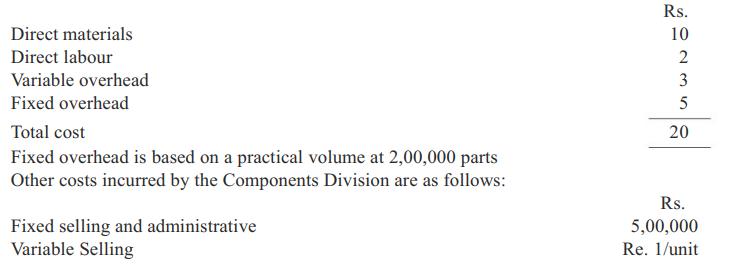
The Components Division produces a part that is used by the Goods Division. The cost of manufacturing the part is given below: The part usually sells for between Rs. 28 and Rs. 30 in the external market. Currently, the Components Division is selling it to external customers for Rs. 29. The
Distinguish between cost centre and profit centre.
Discuss responsibility accounting in brief.
What is responsibility centre? Discuss briefly the nature of various types of responsibility centres.
Write short notes on the following: Responsibility centres-cost centre and profit centre.
Describe and compare the main performance measures that have been suggested to measure the divisional performance.
Profit, return on investment and residual income have stood the test of time and are widely used for measuring the performance of a division. Describe the strengths and weaknesses of these measures of performance.
Outline problem in defining and measuring capital employed in a division.
Explain the rationale of using an interest charge while measuring the performance of a division.
In ROI, there is lack of consensus on the definition of numerator and denominator both. Explain the statement.
Explain the essential ingredients of a system of Responsibility Accounting.
What are the financial and non-financial methods of performance measurement? Explain with examples, wherever, feasible.
What is meant by divisional performance measurement? Describe any two techniques used for this purpose.
Discuss the important of market prices in transferring pricing system.
What do you mean by responsibility accounting?
Discuss the merits and demerits of ROI and RI for divisional performance measurement.
What are the objectives of transfer pricing system?
Explain the utility of cost-based prices under transfer pricing.
Write notes on. (i). Negotiated prices(ii). Dual prices.
Explain the concept of uniform costing. What is a uniform costing manual?
What principal factors should be considered in introducing a system of uniform costing in an industry?
What is a uniform cost accounting system? What are the items on which you would seek uniformity so far as overheads are concerned in a uniform cost accounting system?
A scheme of inter-firm comparison combines the advantages of a uniform costing system and the benefits arising out of the use of ratios. Discuss.
Discuss the scope and applications of uniform costing methods and their usefulness especially in the context of the economy of our country. Assume that you are advising a trade association in this regard in the interest of its member firms and outline your views and suggestions.
Why is inter-firm comparison desirable? What are the essential points that should be considered in inter-firm comparison? What are its advantages.
What are the purpose of uniform costing when it is introduced in an industry under a federation? What are the basic requirements of uniform costing?
Explain in brief, the advantages and limitations of uniform costing.
State the essential requirements for the installation of uniform costing system in an industry.
What are the areas of activity which a cost audit programme is expected to cover?
The statutory cost audit under the provisions of the Indian Companies Act is also intended to subserve social interests. Comment.
Distinguish between: (i). Cost audit and financial audit (ii). Cost audit and management audit.
Cost audit is a necessity and not a luxury and is viewed as a barometer to measure the operational performance, the effectiveness of utilisation and working results. Illustrate.
Explain the advantages of cost audit.
Is it correct to say that cost audit is efficiency audit. Give arguments.
Discuss the aspects usually covered in management audit.
What areas are covered in cost audit?
Explain the concept of value analysis as a technique of cost reduction.
Discuss the purpose of cost audit and circumstances under which a cost audit is desirable.
Define cost audit. How is it useful to: (i). Management (ii). Society (iii). Share holders (iv). Government?
What as a cost auditor will you verify in the area of work-in-progress?
Describe how a P/V chart is drawn. How does the P/V chart differ from a break-even chart?
Define and explain the concepts of standard cost and standard costing.
Discuss briefly the use of standard costs in the following management activities: cost reductions, operating performance, evaluation, product pricing decisions and providing incentives.
Compare and contrast the usefulness of ideal standards, basic standards, and currently attainable standards.
Standard costs are bases for a proper managerial control of manufacturing operation. Define standard cost and explain the above statement.
What is standard costing and how would you distinguish it from budgetary control?
What are the points of similarity and difference between budgeted and standard costs.
Variance analysis is an integral part of standard cost accounting. Explain this statement.
By purchasing low-grade materials, a company reports favourable material price variance, but it consistently experiences unfavourable material quantity variances. What relationship may exist between these conditions? Is the price variances really favourable?
What are the shortcomings of historical costs for managerial uses?
What is the difference between an estimated cost and a standard cost?
Describe briefly how standard costs are set for (a). Material (b). Labour.
Discuss some of the problems that might be created by standards which are set too high and by standards which are too loose.
What are the advantages and limitations of standard costing?
Discuss briefly shortcomings of standard cost system.
Explain why overhead variances are generally treated as period costs.
Showing 5900 - 6000
of 6579
First
52
53
54
55
56
57
58
59
60
61
62
63
64
65
66
Step by Step Answers

 Get 50% OFF
Claim Now
Get 50% OFF
Claim Now