New Semester
Started
Get
50% OFF
Study Help!
--h --m --s
Claim Now
Question Answers
Textbooks
Find textbooks, questions and answers
Oops, something went wrong!
Change your search query and then try again
S
Books
FREE
Study Help
Expert Questions
Accounting
General Management
Mathematics
Finance
Organizational Behaviour
Law
Physics
Operating System
Management Leadership
Sociology
Programming
Marketing
Database
Computer Network
Economics
Textbooks Solutions
Accounting
Managerial Accounting
Management Leadership
Cost Accounting
Statistics
Business Law
Corporate Finance
Finance
Economics
Auditing
Tutors
Online Tutors
Find a Tutor
Hire a Tutor
Become a Tutor
AI Tutor
AI Study Planner
NEW
Sell Books
Search
Search
Sign In
Register
study help
business
introduction to probability statistics
Introduction To Probability Volume 2 1st Edition Narayanaswamy Balakrishnan, Markos V. Koutras, Konstadinos G. Politis - Solutions
If an event A is independent of an event B, and B is independent of another event C, is it always true that A and C are independent? Prove or disprove (using a counterexample in the latter case) this assertion.
If for three independent events A, B, and C of a sample space, we know that P(AB) = 0.3, P(AC) = 0.48, P(BC) = 0.1, find the probability of the event A ∪ B ∪ C.
Let A and B be two events on a sample space. Then, show the following:(i) If P(A) = 0, this implies that P(AB) = 0.(ii) If P(A) = 1, then we have P(A ∪ B) = 1; use this to establish that P(AB) = P(B).Use the above results to prove that if P(A) = 0 or P(A) = 1, then the event A is independent of
If the events A and B are independent and A ⊆ B, show that P(A) = 0 or P(B) = 1.
If A and B are two events on a sample space such that 0 < P(A), P(B) < 1, verify that each of the following conditions is equivalent to the independence of A and B:(i) P(A|B) + P(A′) = 1;(ii) P(B|A) + P(B′) = 1;(iii) P(B|A′) = P(B|A);(iv) P(A|B) = P(A|B′);(v) P(B′|A′) = P(B′|A);(vi)
Pat takes part in a quiz show with multiple choice questions. There are three possible answers to each question. The probability that she knows the answer to a question is 80%. If Pat does not know the answer to a particular question, she gives an answer at random. If she has answered the first two
We have n chips numbered 1, 2,…, n. Tom, who likes fancy experiments, selects a chip at random and if the number on that chip is i, he tosses a coin i times(1 ≤ i ≤ n). Tom has just completed this experiment and he tells us that no heads appeared in the coin tossing. What is the probability
Among male smokers, the lifetime risk of developing lung cancer is 17%; among female smokers, this risk is 12%. For nonsmokers, this risk is significantly lower:1.3% for men and 1.5% for women. Assuming equal numbers of men and women in the general population, find the probability that(i) a man who
A telecommunications system transmits binary signals (0 or 1). The system includes a transmitter that emits the signals and a receiver which receives those signals. The probability that the receiver registers a signal 1 when the transmitter has sent a signal 1 is 99.5%, while the probability that
Diana is about to go out with her friends and her mother asks her how much money she has in her purse. Diana says she has either a $10 note or a $20 note, but she can’t remember. Her mother puts in her purse a $20 note without Diana noticing it. Later on, when she visits the local cinema, Diana
In a certain company, there are three secretaries responsible for typing the mail of the manager. When she types a letter, Secretary A has a probability of 0.04 for making at least one misprint, while this probability for Secretary B is 0.06 and for Secretary C is 0.02. The probability that a
Suppose that in a painting exhibition, 96% of the exhibits are genuine, while the remaining 4% are fake. A painting collector can identify a genuine painting as such with a probability 90%, while if the painting is fake the probability that the collector finds this out is 80%. If she exits the
Electric bulbs manufactured in a production unit are packaged in boxes, with each box containing 120 bulbs. The probability that a box has i defective bulbs is 1∕5, for each i = 0, 1, 2,…, 4. If we choose 10 bulbs from a box and none is defective, what is the probability that this box
A box B1 contains four red and six black balls, while a second box B2 contains seven red and three black balls. We select a ball from B1 and place it in B2. Then, we pick up a ball from B2 at random and find out that it is red.What is the probability that the ball we selected from B1 and placed
A box B1 contains 3 red and 6 blue balls, a second box B2 contains 7 red and 7 blue balls, while a third box B3 has 5 red and 9 blue balls. We select a box at random and then from this box we pick a ball at random.If the ball selected is red,(i) what is the probability that the ball came from
A motor insurance company classifies its customers as good drivers (G) and bad drivers (B). 65% of the company’s customers are classified as G. The probability that a good customer makes a claim in any particular month is 0.02, while the same probability for a bad driver is 0.07. What is the
Students at a University take a Probability exam in three classrooms. The number of students who are well-prepared (W) and poorly-prepared (P) for the exam in each of the three classrooms are as follows:Classroom I: 60 W, 20 P;Classroom II: 50 W, 30 P;Classroom III: 65 W, 15 P.Students who are well
Assume that in a lottery, 20 balls numbered 1 to 20 are put in a large bowl and then 3 balls are selected, one after the other, at random and without replacement. What is the probability that the third ball drawn has the largest number on it?(Hint: Let E be the event that the third ball has the
We throw a die and if the outcome is k (1 ≤ k ≤ 6), then we select a ball from an urn that contains 2k white balls and 14 − 2k black ones. Show that the probability of selecting a white ball is equal to the probability of selecting a black one from the urn.
We throw a die and, if the outcome is i, then we toss a coin i times. What is the probability that in these coin tosses,(a) no heads appear?(b) only one face of the coin appears, that is if we toss the coin i times, then we get either i heads or i tails?
John has a red and a blue die and throws them simultaneously.(i) What is the probability that the outcome of the blue die is larger than that of the red die?(ii) Find the probability that the difference between the two outcomes is equal to 2.
A factory has three production lines that produce 50%, 30%, and 20%, respectively, of the items made in the factory during a day. It has been found that 0.7% of the items produced in the first line of production are defective, while in the second and third lines the corresponding proportions are 1%
Among the drivers insured with an insurance company, 45% made no claims during a year, 35% made one claim, and 20% made at least two claims. The probabilities that a driver will make more than one claim during a year if during the previous year the driver had 0, 1, and 2 or more claims, are 0.1,
From an usual pack of 52 cards, we select a card at random. Then we select another card from the remaining 51 cards. What is the probability that the second card chosen is(a) an ace?(b) a diamond?(c) the ace of diamonds?
A bowl contains six white and five red balls, while a second bowl contains three white and seven red balls. We select randomly a ball from the first bowl and place it in the second. Then, we choose at random a ball from the second bowl. What is the probability that the ball selected is red?
Sixty percent of the students in a University class are females. If, among the female students, 25% have joined the University Sports Club to do at least one sport, and the corresponding percentage for male students is 35%, calculate the proportion of students who do at least one sport at the
A University degree program enrolled this year r female and s male students. If students are registered at the University in a completely random order, what is the probability that, for k ≤ min(r, s), during the first 2k registrations no two students of the same sex are registered successively?
An urn contains a red and b green balls.We select k balls without replacement with k ≤ min{a, b}. Show that the probability all selected balls are of the same color equals(a)k + (b)k(a + b)k.Application: In a lottery with 49 numbers, 6 are selected in each draw. Find the probability that, in a
In an oral exam at a University, the course lecturer has to examine r female and s male students. The order in which the students are examined is assumed to be random.Consider the events A: all female students are examined before the first male student;B: no two students of the same gender are
A pharmaceutical company produces boxes of tablets for a particular disease. Each box contains 20 tablets. The quality control unit of the company selects a box at random and examines the tablets to see if any of them are defective. If a particular box contains two defective tablets, what is the
An insurance company classifies the claims arriving as being either low (L) or high(H). On a certain day, 21 claims arrived, 12 of which were L. At the end of the day, a company employee registers the claims in a file without knowing the order in which they were received during the day. What is the
During a football season in the English Premier League in football, Manchester United won 25 games, had 9 draws, and lost 4 games. If we do not know the order that United faced their opponents, so that the probability that United wins, loses or draw a game is the same for all 38 matches, find the
Maria has bought a toy which contains a bag with the 26 letters of the alphabet in it.(i) Maria selects five letters at random. What is the probability that the letters she chose can be rearranged so that the word MATHS is produced?(ii) If she selects seven letters rather than five, what is the
Tom has a bowl that contains four white balls and three red balls. He selects balls successively from the bowl (at random and without replacement) and puts them one next to the other.The following day, Tom has the same bowl with four white balls and three red ones, but he thinks the previous game
From an usual pack of 52 cards, we select cards without replacement until the first diamond is drawn. What is the probability that this happens with the 4th card drawn?(Hint: Let Ei be the event that the ith card selected is not a diamond. The event we seek is then E1E2E3E′4.)
With reference to Example 3.6, suppose that there are m different types of coupons and Jimmy buys r packs of cereals (with r < m).(i) What is the probability that the coupons contained in these r packs are all of a different type?(ii) Assuming r > 2, find the probability that the r coupons belong
Kate is in the final year of her studies and she has to choose exactly one of two optional courses offered this semester. She would prefer to take Course I, which she likes best, but she feels that this is difficult and estimates that the probability of getting an A grade in this course is 25%,
(The prisoner’s dilemma) Three prisoners, A, B, and C, are sentenced to death and they have been put in separate cells. All three have equally good grounds to apply for parole and the parole board has selected one of them at random to be pardoned.The warden knows which one is pardoned, but is not
Suppose A1, A2, and A3 are three events on a sample space Ω and let B be another event such that P(B) > 0. Show that P(A1 ∪ A2 ∪ A3) = S1 − S2 + S3, where S1 = P(A1|B) + P(A2|B) + P(A3|B), S2 = P(A1A2|B) + P(A1A3|B) + P(A2A3|B), and S3 = P(A1A2A3|B).Then, generalize this result for the case
Prove Property (f) of Proposition 3.2 directly using the definition of conditional probability (Definition 3.1).
A large PC manufacturing unit has 1000 CPU (central processing units) with speed 2.6 GHz. Each unit has been labeled with a number from 1 to 1000. The same manufacturer has also 1750 CPU with speed 3.0 GHz. Each of those units has been labeled with a number from 1 to 1750. We choose randomly a CPU,
Paul selects 6 cards from a pack of 52 cards and announces that three of them are spades. What is the probability that all six cards selected are spades?
Let A and B be two events in a sample space Ω. Prove that P(A|B) > P(A) holds if and only if P(B|A) > P(B). In such a case, the two events A and B are said to be positively correlated since the knowledge that one has appeared increases the probability that the other appears, too.Verify also the
Stephie, who is a theater-lover, attends a theater performance every week in one of the 25 theaters in her city. This year, 11 of these performances are comedies, while the remaining 14 are dramas. Every week, she selects a theater to visit at random among those she has not attended. After Stephie
In a large company, there are 500 electronic systems installed. Each of them is either connected to a network (N) or functions as a separate unit (U). Also, some of them have incorporated a new high-speed device (H) while the remaining ones operate on an older, low-speed device (L). The frequencies
Let A, B, and C be three events in a sample space Ω. Assuming that the following inequalities hold P(A|B) ≥ P(C|B) and P(A|B′) ≥ P(C|B′), verify that P(A) ≥ P(C).
Mary selects three cards at random from a regular 52-card pack without replacement.Let Ai be the event that the ith card drawn is a Queen for i = 1, 2, 3. Calculate the probabilities(i) P(A2|A1);(ii) P(A3|A1A2);(iii) P(A2A3|A1).
The percentage of unemployed women in a population is 14%, while the general unemployment rate in the population is 11%. Assuming that the two sexes to be equally likely, we select a person at random and this person turns out to be unemployed. What is the probability that this person is(i)
Henry throws two dice simultaneously. He observes the outcomes of the two throws and tells us that the two dice showed different faces.What is the probability that the sum of the two outcomes is(i) a six?(ii) either a two or a twelve?
Suppose that Paul selects three cards at random without replacement. Find the probability that the third card drawn is a spade given that the first two cards included k spades. Give your answer for k = 0, 1, 2. (If, unlike Paul, you do not like card games at all, there are 13 spades in a regular
Paul selects a card at random from a pack of 52 cards, and then selects a second one among the 51 remaining cards (i.e. without replacement).What is the probability that the second card drawn is an ace if we know that the first card(i) is a king?(ii) is an ace?
Andrew tosses three coins. Find the probability that all three coins land heads if we know that(i) the first of the three coins landed heads;(ii) at least one coin landed heads.
Nicky throws a die three times in succession. Consider the events A: the outcome of the second throw is a four;B: two throws out of the three resulted in a four.Calculate the probabilities P(B|A) and P(A|B). Are these equal?
The percentages of people with each of the four blood types (O, A, B, and AB) in Iceland are as follows:type O: 56%; type A: 31%; type B: 11%; type AB: 2%.For a certain person in Iceland, we know that his red blood cells express A antigen, so that his blood type is either A or AB. What is the
In the examination of a Probability I course at aUniversity, 180 students participated in the exam. Among these students, 80 study for a Mathematics degree, 60 for a Statistics degree, and 40 are in a joint degree in Mathematics and Economics.The course examiner selects a script with answers at
3.37 Test-Interviews, continued Refer to Exercise 3.36.a. Find the correlation coefficient, r, to describe the relationship between the two tests.b. Would you be willing to use the second and quicker test rather than the longer test-interview to evaluate personnel? Explain.
3.19 LCD TVs, continued Refer to Exercise 3.18. Suppose we assume that the relationship between x and y is linear.a. Find the correlation coefficient, r. What does this value tell you about the strength and direction of the relationship between size and price?b. Refer to parta. Would it be
3.11 Refer to Exercise 3.10.a. Use the data entry method in your scientific calculator to enter the six pairs of measurements. Recall the proper memories to find the correlation coefficient, r, the y-intercept,a, and the slope,b, of the line.b. Verify that the calculator provides the same values
3.10 A set of bivariate data consists of these measurements on two variables, x and y: (3,6) (5,8) (2,6) (1, 4) (4,7) (4,6)a. Draw a scatterplot to describe the data.b. Does there appear to be a relationship between x and y? If so, how do you describe it?c. Calculate the correlation coefficient, r,
Find the correlation coefficient for the number of square metres of living area and the selling price of a home for the data in Example 3.5.
How to Calculate the Regression Line
How to Calculate the Correlation Coefficient
A water network has three connections, C1,C2,C3, as shown in Figure 1.18. For each connection, at the places marked 1, 2, 3, some switches have been put and at a particular instant, any switch can be either ON (thus allowing water to pass through) or OFF. A connection is considered to be working if
Let Ω be a sample space and suppose we have defined a set function, P(⋅), which satisfies the properties P1–P3 of Definition 1.10, on that space. Examine whether each of the set functions defined below can be used as a probability on that space;here, A is an arbitrary event on Ω.(i) P1(A) =
Let A1, A2,…, An be an arbitrary collection of n events in a sample space Ω. Show thatThis is known as Bonferroni’s inequality.(Hint: Apply Boole’s inequality from the last exercise to the events A′i , i = 1, 2,…, n.) n n P(AAA)1- P(A) = P(A;)-(n 1).
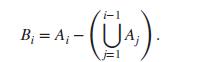
We consider the events A1, A2,…, An of a sample space Ω and, from these events, we form n new events B1, B2,…, Bn defined as follows: B1 = A1, while for i = 2, 3,…, n,(i) Verify that the events B1, B2,…, Bn are pairwise disjoint and that they satisfy the relationsand P(Bi) ≤ P(Ai), i =
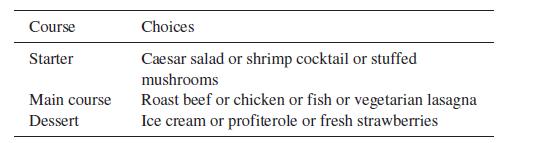
On a particular day, a restaurant has a special three-course menu with the following choices:Poppy, who is visiting this restaurant with her friends, is to choose one course from each category above.(i) How many outcomes does the sample space for this experiment have?(ii) Let A be the event that
For the experiment of throwing a die twice, we consider again the events A, B,C, and D from the last exercise and denote by E the event “exactly two among the events A, B,C, and D occur”:(i) Express the event E in terms of the events A, B,C and D.(ii) Find which elements of the sample space are
In the experiment of throwing a die twice, consider the following events:A: the first outcome is 6;B: the second outcome is 4;C: the sum of the two outcomes is 9;D: the first outcome is greater than the second.Provide a suitable sample space for this experiment and then find which elements of this
Assume that the probability of each elementary event {i} defined in the sample space Ω = {1, 2, 3,…} is given by P({i}) = 5i−1∕7i, i = 1, 2, 3,….Let us define the events An = {n, n + 1, n + 2, n + 3, n + 4}, n = 1, 2, 3,….(i) After establishing that the relationshipholds, verify that
Assume that A, B, and C are three events in a sample space Ω. Show that the following relations hold:(i) P(A ∪ B ∪ C) = P(A) + P(B) + P(C) − P(A′BC) − P(AB′C)−P(ABC′) − 2P(ABC);(ii) P(ABC) ≥ P(A) + P(B) + P(C) − 2;(iii) P(A′BC) + P(AB′C) + P(ABC′) ≤ 2P(A′ ∪ B′
Let A and B be events in a sample space Ω for which it is known that P(A) ≥ a and P(B) ≥b, where a and b are given real numbers.(i) Show that P(AB) ≥ a + b − 1.(ii) If a + b > 1, what do you conclude about the events A and B?
The claims arriving at an insurance company are classified by the company as either Large (L) or Small (S) according to their size. The company wants to study the number of claims arriving prior to the first large claim.(i) Give an appropriate sample space Ω which can be used for the above study.
Lena, Nick and Tom, who work for the same company, when they arrive for work one morning, meet at the ground floor elevator of the company building, which has three floors above the ground floor. Write down a sample space for the experiment which describes at which floor each person is going to.
In a major athletics competition, an athlete has three attempts to clear a certain height. If he succeeds in his first or second attempt, he makes no other attempts on this height.(i) Write down a suitable sample space Ω for this experiment and identify which elements of that space are included in
When Carol visits the local supermarket she buys a pack of crisps with probability 0.3, a chocolate with probability 0.4 and her favorite fruit juice with probability 0.6. The probability that she buys both crisps and chocolate is 0.2, that she buys both crisps and the fruit juice is 0.45, and that
At a large University class, there are 140 male students, 40 of whom own a car, and 160 female students, 20 of whom own a car. Let A be the event that “a randomly selected student is female” while B represents the event “a student owns a car.”Using the relative frequency as an estimate for
For the disjoint events A and B in a sample space Ω, we know that P(A ∪ B) = 5∕6, 4P(A) + P(B′) = 1.Then, the probabilities of the events A and B are, respectively, equal to(a) P(A) = 1∕6, P(B) = 2∕3 (b) P(A) = 2∕3, P(B) = 1∕6(c) P(A) = 1∕3, P(B) = 1∕2 (d) P(A) = 1∕2, P(B) =
We toss a coin successively. Let Bi be the event that the outcome of the ith toss is Heads. Then, the event “Heads occur for the first time at, or after, the second toss”can be written, in terms of the sets Bi, as follows:(a) B1 (b) B1B2 (c) B′1B2 (d) B′1B2B3B4 · · · (e) B′1.
We throw a die until a six appears for the first time, at which point the experiment stops. Let Ai be the event that the outcome of the ith throw is a six. The event “a six appears for the first time in the 3rd throw” can be expressed in terms of the sets Ai as(a) A1A2A3 (b) A1A2A′3 (c)
Let A, B, and C be three events in a sample space Ω, such that A ∪ B ∪ C = A. Then, the following is always true:(a) B ∪ C = A (b) B ∪ C ⊆ A (c) A ⊆ B ∪ C(d) BC = A (e) A ⊆ BC.
Which of the following statements is correct with reference to the sample spacesΩi, for i = 1, 2, 3, 4, 5, defined in the last problem?(a) Ω1 and Ω5 are the only sample spaces which are finite(b) Ω2 is a discrete sample space, but Ω4 is not(c) Ω4 is a discrete sample space, but Ω2 is not(d)
Maria is waiting at a bus stop for her friend Sarah so that they meet and go to a concert together.Maria wants to know how long she will have to wait until the next bus arrives at the bus stop and whether Sarah will be on it. A suitable sample space for this experiment is (a “0” below indicates
For the events A and B in a sample space Ω, we know that P(A ∪ B) = 1∕6. Then, the value of P(A′) − P(B) is(a) always equal to 5∕6 (b) equal to 5∕6 provided that AB = ∅(c) always equal to 1∕6 (d) equal to 1∕6 provided that AB = ∅(e) none of the above.
In a single throw of a die, consider the events A = {1, 2, 3} and B = {2, 4, 6}. The event (B − A)′ is equal to(a) {4} (b) {2, 4, 5, 6} (c) {1, 3}(d) {4, 6} (e) {1, 2, 3, 5}.
Marc tosses a coin until “Heads” appear for the second time. He is interested in the number of “Tails” which appear before the second appearance of “Heads.” Then, a suitable sample space for this experiment is(a) {0, 1, 2,…} (b) {0, 1, 2} (c) {1, 2} (d) {2, 3,…} (e) {1, 2,…}.
Let A, B, and C be three events in a sample space Ω, such that P(A) = 2P(B)and P(B) = 2P(C). If in addition we have A = (B ∪ C)′, then the probability of the event A is(a) 1∕7 (b)2∕7 (c)4∕7 (d)1∕2 (e)3∕5.
For the events A and B in a sample space Ω, we know that P(A) = (1 + ????)∕3, P(B) = 1 − ????2 for some real number ????. The admissible range of values for ???? is(a) ???? ≥0 (b) 0 ≤ ???? ≤1 (c) −1 ≤ ???? ≤ 1 (d) 0 ≤ ???? ≤ 2∕3 (e) −1∕3 ≤ ???? ≤ 2∕3.
The event that exactly one of the three events A, B, and C in a sample space Ωoccurs is(a) (ABC)′ (b) (A ∪ B ∪ C)′(c) AB′C′ (d) (AB′C′) ∪ (A′BC′) ∪ (A′B′C)(e) AB ∪ C
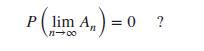
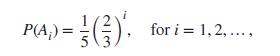
Let A1, A2,… be a monotone sequence of events defined in a sample space Ω. If it is known thatthen the probability of the event that at least one of the Ai’s occur is equal to zero. P(A)=() for i=1,2,...,
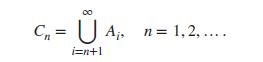
Let A1, A2,… be a sequence of events defined in a sample space Ω, and let a new sequence {Cn}n≥1 be defined byThen, {Cn}n≥1 is a decreasing sequence of events in Ω. 00 CA = 1, 2,.... n i=n+1
Let A1, A2,… be a sequence of events defined in a sample space Ω, and let a new sequence {Bn}n≥1 be defined by Bn = A1A2 · · · An, n = 1, 2,….Then, {Bn}n≥1 is a decreasing sequence of events in Ω.
If two events A and B, defined in the same sample space Ω, are mutually exclusive, then A′ ∪ B = Ω.
If for the events A and B we know that P(A) − P(B) = 1∕3, then P(A − B) ≤ 1∕3.
Let A and B be two events in a sample space Ω with A ⊆ B. Then, A′ ∪ B = Ω.
Let A and B be two events in a sample space Ω such that A ⊆ B, and C be another event in Ω. If the events B and C are disjoint, then A and C will also be disjoint events.
If P(A) = 1∕4 and P(A′) = 5P(B) − 1, then the probability of the event B is also 1∕4.
For any events A, B, and C in the same sample space, we have A(BC) = (AB) ∪ (AC).
We toss a coin 300 times and observe that in 160 of these tosses the outcome is“Heads.” Based on this, the relative frequency of the event “Heads occur in a single toss of a coin” is 160.
Assume that A, B, and C are three events on a sample space. If the events A and C are disjoint, and the events A and B are disjoint, then B and C are also disjoint events.
Showing 4900 - 5000
of 7136
First
43
44
45
46
47
48
49
50
51
52
53
54
55
56
57
Last
Step by Step Answers

 Get 50% OFF
Claim Now
Get 50% OFF
Claim Now