New Semester
Started
Get
50% OFF
Study Help!
--h --m --s
Claim Now
Question Answers
Textbooks
Find textbooks, questions and answers
Oops, something went wrong!
Change your search query and then try again
S
Books
FREE
Study Help
Expert Questions
Accounting
General Management
Mathematics
Finance
Organizational Behaviour
Law
Physics
Operating System
Management Leadership
Sociology
Programming
Marketing
Database
Computer Network
Economics
Textbooks Solutions
Accounting
Managerial Accounting
Management Leadership
Cost Accounting
Statistics
Business Law
Corporate Finance
Finance
Economics
Auditing
Tutors
Online Tutors
Find a Tutor
Hire a Tutor
Become a Tutor
AI Tutor
AI Study Planner
NEW
Sell Books
Search
Search
Sign In
Register
study help
business
introduction to probability statistics
Introduction To Probability Volume 2 1st Edition Narayanaswamy Balakrishnan, Markos V. Koutras, Konstadinos G. Politis - Solutions
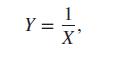
In Example 6.3, we obtained the distribution function of Y = aX +b, when the distribution of X is known and a > 0. Obtain a similar result for the case when a < 0, i.e. by assuming that the distribution function, F, of the variable X is known, find the distribution function and the density of Y =
Let X be a random variable with density function f (x) = e−x, x > 0.Let Y be another variable defined by Y ={X, if X ≤ 1, 1∕X, if X > 1.Find the distribution function, the density function and the expectation of Y.
Suppose that a continuous variable X has density function f (x) ={cxs, 0 ≤ x ≤ a, 0 elsewhere, where a and s are two given positive real numbers, while c is a suitable constant.(i) Find the value of c in terms of a and s.(ii) Obtain the distribution function for each of the following random
Assuming that for the random variables X and Y, we have E[(X − Y)2] = 0, establish that P(X = Y) = 1.(Hint: Work with the random variable Z = X − Y.)
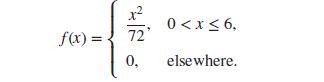
The daily orders for a particular product at a factory, in hundreds of kilograms, are represented by a random variable X having density function f (x) ={a(x − 1)2, 0 ≤ x ≤ 6, 0, elsewhere.(i) Obtain the value of a.(ii) Find the proportion of days in which the total amount of the product
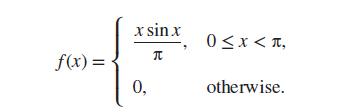
Assume that X is a random variable with density functionLet ????′r = E(Xr), r = 1, 2,…, be the moments of X (around zero). Then, verify that these moments satisfy the recursive relationship ????′r+1 = πr+1 − (r + 1)(r + 2)????′r−1, r = 2, 3,… f(x)= x sin x 0, 0x n, otherwise.
Let X be a continuous random variable with density f , and Y be another variable related to X by Y = X3. Show that the density function of Y is fY (y) =f(3 √y)3 3 √y2.
For the random variable X we have P(X = 0) = 1∕4, while X has a density f (x) = 9 4e−3x, x > 0.The expected value of X is(a) 1∕4 (b)3∕4 (c)9∕4 (d) 3 (e) 4
The distribution function of the random variable X is F(t) = 1 − e−5t3, t ≥ 0.The density function of X (for x ≥ 0) is(a) f (x) = e−5x2 (b) f (x) = 5e−5x2 (c) f (x) = 15e−5x3(d) f (x) = 5x2e−5x3 (e) f (x) = 15x2e−5x3
If the random variable X has density f (x) ={x, 0 ≤ x < 1, 2 − x, 1 ≤ x ≤ 2, then the conditional probability P(X ≤ 3∕2|X ≥ 1∕2) equals(a) 3∕7 (b)7∕8 (c)3∕4 (d)6∕7 (e)2∕7
A random variable X has distribution function F(t) =⎧⎪⎨⎪⎩0, t < 0, t∕6, 0 ≤ t < 3, 3∕5, 3 ≤ t < 5, 1, t ≥ 5.Then(a) F has no jumps (it is a continuous distribution)(b) F has one jump at the point t = 5(c) F has two jumps at the points t = 0 and t = 3(d) P(X = 3) = 1∕10(e) P(X
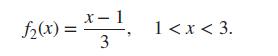
A random variable X has a discrete range Rd = {1, 2}, while its continuous range is the open interval (1, 2) with density f2(x) = x∕6, 1 < x < 2.If it is known that P(X = 1) = 2P(X = 2), then the probability P(X = 2) equals(a) 1 8(b) 3 8(c) 1 4(d) 1 6(e) 1 12
If X has distribution function F(t) =⎧⎪⎨⎪⎩0, t < 0, t∕2, 0 ≤ t < 2, 1, t ≥ 2, then the standard deviation of X is(a)√1 3(b)√2 3(c) 1 (d)√3 2(e)√3
Let X be a continuous variable with distribution function F(t) ={0, t < 0, 1 − e−2t(1 + 2t + 2t2), t ≥ 0.The probability P(X ≥ 2|X ≥ 1) equals(a) 13e−2 (b) 5 13 e−2 (c) 13 5e−2 (d) 5 13(e) 1 5e−2
The monthly income (in thousands of dollars) of employees in a large firm is represented by a continuous variable X having density f (x) ={ 160 x6 , x ≥ 2, 0 otherwise.Then the expected value of X is(a) 5 (b) 10 (c) 15∕2 (d)5∕2 (e)5∕4
The time X (in minutes) for a customer to be served at a post office has density function f (x) = 2e−2x, x ≥ 0.The probability that each of the next three customers will be served within one minute equals(a) e−6 (b) 3e−2 (c) 2e−6 (d) 2e−3 (e) (1 − e−2)3
The density function of a random variable X is given by f (x) =⎧⎪⎨⎪⎩−????x, −1 < x ≤ 1,????e−3x, x > 1, 0, elsewhere.Find the values of ???? and ???? if it is known that E(X) = 1.
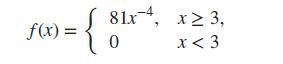
The density function of a variable X is given by f (x) ={24∕x4, x ≥ 2 0, x < 2.(i) Find the mean and variance of X.(ii) Obtain the distribution function, F, of X and use it to calculate the conditional probability P(X ≤ 7|X ≥ 4).(iii) Find the probability density, the mean and the variance
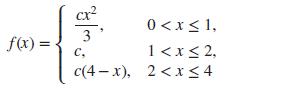
The quantity of petrol, X (in thousands of liters), sold by a gas station daily is a continuous random variable with density function f (x) =⎧⎪⎨⎪⎩cx, 0 ≤ x < 2, 2c, 2 ≤ x < 4, c(6 − x), 4 ≤ x ≤ 6.(i) Find the value of the constant c.(ii) Calculate the probabilities P(X > 2), P(1
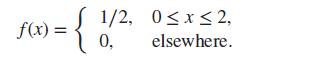
A super market sells potato sacks whose weight, X (in kilograms), is a continuous random variable with density function f as f (x) ={|x − 2|, 1 ≤ x ≤ 3, 0, elsewhere.(i) What proportion of sacks will have a weight between 1.6 and 2.4 kg?(ii) Find the standard deviation for the weight of a
Let X be a continuous random variable with density function f . Recall that the median of the distribution of X is the real number m such that P(X ≤ m) = P(X ≥ m).Show that, if the distribution of X is symmetric around a point a (see Exercise 21 of Section 6.1), and the expectation E(X) exists,
The density function of a random variable X is given by f (x) = 1 n!xne−x, x > 0, where n is a positive integer. Show that P(X n n + 1.(Hint: Use the formulato find the mean and variance of X. Then, use Chebyshev’s inequality.) 0 xke xdxk!, k = 0, 1,2...,
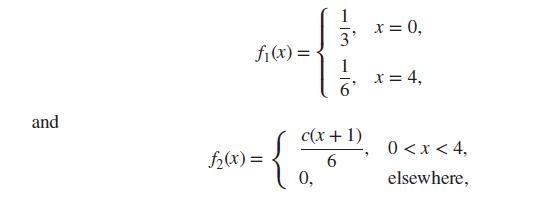
A random variable X has a mixed distribution whose discrete and continuous parts, f1(x) and f2(x), are given, respectively, byfor some suitable constant c.(i) What is the range of values for X?(ii) Find the value of the constant c.(iii) Calculate the probability P(2 ≤ X ≤ 4).(iv) Obtain the
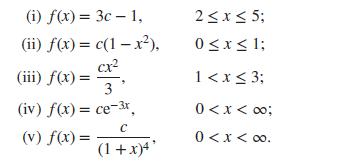
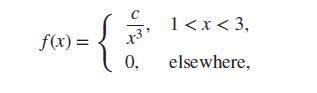
In each of the following cases, identify the value of c so that the function f is a probability density (f vanishes outside the range of values indicated below). (i) f(x)=3c 1, - (ii) f(x) = c(1-x), 2x5; 0x 1; cx (iii) f(x) = 1 < x < 3; 3' (iv) f(x) = ce-r (v) f(x)= 0 < x < 0; C 0
Let the potential losses from an investment, in thousands of dollars, be represented by a random variable X having density functionfor some real constant c.(i) Find the value of c.(ii) Calculate the probability that the losses from this investment are at most $400.(iii) If we make five such
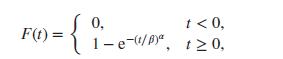
The time X, in hours, from the production time of a dairy product until it is safe to consume is a random variable with distribution functionwith ???? = 20, ???? = 100.(i) Find the density function of X.(ii) What is the percentage of products of that type that become unsafe to use between 98 and
The lifetime, X (in days), of a sea microorganism has density function f (x) = cx2e−4x, x ≥ 0, for a suitable constant c.(i) Obtain the value of c.(ii) Find the distribution function of X and hence the probability that a newly-born microorganism survives for at least three days.
Let X be a continuous random variable with density function f . We say that X has a symmetric distribution around the point a if we have P(X ≥ a + x) = P(X ≤ a − x)for any x ∈ ℝ.(i) Show that the distribution of X is symmetric around a if and only if f (a − x) = f (a + x).(ii) Establish
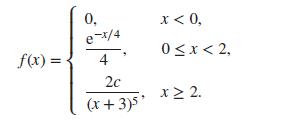
A continuous random variable X has density function(i) Obtain the value of c.(ii) Calculate the probabilities P(0 (iii) Find the distribution function, F(x), of X. Is it true that F′(x) = f (x) for all real x? Explain. 0. x < 0, e-x/4 f(x)= 0x2, 4 2c X 2. (x+3)5'
The temperature C (in degrees Celsius) where a certain chemical reaction takes place can be considered as a continuous random variable with density functionObtain the density function of the temperature that the reaction takes place, in degrees Farenheit (recall that if F and C denote temperature
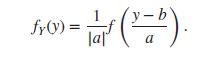
Let X be a continuous random variable with probability density function f and assume that a ≠ 0 and b are two real numbers.(i) Show that the probability density fY of the variable Y = aX + b is given by the formula(ii) If the probability density of X is given byfind the density function of Y =
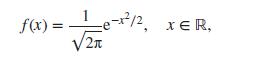
Let X be a continuous random variable with density function f (x), x ∈ RX, and distribution function F(t), t ∈ ℝ. Express the density function and the distribution function of the random variable Y = X2 in terms of f and F.Application: Find the density function of Y = X2 when the density of X
The density of a random variable X is given byDerive the density function of the random variables Y = Xa and Z = eX, where a is a given positive real number. f(x)= { 1, 0, 0 x1, elsewhere.
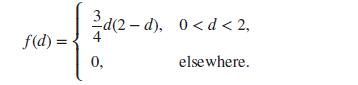
The diameter of a bubble, at the time when it breaks, is a random variable X with density functionFind the distribution function of the area E and the volume V of the bubble at the time when it breaks. f(d)= 0, d(2-d), 0
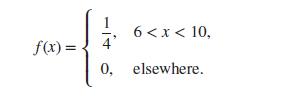
The value I of the electric current passing through a resistance, R, of a circuit is a continuous random variable with probability densityDerive the density function of the electric power, given by P = RI2, assuming the value of the resistance R to be kept constant. 6 < x < 10, f(x) = 4' 0,
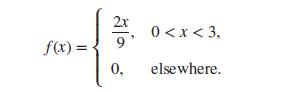
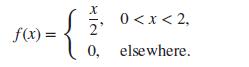
A continuous variable X has density functionFind the density function of the variables (i) Y = 3X − 2;(ii) W = (3 − X)(3 + X). 2x 0 < x
Let X be a continuous random variable with density f . Suppose Y is another random variable which is related to X by(i) Prove that the density function, fY (y), of Y is related to f by the formula(ii) Apply the result from Part (i) to find fY in the case when the density f is given by Y = ex.
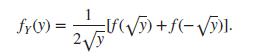
For a continuous variable X with density f , show that the density function, fY, of the variable Y = X2 is given by fro) = () + ()].
The sizes of claims (in thousands of dollars) arriving at an insurance company can be modeled by a random variable X having density functionWhat is the proportion of claims arriving at the company that are (i) at least $10 000?(ii) between $5000 and $8000? 4x f(x)= x>0. (x+2)
The sizes of claims (in thousands of dollars) arriving at an insurance company can be modeled by a random variable X having density functionis also a density function. 4x f(x) = x > 0. (x+2)
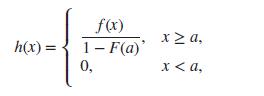
Assume that X is a continuous random variable with density function f and distribution function F. Suppose that a is a real number for which P(X ≤a) Show that the function h defined byis also a density function. f(x) x a, h(x)= 1- F(a)' 0, x
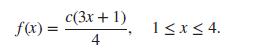
A continuous random variable X has density function(i) Find the value of c.(ii) Obtain the distribution function of X.(iii) Calculate the probabilities P(X ≤ 2), P(X > 2.5), P(1.5 c(3x+1) f(x)= = 1x4. 4
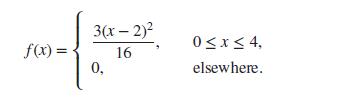
The daily amount of time, in hours, that Nicky spends surfing on the internet is a random variable X with density functionFind the proportion of days on which she spends (i) less than two hours;(ii) between one and three hours. f(x)= 3(x-2) 0x4, 16 0, elsewhere.
The measurement error of a certain instrument is a continuous random variable X with density function(i) Find the value of the constant c.(ii) Obtain the distribution function of X.(iii) Find the probability that the measurement error is (a) positive;(b) less than 1 in absolute value;(c) smaller
The total distance, in miles, that a taxi driver drives during a day is a continuous random variable with density function(i) Verify that this function satisfies properties DF1 and DF2 so that it is indeed a valid probability density and sketch this function.(ii) Find the probability that the
The borrowing period, in days, for a particular book at a University library can be regarded as a continuous random variable X with density function(i) What is the maximum period allowed for borrowing this book?(ii) Calculate the probability that a new borrower keeps the book (a) for at least one
Dr Smith finishes a particular lecture at the University between 2:58 p.m. and 3:04 p.m. The time X, in minutes after 2:58 p.m., that she finishes her class is a random variable with density function(i) Find the probability that the class finishes (a) after 3:00 p.m.;(b) between 2:59 p.m. and 3:01
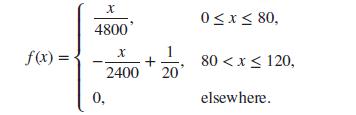
The lifetime of a light bulb, in thousands of hours, is a continuous variable with density function(i) What proportion of this type of bulbs will work for at least 2500 hours?(ii) Find the proportion of light bulbs with a life length between 2000 and 3200 hours. f(x)= = { a CX, 0 < x < 2, c(4-x), 2
The response time (in minutes) of a patient to a new medical treatment for a disease is a continuous random variable X with distribution function F(x) = 1 − (x + 1)e−x, x > 0.(i) Obtain the density of this distribution.(ii) Find the probability that, if three patients are subject to this
For what value of c the function f (x) = c(1 − x), −1 < x < 1, is the probability density of a continuous random variable? Obtain the distribution function of this random variable.
The quantity of gasoline (in tens of thousands of gallons) sold at a gas station during a day has the density functionfor a suitable constant c (which you should be able to identify). Calculate the probability that the daily sales of gasoline at this gas station are (i) at most 4000 gallons;(ii)
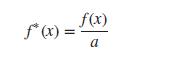
Let f be a nonnegative real function for which we have=for some positive numbera. Show that the functioncan be a probability density for a continuous random variable. -00 f(x)dx = a,
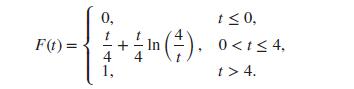
The distribution function of a continuous random variable X is given by(i) Calculate the probabilities P(X ≤ 3), P(X ≥ 1), P(1 ≤ X ≤ 3).(ii) Calculate the conditional probabilities P(X ≤ 3|X ≥ 1), P(X ≤ 4|X ≥ 1).(iii) Find the density function of X. F(t)= 0, t0, 4 ++ In (4). 0 4.
The pressure X, measured in psi (pound-force per square inch), at the wings of a turbine that is tested in a tunnel, follows the so-called Rayleigh distribution with density functionwhere a = 1∕20 000 and c is a positive constant.(i) What is the value of c?(ii) Find the distribution function of X
If f1, f2, and f3 are three density functions, define a new function f byFor which value(s) of ???? is f a probability density? What is the range of values associated with f in terms of the ranges corresponding to f1, f2, and f3? *x) F + (x)F = + (x)'Y { = ( f(x)
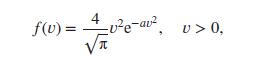
The velocity of the molecules in a homogeneous gas that is in the state of equilibrium can be described by a continuous variable V with density functionfor some positive constant a.(i) Find the value of a using the following result (known from calculus):(ii) Obtain the density function of the
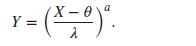
Assume that X is a continuous random variable with distribution functionwhere a > 0, ???? > 0, and ???? ∈ ℝ are known parameters of this distribution. Find the density function of the random variable F(x)= 0, x < 0. 1-exp[-(*)"] x 0,
The number of light bulbs of a certain type (measured in hundreds), sold by a large store during a year, is a random variable X having the distribution functionThe profit that the store makes for each lightbulb sold is $1. If by the end of a year, a lightbulb has not been sold, it results in a loss
Show that there does not exist a random variable X having mean ???? and variance ????2 such that P(???? − 3???? < X < ???? + 3????) = 0.80.
Prove that there does not exist a positive random variable X with E(X) = ???? for which we have P(X ≥ 3????) = 0.5.
The running time in minutes, X, of a computer program on a PC has a distribution function F(t) = 1 − (3t + 1)e−3t, t ≥ 0.(i) John has started running this program half a minute ago and it is still running.What is the probability that it will stop within the next 15 seconds?(ii) Obtain the
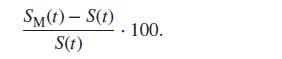
The maximum daily rainfall, measured in inches, during a year for a particular city is represented by a random variable X having density function(this is an example of the Pareto distribution discussed in Examples 6.6 and 6.9).(i) Let the function S(t) be defined by the relationshipObtain the value
Assume that X is a nonnegative random variable having distribution function F.Arguing as in the proof of Proposition 6.7, show that the moment of order r of X(around zero) can be expressed in the form E(X") = r 00 x-(1-F(x))dx.
The time, in seconds, that a butterfly sits on a leaf of a tree is a random variable X having distribution function(i) Verify that F is a proper distribution function of a random variable.(ii) Calculate the probabilities P(X ≥ 2), P(1 ≤ X ≤ 2), P(X ≤ 2|X ≥ 1).(iii) Calculate the expected
Let X be a continuous variable for which the expectation E(X) exists. Show that the following holds:(Hint: Making use of Proposition 6.7 for the nonnegative variable Y = |X|, express the expected value of Y asThen observe that for t ∈ [n, n + 1), we have P(Y ≥ n + 1) ≤ P(Y > t) ≤ P(Y ≥
For the random variable X, suppose that we have E(X) = 5 and E(X2) = 30. Find(i) an upper bound for the probability P(X ≤ −1 or X ≥ 11);(ii) an upper bound for the probability P(X ≤ −1);(iii) a lower bound for the probability P(1 ≤ X ≤ 9).
Using the following diagram, which gives the distribution function of a random variable X, calculate the probabilities(i) P(X < −2);(ii) P(X = i), for i = −3,−1, 1, 2;(iii) P(X ≤ −1);(iv) P(−2 < X < 2).
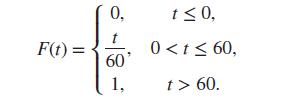
When a car passes through a traffic junction, the delay (in minutes) caused by the red light in the traffic lights is a random variable X with distribution function(i) Explain why this is a mixed distribution and find the probability that a car has no delay in passing through the traffic lights of
A random variable X has a jump at the point x = 2, while its continuous part is described by the density(i) What is the value of the probability P(X = 2)?(ii) Find the expected value of X. x-2x f(x)= 2 < x 4. 10
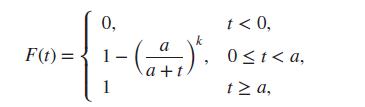
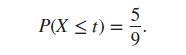
The distribution function of a random variable X is given byfor some positive constants a and k.(i) Find the value of the probabilities P(X = 0) and P(X = a).(ii) For what value of k, we have P(X =a) = 1∕4?(iii) For a = 4, k = 2, obtain the value of t such that(Distributions of this form occur
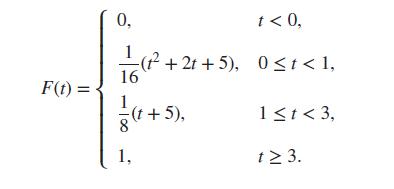
The distribution function of a random variable X is(i) Which are the points of discontinuity for F?(ii) Calculate the probabilities P(0 (iii) Find the expected value and the variance of X. 0, 16 F(t)= t
The production time, in minutes, of a manufacturing item is a continuous random variable X with density functionfor some suitable constants b and c.(i) If it is known that E(X) = 13∕9, what are the values of b and c?(ii) Calculate the standard deviation of X.(iii) Find the probability that, among
Let X be a continuous variable with densityand let Y = [3X + 1], where [ ] denotes the integer part.(i) Calculate the distribution of the discrete random variable Y and then use Definition 4.4 to derive its expectation.(ii) Is it true that the expected value of Y equals three times the integer part
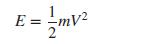
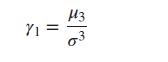
For a random variable X with mean ????, standard deviation ????, and third central moment ????3 = E[(X − ????)3], the coefficient of skewness for the distribution of X is given by(this is a measure of the departure from symmetry for the distribution of X; note that ????1 can take both positive
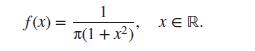
Two continuous random variables X and Y with RX = ℝ and RY = (−π∕2, π∕2)are related by X = tan Y. Find the density function of the random variable Y if it is known that the density of X is given byThe distribution of the variable X above is known as Cauchy distribution. 1 f(x)= XER. (1+x)'
Let X be a continuous random variable whose distribution function F is strictly increasing throughout ℝ. Show that the random variable Y = [X], the integer part of X, is a discrete variable with probability function fy(y) F(y+1) F(y), y Ry = {0, 1, 2,...}.
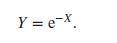
Let X be a random variable with density function f (x) = e−x, x > 0.Obtain the density function for each of the following variables:Y = −2X, Z = (1 + X)−1, and W ={X, if X ≤ 1, 1∕X, if X > 1.
The time, in hours, it takes to repair the fault in a machine has a continuous distribution with density functionIf the cost associated with the machine not working for x hours is 3x + 2, calculate the expected cost for each fault of the machine. f(x) = { 1, 0, 0 x1, elsewhere.
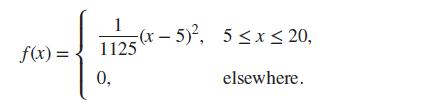
The ash concentration (as a percentage) in a certain type of coal is a continuous random variable with probability density functionFind the mean percentage concentration of ash for this type of coal. 1 1125(x-5), 5x20, elsewhere. f(x)= 0,
The repair time, in hours, for a certain type of laptop is a continuous variable with density function(i) What is the expected time to repair a laptop of this type when it breaks down?(ii) If the repair cost depends on the time that the repair takes and, when this time is x hours, the associated
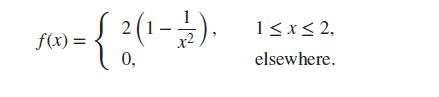
The weekly circulation, in tens of thousands, of a magazine is a random variable X whose density function isWhat is the expected value and the standard deviation for the number of magazines sold weekly? f(x) = = {2 (1-2). 1 x 2, elsewhere.
The monthly income (in thousands of dollars) of a family in a city, represented by a random variable X, has the Pareto distribution (see Examples 6.6 and 6.9)with parameters k = 4 and ???? = 2.(i) Obtain the distribution function of X.(ii) Find the probability that the monthly income of a randomly
The density function of a random variable X is f (x) = a + bx2, 0 ≤ x ≤ 1.If we know that E(X) = 3∕5, what are the values of a and b?
For what values of a and b is the function f (x) = a(b − x)2, 0 ≤ x ≤ b, the probability density function of a continuous random variable X with E(X) = 1?
The time, in hours, that a student needs to complete a Mathematics exam is a random variable X with density functionWhat is the expected value and the variance of X? f(x) = = { 0, 6(x 1)(2x), 1
Suppose the density function of a random variable X iswhere c is a real constant.(i) Find the value of c.(ii) Calculate the expected value of the random variable Y = ln X. f(x)= { 1
Let X be a random variable with density functionwhich is the density of the Cauchy distribution – see Exercise 12 of Section 6.2.Prove that the expectation of X does not exist. 1 f(x) = (1+x)' -8
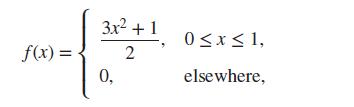
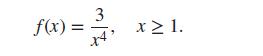
Find the expectation and the variance of a random variable X whose density function isThen, find the density function, the expectation and the variance of the random variableand verify that the following hold true in this case: 3 f(x) = x 1. x4'
A random variable X has discrete range Rd = {1, 3}, while its continuous range is the open interval (1, 3), with density in that interval given byIf it is known that E(X) = 7∕3, calculate the probabilities 2(x) = x - 1 1 < x < 3. 3
The lifetime, in hours, of an electrical appliance is described by a random variable X, having distribution functionwhere ???? > 0 is a known parameter of this distribution. A company sells this appliance making a profit of k dollars and gives its customers a guarantee that the appliance will
A box contains five red and six yellow balls. We select four balls at random.(i) What is the probability that at least three are red? Compare the answers you get if the selection is made• without replacement;• with replacement.(ii) From each of the two sampling strategies in (i), find the
Susan rolls two dice and Adam rolls three dice. What is the probability(i) that they get the same number of sixes?(ii) that Susan gets more sixes than Adam?(iii) that Adam gets exactly one more six than Susan?
Daniel goes with his father to an amusement park and heads straight for the shooting game. He pays $3 to enter the game and he is offered five shots; if he finds the target in at least four of them, he wins a prize which his dad estimates to be worth $6.Assuming that the probability of hitting the
Again, compare the results if sampling is made with or without replacement.
John rolls a die, and if the outcome is k, he rolls the dice k times successively.(i) What is the sample space for this experiment?(ii) Write down the probability function for the number of trials (rolls of the die).(iii) Let Y be the number of 3’s which turn up. Find the probability function of
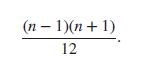
Consider the discrete uniform distribution, (n), defined in Section 5.7. For this distribution,(i) calculate the first three moments around zero, that is, ????′i for i = 1, 2, 3;(ii) show that the third moment around the mean is always zero;(iii) verify that the variance of the random
Six school girls discuss about their color preferences. They decide to write in a piece of paper their two favorite colors among a possible set of seven colors: pink, purple, yellow, maroon, red, green, and brown.If we assume that all colors are equally likely to be selected, what is the
In Section 5.2, we showed that the geometric distribution has the memoryless property, i.e. for any positive integers n, k, we haveVerify that the converse is true; that is, if a random variable Y on the nonnegative integers satisfies the above for all n and k, then the distribution of Y is
The number of molecules that a gas contains can be described by a Poisson process with rate ????, so that in an area of ???? units the expected number of molecules is ????????.Find the probability that a specific molecule(i) has a distance from its closest molecule less than a fixed positive number
Reservations for a theater performance are made according to a Poisson process with rate ???? = 5 reservations per hour. If there are currently 20 seats available, what is the probability that all the seats will have been booked within the next three hours?
Showing 4400 - 4500
of 7136
First
38
39
40
41
42
43
44
45
46
47
48
49
50
51
52
Last
Step by Step Answers

 Get 50% OFF
Claim Now
Get 50% OFF
Claim Now