New Semester
Started
Get
50% OFF
Study Help!
--h --m --s
Claim Now
Question Answers
Textbooks
Find textbooks, questions and answers
Oops, something went wrong!
Change your search query and then try again
S
Books
FREE
Study Help
Expert Questions
Accounting
General Management
Mathematics
Finance
Organizational Behaviour
Law
Physics
Operating System
Management Leadership
Sociology
Programming
Marketing
Database
Computer Network
Economics
Textbooks Solutions
Accounting
Managerial Accounting
Management Leadership
Cost Accounting
Statistics
Business Law
Corporate Finance
Finance
Economics
Auditing
Tutors
Online Tutors
Find a Tutor
Hire a Tutor
Become a Tutor
AI Tutor
AI Study Planner
NEW
Sell Books
Search
Search
Sign In
Register
study help
business
introduction to probability statistics
Introduction To Probability Volume 2 1st Edition Narayanaswamy Balakrishnan, Markos V. Koutras, Konstadinos G. Politis - Solutions
6.60 Let X be a binomial random variable with n = 36 and p=0.54. Use the normal approximation to find: a. P(X 25) b. P(15 X 20) c. P(X>30)
6.61 Using Table 3 in Appendix I, calculate the area under the standard normal curve to the left of the following:a. z=1.2c. z=1.46b. z=-0.99d. z=-0.42
6.63a. Find the probability that z is greater than -0.75.b. Find the probability that z is less than 1.35.
Suppose A and B are two events in a sample space Ω such that P(A) = ????, P(B) = ????.Show that the conditional probability P(A|B) satisfies the inequality a+B-1 P(A|B)
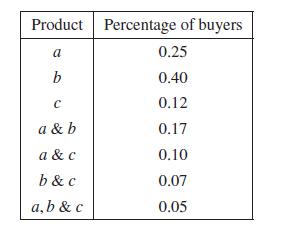
A large department store wants to study the purchasing habits of its customers for three specific products,a, b,c. The data given in the following table come from a market research that the store conducted and show the proportions of customers who purchase one or more among the three products
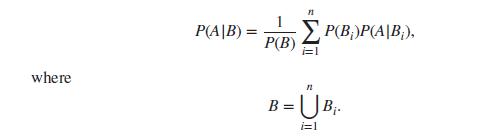
(A generalization of the law of total probability) Let B1, B2,…, Bn be disjoint events on a sample space Ω such that P(Bi) > 0, for all i = 1, 2,…, n. Prove that for any event A on this sample space, the following holds:Explain how Proposition 3.5 can be deduced as a special case of this
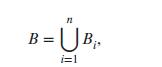
Let Ω be a sample space, A an event of that space and B1, B2,…, Bn be pairwise disjoint events in Ω with P(Bi) > 0 for all i. Assume further that P(A|Bi) = p for all i = 1, 2,…, n.If the event B is defined byshow that the conditional probability of A given B is also equal to p, that is
Suppose that A1, A2,…, An are completely independent events of a sample space Ωwith P(Ai) = pi, with pi (i) Verify that the probability that exactly one of the events A1, A2,…, An appear equals(ii) If we throw two dice n times, what is the probability that a double four appears exactly once?
Three contestants in a quiz show have to answer, in turn, a series of questions. Let p1, p2, and p3 be the probabilities that the first, second, and third player answer a question correctly. The game ends when the first correct answer is given. For n = 1, 2,…, define the events An∶ the first
Let A1, A2,…, An be completely independent events on a sample space Ω with P(Ai) = pi, for i = 1, 2,…, n. The probability that none of the events Ai occur is equal to - =1 - Pi).
We select (without replacement) two cards from a pack of 52 cards. The probability that the two cards selected belong to different suits is 3.4 (a) (b) / 51-52 34 39 (c) 51 (d) 31 (e) 51 51
An urn contains six red balls and five blue balls. We select one ball at random and then, without replacing it, we select another ball. Then, the probability that the second ball drawn is blue is 2.6.5 5 (a) (b) (c) (d) (e) ()
At a sports club of a University, there are 15 students who play basketball and 13 students who play baseball. We choose successively two students. The probability that the first student selected plays baseball and the second one plays basketball equals (a) 15 (1)(4) (2) 28 13 15 13+15 2(13+15) 13
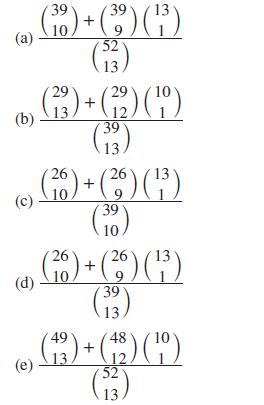
In a hand of bridge, each of the four players receives 13 cards from a standard pack of 52 cards. Nick and Leopold are partners. What is the probability that, in a given hand, Nick has at most one spade given that Leopold has exactly three spades? (a) (39) +(39) (13) 52 13 (229) + (22) (19) (b) 13
Pat takes part in a quiz show with multiple choice questions. There are three possible answers to each question. The probability that she knows the answer to a question is p. If Pat does not know the answer to a particular question, she gives an answer at random. If she answered the first question
Let A and B be two disjoint events of the same sample space with P(A) ≠ 0 and P(B) ≠ 0. Show that P(A|A UB) P(B|AUB) 1 P(A) P(B) P(A) + P(B)
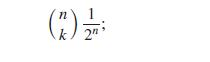
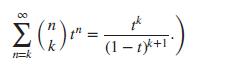
We assume that the probability of a family having n children is apn for n = 1, 2,…(where a is a positive real number such that apn We also assume that boys and girls are equally likely to be born.(i) Show that the probability a family with n children to have exactly k girls is(ii) Establish that
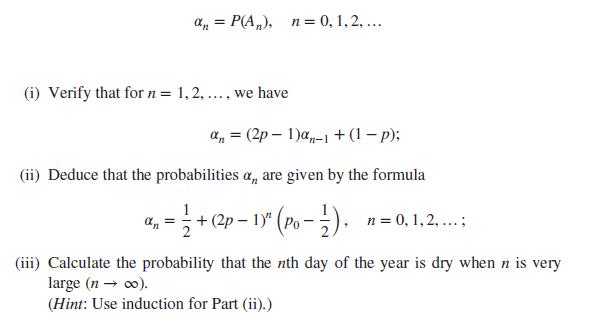
An amateur meteorologist uses the following, rather primitive, weather forecasting system. Each day is classified as dry or wet and he then assumes that the following day will be of the same type (dry or wet, resp.) with probability p (0 Using statistical data from previous years, he decides that
A certain University exam involves True–False questions. Students who take this exam can be classified into three classes: skilled, who answer each question correctly with probability 0.95, well-prepared, who answer each question correctly with probability 0.75, and guessers who simply take a
A coin that does not have equal probabilities of landing heads and tails is said to be a biased coin. Suppose that we have two biased coins; the probability of landing heads for the first of these (coin A) is p1, while for the second one (coin B) it is p2.We select initially one of these two coins
Two groups of children decide to make a draw so that a three-member committee is selected. The first group consists of 7 boys and 3 girls, while the second group has 1 boy and 5 girls. The selection takes place as follows: first, one person is chosen randomly from each group. In order to select the
Isaac and Mary enter a quiz show and reach the final stage in which they will win the grand prize if they answer a true–false question correctly. Assume that each of them has a probability p of giving the correct answer. Before the question is posed, Isaac tells Mary that they should choose one
Recall the definition of a parallel system connection from Example 3.18. Consider now a parallel system that has n components and assume that each of these components works, independently of others, with probability 1∕2. Find the probability that the first component works given that the system is
A primary school teacher asks four children what is their favorite season of the year. If the first two children gave different answers (e.g. summer and autumn), show that the probability that a season is chosen by exactly three children is 1∕8.
We carry out the following experiment successively: we toss a coin and throw two dice simultaneously. What is the probability that an outcome of tails occurs before we get a sum of 3 in a throw of the two dice?
If we throw a die 6 times, what is the probability that the number of sixes minus the numbers of ones we get is equal to 3?
A company classifies its customers into k classes according to the frequency by which they place their orders. The probability that a customer of class j makes no orders in a period of one month is (n − j)∕n, for j = 1, 2,…, k, where 1 ≤ k < n. The proportion of customers who are classified
Two boxes contain exactly the same total number of balls, and in each box some balls are white and the rest are black. Let x and y be the number of white and black balls in the first box, respectively, and let z be the number of white balls in the second box. From each box, we pick up n balls with
A student has to take a multiple-choice exam with n possible answers in each question (only one being correct in each case). The probability that the student knows the correct answer to a question is p (0 < p < 1). If the student does not know the answer to a particular question, he chooses
An urn contains a > 3 white and k > 1 red balls. Suddenly, a ball disappears from the urn.We select two balls from the urn and check their color, to find out that they are both white. What is the probability that the missing ball is red?
For a certain make of a car, spare parts are produced by two manufacturers, A and B. The total production of the manufacturer B is n times as large as that of A. The proportions of defective spare parts produced by the manufacturers A and B are p1 and p2, respectively.(i) If we purchase a spare
Three boxes contain b blue and r red chips each. We select a chip at random from the first box and place it in the second box. Then we select a chip from the second box and place it in the third. If we now select at random a chip from the third box, what is the probability that this is a red one?
Two urns labeled I and II contain n1 and n2 balls, of which r1 and r2, respectively, are green. We select a ball at random from Urn I and place it in the second urn, and then we take a ball from Urn II. What is the probability that this ball is green?
Three darts players have respective probabilities p1, p2, p3 of hitting the center of the dartboard. Each of them shoots against the target once and then we examine how many of them hit the center. Find the probability that the third player found the center if the number of darts found there is (i)
We have n boxes and for i = 1, 2,…, n, the ith box contains ni balls of which ri are white, and the remaining are black. We first select a box and then choose randomly one of the balls in that box. What is the probability that a white ball is selected if(i) the selection of the box is completely
Jenny starts from point A of the diagram below and, at each node, she selects her route with equal probabilities among the possible options.(i) What is the probability that she arrives at point B?(ii) If it is known that she reached point B, what is the probability that she came through one of the
If Steve tosses a coin n times, for n ≥ 2, consider the events A∶ tails appear at most once in the n tosses, B∶ each of the two sides of the coin appears at least once.(i) Find the probabilities of the events A, B, and AB;(ii) Hence, show that A and B are independent only when n = 3.
A driver responsible for a car accident disappears after the accident. After investigating the case, police believe with 70% probability that the accident was caused by a car with plate number XYZ 1867. At this point, an eye witness appears and tells the police that he is certain that the last
Peter throws 10 dice, and he announces to Mary that at least one six appeared.What is the probability that at least two sixes were observed in total?
A military aircraft that carries n bombs shoots against a target until the target is destroyed or the aircraft runs out of bombs. The probability a bomb finds the target is p1, while the probability that a bomb destroys the target when it has already been hit by a bomb is p2. If successive bomb
Among the students who enter a University degree program, 82% of the females and 71% of the males obtain their degree within the scheduled time. If 52% of the students in this program are males, what is the percentage of students who finish in time? What proportion among those who finish in time
A store that sells alcoholic drinks has n bottles of white wine and k bottles of red wine on its shelves.We select a bottle randomly from the shelves and then a second, without replacing the first. What is the probability that the second bottle contains white wine if the first one was also a white
A box contains n lottery tickets, k of which are winning tickets. Frank and Geoffrey select tickets from the box successively, one after the other and without replacement.Whoever picks a winning ticket first wins the game. Who has the higher probability of winning, Frank who chooses first or
Peter throws three dice and he announces to Mary that the three outcomes are different. What is the probability that at least one outcome is 4?
The percentage of the population in a city who suffer from a serious disease is 3%.A person has just taken two medical examinations to see whether he suffers from the disease. Each of the two tests make the correct diagnosis (whether someone suffers from the disease or not) with a probability 98%
For the events A and B of a sample space, it is given that P(A|B) = ????, P(B|A) = ????, P(A|B′) = ????.Find the unconditional probability of event A in terms of ????, ????, and ????.
Let A and B be two events on a sample space such that P(A) = 0.5, P(A ∪ B) = 0.75.Find the probability of the event B in each of the following cases:(i) A and B are disjoint events;(ii) A and B are independent events;(iii) We have P(A|B) = 0.3.
In a telecommunications channel, transmitted bits are either 0 or 1 with respective probabilities 5∕8 and 3∕8. Due to noise, a 0-transmitted bit is received as 1 with probability 1∕5, while a 1-transmitted bit is received as 0 with probability 1∕10.If the last bit received was 0, the
We select (without replacement) two cards from a pack of 52 cards. The probability that both cards selected are spades is(a) 1 51 ⋅ 52(b) 13 51 ⋅ 52(c) 12 ⋅ 13 51 ⋅ 52(d) 132 51 ⋅ 52(e) 2 ⋅ 12 ⋅ 13 51 ⋅ 52
With the assumptions of the previous question, the probability that John passes both exams if he knows that he passed at least one is(a) 27∕40 (b) 39∕40 (c) 19∕20 (d) 9∕13 (e) 13∕40
John is going to take two exams for his degree course next week. The first one is more difficult and he feels that the probability he will pass this exam is 3∕4, while he is more confident about the second one giving a success probability to himself of 9∕10. The probability that John passes at
From a box that contains 10 balls numbered 1, 2,…, 10, we select randomly 2 balls with replacement. For the events A∶ the number on the first ball selected is odd and B∶ the number on each of the two balls selected is even, which of the following statements is true?(a) They have the same
For the events A and B of a sample space it is known that P(B) = 0.5 and P(A′B) = 0.2. Then, the conditional probability P(A|B) equals(a) 0.6 (b) 0.3 (c) 0.5 (d) 0.1 (e) 0.15
If A and B are independent events with P(A) = 1∕5 and P(B) = 1∕2, then the conditional probability P(A|A ∪ B) is equal to(a) 4∕10 (b) 3∕10 (c) 1∕2 (d)1∕10 (e) 1∕3
Let A and B be two independent events on a sample space Ω. If P(A) = 3∕4 and P(AB′) = 21∕40, then the probability of event B is(a) 3∕10 (b) 7∕10 (c) 2∕5 (d)3∕5 (e)9∕40
Assume that A1, A2, and B are three events on a sample space such that P(B) > 0.Then,(a) P(A1|B) = P(A1A2 ∪ A1A′2|B) (b) P(A1 − A2|B) = P(A′1A′2|B)(c) P(A1A2|B) = 1 − P(A′1A′2|B) (d) P(A1A2|B) = 1 − P(A′1 ∪ A′2|B)(e) P(A′1 ∪ A′2|B) = P(A′1|B) + P(A′2|B)
If the events A and B are independent, each having a positive probability of occurrence, then(a) AB = ∅ (b) P(B′|A) = P(B) (c) P(A ∪ B) = P(A) + P(B)(d) P(A|B) = P(B|A) (e) P(A − B) = (1 − P(B))P(A)
LetAandBbe two events of a sample space such thatP(A) = 0.5 andP(A ∪ B) = 0.8.If it is known that P(A|B) = 0.25, then the probability of the event B is(a) 0.9 (b) 0.3 (c) 0.2 (d) 0.4 (e) 0.1
An exam contains two multiple choice questions. The first question has four possible answers, while the second one has five. If a student taking the exam answers both questions completely at random, the probability that he/she gives at least one wrong answer is(a) 12∕20 (b) 19∕20 (c) 1∕15 (d)
Let A, B, and C be three events on a sample space such that P(B) > 0. Then, P(AC′|B) = P(A|B) − P(AC|B).
When throwing a die twice, let A be the event that the first outcome is even and B be the event that the product of the two outcomes is 6. Then, A and B are independent.
Suppose that A1, A2, A3, and B are events on a sample space with P(B) > 0. If the events A1, A2, and A3 are pairwise disjoint, then P(A1 ∪ A2 ∪ A3|B) = P(A1|B) + P(A2|B) + P(A3|B).
For two independent events A and B on a sample space Ω, we have P(A′B′) = P(A′) + P(B′) − 1.
Suppose that {B1, B2} is a partition of a sample space Ω such that P(Bi) > 0, for i = 1, 2. Then, for any event A in Ω, we have P(A) = P(A|B′1)P(B′1) + P(A|B′2)P(B′2).
Assume that, for the events A and B of a sample space Ω, we have 0 < P(A) < 1 and P(B′|A) = P(B′|A′). Then A and B are independent events.
Let A1 and A2 be two disjoint events on a sample space and assume that B is another event with P(B) > 0. Then, we have P(A1 ∪ A2|B) = P(A1|B) + P(A2|B).
If A and B are mutually exclusive events such that P(A) > 0 and P(B) > 0, then A and B cannot be independent.
If A and B are independent events, then the events A′ and B are also independent.
For the events A and B of a sample space Ω, it is known that P(A) ≠ 0 and P(B) ≠ 0.If A and B are independent, then they are also disjoint (mutually exclusive).
The probability for the intersection of two events equals the product of the probabilities for each event.
Suppose that A1, A2, and B are three events on a sample space and P(B) > 0. If A1 and A2 are independent, then P(A1A2|B) = P(A2|B)P(A2|B).
If A and B are two mutually exclusive events such that P(A) = P(B) = 0.3, then A and B are independent.
A, B, and C are three events on a sample space Ω. If P(AB) ≠ 0, then P(ABC) = P(B)P(A|B)P(C|AB).
If A and B are two events on a sample space such that P(A) ≠ 0, P(B) ≠ 0, then we have P(A|B)P(B|A) = 1.
If A and B are two events on a sample space Ω with P(B) < 1, then we have P(A′|B′) = 1 − P(A|B′).
Let A and B be two events on a sample space Ω such that A ⊂ B, with P(B) < 1.Then P(A|B′) = 0.
Assume that n ≥ 2 shooters shoot against the same target, independently of each another. The probability that each shooter hits the target is the same for all shooters and is equal to p. Let R(p, n) be the probability that at least two shooters hit the target.(a) Verify that R(p, n) = 1 − (1
With reference to Exercise 22 of Section 3.5, suppose that the probabilities pi, i =1, 2,…, are all equal, that is, p1 = p2 = · · · = p.Let R1(p), R2(p), and R3(p) be the probabilities that electricity passes through the circuits (a), (b), and (c) of that exercise, respectively.(i) Draw a
Consider the following problem with conditional probabilities: we toss a coin four times and we seek the probability that we get exactly two heads, if we know that(i) the first outcome is heads;(ii) the first two outcomes are both heads.With the set of commands below, we obtain the desired
Bill, Greg, and John are friends attending the same course in French translation at University and they prepare for their exam. The course lecturer has recommended two textbooks, say A and B, to prepare for the exams, and the text they will have to translate will be either from textbook A or from
(The Huygens problem) Tom and Daniel play a game in which they throw alternatively a pair of dice. Daniel wins if he gets a sum of 6 before Tom gets a sum of 7. What is the probability that Daniel wins if he plays first?
We throw two dice simultaneously until either a sum of 7 or a sum of 9 occurs.What is the probability that(i) exactly n throws will be needed?(ii) the experiment stops with the last throw having an outcome 9?(iii) the experiment stops with the last throw having an outcome 7?(iv) the experiment
There are n ≥ 2 shooters who are going to shoot against the same target, independently of one another. If the probability that the ith shooter finds the target is pi, for i = 1, 2,…, n, find the probability that(i) none of them find the target;(ii) exactly one finds the target;(iii) at least
In the first circuit of the last exercise, assume that the probabilities pi are all equal.What value should each pi be so that the probability of electricity transmission through the circuit is 99%?
The following figures show some electrical circuits with switches on them (labeled 1, 2, and so on). Every switch works independently of others and can be at the position OFF (allowing the transmission of electricity) with a probability pi, i = 1, 2,…, or at the position ON, in which case the
An electrical system consists of two components that work independently of one another. We have estimated that the probability both components work properly is 0.756, while the probability that neither of them works is 0.016. For the proper functioning of the system, it is required that at least
(Generalization of the Chevalier de Mére problem) In the experiment of throwing two dice n times, for n ≥ 2, let us consider the event Bn∶ a double six appears at least once in the n throws.(i) Using the result of Part (ii) of Example 3.18, calculate the probability of the event Bn.(ii) How
An urn contains n balls numbered 1, 2,…, n. We select balls successively with replacement. If the ith ball selected from the urn has the number i on it, we say that we have a concordance (between the serial number of selections and the number on the ball). What is the probability to have at least
We throw a die six times. If at the ith throw, 1 ≤ i ≤ 6, we get an outcome i, we say that there is a concordance (between the serial number of throws and the outcome of the die). What is the probability to have at least one concordance in the six throws?
Let A and B be two independent events on a sample space Ω. If P(A) = 0.7 and P(A′B′) = 0.18, find the probabilities of the events(i) AB′;(ii) A′B;(iii) A ∪ B.
When tossing a coin n times, let us consider the events A: heads appears at most once in the n tosses, B: both sides of the coin appear at least once in the n tosses.For n = 2 and n = 3, examine whether A and B are independent. Can you interpret the results?
Suppose that an event A of a sample space Ω is independent of Bi, i = 1, 2,…, where {Bi} is a sequence of pairwise disjoint events of the same space. Show that the events A and B =∞⋃i=1 Bi are independent.
We select at random an integer from the sample spaceΩ = {1, 2,…, 20}. Consider the following three events in that sample space:A = {4, 5,…, 13}, B = {9, 10,…, 18}, and C = {4, 5, 6, 7, 8} ∪ {14, 15,…, 18}.(i) Show that the event A is independent from each of the events B and C.(ii) Prove
Suppose that A, B, and C are (completely) independent events. Show that each of the following pairs consists of independent events:(i) {A, B ∪ C};(ii) {A, B − C}.
John has again a red and blue dice and throws them once. For i = 1, 2, 3, let the events Ai be A1: the outcome of the red die is 1, 2, or 5;A2: the outcome of the red die is 4, 5, or 6;A3: the sum of the two outcomes is equal to 9.Prove that P(A1A2A3) = P(A1)P(A2)P(A3)while each of the pairs {A1,
John has a red die and a blue die and he throws them together. Consider the events A: the outcome of the red die is an odd integer;B: the outcome of the blue die is an odd integer;C: the sum of the two outcomes is an odd integer.Prove that the events A, B, and C are pairwise independent. Are they
We select at random an integer between 1 and 100 (so that our sample space isΩ = {1, 2, 3,…, 100}). We consider the events A1, A2, and A3 which consist of all integers divisible by 2, 5, and 7, respectively.(i) Show that the events A1 and A3 are independent, but the events A2 and A3 are not.(ii)
For two medical diseases a andb, it is known that the percentage of people in the general population who suffer from a only is 20%, the percentage of those who suffer from b only is 12%, while the percentage of people suffering from both diseases is 4%. Are the occurrences of the two diseases
Acompany sells laundrymachines and refrigeratorsmade by a certain manufacturer.It is known from this manufacturer that 5% of the laundry machines and 3% of the refrigerators need servicing before the end of the guarantee period. If someone buys today both a fridge and a laundry machine, what is the
A manufacturing item exhibits two types of faults, say ???? and ????, which occur independently of one another. The probability of a fault, which is type-????, is 12%, while a type-???? fault has a probability of 16% of occurring. Find the probability(i) that an item has both types of faults;(ii)
Showing 4800 - 4900
of 7136
First
42
43
44
45
46
47
48
49
50
51
52
53
54
55
56
Last
Step by Step Answers

 Get 50% OFF
Claim Now
Get 50% OFF
Claim Now