New Semester
Started
Get
50% OFF
Study Help!
--h --m --s
Claim Now
Question Answers
Textbooks
Find textbooks, questions and answers
Oops, something went wrong!
Change your search query and then try again
S
Books
FREE
Study Help
Expert Questions
Accounting
General Management
Mathematics
Finance
Organizational Behaviour
Law
Physics
Operating System
Management Leadership
Sociology
Programming
Marketing
Database
Computer Network
Economics
Textbooks Solutions
Accounting
Managerial Accounting
Management Leadership
Cost Accounting
Statistics
Business Law
Corporate Finance
Finance
Economics
Auditing
Tutors
Online Tutors
Find a Tutor
Hire a Tutor
Become a Tutor
AI Tutor
AI Study Planner
NEW
Sell Books
Search
Search
Sign In
Register
study help
business
megaproject management
Megaproject Management Lessons On Risk And Project Management From The Big Dig 1st Edition Virginia A. Greiman - Solutions
Define the effective role of a governance structure, including systems and tools.
Who are the providers of funding for the Big Dig and what was there role in the project?
How is return on investment measured in a public versus a private project?
What potential problems can arise on public projects to prevent them from earning a return on the investment?
In the JWST NASA case study described in this chapter, the Independent Review Panel issued several findings concerning the failure of governance in the NASA organization and in the JWST program specifically. What are the lessons learned from this case study for future projects? If you were senior
In the book Megaprojects and Risk: An Anatomy of Ambition, the authors suggest a cure for what is termed the ‘‘megaproject paradox.’’ Two important recommendations they have are (1) That the role of government should be shifted from involvement in project promotion to keeping an
How would you have structured the owner’s board of directors on the Big Dig to ensure the best possible expertise? As noted by a former Big Dig Board Member: ‘‘perhaps an owner’s board should have been established with professionals in the field of engineering, finance, construction and
a. What should be the composition of the board? Who should serve on a public board? Insiders? Outsiders? Contractors? Sponsors?b. What are the types of decisions a board should make?c. How should they be compensated?
What are the three most important lessons you learned in this chapter about the governance of megaprojects generally, and the Big Dig specifically, for future projects?
Scope creep tends to be a problem on all projects, but particularly megaprojects. Review the reasons for scope creep on the Big Dig and discuss how these problems might have been prevented with better planning and project structure.Scope CreepScope creep is the tendency of the requirements to grow
In this chapter, you saw many examples of ways in which costs can rise because of the failure to properly control or verify scope. Scope defines the desired behavior of the project system. Much of scope management deals with planning. One of the central issues in scope planning is dealing with
If you are a project manager of a megaproject like the Big Dig, what are the top ten questions you would need answered in your project scope statement?
Describe five ways in which the development of scope for a megaproject differs from the development of scope for a small or midsize project.
What is the purpose of a work breakdown structure? What are the challenges in developing a WBS for a megaproject?
Requirements errors continue to be a major problem in all projects. Describe the processes and procedures you would put in place to reduce and mitigate this problem to avoid extensive rework and project delays.
Develop a work breakdown structure for constructing a new eight-room home with four bedrooms and a budget of $400,000. Be sure to include the deliverables and three levels of activities. After you finish, you learn you will be constructing that same home 2000 times more in varied climates. Would
Why is the triple constraint a critical factor in scope management? Why is quality sometimes considered a fourth constraint? Isn’t quality really a part of scope?
As you learned in this chapter, recovering costs from the designer for errors and omissions and recovering back charges from contractors for failure to follow specifications and contractual obligations are critical factors in controlling costs. Cost recovery is always difficult, but it’s harder
What did Sir Winston Churchill mean when he said that ‘‘plans are of little importance, but planning is essential?’’ Is this advice relevant to the planning of a megaproject?
How will you manage the interdependencies among the project management areas?
Why must projects have both incentives and disincentives to ensure early contract completion? What is the difference between these two strategies? Do you think incentives or disincentives would be more effective, and why?
How will you track, review, and regulate progress to meet performance objectives?
To maintain project schedule, what types of data should be collected during reporting periods?
If the project needs to be accelerated, what kinds of activities would be the primary focus? Why? If the project needs to be delayed, what are the major financial risks and impacts that the project faces? Why?
What are the major issues a megaproject must address concerning the critical path? What options are available if activities on this path are delayed?
Provide three examples of performance measurements you would recommend for a megaproject like the Big Dig and how would you monitor, control and enforce those measurements.
Carlos Ghosn, famous for running two companies on the Fortune Global 500 simultaneously, describes incentives as follows: Incentives are not strategy, they are tactics. Defensive measures. Do you agree with this opinion? Why or why not?
Based on the cost overruns on the Big Dig and the extensive scholarly research on cost management, it appears that most large-scale projects are chronically underestimated. In responding to the following, think about the ethical and legal implications that may arise from serious cost overruns and
What was the root cause of the cost overruns on the Big Dig? How could these overruns have been prevented?
What are the typical causes of projects that are over budget? Were the causes of cost overruns on the Big Dig typical of most projects, unique to large-scale megaprojects, or unique only to the Big Dig?
How would you avoid the problem discussed in this chapter of cost overruns caused by inflationary factors? What cost estimating tools and controls would you utilize to prevent overruns caused by inflation?
What are your options once you identify the root causes of your budget overruns if you are midway through a project?
Assume you are a project manager on a large-scale project and you learn that your boss has fraudulently inflated or deflated the budget. What are your responsibilities to the project? What are your responsibilities to the larger organization? How badly do you want to keep your job?
How would you incentivize project managers, consultants and contractors to deliver a project on schedule and budget?
In an important case reported by the FHWA in the United States, an inspector for the state agency overseeing the project noted that a concrete supplier had delivered precast concrete catch basins only a day after the state Department of Transportation had approved the custom design, including a
What is the impact on a project when a project’s funding sources are insufficient to meet the project’s cost commitments?
How would you structure your cost management team to ensure the proper estimation and management of cost?
What are some cost monitoring tools that you could utilize to provide further advance indications as to the accuracy of cost projections through Project completion that are not discussed in this chapter?
When can earned value be a useful tool in tracking project performance, and when will it be of no use in tracking cost and schedule?
Describe three vital signs that would indicate that your cost control process is out of control.
Research has shown that large scale projects are beset by an overly optimistic bias at their inception. How can projects prevent this systemic underestimation of cost so that the public is aware of the true cost of the project before commitment of any funding?
Why is market competition a critical factor in costing contracts and baselines on long duration projects and how would you mitigate the risk of under estimating the project cost based on competitive factors?
How do you avoid complacency when your project has repeatedly been successful at inherently hazardous or difficult tasks?
What should the risk manager have done in advance planning for potential hurricanes in New Orleans described in the Federal Response to lessons learned in this chapter?. How can you mitigate the losses in advance if it is probable that an act of God will occur in the location of your project (i.e.,
How would you conduct a quantitative and qualitative analysis of the consequences of a disaster, such as a fire in your plant? What type of data would you require? What would your standard form of measurement be?
What should the role of a risk manager be in a project versus in a program? Are the roles identical? What are the differences?
Should the risk manager in a megaproject be responsible for construction risks? Cost and schedule risks? Political risks? Environmental risks? Does it depend on the size of the project? The location of the project? The type of project (infrastructure versus research and development)? What factors
The PMBOKRGuide states: Project Risk has its origins in the uncertainty present in all projects. It defines known risks as those that have been identified and analyzed, making it possible to plan responses for those risks. Specific unknown risks cannot be managed proactively, which suggests that
Risk managers often face ethical decisions concerning conflicts of interest, transparency, environmental obligations, and political risk. Provide an example of an ethical dilemma a risk manager might encounter and explain how you would resolve this dilemma.
How would you prioritize actions in a risk assessment? Would you look at: Impact of the risk? Probability of the risk? Public concerns? Perceptions of risk? Stakeholder expectations? Other concerns?
Distinguish between a hazard and a risk. As a risk manager, would you manage a hazard differently than a risk? Explain why or why not. Should certain risk issues have a higher priority than others?
How would you identify risk opportunities on a project?
Are the risk responses for threats more important than the risk responses for opportunities? Why or why not?
How would you create a culture of fact-finding rather than fault finding on a project with serious safety concerns and near misses?
What are the most important factors to consider in changing behaviors?
Assume you were hired as director of risk management to develop a risk program for a new tunnel project in the United States. The project director has given you full authority to develop the high-level framework and structure for this project. Describe the top ten questions you would ask the
Assume you are the risk manager for an inner-city project similar to the Big Dig. Develop a checklist of 10 items for the project team to assist them in identifying, assessing, responding to, and controlling risk on their construction site. For example, a few items on your checklist might be the
In the introduction to this chapter, William A. Foster is quoted as follows: ‘‘Quality is never an accident; it is always the result of high intention, sincere effort, intelligent direction and skillful execution; it represents the wise choice of many alternatives.’’In the field of project
Assume you were hired as director of quality management to develop a quality program for a new tunnel project in the United States. The project director has given you full authority to develop the high-level framework and structure for this project. Describe the top ten questions you would ask the
When megaprojects fail because of a quality error, no matter how large or small, who should be held accountable? The designer? The project owner? The management consultant? The contractor? Subcontractors? All of the foregoing parties? Is the failure of quality an ethical violation? Should any of
Do you agree with the statement that quality should drive a project rather than cost and schedule? How would you convince your project director that quality must always supersede the triple constraint of cost, time, and scope? What evidence would you provide to the project director who firmly
Develop a definition of a failed project. Is a failed project one with cost overruns? Delayed performance? Quality failures? Risk failure? Or is a failed project one that never finishes because the project runs out of funding sources?
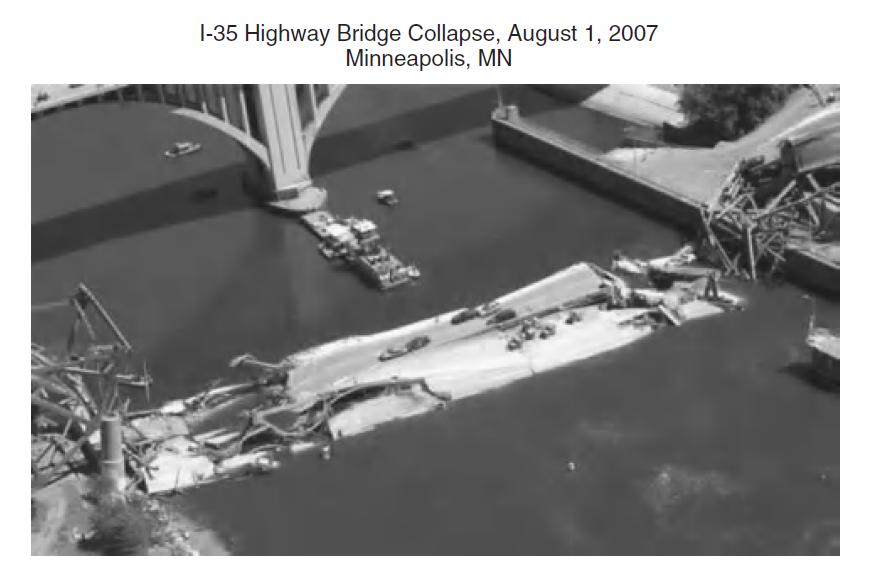
The following statement in italics was contained in the final NTSB Report on the I-35W Bridge Collapse in Minneapolis. What is alarming about this statement, and what should project managers do to address the problems inherent in this statement in their own projects?Moreover, neither Federal nor
Based on the Big Dig tunnel collapse case study, explain the root causes of the failure of quality in this case. Describe the quality assurance and quality control strategy, processes, and procedures you would put in place to prevent future tragedies on highway and tunnel projects?
Explain the root cause of the failure of quality in the Mississippi Bridge Failure case study. Why did the National Transportation Safety Board conclude that, though the bridge had been rated as structurally deficient for 16 years, that rating did not cause or contribute to the accident?
Why are failures of quality control often attributed to project failure, and yet quality success stories like the Big Dig’s Clean Air initiatives, in balance, are not given sufficient consideration?
How would you identify safety critical design and long-term critical failure modes on your project, and what type of procedures would you implement to ensure that these concerns were properly monitored and controlled?
Explain the relationship between project integration and change management by explaining how integration can be used to bring about change.
As described in this chapter, megaprojects have the potential for massive fraud, false claims, kickbacks, bribery, and public corruption. Government agencies, consultants, and contractors should pursue suspected ethics violations aggressively. Assume you have been assigned as the ethics officer for
Why does your reading refer to project integration as the ultimate change management challenge?PROJECT INTEGRATION AND CHANGE MANAGEMENTProject management was developed over many centuries as a means for organizations to manage change. Change management has been written about extensively in the
Explain how integration was exacerbated by the Big Dig’s organizational structure, which separated design from construction through its traditional design-bid-build model. Would it have been better to have a single point of responsibility for both design and construction? Why or why not?
Describe the difference between partnering and public-private partnerships by giving an example of each.
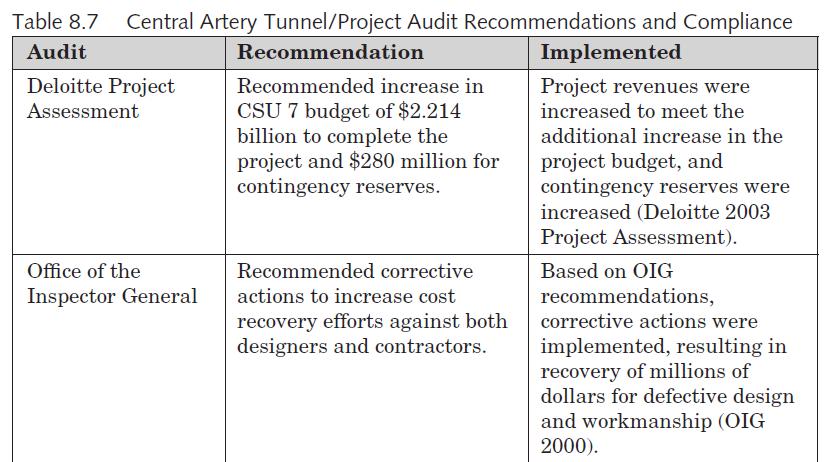
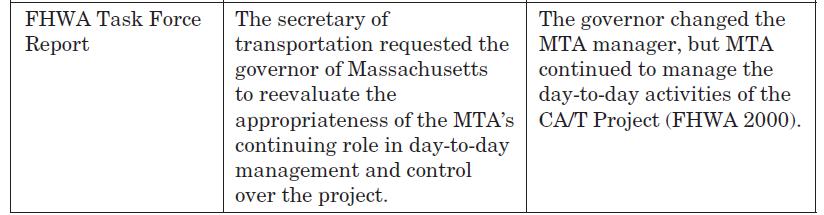
This chapter refers to the use of independent auditors that were external to the project. What are the advantages of independent audits? Describe what you believe should be the role of an independent auditor.Independent AuditsA global accounting and consulting firm was placed on contract to
Review the Big Dig’s Partnering Contractual Provision discussed in this chapter and describe any changes you would make to incentivize the parties to want to use the partnering process more frequently.THE BIG DIG’S PARTNERING CONTRACTUAL PROVISIONThe Owner and the Management Consultant intend
Explain why there was such a large volume of claims and changes on the Big Dig. What were the systemic problems in the project that caused the number of claims to escalate over time? If you were the project manager, what would you have done to control the large number of claims?
How does an audit differ from a performance control system?
What are the benefits of an Oversight Coordination Commission like the one used on the Big Dig? Can you recommend any improvements for structuring the Oversight Coordination Commission?
Assume you discover that one of the barriers to controlling costs on a project is the failure of the project managers to enforce the contract because it was ambiguously written and there is a failure to clearly allocate the responsibility for certain events. Describe the steps you would undertake
This chapter begins with the following quote from the famous Chinese philosopher Lao Tsu: If you do not change direction, you may end up where you are heading.a. What did he mean by this quote, and how is it applicable to project management?b. How will you know when it is time to change direction
Explain the meaning of the following quote by the philosopher Ludwig Wittgenstein. How is it applicable to project change management?We see the world the way we do not because that is the way it is, but because we have these ways of seeing.
To maintain credibility with stakeholders, it is important to always convey the truth about project cost and identify the precision of estimate values. Transparency in estimate communication is sometimes difficult because external stakeholders often want ‘‘one number’’ before an accurate
If you were to prioritize characteristics that are essential for a director of project management for a large infrastructure project, what would be your top three, in order of importance. Explain for each characteristic why you feel it is important for effective leadership.
What are the skills required to manage change in a complex project?
Assess the following problems and describe the most important skill a project manager would need to resolve each of these problems:a. A conflict between a project sponsor and the project’s management consultantb. A change in project goals and mission from a schedule-driven project to a
Do you believe Hall is correct in his assumptions about culture, as described in your reading? If so, what examples can you give that demonstrate high- and low-context cultures? How would context help explain instances of miscommunication between North Americans and Japanese? How could you become a
Explain the difference between a project manager and a leader by analyzing each of the following scenarios from the perspective of the manager and the leader. For example, if a project is running late, the manager might try to find ways to accelerate the schedule or determine the cost of the delay.
Will new leadership be required for the projects of tomorrow described in this chapter? If so, what skills do you see as essential for the innovative projects of our future? How will we manage projects in cyberspace, if we have difficulty managing projects within our present physical space? Will
Showing 6000 - 6100
of 6087
First
47
48
49
50
51
52
53
54
55
56
57
58
59
60
61
Step by Step Answers

 Get 50% OFF
Claim Now
Get 50% OFF
Claim Now