New Semester
Started
Get
50% OFF
Study Help!
--h --m --s
Claim Now
Question Answers
Textbooks
Find textbooks, questions and answers
Oops, something went wrong!
Change your search query and then try again
S
Books
FREE
Study Help
Expert Questions
Accounting
General Management
Mathematics
Finance
Organizational Behaviour
Law
Physics
Operating System
Management Leadership
Sociology
Programming
Marketing
Database
Computer Network
Economics
Textbooks Solutions
Accounting
Managerial Accounting
Management Leadership
Cost Accounting
Statistics
Business Law
Corporate Finance
Finance
Economics
Auditing
Tutors
Online Tutors
Find a Tutor
Hire a Tutor
Become a Tutor
AI Tutor
AI Study Planner
NEW
Sell Books
Search
Search
Sign In
Register
study help
business
nonparametric statistical inference
An Introduction To Multivariate Statistical Analysis 3rd Edition Theodore W. Anderson - Solutions
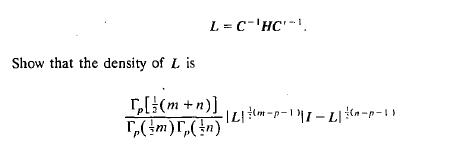
8.20. (Sec. 8.6) The multivariate beta density. Let Hand G be independently distributed according to WO:, m) and WC~:, n), respectively. Let C be a matrL\such that CC' = H + G, and letfor Land [- L positive definite, and 0 otherwise. Show that the density of Lis L=CHC [[(m + n)] (m) (n) -
8.19. (Sec. 8.6.5) Prove for Ii ~ 0, i = 1, ... , p, P I· P P L 1 ~ I :;:; log n (I + Ii):;:; L Ii'i= 1 ' 1= I ;= I Comment: The inequalities imply an ordering of the value, of the Bartlett-Nanda-Pillai trace, the negative logarithm of the likelihood ratio criterion, and the Lawley-Hotelling trace.
8.18. (Sec. 8.5) In casep = 3, ql = 4, and n = N - q = 20, find the 50'7
8.17. (Sec. 8.5) Usc the asymptotic expansion of the distribution to compute Prf-k logU3•3•n :$;M*} for(a) n = 8, M* = 14.7,(b) n = 8, M* = 21.7,(c) n = 16, M* = 14.7,(d) n = 16, M* = 21.7.(Either compute to the third decimal place or use the expansion to the k-4 term.)
8.16. (Sec. 8.4)(a) Show that when p is even, the characteristic function of Y= log Up•m•n , say
8.15. (Sec. 8.4) For p :$; m find ooEUh from the density of G and H. [Hint: Use the fact that the density of K+L:~lViVi' is W(I,s+t} if the density of K is WeI,s) and V], ... ,V; are independently distributed as NCO, I).]
8.14. (Sec. 8.4) Find PrfU4•4•n ~ u}.
8.13. (Sec. 8.4) Find Pr{U4.3.n ~ u}.
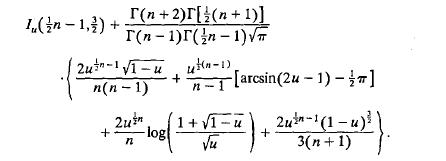
8.12. (Sec. 8.4) Show that the cdf of U3•3•n is[Hint: Use Theorem 8.4.4. The region {O:$; ZI :$; 1,0 :$; Z2 :$; 1, ZfZ2 :$; u} is the union of fO :$;ZI:$; 1,0 :$;Z2:$; u} and fO :$;Zl:$; u/z2, u :$;Z2:$; I}.] (n-1) + (n+2)[(n+1)] T(n-1)(n-1) 24-(n-1), n(n-1) n -[arcsin(2u 1 ) ; -log n Vu +2
8.11. (Sec. 8.4) Prove Lemma 8.4.1 by showing that the density of PIll and P2w is - - K exp[-tr(B2 -B2) A22 (B20 B)']. -
8.10. (Sec. 8.4) By comparing Theorem 8.2.2 and Problem 8.9, prove Lemma 8.4.1.
8.9. (Sec. 8.3) Prove 10 = (124) (z(!). a - = (C-C2AA21)(A1-A2422421):
8.8. (Sec. 8.3) Let ql = qz· How do you test the hypothesis PI = P2?
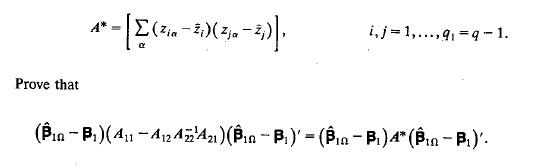
8.7. (Sec. 8.3) Let Zq" = 1, let qz = 1, and let A* i,j=1,..., 9-9-1. Prove that (in - B)(4u - AzA2'42)(Bin - B) = (Bin - Bi)" (Bin - B).
8.6. (Sec. 8.3) Let q = 2, ZI" = w" (scalar), zz" = 1. Show that the U-statistic for testing the hypothesis PI = 0 is a monotonic function of a T2-statistic, and give the TZ-statistic in a simple form. (See Problem 5.1.)
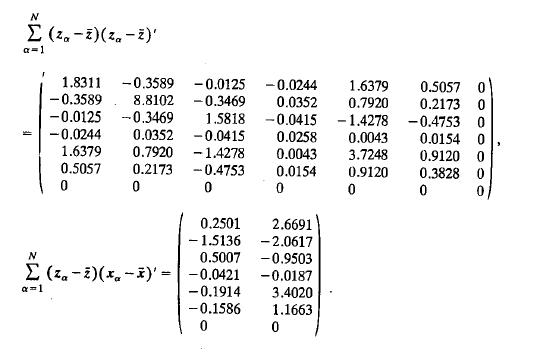
8.5. (Sec. 8.3) In the following data [Woltz, Reid, and Colwell (1948), used by R. L. Anderson and Bancroft (1952») the variables are Xl' rate of cigarette bum;xc' the percentage of nicotine; ZI' the percentage of nitrogen; z2' of chlorine;Z), of potassium; Z4' of phosphorus; Z5, of calcium; and
8.~. (Sec. 8.2) Show that ~ minimizes the generalized variance I r. (X"'''~Z'')(X''-~Z,,)'I·(1'=1
8.3. (Sec. 8.2) Prove Theorem 8.2.3.
8.2. (Sec. 8.2) Show that Theorem 3.2.1 is a special case of Theorem 8.2.1.[Hint: Let q = 1, Zo = 1, ~ = JL.)
8.1. (Sec. 8.2.2) Consider the following sample (for N = 8):Let Z20 = 1, and let Zlo be the amount of fertilizer on the ath plot. Estimate P for this sample. Test the hypothesis ~I = 0 at ('Ie 0.01 significance level. Weight of grain 40 17 Weight of straw 53 19 Amount of fertilizer 24 11 906 10 5
7.37. (Sec. 7.5) Show that if X~-I and X~-z are independently distributed, then x~· I X~ z is distrihuted ~s (:d'l ,l" /4. [Hint: In the joint density of x = X~-I and y = x.~ _ z substitute z = 2/;;, x = x, and CXPI ess the marginal density of z as z'\" .1h(Z)' where h(z) is an integral with
7.36. (Sec. 7.2) Dirichlet distribution. Let YI , •.• , Y,n be independently distributed as,\'~-variables with Pi' ... ' Pm degrees of freedom, respectively. Define Z; =YjL7~1}j, i = [, ... ,m. Show that the density of ZI"",Zm_1 isfor Zi ~ 0, i = 1, .... m. (P) (P) m-1 i-1
7.35. Let the density of Y he I(y) = K for y' y 5, P + 2 and 0 elsewhere. Prove that K = r
7.34. (Sec. 7.8) Verify (II).
7.33. (Sec. 7.R) Prove L,/I.,G) is a multiple of (g_(J"Yct>-I(g-U). Hint: Transform so ~ = I. Then show= .~(2I 0) tI 0 I'
7.32. (Sec. 7.8) Prove LiI., G) and LI(I., G) are invariant with respect to transformations G* = CGe', I.* = CI.C' for C nonsingular.
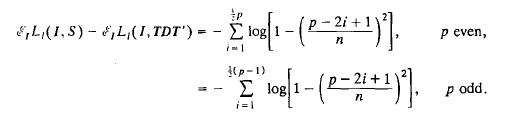
7.31. (Sec. 7.8) Prove for optimal D L(IS) L(I,TDT') = = - =- P -1-(0-2+1)] log (p-1) 108 - (P-21+1)]. i=1 n p even, p odd.
7.30. (Sec. 7.8) Verify (17) and (18). [Hillt: To verify (18) let I = [([(', A"' [(A*[(', and A* = T* T*, where K and T* are lower triangular.]
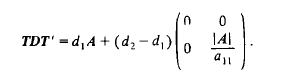
7.29. (Sec. 7.8) Prove for p = 2 TDT d,A+(d-d) |A| all
7.28. (Sec. 7.8) Prove that Fe is not proportional to f by calculating FE.
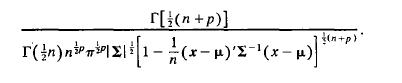
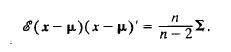
7.27. (Sec. 7.7) Multivariate t-distributioll. Let y and u be independently distributed according to N(O, I) and the x;-distribution, respectively, and let .;nTri y = xJ.l..(a) Show that the density of x is(b) Show that Gx = J.l. and [(n+p)] ()''(x p)]` (n+p)*
7.26. (Sec. 7.6) Show that when I is diagonal the set 'ij are pairwise independent.
1.25. (Sec. 7.6) Show that when p = 3 and I is diagonal '12' '13' '23 are not mutually independent.
1.24. (Sec. 7.6) Reverse the steps in Problem 7.20 to derive (9) of Section 7.6.
r.23. (Sec. 7.6) Prove the conclusion of Problem 7.20 by using Problems 7.21 and 7.22.
'.22. (Sec. 7.6) Prove (without the use of Problems 7.19 and 7.20) that if I = I. then the set 'II', ... ,',,-I,p is independent of the set 'ji'p' i,j = l. .... p _. I. [Hillt:From Section 4.3.2 app' and (u jp ) arc independent of (u'i'pl. Prow thaI app,(aj), and a jj, i=l,oo.,p-l, are independent
.21. (Sec. 7.6) Prove (without the use of Problem 7.20) that if I = I, then'Ip"'" 'p-l, P are independently distributed. [Hint: 'jp = ajp/(,;a;; ,;a;;). Prove that the pairs (alp' all)' ... ,(ap-l,p, ap-l. p _ l ) are independent when(Zip"", z"p) are fixed, and note from Section 4.2.1 that the
7.20. (Sec. 7.6) Prove that the joint density of '12·3 ..... p"13.4 •..• p"2J.4 .... ,p' ... ,'Ip"""p-I.p is r{ Un - (p - 2)]} (1- 2 )±In-
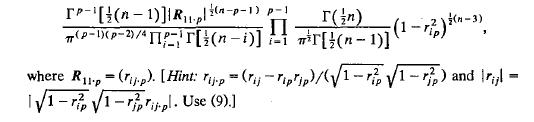
7.19. (Sec. 7.6) Prove that if I. = 1, the joint density of 'ij.p' i, j = 1, ... , P - 1, and'Ip"""p-I,p is [(n-1)]R (p-1) p-1 (P-1)(p-2)/[(n-i)] - where R11p (p). [Hint: Tip=(rij 1. Use (9).] (in) I (1-7) (-3) [(n-1)] p)/(1-1-) and Irl-
7.1S. (Sec. 7.5) Consider the confidence region for .... given bywhere i and S are based on a sample of N from N( .... , I.). Find the expected value of the volume of the confidence region. N(*)'S() -N-P (N-1)PFp, N-(E),
7.17. (Sec.7.5) Find tS'IAlh directly from W(I.,n). [Hint: The fact that jw(AII.,n)dA == 1 showsas an identity in n.] 14-exp(tr)=2(n)
7.16. (Sec. 7.4) Verify that Theorem 7.4.1 follows from Lemma 7.4.1. [Hint: Prove that Qj having the distribution W(I.,,) implies the existence of (6) where 1 is of order 'j and that the independence of the Q;'s implies that the I's in (6) do not overlap.]
7.15. (Sec. 7.4) Show that tC ( XN2- I XN2-2) " = tC (X22 N.,4/4 )" , h ~O, by use of the duplication formula for the gamma function; X~ _I and X~- 2 are independent. Hence show that the distribution of X~- J X~-2 is the distribution of xlN-4/4.
7.14. (Sec. 7.4) Let Xu be an obseIVation from NCJ3z,,, I), a = I, ... , N, where za is a seal,,£. Let b = LaZaXa/LaZ';. Use Theorem 7.4.1 to show that [axax~bb'["z,; and bb' are independent.
7.13. (Sec. 7.3) Let ZI' ... ' Z" be independently distributed, each according to N(O, I). Let W = [:. Il- I ball Za Z~. Prove that if a' Wa = X~ for all a such that a' a = 1, then W is distributed according to W{/, m). [Hint: Use the characteristic function of a'Wa.]
7.12. (Sec. 7.3.1) Find the first two moments of the elements of A by differentiating the characteristic function (11).
7.11. (Sec. 7.3.2) Prove Theorem 7.3.2 by use of characteristic functions.
7.10. (Sec. 7.3) Find the characteristic function of A from WeI, n). [Hint: From[w(AI I, n) dA = as an identity in ~.] Note that comparison of this result with that of Section 7.3.1 is a proof of the Wishart distribution. 14(p-1) exp(-tr A) dA 2PT(n) -
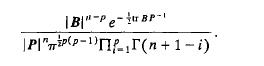
7.9. (Sec. 7.2) The complex Wishart distribution. Let WI' ... ' w" be independently distributed, each according to the complex normal distribution with mean 0 and covariance matrix P. (See Problem 2.64.) Show that the density of B =[:_1 Wa Wa* is |B|"Peu BP-1 PI-(n+1-i)
7.S. (Sec. 7.2) Independence of estimators of the parameters of the complex normal distribution. Let ZI' ... ' z,v be N obseIVations from the complex normal distribution with mean IJ and covariance matrix P. (See Problem 2.64.) Show that Z and A = Z~_I(Za - Z)(Za - Z)* are independently
7.7. (Sec. 7.2) Use the proof of Theorem 7.2.1 to demonstrate Pr{IAI = O} = O.
7.6. (Sec. 7.2) Use (9) of Section 7.6 to derive the distribution of A.
7.5. (Sec. 7.2) X2-distribution. Use Problem 7.4 to show that if Yl'"'' Yn are independe?tly dist.ribut~d, each according to N(O, 1), then U = r.:= 1 Y; has the density U,"-Ie- ,Uj[2,nntn)], which is the x2-density with n degrees of freedom.
7.4. (Sec. 7.2) Use Problems 7.1, 7.2, and 7.3 to prove that if the density of y' =yp".,y,,) is f(y'y), then the density of u = y'y is ~C(n)f(u)ul"-I.
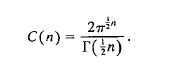
7.3. (Sec. 7.2) Use Problems 7.1 and 7.2 to prove that the swface area of a sphere of unit radius in n dimensions is C(n) = 2 (n)
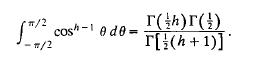
7.2. (Sec. 7.2) Prove that[Hint: Let cos2 (I = u, and use the definition of B(p, q).] S cosh-ede- -/2 r(h)r() T[(h+1)]
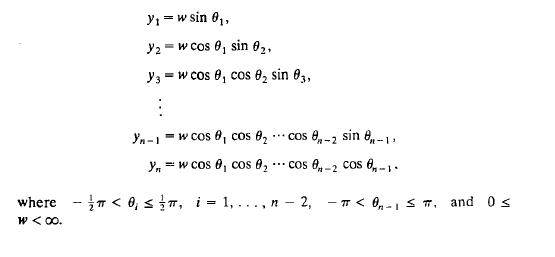
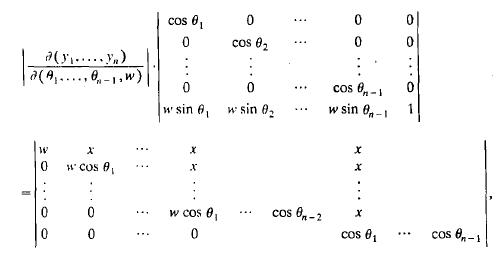
7.1. (Sec. 7.2) A transfonnation from rectangular to polar coordinates is(a) Prove w 2 = r.y~. [Hint: Compute in turn Y; + Y;_I'(Y;+Y;_I) +Y;-2' and so forth.](b) Show that the Jacobian is w" -I cos"-2 /II cos" -3 /12 .. , cos /I" -2' [Hint: Provewhere x denotes elements whose explicit values are
6.20. (Sec. 6.5) Verify (33).
6.19. (Sec. 6.8) Let x\j), ... ,x~) be observations from NCJL(i),I.), i= 1,2,3, and let x be an observation to b~ classified. Give explicitly the maximum likelihood rule.
6.18. (Sec. 6.10) Show that b' x = c is the equation of a plane that is tangent to an ellipsoid of constant density of 7T, and to an ellipsoid of constant density of 7T2 at a common point.
6.17. (Sec. 6.8) In Section 8.8 data are given on samples from four populations of skulls. Consider the first two measurements and the first three sample>.Construct the classification functions uij(x), Find the procedure for qi =Nj( N, + Nz + N,). Find the minimax procedure.
6.16. (Sec. 6.8) Let 7Ti be N(fL(i),l:), i = L ... , m. If the fL(i) arc on a line (i.e ..fLU) = fL + v i l3), show that for admissible procedures the Ri are defined by parallel planes. Thus show that only one discriminant function llrk(X) need be used.
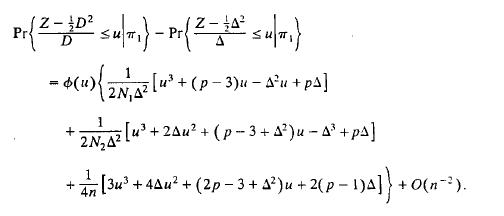
6.15. (Sec. 6.6.2) Show (Z-D Pr{ Z - D su m) - Pr{ Z- su|Ti} - = 0 (u) { 2N [u + ( p 3)u Au + pA] A - - + 2 N [4 + 2 Au + ( p 3 + A )uA+pA] 1 + [34 + 4 Au + (2p 3 + A )u + 2 (p-1 1)A]} + O(n). 4n
6.14. (Sec. 6.6) Show IC D2 is (4). [Hint: Let l: = I and show that IC(S -11:l = I) =[n/(n - p - 1)]1.]
6.13. (Sec. 6.6) Show that the derivative of (2) to terms of order 11- I is p- -(a){+[+- -(){ + [+ 4
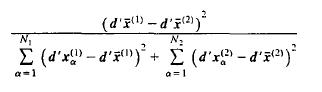
6.12. (Sec. 6.5) Consider d'x(i). Prove that the ratio (d'F()-d'()) N N (d'x)-d'x) + (d'x) d') - a=1 a=1
6.11. (Sec. 6.5) Show that the elements of M are invariant under the transformation(34) and that any function of the sufficient statistics that is invariant is a function of M.
6.10. (Sec. 6.5.1) Show that the probabilities of misclassification of Xl •... ' x'" (all assumed to be from either 7T I or 7T 2) decrease as N increases.
6.9. (Sec. 6.5.1) Let W(x) be the classification criterion given by (2). Show that the T2-criterion for testing N(fL(I), l:) = N(fL(2),l:) is proportional to W(ill,) and W(i(2».
6.S. (Sec. 6.5.1) Find the criterion for classifying irises as Iris selosa or Iris versicolor on the basis of data given in Section 5.3.4. Classify a random sample of 5 Iris virginica in Table 3.4.
6.7. (Sec. 6.4) Let x' = (x(1)', X(2),). Using Problem S.23 and Problem 6.6, prove that the class of classification procedures based on x is uniformly as good as the class of procedures based on x(l).
6.6. (Sec. 6.4) Let P(21!) and POI2) be defined by (14) and (5). Prove if- ~~2 < C < ~~z, then P(21!) and POI2) are decreasing functions of ~.
6.5. (Sec. 6.3) When p(x) = n(xllL, ~) find the best test of IL = 0 against IL = IL*at significance level 8. Show that this test is uniformly most powerful against all alternatives fL = CfL*, C > O. Prove that there is no uniformly most powerful test against fL = fL(!) and fL = fL(2) unless fLO) =
6.4. (Sec. 6.3) The Neymull-Peursoll!ulldumelllullemmu states that of all tests at a given significance level of the null hvpothesis that x is drawn from Pl(X)agaimt alternative that it is drawn from P2(X) the most powerful test has the critical region Pl(x)/pix) < k. Show that the discussion in
6.3. ~Sec. 6.3) Prove that if the class of admissible procedures is complete, it is minimal complete.
6.2. (Sec. 6.3) Prove that every complete class of procedures includes the class of admissible procedures.
6.1. (Sec. 6.3) Let 1Ti be N(IL, I.), i = 1,2. Find the form of the admissible dassification procedures.
5.27. (Sec. 5.2) Prove (25) is the density of V = x;:j( xl + xt). [Hint: In the joint density of U = xl and W = xt make the transformation u = uw(1 - u)-l, w = w and integrate out w.j
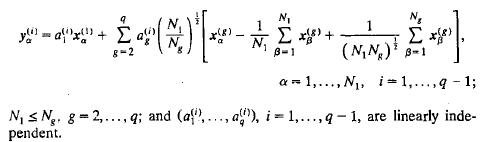
5.26. (Sec. 5.5) Suppose x~g) is an observation from N(jJ.181,::£g). a = 1. .... Ny.g= 1, ... ,q. (a) Show that the hypothesis .... (l) = ... = .... (q) is equivalent to t!y~i) = 0, i = I, ...• q - I, where(b) Show how to construct a T 2-test of the hypothesis using (y(l)', ... , y(q .. )
5.25. Find the distribution of the criterion in the preceding problem under the null hypothesis.
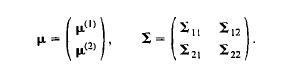
5.24. Let Xli)' = (Yli )', Z(i)'), i = 1,2, where y(i) has p components and Zlil has q components, be distributed according to N(jJ.(i), ::£), whereFind the likelihood ratio criterion (or equivalent T2-criterion) for testing jJ.~1) = jJ., i = 1.~. [Hint:Express the likelihood in terms of the
5.23. (Sec. 5.4) LetProve jJ.'::£ -1jJ. ~ jJ.l l),::£ 111jJ.(I). Give a condition for strict inequality to hold.[Hint: This is the vector analog of Problem 5.21.] --(2) -(%)
5.22. (Sec. 5.3)(a) Using the data of Section 5.3.4, test the hypothesis 1-'-\1) = 1-'-(1 2).(b) Test the hypothesis I-'-V) = I-'-(?).I-'-~) = I-'-S2).
5.21. (Sec. 5.4) Prove that jJ.,::£-IjJ. is larger for jJ.' = (1-'-1,1-'-2) than for jJ. = 1-'-1 by verifyingDiscuss the power of the test 1-'-1 = 0 compared to the power of the test 1-'-1 = 0, 1-'-2 = O. 1 2p- + 1-p (142-0021410) (1-p) 03
5.20. (Sec. 5.3) Let x~) be observations from N(jJ.(i), ::£,), a = 1, ... , Ni• i = 1.2. Find the likelihood ratio criterion for testing the hy')othesis jJ.(l} = jJ.(2).
5.19. (Sec. 5.3) Let x and S be based on N observations from N(fl., ::£), and let x be an additional observation from N(fl., ::£). Show that x - x is distributed according to N[0,(1+1IN)::£].Verify that [N I(N + l)](x - X)'S-I(X - x) has the T2-distribution with N - 1 degrees of freedom. Show
5.18. (Sec. 5.6.2) Prove that if the set A is convex, then the closure of A is convex.
5.17. (Sec. 5.6.2) Show that z'B-1z is a convex function of (z,B), where B is a positive definite matrix. [Hint: Use Problem 5.16.]
5.16. (Sec. 5.6.2) Let get) = f[lyl + (1 - t)Y2]' where fey) is a real.yalued functiun of the vector y. Prove that if get) is convex, then fey) is convex.
5.15. (Sec. 5.6.2) T 2-test as a Bayes procedure [Kiefer and Schwartz (1965)]. Let XI' ... , X N be independently distributed, each according to N( fl., I). Let TI 0 be defined by [fl.,::£] = [0,([ + TJTJ')-I] with TJ having a density proportional to II+TJTJ'I-~N, and let TIl be defined by
5.14. (Sec. 5.5) Use the data of Problem 4.41 to test the hypothesis that the mean head length and breadth of first sons are equal to those of ~econd sons at significance level 0.01.
5.13. (Sec. 5.3) Prove the statement in Section 5.3.6 that the T2-statistic is independent of the choice of C.
5.12. (Sec. 5.3) Using the data in Section 3.2, give a confidence region for fl. with confidence coefficient 0.95.
5.11. (Sec. 5.3) Use the data in Section 3.2 to test the hypothesis that neither drug has a soporific effect at significance level 0.01.
5.10. (Sec. 5.2.2) From Problems 5.5-5.9, verify Corollary 5.2.1.
5.9. (Sec.5.2.2) Verify that r=s/(1-s) multiplied by (N -0/1 has the noncentral F-distribution with 1 and N - 1 degrees of freedom and noncentrality parameter NT 2.
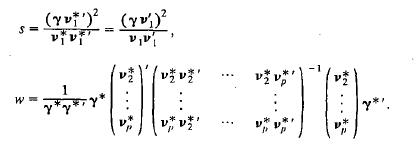
5.S. (Sec. 5.2.2) Prove that w has the distribution of the square of a multiple correlation between one vector and p - I vcctors in (N - O-space without subtracting means; that is, it has densityHint: The transformation o~ Problem 5.7 is a projection of v 2 , •.. , v p , Y on the (N -I)-space
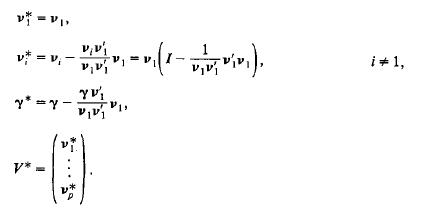
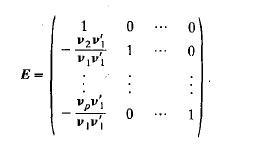
,5.7. (Sec. 5.2.2) LetProve that U = s + (1 - s)w, whereHint: EV,= V*, where = v=v; -3-(-) * P i 1,
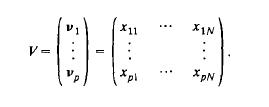
5.6. (Sec. 5.2.2) Let U = [T 2/(N - Dl![l + T 2/(N - 0]. Show that U ='YV'(W,)-IV'Y', where 'Y = (1/ {N, ... , 1/ {N) and Ndx XIN V= 1-(0)-
5.5. (Sec. 5.2.2) Let T 2=Ni'S-li, where i and S are the mean vector and covariance matrix of a sample of N from N(fL, l:). Show that T2 is distributed the same when fL is repla
Showing 2900 - 3000
of 5397
First
23
24
25
26
27
28
29
30
31
32
33
34
35
36
37
Last
Step by Step Answers

 Get 50% OFF
Claim Now
Get 50% OFF
Claim Now