New Semester
Started
Get
50% OFF
Study Help!
--h --m --s
Claim Now
Question Answers
Textbooks
Find textbooks, questions and answers
Oops, something went wrong!
Change your search query and then try again
S
Books
FREE
Study Help
Expert Questions
Accounting
General Management
Mathematics
Finance
Organizational Behaviour
Law
Physics
Operating System
Management Leadership
Sociology
Programming
Marketing
Database
Computer Network
Economics
Textbooks Solutions
Accounting
Managerial Accounting
Management Leadership
Cost Accounting
Statistics
Business Law
Corporate Finance
Finance
Economics
Auditing
Tutors
Online Tutors
Find a Tutor
Hire a Tutor
Become a Tutor
AI Tutor
AI Study Planner
NEW
Sell Books
Search
Search
Sign In
Register
study help
business
organization development
Practicing Organization Development Leading Transformation And Change 4th Edition William J Rothwell, Jacqueline M Stavros - Solutions
What are the client organization's values as reflected in a particular country's culture? Are they compatible with my OD values?
What is the nature of the political system?
What is the appropriate OD process? What interventions are appropriate and what needs to be modified?
In what ways are HRM and OD different?
In what ways are HRM and OD similar?
What is the justification for believing that HRM and OD are converging?
Do you have a clear idea of what your power bases are—operating either as an internal or an external OD practitioner? Name them.
How deliberate have you been in channeling your power bases into power strategies to accomplish what you set out to do for the client system? Share a story.
In your diagnostic work, how often do you diagnose the power terrain of the client system?Once you have the data, what do you use them for in your change work?
As an interventionist, how conscious and intentional have you been in designing interventions that will minimize the power differential and encouraging cross-rank and cross-border collaboration? Recall cases so you can teach others.
On a continuum of 0 to 10, where 0 means you never deliberately use power and politics to support change work and 10 means you deliberately use power and politics all the time in change work, where would you position yourself? What action steps would you take to climb a notch or two on the
If you gave a short introductory workshop for OD novices on power and politics, what key points would you include in your workshop outline?
Network connections are generally trust-based; hierarchical connections are generally authority-based. How would you use this framework to construct a research design for the study of heterarchies?
Can you identify historical geopolitical conflicts and deconstruct their outcome in terms of heterarchical governance or the lack thereof?
What industries are most likely to organize themselves as heterarchies and why?
Have you observed heterarchical structure in your own work or research? If so, can you describe specific examples of the management or mismanagement of heterarchy?
How can the concept of heterarchy provide insight and new directions for OD practitioners?
What aspects of the Dialogic Mindset are consistent with or contrast with your current ways of thinking about organizations and change?
When might it be more, or less, appropriate to use Dialogic OD methods? Or, perhaps to combine Dialogic with Diagnostic OD approaches?
Based on reading this chapter, what ideas would you like to learn more about? How might you do that?
Where are you on the humanistic versus organizational effectiveness values continuum?
How strong are your measurement and data analytic skills? Do you understand linkage research and how to connect information across different levels of analysis?
How would you design an individual feedback framework for assessment and development? What tools would you select and why?
How would you describe your approach to coaching? What types of coaching engagements do you prefer and why?
Which professional associations and conferences are you engaged in and why? How many are focused on OD versus content or practice domain specific?
Discuss each of the items in the chapter by commenting on what the author has said and then adding any additional insights.
Take time to review what chapters in the book can best help you address the issues, challenges, and suggested learning to be a most effective OD practitioner.
What are transformation and change management (CM) key components of organization development (OD)?
What organizational functions are impacted by OD?
What is systems thinking, and why is it important to OD?
What did each of these four contribute to the development of the field of OD: Taylor, Lewin, Bion, and McGregor? How much of what they “discovered” is still in use today by OD practitioners?
How did “group development” expand to become “organization development”? What was the role of the T-group in that evolution?
What stands out for you as you study Alban's OD Timeline? What are some examples of how what was happening in the larger world contributed the context and/or the stimulus for something that happened in the evolution of OD?
What criticisms might you expect to hear from operating managers about the traditional action research model, and how might you answer them?
Why is Appreciative Inquiry often regarded as a revolutionary approach to change?
How are Burke's pre-launch, launch, and post-launch unique and different from other approaches to change?
What is the difference between incremental and transformational change?
How does action research compare to Appreciative Inquiry?
What types of change are you consulting on? Are any of these changes transformational?
How well do your clients understand the unique requirements of transformational change and how to lead them?
How could you get better positioned to consult on large-scale change efforts from their launch, especially those that are transformational?
What large-system change methodologies do you or can you use? How well do they address the requirements of transformational change?
How well are you positioned to provide executive coaching to leaders who aspire to lead their change efforts in conscious ways?
How can transformational leadership help transform organizations?
What OD competencies help to strengthen a transformational leader?
Do your personal values, vision, and mission align with your organization's values, vision, and mission? If so, how and why? If not, what can be done?
How can you as a transformational leader stay aware of internal and external factors of your organization and its environment before and during an organization's transformation?
Take a negative situation; using the AI philosophy and principles, how would you reframe the situation into a positive situation—something that you wish to learn about and have more of?
How are you seeing the three circles of the strengths revolution affecting the field of OD today? How are you working to lift up, magnify, and refract strengths in yourself and others through your work?
Reflect on how you might experiment with the impact of inquiry—how much do you track the impacts of different types of questions you ask? How does a deficit-based question lead to a different dialogue than an appreciative question?
How can you integrate the principles of AI with other OD methodologies to experiment with new approaches for creating positive organizational change?
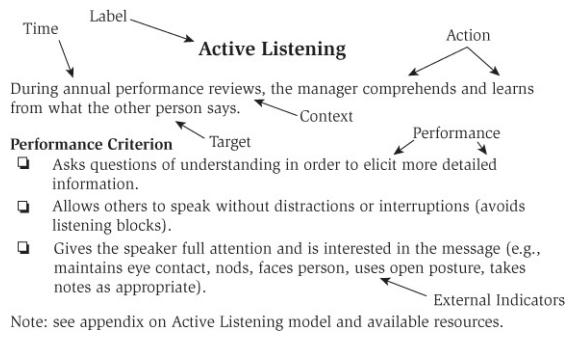
Pick a particular set of jobs (OD professionals) or roles (leadership). Create a competency framework utilizing the competency development model: domains to subdomains to the competency statement.
Identify existing competencies and use the model prescribed in Figure 7.1 Example of Competency Statement within a Conceptual Framework to assess how well the competency meets the specificity requirements.Figure 7.1 Label. Time Action Active Listening During annual performance reviews, the manager
What are the benefits of developing validated OD competencies? What are the challenges to creating a competency framework for the field of OD?
What role can OD practitioners play in developing and implementing competency approaches in organizations?
Do you find market needs changing for your expertise?
Are you periodically asking if your passions are changing?
Are you spending time on ideal or less-than-ideal buyers?
Are you meeting an average of two ideal buyers weekly?
What book topics would find appeal among your ideal buyers?
What events can you host that will attract buyers/recommenders?
What have you found most challenging during front-end work?
What are your best practices for the front-end outcomes?
What have you found most critical in how your use of self shows up during this front-end work?
Where do you see opportunities for improving current practices?
Where do you see similarities or differences in opportunities and challenges for internal and external OD practitioners?
Why is the launch phase of assessing, action planning, and implementation so important in the OD process?
What are some of the philosophical issues that should be considered between the change agent and the client before engaging in the launch phase of OD, and why are these issues important to the change process?
What are examples of how significant changes and decisions have been made by top level leaders without first assessing reality and listening to those closest to the issues involved?
What are important advantages and disadvantages of using various assessment methods?
What would you put on your checklist of criteria to remember in making action planning and implementation successful?
What do you believe are important pitfalls to avoid in the launch phase of OD?
Describe a situation or scenario where you have had to compromise proving or improving, because of time and money limitations? How did you handle that situation, what did you learn, and what would you do differently next time?
What are the benefits to finding effective ways to balance these competing demands? What are some of the risks?
As you look at the 10 evaluation strategies, can you come up with more examples or options that you could utilize? Consider describing low- versus high-rigor strategies for one of the levels. Then describe a blended approach drawing from both.
In a small group, have one person bring an evaluation challenge. Walk through the two question series to identify a strategy, and then discuss the implementation of that strategy.
What benefits result from a co-created, shared definition of change success?
How does the Change Measurement Framework build on earlier efforts to measure the impact of OD and CM activities?
For the CRM example described above, identify measures relevant to the individual adoption and usage outcomes.
Discuss the difficulties you would expect to experience when implementing the Prosci Change Measurement Framework.
What have been your experiences with closing OD engagements?
What is a healthy mindset to have around closure?
How can you incorporate the closing questions to mobilize energy throughout the OD process?
As an OD practitioner, if a client asks you what your values are, what would be your answer? Does it matter?
Do you identify yourself more with Diagnostic OD or Dialogic OD? Why?
Think about a current or recent client and identify in that organization the operator, engineering/design, and executive cultures.
As you think about that client, what are the major occupations of the key managers and employees, what technologies drive the organization, and what occupational cultures are involved?
Has your organization used behavioral coaching in its improvement attempts? Was the effort successful? Why? Why not?
As a member of an organization, at whatever level, consider this statement: “To help others develop, you must start with yourself.” What does this mean for you, your team, or organization?
Think about team(s) you have led or been a part of. How might the Team Building without Time Wasting process have been implemented?
Have you ever been part of a “dysfunctional” team? How did that work out? How about a functional team? What did you find was the biggest difference being dysfunctional or functional made to you, to your team, to the organization?
Why are some teams unable to be as innovative as they would like to be?
Which of the five innovation skills—questioning, observing, networking, experimenting, associative thinking—are most important? How can OD practitioners help teams develop each of these skills?
How can OD practitioners encourage team leaders to be more innovative in their approach to managing their teams? How might the practitioner help the team in general to be more innovative?
In what ways does transformation and change in large systems differ from change in small systems such as leader-subordinate dyads or work teams?
What special knowledge and skills are needed to practice OD in large systems?
OD has traditionally been applied within a particular system. Large system change may require interventions that go beyond the system's boundaries to influence parts of the environment. What are the challenges of moving beyond the system?
It has often been said that large systems cannot rely on outside experts to transform and change them but must build their own change capability within the system. What does this mean for large systems? What does it mean for OD practitioners?
How can SOAR be combined with other change management techniques to bring about transformation within your organization?
How can SOAR be utilized to build strategic capacity within the teams that you work with?
Showing 1200 - 1300
of 1306
1
2
3
4
5
6
7
8
9
10
11
12
13
14
Step by Step Answers

 Get 50% OFF
Claim Now
Get 50% OFF
Claim Now