New Semester
Started
Get
50% OFF
Study Help!
--h --m --s
Claim Now
Question Answers
Textbooks
Find textbooks, questions and answers
Oops, something went wrong!
Change your search query and then try again
S
Books
FREE
Study Help
Expert Questions
Accounting
General Management
Mathematics
Finance
Organizational Behaviour
Law
Physics
Operating System
Management Leadership
Sociology
Programming
Marketing
Database
Computer Network
Economics
Textbooks Solutions
Accounting
Managerial Accounting
Management Leadership
Cost Accounting
Statistics
Business Law
Corporate Finance
Finance
Economics
Auditing
Tutors
Online Tutors
Find a Tutor
Hire a Tutor
Become a Tutor
AI Tutor
AI Study Planner
NEW
Sell Books
Search
Search
Sign In
Register
study help
business
project management
Project Management A Systems Approach To Planning Scheduling And Controlling 8th Edition Harold R. Kerzner - Solutions
11–10 If the scope of effort of a project changes during execution of activities, what should be the role of the functional manager?
11–11 What types of conflicts can occur during the planning cycle, and what modes should be used for their resolution?
11–12 What would be the effectiveness of Figure 11–2 if the work packages were replaced by tasks?
11–13 Under what situations or projects would work planning authorization not be necessary?
11–14 On what types of projects could hedge positions be easily identified on a schedule?
11–15 Can activities 5 and 6 of Figure 11–10 be eliminated? What risks does a project manager incur if these activities are eliminated?
11–16 Where in the planning cycle should responsibility charts be prepared? Can you identify this point in Figure 11–10?
11–17 For each one of the decision points in Figure 11–12, who makes the decision? Who must input information? What is the role of the functional manager and the functional team member? Where are strategic variables identified?
11–18 Consider a project in which all project planning is performed by a group. After all planning is completed, including the program plan and schedules, a project manager is selected. Is there anything wrong with this arrangement? Can it work?
11–19 How do the customer and contractor know if each one completely understands the statement of work, the work breakdown structure, and the program plan?
11–20 Should a good project plan formulate methods for anticipating problems?
11–21 Some project managers schedule staff meetings as the primary means for planning and control. Do you agree with this philosophy?
11–23 Many textbooks on management state that you should plan like you work, by doing one thing at a time. Can this same practice be applied at the project level, or must a project manager plan all activities at once?
11–24 Is it true that project managers set the milestones and functional managers hope they can meet them?
11–25 You have been asked to develop a work breakdown structure for a project. How should you go about accomplishing this? Should the WBS be time-phased, department-phased, division-phased, or some combination?
11–27 Once a project begins, a good project manager will set up checkpoints. How should this be accomplished? Will the duration of the project matter? Can checkpoints be built into a schedule? If so, how should they be identified?
11–28 Detailed schedules (through WBS levels 3, 4, 5, . . .) are prepared by the functional managers. Should these schedules be shown to the customer?
11–32 Once the functional manager and project manager agree on a project schedule, who is responsible for getting the work performed? Who is accountable for getting the work performed?Why the difference, if any?
11–37 Planning is often described as establishing, budgeting, scheduling, and resource allocation.Identify these four elements in Figure 11–1.
11–41 “Expecting trouble.” Good project managers know what type of trouble can occur at the various stages in the development of a project. The activities in the numbered list below indicate the various stages of a project. The lettered list that follows identifies major problems. For each
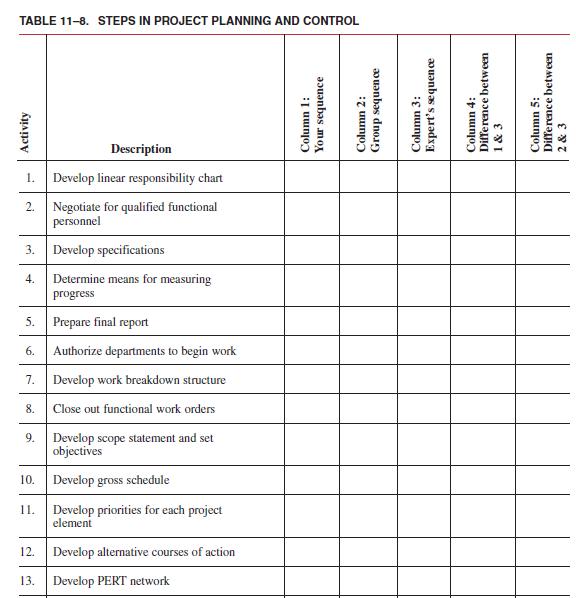
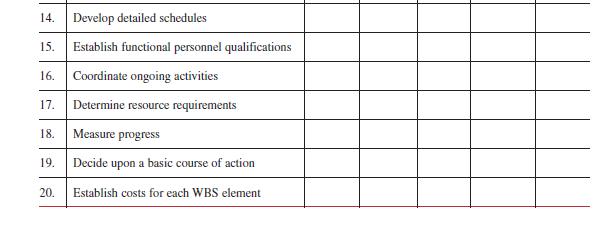
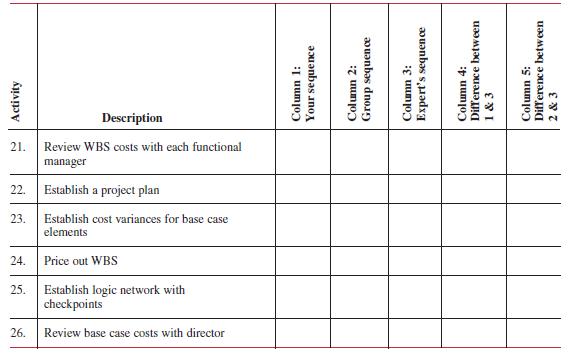
11–42 Table 11–8 identifies twenty-six steps in project planning and control. Below is a description of each of the twenty-six steps. Using this information, fill in columns 1 and 2 (column 2 is a group response). After your instructor provides you with column 3, fill in the remainder of the
11–43 Consider the work breakdown structure shown in Figure 11–18. Can the project be managed from this one sheet of paper assuming that, at the end of each month, the project manager also receives a cost and percent-complete summary?
12–1 Should a PERT/CPM network become a means of understanding reports and schedules, or should it be vice versa?
12–3 Who prepares the PERT diagrams? Who is responsible for their integration?
12–4 Should PERT networks follow the work breakdown structure?
12–5 How can a PERT network be used to increase functional ability to relate to the total program?
12–6 What problems are associated with applying PERT to small programs?
12–7 Should PERT network design be dependent on the number of elements in the work breakdown structure?
12–8 Can bar charts and PERT diagrams be used to smooth out departmental manpower requirements?
12–9 Should key milestones be established at points where trade-offs are most likely to occur?
12–10 Would you agree or disagree that the cost of accelerating a project rises exponentially, especially as the project nears completion?
12–11 What are the major difficulties with PERT, and how can they be overcome?
12–12 Is PERT/cost designed to identify critical schedule slippages and cost overruns early enough that corrective action can be taken?
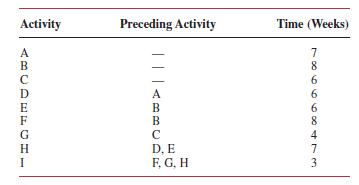
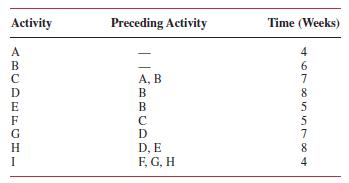
12–13 Draw the network and identify the critical path. Also calculate the earliest–latest starting and finishing times for each activity: Activity Preceding Activity Time (Weeks) D ABCDE |ABBC F G H I D. E F, G, H 7 8 6 6 6 8 4473
12–14 Draw the network and identify the critical path. Also calculate the earliest–latest starting and finishing times for each activity: Activity Preceding Activity Time (Weeks) A C B A, B D B E B F C G D H D, E F, G, H 46985578-
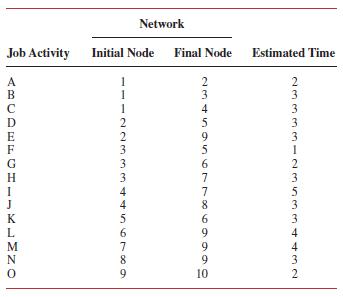
12–16 Consider the following network for a small MIS project (all times are in days; network proceeds from node 1 to node 10):a. Identify the critical path.b. Calculate the total network slack time.c. Suppose that activities A, B, and C all utilize the same manpower base, and shortening any one
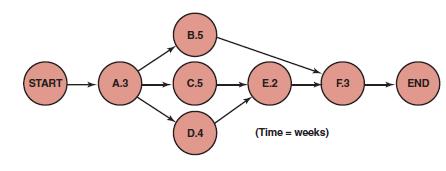
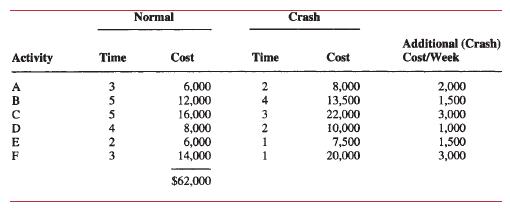
12–17 On May 1, Arnie Watson sent a memo to his boss, the director of project management, stating that the MX project would require thirteen weeks for completion according to the figure shown below.Arnie realized that the customer wanted the job completed in less time. After discussions with the
12–19 Can PERT charts have more depth than the WBS?
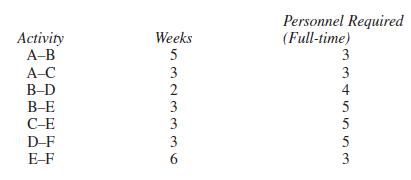
12–21 Scheduling departmental manpower for a project is a very difficult task, even if slack time is available. Many managers would prefer to supply manpower at a constant rate rather than continually shuffle people in and out of a project.a. Using the information shown below, construct the PERT
12–22 How does a manager decide whether the work breakdown structure should be based on a “tree” diagram or the PERT diagram?
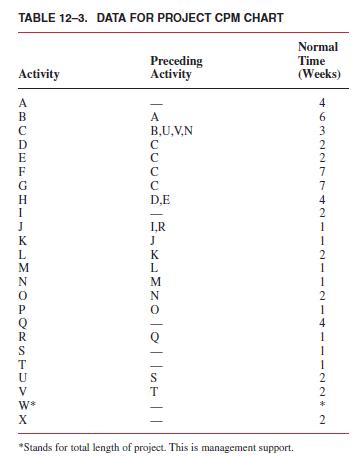
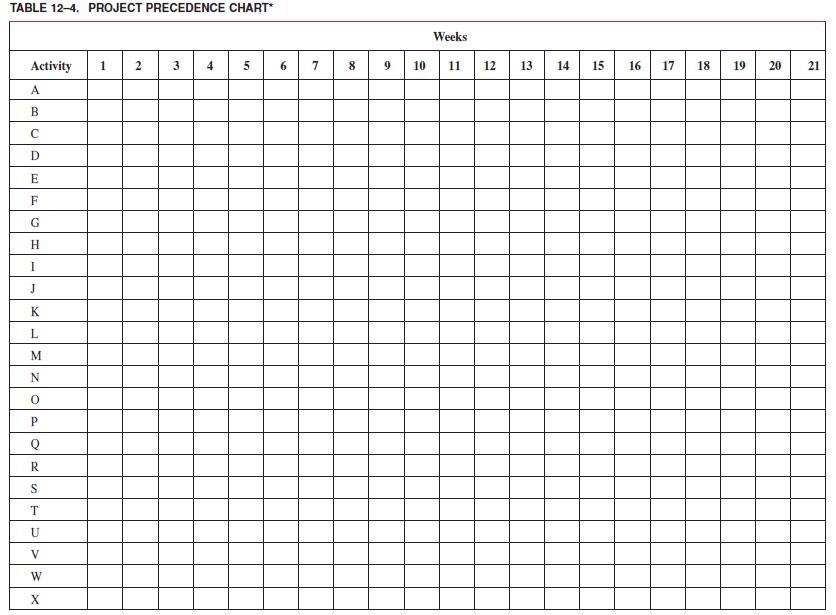
12–23 Using Table 12–3, draw the CPM chart for the project. In this case, make all identifications on the arrows (activities) rather than the events. Show that the critical path is twentyone weeks.Using Table 12–4, draw the precedence chart for the project, showing interrelationships.Try to
14–1 How does a project manager price out a job in which the specifications are not prepared until the job is half over?
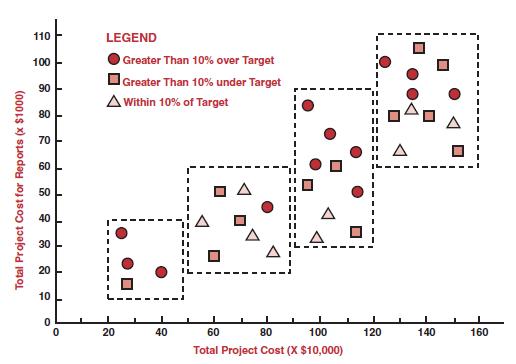
14–4 Can Figure 14–20 be used effectively to price out the cost of preparing reports? 110 100 88 90 80 70 Total Project Cost for Reports (x $1000) 60 60 50 40 30 20 10 0 LEGEND Greater Than 10% over Target Greater Than 10% under Target A Within 10% of Target 20 40 60 80 100 120 140 160 Total
14–8 Which of the figures presented in this chapter should program management make available to the functional managers? Explain your answer.
14–14 Should the project manager give the final manpower loading curves to the functional managers? If so, at what point in time?
14–16 Should a project manager be appointed in the bidding stage of a project? If so, what authority should he have, and who is responsible for winning the contract?
14–17 Explain how useful each of the following can be during the estimating of project costs:a. Contingency planning and estimatingb. Using historical databases (see Figure 15–11)c. Usefulness of computer estimatingd. Usefulness of performance factors to account for inefficiencies and
15–1 Do cost overruns just happen, or are they caused?
15–4 Under what circumstances would each of the figures in Chapter 13 be applicable for customer reporting? In-house reporting? Reporting to top-level management?
15–5 What impact would there be on BCWS, BCWP, ACWP, and cost and schedule variances as a result of the:a. Early start of an activity on a PERT chart?b. Late start of an activity on a PERT chart?
15–9 What would be the result if all project managers decided to withhold a management reserve?What criteria should be used for determining when a management reserve is necessary?
15–12 How can a country’s inflation rate influence the contractual payment policy?
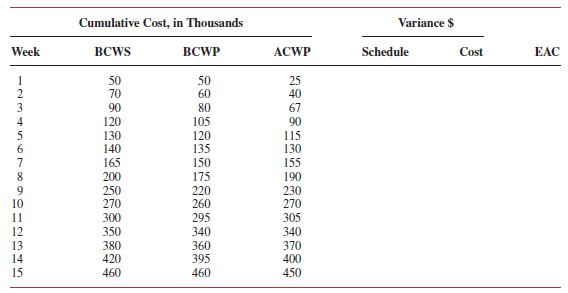
15–15 Complete the table below and plot the EAC as a function of time. What are your conclusions? Cumulative Cost, in Thousands Variance $ Week BCWS BCWP ACWP Schedule Cost EAC 10 11 12 13 14 15 123456789012345 50 70 90 120 130 140 165 200 175 250 220 270 260 300 295 350 340 380 360 420 395 25
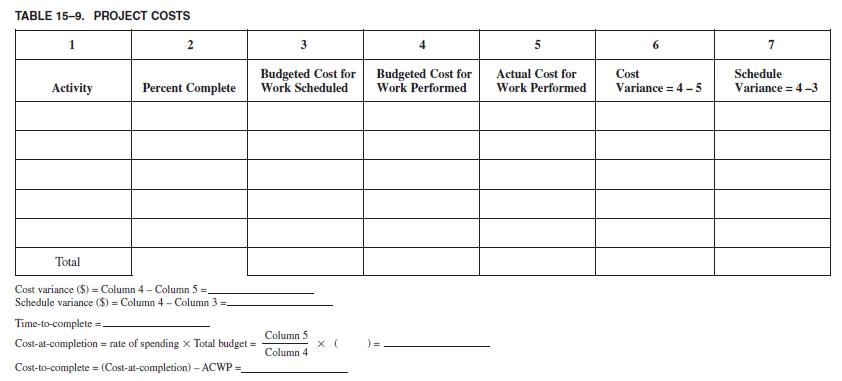
15–16 Using the information in Chapter 12, problem 12–18, complete Table 15–9. TABLE 15-9. PROJECT COSTS 1 2 Activity Percent Complete Budgeted Cost for Work Scheduled Total Cost variance ($) Column 4 - Column 5= = Schedule variance ($) = Column 4 - Column 3 = Time-to-complete Column 5
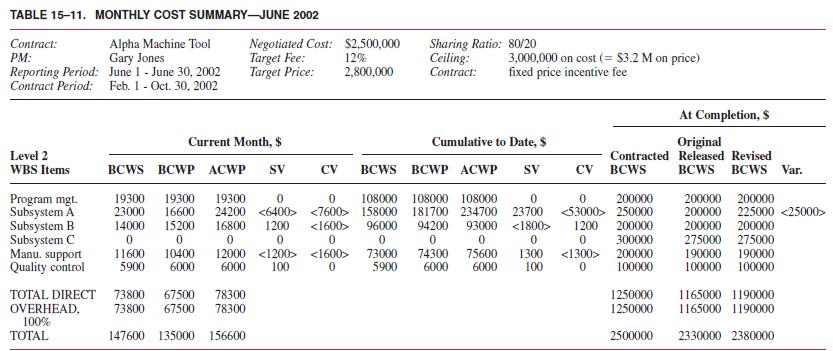
15–18 The Alpha Machine Tool Project Acme Corporation has received a contractual order to build a new tooling machine for Alpha Corporation. The project started several months ago. Table 15–11 is the Monthly Cost Summary for June, 2002. Some of the entries in the table have been purposely
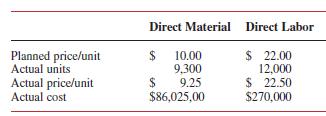
15–19 Calculate the total price variance for direct labor and the labor rate cost variance from the following data: Direct Material Direct Labor Planned price/unit $ 10.00 Actual units 9,300 $ 22.00 12,000 Actual price/unit $ 9.25 $ 22.50 Actual cost $86,025,00 $270,000
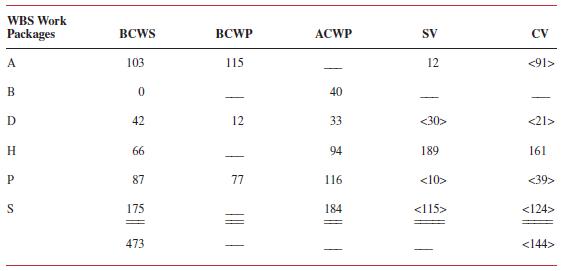
15–20 One of your assistant project managers has given you an earned value report that is only partially complete. Can you fill in the missing information? WBS Work Packages BCWS BCWP ACWP SV A 103 115 12 12 CV B 0 40 - - - D 42 12 33 H 66 94 189 161 P 87 77 116 S 175 184 ===== 473
15–21 The award of the Scott contract on January 3, 1987, left Park Industries elated. The Scott Project, if managed correctly, offered tremendous opportunities for follow-on work over the next several years. Park’s management considered the Scott Project as strategic in nature.The Scott
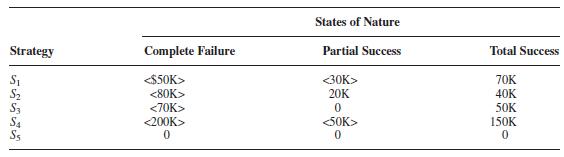
17–2 You have been asked to use the expected-value model to assess the risk in developing a new product. Each strategy requires a different sum of money to be invested and produces a different profit payoff as shown below:8. A More Constructive Test Approach Is Key to Better Weapon System
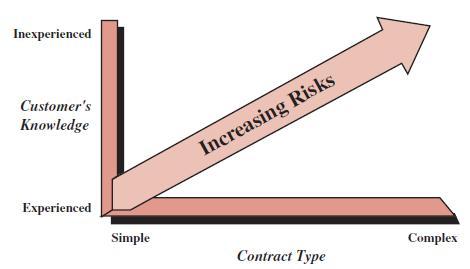
17–5 A telecommunications firm believes that the majority of its income over the next ten years will come from organizations outside of the United States. More specifically, the income will come from third world nations that may have very little understanding or experience in project management.
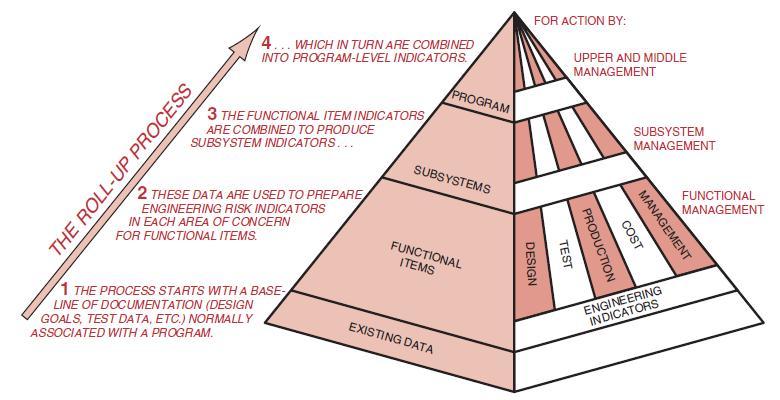
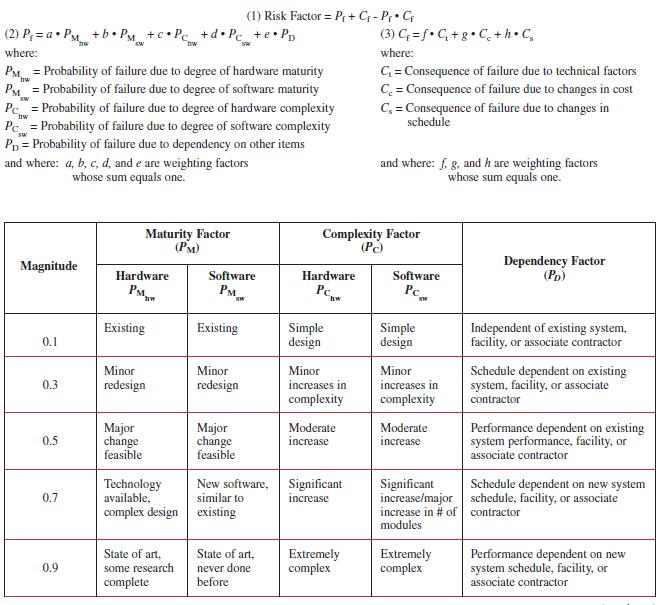
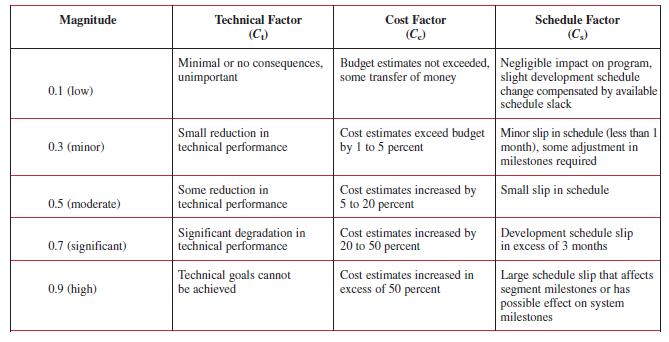
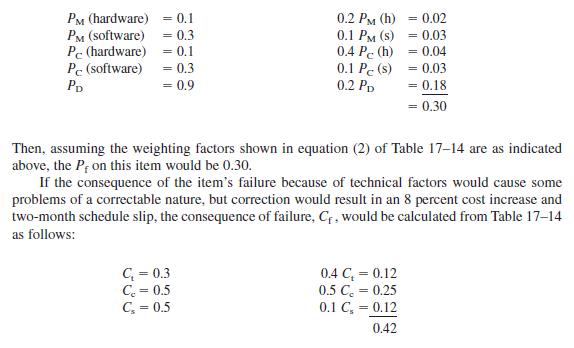
17–8 With the explosion of computer hardware and software during the 1970s and 1980s, companies began developing models to assess the technical risk for the computer hardware and software effort. One such model is discussed in this problem. Although some people contend that there may still exist
17–8 Teloxy Engineering has received a onetime contract to design and build 10,000 units of a new product. During the proposal process, management felt that the new product could be designed and manufactured at a low cost. One of the ingredients necessary to build the product was a small
17–8 Your manufacturing team informs you that they have found a way to increase the size of the manufacturing run from 10,000 to 18,000 units, in increments of 2,000 units. However, the setup cost will be $150,000 and defects will cost the same $120 for removal and repair.1. Calculate the
18–2 A company is performing on an 85 percent learning curve. If the first unit requires 620 hours, how much time will be required for the 300th unit?
18–5 If the first unit of production requires 1,200 hours and the 150th unit requires 315 hours, then what learning curve is the company performing at?
18–7 Referrring to question 18–6, how many units of the follow-on contract must be produced before a profit is realized?
22-1 Describe the five types of buffers used by the Critical Chain methodology, and the unique purpose of each one.
22-2 How should a resource manager decide which task a resource should work on, when there is a conflict?
22-3 In what ways does a Critical Chain plan address Deming’s concerns about common cause variation?
22-4 Is a Critical Chain schedule more useful to people planning and managing tasks, or to people actually performing the tasks? Explain.
22-5 Describe the primary role of the “drum” manager.
22-6 Describe four ways that Critical Chain is different from (extends) the Critical Path approach(as Critical Path is traditionally applied)?
22-7 How could a buffer report alert a manager to a schedule problem?
22-12 Why must executives buy into the multiproject Critical Chain approach?
22-13 There are three major software products that support Critical Chain. One product is an“add-on” to Microsoft Project. Describe one major advantage of being linked to Microsoft Project and one major disadvantage.
22-14 One of the software products that supports Critical Chain is based on the Oracle database.Describe one major advantage of having a project management product use the Oracle database and one major disadvantage.
22-15 One of the software products that supports Critical Chain has its own proprietary database.Describe one major advantage of having a project management product use its own database and one major disadvantage.
22-16 Why does the Critical Chain methodology claim that individual tasks cannot be protected by inflated estimates or due dates? How does buffering a project and feeding paths provide greater predictability in a project outcome?
22-17 If you were a project manager in your first Critical Chain project, how would you convince team members to pass their work on early to the next resource?
22-18 As a resource manager, what information do you need from your resources daily or weekly in order to keep the Critical Chain database up to date?
22-20 For each buffer category below, indicate how many buffers you would expect to find in any single project?a. Project bufferb. Feeding bufferc. Resource bufferd. Strategic resource buffere. Drum buffer
A well-run project will include . . .a. _____ efforts by the project manager to reduce the team’s resistance to his decisions by indicating what they have to gain from them.b. _____ “give-and take” sessions to enable the project manager and team to explore more fully the implications of the
In making a decision concerning the work situation, a project manager should . . .a. _____ present his decision and ideas and engage in a “give-and-take” session with his team to allow them to fully explore the implications of the decision.b. _____ present the problem to his team, get
A project manager . . .a. _____ should make all decisions himself.b. _____ should present the problem to his team, get suggestions, and then make a decision.
On the job, a project manager . . .a. _____ need not give consideration to what his team will think or feel about his decisions.b. _____ should present his decisions and engage in a “give-and-take” session to enable everyone concerned to explore, more fully, the implications of the decisions.
A good method for a project manager is . . .a. _____ to “tell” and then try to “sell” his decision.b. _____ to define the problem for his team, then pass them the right to make decisions.
To do a good job, a project manager should . . .a. _____ present solutions for his team’s reaction.b. _____ present the problem and collect from the team suggested solutions, then make a decision based on the best solution offered.
A project manager . . .a. _____ should make the decisions in his organization and tell his team to carry them out.b. _____ should work closely with his team in solving problems, and attempt to do so with a minimum of authority.
A good work situation is one in which the project manager . . .a. _____ “tells” his team about a decision and then tries to “sell” it to them.b. _____ calls his team together, presents a problem, defines the problem, and requests they solve the problem with the understanding that he will
A good project manager is one who takes . . .a. _____ the responsibility for locating problems and arriving at solutions, then tries to persuade his team to accept them.b. _____ the opportunity to collect ideas from his team about problems, then he makes his decision.
It is good . . .a. _____ to permit the team an opportunity to exert some influence on decisions, but the project manager should reserve final decisions for himself.b. _____ for the project manager to participate with his team in group decisionmaking with as little authority as possible.
Should I invite any of my people to provide input to the organizational restructuring?Can this be used as a technique to ease power plays?
Project managers . . .a. _____ should seek to reduce the team’s resistance to their decisions by indicating what they have to gain from them.b. _____ should seek possible solutions from their team when problems arise and then make a decision from the list of alternatives.
A good way for a project manager to handle work problems is to . . .a. _____ implement decisions without giving any consideration to what his team will think or feel.b. _____ permit the team an opportunity to exert some influence on decisions but reserve the final decision for himself.
An effective project manager should . . .a. _____ make the decisions on his project and tell his team to carry them out.b. _____ make the decisions and then try to persuade his team to accept them.
The project manager who gets the most from his team is the one who . . .a. _____ exercises direct authority.b. _____ seeks possible solutions from them and then makes a decision.
A project manager should . . .a. _____ permit his team an opportunity to exert some influence on decisions but reserve final decisions for himself.b. _____ participate with his team in group decision-making but attempt to do so with a minimum of authority.
A project manager . . .a. _____ is paid to make all the decisions affecting the work of his team.b. _____ should commit himself in advance to assist in implementing whatever decision his team selects when they are asked to solve a problem.
When a project manager presents a problem to his subordinates . . .a. _____ he should get suggestions from them and then make a decision.b. _____ he should define it and request that the group make a decision.
On the job, a project manager should make a decision and . . .a. _____ tell his team to carry it out.b. _____ “tell” his team about the decision and then try to “sell” it.
Showing 2500 - 2600
of 5801
First
19
20
21
22
23
24
25
26
27
28
29
30
31
32
33
Last
Step by Step Answers

 Get 50% OFF
Claim Now
Get 50% OFF
Claim Now