New Semester
Started
Get
50% OFF
Study Help!
--h --m --s
Claim Now
Question Answers
Textbooks
Find textbooks, questions and answers
Oops, something went wrong!
Change your search query and then try again
S
Books
FREE
Study Help
Expert Questions
Accounting
General Management
Mathematics
Finance
Organizational Behaviour
Law
Physics
Operating System
Management Leadership
Sociology
Programming
Marketing
Database
Computer Network
Economics
Textbooks Solutions
Accounting
Managerial Accounting
Management Leadership
Cost Accounting
Statistics
Business Law
Corporate Finance
Finance
Economics
Auditing
Tutors
Online Tutors
Find a Tutor
Hire a Tutor
Become a Tutor
AI Tutor
AI Study Planner
NEW
Sell Books
Search
Search
Sign In
Register
study help
business
statistical sampling to auditing
Applications Of Statistical Sampling To Auditing 1st Edition Alvin A. Arens, James K. Loebbecke - Solutions
What is meant by the term discriminant analysis? How might discriminant analysis be used by auditors?
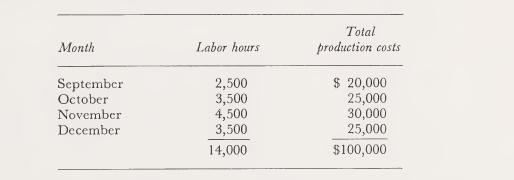
During your examination of the 1980 financial statements of MacKenzie Park Co., which manufactures and sells trivets, you wish to analyze selected aspects of the company’s operations.Labor hours and production costs for the last four months of 1980, which you believe are representative for the
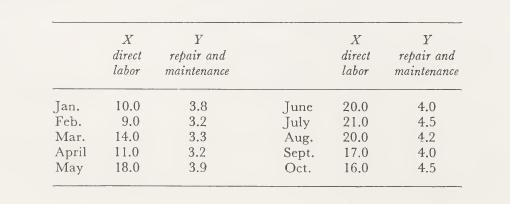
Renolds Rims and Spokes manufactures a large variety of automobile and truck tire rims for sale to manufacturers and repair shops. The equipment used to manufacture the rims is expensive and requires considerable maintenance. Management has always followed the policy of doing preventive maintenance
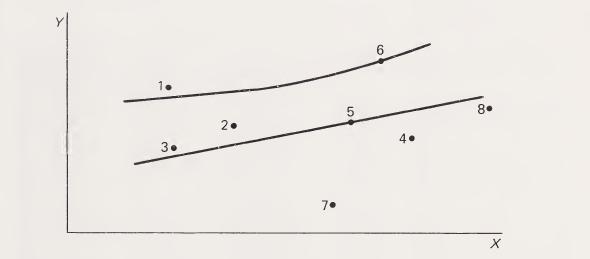
The graph below is a 97.5% confidence interval for a regression analysis.Eight data sets were used for the calculations. The following questions refer to the graph.a. The two variables being used in the regression are monthly repairs and maintenance expense and monthly total factory machine hours.
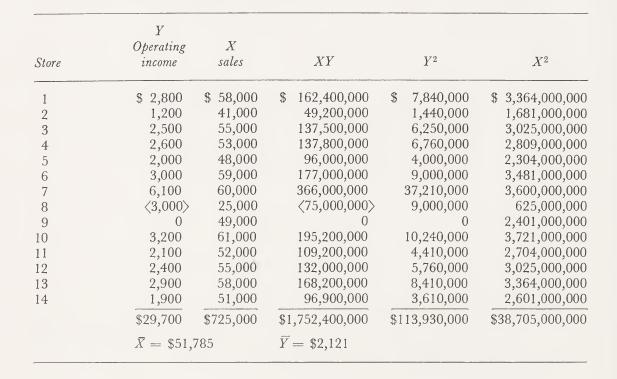
Tastee Dinner operates 14 family restaurants in the southwestern United States. All restaurants are centrally owned and controlled by a management group in Phoenix. Every Tastee Dinner is built on an identical floor plan, has the same furniture, and uses the same menu. There is an ongoing attempt
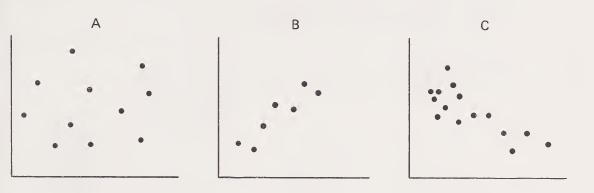
Below are three graphs showing data points for independent and related dependent variables.a. Draw a rough approximation of the regression line for each, A to G (Y= a + bX).b. Identify the graph with a coefficient of correlation near zero. What causes a coefficient to be near zero ?c. Identify the
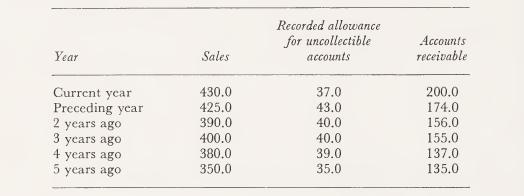
George Mayer, CPA, is auditing the allowance for uncollectible accounts. The client has always had collection problems, but management has been uncooperative about booking recommended adjustments to the allowance. Every year there is disagreement between the auditor and management about the
Explain the difference in methodology and statistical conclusions between compliance tests using attributes sampling (physical unit) and those using simple attributes (dollar unit).
A sample size of 150 items is selected in a test of purchase transactions to determine whether the receiving report is attached to the related vendors’ invoices. The population size is 5,000 items and the recorded purchases for the year are \($1,800,000.\) Three of the vendors’ statements did
You are testing for the client’s failure to record purchases in the accounts payable journal by sampling receiving reports. No errors are expected. Explain how you would conduct the tests. Why would simple attributes not be appropriate in this situation ?
What is the difference between error bounds as used for dollar unit sampling and confidence limits ? Explain why the term upper and lower error bounds is used for dollar unit sampling instead of the term confidence limits.
Explain why error bounds are calculated for substantive tests using simple attributes, whereas an upper precision limit in dollars is calculated for compliance tests.
An auditor is determining the appropriate sample size for testing inventory valuation using dollar unit sampling. The population has 2,620 inventory items valued at \($12,625,000.\) The allowable understatement or overstatement is \($500,000\) at a 90% confidence level. No errors are expected in
The 2,620 inventory items described in question 9-6 are listed on 44 inventory pages with 60 lines per page. There is a total for each page. The client’s data are not in computer-readable form, and the CPA firm does not have a computer terminal available. Describe the three ways in which a dollar
The auditor decided to select a sample of 100 items using the random number table noncumulative method for verifying the inventory valuation in question 9-6. In the selection of the 100 random numbers, none of the dollar units were duplicates, but after the dollar units had been associated with the
No errors were uncovered in the sample of 100 items for question 9-6. Calculate the error bounds and draw audit conclusions based upon the results. How would the error bounds be affected if you used a 50% error assumption?Question 9-6:An auditor is determining the appropriate sample size for
What is meant by the “percent of error assumption” in those population items that are in error? Why is it common to use a 100% error assumption when it is almost certain to be highly conservative ?
Explain the difference between simple attributes and combined attributes- variables evaluation. When should each be used ?
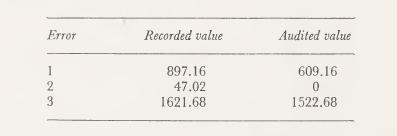
Instead of no errors in question 9-9, assume that the following three errors were found:Calculate error bounds for the population, using both the attributes tables and the shortcut method. Draw audit conclusions based on the results.Question 9-9:No errors were uncovered in the sample of 100 items
Assume that in question 9-12, the population item that included error 1 was included in the sample twice as two separate dollar units. How should the auditor treat this item?Question 9-12:Instead of no errors in question 9-9, assume that the following three errors were found:Calculate error bounds
Why is it difficult to determine the appropriate sample size for combined attributes-variables evaluation? How should the auditor determine the proper sample size?
What options does the auditor have when an error bound for combined attributes-variables evaluation is larger than the allowable error? When should each option be followed ?
Explain what is meant by multinomial bound evaluation. What are the advantages and disadvantages of multinomial bound evaluation compared to combined attributes-variables evaluation ? When should it be used ?
Explain what is meant by dollar unit difference estimation. What are the advantages and disadvantages of dollar unit difference estimation compared to physical unit difference or ratio estimation ?
Under what circumstances is there a risk that dollar unit difference estimation is a biased estimator? Under what circumstances is it apt to be an unreliable estimator?
What are the circumstances in which dollar unit difference estimation should be used rather than one of the other three dollar unit sampling methods described in the chapter? When would it be inappropriate to use dollar unit difference estimation?
Taken as a group, what are the primary advantages and disadvantages of the dollar unit sampling methods described in this chapter?
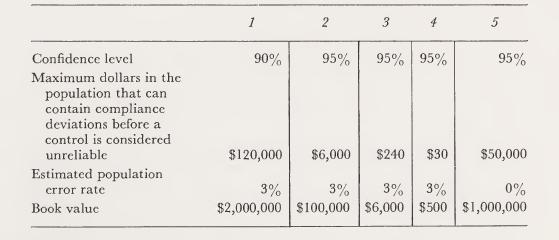
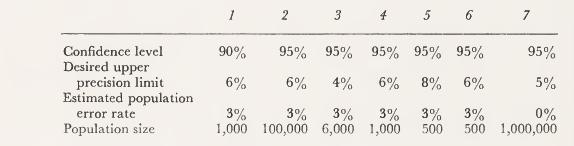
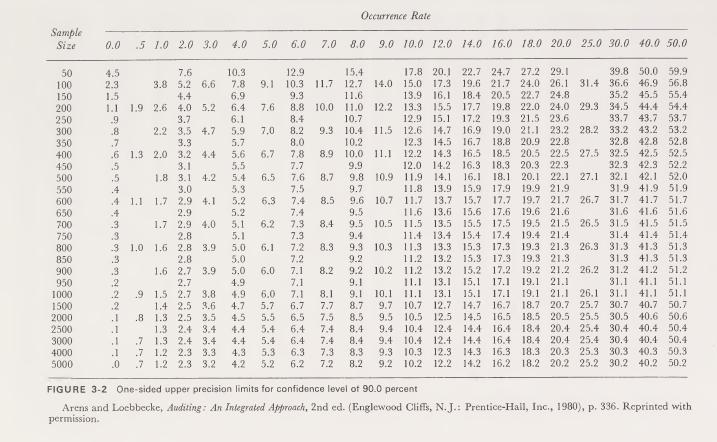
The following questions concern the determination of the proper sample size in simple attributes sampling using dollar unit sampling.a. For each column, 1 through 5, determine the initial sample size needed to satisfy the auditor’s requirements from the appropriate table.b. Explain why the
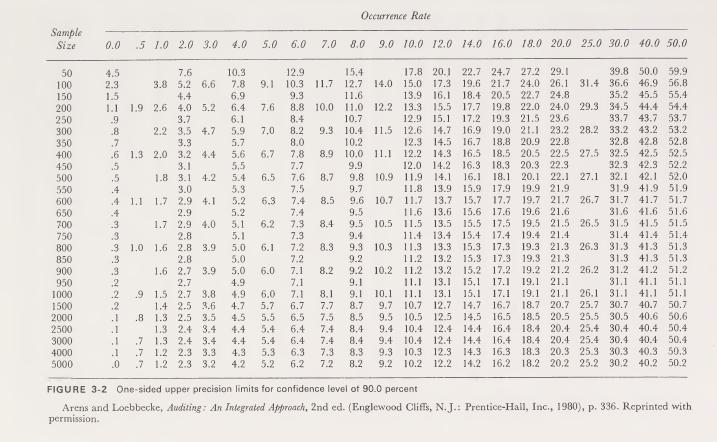
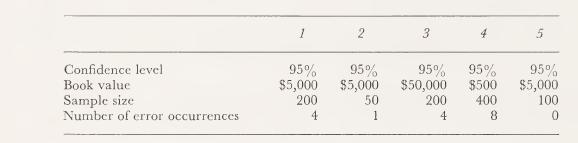
The following questions relate to determining the computed upper precision limit in simple attributes.a. For each column, 1 through 5, determine the computed upper precision limit from the appropriate tables.b. Using your understanding of the relationship between the four factors above and the
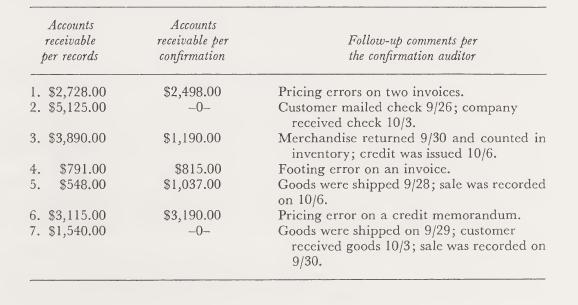
You are planning to use dollar unit sampling to evaluate the results of accounts- receivable confirmation for the Meridian Company. You have already tested internal controls for sales, sales returns and allowances, and cash receipts, and they are considered excellent. Owing to the quality of the
You intend to use dollar unit sampling as a part of the audit of several accounts for Rovnpower Manufacturing Company. You have done the audit for the past several years, and there has rarely been an adjusting entry of any kind. Your audit tests of all tests of transactions cycles were completed at
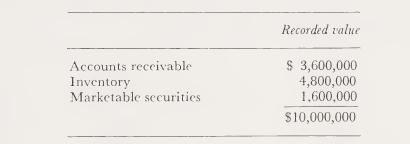
You want to select a dollar unit sample from a population of cash disbursements. The parameters are:Assume a confidence level of 90% and an allowable error of \($1,000,000\).Required :a. What is the sampling interval if you plan to use systematic sampling?b. How might you identify physical audit
Phil Murphy is using simple attributes in the audit of sales transactions. The system of internal control is excellent in all regards except for the internal verification of unit prices, extensions, and footings of sales invoices. Phil expects to find no errors in the sales tests.The recorded
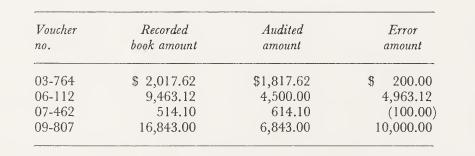
In the audit of Price Seed Company for the year ended 9/30, the auditor set a maximum allowable error of \($50,000\) at a Beta risk of 10%. A sample size of 100 was selected from a population of 1,850 that had a recorded accounts receivable balance of \($1,975,000\). The following differences were
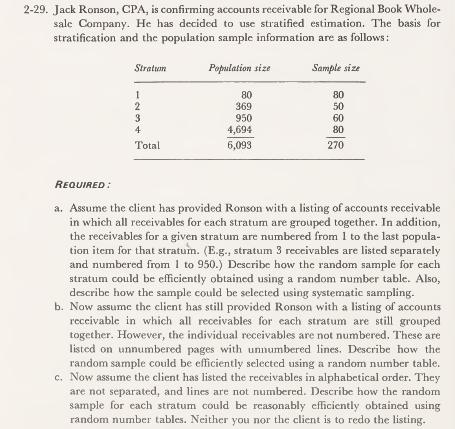
Refer to problem 2-29, at the end of Chapter 2. Instead of using stratified estimation, assume Ronson intends to use dollar unit sampling.Required :a. Compare the ease of selection using dollar unit sampling with random number tables to selection using stratified sampling for parts a and c.b.
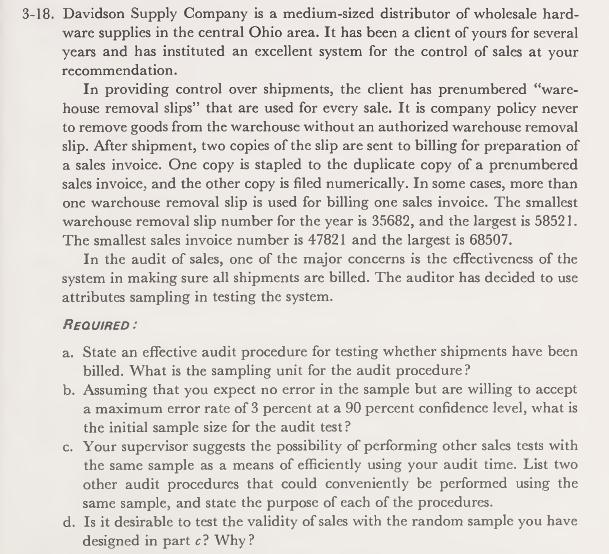
Refer to problem 3-18, at the end of Chapter 3, concerning audit tests of control on shipments. The auditor in that case has now decided to use simple attributes.Required :a. Given the sampling unit that was used for part a in problem 3-18, do you believe dollar unit sampling would be desirable in
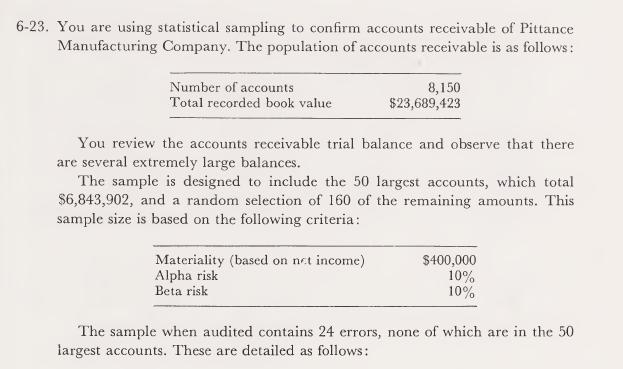
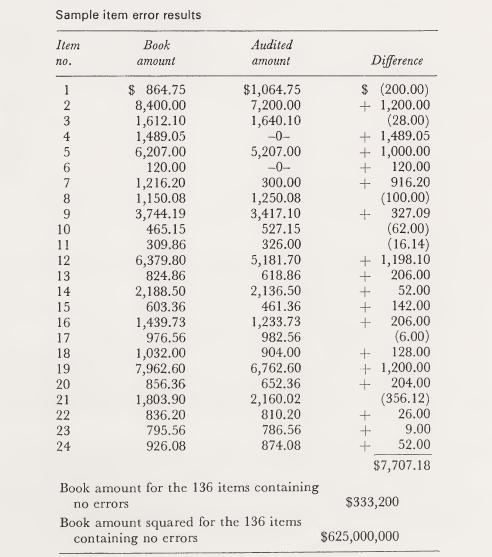
Refer to problem 6-23, at the end of Chapter 6, concerning the confirmation of accounts receivable of Pittance Manufacturing Company. You are now considering using dollar unit sampling in the audit of accounts receivable.Required :a. Is it acceptable to audit the 50 largest accounts when dollar
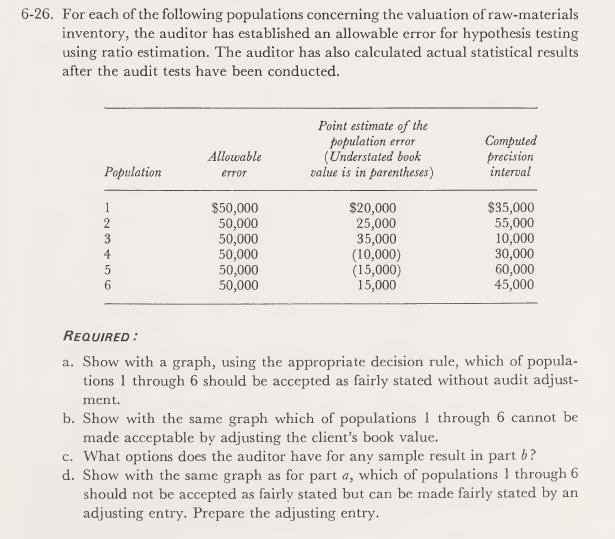
Refer to problem 6-26, concerning decision rules for variables sampling. Instead of using ratio estimation, the auditor is using dollar unit difference estimation. Assume that the allowable error, point estimate, and computed interval using dollar unit difference estimation are as stated in the
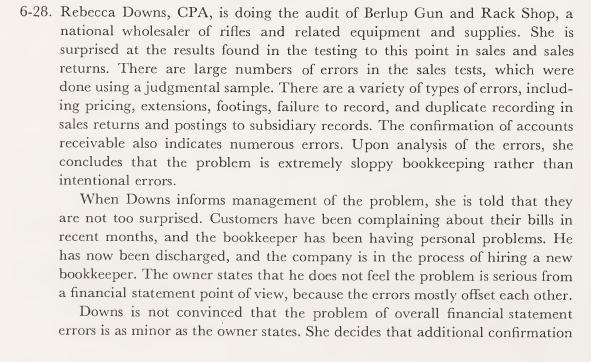
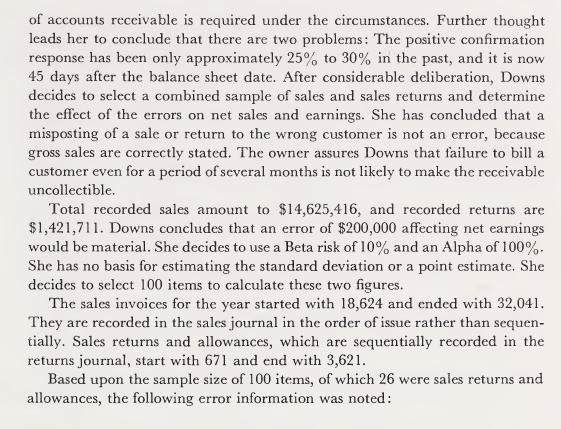
Refer to problem 6-28, concerning the audit of sales and sales returns. For this problem, assume that Rebecca is using dollar unit sampling.Required :a. Would it be practical to use combined attributes-variables estimation in this situation? Why would she have to use a different sampling method
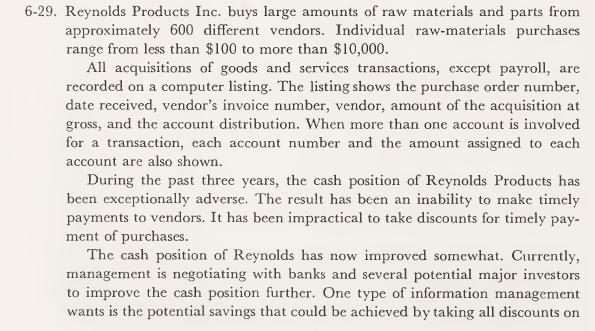
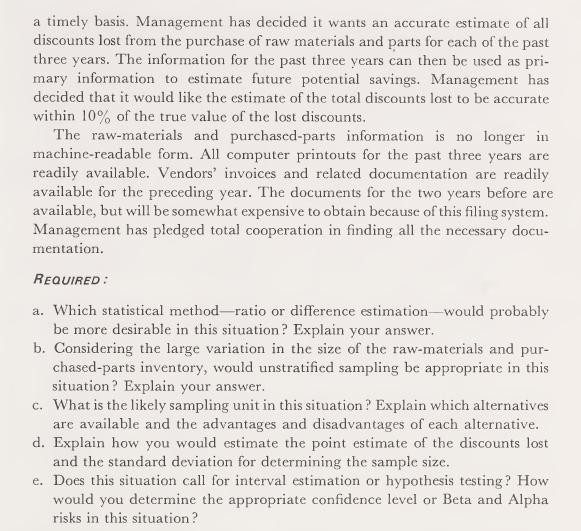
Refer to problem 6-29, concerning discounts on raw materials and purchased parts. As an alternative to ratio or difference estimation, the CPA is considering dollar unit difference estimation.Required:a. Would the total sample size for dollar unit difference estimation probably be larger than for
Define stratified sampling.
What are the purposes of stratification?
Explain why stratification with three or four strata is more likely to be used for mean-per-unit estimation than for difference or ratio estimation.
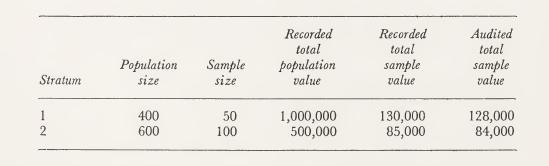
Explain how the point estimate for the total population is calculated using stratified sampling. Calculate the point estimates for mean-per-unit, difference, and ratio estimation from the following information: Recorded Recorded Audited total total total Population Sample population sample sample
Explain how the standard deviation is calculated when stratified mean-per- unit sampling is used. What information is needed before the calculation can be made?
Explain why the standard error rather than the computed precision interval is calculated for each stratum when stratified sampling is used. Would the same combined computed precision interval result if the computed precision interval were calculated for each stratum ? Explain.
Calculate the combined standard error of the population if the standard deviation in question 8-4 is 500 in stratum 1 and 300 in stratum 2. (Ignore the finite correction factor.)Question 8-4:Explain how the point estimate for the total population is calculated using stratified sampling. Calculate
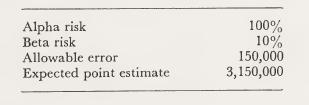
Explain in what ways the decision-rule graph used in Chapter 7 to evaluate whether a population is materially misstated is similar to and different from the appropriate graph for stratified mean-per-unit estimation. Assuming a total allowable error of \($60,000\), a Beta risk of 5%, and an Alpha
What are the two most important criteria in deciding on the appropriate number of strata that should be used in an audit situation ?
Explain why recorded values are ordinarily used as the basis for determining the number of strata and stratum boundaries, when stratification on the basis of audited values would ordinarily result in a smaller combined computed precision interval.
What basis other than recorded values could be used to determine stratum boundaries? Under what circumstances should a basis other than recorded values be used?
Explain the difference in methodology of each of the following three methods of determining stratum boundaries: judgmental, equal recorded value, and equal cumulative square root of frequency. Under which circumstances should each method be used ?
What is the difference between the formulas for sample size determination for stratified mean-per-unit and for stratified difference estimation ?
Determine the required sample size using stratified mean-per-unit estimation for the population in questions 8-4, 8-7, and 8-8.Question 8-8:Explain in what ways the decision-rule graph used in Chapter 7 to evaluate whether a population is materially misstated is similar to and different from the
Assume a calculated sample size of 200 for question 8-14. Allocate this sample size to the two strata by the two methods described in the chapter.Question 8-14:Determine the required sample size using stratified mean-per-unit estimation for the population in questions 8-4, 8-7, and 8-8.Question
Under what circumstances should stratified mean-per-unit be considered a more desirable alternative than ratio and difference estimation ?
What are the most appropriate circumstances in which to use stratified mean- per-unit estimation?
What are the most appropriate circumstances in which to use stratified difference or ratio estimation ?
Define what is meant by post-stratification. When is it appropriate to post- stratify ?
Explain the methodology for combining two or more statistical estimates from different audit tests. Calculate the combined confidence limits for two asset accounts whose separate confidence intervals at a 95% confidence level are: Account 1: 20,000 16,000 Account 2: (14,000) 12,000
The following problems apply to stratified sampling. Choose the best response.a. Mr. Murray decides to use stratified sampling. The basic reason for using stratified sampling rather than unrestricted random sampling is to(i) Reduce as much as possible the degree of variability in the overall
Assume that an auditor is using stratified ratio estimation in the confirmation of accounts receivable. There are 940 accounts with a recorded value of \($250,000\). They are listed on ten pages, with a maximum of 100 lines per page in alphabetical order. The auditor has decided to use three
Your client is a wholesaler of automobile and truck parts. The parts come in two sizes: loose parts, which are in bins, and bulk parts, which are in sealed packages arranged in pallets.You are considering using statistical sampling to test the perpetual inventory records, which are kept by price
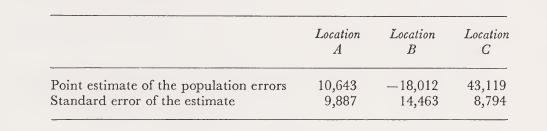
Your client has three locations. You visit each to test the perpetual inventory records. You take a sample at each and obtain count data and check prices and extensions. You also test 100% all items over SI0,000. You calculate results for each sample, including all items tested 100%, using ratio
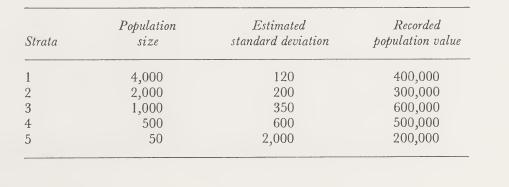
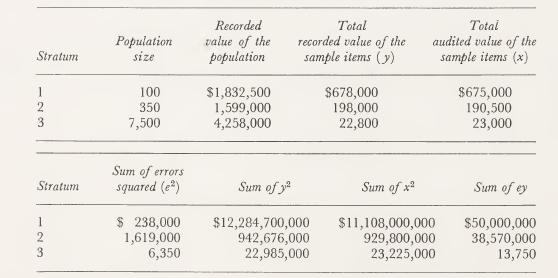
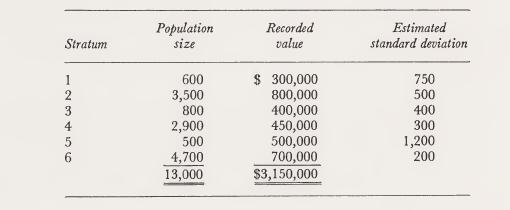
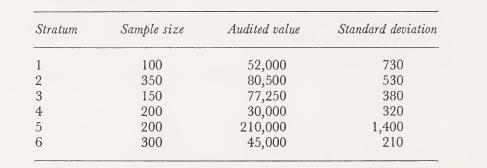
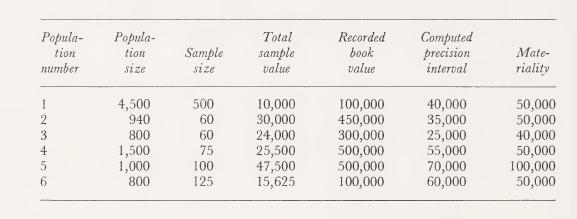
You are using stratified mean-per-unit estimation in the confirmation of accounts receivable. You have already decided to use five strata, and the stratum boundaries have been set. A sample size of 250 positive confirmations has already been determined.The following data have been determined from
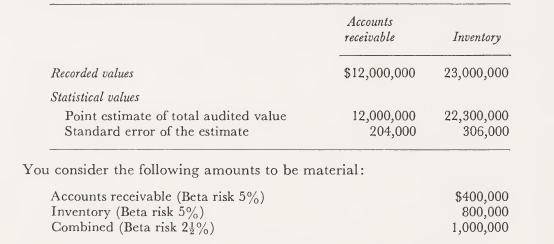
You are doing the audit of Virginia Tire and Parts, a wholesale auto parts dealer. Unstratified mean-per-unit estimation has been used to calculate statistical information for accounts receivable and inventory. The following data have been calculated or taken from the client’s records:Required
Label Products, Inc., produces badges, stickers, posters, etc., to be used for promotional purposes. It caters to a few big customers, but it also accepts a lot of small orders for certain types of badges.The accounts receivable balances are to be audited by your firm. You have reviewed the
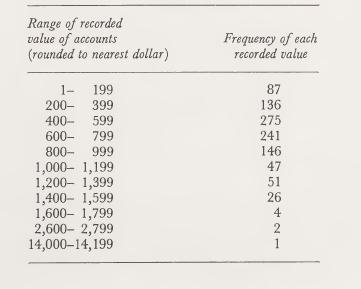
You are using stratified mean-per-unit estimation in the confirmation of accounts receivable for the audit of Johnstone Lumber Company. You are trying to decide on the number of strata and stratum boundaries for each stratum. The client provides you with the following frequency distribution
You are doing the audit of inventory pricing of Western Engine and Supply. The company follows the policy of valuing year-end inventory at standard cost. The standards were last revised 19 months ago, but they are adjusted monthly for inflation by the same percentage as the change in the National
Jake Jones. CPA, is price-testing the inventory for the Concord Jar Company. A listing of inventory that includes description, quantity determined by a physical count, unit cost, and extended cost is prepared on the client’s computer system. The listing includes 45 lines per page in part-number
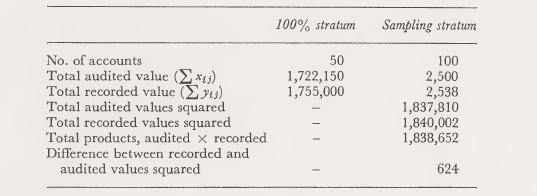
The data from problem 7-17 are used in this problem to make calculations in part a. All inventory items valued at more than \($700\) are considered a part of stratum 1. All those valued at \($700\) or less are considered a part of stratum 2, which includes 640 population items with a recorded value
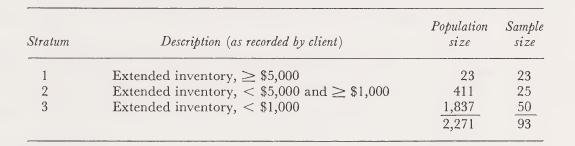
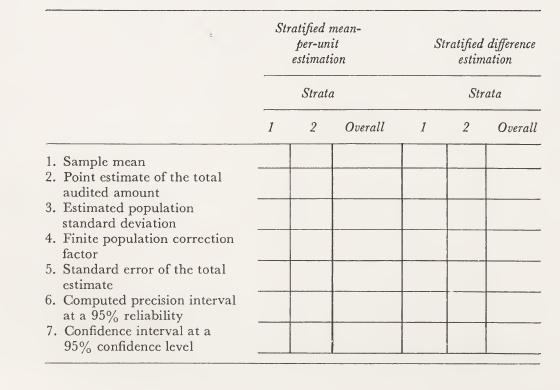
Mary Obrien, CPA, is using stratified mean-per-unit to determine whether the client’s recorded inventory is correctly stated. The decision has been made to use mean-per-unit rather than difference or ratio estimation because a low error rate is expected.Inventory has been stratified by two
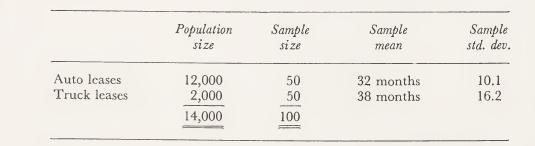
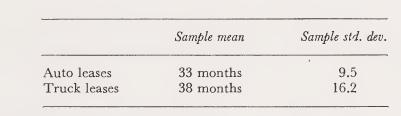
The ARC Leasing Co. leases both trucks and autos. You have decided to test the client’s assertion that the average combined useful life for all leases is 35 months.The client has 12,000 auto leases and 2,000 truck leases. You believe that the truck leases have a different variability from the
Distinguish between mean-per-unit and difference estimation in terms of methodology and when each method should be used.
Identify the two situations in which unstratified mean-per-unit is most apt to be used. Explain why they are the only two situations where mean-per-unit is a likely estimation.
Explain why an auditor is more likely to use mean-per-unit estimation for interval estimates than difference or ratio estimation.
Assume that an auditor decides to use unstratified mean-per-unit estimation to estimate the value of inventory in cooperation with a client. The client has not taken a complete physical inventory because of the high cost of doing it. Why is mean-per-unit preferable to difference and ratio
Answer as true or false the following four questions about question 7-4 and give reasons for each answer.a. A hypothesis test is more appropriate than an interval estimation.b. It is unnecessary to make an estimate of the point estimate to determine the preliminary sample size.c. It is unnecessary
What are the probable consequences of taking a preliminary sample size that is smaller than actually needed in the circumstance described in 7-4? What are the probable consequences of taking a preliminary sample size that is larger than actually needed? Draw a general conclusion from your
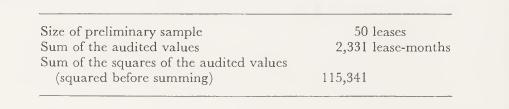
In question 7-4, the population size is 10,000 and the estimated standard deviation is 40. Last year’s recorded book value was \($2,000,000\), and the client believes this year’s will be approximately the same. The auditor decides that a material misstatement of inventory would be \($50,000\)
Assume that a reasonable advance estimate of the standard deviation was impractical in 7-7. How should the auditor determine an appropriate estimate?7-7:In question 7-4, the population size is 10,000 and the estimated standard deviation is 40. Last year’s recorded book value was
The auditor took a sample of 250 items based on the answer to question 7-7 and calculated the standard deviation as \($44\). The summation of the inventory values at cost in the sample was \($52,500\). Calculate the point estimate of the inventory and the precision interval. Explain what caused the
Assume the same results as in question 7-9 except that the standard deviation was \($39\). Calculate the adjusting entry for inventory if inventory is now stated at last year’s ending balance of \($2,000,000\).Question 7-9:The auditor took a sample of 250 items based on the answer to question 7-7
Under what circumstances is mean-per-unit estimation likely to be more efficient than difference or ratio estimation? What are the implications of your conclusions ?
Under what circumstances is mean-per-unit likely to be a more reliable estimation than difference or ratio estimation ? What are the implications of your conclusions ?
The reliability of mean-per-unit estimation is not affected by either the rate of error in a population or the magnitude of the errors. Explain why.
An auditor wants to use unstratified mean-per-unit estimation if he can be confident that the statistical conclusions are reliable. At what point will the population be so skewed that reliable statistics are unlikely? What factor other than skewness will affect your answer ?
Under what circumstances is it appropriate to use unstratified mean-per-unit estimation ?
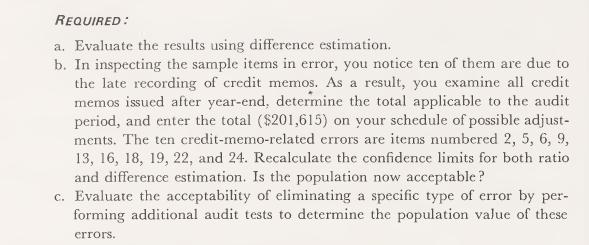
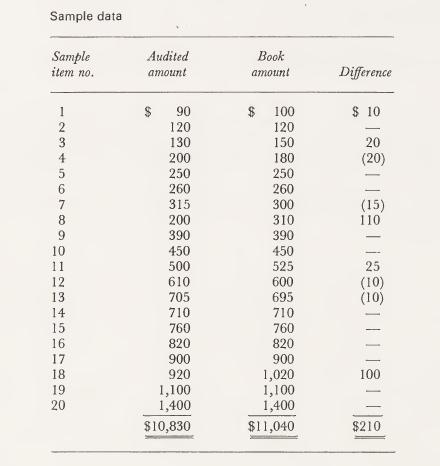
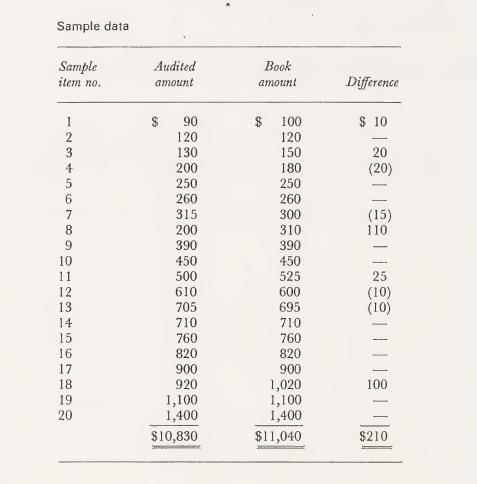
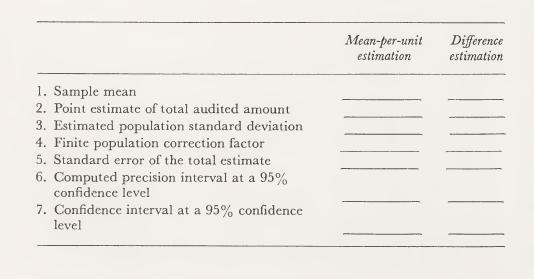
The following is a set of sample and related data taken from a population of 1,000 items that have a recorded book value of \($498,000\). Even though only 20 items are used to simplify the problem, compute the sampling results as indicated.Required :a. Calculate each of the following:b. Why is the
An inventory has a book value of \($1,829,000.\) An auditor obtains a random variables sample and projects the result. The point estimate is \($1,425,000.\) The interval estimate is from \($1,325,000\) to \($1,525,000\) at the 95% confidence level. Assume that a material error is defined as
In each of the following situations, an auditor used the mean-per-unit estimation direct projection method of variables sampling. The method used was inefficient because of the great variability in the data.(1) The auditor was sampling accounts receivable to determine the total dollar amount of
Mean-per-unit estimation is being used in the audit of inventory to determine confidence intervals for the following independent populations:Required :a. Using a hypothesis test at a 5% Beta risk, identify which of the six populations are acceptable as stated.b. Using a hypothesis test at a 5% Beta
Owing to data processing problems and a shortage of accounting personnel at the King Cleaning Supply Company, management has neither records of the balances in accounts payable at the balance sheet date nor a listing of accounts payable in total or by vendor. An audit for the current year is
Armandy Discount Stores is a large department store catering primarily to low-income people. More than 20,000 different products are kept in inventory and sold by the store. Management has followed the practice of using the retail inventory method in previous years. A team of outside professional
Jay Smith, CPA, is doing the audit of accounts receivable ofJones Wholesale Stationery and Office Supplies. There are 820 accounts receivable, totaling \($887,500\). Total current assets are \($1,450,000\), and total assets are \($2,200,000\).Jay makes no effort to determine the appropriate sample
Your client, Motor Leasing Corporation, leases trucks and automobiles, both by fleet (with each vehicle on a separate lease) and individually. For internal purposes, the company computes interest earned on leases on a straight-line basis; for statement purposes, it makes an adjustment to accrue
Distinguish among attributes sampling, difference estimation, and ratio estimation. Which two sampling methods are similar?
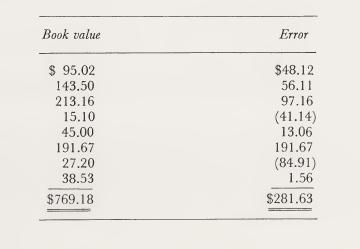
What is meant by the point estimate of the total errors for ratio estimation? Calculate the point estimate when there are the following client errors in a sample of 120 items from a population of 3,000.The recorded value of all 120 items in the sample was \($5,820\). The sum of the recorded value
Distinguish between the methods of calculating the population point estimate for ratio and for difference estimation. Give one specific example of an audit test in which you believe ratio estimation is likely to result in a more efficient estimate of the population error. Provide another example in
What is meant by the population standard deviation for ratio estimation? Calculate the estimate of the population standard deviation based on the sample results in question 6-3. Compare your answer to the one for question 5-10 where the same errors were used to determine a standard deviation for
Showing 4700 - 4800
of 4976
First
36
37
38
39
40
41
42
43
44
45
46
47
48
49
50
Step by Step Answers

 Get 50% OFF
Claim Now
Get 50% OFF
Claim Now