New Semester
Started
Get
50% OFF
Study Help!
--h --m --s
Claim Now
Question Answers
Textbooks
Find textbooks, questions and answers
Oops, something went wrong!
Change your search query and then try again
S
Books
FREE
Study Help
Expert Questions
Accounting
General Management
Mathematics
Finance
Organizational Behaviour
Law
Physics
Operating System
Management Leadership
Sociology
Programming
Marketing
Database
Computer Network
Economics
Textbooks Solutions
Accounting
Managerial Accounting
Management Leadership
Cost Accounting
Statistics
Business Law
Corporate Finance
Finance
Economics
Auditing
Tutors
Online Tutors
Find a Tutor
Hire a Tutor
Become a Tutor
AI Tutor
AI Study Planner
NEW
Sell Books
Search
Search
Sign In
Register
study help
computer science
computer networking
Computer Networks A Systems Approach 6th Edition Larry L. Peterson, Bruce S. Davie - Solutions
Suppose a network N within a larger organization A acquires its own direct connection to an Internet service provider, in addition to an existing connection via A. Let R1 be the router connecting N to its own provider, and let R2 be the router connecting N to the rest of A.(a) Assuming N remains a
How do routers determine that an incoming IP packet is to be multicast?
Suppose a multicast group is intended to be private to a particular routing domain. Can an IP multicast address be assigned to the group without consulting with other domains with no risk of conflicts?
Under what conditions could a nonrouter host on an Ethernet receive a IP multicast packet for a multicast group it has not joined?
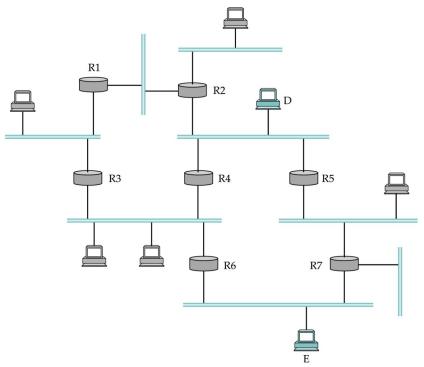
Consider the example internet shown in Figure 4.30, in which sources D and E send packets to multicast group G, whose members are shaded in gray. Show the shortest path multicast trees for each source.Figure 4.30) R1 R3 R2 R4 R6 D R5 R7 E
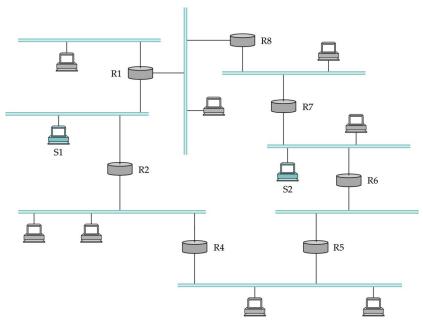
Consider the example internet shown in Figure 4.31, in which sources S1 and S2 send packets to multicast group G, whose members are shaded in gray. Show the shortest-path multicast trees for each source.Figure 4.31) SI R1 R2 R4 R8 S2 R7 R5 R6
Suppose host A is sending to a multicast group; the recipients are leaf nodes of a tree rooted at A with depth N and with each nonleaf node having k children; there are thus kN recipients.(a) How many individual link transmissions are involved if A sends a multicast message to all recipients?(b)
The existing Internet depends in many respects on participants being good “network citizens”—cooperating above and beyond adherence to standard protocols.(a) In the PIM-SM scheme, who determines when to create a source-specific tree? How might this be a problem?(b) In the PIM-SSM scheme, who
(a) Draw an example internetwork where the BIDIR-PIM route from a source’s router to a group member’s router is longer than the PIM-SM source-specific route.(b) Draw an example where they are the same.
Determine whether or not the following IPv6 address notations are correct:(a) ::0F53:6382:AB00:67DB:BB27:7332.(b) 7803:42F2:::88EC:D4BA:B75D:11CD.(c) ::4BA8:95CC::DB97:4EAB.(d) 74DC::02BA.(e) ::00FF:128.112.92.116.
MPLS labels are usually 20 bits long. Explain why this provides enough labels when MPLS is used for destination-based forwarding.
MPLS has sometimes been claimed to improve router performance.Explain why this might be true, and suggest reasons why in practice this may not be the case.
Assume that it takes 32 bits to carry each MPLS label that is added to a packet when the “shim” header of Figure 4.20(b) is used.(a) How many additional bytes are needed to tunnel a packet using the MPLS techniques?(b) How many additional bytes are needed, at a minimum, to tunnel a packet using
RFC 791 describes the Internet Protocol and includes two options for source routing. Describe three disadvantages of using IP source route options compared to using MPLS for explicit routing.
If a UDP datagram is sent from host A, port P to host B, port Q, but at host B there is no process listening to port Q, then B is to send back an ICMP Port Unreachable message to A. Like all ICMP messages, this is addressed to A as a whole, not to port P on A.(a) Give an example of when an
Consider a simple UDP-based protocol for requesting files (based somewhat loosely on the Trivial File Transport Protocol [TFTP]). The client sends an initial file request, and the server answers (if the file can be sent) with the first data packet. Client and server then continue with a
Design a simple UDP-based protocol for retrieving files from a server. No authentication is to be provided. Stop-and-wait transmission of the data may be used. Your protocol should address the following issues:(a) Duplication of the first packet should not duplicate the “connection.”(b) Loss of
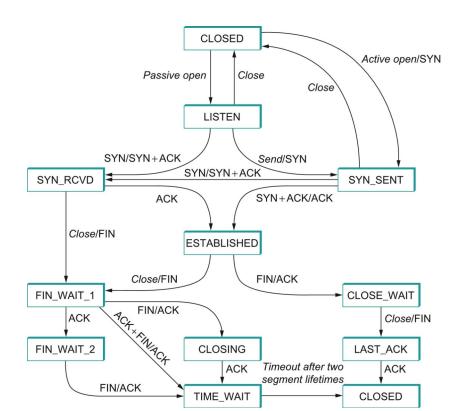
This chapter explains three sequences of state transitions during TCP connection teardown. There is a fourth possible sequence, which traverses an additional arc from FIN_WAIT_1 to TIME_WAIT and labeled FIN+ACK/ACK. Explain the circumstances that result in this fourth teardown sequence.
When closing a TCP connection, why is the two-segment-lifetime timeout not necessary on the transition from LAST_ACK to CLOSED?
A sender on a TCP connection that receives a 0 advertised window periodically probes the receiver to discover when the window becomes nonzero. Why would the receiver need an extra timer if it were responsible for reporting that its advertised window had become nonzero (i.e., if the sender did not
Read the man page (or Windows equivalent) for the Unix/Windows utility netstat. Use netstat to see the state of the local TCP connections. Find out how long closing connections spend in TIME_WAIT.
The sequence number field in the TCP header is 32 bits long, which is big enough to cover over 4 billion bytes of data. Even if this many bytes were never transferred over a single connection, why might the sequence number still wrap around from 232 − 1 to 0?
You are hired to design a reliable byte-stream protocol that uses a sliding window (like TCP). This protocol will run over a 100-Mbps network. The RTT of the network is 100 ms, and the maximum segment lifetime is 60 seconds.(a) How many bits would you include in the AdvertisedWindow and SequenceNum
You are hired to design a reliable byte-stream protocol that uses a sliding window (like TCP). This protocol will run over a 1-Gbps network. The RTT of the network is 140 ms, and the maximum segment lifetime is 60 seconds. How many bits would you include in the AdvertisedWindow and SequenceNum
Suppose a host wants to establish the reliability of a link by sending packets and measuring the percentage that is received; routers, for example, do this. Explain the difficulty doing this over a TCP connection.
Suppose TCP operates over a 1-Gbps link.(a) Assuming TCP could utilize the full bandwidth continuously, how long would it take the sequence numbers to wrap around completely?(b) Suppose an added 32-bit timestamp field increments 1000 times during the wraparound time you found above. How long would
Suppose TCP operates over a 40-Gbps STS-768 link.(a) Assuming TCP could utilize the full bandwidth continuously, how long would it take the sequence numbers to wrap around completely?(b) Suppose an added 32-bit timestamp field which increments 1000 times during the wraparound time you found above.
If host A receives two SYN packets from the same port from remote host B, the second may be either a retransmission of the original or else, if B has crashed and rebooted, an entirely new connection request.(a) Describe the difference as seen by host A between these two cases.(b) Give an
Suppose x and y are two TCP sequence numbers. Write a function to determine whether x comes before y (in the notation of Request for Comments 793, “x =< y”) or after y; your solution should work even when sequence numbers wrap around.
Suppose an idle TCP connection exists between sockets A and B. A third party has eavesdropped and knows the current sequence number at both ends.(a) Suppose the third party sends A a forged packet ostensibly from B and with 100 bytes of new data. What happens? Hint:Look up in Request for Comments
Suppose party A connects to the Internet via a dial-up IP server (e.g., using SLIP or PPP), has several open Telnet connections (using TCP), and is cut off. Party B then dials in and is assigned the same IP address that A had. Assuming B were able to guess to what host(s) A was connected, describe
Diagnostic programs are commonly available that record the first 100 bytes, say, of every TCP connection to a certain host, port. Outline what must be done with each received TCP packet, P, in order to determine if it contains data that belong to the first 100 bytes of a connection to host HOST,
If a packet arrives at host A with B’s source address, it could just as easily have been forged by any third host C. If, however, A accepts a TCP connection from B, then during the three-way handshake, A sent ISNA to B’s address and received an acknowledgment of it. If C is not located so as to
The Nagle algorithm, built into most TCP implementations, requires the sender to hold a partial segment’s worth of data (even if PUSHed)until either a full segment accumulates or the most recent outstanding ACK arrives.(a) Suppose the letters abcdefghi are sent, one per second, over a TCP
Suppose a client C repeatedly connects via TCP to a given port on a server S and that each time, it is C that initiates the close.(a) How many TCP connections per second can C make here before it ties up all its available ports in TIME_WAIT state?Assume that client ephemeral ports are in the range
Explain why TIME_WAIT is a somewhat more serious problem if the server initiates the close than if the client does. Describe a situation in which this might reasonably happen.
What is the justification for the exponential increase in timeout value proposed by Karn and Partridge? Why, specifically, might a linear (or slower) increase be less desirable?
The Jacobson/Karels algorithm sets TimeOut to be 4 mean deviations above the mean. Assume that individual packet round-trip times follow a statistical normal distribution, for which 4 mean deviations areπ standard deviations. Using statistical tables, for example, what is the probability that a
Suppose a TCP connection, with window size 1, loses every other packet. Those that do arrive have RTT = 1 second. What happens?What happens to TimeOut? Do this for two cases:(a) After a packet is eventually received, we pick up where we left off, resuming with EstimatedRTT initialized to its
Suppose, in TCP’s adaptive retransmission mechanism, that EstimatedRTT is 4.0 at some point and subsequent measured RTTs all are 1.0.How long does it take before the TimeOut value, as calculated by the Jacobson/Karels algorithm, falls below 4.0? Assume a plausible initial value of Deviation; how
Suppose, in TCP’s adaptive retransmission mechanism, that EstimatedRTT is 90 at some point and subsequent measured RTTs all are 200.How long does it take before the TimeOut value, as calculated by the Jacobson/Karels algorithm, falls below 300? Assume an initial Deviation value of 25; use δ =
Suppose TCP’s measured RTT is 1.0 except that every Nth RTT is 4.0.What is the largest N, approximately, that does not result in timeouts in the steady state (i.e., for which the Jacobson/Karels TimeOut remains greater than 4.0)? Use δ = 1/8.
Suppose that TCP is measuring RTTs of 1.0 second, with a mean deviation of 0.1 second. Suddenly the RTT jumps to 5.0 seconds, with no deviation. Compare the behaviors of the original and Jacobson/Karels algorithms for computing TimeOut. Specifically, how many timeouts are encountered with each
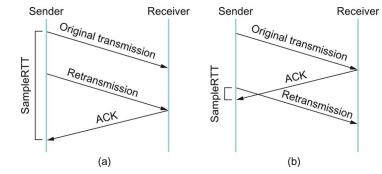
Suppose that when a TCP segment is sent more than once, we take SampleRTT to be the time between the original transmission and the ACK, as in Figure 5.10(a). Show that if a connection with a one-packet window loses every other packet (i.e., each packet is transmitted twice), then EstimatedRTT
Suppose that when a TCP segment is sent more than once, we take SampleRTT to be the time between the most recent transmission and the ACK, as in Figure 5.10(b). Assume, for definiteness, that TimeOut = 2 × EstimatedRTT. Sketch a scenario in which no packets are lost but EstimatedRTT converges to
Consult Request for Comments 793 to find out how TCP is supposed to respond if a FIN or an RST arrives with a sequence number other than NextByteExpected. Consider both when the sequence number is within the receive window and when it is not.
One of the purposes of TIME_WAIT is to handle the case of a data packet from a first incarnation of a connection arriving very late and being accepted as data for the second incarnation.(a) Explain why, for this to happen (in the absence of TIME_WAIT), the hosts involved would have to exchange
Propose an extension to TCP by which one end of a connection can hand off its end to a third host; that is, if A were connected to B, and A handed off its connection to C, then afterwards, C would be connected to B and A would not. Specify the new states and transitions needed in the TCP
TCP’s simultaneous open feature is seldom used.(a) Propose a change to TCP in which this is disallowed. Indicate what changes would be made in the state diagram (and, if necessary, in the undiagrammed event responses).(b) Could TCP reasonably disallow simultaneous close?(c) Propose a change to
TCP is a very symmetric protocol, but the client/server model is not. Consider an asymmetric TCP-like protocol in which only the server side is assigned a port number visible to the application layers.Client-side sockets would simply be abstractions that can be connected to server ports.(a) Propose
The following exercise is concerned with the TCP state FIN_WAIT_2(see Figure 5.7).(a) Describe how a client might leave a suitable server in state FIN_WAIT_2 indefinitely. What feature of the server’s protocol is necessary here for this scenario?(b) Try this with some appropriate existing server.
Request for Comments 1122 states (of TCP):A host MAY implement a “half-duplex” TCP close sequence, so that an application that has called CLOSE cannot continue to read data from the connection. If such a host issues a CLOSE call while received data is still pending in TCP, or if new data is
When TCP sends a {SYN, SequenceNum = x} or {FIN, SequenceNum =x}, the consequent ACK has Acknowledgment = x +1; that is, SYNs and FINs each take up one unit in sequence number space. Is this necessary? If so, give an example of an ambiguity that would arise if the corresponding Acknowledgment were
Find out the generic format for TCP header options from Request for Comments 793.(a) Outline a strategy that would expand the space available for options beyond the current limit of 44 bytes.(b) Suggest an extension to TCP allowing the sender of an option a way of specifying what the receiver
The TCP header does not have a boot ID field. Why is there no problem with one end of a TCP connection crashing and rebooting then sending a message with an ID it had previously used?
Suppose we were to implement remote file system mounting using an unreliable RPC protocol that offers zero-or-more semantics. If a message reply is received, this improves to at-least-once semantics.We define read(n) to return the specified nth block rather than the next block in sequence; this
The RPC-based “NFS” remote file system is sometimes considered to have slower-than-expected write performance. In NFS, a server’s RPC reply to a client write request means that the data are physically written to the server’s disk, not just placed in a queue.(a) Explain the bottleneck we
Consider a client and server using an RPC mechanism that includes a channel abstraction and boot IDs.(a) Give a scenario involving server reboot in which an RPC request is sent twice by the client and is executed twice by the server, with only a single ACK.(b) How might the client become aware this
Suppose an RPC request is of the form “increment the value of field X of disk block N by 10%.” Specify a mechanism to be used by the executing server to guarantee that an arriving request is executed exactly once, even if the server crashes while in the middle of the operation.Assume that
Consider a SunRPC client sending a request to a server.(a) Under what circumstances can the client be sure its request has executed exactly once?(b) Suppose we wished to add at-most-once semantics to SunRPC.What changes would have to be made? Explain why adding one or more fields to the existing
Suppose TCP were to be used as the underlying transport in an RPC protocol; each TCP connection is to carry a sequential stream of requests and replies. What analog, if any, would TCP have for:(a) channel ID?(b) message ID?(c) boot ID?(d) a message type for requests?(e) a message type for
Write a test program that uses the socket interface to send messages between a pair of Unix workstations connected by some LAN (e.g., Ethernet, ATM, or FDDI). Use this test program to perform the following experiments.(a) Measure the round-trip latency of TCP and UDP for different message sizes
Try to find situations where an RTP application might reasonably do the following:■ Send multiple packets at essentially the same time that need different timestamps.■ Send packets at different times that need the same timestamp.Argue, in consequence, that RTP timestamps must, in at least some
Having the timestamp clock count time in units of one frame time or one voice sample time would be the minimum resolution to ensure accurate playback. But the time unit is usually considerably smaller;what is the purpose of this?
Suppose we want returning RTCP reports from receivers to amount to no more than 5% of the outgoing primary RTP stream. If each report is 84 bytes, the RTP traffic is 20 kBps, and there are 1000 recipients, how often do individual receivers get to report? What if there are 10,000 recipients?
RFC 3550 specifies that the time interval between receiver RTCP reports include a randomization factor to avoid having all the receivers send at the same time. If all the receivers sent in the same 5% subinterval of their reply time interval, the arriving upstream RTCP traffic would rival the
What might a server actually do with the packet loss rate data and jitter data in receiver reports?
Video applications typically run over UDP rather than TCP because they cannot tolerate retransmission delays. However, this means video applications are not constrained by TCP’s congestion control algorithm. What impact does this have on TCP traffic? Be specific about the
Propose a mechanism for deciding when to report an RTP packet as lost. How does your mechanism compare with the TCP adaptive retransmission mechanisms?
It is possible to define flows on either a host-to-host basis or a process-to-process basis.(a) Discuss the implications of each approach to application programs.(b) IPv6 includes a FlowLabel field for supplying hints to routers about individual flows. The originating host is to put here a
TCP uses a host-centric, feedback-based, window-based resource allocation model. How might TCP have been designed to use instead the following models?(a) Host-centric, feedback-based, and rate-based.(b) Router-centric and feedback-based.
Sketch curves for throughput, delay, and power, each as a function of load, for the following networks. Throughput is to be measured as a percentage of the maximum. Load is to be measured (somewhat unnaturally) as the number of stations (N ) ready to send at any one time; note that this implies
Suppose two hosts A and B are connected via a router R. The A–R link has infinite bandwidth; the R–B link can send one packet per second.R’s queue is infinite. Load is to be measured as the number of packets per second sent from A to B. Sketch the throughput-versus-load and delay-versus-load
Is it possible for TCP Reno to reach a state with the congestion window size much larger than (e.g., twice as large as) RTT × bandwidth?Is it likely?
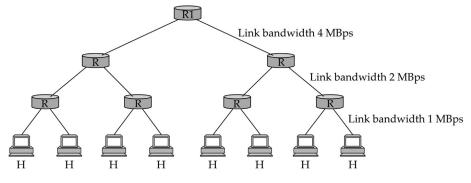
Consider the arrangement of host H and routers R and R1 in Figure 6.28. All links are full duplex, and all routers are faster than their links. Show that R1 cannot become congested, and for any other router R, we can find a traffic pattern that congests that router alone.Figure 6.28) R H H H H RI H
Suppose a congestion control scheme results in a collection of competing flows that achieve the following throughput rates: 100 kBps, 60 kBps, 110 kBps, 95 kBps, and 150 kBps.(a) Calculate the fairness index for this scheme.(b) Now add a flow with a throughput rate of 1000 kBps to the above, and
In fair queuing, the value Fi was interpreted as a timestamp: the time when the ith packet would finish transmitting. Give an interpretation of Fi for weighted fair queuing, and also give a formula for it in terms of Fi−1, arrival time Ai, packet size Pi, and weight w assigned to the flow.
Give an example of how nonpreemption in the implementation of fair queuing leads to a different packet transmission order from bitby-bit round-robin service.
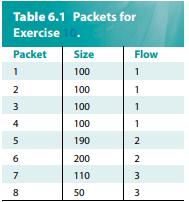
Suppose a router has three input flows and one output. It receives the packets listed in Table 6.1 all at about the same time, in the order listed, during a period in which the output port is busy but all queues are otherwise empty. Give the order in which the packets are transmitted, assuming: (a)
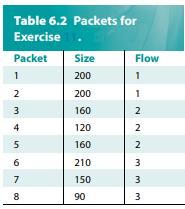
Suppose a router has three input flows and one output. It receives the packets listed in Table 6.2 all at about the same time, in the order listed, during a period in which the output port is busy but all queues are otherwise empty. Give the order in which the packets are transmitted, assuming:(a)
Suppose a router’s drop policy is to drop the highest-cost packet whenever queues are full, where it defines the “cost” of a packet to be the product of its size by the time remaining that it will spend in the queue.Note that in calculating cost, it is equivalent to use the sum of the sizes
Two users, one using Telnet and one sending files with FTP, both send their traffic out via router R. The outbound link from R is slow enough that both users keep packets in R’s queue at all times. Discuss the relative performance seen by the Telnet user if R’s queuing policy for these two
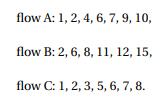
Consider a router that is managing three flows, on which packets of constant size arrive at the following wall clock times:All three flows share the same outbound link, on which the router can transmit one packet per time unit. Assume that there is an infinite amount of buffer space.(a) Suppose the
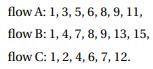
Consider a router that is managing three flows, on which packets of constant size arrive at the following wall clock times:All three flows share the same outbound link, on which the router can transmit one packet per time unit. Assume that there is an infinite amount of buffer space.(a) Suppose the
Assume that TCP implements an extension that allows window sizes much larger than 64 kB. Suppose that you are using this extended TCP over a 1-Gbps link with a latency of 100 ms to transfer a 10-MB file, and the TCP receive window is 1 MB. TCP sends 1-kB packets(assuming no congestion and no lost
Consider a simple congestion control algorithm that uses linear increase and multiplicative decrease but not slow start, that works in units of packets rather than bytes, and that starts each connection with a congestion window equal to one packet. Give a detailed sketch of this algorithm. Assume
For the situation given in the previous problem, compute the effective throughput achieved by this connection. Assume that each packet holds 1 kB of data and that the RTT = 100 ms.Exercise 17:Consider a simple congestion control algorithm that uses linear increase and multiplicative decrease but
During linear increase, TCP computes an increment to the congestion window asExplain why computing this increment each time an ACK arrives may not result in the correct increment. Give a more precise definition for this increment. A given ACK can acknowledge more or less than one MSS’s worth of
Under what circumstances may coarse-grained timeouts still occur in TCP even when the fast retransmit mechanism is being used?
Suppose that between A and B there is a router R. The A–R bandwidth is infinite (that is, packets are not delayed), but the R–B link introduces a bandwidth delay of one packet per second (that is, two packets take 2 seconds, etc.). Acknowledgments from B to R, though, are sent instantaneously.
Suppose A, R, and B are as in the previous exercise, except that R’s queue now has a size of three packets in addition to the one being transmitted. A starts a connection using slow start with an infinite receive window. Fast retransmit is done on the second duplicate ACK(that is, the third ACK
Suppose the R–B link in the previous exercise changes from a bandwidth delay to a propagation delay so that two packets now take 1 second to send. List what is sent and received during the first 8 seconds. Assume a static timeout value of 2 seconds, that slow start is used on a timeout, and that
Suppose host A reaches host B via routers R1 and R2: A–R1–R2–B.Fast retransmit is not used, and A calculates TimeOut as 2 × EstimatedRTT. Assume that the A–R1 and R2–B links have infinite bandwidth; the R1−→R2 link, however, introduces a 1-secondper-packet bandwidth delay for data
You are an Internet service provider; your client hosts connect directly to your routers. You know some hosts are using experimental TCPs and suspect some may be using a “greedy” TCP with no congestion control. What measurements might you make at your router to establish that a client was not
Defeating TCP congestion control mechanisms usually requires explicit cooperation of the sender. However, consider the receiving end of a large data transfer using a TCP modified to ACK packets that have not yet arrived. It may do this either because not all of the data are necessary or because
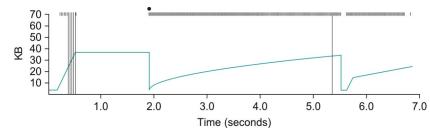
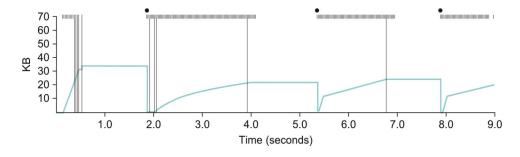
Consider the TCP trace in Figure 6.29. Identify time intervals representing slow start on startup, slow start after timeout, and linearincrease congestion avoidance. Explain what is going on from T =0.5 to T = 1.9. The TCP version that generated this trace includes a feature absent from the TCP
Suppose you are downloading a large file over a 3-kBps phone link.Your software displays an average-bytes-per-second counter. How will TCP congestion control and occasional packet losses cause this counter to fluctuate? Assume that only one-third, say, of the total RTT is spent on the phone link.
Suppose TCP is used over a lossy link that loses on average one segment in four. Assume the bandwidth × delay window size is considerably larger than four segments.(a) What happens when we start a connection? Do we ever get to the linear-increase phase of congestion avoidance?(b) Without using an
Suppose two TCP connections share a path through a router R. The router’s queue size is six segments; each connection has a stable congestion window of three segments. No congestion control is used by these connections. A third TCP connection now is attempted, also through R. The third connection
Suppose a TCP connection has a window size of eight segments and an RTT of 800 ms, the sender sends segments at a regular rate of one every 100 ms, and the receiver sends ACKs back at the same rate without delay. A segment is lost, and the loss is detected by the fast retransmit algorithm on the
Showing 200 - 300
of 2050
1
2
3
4
5
6
7
8
9
10
11
12
13
14
15
Last
Step by Step Answers

 Get 50% OFF
Claim Now
Get 50% OFF
Claim Now