New Semester
Started
Get
50% OFF
Study Help!
--h --m --s
Claim Now
Question Answers
Textbooks
Find textbooks, questions and answers
Oops, something went wrong!
Change your search query and then try again
S
Books
FREE
Study Help
Expert Questions
Accounting
General Management
Mathematics
Finance
Organizational Behaviour
Law
Physics
Operating System
Management Leadership
Sociology
Programming
Marketing
Database
Computer Network
Economics
Textbooks Solutions
Accounting
Managerial Accounting
Management Leadership
Cost Accounting
Statistics
Business Law
Corporate Finance
Finance
Economics
Auditing
Tutors
Online Tutors
Find a Tutor
Hire a Tutor
Become a Tutor
AI Tutor
AI Study Planner
NEW
Sell Books
Search
Search
Sign In
Register
study help
computer science
computer networking
Computer Networks A Systems Approach 6th Edition Larry L. Peterson, Bruce S. Davie - Solutions
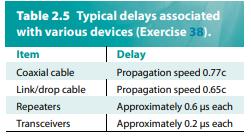
The 1982 Ethernet specification allowed between any two stations up to 1500 m of coaxial cable, 1000 m of other point-to-point link cable, and two repeaters. Each station or repeater connects to the coaxial cable via up to 50 m of “drop cable.” Typical delays associated with each device are
Coaxial cable Ethernet was limited to a maximum of 500 m between repeaters, which regenerate the signal to 100% of its original amplitude. Along one 500-m segment, the signal could decay to no less than 14% of its original value (8.5 dB). Along 1500 m, then, the decay might be (0.14)3 = 0.3%. Such
Suppose the round-trip propagation delay for Ethernet is 46.4 µs.This yields a minimum packet size of 512 bits (464 bits corresponding to propagation delay + 48 bits of jam signal).(a) What happens to the minimum packet size if the delay time is held constant and the signaling rate rises to 100
Let A and B be two stations attempting to transmit on an Ethernet.Each has a steady queue of frames ready to send; A’s frames will be numbered A1, A2, and so on, and B’s similarly. Let T = 51.2 µs be the exponential backoff base unit.Suppose A and B simultaneously attempt to send frame 1,
Suppose the Ethernet transmission algorithm is modified as follows:after each successful transmission attempt, a host waits one or two slot times before attempting to transmit again and otherwise backs off the usual way.(a) Explain why the capture effect of the previous exercise is now much less
Ethernets use Manchester encoding. Assuming that hosts sharing the Ethernet are not perfectly synchronized, why does this allow collisions to be detected soon after they occur, without waiting for the CRC at the end of the packet?
Suppose A, B, and C all make their first carrier sense, as part of an attempt to transmit, while a fourth station D is transmitting. Draw a timeline showing one possible sequence of transmissions, attempts, collisions, and exponential backoff choices. Your timeline should also meet the following
Repeat the previous exercise, now with the assumption that Ethernet is p-persistent with p = 0.33 (that is, a waiting station transmits immediately with probability p when the line goes idle and otherwise defers one 51.2-µs slot time and repeats the process). Your timeline should meet criterion
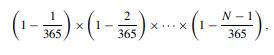
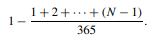
Suppose Ethernet physical addresses are chosen at random (using true random bits).(a) What is the probability that on a 1024-host network, two addresses will be the same?(b) What is the probability that the above event will occur on some one or more of 220 networks?(c) What is the probability that
Suppose five stations are waiting for another packet to finish on an Ethernet. All transmit at once when the packet is finished and collide.(a) Simulate this situation up until the point when one of the five waiting stations succeeds. Use coin flips or some other genuine random source to determine
Write a program to implement the simulation discussed above, this time with N stations waiting to transmit. Again, model time as an integer, T, in units of slot times, and again, treat collisions as taking one slot time (so a collision at time T followed by a backoff of k = 0 would result in a
Suppose that N Ethernet stations, all trying to send at the same time, require N/2 slot times to sort out who transmits next. Assuming the average packet size is 5 slot times, express the available bandwidth as a function of N.
Consider the following Ethernet model. Transmission attempts are made at random times with an average spacing of λ slot times; specifically, the interval between consecutive attempts is an exponential random variable x = −λ log u, where u is chosen randomly in the interval 0 ≤ u ≤ 1.An
How can a wireless node interfere with the communications of another node when the two nodes are separated by a distance greater that the transmission range of either node?
Why might a mesh topology be superior to a base station topology for communications in a natural disaster?
Suppose a single computer is capable of generating output data at a rate higher than Bluetooth’s bandwidth. If the computer were equipped with two or more Bluetooth masters, each with its own slaves, would that work?
When a cell phone moves from an area served exclusively by a single base station to an area where the cells of several base stations overlap, how is it determined which base station will control the phone?
Why is it important that nodes in sensor nets consume very little power?
Why is it not practical for each node in a sensor net to learn its location by using GPS? Describe a practical alternative.
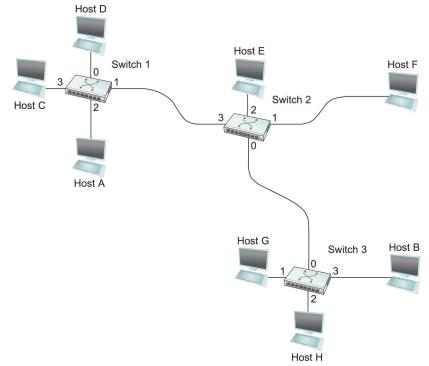
Using the example network given in Figure 3.42, give the virtual circuit tables for all the switches after each of the following connections is established. Assume that the sequence of connections is cumulative; that is, the first connection is still up when the second connection is established and
Using the example network given in Figure 3.42, give the virtual circuit tables for all the switches after each of the following connections is established. Assume that the sequence of connections is cumulative; that is, the first connection is still up when the second connection is established,
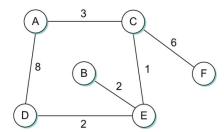
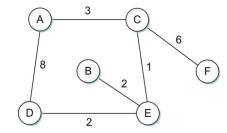
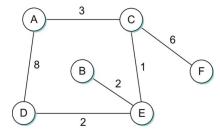
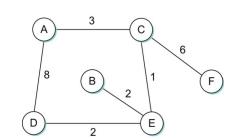
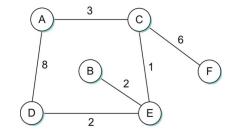
For the network given in Figure 3.43, give the datagram forwarding table for each node. The links are labeled with relative costs; your tables should forward each packet via the lowest-cost path to its destination.Figure 3.43) D A 8 3 B 2 2 1 E 6 F.
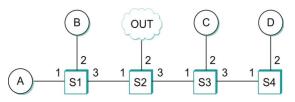
Give forwarding tables for switches S1–S4 in Figure 3.44. Each switch should have a “default” routing entry, chosen to forward packets with unrecognized destination addresses toward OUT. Any specificdestination table entries duplicated by the default entry should then be
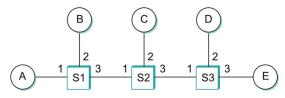
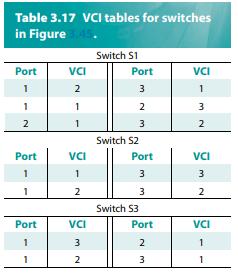
Consider the virtual circuit switches in Figure 3.45. Table 3.17 lists, for each switch, what port, {VCI} (or {VCI, interface}) pairs are connected to what other. Connections are bidirectional. List all endpoint-to-endpoint connections.Figure 3.45)Table 3.17) A 1 B 2 S1 3 1 2 S2 3 1 D 2 S3 3 E
In the source routing example, the address received by B is not reversible and does not help B know how to reach A. Propose a modification to the delivery mechanism that does allow for reversibility. Your mechanism should not require giving all switches globally unique names.
Propose a mechanism that virtual circuit switches might use so that if one switch loses all its state regarding connections, then a sender of packets along a path through that switch is informed of the failure.
Propose a mechanism that might be used by datagram switches so that if one switch loses all or part of its forwarding table, affected senders are informed of the failure.
The virtual circuit mechanism assumes that each link is point-to-point. Extend the forwarding algorithm to work in the case that links are shared-media connections, for example, Ethernet.
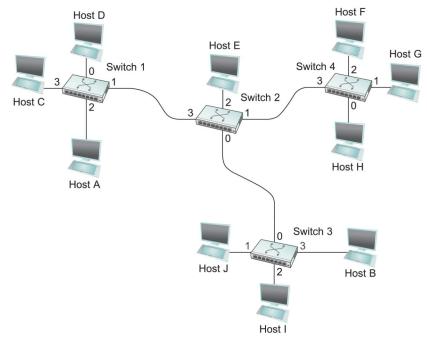
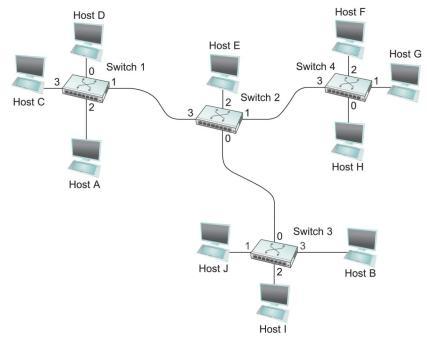
Suppose, in Figure 3.2, that a new link has been added, connecting switch 3 port 1 (where G is now) and switch 1 port 0 (where D is now);neither switch is “informed” of this link. Furthermore, switch 3 mistakenly thinks that host B is reached via port 1.(a) What happens if host A attempts to
Give an example of a working virtual circuit whose path traverses some link twice. Packets sent along this path should not, however, circulate indefinitely.
Each switch chose the VCI value for the incoming link. Show that it is also possible for each switch to choose the VCI value for the outbound link and that the same VCI values will be chosen by each approach. If each switch chooses the outbound VCI, is it still necessary to wait one RTT before data
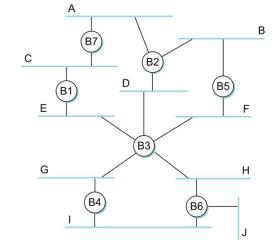
Given the extended LAN shown in Figure 3.46, indicate which ports are not selected by the spanning tree algorithm.Figure 3.46) E G A B1 1 B7 B4 D B2 (B3) B6 (B5 F H J B
Given the extended LAN shown in Figure 3.46, assume that bridge B1 suffers catastrophic failure. Indicate which ports are not selected by the spanning tree algorithm after the recovery process and a new tree has been formed.Figure 3.46) E G A B1 1 B7 B4 D B2 (B3) B6 (B5 F H J B
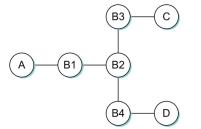
Consider the arrangement of learning bridges shown in Figure3.47.Assuming all are initially empty, give the forwarding tables for each of the bridges B1–B4 after the following transmissions:■ A sends to C.■ C sends to A.■ D sends to C.Identify ports with the unique neighbor reached directly
As in the previous problem, consider the arrangement of learning bridges shown in Figure 3.47. Assuming all are initially empty, give the forwarding tables for each of the bridges B1–B4 after the following transmissions:■ D sends to C.■ C sends to D.■ A sends to C.Figure 3.47) A B1 B3 B2
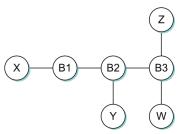
Consider hosts X, Y, Z, W and learning bridges B1, B2, B3, with initially empty forwarding tables, as in Figure 3.48.(a) Suppose X sends to Z. Which bridges learn where X is? Does Y’s network interface see this packet?(b) Suppose Z now sends to X. Which bridges learn where Z is?Does Y’s network
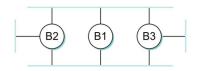
Give the spanning tree generated for the extended LAN shown in Figure 3.49, and discuss how any ties are resolved.Figure 3.49) B2 B1 B3
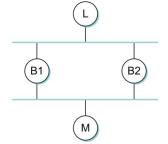
Suppose two learning bridges B1 and B2 form a loop as shown in Figure 3.50 and do not implement the spanning tree algorithm. Each bridge maintains a single table of address, interface pairs.(a) What will happen if M sends to L?(b) Suppose a short while later, L replies to M. Give a sequence of
Suppose that M in Figure 3.50 sends to itself (this normally would never happen). State what would happen, assuming:(a) the bridges’ learning algorithm is to install (or update) the new sourceaddress, interface entry before searching the table for the destination address.(b) the new source
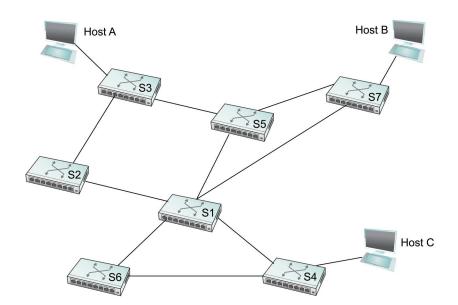
Consider the extended LAN of Figure 3.10. What happens in the spanning tree algorithm if switch S1 does not participate and(a) simply forwards all spanning tree algorithm messages?(b) drops all spanning tree messages?Figure 3.10) S2 Host A S6 $3 $1 $5 S4 Host B S7 Host C
Suppose some repeaters (hubs), rather than bridges, are connected into a loop.(a) What will happen when somebody transmits?(b) Why would the spanning tree mechanism be difficult or impossible to implement for repeaters?(c) Propose a mechanism by which repeaters might detect loops and shut down some
Suppose a bridge has two of its ports on the same network. How might the bridge detect and correct this?
What percentage of an ATM link’s total bandwidth is consumed by the ATM cell headers? Ignore padding to fill cells.
Cell switching methods (like ATM) essentially always use virtual circuit routing rather than datagram routing. Give a specific argument why this is so.
Suppose a workstation has an I/O bus speed of 800 Mbps and a memory bandwidth of 2 Gbps. Assuming DMA in and out of main memory, how many interfaces to 100-Mbps Ethernet links could a switch based on this workstation handle?
Suppose a workstation has an I/O bus speed of 1 Gbps and a memory bandwidth of 2 Gbps. Assuming DMA in and out of main memory, how many interfaces to 100 Mbps Ethernet links could a switch based on this workstation handle?
Suppose a switch can forward packets at a rate of 500,000 per second, regardless (within limits) of size. Assuming the workstation parameters described in the previous problem, at what packet size would the bus bandwidth become the limiting factor?
Suppose that a switch is designed to have both input and output FIFO buffering. As packets arrive on an input port, they are inserted at the tail of the FIFO. The switch then tries to forward the packets at the head of each FIFO to the tail of the appropriate output FIFO.(a) Explain under what
Suppose a 10-Mbps Ethernet hub (repeater) is replaced by a 10-Mbps switch, in an environment where all traffic is between a single server and N “clients.” Because all traffic must still traverse the serverswitch link, nominally, there is no improvement in bandwidth.(a) Would you expect any
What aspect of IP addresses makes it necessary to have one address per network interface rather than just one per host? In light of your answer, why does IP tolerate point-to-point interfaces that have nonunique addresses or no addresses?
Why does the Offset field in the IP header measure the offset in 8-byte units? (Hint: Recall that the Offset field is 13 bits long.)
Some signaling errors can cause entire ranges of bits in a packet to be overwritten by all 0s or all 1s. Suppose all the bits in the packet including the Internet checksum are overwritten. Could a packet with all 0s or all 1s be a legal IPv4 packet? Will the Internet checksum catch that error? Why
Suppose a TCP message that contains 2048 bytes of data and 20 bytes of TCP header is passed to IP for delivery across two networks of the Internet (i.e., from the source host to a router to the destination host). The first network uses 14-byte headers and has an MTU of 1024 bytes; the second uses
Path MTU is the smallest MTU of any link on the current path (route)between two hosts. Assume we could discover the Path MTU of the path used in the previous exercise and that we use this value as the MTU for all the path segments. Give the sizes and offsets of the sequence of fragments delivered
Suppose an IP packet is fragmented into 10 fragments, each with a 1% (independent) probability of loss. To a reasonable approximation, this means there is a 10% chance of losing the whole packet due to loss of a fragment. What is the probability of net loss of the whole packet if the packet is
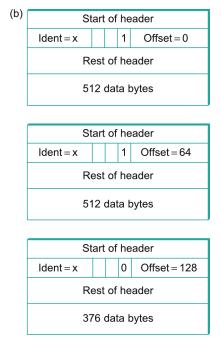
Suppose the fragments of Figure 3.19(b) all pass through another router onto a link with an MTU of 380 bytes, not counting the link header. Show the fragments produced. If the packet were originally fragmented for this MTU, how many fragments would be produced?Figure 3.19(b) (b) Start of header
What is the maximum bandwidth at which an IP host can send 576-byte packets without having the Ident field wrap around within 60 seconds? Suppose IP’s maximum segment lifetime (MSL) is 60 seconds; that is, delayed packets can arrive up to 60 seconds late but no later. What might happen if this
Why do you think IPv4 has fragment reassembly done at the endpoint rather than at the next router? Why do you think IPv6 abandoned fragmentation entirely? Hint: Think about the differences between IP-layer fragmentation and link-layer fragmentation.
Having ARP table entries time out after 10–15 minutes is an attempt at a reasonable compromise. Describe the problems that can occur if the timeout value is too small or too large.
IP currently uses 32-bit addresses. If we could redesign IP to use the 6-byte MAC address instead of the 32-bit address, would we be able to eliminate the need for ARP? Explain why or why not.
Suppose hosts A and B have been assigned the same IP address on the same Ethernet, on which ARP is used. B starts up after A.What will happen to A’s existing connections? Explain how “self-ARP”(querying the network on startup for one’s own IP address) might help with this problem.
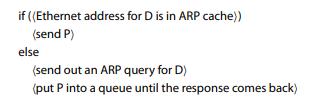
Suppose an IP implementation adheres literally to the following algorithm on receipt of a packet, P, destined for IP address D:(a) If the IP layer receives a burst of packets destined for D, how might this algorithm waste resources unnecessarily?(b) Sketch an improved version.(c) Suppose we simply
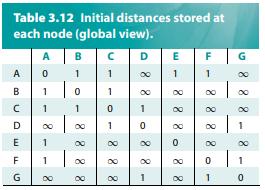
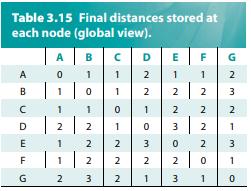
For the network given in Figure 3.51, give global distance-vector tables like those of Tables 3.12 and 3.15 when:(a) each node knows only the distances to its immediate neighbors.(b) each node has reported the information it had in the preceding step to its immediate neighbors.(c) step (b) happens
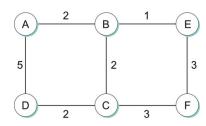
For the network given in Figure 3.52, give global distance-vector tables like those of Tables 3.12 and 3.15 when:(a) each node knows only the distances to its immediate neighbors.(b) each node has reported the information it had in the preceding step to its immediate neighbors.(c) step (b) happens
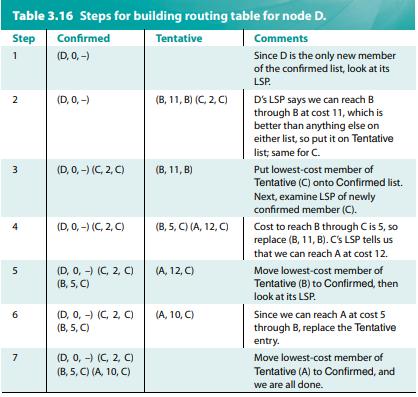
For the network given in Figure 3.51, show how the link-state algorithm builds the routing table for node D.Figure 3.51) D A 8 3 B 2 2 1 E 6 F LL
Use the Unix utility traceroute (Windows tracert) to determine how many hops it is from your host to other hosts in the Internet(e.g., cs.princeton.edu or www.cisco.com). How many routers do you traverse just to get out of your local site? Read the man page or other documentation for traceroute and
What will happen if traceroute is used to find the path to an unassigned address? Does it matter if the network portion or only the host portion is unassigned?
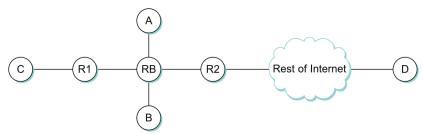
A site is shown in Figure 3.53. R1 and R2 are routers; R2 connects to the outside world. Individual LANs are Ethernets. RB is a bridge router; it routes traffic addressed to it and acts as a bridge for other traffic. Subnetting is used inside the site; ARP is used on each subnet. Unfortunately,
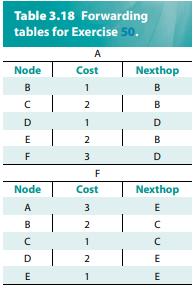
Suppose we have the forwarding tables shown in Table 3.18 for nodes A and F in a network where all links have cost 1.Give a diagram of the smallest network consistent with these tables. Table 3.18) Table 3.18 Forwarding tables for Exercise 50. A Node B D E F Node ABCDE T Cost 1 2 1 2 3 F Cost 3
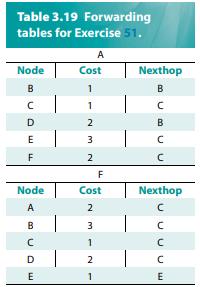
Suppose we have the forwarding tables shown in Table 3.19 for nodes A and F in a network where all links have cost 1.Give a diagram of the smallest network consistent with these tables.Table 3.19) Table 3.19 Forwarding tables for Exercise 51. A Node B D E F Node [40] A B D E Cost 1 2 3 2 F Cost
For the network in Figure 3.51, suppose the forwarding tables are all established as in Exercise 44 and then the C–E link fails. Give:(a) the tables of A, B, D, and F after C and E have reported the news.(b) the tables of A and D after their next mutual exchange.(c) the table of C after A
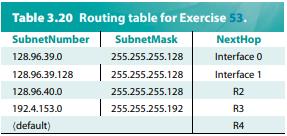
Suppose a router has built up the routing table shown in Table 3.20.The router can deliver packets directly over interfaces 0 and 1, or it can forward packets to router R2, R3, or R4. Describe what the router does with a packet addressed to each of the following destinations:(a) 128.96.39.10.(b)
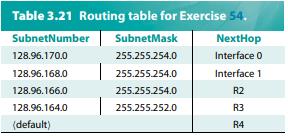
Suppose a router has built up the routing table shown in Table 3.21.The router can deliver packets directly over interfaces 0 and 1, or it can forward packets to router R2, R3, or R4. Assume the router does the longest prefix match. Describe what the router does with a packet addressed to each of
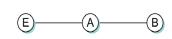
Consider the simple network in Figure 3.54, in which A and B exchange distance-vector routing information. All links have cost 1.Suppose the A–E link fails.(a) Give a sequence of routing table updates that leads to a routing loop between A and B.(b) Estimate the probability of the scenario in
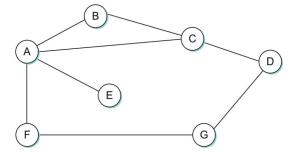
Consider the situation involving the creation of a routing loop in the network of Figure 3.30 when the A–E link goes down. List all sequences of table updates among A, B, and C, pertaining to destination E, that lead to the loop. Assume that table updates are done one at a time, that the
Suppose a set of routers all use the split-horizon technique; we consider here under what circumstances it makes a difference if they use poison reverse in addition.(a) Show that poison reverse makes no difference in the evolution of the routing loop in the two examples described, given that the
Hold down is another distance-vector loop avoidance technique, whereby hosts ignore updates for a period of time until link failure news has had a chance to propagate. Consider the networks in Figure 3.55, where all links have cost 1 except E–D with cost 10.Suppose that the E–A link breaks and
Consider the network in Figure 3.56, using link-state routing. Suppose the B–F link fails, and the following then occur in sequence:(a) Node H is added to the right side with a connection to G.(b) Node D is added to the left side with a connection to C.(c) A new link D–A is added.The failed
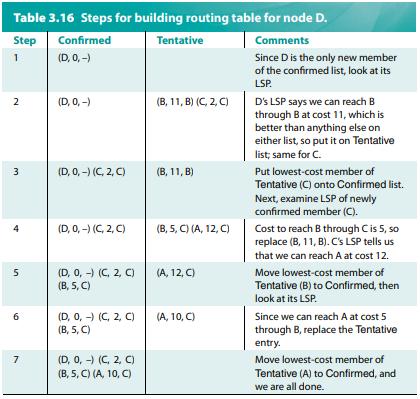
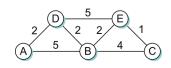
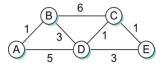
Give the steps as in Table 3.16 in the forward search algorithm as it builds the routing database for node A in the network shown in Figure 3.57.Table 3.16)Figure 3.57) Table 3.16 Steps for building routing table for node D. Step Confirmed Tentative Comments 1 (D, 0,-) Since D is the only new
Give the steps as in Table 3.16 in the forward search algorithm as it builds the routing database for node A in the network shown in Figure 3.58.Table 3.16)Figure 3.58) Table 3.16 Steps for building routing table for node D. Step Confirmed Tentative Comments 1 (D, 0,-) Since D is the only new
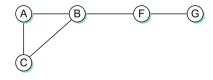
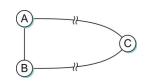
Suppose that nodes in the network shown in Figure 3.59 participate in link-state routing, and C receives contradictory LSPs: one from A arrives claiming the A–B link is down, but one from B arrives claiming the A–B link is up. (a) How could this happen? (b) What should C do? What can C expect?
Suppose IP routers learned about IP networks and subnets the way Ethernet learning bridges learn about hosts: by noting the appearance of new ones and the interface by which they arrive. Compare this with existing distance-vector router learning:(a) for a leaf site with a single attachment to the
IP hosts that are not designated routers are required to drop packets misaddressed to them, even if they would otherwise be able to forward them correctly. In the absence of this requirement, what would happen if a packet addressed to IP address A were inadvertently broadcast at the link layer?
Read the man page or other documentation for the Unix/Windows utility netstat. Use netstat to display the current IP routing table on your host. Explain the purpose of each entry. What is the practical minimum number of entries?
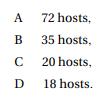
An organization has been assigned the prefix 200.1.1/24 (a class C)and wants to form subnets for four departments, with hosts as follows:There are 145 hosts in all.(a) Give a possible arrangement of subnet masks to make this possible.(b) Suggest what the organization might do if department D grows
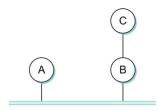
Suppose hosts A and B are on an Ethernet LAN with IP network address 200.0.0/24. It is desired to attach a host C to the network via a direct connection to B (see Figure 3.60). Explain how to do this with subnets; give sample subnet assignments. Assume that an additional network prefix is not
An alternative method for connecting host C in Exercise 67 is to use proxy ARP and routing: B agrees to route traffic to and from C, and also answers ARP queries for C received over the Ethernet.(a) Give all packets sent, with physical addresses, as A uses ARP to locate and then send one packet to
Suppose two subnets share the same physical LAN; hosts on each subnet will see the other subnet’s broadcast packets.(a) How will DHCP fare if two servers, one for each subnet, coexist on the shared LAN? What problems might [do!] arise?(b) Will ARP be affected by such sharing?
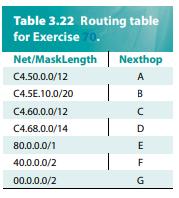
Table 3.22 is a routing table using CIDR. Address bytes are in hexadecimal. The notation “/12” in C4.50.0.0/12 denotes a netmask with 12 leading 1 bits, that is, FF.F0.0.0. Note that the last three entries cover every address and thus serve in lieu of a default route. State to what next hop the
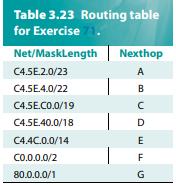
Table 3.23 is a routing table using CIDR. Address bytes are in hexadecimal. The notation “/12” in C4.50.0.0/12 denotes a netmask with 12 leading 1 bits, that is, FF.F0.0.0. State to what next hop the following will be delivered:(a) C4.4B.31.2E.(b) C4.5E.05.09.(c) C4.4D.31.2E.(d) C4.5E.03.87.(e)
An ISP that has authority to assign addresses from a /16 prefix(an old class B address) is working with a new company to allocate it a portion of address space based on CIDR. The new company needs IP addresses for machines in three divisions of its corporate network: Engineering, Marketing, and
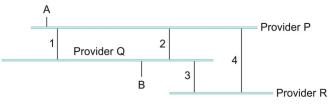
Consider the network shown in Figure 4.29, in which horizontal lines represent transit providers and numbered vertical lines are interprovider links.(a) How many routes to P could provider Q’s BGP speakers receive?(b) Suppose Q and P adopt the policy that outbound traffic is routed to the closest
Give an example of an arrangement of routers grouped into autonomous systems so that the path with the fewest hops from a point A to another point B crosses the same AS twice. Explain what BGP would do with this situation.
Let A be the number of autonomous systems on the Internet and let D (for diameter) be the maximum AS path length.(a) Give a connectivity model for which D is of order logA and another for which D is of order √A.(b) Assuming each AS number is 2 bytes and each network number is 4 bytes, give an
Propose a plausible addressing plan for IPv6 that runs out of bits.Specifically, provide a diagram such as Figure 4.11, perhaps with additional ID fields, that adds up to more than 128 bits, together with plausible justifications for the size of each field. You may assume fields are divided on byte
Suppose P, Q, and R are network service providers, with respective CIDR address allocations C1.0.0.0/8, C2.0.0.0/8, and C3.0.0.0/8. Each provider’s customers initially receive address allocations that are a subset of the provider’s. P has the following customers:PA, with allocation
In the previous problem, assume each provider connects to both others. Suppose customer PA switches to provider Q and customer QB switches to provider R. Use the CIDR longest match rule to give routing tables for all three providers that allow PA and QB to switch without renumbering.
Suppose most of the Internet used some form of geographical addressing but that a large international organization has a single IP network address and routes its internal traffic over its own links.(a) Explain the routing inefficiency for the organization’s inbound traffic inherent in this
The telephone system uses geographical addressing. Why do you think this was not adopted as a matter of course by the Internet?
Suppose a site A is multihomed, in that it has two Internet connections from two different providers, P and Q. Provider-based addressing as in Exercise 5 is used, and A takes its address assignment from P.Q has a CIDR longest match routing entry for A.(a) Describe what inbound traffic might flow on
Showing 100 - 200
of 2050
1
2
3
4
5
6
7
8
9
10
11
12
13
14
15
Last
Step by Step Answers

 Get 50% OFF
Claim Now
Get 50% OFF
Claim Now