New Semester
Started
Get
50% OFF
Study Help!
--h --m --s
Claim Now
Question Answers
Textbooks
Find textbooks, questions and answers
Oops, something went wrong!
Change your search query and then try again
S
Books
FREE
Study Help
Expert Questions
Accounting
General Management
Mathematics
Finance
Organizational Behaviour
Law
Physics
Operating System
Management Leadership
Sociology
Programming
Marketing
Database
Computer Network
Economics
Textbooks Solutions
Accounting
Managerial Accounting
Management Leadership
Cost Accounting
Statistics
Business Law
Corporate Finance
Finance
Economics
Auditing
Tutors
Online Tutors
Find a Tutor
Hire a Tutor
Become a Tutor
AI Tutor
AI Study Planner
NEW
Sell Books
Search
Search
Sign In
Register
study help
computer science
signals and systems
Signals and Systems using MATLAB 2nd edition Luis Chaparro - Solutions
Consider the full-wave rectified signaly(t) = |sin(πt)| −∞(a) As a periodic signal, y(t) does not have finite energy but it has a finite-power Py. Find it.(b) It is always useful to get a quick estimate of the power of a periodic signal by finding a bound for the signal squared. Find a bound
One of the advantages of defining the δ(t) functions is that we are now able to find the derivative of discontinuous signals. Consider a periodic sinusoid defined for all timesx(t) = cos(Ω0 t) −∞and a causal sinusoid defined as x1 (t) = cos(Ω0 t) u(t), where the
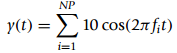
An interesting phenomenon in the generation of musical sounds is beating or pulsation. Suppose NP different players try to play a pure tone, a sinusoid of frequency 160 Hz, and that the signal recorded is the sum of these sinusoids. Assume the NP players while trying to play the pure tone end up
Consider now the Doppler effect in wireless communications. The difference in velocity between the transmitter and the receiver causes a shift in frequency in the signal, which is called the Doppler effect. Just like the acoustic effect of a train whistle as the train goes by. To illustrate the
In wireless communications, the effects of multi-path significantly affect the quality of the received signal. Due to the presence of buildings, cars, etc. between the transmitter and the receiver the sent signal does not typically go from the transmitter to the receiver in a straight path (called
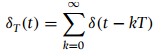
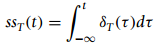
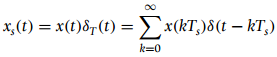
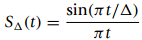
Consider the sampling signalwhich we will use in the sampling of analog signals later on.(a) Plot δT(t). Findand carefully plot it for all t. What does the resulting signal ss(t) look like? In [18] the author calls it the €œstairway to the stars.€
When defining the impulse or δ(t) signal the shape of the signal used to do so is not important. Whether we use the rectangular pulse we considered in this Chapter or another pulse, or even a signal that is not a pulse, in the limit we obtain the same impulse signal. Consider the
(a) Consider the periodic signals x1 (t) = 4cos(πt) and x2(t) = −sin(3πt +π/2). Find the periods T1 of x1 (t) and T2 of x2 (t) and determine if x(t) = x1 (t) + x2(t) is periodic. If so, what is its fundamental period T0?(b) Two periodic signals x1(t) and x2(t) have periods T1 and T2
Signal energy and RC circuit€”The signal x(t) = eˆ’ˆ£tˆ£is defined for all values of t.(a) Plot the signal x(t) and determine if this signal is finite energy.(b) If you determine that x(t) is absolutely integrable, or that the following integralis
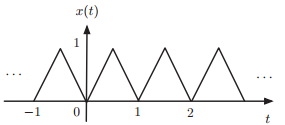
Consider the triangular train of pulses x(t) in Figure 1.23.(a) Carefully plot the derivative of x(t), y(t) = dx(t)/dt.(b) Can you computeIf so, what is it equal to? If not, explain why not.(c) Is x(t) a finite energy signal? how about y(t)?Figure 1.23: | [(x(t) – 0.5]dt? z(t) = x(t) -1 1
For a complex exponential signal x(t) =2ej2πt(a) Suppose y(t) = ejπt, would the sum of these signals z(t) = x(t) + y(t) be also periodic? If so, what is the fundamental period of z(t)?(b) Suppose we then generate a signal v(t) = x(t) y(t), with the x(t) and y(t) signals given before, is v(t)
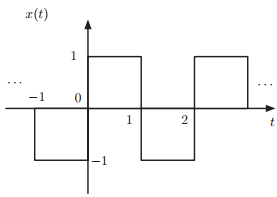
A periodic signal can be generated by repeating a period.(a) Find the function g(t), defined in 0 ‰¤ t ‰¤ 2 only, in terms of basic signals and such that when repeated using a period of 2 generates the periodic signal x(t) shown in Figure 1.22.(b) Obtain an
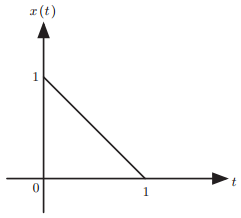
Consider the signal x(t) in Figure 1.21.(a) Plot the even-odd decomposition of x(t), i.e., find and plot the even xe(t) and the odd xo(t) components of x(t).(b) Show that the energy of a signal x(t) can be expressed as the sum of the energies of its even and odd components, i.e.,
Let x(t) = t[u(t) − u(t −1)], we would like to consider its expanded and compressed versions.(a) Plot x(2t) and determine if it is a compressed or expanded version of x(t).(b) Plot x(t/2) and determine if it is a compressed or expanded ver-sion of x(t).(c) Suppose x(t) is an acoustic
A signal x(t) is defined as x(t) = r(t + 1) ˆ’ r(t) ˆ’2u(t) + u(t ˆ’ 1).(a) Plot x(t) and indicate where it has discontinuities. Compute y(t) = dx(t)/dt and plot it. How does it indicate the discontinuities? Explain.(b) Find the integraland give the values of
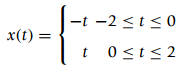
The signalcan be written as x(t) = ˆ£tˆ£p(t).(a) Carefully plot x(t) and define p(t), then find y(t) = dx(t)/dt and carefully plot it.(b) Calculateand comment on how your result relates to x(t).(c) Is it true that -t -2
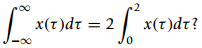
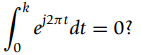
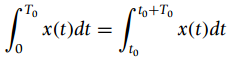
Is it true that (if not true, give correct answer)(a) for any positive integer k(b) for a periodic signal x(t) of fundamental period T0for any value of t0? Consider, for instance, x(t) =cos(2Ï€ t).(c) cos(2Ï€ t) δ(t ˆ’ 1) = 1?(d) if x(t) =
Consider the periodic signal x(t) = cos(2Ω0t) + 2 cos(Ω0t),−∞ < t < ∞, and Ω0 = π. The frequencies of the two sinusoids are said to be harmonically related.(a) Determine the period T0 of x(t). Compute the power Px of x(t) and verify that the power Px is the sum of the
Consider a circuit consisting of a sinusoidal source vs(t) = cos(t) u(t) connected in series to a resistor Rand an inductor L and assume they have been connected for a very long time.(a) Let R = 0, L = 1 H, compute the instantaneous and the average powers delivered to the inductor.(b) Let
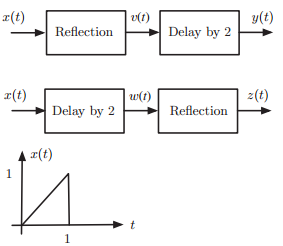
Do reflection and time-shifting commute? That is, do the two block diagrams in Figure 1.20 provide identical signals, i.e., is y(t) equal to z(t)? To provide an answer to this consider the signal x(t) shown in Figure 1.20 is the input to the two block diagrams. Find y(t) and z(t), plot them and
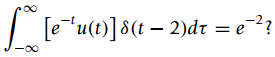
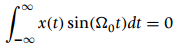
The following problems relate to the symmetry of the signal:(a) Consider a causal exponential x(t) = eˆ’t u(t). i. Plot x(t) and explain why it is called causal. Is x(t) an even or an odd signal? ii. Is it true that
Consider a finite support signal x(t) = t, 0 ≤ t ≤1, and zero elsewhere.(a) Plot x(t +1) and x(−t +1). Add these signals to get a new signal y(t). Do it graphically and verify your results analytically.(b) How does y(t) compare to the signal Ʌ(t) = (1−|t|)for −1 ≤ t ≤ 1 and zero
Showing 500 - 600
of 522
1
2
3
4
5
6
Step by Step Answers

 Get 50% OFF
Claim Now
Get 50% OFF
Claim Now


![y(t) = e?ot + ael gjøt = ei?gt m[1+ aew]](https://dsd5zvtm8ll6.cloudfront.net/si.question.images/images/question_images/1544/8/9/1/9535c152e31d3f071544874530647.jpg)


![| [(x(t) – 0.5]dt? z(t) =](https://dsd5zvtm8ll6.cloudfront.net/si.question.images/images/question_images/1544/8/8/9/2255c152389820221544871802415.jpg)



![[x(t) + x(-t)] sin(2,t)dt = 0 %3D](https://dsd5zvtm8ll6.cloudfront.net/si.question.images/images/question_images/1544/8/8/3/7585c150e2ee72f21544866335985.jpg)


