







Question: The thermal chamber transfer function C(s) E(s) = 2 (s + 0.5) of Problem 1.6-1 is based on the units of time being minutes. (a)
The thermal chamber transfer function C(s) E(s) = 2 (s + 0.5) of Problem 1.6-1 is based on the units of time being minutes.
(a) Modify this transfer function to yield the chamber temperature c(t) based on seconds.
(b) Verify the result in part (a) by solving for c(t) with the door closed and the input e(t) = 5u(t)
volts, (i) using the chamber transfer function found in part (a), and (ii) using the transfer function of Fig. P1.6-1. Show that (i) and (ii) yield the same temperature at t = 1 min.
Problem 1.6-1
A thermal test chamber is illustrated in Fig. P1.6-1(a). This chamber, which is a large room, is used to test large devices under various thermal stresses. The chamber is heated with steam, which is controlled by an electrically activated valve. The temperature of the chamber is measured by a sensor based on a thermistor, which is a semiconductor resistor whose resistance varies with temperature. Opening the door into the chamber affects the chamber temperature and thus must be considered as a disturbance.
A simplified model of the test chamber is shown in Fig. P1.6-1(b), with the units of time in minutes. The control input is the voltage e(t) , which controls the valve in the steam line, as shown. For the disturbance d(t) , a unit step function is used to model the opening of the door.
With the door closed, d(t) = 0. 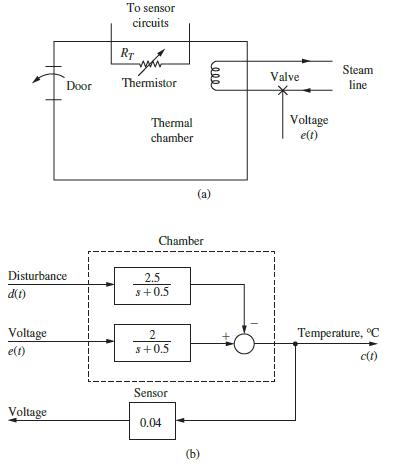
Disturbance d(t) Voltage e(t) Door Voltage To sensor circuits RT Thermistor Thermal chamber Chamber 2.5 $+0.5 2 $+0.5 Sensor 0.04 (a) ele (b) Valve Voltage e(t) Steam line Temperature, C c(t)
Step by Step Solution
3.39 Rating (171 Votes )
There are 3 Steps involved in it
a t 2min 120s Cs 4 4 00333 Es ts1 2s1 120... View full answer

Get step-by-step solutions from verified subject matter experts
 Study Help