New Semester
Started
Get
50% OFF
Study Help!
--h --m --s
Claim Now
Question Answers
Textbooks
Find textbooks, questions and answers
Oops, something went wrong!
Change your search query and then try again
S
Books
FREE
Study Help
Expert Questions
Accounting
General Management
Mathematics
Finance
Organizational Behaviour
Law
Physics
Operating System
Management Leadership
Sociology
Programming
Marketing
Database
Computer Network
Economics
Textbooks Solutions
Accounting
Managerial Accounting
Management Leadership
Cost Accounting
Statistics
Business Law
Corporate Finance
Finance
Economics
Auditing
Tutors
Online Tutors
Find a Tutor
Hire a Tutor
Become a Tutor
AI Tutor
AI Study Planner
NEW
Sell Books
Search
Search
Sign In
Register
study help
engineering
modern electrodynamics
Modern Electrodynamics 1st Edition Andrew Zangwill - Solutions
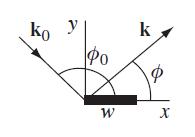
A thin and infinitely long, perfectly conducting strip occupies the area 0 ≤ x ≤ w of the y = 0 plane. A monochromatic plane wave polarized along +z scatters from the strip as shown below. Assume specular reflection and let ω = ck = ck0.(a) Find the physical optics surface current density.(b)
A linearly polarized plane wave with electric field amplitude E0 is incident on a small, perfectly conducting sphere. Use the dipole moment information provided in Problem 21.5 and find the angle between the scattering wave vector k and the incident wave vector k0 where the radiated electric
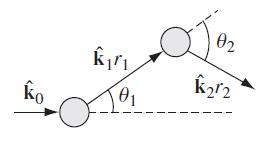
A long-wavelength, left circularly polarized, monochromatic plane wave scatters into the direction k̂1 from a uniform dielectric sphere with radius a and polarizability α. The scattered wave travels a distance r1 >> a and scatters from an identical sphere into the direction k̂2. Find the
The pulsar SGR1806-20 has a period T = 7.5 sec and a “spindown” rate of |Ṫ| = 10−11. Estimate the maximum magnetic field strength |B| at the surface of this pulsar by assuming that the rotational kinetic energy (M = 3 × 1030 kg and R = 103 m) is dissipated by magnetic dipole
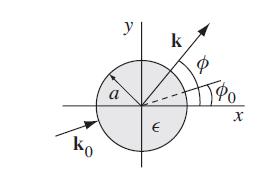
The symmetry axis of an infinitely long dielectric cylinder with radius a and permittivity coincides with the z-axis. Amonochromatic wave withwave vector k0 is normally incident on the cylinder as shown below. Find the electric field everywhere if the incident wave is polarized in the z-direction.
(a) Place a perfectly conducting sphere with radius a in a uniform electric field E0 and let an origin centered electric dipole field represent the field produced by the sphere. Use this information to deduce that p = 4πϵ0a3E0 is the dipole moment induced in the sphere.(b) Place the sphere in a
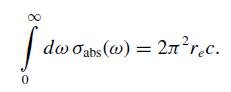
A monochromatic plane wave scatters from a Lorentz atom where a bound electron obeys the classical equation of motion Assume that the electron displacement and damping are both very small. If re = e2/4π ϵ0mc2 is the classical electron radius, show that the integrated total absorption cross
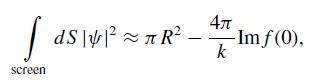
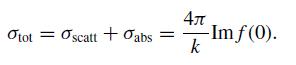
A unit-amplitude, monochromatic plane wave of a scalar field ψ(r) scatters from an origin-centered obstacle of finite size. Apart from a factor of exp(−iωt ), the field takes the asymptotic formFocus on the almost-forward direction where θ > z/k collects the energy of the wave at a distance
Three identical point charges q are glued to the corners of an equilateral triangle that lies in the x-y plane. The charges rotate with constant angular velocity ω around the z-axis, which passes through the center of the triangle. Find the angular distribution of electric dipole, magnetic dipole,
Two point particles with masses m1 and m2 and charges q1 and q2 move slowly toward one another. For what choices of mass and charge is this motion not accompanied by dipole radiation?
(a) Compare the conservation laws for energy and linear momentum for a spherical volume. Use this to define an angular distribution of the rate at which electromagnetic waves radiate linear momentum, dPEM/dt dΩ, by analogy with the definition of the angular distribution of the rate at which
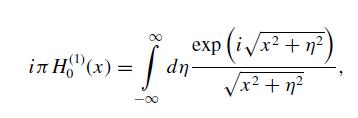
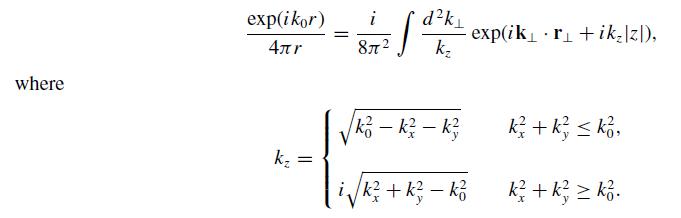
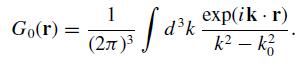
This problem outlines a contour integration method to prove thatSee Problem 8.23 for another method.(a) The left side of the Weyl identity is the free-space Green function, G0(r), which satisfies (∇2 + k20)G0(r) = −δ(r). Fourier transform this differential equation and show that(b) Use contour
(a) Integrate the differential cross sections derived in the text to find the total scattering cross sections σΙΙ and σ⊥ for an infinitely long and perfectly conducting cylinder with Einc oriented, respectively, parallel and perpendicular to the cylinder axis.(b) In two dimensions, the
Find the total scattering cross section when a circularly polarized wave scatters from an electron bound to a point in space by a spring with spring constant k. Assume that the amplitude of the incident wave is not large.
Let q = k0 − k be the scattering vector defined in Example 1.2. If aB is the Bohr radius, show that the cross section for plane wave scattering from a hydrogen atom is proportional to the factor [1 + (qaB/2)2]−4.Example 1.2:Prove that ∇ × (A × B) = A∇ · B − (A · ∇)B + (B · ∇)A
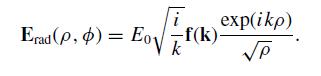
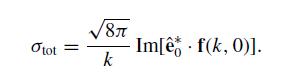
An incident plane wave ê0 E0 exp[i(k0 · r − ωt)] scatters from a target with amplitude f(k). One can prove that f(k0) · ê∗0/k2 is a causal response function of the sort discussed in Section 18.7. Use this information to prove the wavelength sum rule, lim Re [f(x, ko). ê]
In one of his papers devoted to the color of skylight, Lord Rayleigh used physical reasoning and dimensional analysis to deduce the wavelength dependence of the intensity of light scattered by a particle in the atmosphere. Invent Rayleigh’s argument, beginning with his assumption that the ratio
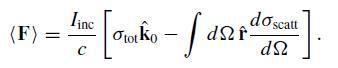
An object scatters an incident plane wave with Einc(r, t) = ê0E0 exp[i(k0 · r − ωt)]. Use the Maxwell stress tensor formalism to show that the time-averaged force on the object can be written in terms of the incident wave intensity Iinc, the total cross section σtot, and the differential
A linearly polarized, monochromatic plane wave scatters from a polar molecule by exerting a torque that sets the molecule into motion. Treat the molecule as an electric dipole with moment p and moment of inertia I . Ignore terms quadratic in the (very slow) angular velocity of the molecule and
A low-frequency, plane electromagnetic wave Rayleigh scatters from a sphere with radius a and conductivity σ. Assume that the skin depth δ >> a.(a) Find the electric dipole moment induced in the sphere by the incident wave.(b) Calculate the absorption cross section of the sphere.(c) Show
A plane wave propagating in the +x-direction with electric field E0 strikes a thin metal screen at x = 0 and diffracts from a long and narrow horizontal slit (width a) cut out of the screen. The scattering vector k lies in the x-y plane (perpendicular to the long direction of the slit) at an angle
A monochromatic plane wave with electric field amplitude E0 is incident on a perfectly conducting object with an arbitrary shape. Prove that the electric field radiated in the backward direction is parallel to E0 in the physical optics approximation.
A plane wave E0 exp[i(k0 · r − ωt)] scatters from a dielectric cube with volume V = a3 and electric susceptibility χ << 1. Two cube edges align with k0 and E0.(a) Calculate the differential scattering cross section in the Born approximation.(b) Show that σBorn ≈
Show that σabs = (ω/c)Imα is the frequency dependent absorption cross section for a microscopic object (atom, molecule, or nucleus) with polarizability α.
Let u = dr/dt be the velocity of a particle observed in an inertial frame K. The same quantity observed in an inertial frame K' moving with velocity v with respect to K is u' = dr'/dt'.(a) Use the transformation properties of dt, rΙΙ, and r⊥ directly to derive the velocity addition rule,(b)
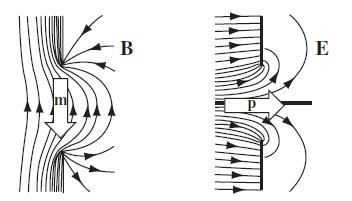
Let z = 0 be a perfect conductor except for an aperture whose size is very small compared to the wavelength of a plane wave incident from z ΙΙ, the component of the exact electric field in the plane of the aperture. Are your results consistent with Figure 21.21? - B E
A monochromatic plane wave with fields E0 and B0 scatters from a thin conducting disk of radius a. In the long-wavelength limit, the scattered field is described by electric and magnetic dipole radiation fields with momentsThe unit vector n̂ points in the direction of the incident wave propagation
The text exploits the homogeneity of space to conclude that the Lorentz transformation must be linear. Some authors state that this conclusion also follows if we demand that uniform rectilinear motion in K corresponds to uniform rectilinear motion in K'. Show, to the contrary, that the same
(a) Consider the electric field diffracted by a circular aperture of radius a using a Kirchoff approximation where Einc = E0 exp(−ρ2/ω2)ŷ in the plane of the aperture. Show that the far-zone field still has a Gaussian profile when the beam waist ω << a.(b) Repeat the calculation
Use the transformation properties of the four-vectors and directly toprove that A
A monochromatic plane wave polarized along ˆy is normally incident from z < 0 onto a two-dimensional conducting scatterer confined to the z = 0 plane. Use Kirchoff’s approximation but do not use the Fraunhofer approximation.(a) Let the scatterer be a conducting disk of radius a. Find Edisk(0,
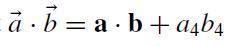
Let be two four-vectors. Show that the scalar product is a Lorentz invariant scalar. It will be convenient to write a = aΙΙ + a⊥ and similarly for b. à = (a, a4) and b = (b, b4)
Show by explicit calculation that the formulae for the charge and current densities of a collection of point charges,have exactly the same form when we boost from frame K to frame K' by a velocity v0.Show first thatby evaluating the Jacobian determinant in the volume element transformation N N p(r,
Let Δz and Δt be the difference between the space coordinates and the time coordinates of a pair of events. Show that, for at least some pairs of events, a Lorentz transformation of these differences does not reduce to a Galilean transformation in the limit of very low boost speed. Are the events
(a) Boost from the laboratory frame K to the rest frame K' to find the vector potential A(r, t) and the scalar potential ϕ(r, t) for a charged particle q which moves with constant velocity v when viewed from the laboratory.(b) Find E and B in the laboratory frame using the potentials computed in
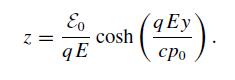
A point particle with charge q and mass m moves in response to a uniform electric field E = Eẑ. The initial energy, linear momentum, and velocity are ε0, p0, and u(0) = u0 ŷ. Find r(t ) and show that eliminating t gives the particle trajectoryCheck the non-relativistic limit.
(a) Use the four-vector character ofand the Lorentz transformation laws for B and E to deduce that the scalar and vector potentials form a four-vector (A, iϕ/c). This reverses the methodology followed in the text.(b) Show that the spherical equipotentials of a stationary point charge distort to
Let A(Vector) be a four-vector and let (B1,B2,B3,B4) be an ordered set of four variables with unknown properties. Prove that this set constitutes a four-vector B(Vector) if Aμ Bμ is a Lorentz invariant scalar for any choice of A(Vector).
The charged particles of an infinitely long and filamentary wire produce a linear charge density λ' and a current I'. Let the vector I' = I' ẑ indicate the direction of current flow.(a) What is the current I and linear charge density λ measured in the laboratory frame when the wire moves with
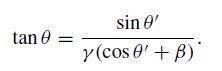
The position of a star in the heavens is determined by the direction of the propagation vector of the light it emits. Let inertial frame K' move with velocity v with respect to K. If k · v = kν cos θ and k' · v = k 'ν cos θ , show that tan 0 = sin 0' y (cos 0' + B)
A static charge distribution ρ(r) generates an electric field E(r) in the frame K'. Set the distribution into motion with velocity v = νx̂ as viewed from the laboratory frame K.(a) Let uEM be the electromagnetic energy density. Show that ∂uEM/∂t' = 0. Use this fact to show that ∇ ·
For some event, observer A measures E = (α, 0, 0) and B = (α/c, 0, 2α/c) and observer B measures E' = (E'x, α, 0) and B' = (α/c, B'y, α/c). Observer C moves with velocity νx̂ with respect to observer B. Find (a) The fields E' and B' measured by observer B; (b) The fields E" and B"
Establish the covariance of the four vacuum Maxwell equations the “hard way” by using the transformation properties of the derivatives, the fields, and the charge and current density. Let the boost be in an arbitrary direction β = v/c.
(a) Use the transformation laws for E and B to show that E · B is a Lorentz invariant. (b) Find the boost velocity v from K to K' so that the field is purely electric or purely magnetic in K if E⊥B and E = cB in S.(c) Static fields E = E0 ˆy and cB = E0(ŷ cos θ + ẑ sin θ) exist in
(a) A small current loop moves with constant velocity v0 as viewed in the laboratory frame. Find the vector potential A(r) and the scalar potential ϕ(r) in the lab frame. It may be convenient to introduce the vector R = r − v0t.(b) Take the limit ν0 << c in your formulae and deduce
Use the inertial-frame transformation laws for the polarization P and magnetization M to deduce the electric dipole moment p and magnetic dipole moment m observed in the laboratory for a body that moves with velocity v. Assume that the body has non-zero values for both these moments in its own rest
Show that a TE (TM)waveguide mode remains a TE (TM)waveguide mode for a Lorentz boost along the propagation direction of a straight waveguide.
Surprisingly good astronomical mirrors can be constructed from a rotating dish of liquid mercury. Consider a ray of light incident on such a mirror at an arbitrary angle. Treat the mirror surface as locally flat but moving with a linear velocity v at the point of reflection. Show that, when
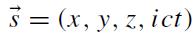
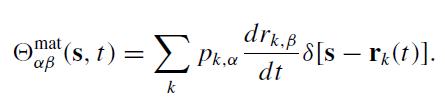
A set of particles has charges qk , masses mk , and positions rk(t ). Let be the space-time four-vector and define . The components of the stress-energy tensor for this system are the sum of the density and current density of energy-momentum of the individual particles:(a) Prove that Θmat αβ =
A plane wave in vacuum with electric field E0 = x̂E0 exp[i(k0z − ω0t)] reflects at normal incidence from a mirror which moves at constant speed νẑ. Derive the results found in Application 22.4 for the frequency and electric field amplitude of the reflected wave using a method which
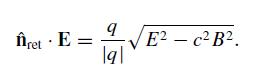
This problem reconstructs the trajectory r0(t) of a charged particle from the fields produced by the particle at observation points where the magnetic field does not vanish.(a) Use cB = n̂ret × E to deduce thatThe Li´enard-Wiechert electric field determines the factor q/|q|. (b) Use the
(a) Consider a wave with dispersion relation ω(k). Show that the group velocity u = ∇kω transforms under a Lorentz transformation exactly like a particle velocity.(b) Show that the phase velocity up = (ω/k)k̂ transforms under a Lorentz transformation exactly like a particle velocity when ω =
(a) Use direct integration to show that a radiating charge q emits energy at the rateIn this expression, S is the Poynting vector, β = v/c, a = v̇, g = 1 − n̂ · β, and γ = 1/ √1 − β2. The integration is carried out over the surface A of an enormously large sphere.(b) Use direct
A flat-screen photodetector continuously absorbs energy from a plane wave (frequency ω) when the wave strikes the screen (area A) at normal incidence. Use the lab frame (where the detector is at rest) and a frame moving uniformly in the direction of the wave to study the total energy UEM absorbed
The scalar and vector potentials satisfy the homogeneous wave equation in free space. Often, we choose ϕ = 0 and require that the polarization vector e of the vector potential be transverse to its wave vector: e · k = 0. This is not a Lorentz invariant requirement. However, consider a plane wave
At a single space-time point, it is always possible to orient the space axes so Ez = Bz= 0 and E · B = EB cos θ.(a) Under these conditions, diagonalize μν and show that the two distinct eigenvalues are(b) Show that part (a) implies that the electromagnetic energy density at the space-time
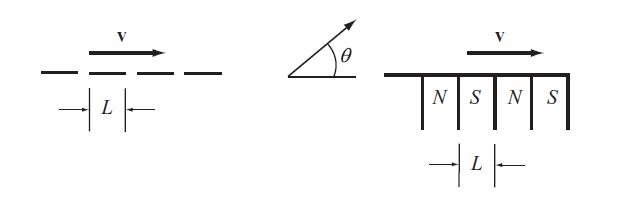
(a) The side view to the left below shows an electron with velocity v = νẑ skimming over a diffraction grating composed of a periodic array of metal strips with periodicity L. Explain why radiation is produced. Use a constructive interference argument to show that the radiation is observed at an
For a monochromatic plane wave, the vectors (E,B, k) form a right-handed orthogonal triad. Prove that this is a Lorentz invariant statement because GμνFμν is a Lorentz scalar and kμFμν is a four-vector.
Backward The success of the “working backward” method used in the text to find the Lagrangian for a charged particle in an external electromagnetic field is not obvious. Helmholtz proved in 1887 that a Lagrangian description exists for a general position- and velocity-dependent force with
Evaluate the Lorentz invariant ΘμνΘμν in an arbitrary inertial frame. Identify a type of electromagnetic field where this invariant is zero.
A point charge oscillates with the trajectory r0(t ) = a cos(ω0 t)ẑ. Find the angular distribution of power radiated into the mth harmonic, dPm/dΩ, during one period of the motion. Which harmonics dominate in the non-relativistic limit? Two Bessel function identities will be useful:
Show by direct integration (in the laboratory frame) that the electric field of a point charge q moving with constant speed ν in the x-direction satisfies Gauss’ law in integral form.
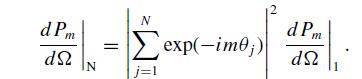
N identical point particles, each with charge q, move in a circle of radius a. The angular position of the jth particle is φj(t) = ω0(t − t0) + θj.(a) Prove that the power spectrum satisfies N identical point particles, each with charge q, move in a circle of radius a. The angular position of
A point charge q moves along a specified trajectory r0(t) with velocity v(t) = ṙ0(t). For each choice of t , show that the equation tret = t − |r − r0(tret)|/c has exactly one solution for the retarded time tret, provided |v(t )| < c.
Model the beta decay reaction n → p + e + v̅e as the abrupt creation of an electron at t = 0 with constant velocity v = cβ.(a) Find the angular distribution of energy radiated per unit frequency, dI/dΩ. Use θ for the angle between v and the observation point. (b) Show that the total
An effective force between two nucleons used to analyze scattering data can be derived from a non-relativistic Hamiltonian that depends only on the relative coordinate r = |r1 − r2| between the nucleons and the corresponding radial momentum p:(a) Treat r and p as canonically conjugate and derive
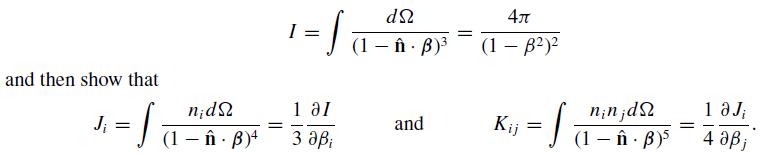
Show that the angular distribution of power emitted by a moving point charge transforms likeUse the fact that (Prad, iUrad/c) is a four-vector for a finite volume of radiation. dP dΩ = y ² (1+B cos 0¹)³dP' dΩ 1 dP' y4(1 + ß cos 0)³ d'
Prove that the “velocity” part of the Lie'nard-Wiechert electric field points to the observer from the “anticipated position” of the moving point charge. The latter is the position the charge would have moved to if it retained the velocity vret from t = tret to the present time of
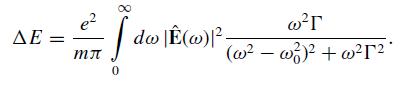
A charged particle produces an electric field E(r, t) as it passes by an isolated atom. Model a bound electron in the atom as a damped harmonic oscillator with natural frequency ω0 and damping constant Γ". Assume that the electric field induces small-amplitude, nonrelativistic motion of the bound
In 1880, Rudolf Clausius proposed a Lagrangian for a collection of charged particles moving in an external electromagnetic field. If rαβ = rα − rβ, the Clausius Lagrangian is(a) Show that LC follows from the Lagrangian L0 for a collection of charges in an external field if one usesthe static
A particle with charge q follows a periodic trajectory where r0(t) = r0(t + T). If ω0 = 2π/T , prove that the angular distribution of the average power radiated into the mth harmonic during one period of the motion is d Pm dΩ = Moq²m²w 32πªc fx 2π/00 ! 0 dt v(t)exp{-imwo[fro(t)/ct]}
(a) Calculate Fμν = ∂μAν − ∂νAμ from the Li´enard-Wiechert potential Aμ. Express the result in terms of Rμ, the four-velocity Uμ, and the four-acceleration ∂Uμ/∂τ . It will be useful to evaluate ∂μ(RσRσ) in order to show that ∂μτ = Rμ/(RσUσ).(b) Show that the
A particle with charge q and mass m moves in a uniform external magnetic field B. Find the total rate at which the particle loses energy by radiation when its motion is relativistic.
A non-relativistic charged particle begins at rest, moves in a straight line, and then comes back to rest. The total journey of distance d takes a time T to complete. (a) Find the total amount of energy radiated if the particle accelerates at a constant rate for half the journey and
A non-relativistic particle with charge q, mass m, and initial speed v0 collides head-on with a fixed field of force. The force is Coulombic with potential V (r) = Ze2/r. Integrate Larmor’s formula to show that the total energy lost by the particle to radiation is ΔE = 2mv50/45π
A non-relativistic particle with charge q performs circular cyclotron motion in a uniform magnetic field B = Bẑ. Include the radiation reaction force in the equation of motion and solve it assuming that the motion remains approximately circular. Find the time constant for the decay of the
The Lagrangian density,was introduced by Boris Podolsky in 1942 as a generalization of Maxwell theory which preserves the linear character of the ⅘field equations yet avoids certain unwanted divergences.(a) Apply Hamilton’s principle and derive generalized Lagrange equations appropriate to a
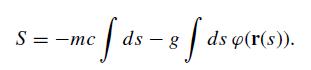
The action for a relativistic point particle coupled by a strength g to a space-time-dependent Lorentz scalar field ϕ(x) isFind the equation of motion for the particle. How does the force on the particle differ from the Coulomb force of an electric field? -me fds-8 fds 40 ds (r(s)). S = -mc
A non-relativistic particle with charge q follows a trajectory r0(t) = R[x̂ cos(ω1t) cos(ω2 t) + ŷ sin(ω2t)]. Identify the frequencies at which dipole radiation occurs.
Write Larmor’s formula for the power radiated by a charged particle in a manifestly covariant form which explicitly displays the electromagnetic field experienced by the particle. Evaluate this formula in an inertial frame where the particle has velocity cβ.
An electron enters and exits a capacitor with parallel-plate separation d through two small holes. The electron velocity νẑ is parallel to the capacitor electric field E and the change in the electron velocity is small. Calculate the total energy ΔU'EM and linear momentum
(a) The Lagrangians L and L + d Λ/dt produce the same Lagrange equations if Λ = Λ (qk, t). What happens if = (˙qk, qk, t)?(b) Not all equivalent Lagrangians differ by a total time derivative. Find a Lagrangian which yields the same equations of motion as L = ˙x ˙y − xy but does not differ
Find the equation of motion for the scalar field φ(r, t) if the Lagrangian density is(a)(b) ΦΔ - Pi = I
The free-field Lagrangian density,with = ℓ −h/mc, was introduced by Alexandre Proca in 1936 as an alternative to Dirac’s theory of the positron. Today, it serves as a model for electrodynamics with a photon with mass m when matter-field coupling is added to get the total Lagrangian density,
A model for an electrodynamics which respects gauge invariance but violates Lorentz invariance supplements the usual Maxwell Lagrangian with terms drawn from a four-vector (a) Find the restrictions that must be imposed on d(vector)to ensure that a gauge transformation does not alter the
Treat the ten scalar functions in the set (ϕ,A,E, B) as independent generalized coordinates in the Lagrangian density(a) Show that the Lagrange equations produce all four Maxwell equations directly.(b) Identify the primary constraints associated with L. C(¢,A,E,B)=j•A− p¢ − =€(E? –
A one-dimensional field theory with scalar potential ϕ (x, t) is characterized by the actionFind the equation of motion for ϕ (x, t) by both Lagrangian and Hamiltonian methods. [+-- / (*) - (*) z] xpop [ [ 7=s
Construct a covariant expression for the rate at which a moving charged particle loses total energy-momentum Pμ = (Prad, iUrad/c). Evaluate your expression in an arbitrary inertial frame as a check.
An electron is scattered by an electromagnetic plane wave E0 exp[i(k · r − ωt)]. Show that radiation reaction induces a small, time-averaged, self-Lorentz force on the electron which may be interpreted as radiation pressure exerted by the wave. Express the force is terms of the Thomson
A system with Lagrangian L = L(q, q̇) and canonical momentum p = ∂L/∂q̇ exhibits a primary constraint ψ (p, q) = 0. If u(p, q) is an arbitrary function, show that the Lagrange equation and the primary constraint together imply Hamilton’s equations for a “primary Hamiltonian”, HP =
Show that the Lagrangian L(r, v) = −mc2/γ + ev · A(r, t) − eϕ(r, t) predicts the correct relativistic equation of motion for a point particle with mass m and charge e.
Let Ω = ∇ · A + (1/c2)∂ϕ/∂t. Fermi showed that one can use a Lagrange parameter λ to impose the Lorenz gauge condition Ω = 0 using the Lagrangian density(a) Show that the Lagrange equations for the potentials are modified inhomogeneous wave equations.(b) Find the corresponding modified
The scalar pμpμ = −m2c2 is Lorentz invariant because it is the magnitude of a four-vector. Use the covariant equation of motion for a point charge in an electromagnetic field to prove, independently, that pμpμ is a constant, independent of proper time.
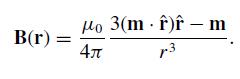
Expand the integrand of the Biot-Savart formula for the magnetic field and show that B(r) very far from a localized source of current is exactly the dipole magnetic field B(r) = Ho 3(m ) m r.3 4л
Let m1, m2, and m3 be three point dipoles.(a) Find the constraints that must be imposed on the mα and their positions rα if the asymptotic magnetic field is octupolar.(b) Show that one class of solutions places all the dipoles (with suitable magnitudes) on a line (separated by suitable distances)
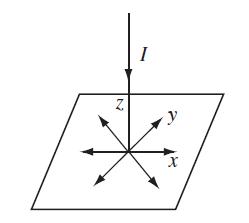
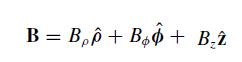
The figure below shows a current I which flows down the z-axis from infinity and then spreads out radially and uniformly to infinity in the z = 0 plane.(a) The given current distribution is invariant to reflection through the y-z plane. Prove that, when reflected through this plane, the cylindrical
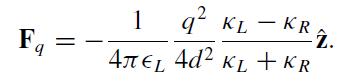
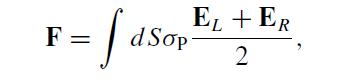
The half-plane z L and the half-plane z > 0 has dielectric constant κR. Embed a point charge q on the z-axis at z = − d. The text computed the force on q to be(a) Use the stress tensor formalism to show that the force on the z = 0 interface is equal in magnitude but opposite in direction to
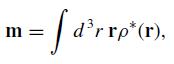
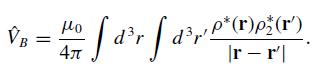
(a) Show that the magnetic dipole moment of a magnetized body can be writtenwhere ρ∗(r) = −∇ ·M(r) is the density of fictitious magnetic charge.(b) Let B1 and B2 be the magnetic fields produced by bodies with magnetizations M1 and M2, respectively. Use the fact that magnetization current
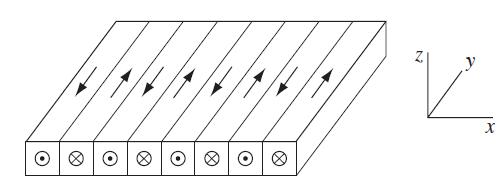
(a) Show that the Helmholtz theorem representation of the magnetization M(r) is equivalent to the equation BM = μ0(HM + M).(b) The figure shows a thin film (infinite in the x and y directions) where alternating strips have constant magnetization M = ± Mŷ. Find B(r) and H(r) everywhere and
The half-space z > 0 has uniform magnetization M = −Mẑ. The half-space z < 0 has uniform magnetization M = + Mẑ. Find the magnetic field B at every point in space using (a) The method of magnetization current and (b) The method of effective magnetization charge.
Showing 200 - 300
of 568
1
2
3
4
5
6
Step by Step Answers

 Get 50% OFF
Claim Now
Get 50% OFF
Claim Now








![[V x (A x B)]; = Eijkdj (A x B)k = EijkEkst dj(A, B)](https://dsd5zvtm8ll6.cloudfront.net/si.question.images/images/question_images/1695/4/4/8/409650e7d590a2fe1695448406658.jpg)
![[V x (A x B)]; = kijkstdj (A B) = (dis8jt Sit&js) (AjB + B As).](https://dsd5zvtm8ll6.cloudfront.net/si.question.images/images/question_images/1695/4/4/8/434650e7d72bf6541695448433209.jpg)
![[V x (A x B)]; = A A + Bj A B A.](https://dsd5zvtm8ll6.cloudfront.net/si.question.images/images/question_images/1695/4/4/8/455650e7d872b5001695448453614.jpg)