New Semester
Started
Get
50% OFF
Study Help!
--h --m --s
Claim Now
Question Answers
Textbooks
Find textbooks, questions and answers
Oops, something went wrong!
Change your search query and then try again
S
Books
FREE
Study Help
Expert Questions
Accounting
General Management
Mathematics
Finance
Organizational Behaviour
Law
Physics
Operating System
Management Leadership
Sociology
Programming
Marketing
Database
Computer Network
Economics
Textbooks Solutions
Accounting
Managerial Accounting
Management Leadership
Cost Accounting
Statistics
Business Law
Corporate Finance
Finance
Economics
Auditing
Tutors
Online Tutors
Find a Tutor
Hire a Tutor
Become a Tutor
AI Tutor
AI Study Planner
NEW
Sell Books
Search
Search
Sign In
Register
study help
engineering
modern electrodynamics
Modern Electrodynamics 1st Edition Andrew Zangwill - Solutions
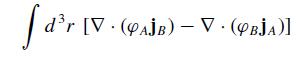
The correct form of the interaction energy between two current carrying circuits was much debated in the 1870s by Maxwell and the German theoretical physicists Carl Neumann, Wilhelm Weber, and Hermann Helmholtz. If ds1 is a line element of circuit 1 and ds2 is a line element of circuit 2, all of
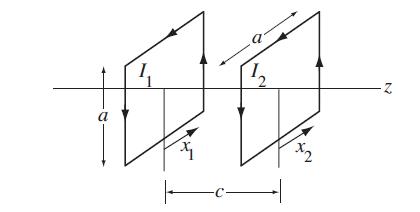
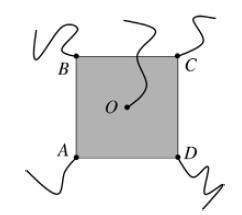
The figure shows two square, current-carrying loops with side length a and center-to-center separation c. The currents I1 and I2 circulate in the same direction.(a) Evaluate Neumann’s integral and show that the mutual inductance between the loops is(b) Show that the force of attraction between
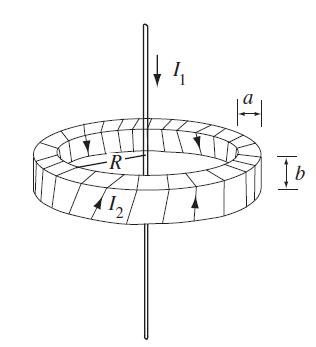
A straight wire carries a current I1 down the symmetry axis of a toroidal solenoid with a rectangular cross section of area ab. The solenoid has inner radius R and is composed of N turns of a wire that carries a current I2.(a) Find the mutual inductance of the coil with respect to the wire.(b) Find
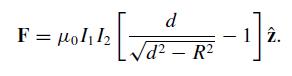
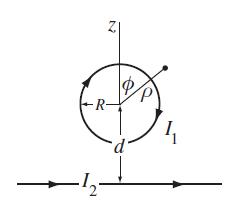
A circular loop of radius R carries a current I1. A straight wire with a current I2 in the plane of the loop passes a distance d from the loop center.(a) Use an energy method to show that the force on the loop is(b) Interpret your force formula in the limit d >> R in the language of magnetic
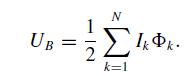
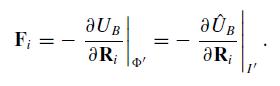
Consider a collection of current loops whereUsing the notation of the text for variables that are to be held constant in partial derivatives, prove that the magnetic force exerted on the ith loop satisfies UB || 1 2 N k=1 Ι.Φ.
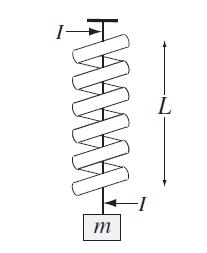
(a) Use an energy method to determine how much current must be passed through the coil if it is to remain unstretched when a mass m is hung from its bottom end. Neglect stray fields at the ends of the coil and purely mechanical forces which might produce a “spring constant”.(b) Give a simple
A filamentary wire carries a current along the positive z-axis in the presence of a constant magnetic field B = B0 x̂ + B'ẑ.(a) Find the straight line in space along which the magnitude of the total magnetic field has an absolute minimum.(b) Find the frequency of small oscillations in the
Two infinite, straight, parallel wires, each carrying current I in the same direction, are coincident with the lines (1, 0, z) and (−1, 0, z). In addition, there is a large external field B0 = B0 ẑ. An atom (mass M) whose magnetic dipole moment m0 is always anti-parallel to the local magnetic
The LevitronTM is a toy in which a spinning magnetic top floats stably in air above a magnetized base. The potential energy of this system is V̂B(r) = Mgz − m · B(r) if we model the top as a point magnetic dipole with moment m and mass M moving in the magnetic field of the base. A
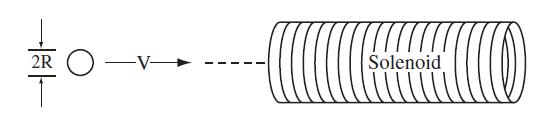
A superconducting sphere (radius R) placed in a uniform magnetic field B spontaneously generates currents on its surface which produce a dipole magnetic field. The field is equivalent to that produced by a point dipole at the center of the sphere with magnetic moment m = −(2π/μ0)R3B. Suppose
Two identical point dipoles m = mẑ sit rigidly at (±a, 0, 0). A third point dipole M is free to rotate at its fixed position (0, y, z). Find the Cartesian components of M which correspond to stable mechanical equilibrium.
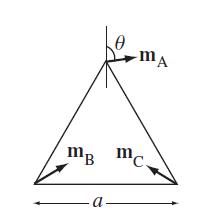
The diagram shows three small magnetic dipoles at the vertices of an equilateral triangle. Moments mB and mC point permanently along the internal angle bisectors. Moment mA is free to rotate in the plane of the triangle. Find the stable equilibrium orientation of the latter and the period of
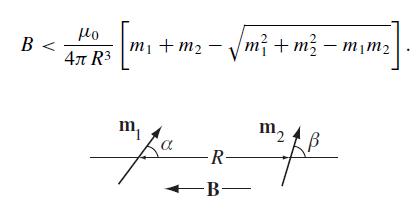
Two point dipoles m1 and m2 on the x-axis are separated by a distance R and misaligned from the positive x-axis by small angles α and β as shown below. A uniform agnetic field B points along the negative x-axis. Show that α = β = 0 corresponds to stable equilibrium if B< po 4π R³ [m m₁ +
The chemical diagnostic tool of nuclear magnetic resonance uses a static magnetic field B0 = B0ẑ and a small-amplitude radio-frequency magnetic field B1(t) to orient and manipulate nuclear spins in solids and liquids. To get a flavor for the manipulation, letbe the equation of motion for a
Let α(r) be an arbitrary scalar function. A magnetic field which satisfies ∇ × B = αB is called force-free because the Lorentz force density j(r) × B(r) vanishes everywhere. There is some evidence that fields of this sort exist in the Sun’s magnetic environment.(a) Under what conditions is
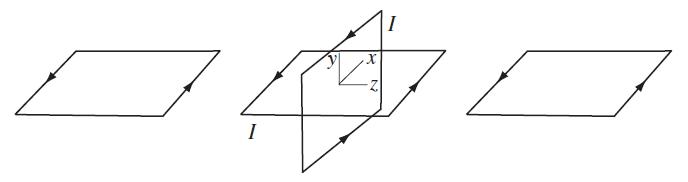
Two identical, current-carrying rectangular loops are oriented at right angles, one in the vertical x-y plane, one in the horizontal x-z plane. The horizontal loop moves infinitesimally slowly from z = −∞, through z = 0 (where the centers of the two loops coincide), to z = +∞.(a) Graph
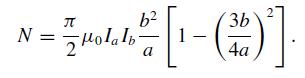
Two origin-centered circular rings have radii a and b a and Ib. A narrow insulating rod coincident with their common diameter permits the smaller ring to rotate freely inside the larger ring. Show that the torque which must be applied to hold the planes of the rings at a right angle has magnitude.
Two finite-length, concentric, cylindrical solenoids carry current in the same direction. The outer solenoid is very slightly longer and has a very slightly larger radius than the inner solenoid, but their mid-planes are coincident. Determine if the inner solenoid is stable or unstable against a
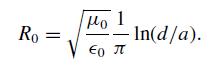
Two long, parallel wires of length L, separation d, and cross sectional radius a are connected by a U-turn at each end to form a closed circuit. Insert a battery with potential difference V at one U-turn and a shunt resistor R at the other U-term. Assume that R is much larger than the ohmic
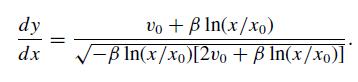
Let a steady current I flow up the y-axis and let the initial position and velocity of a particle with mass m and charge q be r0 = (x0, 0, 0) and v0 = (0, ν0, 0).(a) Show that the motion of the particle is confined to the x-y plane.(b) Prove that νy = v0 + β ln(x/x0) (where β is a constant)
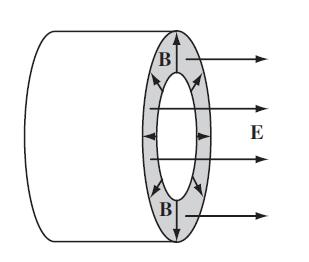
An axial electric field E = Eẑ and a radial magnetic field B = Bp̂ coexist in the volume V between two short cylindrical shells concentric with the z-axis. Suppose V is filled with xenon gas and, at a given moment, a discharge ionizes the gas into a plasma composed of ne electrons per unit
A particle with mass m and charge q moves non-relativistically in static fields E(r) and B(r). Show that a re-scaling of the magnetic field and the time is sufficient for a particle with mass M and charge q to follow exactly the same trajectory as the original particle. Do the motions of m andM
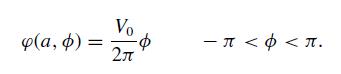
Roll up an ohmic sheet to form an infinitely long, origin-centered cylinder of radius a. Cut a narrow slot along the length of the cylinder and insert a line source of EMF so the electrostatic potential within the sheet (in polar coordinates) is(a) Find a separated-variable solution to Laplace’s
Show that a current density with vector potential A(r) = f (r)r has zero magnetic dipole moment.
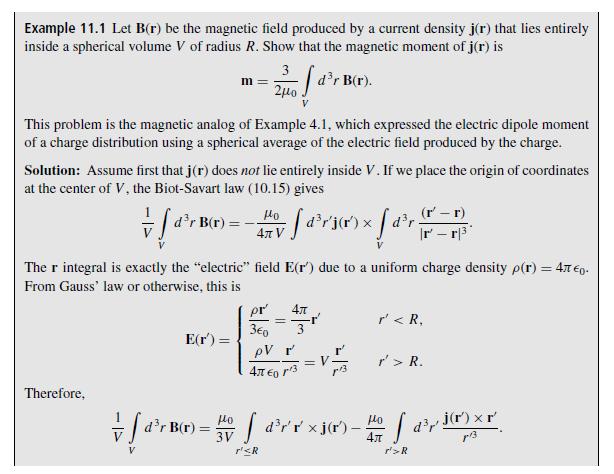
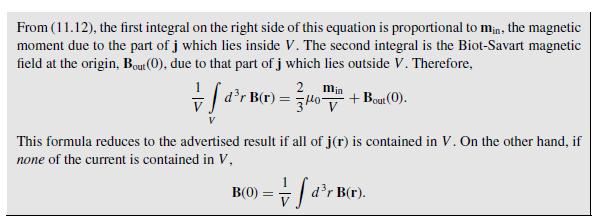
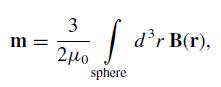
Show that the formula for the magnetic dipole moment derived in Example 11.1,is consistent with the spherical multipole expansion of the vector potential derived in Section 11.4, Example 11.1 Let B(r) be the magnetic field produced by a current density j(r) that lies entirely inside a spherical
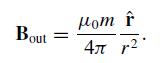
If such a thing existed, the magnetic field of a point particle with magnetic charge g at rest at the origin would be Bmono(r) = (μ0gr/(4πr3). Show that the magnetic field of a point magnetic dipole m is B = −(m · ∇)Bmono/g at points away from the dipole.
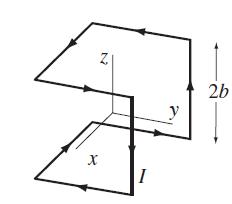
A filamentary current loop traverses eight edges of a cube with side length 2b as shown below.(a) Find the magnetic dipole moment m of this structure.(b) Do you expect a negligible or a non-negligible magnetic quadrupole moment? Place the origin of coordinates at the center of the cube as shown.
It is true (but not obvious) which any vector field V(r) which satisfies ∇ · V(r) = 0 can be written uniquely in the formwhere L = −ir × ∇ is the angular momentum operator and ψ(r) and γ (r) are scalar fields. T(r) = Lψ(r) is called a toroidal field and P(r) = ∇ × Lγ (r) is called a
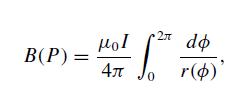
(a) Let I be the current carried by a wire bent into a planar loop. Place the origin of coordinates at an observation point P in the plane of the loop. Show that the magnitude of the magnetic field at the point P iswhere r(φ) is the distance from the origin of coordinates at P to the point on the
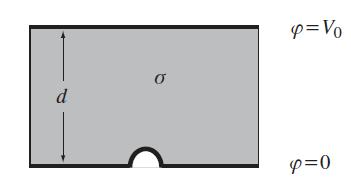
A voltage difference V0 causes a steady current to flow from the top conductor to the bottom conductor (in the sketch below) through an ohmic medium with conductivity σ. Find an approximate expression for the current I that flows into the hemispherical bump (radius R) portion of the lower
Use Green’s second identity to prove that GD(r, r') = GD(r', r).
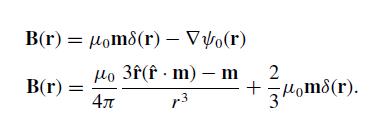
The text writes two expressions for the magnetic field of point magnetic dipole at the origin:ψ0(r) is the magnetic scalar potential of a point dipole. Prove that the delta function content of these two formulae are the same, at least when used as part of an integration over a volume integral.
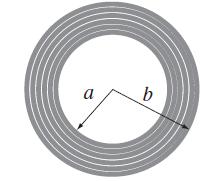
Find the magnetic moment of a planar spiral with inner radius a and outer radius b composed of N turns of a filamentary wire that carries a steady current I. a b
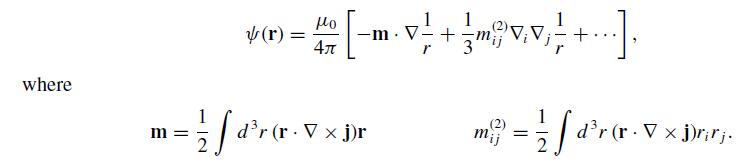
The text produced a spherical multipole expansion for the magnetic scalar potential ψ(r) based on the identityA Cartesian expansion for the scalar potential can be developed from the same starting point.(a) Expand |r − r'|−1 and confirm that(b) Show that the dipole moment can be written in the
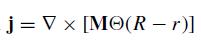
A charge Q is uniformly distributed over the surface of a sphere of radius R. The sphere spins at a constant angular frequency ω.(a) Show that the current density of this configuration can be written in the form where M is a constant vector.(b) Find the magnetic moment of this current
Show that the first non-zero term in an interior Cartesian multipole expansion of the vector potential can be written in the form A(r) = (μ0/4π)G × r where G is a constant vector. Show that the associated magnetic field is a Biot-Savart field.
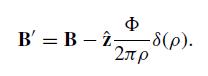
A semi-infinite solenoid (conce ntric with the negative z-axis) has cross sectional area A = πR2, n turns per unit length of a wire with current I , and magnetic moment per unit length m = nIA. When A → 0 and N →∞ with m fixed, Application 11.1 showed that the agnetic field outside this
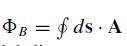
(a) Find the vector potential inside and outside a solenoid that generates a magnetic field B = Bẑ inside an infinite cylinder of radius R. Work in the Coulomb gauge. (b) The A haronov-Bohm effect occurs because the magnetic flux is non-zero when the integration circuit is, say, the rim of a
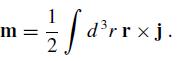
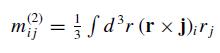
Let j (r) be an arbitrary current distribution.(a) Show that the components of the magnetic dipole moment m = 1/ 2 ∫ d3 r r × j are invariant to a rigid shift of the origin of coordinates.(b) Show that the components of the Cartesian magnetic quadrupole momentare invariant to a rigid shift of
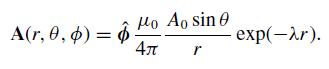
A current distribution produces the vector potentialWhat is the magnetic moment associated with this current distribution? 0 A(r, 0, 0) = o Ao sin $ - exp(-λr). 4π r
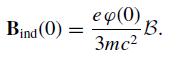
A quantum particle with charge q, mass m, and momentum p in a magnetic field B(r) = ∇ × A(r) has velocity ν(r) = p/m − (q/m)A(r). This means that a charge distribution ρ(r) generates a “diamagnetic current” j (r) = −(q/m)ρ(r)A(r) when it is placed in a magnetic field.(a) Show that
A compact disk with radius R and uniform surface charge density σ rotates with angular speed ω. Find the magnetic dipole moment m when the axis of rotation is(a) The symmetry axis of the disk;(b) Any diameter of the disk.
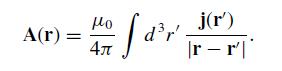
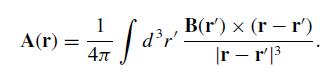
(a) Show by direct calculation that the Coulomb gauge condition ∇ · A = 0 applies to(b) Find the choice of gauge where a valid representation of the vector potential is A(r): Ho 4π d³r' j(r) |rr|
A cylindrical solenoid with length L and cross sectional area A = πR2 is formed by wrapping n turns per unit length of a wire that carries a current I . Estimate the magnitude of the magnetic field just outside the solenoid and far away from the ends when L >> R. Do this by integrating ∇
The text describes a Helmholtz coil as two parallel, coaxial, and circular current loops of radius R separated by a distance R. Each loop carries a current I in the same direction.(a) Use the magnetic scalar potential and both matching conditions at an appropriate spherical surface to show that
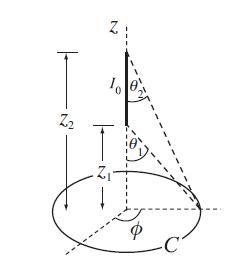
A current I0 flows up the z-axis from z = z1 to z = z2 as shown below.(a) Use the Biot-Savart law to show that the magnetic field in the z = 0 plane is(b) Symmetry and the Coulomb gauge vector potential show that A = Az(ρ, z) ẑ and B = ∇ × A = Bφ(ρ, z). However, an origin-centered, circular
Consider a charge distribution ρ(r) in rigid, uniform motion with velocity υ.(a) Show that the magnetic field produced by this system is B(r) = (ν/c2) × E, where E(r) is the electric field produced by ρ(r) at rest.(b) Use this result to find B(r) for an infinite line of current and an infinite
The magnetic scalar potential in a volume V is ψ(x, y, z) = (C/2) ln(x2 + y2). Find a vector potential A = Ax x̂ + Ay ŷ which produces the same magnetic field.
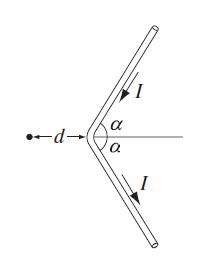
Biot and Savart derived their eponymous formula using a currentcarrying wire bent as shown below. Find B(r) in the plane of the wire at a distance d from the bend along the axis of symmetry. ←P→• a a
Show that the normal derivative of the Coulomb gauge vector potential suffers a jump discontinuity at a surface endowed with a current density K(rS).
Use the solid angle representation of the magnetic scalar potential ψ(r) to find B(r) everywhere for an infinite, straight line of current I . State carefully the surface you have chosen to “cut” the current-free volume to make ψ(r) single-valued.
Let B(x, z) be the magnetic field produced by a surface current density K(y, z) = K(z) ŷ confined to the x = x0 plane.(a) Show that the Biot-Savart law for this situation reduces to a one dimensional convolution integral for each component of B.(b) Confine your attention to x < x0 and
The figure below shows an infinitely long current filament wound in the form of a circular helix with radius R and pitch l , i.e., is the distance along the z-axis occupied by one wind of the helix. Find the ρ dependence of the magnetic field B(ρ,φ, z) in the limit ρ. Does the → 0 limit make
A charge Q is uniformly distributed over the surface of a sphere of radius R. The sphere spins at a constant angular frequency with ω = ωẑ. Use B = −∇ψ to find the magnetic field everywhere.
Find the surface current density K(θ,φ) on the surface of sphere of radius a which will produce a magnetic field inside the sphere of B<(x, y, z) = (B0 a)(xx̂ − yŷ). Express your answer in terms of elementary trigonometric functions.
A circular loop with radius R and current I lies in the x-y plane centered on the z-axis. The magnetic field on the symmetry axis is R² B(z) = μ₁¹ (R² + z²)³/2². z In cylindrical coordinates, B,(p, z) = f(z)p when p
(a) Use superposition and the magnetic field on the symmetry axis of a current ring to find the magnetic field at the midpoint of the symmetry axis of a cylindrical solenoid. The solenoid has radius R, length L, and is wound with n turns per unit length of a wire that carries a current I.(b) Assume
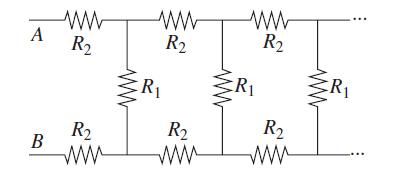
The diagram below shows that the resistance between the terminals A and B is determined by a motif of three resistors R2 − R1 − R2 repeated an infinite number of times. Determine the ratio R1/R2 such that the rate at which Joule heat is produced by all the R1 resistors combined is a
A current I starts at z = −∞and flows up the z-axis as a linear filament until its hits an origin-centered sphere of radius R. The current spreads out uniformly over the surface of the sphere and flows up lines of longitude from the south pole to the north pole. The recombined current flows
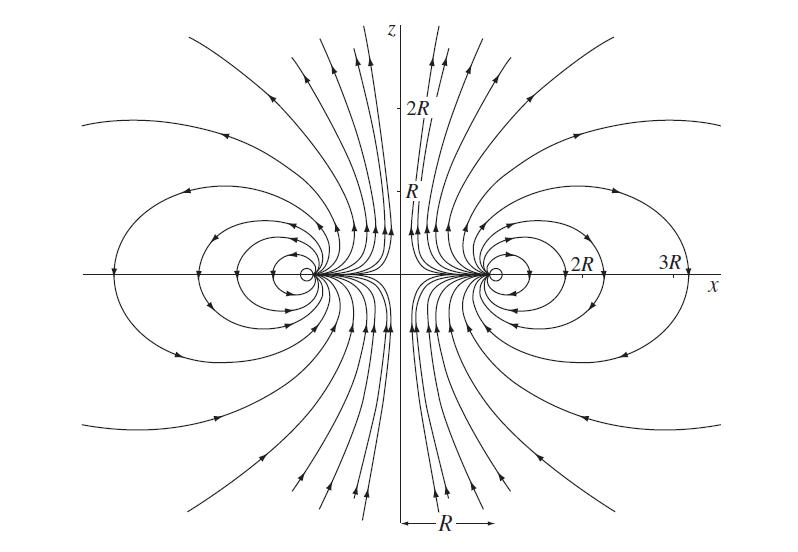
The z-axis coincides with the symmetry axis of a flat disk of radius R in the x-y plane. Sketch and justify in words the pattern of currents that must flow in the disk to produce the magnetic field pattern shown below (as viewed edge-on with the disk). The field pattern has the rotational symmetry
The conductivity of the Earth’s atmosphere increases with height due to ionization by solar radiation. At an altitude of about H = 50 km, the atmosphere can be considered practically an ideal conductor. Experiment shows that the height dependence of the conductivity of the atmosphere can be
(a) Use the Biot-Savart law to find B(r) everywhere for a current sheet at x = 0 with K = Kẑ.(b) Check your answer to part (a) by superposing the magnetic field from an infinite number of straight current-carrying wires.
(a) Two rings of radius R, coaxial with the z-axis, are separated by a distance 2b and carry a current I in the same direction. Make explicit use of the formula for the magnetic field of a single current ring on its symmetry axis to derive the Helmholtz relation between b and R that makes Bz(z)
(a) Consider a semi-infinite and tightlywound solenoid with a circular cross section. Prove that the magnetic flux which passes out through the open end of the solenoid is exactly one-half the flux which passes through a cross section deep inside the solenoid.(b) A tightly wound solenoid has length
A uniform surface current K = Kẑ confined to a strip of width b carries a total current I . Find the magnetic field at a point in the plane of the strip that lies a perpendicular distance a from the strip in the ŷ-direction.
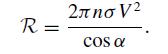
Current flows on the surface of a spherical shell with radius R and conductivity σ. The potential is specified on two rings as ϕ(θ = α) = V cos nφ and ϕ(θ = π − α) = −V cos nφ. Show that the rate at which Joule heat is generated between the two rings isThe substitution y =
A spherical shell with radius a has conductivity σ in the angular range α1 < θ < π − α2. Otherwise, the shell is perfectly conducting and a potential difference V is maintained between θ = 0 and θ = π.(a) Solve Laplace’s equation to find the potential, surface current density, and
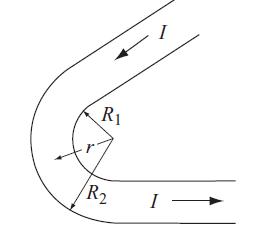
A potential difference V drives a steady current I through an ohmic wire with conductivity σ and a constant circular cross section. One portion of the wire has the shape of a circular arc with inner radius of curvature R1 and outer radius of curvature R2. Find the dependence of the current density
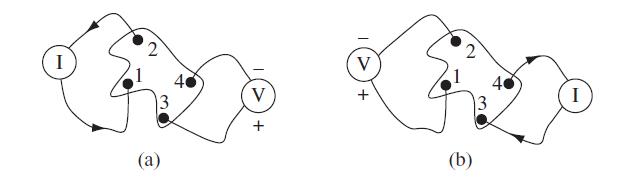
The diagram below illustrates a reciprocal principle satisfied by an ohmic sample of any shape.The principle asserts that if the impressed currents satisfy IA = IB, the measured voltages satisfy VA = VB.Prove this by evaluating the integralin two different ways. Assume that the current enters
The diagram below shows an ohmic film with conductivity σ, thickness d, infinite length, and semi-infinite width. A total current I enters the film at the point A through a line contact (modeled as a half-cylinder with negligible radius) and exits the film similarly at the point B. The potential
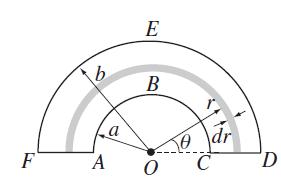
The annulus shown below is cut from a planar metal sheet with thickness t and conductivity σ.(a) Let V be the voltage between the edge CD and the edge FA. Solve Laplace’s equation to find the electrostatic potential, current density, and resistance of the annulus.(b) Divide the annulus into a
A square plate of copper metal can be used as a crude variable resistor by making suitable choices of the places to attach leads that carry current to and from the plate.(a) Current enters at A and exits at B.(b) Current enters at A and exits at C.(c) Current enters at A and exits at O.(d) Current
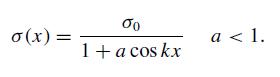
Steady current flows in the x-direction in an infinite, two-dimensional strip defined by |y| < L. The current density j is constant everywhere in the strip and the conductivity varies in space asThe conductivity is zero outside the strip. Find the electric field E everywhere. o(x)= = 00 1 + a
A current I flows up the z-axis and is intercepted by an origincentered sphere with radius R and conductivity σ. The current enters and exits the sphere through small conducting electrodes which occupy the portion of the sphere’s surface defined by θ ≤ α and π − α ≤ θ ≤ π. Derive
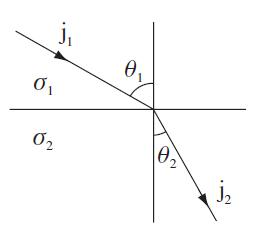
Show that the lines of current density j obey a “law of refraction” at the flat boundary between two ohmic media with conductivities σ1 and σ2. Use the geometry shown below. 0₁ 02 0₁ 10₂
The electrodes of a spherical capacitor have radii a and b > a. The inner electrode is grounded; the outer electrode is held at potential V. In vacuum diode mode, the thermionic current which flows from the inner cathode to the outer anode increases with temperature until the electric field due
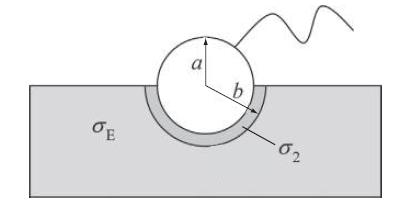
The diagram shows a wire connected to the Earth (conductivity σE) through a perfectly conducting sphere of radius a which is half-buried in the Earth. The layer of earth immediately adjacent to the sphere with thickness b − a has conductivity σ2. Find the resistance between the end of the wire
Consider the vacuum diode problem treated in the text with the space between the plates filled with a poor conductor with dielectric permittivity ϵ. For matter of this kind, v = ũE, where the mobility ũ is the constant of proportionality between the drift velocity of the electrons and the
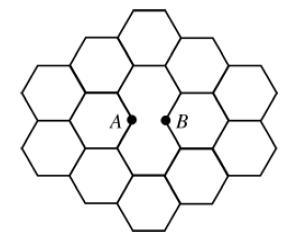
An infinite, two-dimensional network has a honeycomb structure with one hexagon edge removed. Otherwise, the resistance of every hexagon edge is r. Find the resistance of the network when a current I enters point A and is extracted at the point B. A B
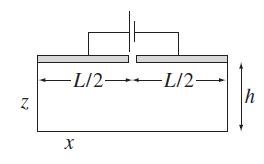
A battery maintains a potential difference V between the two halves of the cover of a tank (L×∞×h) filled with salty water. Find the current density j(x, y, z) induced in the water. N -L/2 L/2- X h
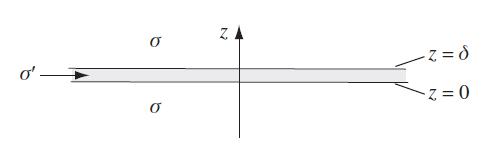
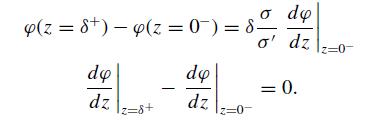
A thin membrane with conductivity σ and thickness δ separates two regions with conductivity σ.Assume uniform current flow in the z-direction in the figure above. When δ is small, it makes sense to seek “across-the-membrane” matching conditions for the electrostatic potential ϕ(z) defined
Two highly conducting spheres with radii a1 and a2 are used to inject and extract current from points deep inside a tank of weakly conducting fluid. Show that the resistance between the spheres depends very weakly on their separation d when d is large compared to a1 and a2. Confirm that
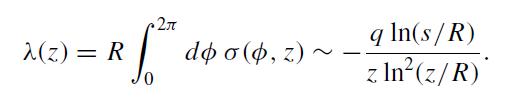
(a) Derive an integral expression for the charge density σ(φ, z) induced on the outer surface of a conducting tube of radius R when a point charge q is placed at a perpendicular distance s > R from the symmetry axis of the tube.(b) Confirm that the point charge induces a total charge −q on
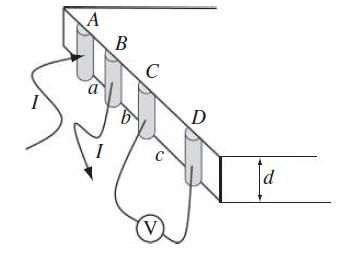
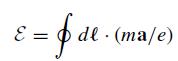
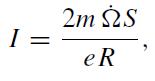
(a) A long straight rod with cross sectional area A and conductivity σ accelerates parallel to its length with acceleration a. Write down the Drude-like equation of motion for the average velocity v of an electron of mass m in the rod relative to the motion of the rod itself. Show that, in the
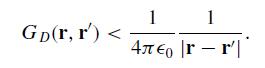
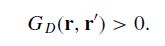
The Dirichlet Green function for any finite volume V can always be written in the form(a) Use the physical meaning of the Dirichlet Green function to prove that(b) Use Earnshaw’s theorem to prove that 1 1 4л €о |rr| The function A (r, r') satisfies V²A(r, r') = 0. GD(r, r') = + A(r, r') r,
A wire with conductivity σ carries a steady current I. Confirm the statement made in the text that a charge Q ∼ = ϵ0 I/σ accumulates on the wire’s surface in the immediate neighborhood of a 90◦ right-angle bend. Make a sketch of the wire indicating the position and sign of the surface
(a) Use the completeness relation,and the method of direct integration to show that(b) Show that G(r, r') above is identical to the image solution for this problem. ΣYEM (F)YM (P) = lm lm lm 1 sin 0 -8(0 - 0')8($ - $'),
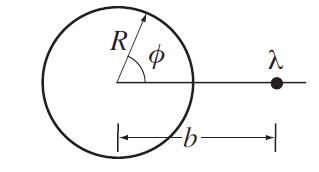
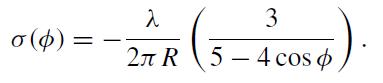
Let b be the perpendicular distance between an infinite line with uniform charge per unit length λ and the center of an infinite conducting cylinder with radius R = b/2.(a) Show that the charge density induced on the surface of the cylinder is(b) Find the force per unit length on the cylinder by
An infinitely long cylindrical conductor carries a constant current with density jz(r).(a) Despite Ohm’s law, compute the radial electric field Er (r) that ensures that the radial component of the Lorentz force is zero for every current-carrying electron.(b) The source of Er (r) is ρ(r) = ρ+ +
A steady current is produced by a collection of moving charges confined to a volume V . Prove that the rate at which work is done on these moving charges by the electric field produced by a static charge distribution (not necessarily confined to V) is zero.
(a) Use completeness relations to represent δ(x − x')δ(y − y') and then the method of direct integration for the inhomogeneous differential equation which remains to find the interior Dirichlet Green function for a cubical box with side walls at x = ±a, y = ±a, and z = ±a.(b) Use the
(a) Let Φ(ρ,Ф) be a solution of Laplace’s equation in a cylindrical region ρ < R. Show that the function Ψ(ρ,φ) = Φ(R2/ρ,φ) is a solution of Laplace’s equation in the region ρ > R.(b) Show that a suitable linear combination of the functions Φ and Ψ in part (a) can be used to
In 1910, Debye suggested that the work function W of a metal could be computed as the work performed against the electrostatic image force when an electron is removed from the interior of a finite piece of metal to a point infinitely far outside the metal. Model the metal as a perfectly conducting
The text showed that the attractive force F between an origin-centered, grounded, conducting sphere of radius R and a point charge located at a point s > R on the positive z-axis varies as 1/s3 when s >> R. Replace the sphere by a grounded conductor of any shape. Use Green’s reciprocity
Two semi-infinite and grounded conducting planes meet at a right angle as seen edge-on in the diagram. Find the charge induced on each plane when a point charge Q is introduced as shown. 20
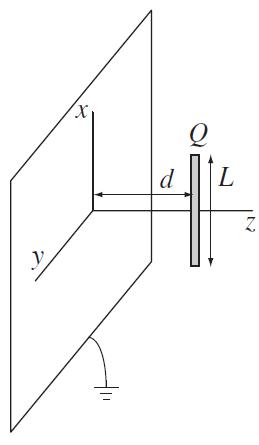
The diagram below shows a rod of length L and net charge Q (distributed uniformly over its length) oriented parallel to a grounded infinite conducting plane at the distance d from the plane.(a) Evaluate a double integral to find the exact force exerted on the rod by the plane.(b) Simplify your
An infinite slab with dielectric constant κ = ε/ε0 lies between z = a and z = b = a + c. A point charge q sits at the origin of coordinates. Let β = (κ − 1)/(κ + 1) and use solutions of Laplace’s equation in cylindrical coordinates to show that. 4(z > c) = q(1 -
Suppose that a collection of image point charges q1, q2, . . . , qN is used to find the force on a point charge q at position rq due to the presence of a conductor held at potential ϕC. Let UA be the electrostatic potential energy between q and the conductor. Let UB be the electrostatic energy of
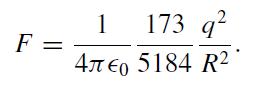
A point charge q is placed at a distance 2R from the center of an isolated, conducting sphere of radius R. The force on q is observed to be zero at this position. Now move the charge to a distance 3R from the center of the sphere. Show that the force on q at its new position is repulsive with
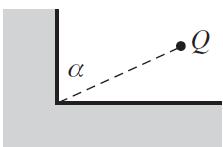
Positive charges Q and Q' are placed on opposite sides of a grounded sphere of radius R at distances of 2R and 4R, respectively, from the sphere center. Show that Q' is repelled from the sphere if Q' < (25/144)Q.
Showing 300 - 400
of 568
1
2
3
4
5
6
Step by Step Answers

 Get 50% OFF
Claim Now
Get 50% OFF
Claim Now