New Semester
Started
Get
50% OFF
Study Help!
--h --m --s
Claim Now
Question Answers
Textbooks
Find textbooks, questions and answers
Oops, something went wrong!
Change your search query and then try again
S
Books
FREE
Study Help
Expert Questions
Accounting
General Management
Mathematics
Finance
Organizational Behaviour
Law
Physics
Operating System
Management Leadership
Sociology
Programming
Marketing
Database
Computer Network
Economics
Textbooks Solutions
Accounting
Managerial Accounting
Management Leadership
Cost Accounting
Statistics
Business Law
Corporate Finance
Finance
Economics
Auditing
Tutors
Online Tutors
Find a Tutor
Hire a Tutor
Become a Tutor
AI Tutor
AI Study Planner
NEW
Sell Books
Search
Search
Sign In
Register
study help
engineering
modern electrodynamics
Modern Electrodynamics 1st Edition Andrew Zangwill - Solutions
A point electric dipole with moment p sits at the center of a grounded, conducting, spherical shell of radius R. Use the method of images to show that the electric field inside the shell is the sum of the electric field produced by p and a constant electric field E = p/4πε 0R3.
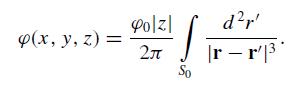
The plane z = 0 is grounded except for an finite area S0 which is held at potential ϕ0. Show that the electrostatic potential away from the plane is p(x, y, z) = Polz| 2π So d²r' r-r'³*
Maintain the plane z = 0 at potential V and introduce a grounded conductor somewhere into the space z > 0. Use the “magic rule” for the Dirichlet Green function to find the charge density σ(x, y) induced on the z = 0 plane by the charge σ0(r) induced on the surface S0 of the grounded
Find the free-space Green functionG(d)0 (r, r') in d = 1, 2, 3 space dimensions by the method of eigenfunction expansion. For d = 2, you will need (i) an integral representation of J0(x); (ii) the regularization k −1 = limη→0 k/(k2 + η2); and (iii) an integral representation of K0(x). For d =
The free-space Green function in two dimensions (potential of a line charge) is:Use the method of direct integration to reduce the two-dimensional equationto a one-dimensional equation and establish the alternative representation. (2) Go(r, r) In r- r/2л€0. —
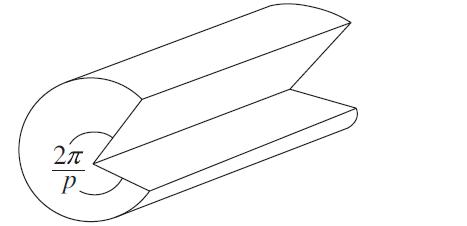
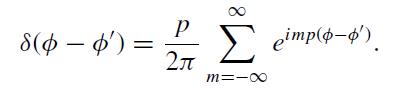
An empty beer can is bounded by the surfaces z = 0, z = h, and ρ = R. By slamming it against his forehead, a frustrated football fan dents the can into the shape shown below. Our interest is the interior Dirichlet Green function of the dented can.(a) Show that suitable choices for the allowed
Write δ(r − r') = δ(r⊥ − r'⊥)δ(z − z') and use direct integration to derive Weyl’s formula for the free-space Green function in three dimensions, Go(r, r') = 1 2€0 S d²k₁__ik₁·(r₁-r'₁ ) _—_-k₁|z-z'l k₁ (27)²
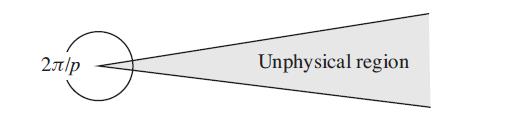
A cosmic string is a one-dimensional object with an extraordinarily large linear mass density (μ ∼ 1022 kg/m) which (in some theories) formed during the initial cool-down of the Universe after the Big Bang. In two-dimensional (2D) general relativity, such an object distorts flat spacetime into
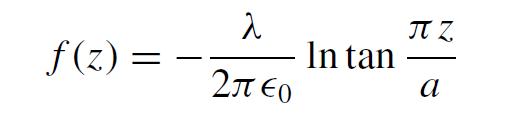
Show that can be used as the complex potential for an array of equally spaced, parallel, charged lines in the y = 0 plane. Let n be an integer and let x = na and x = (n + 1/2 )a be the positions of the positive and negatively charged lines, respectively. Find the asymptotic behavior (|y| → ∞)
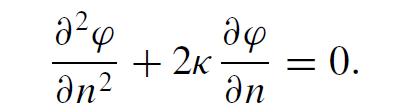
Let ˆn be the normal to an equipotential surface at a point P. The principal radii of curvature of the surface at P are R1 and R2. A formula due to George Green relates normal derivatives (∂/∂n ≡ ˆn · ∇) of the potential φ(r) (which satisfies Laplace’s equation) at the equipotential
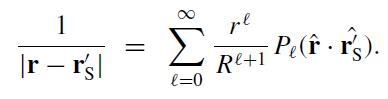
The Poisson integral formulagives the potential at any point r inside a sphere if we specify the potential ¯ϕ (rS) at every point on the surface of the sphere. Derive this formula by summing the general solution of Laplace’s equation inside the sphere using the derivatives (with respect to r
The z-axis runs down the center of an infinitely long heating duct with a square cross section. For a real metal duct (not a perfect conductor), the electrostatic potential φ(x, y) varies linearly along the side walls of the duct. Suppose that the duct corners at (±a, 0) are held at potential +V
Four identical positive point charges sit at (a, a), (−a, a), (−a,−a), and (a,−a) in the z = 0 plane. Very near the origin, the electrostatic potential can be written in the form(a) Deduce the non-zero terms in this expansion and the algebraic signs of their coefficients. Do not calculate
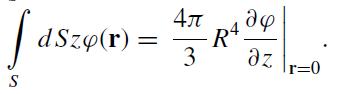
Use the orthogonality properties of the spherical harmonics to prove the following identities for a function φ(r) which satisfies Laplace’s equation in and on an origin-centered spherical surface S of radius R:(a) ∫ dS φ(r) = 4πR2φ(0).(b) I S dSzo(r) = = Ал 3 до R4 дz r=0
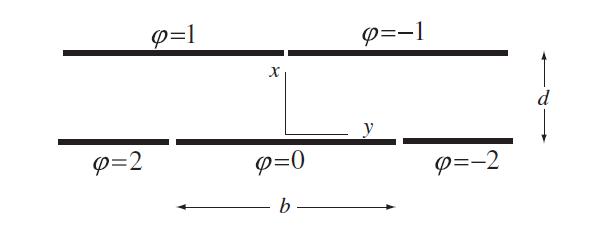
The parallel plates of a microchannel plate electron multiplier are segmented into conducting strips of width b so the potential can be fixed on the strips at staggered values. We model this using infinite-area plates, a finite portion of which is shown below. Find the potential φ(x, y) between
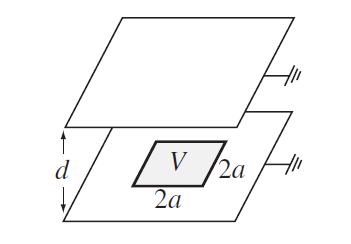
The square region defined by−a ≤ x ≤ a and−a ≤ y ≤ a in the z = 0 plane is a conductor held at potential φ = V . The rest of the z = 0 plane is a conductor held at potential φ = 0. The plane z = d is also a conductor held at zero potential.(a) Find the potential for 0 ≤ z ≤ d in
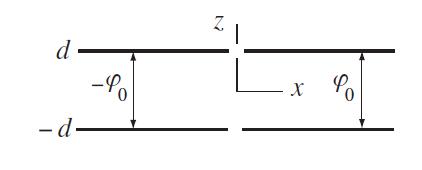
Two flat conductor plates (infinite in the x- and y-directions) occupy the planes z = ±d. The x > 0 portion of both plates is held at φ = +φ0. The x < 0 portion of both plates is held at φ = −φ0. Derive an expression for the potential between the plates using a Fourier integral to
Confirm Poisson formula (derived in Section 6.3) for the case when the volume V is a rectangular slab which is infinite in the x and y directions and occupies the interval −t ≤ z ≤ t otherwise. Keep the direction of P0 arbitrary.
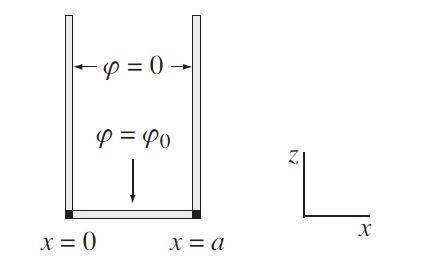
The figure shows an infinitely long and deep slot formed by two grounded conductor plates at x = 0 and x = a and a conductor plate at z = 0 held at a potential φ0. Find the potential inside the slot and determine its asymptotic behavior when z >> a. x = 0 -0= P = 40 x = a X
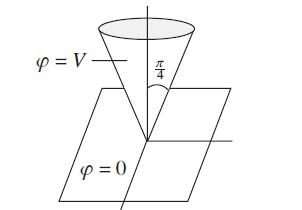
A capacitor is formed by the infinite grounded plane z = 0 and an infinite, solid, conducting cone with interior angle π/4 held at potential V. A tiny insulating spot at the cone vertex (the origin of coordinates) isolates the two conductors.(a) Explain why φ(r, θ, φ) = φ(θ) in the space
Find the volume charge density ρ and surface charge density σ which must be placed in and on a sphere of radius R to produce a field inside the sphere of: E = • 1³8 + 1/8 (1² - 138 - 1/0 2. ху Vo Vo x² ) R3 R3 R -2 Vo
A spherical conducting shell centered at the origin has radius R1 and is maintained at potential V1. A second spherical conducting shell maintained at potential V2 has radius R2 > R1 but is centered at the point s ˆz where s << R1.(a) To lowest order in s, show that the charge
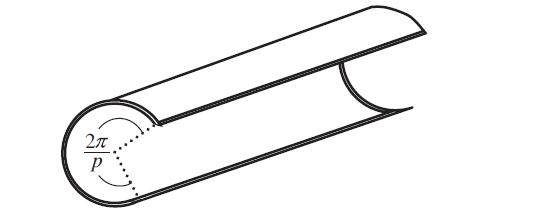
The figure below shows an infinitely long cylindrical shell from which a finite angular range has been removed. Let the shell be a conductor raised to a potential corresponding to a charge per unit length λ. Find the fraction of charge which resides on the inner surface of the shell in terms of λ
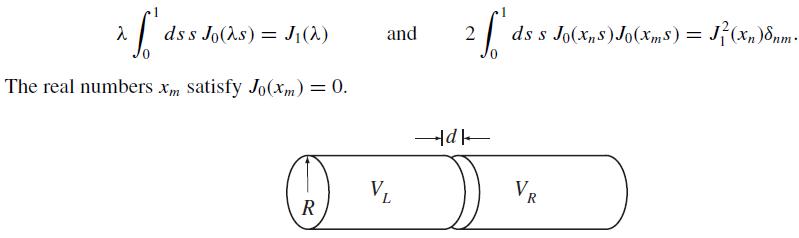
Two semi-infinite, hollow cylinders of radius R are coaxial with the z-axis. Apart from an insulating ring of thickness d → 0, the two cylinders abut one another at z = 0 and are held at potentials VL and VR. Find the potential everywhere inside both cylinders. You will need the integrals ².
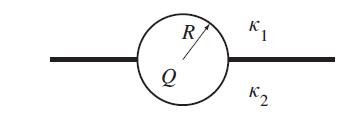
A conducting sphere with radius R and charge Q sits at the origin of coordinates. The space outside the sphere above the z = 0 plane has dielectric constant κ1. The space outside the sphere below the z = 0 plane has dielectric constant κ2.(a) Find the potential everywhere outside the
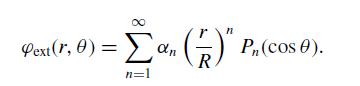
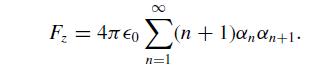
A set of known constants αn parameterizes the potential in a volume r < a asLet ˆz point along θ = 0 and insert a solid conducting sphere of radius R < a at the origin. Show that the force exerted on the sphere when it is connected to ground is in the z-direction and ∞ n Φιλι(ν, θ)
A spherical shell of radius R is divided into three conducting segments by two very thin air gaps located at latitudes θ0 and π − θ0. The center segment is grounded. The upper and lower segments are maintained at potentials V and −V , respectively. Find the angle θ0 such that the electric
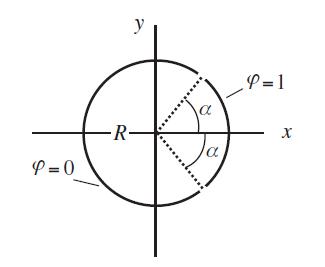
The figure below is a cross section of an infinite, conducting cylindrical shell. Two infinitesimally thin strips of insulating material divide the cylinder into two segments. One segment is held at unit potential. The other segment is held at zero potential. Find the electrostatic potential inside
Let the z-axis be the symmetry axis for an infinite number of identical rings, each with charge Q and radius R. There is one ring in each of the planes z = 0, z = ±b, z = ±2b, etc. Exploit the Fourier expansion in Example 1.6 to find the potential everywhere in space. Check that your solution
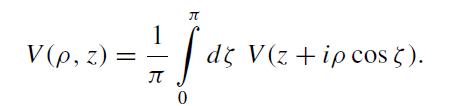
Let V (z) be the potential on the axis of an axially symmetric electrostatic potential in vacuum. Show that the potential at any point in space is V(p, z) = 1 π Л fd² 0 de V(z+ip cos ().
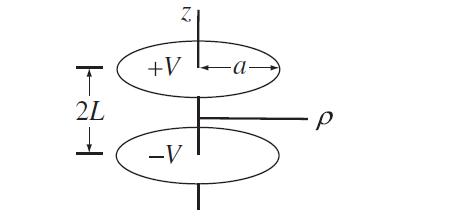
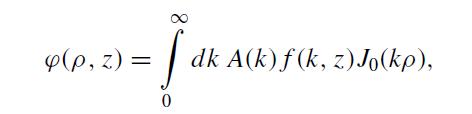
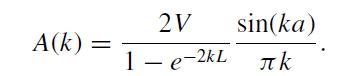
Consider a parallel-plate capacitor with circular plates of radius a separated by a distance 2L.A paper published in 1983 proposed a solution for the potential for this situation of the formWhere J0 is the zero-order Bessel function and(a) Find the function f (k, z) so the proposed solution
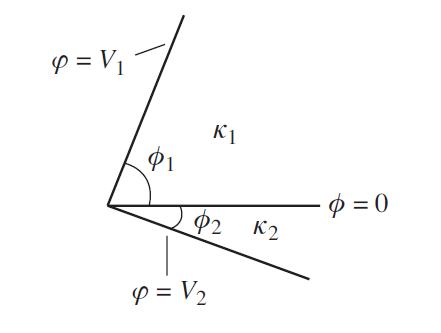
Two wedge-shaped dielectrics meet along the ray φ = 0. The opposite edge of each wedge is held at a fixed potential by a metal plate. The system is invariant to translations perpendicular to the diagram.(a) Explain why the potential ϕ(ρ,φ) between the plates does not depend on the polar
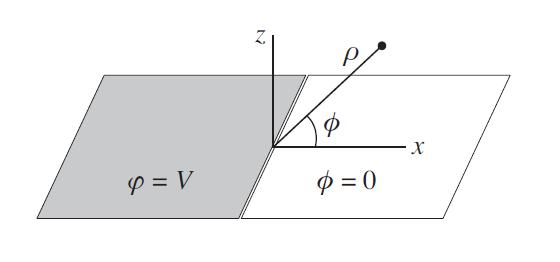
The x > 0 half of a conducting plane at z = 0 is held at zero potential. The x < 0 half of the plane is held at potential V . A tiny gap at x = 0 prevents electrical contact between the two halves.(a) Use a change-of-scale argument to conclude that the z > 0 potential ϕ(ρ,φ) in plane
Give a physical realization of the electrostatic boundary value problem whose solution is provided by the complex potential. f(w) = i V₁ + V₂ 2 + V₁ - V₂ 2 R+iw In [R+ R-iw
An infinitely long conducting cylinder (radius a) oriented along the z-axis is exposed to a uniform electric field E0 ˆy.(a) Consider the conformal map g(w) = w + a2/w, where g = u + iv and w = x + iy. Show that the circle |w| = a and the parts of the x-axis that lie outside the circle map onto
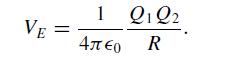
A spherical charge distribution ρ1(r) has total charge Q1 and a second, non-overlapping spherical charge distribution ρ2(r) has total charge Q2. The distance between the centers of the two distributions is R. Use the stress tensor formalism to prove that the interaction energy between the two is
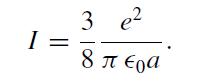
A model hydrogen atom is composed of a point nucleus with charge +|e| and an electron charge distributionShow that the ionization energy (the energy to remove the electronic charge and disperse it to infinity) of this atom is p_(r) = lel πα?, exp(-2r/a). :
This problem exploits the ring and disk electric fields calculated Example 2.1.(a) Find E(r) inside and outside a uniformly charged spherical shell by superposing the electric fields produced by a collection of charged rings.(b) Find E(r) inside and outside a uniformly charged spherical volume by
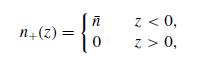
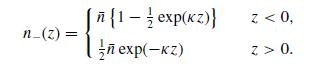
A surprisingly realistic microscopic model for the charge density of a semi-infinite metal (with z = 0 as its macroscopic surface) consists of a positive charge distributionAnd a negative charge distribution:(a) Sketch n+(z) and n−(z) on the same graph and give a physical explanation of why they
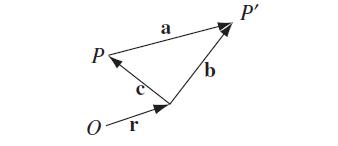
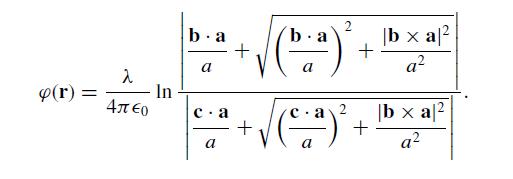
The Potential of a Charged Line Segment The line segment from P to P' in the diagram below carries a uniform charge per unit length λ. The vector a is coincident with the segment. The vectors c and b point from the observation point r to the beginning and end of a, respectively.Evaluate the
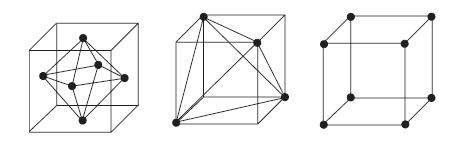
Identical point electric dipoles are placed at the vertices of the regular polyhedra shown below. All the dipoles are parallel but the direction they point is arbitrary. Show that the electric field at the center of each polyhedron is zero.
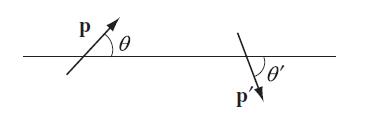
Two coplanar dipoles are oriented as shown in the figure below.Find the equilibrium value of the angle θ' if the angle θ is fixed. P Zo 0 P '0'
Find the electric dipole moment of:(a) A ring with charge per unit length λ = λ0 cos ϕ where ϕ is the angular variable in cylindrical coordinates.(b) A sphere with charge per unit areas σ = σ0 cos θ where θ is the polar angle measured from the positive z-axis.
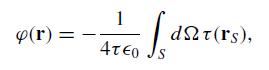
(a) Show that the potential due to a double-layer surface S with a dipole density τ (rS ) ˆn is where dΩ is the differential element of solid angle as viewed from r.(b) Use this result to derive the matching condition at a double-layer surface. φ(r) = 1 Ατερ dΩτ(rs),
The text used Poisson’s equation to show that the charge density of a point electric dipole with moment p located at the point r0 is ρD(r) = −p · ∇δ(r − r0).(a) Derive the given formula for ρD(r) using a limiting process analogous to the one used in the text to find its electrostatic
Use the electric stress tensor formalism to prove that no isolated charge distribution ρ(r) can exert a net force on itself. Distinguish the cases when ρ(r) has a net charge and when it does not.
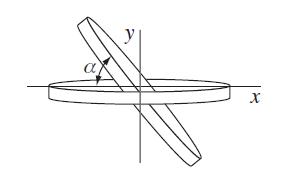
The diagram shows two identical, charge-neutral, origin centered disks. One disk lies in the x-z plane. The other is tipped away from the first by an α angle around the z-axis. The charge density of each disk depends only on the radial distance from its center. Find the angle α at which the
Place a point electric dipole p = p ˆz at the origin and release a point charge q (initially at rest) from the point (x0, y0, 0) in the x-y plane away from the origin. Show that the particle moves periodically in a semi-circular arc.
Show that dW = −E(r) · dp is the work increment required to assemble a point electric dipole with moment dp at the point r beginning with charge dispersed at infinity.
A soap bubble (an insulating, spherical shell of radius R) is uniformly coated with polar molecules so that a dipole double layer with τ = τ ˆr forms on its surface. Find the potential at every point in space. Check that the matching condition is satisfied at r = R
The z-axis is the symmetry axis for an origin-centered ring with charge Q and radius a which lies in the x-y plane. A coplanar and concentric ring with radius b > a has charge −Q. Calculate the lowest non-vanishing Cartesian multipole moment to find the asymptotic (r →∞) electrostatic
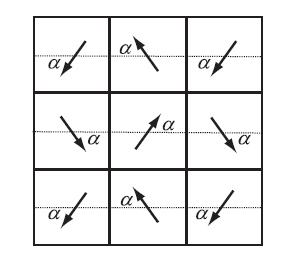
Molecules adsorbed on the surface of a solid crystal surface at low temperature typically arrange themselves into a periodic arrangement, e.g., one molecule lies at the center of each a × a square of a two-dimensional checkerboard formed by the surface atoms of the crystal. For diatomic molecules
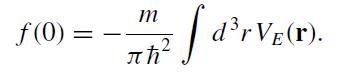
The low-energy Born approximation to the amplitude for electron scattering from a neutron is proportional to the volume integral of the potential energy of interaction between the electron and the neutron,(a) Write a formula for VE(r) if ρN(s) is the charge density of the neutron and φ(s) is the
Find the primitive, Cartesian monopole, dipole, and quadrupole moments for each of the following charge distributions. Use the geometrical center of each as the origin.(a) Two charges +q at two diagonal corners of a square (±a,±a, 0) and two minus charges −q at the two other diagonals of the
The z-axis is the symmetry axis of a disk of radius R which lies in the x-y plane and carries a uniform charge per unit area σ. Let Q be the total charge on the disk.(a) Evaluate the exterior multipole moments and show that(b) Compute the potential at any point on the z-axis by elementary means
(a) Place two charges +q at two diagonal corners of a square (±a,±a, 0) and two minus charges −q at the two other diagonals of the square (±a,∓a, 0). Evaluate the primitive quadrupole moment components Qij = 1/2 ∫ rirjρ(r)dV and use the result to write down the asymptotic electrostatic
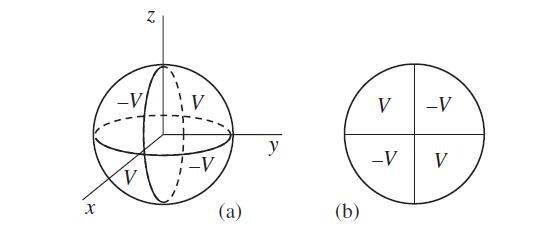
(a) Let ϕ(R, θ, φ) be specified values of the electrostatic potential on the surface of a sphere. Show that the general form of an exterior, spherical multipole expansion implies thatb) The eight octants of a spherical shell are maintained at alternating electrostatic potentials ±V as shown
(a) Show that the charge density of a point quadrupole is ρ(r) = Qij ∇i ∇j δ(r − r0).(b) Show that the force on a point quadrupole in a field E(r) is Qij ∂i∂jE(r0).(c) Show that the torque on a point quadrupole in a field E(r) is N = 2(Q · ∇) × E + r × F where (Q · ∇)iQij
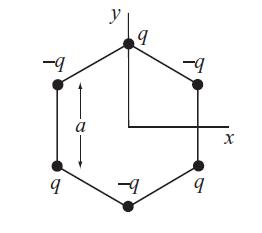
Six point charges form an ideal hexagon in the z = 0 plane as shown below. The absolute values of the charges are the same, but the signs of any two adjacent charges are opposite.(a) What is the first non-zero electric multipole moment of this charge distribution? You need not compute its value.(b)
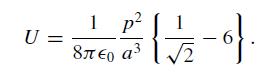
How does the leading contribution to the electrostatic interaction energy between two nitrogen molecules depend on the distance R between them?
A charge distribution is contained entirely inside a black box. Measurements of the electrostatic potential outside the box reveal that all of the exterior multipole moments for ℓ = 1, 2, . . . are zero in a coordinate system with its origin at the center of the box. This does not imply that the
(a) Evaluate the exterior spherical multipole moments for a shell of radius R which carries a surface charge density σ(θ, φ) = σ0 sin θ cos φ.(b) Write φ(r < R,θ,ϕ) in the form φ(x, y, z, r).(c) Evaluate the interior spherical multipole moments for the shell of part (a).(d) Write φ(r
An asymptotic (long-distance) electrostatic potential has the form(a) Use a traceless Cartesian multipole expansion to show that no localized charge distribution exists which can produce an asymptotic potential of this form.(b) Repeat part (a) using a primitive Cartesian multipole expansion.(c)
Let V be a charge-free volume of space. Use an interior spherical multipole expansion to show that the average value of the electrostatic potential φ(r) over the surface of any spherical sub-volume inside V is equal to the potential at the center of the sub-volume.
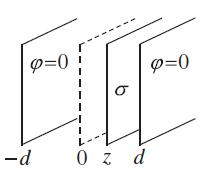
Two infinite conducting planes are held at zero potential at z = −d and z = d. An infinite sheet with uniform charge per unit area σ is interposed between them at an arbitrary point.(a) Find the charge density induced on each grounded plane and the potential at the position of the sheet of
A solid conductor has a vacuum cavity of arbitrary shape scooped out of its interior. Use Earnshaw’s theorem to prove that E = 0 inside the cavity.
A spherical conducting shell with radius b is concentric with and encloses a conducting ball with radius a. Compute the capacitance C = Q/Δφ when(a) the shell is grounded and the ball has charge Q.(b) the ball is grounded and the shell has charge Q.
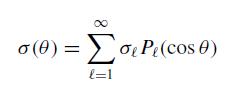
A point charge q lies a distancer > R from the center of an uncharged, conducting sphere of radius R. Express the induced surface charge density in the formwhere θ is the polar angle measured from a positive z-axis which points from the sphere center to the point charge.(a) Show that the total
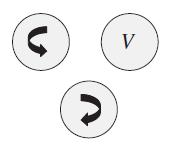
A research paper published in the journal Applied Physics Letters describes experiments performed with three identical spherical conductors suspended from above by insulating wires so a (fictitious) horizontal plane passes through the center of all three spheres. It was reported that a large
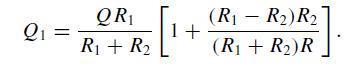
A metal ball with radius R1 has charge Q. A second metal ball with radius R2 has zero charge. Now connect the balls together using a fine conducting wire. Assume that the balls are separated by a distance R which is large enough that the charge distribution on each ball remains uniform. Show that
A capacitor is formed from three very long, concentric, conducting, cylindrical shells with radii a < b < c. Find the capacitance per unit length of this structure if a fine wire connects the inner and outer shells and λb is the uniform charge per unit length on the middle cylinder.
Three concentric spherical metallic shells with radiic > b > a have charges ec, eb, and ea , respectively. Find the change in potential of the outermost shell when the innermost shell is grounded.
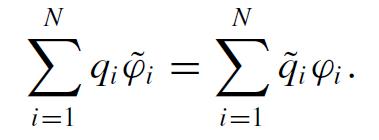
The text derived Green’s reciprocity theorem for a set of conductors as a special case of a more general result. For conductors with charges and potentials (qk, ϕK) and the same set of conductors with charges and potentials (˜qk, ˜φk), the theorem reads(a) Use the symmetry of the capacitance
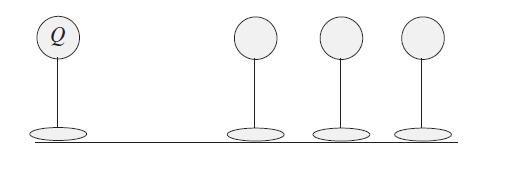
Four identical conducting balls are attached to insulating supports that sit on the floor as shown below. One ball has charge Q; its support is fixed in space. The other three balls are uncharged but their supports can be moved around. Describe a procedure (that involves only moving and/or bringing
(a) What is the self-capacitance (in farads) of the Earth? How much energy is required to add one electron to the (neutral) Earth?(b) What is the self-capacitance (in farads) of a conducting nanosphere of radius 10 nm? How much energy (in electron volts) is required to add one electron to the
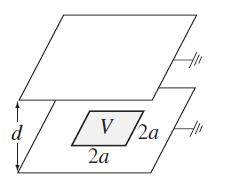
The square region defined by −a ≤ x ≤ a and −a ≤ y ≤ a in the plane z = 0 is a conductor held at potential ϕ = V. The rest of the plane z = 0 is a conductor held at potential ϕ = 0. The plane z = d is also a conductor held at zero potential. Use Green’s reciprocity relation to find
A conducting disk of radius R held at potential V sits in the x-y plane centered on the z-axis.(a) Use the charge density for this system calculated in the text to find the potential everywhere on the z-axis.(b) Ground the disk and place a unit point charge q0 on the axis at z = d. Use the
Let C be the capacitance of capacitor formed from two identical, flat conductor plates separated by a distance d. The plates have area A and arbitrary shape. When d << √ A, we know that the capacitance approaches the value C0 = Aε0/d.(a) If δE = E − E0, prove the identity(b) Let E =
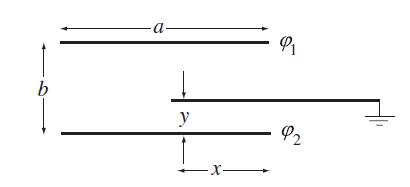
A grounded metal plate is partially inserted into a parallel-plate capacitor with potential difference ϕ2 − ϕ1 > 0 as shown in the diagram below. Find the elements of the capacitance matrix. Assume that all plates extend a distance d in the direction perpendicular to the paper. Ignore
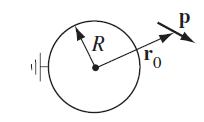
A point dipole p is placed at r = r0 outside a grounded conducting sphere of radius R. Use Green’s reciprocity (and a comparison system with zero volume charge density) to find the charge drawn up from ground onto the sphere. R ro
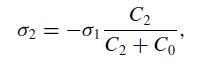
Let d be the separation between two infinite, parallel, perfectly conducting plates. The lower surface of the upper plate has charge per unit area σ1 > 0. The upper surface of the lower plate has charge per unit area σ2 > 0. At a distance L above the lower plate, there is an infinite sheet
A point electric dipole with moment p is placed at the center of a hollow spherical cavity scooped out of an infinite conducting medium.(a) Find the surface charge density induced on the surface of the cavity.(b) Show that the force on the dipole is zero.
Confirm the assertion made in the text that the inverse relation between the matrix of capacitive coefficients and the matrix of potential coefficients implies the equivalence of these two expressions for the force on the kth conductor of a collection of N conductors: NN 1-ΣΣ = il
A non-conducting square has a fixed surface charge distribution. Make a rectangle with the same area and total charge by cutting off a slice from one side of the square and gluing it onto an adjacent side. The energy of the rectangle is lower than the energy of the square because we have moved
Two pyramid-shaped conductors each carry a net charge Q.(a) Transfer charge δQ from pyramid 2 to pyramid 1. Derive a condition on the coefficients of potential Pij which guarantees that this charge transfer lowers the total energy of the system.(b) Show that the condition in part (a) implies
A long, straight wire has length L and a circular cross section with area πa2. Arrange two such wires so they are parallel and separated by a distance d. You may assume that L >> d >> a and ignore end effects.(a) Graph the electrostatic potential along the straight line which connects
A battery maintains the potential difference V between the spheres of a spherical capacitor with capacitance C. Move the center of the inner sphere away from the center of the outer sphere by an amount Δ and call the new capacitance C'.(a) Use a symmetry argument to show that C' = C to first order
(a) A spherical metal shell is charged to an electrostatic potential V . Cut this shell in half and pull the halves infinitesimally apart. Find the force with which one hemisphere of the shell repels the other hemisphere.(b) A spherical capacitor is formed from concentric metal shells with charges
A conducting shell of radius R has total charge Q. If sawed in half, the two halves of the shell will fly apart. This can be prevented by placing a point charge Q' at the center of the shell.(a) What value of Q' just barely holds the shell together?(b) How does the answer to part (a) change for the
Two spheres with radius R have uniform but equal and opposite charge densities ±ρ. The centers of the two spheres fail to coincide by an infinitesimal displacement vector δ. Show by direct superposition that the electric field produced by the spheres is identical to the electric field produced
Find a polarization P(r) which produces a polarization charge density in the form of an origin-centered sphere with radius R and uniform volume charge density ρP.
Find the total electrostatic energy of a ball with radius R and uniform polarization P.
The polarization in all of space has the form P = PΘ(r − R)ˆr, where P and R are constants. Find the polarization charge density and the electric field everywhere.
A cube is polarized uniformly parallel to one of its edges. Show that the electric field at the center of the cube is E(0) = −P/3ε0. Compare with E(0) for a uniformly polarized sphere.
The electrostatic polarization inside an origin-centered sphere is P(r) = P(r). (a) Show that φ(r) outside the sphere is equal to the potential of a point electric dipole at the origin with a moment equal to the electric dipole moment of the entire sphere. (b) What is φr) inside the
A polarizable sphere of radius R is filled with free charge with uniform density ρc. The dielectric constant of the sphere is κ.(a) Find the polarization P(r).(b) Confirm explicitly that the total volume polarization charge and the total surface polarization charge sum to the expected value.
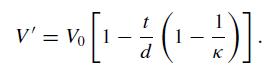
An air-gap capacitor with parallel-plate area A discharges by the electrical breakdown of the air between its parallel plates (separation d) when the voltage between its plates exceeds V0. Lay a slab with dielectric constant κ and thickness t < d on the surface of the lower plate and maintain a
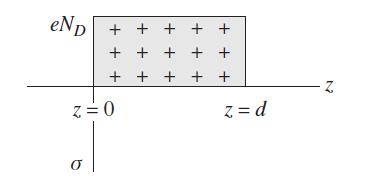
A semiconductor with permittivity ε occupies the space z ≥ 0. One “dopes” such a semiconductor by implanting neutral, foreign atoms with uniform density ND in the near-surface region 0 ≤ z ≤ d. Assume that one electron from each dopant atom ionizes and migrates to the free surface of the
(a) The entire volume between two concentric spherical shells is filled with a material with uniform polarization P. Find E(r) everywhere. (b) The entire volume inside a sphere of radius R is filled with polarized matter. Find D(r) everywhere if P = P ˆr/r2.
Students are often told that E = Fq/q defines the electric field at a point if Fq is the measured force on a tiny charge q placed at that point. More careful instructors let q → 0 to avoid the polarization of nearby matter due to the presence of q. Unfortunately, this experiment is
Showing 400 - 500
of 568
1
2
3
4
5
6
Step by Step Answers

 Get 50% OFF
Claim Now
Get 50% OFF
Claim Now