New Semester
Started
Get
50% OFF
Study Help!
--h --m --s
Claim Now
Question Answers
Textbooks
Find textbooks, questions and answers
Oops, something went wrong!
Change your search query and then try again
S
Books
FREE
Study Help
Expert Questions
Accounting
General Management
Mathematics
Finance
Organizational Behaviour
Law
Physics
Operating System
Management Leadership
Sociology
Programming
Marketing
Database
Computer Network
Economics
Textbooks Solutions
Accounting
Managerial Accounting
Management Leadership
Cost Accounting
Statistics
Business Law
Corporate Finance
Finance
Economics
Auditing
Tutors
Online Tutors
Find a Tutor
Hire a Tutor
Become a Tutor
AI Tutor
AI Study Planner
NEW
Sell Books
Search
Search
Sign In
Register
study help
mathematics
calculus 10th edition
Calculus 10th Edition Ron Larson, Bruce H. Edwards - Solutions
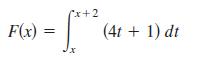
In Exercises find F'(x). - F(x) = (x+2 √x (4t + 1) dt
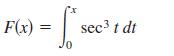
In Exercises use the Second Fundamental Theorem of Calculus to find F'(x). - f₁² 0 F(x) = sec³ t dt
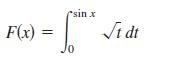
In Exercises find F'(x). F(x) = Jo sin x √t dt
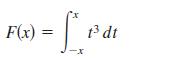
In Exercises find F'(x). F(x) = -X t³ dt
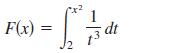
In Exercises find F'(x). F(x) = # 1/3 dt J2
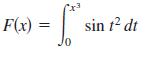
In Exercises find F'(x). F(x) = So Jo sin t² dt
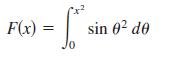
In Exercises find F'(x). - So F(x) = sin 0² de
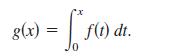
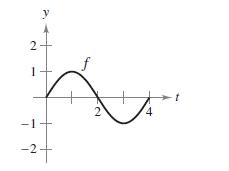
Graphical Analysis Sketch an approximate graph of g on the interval 0 ≤ x ≤ 4, whereIdentify the x-coordinate of an extremum of g. = f* g(x) = f(t) dt.
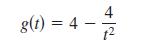
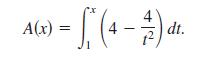
The area A between the graph of the functionand the t-axis over the interval [1, x] is(a) Find the horizontal asymptote of the graph of g.(b) Integrate to find A as a function of x. Does the graph of Ahave a horizontal asymptote? Explain. g(t) = 4- 4
In Exercises the velocity function, in feet per second, is given for a particle moving along a straight line. Find (a) The displacement(b) The total distance that the particle travels over the given interval. v(t) = t³ 10t² + 27t 18, 1≤t≤7
In Exercises the velocity function, in feet per second, is given for a particle moving along a straight line. Find (a) The displacement(b) The total distance that the particle travels over the given interval. v(t) = 5t 7, 0≤ t ≤ 3 -
In Exercises the velocity function, in feet per second, is given for a particle moving along a straight line. Find (a) The displacement(b) The total distance that the particle travels over the given interval. v(t) = ²t 12, 1 ≤ t ≤ 5 -
In Exercises the velocity function, in feet per second, is given for a particle moving along a straight line. Find (a) The displacement(b) The total distance that the particle travels over the given interval. v(t) = t³ 81² + 15t, 0≤ t ≤ 5 -
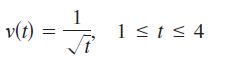
In Exercises the velocity function, in feet per second, is given for a particle moving along a straight line. Find (a) The displacement(b) The total distance that the particle travels over the given interval. v(t) || 1 1 ≤ t ≤ 4
In Exercises the velocity function, in feet per second, is given for a particle moving along a straight line. Find (a) The displacement(b) The total distance that the particle travels over the given interval. v(t) = cos t, cos t, 0≤ t ≤ 3π
A particle is moving along the x-axis. The position of the particle at time t is given byFind the total distance the particle travels in 5 units of time. x(t) = t³ - 6t² + 9t2, 0≤ t ≤ 5.
Repeat Exercise for the position function given byData from in exercise 101A particle is moving along the x-axis. The position of the particle at time t is given by x(t) = (t 1)(t - 3)², 0≤ t ≤ 5.
Water flows from a storage tank at a rate of (500 - 5t) liters per minute. Find the amount of water that flows out of the tank during the first 18 minutes.
At 1:00 P.M., oil begins leaking from a tank at a rate of (4 + 0.75t) gallons per hour.(a) How much oil is lost from 1:00 P.M. to 4:00 P.M.?(b) How much oil is lost from 4:00 P.M. to 7:00 P.M.?(c) Compare your answers to parts (a) and (b). What do younotice?
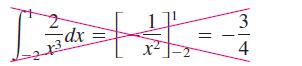
In Exercises describe why the statement is incorrect. x-² dx = |x²|²₁| (-1)-1=-2
In Exercises describe why the statement is incorrect. dx 3 4
In Exercises describe why the statement is incorrect. 137/4 Jπ/4 -73π/4 X TT/4 secx ² x dx = [tan 3 = -2
In Exercises describe why the statement is incorrect. 30/2 T/2 csc x cotx dxc CSC 377/20 = 2 csc x CSC XT/2
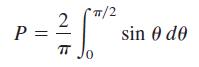
A horizontal plane is ruled with parallel lines 2 inches apart. A two-inch needle is tossed randomly onto the plane. The probability that the needle will touch a line iswhere θ is the acute angle between the needle and any one of the parallel lines. Find this probability. P = TT *π/2 0 sin Ꮎ
A horizontal plane is ruled with parallel lines 2 inches apart. A two-inch needle is tossed randomly onto the plane. The probability that the needle will touch a line isProve that (v(x) [²0] = f(t) dt = f(v(x))v'(x) — ƒ (u(x))u'(x). - lu(x) d dx
In Exercises determine whether the statement is true or false. If it is false, explain why or give an example that shows it is false.If F'(x) = G'(x) on the interval [a, b], then F(b) - F(a) = G(b) - G(a).
In Exercises determine whether the statement is true or false. If it is false, explain why or give an example that shows it is false.If ƒ is continuous on [a, b], then ƒ is integrable on [a, b].
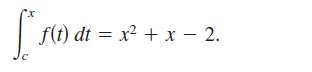
Find the function ƒ(x) and all valuesof c such that [1(1) a f(t) dt = x² + x − 2. -
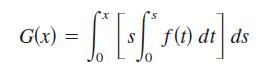
Letwhere ƒ is continuous for all real t. Find (a) G(0)(b) G'(0)(c) G"(x)(d) G"(0) >= [[ f* G(x) S f(t) dt ds
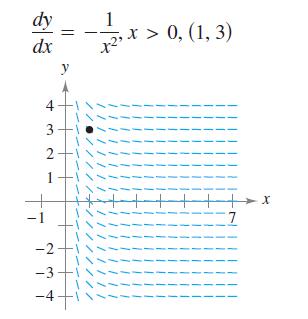
In Exercises a differential equation, a point, and a slope field are given. A slope field (or direction field) consists of line segments with slopes given by the differential equation. These line segments give a visual perspective of the slopes of the solutions of the differential
In Exercises use the limit process to find the area of the region bounded by the graph of the function and the x-axis over the given interval. Sketch the region. y = 4 - x², [- 2, 2]
In Exercises use a(t) = -9.8 meters per second per second as the acceleration due to gravity. (Neglect air resistance.)A baseball is thrown upward from a height of 2 meters with an initial velocity of 10 meters per second. Determine its maximum height.
In your own words and using appropriate figures, describe the methods of upper sums and lower sums in approximating the area of a region.
At the instant the traffic light turns green, a car that has been waiting at an intersection starts with a constant acceleration of 6 feet per second per second. At the same instant, a truck traveling with a constant velocity of 30 feet per second passes the car.(a) How far beyond its starting
Find a function ƒ such that the graph of ƒ has a horizontal tangent at (2, 0) and ƒ"(x) = 2x.
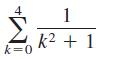
In Exercises find the sum. Use the summation capabilities of a graphing utility to verify your result. k=0 1 k² + 1
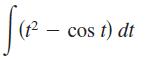
In Exercises find the indefinite integral and check the result by differentiation. (1² cos t) dt
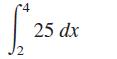
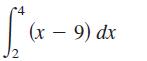
In Exercises, evaluate the integral using the following values. [x³dx = 60, [*xdx = 6₁ [dx = 2 6,
In Exercises find the particular solution that satisfies the differential equation and the initial condition. f'(x) = 6x, f(0) = 8
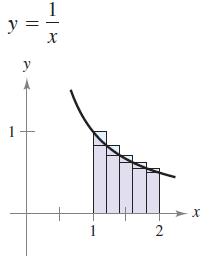
In Exercises use upper and lower sums to approximate the area of the region using the given number of subintervals (of equal width). y y 1 X 1 2
In Exercises, evaluate the integral using the following values. [x³dx = 60, [*xdx = 6₁ [dx = 2 6,
In Exercises find the particular solution that satisfies the differential equation and the initial condition. g'(x) = 4x², g(-1) = 3
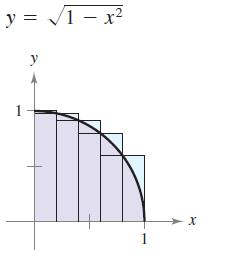
In Exercises use upper and lower sums to approximate the area of the region using the given number of subintervals (of equal width). y = √√√√1-x² 1 X
In Exercises, evaluate the integral using the following values. [x³dx = 60, [*xdx = 6₁ [dx = 2 6,
In Exercises find the particular solution that satisfies the differential equation and the initial condition. h'(t) = 8t³ + 5, h(1) = -4
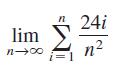
In Exercises find a formula for the sum of n terms. Use the formula to find the limit as n → ∞. lim n1x i= 24i n² 2
In Exercises, evaluate the integral using the following values. [x³dx = 60, [*xdx = 6₁ [dx = 2 6,
In Exercises find the particular solution that satisfies the differential equation and the initial condition. f'(s) = 10s 12s³, f(3) = 2 -
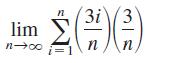
In Exercises find a formula for the sum of n terms. Use the formula to find the limit as n → ∞. lim n→∞0 IM= 3i (0) n n
In Exercises, evaluate the integral using the following values. [x³dx = 60, [*xdx = 6₁ [dx = 2 6,
In Exercises find the particular solution that satisfies the differential equation and the initial condition. ƒ"(x) = 2, f'(2) = 5, f(2)= 10
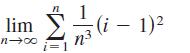
In Exercises find a formula for the sum of n terms. Use the formula to find the limit as n → ∞. lim n→∞0 n i=1 1 Ƒ(i − 1)² - n³
In Exercises, evaluate the integral using the following values. [x³dx = 60, [*xdx = 6₁ [dx = 2 6,
In Exercises find the particular solution that satisfies the differential equation and the initial condition. ƒ”(x) = x², ƒ′(0) = 8, ƒ(0) = 4
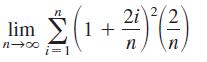
In Exercises find a formula for the sum of n terms. Use the formula to find the limit as n → ∞. lim i=1 1 + 2i 2)²(²) n n
In Exercises find the particular solution that satisfies the differential equation and the initial condition. f"(x) = x-3/², f'(4) = 2, f(0) = 0
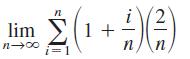
In Exercises find a formula for the sum of n terms. Use the formula to find the limit as n → ∞. lim 007-11 Σ = 1 1 + n n
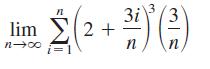
In Exercises find a formula for the sum of n terms. Use the formula to find the limit as n → ∞. n 3i\³ 34)*(-²1) n n lim 2+ n→∞ = 1
In Exercises find the particular solution that satisfies the differential equation and the initial condition. f"(x) = sin x, f'(0) = 1, f(0) = 6
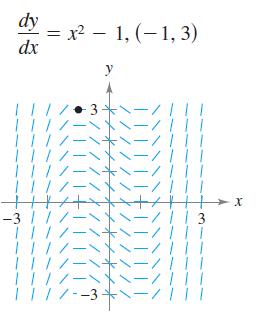
In Exercises a differential equation, a point, and a slope field are given. A slope field (or direction field) consists of line segments with slopes given by the differential equation. These line segments give a visual perspective of the slopes of the solutions of the differential
In Exercises use the limit process to find the area of the region bounded by the graph of the function and the x-axis over the given interval. Sketch the region. y = -4x + 5, [0, 1] y +
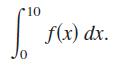
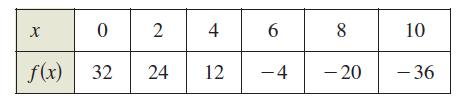
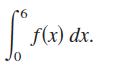
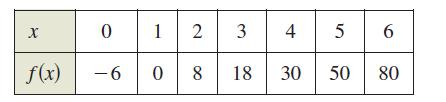
Use the table of values to find lower and upper estimates ofAssume that ƒ is a decreasing function. *10 10 f(x) dx.
Use the table of values to estimateUse three equal subintervals and the (a) Left endpoints(b) Right endpoints (c) Midpoints. When is an increasing function, how does each estimate compare with the actual value? Explain your reasoning *6 S² 0 f(x) dx.
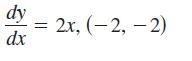
In Exercises (a) Use a graphingutility to graph a slope field for the differential equation(b) Use integration and the given point to find the particularsolution of the differential equation(c) Graph the solutionand the slope field in the same viewing window dy dx 2x, (-2,-2)
In Exercises use the limit process to find the area of the region bounded by the graph of the function and the x-axis over the given interval. Sketch the region. y = 3x2, [2,5]
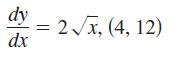
In Exercises (a) Use a graphing utility to graph a slope field for the differential equation(b) Use integration and the given point to find the particular solution of the differential equation(c) Graph the solution and the slope field in the same viewing window dy dx = 2√x, (4, 12)
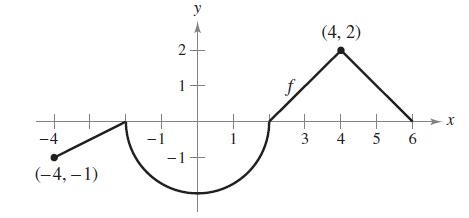
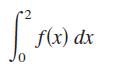
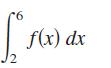
The graph of ƒ consists of line segments and a semicircle, as shown in the figure. Evaluate each definite integral by using geometric formulas.(a)(b)(c)(d)(e)(f) -4 (-4,-1) -1 2 1 -1 (4,2) 3 4 5 6 X
In Exercises use the limit process to find the area of the region bounded by the graph of the function and the x-axis over the given interval. Sketch the region. y = x² + 2, [0, 1]
In Exercises use the limit process to find the area of the region bounded by the graph of the function and the x-axis over the given interval. Sketch the region. y = 3x² + 1, [0, 2]
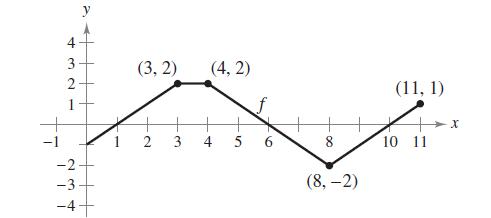
The graph of ƒ consists of line segments, as shown in the figure. Evaluate each definite integral by using geometric formulas.(a)(b)(c)(d)(e)(f) ㅜ 432 1 -2 -3 -4 2 (3, 2) (4,2) 2 3 4 5 6 8 (8,-2) (11, 1) 10 11
What is the difference, if any, between finding the antiderivative of ƒ(x) and evaluating the integral ∫ ƒ(x) dx?
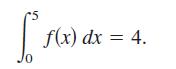
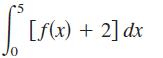
It Consider the function ƒ that is continuouson the interval [-5, 5] and for whichEvaluate each integral.(a)(b)(c)(d) 5 Jo f(x) dx = 4.
In Exercises use the limit process to find the area of the region bounded by the graph of the function and the x-axis over the given interval. Sketch the region. y = 25x², [1,4]
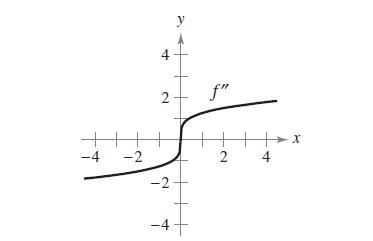
The graphs of ƒ and ƒ' each pass through the origin. Use the graph of ƒ" shown in the figure to sketch the graphs of ƒ and ƒ'. -4 H -2 4 2 -2 -4 y f" H 2 4
Consider ƒ(x) = tan² x andg(x) = sec² x. What do you notice about the derivatives ofƒ(x) and g(x)? What can you conclude about therelationship between ƒ(x) and g(x)?
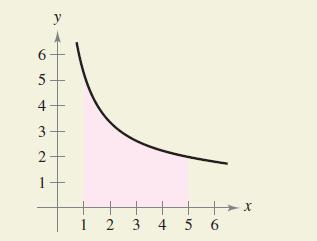
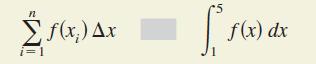
Use the figure to fill in the blank with the symbol <, >, or =. Explain your reasoning.(a) The interval [1, 5] is partitioned into n subintervals of equal width Δx, and xi is the left endpoint of the ith subinterval.(b) The interval [1, 5] is partitioned into n subintervals of equal width
An evergreen nursery usually sells a certain type of shrub after 6 years of growth and shaping. The growth rate during those 6 years is approximated by dh/dt = 1.5t + 5, where t is the time in years and h is the height in centimeters. The seedlings are 12 centimeters tall when planted (t = 0).(a)
In Exercises use the limit process to find the area of the region bounded by the graph of the function and the x-axis over the given interval. Sketch the region. y = 2x³x², [1,2]
In Exercises use the limit process to find the area of the region bounded by the graph of the function and the x-axis over the given interval. Sketch the region. y = 27x³, [1,3]
In Exercises use the limit process to find the area of the region bounded by the graph of the function and the x-axis over the given interval. Sketch the region. y = 2x x³, [0, 1]
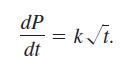
The rate of growth dP/dt of a population of bacteria is proportional to the square root of t, where P is the population size and t is the time in days (0 ≤ t ≤ 10). That is,The initial size of the population is 500. After 1 day the population has grown to 600. Estimate the population after 7
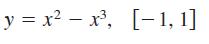
In Exercises use the limit process to find the area of the region bounded by the graph of the function and the x-axis over the given interval. Sketch the region. y=x²x³, [−1,1]
In Exercises use the limit process to find the area of the region bounded by the graph of the function and the y-axis over the given y-interval. Sketch the region. f(y) = 4y, 0≤ y ≤ 2
In Exercises use a(t) = -32 feet per second per second as the acceleration due to gravity. (Neglect air resistance.)A ball is thrown vertically upward from a height of 6 feet with an initial velocity of 60 feet per second. How high will the ball go?
In Exercises use the limit process to find the area of the region bounded by the graph of the function and the y-axis over the given y-interval. Sketch the region. g(y) = y, 2 ≤ y ≤ 4
In Exercises use a(t) = -32 feet per second per second as the acceleration due to gravity. (Neglect air resistance.)With what initial velocity must an object be thrown upward (from ground level) to reach the top of the Washington Monument (approximately 550 feet)?
In Exercises use the limit process to find the area of the region bounded by the graph of the function and the y-axis over the given y-interval. Sketch the region. f(y) = y², 0≤ y ≤ 5
In Exercises use the limit process to find the area of the region bounded by the graph of the function and the y-axis over the given y-interval. Sketch the region. f(y) = 4y - y², 1 ≤ y ≤ 2
In Exercises use a(t) = -32 feet per second per second as the acceleration due to gravity. (Neglect air resistance.)A balloon, rising vertically with a velocity of 16 feet per second, releases a sandbag at the instant it is 64 feet above the ground.(a) How many seconds after its release will the
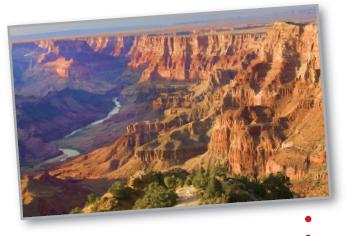
The Grand Canyon is 1800 meters deep at its deepest point. A rock is dropped from the rim above this point. Write the height of the rock as a function of the time t in seconds. How long will it take the rock to hit the canyon floor? INNOLY
In Exercises use a(t) = -9.8 meters per second per second as the acceleration due to gravity. (Neglect air resistance.)With what initial velocity must an object be thrown upward (from a height of 2 meters) to reach a maximum height of 200 meters?
In Exercises use the limit process to find the area of the region bounded by the graph of the function and the y-axis over the given y-interval. Sketch the region. g(y) = 4y²y³, 1 ≤ y ≤ 3
In Exercises use the limit process to find the area of the region bounded by the graph of the function and the y-axis over the given y-interval. Sketch the region. h(y) = y³+1, 1 ≤ y ≤ 2
On the moon, the acceleration due to gravity is - 1.6 meters per second per second. A stone is dropped from a cliff on the moon and hits the surface of the moon 20 seconds later. How far did it fall? What was its velocity at impact?
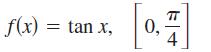
In Exercises use the Midpoint Rule with n = 4 to approximate the area of the region bounded by the graph of the function and the x-axis over the given interval. f(x) = tan x, 0, 4
Repeat Exercise 61 for the position functionData from in Exercise 61(a) Find the velocity and acceleration of the particle.(b) Find the open intervals on which the particle is moving to the right.(c) Find the velocity of the particle when the acceleration is 0. x(t) = (t = 1)(t - 3)², 0 ≤ t ≤
(a) Find the velocity and acceleration of the particle.(b) Find the open intervals on which the particle is moving to the right.(c) Find the velocity of the particle when the acceleration is 0. x(t) = t³ - 6t² + 9t - 2, 0≤t≤ 5
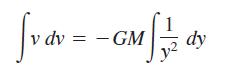
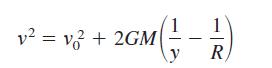
The minimum velocity required for an object to escape Earth’s gravitational pull is obtained from the solution of the equationwhere v is the velocity of the object projected from Earth, y is the distance from the center of Earth, G is the gravitational constant, and M is the mass of Earth. Show
In Exercises use the Midpoint Rule with n = 4 to approximate the area of the region bounded by the graph of the function and the x-axis over the given interval. f(x) = x² + 3, [0, 2]
In Exercises use the Midpoint Rule with n = 4 to approximate the area of the region bounded by the graph of the function and the x-axis over the given interval. f(x) = x² + 4x, [0,4]
Showing 7900 - 8000
of 9867
First
73
74
75
76
77
78
79
80
81
82
83
84
85
86
87
Last
Step by Step Answers

 Get 50% OFF
Claim Now
Get 50% OFF
Claim Now