New Semester
Started
Get
50% OFF
Study Help!
--h --m --s
Claim Now
Question Answers
Textbooks
Find textbooks, questions and answers
Oops, something went wrong!
Change your search query and then try again
S
Books
FREE
Study Help
Expert Questions
Accounting
General Management
Mathematics
Finance
Organizational Behaviour
Law
Physics
Operating System
Management Leadership
Sociology
Programming
Marketing
Database
Computer Network
Economics
Textbooks Solutions
Accounting
Managerial Accounting
Management Leadership
Cost Accounting
Statistics
Business Law
Corporate Finance
Finance
Economics
Auditing
Tutors
Online Tutors
Find a Tutor
Hire a Tutor
Become a Tutor
AI Tutor
AI Study Planner
NEW
Sell Books
Search
Search
Sign In
Register
study help
mathematics
calculus 4th
Calculus 4th Edition Jon Rogawski, Colin Adams, Robert Franzosa - Solutions
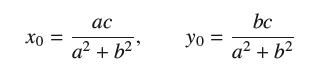
Show that the point (x0, y0) closest to the origin on the line ax + by = c has coordinates Xo = ac a + b2' yo bc a + b2
Find the maximum value of constants. f(x, y) = xayb for x 0, y 0 on the line x + y = 1, where a, b > 0 are
Show that the maximum value of ƒ(x, y) = x2y3 on the unit circle is 6/25 √3/5.
Find the maximum value of ƒ(x, y) = xayb for x ≥ 0, y ≥ 0 on the unit circle, where a, b > 0 are constants.
Find the maximum value of ƒ(x, y, z) = xaybzc for x, y, z ≥ 0 on the unit sphere, where a, b, c > 0 are constants.
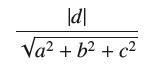
Show that the minimum distance from the origin to a point on the plane ax + by + cz = d is |d| a + b +c
Antonio has $5.00 to spend on a lunch consisting of hamburgers ($1.50 each) and french fries ($1.00 per order). Antonio’s satisfaction from eating x1 hamburgers and x2 orders of french fries is measured by a function U(x1, x2) = √x1x2. How much of each type of food should he purchase
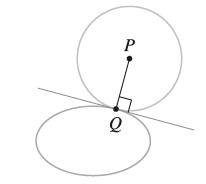
Let Q be the point on an ellipse closest to a given point P outside the ellipse. It was known to the Greek mathematician Apollonius (third century bce) that PQ is perpendicular to the tangent to the ellipse at Q (Figure 16). Explain in words why this conclusion is a consequence of the method of
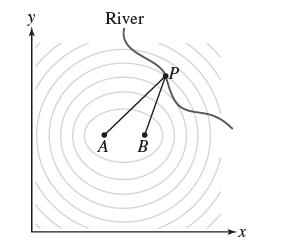
In a contest, a runner starting at A must touch a point P along a river and then run to B in the shortest time possible (Figure 17). The runner should choose the point P that minimizes the total length of the path.(a) Define a functionRephrase the runner’s problem as a constrained optimization
Let V be the volume of a can of radius r and height h, and let S be its surface area (including the top and bottom).Find r and h that minimize S subject to the constraint V = 54π.
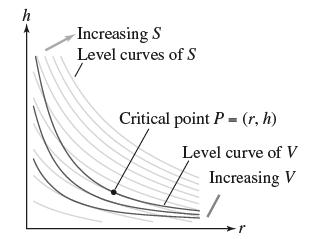
Show that for both of the following two problems, P = (r, h) is a Lagrange critical point if h = 2r:• Minimize surface area S for fixed volume V.• Maximize volume V for fixed surface area S .Then use the contour plots in Figure 18 to explain why S has a minimum for fixed V but no maximum and,
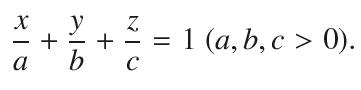
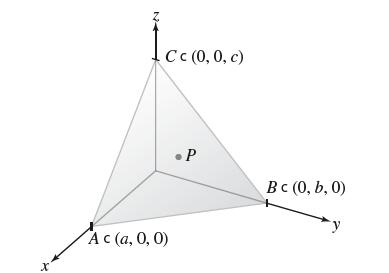
Figure 19 depicts a tetrahedron whose faces lie in the coordinate planes and in the plane with equation The volume of the tetrahedron is given by V = 1/6 abc. Find the minimum value of V among all planes passing through the point P = (1, 1, 1). X a + y b + Z = 1 (a,b,c > 0).
With the same set-up as in the previous problem, find the plane that minimizes V if the plane is constrained to pass through a point P = (α, β, γ) with α, β, γ > 0.
Show that the Lagrange equations for ƒ(x, y) = x + y subject to the constraint g(x, y) = x + 2y = 0 have no solution. What can you conclude about the minimum and maximum values of f subject to g = 0? Show this directly.
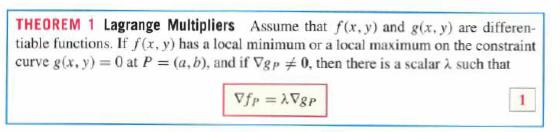
Show that the Lagrange equations for ƒ(x, y) = 2x + y subject to the constraint g(x, y) = x2 − y2 = 1 have a solution but that f has no min or max on the constraint curve. Does this contradict Theorem 1? THEOREM 1 Lagrange Multipliers Assume that f(x, y) and g(x, y) are differen- tiable
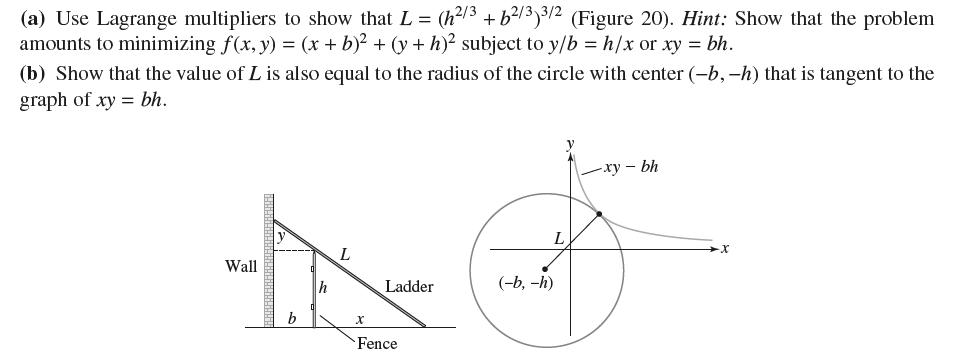
Let L be the minimum length of a ladder that can reach over a fence of height h to a wall located a distance b behind the wall. (a) Use Lagrange multipliers to show that L = (h/3 + b2/3 3/2 (Figure 20). Hint: Show that the problem amounts to minimizing f(x, y) = (x + b) + (y + h) subject to y/b =
Find the maximum value of ƒ(x, y, z) = xy + xz + yz − xyz subject to the constraint x + y + z = 1, for x ≥ 0, y ≥ 0, z ≥ 0.
Find the maximum of ƒ(x, y, z) = z subject to the two constraints x2 + y2 = 1 and x + y + z = 1.
Find the point lying on the intersection of the plane x + 1/2 y + 1/4 z = 0 and the sphere x2 + y2 + z2 = 9 with the greatest z-coordinate.
Find the maximum of ƒ(x, y, z) = x + y + z subject to the two constraints x2 + y2 + z2 = 9 and 1/4 x2 + 1/4 y2 + 4z2 = 9.
The cylinder x2 + y2 = 1 intersects the plane x + z = 1 in an ellipse. Find the point on such an ellipse that is farthest from the origin.
Find the minimum and maximum of ƒ(x, y, z) = y + 2z subject to two constraints, 2x + z = 4 and x2 + y2 = 1.
Find the minimum value of ƒ(x, y, z) = x2 + y2 + z2 subject to two constraints, x + 2y + z = 3 and x − y = 4.
Suppose that both ƒ(x, y) and the constraint function g(x, y) are linear. Use contour maps to explain why ƒ(x, y) does not have a maximum subject to g(x, y) = 0 unless g = aƒ + b for some constants a, b.
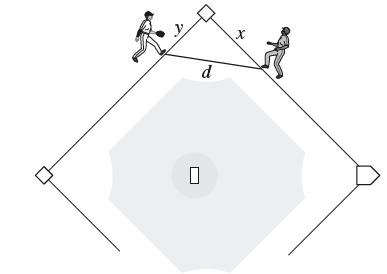
A baseball player hits the ball and then runs down the first base line at 20 ft/s. The first baseman fields the ball and then runs toward first base along the second base line at 18 ft/s as in Figure 7.Determine how fast the distance between the two players is changing at a moment when the hitter
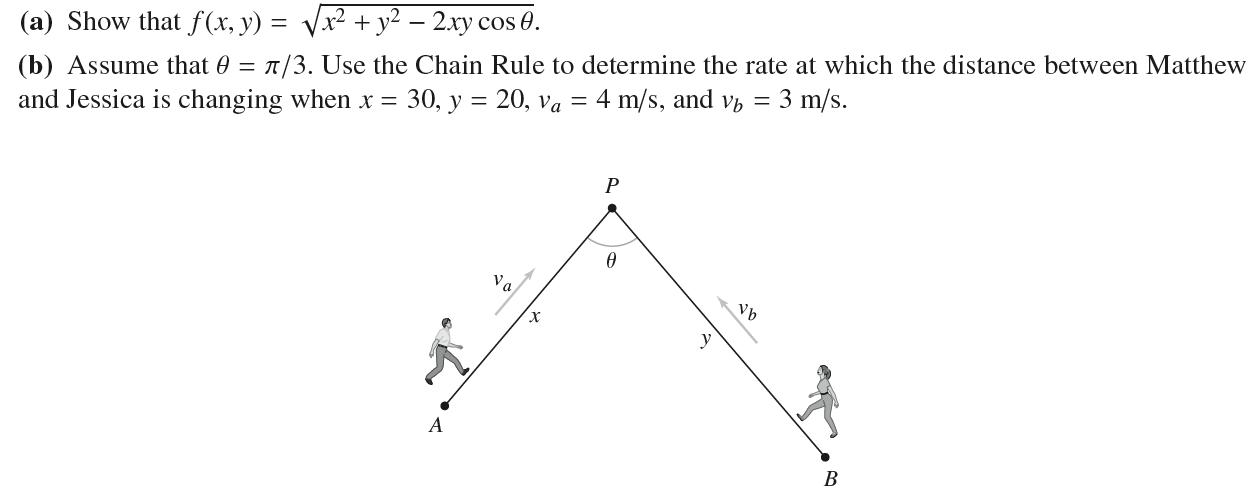
Jessica and Matthew are running toward the point P along the straight paths that make a fixed angle of θ (Figure 8). Suppose that Matthew runs with velocity va meters per second and Jessica with velocity vb meters per second. Let ƒ(x, y) be the distance from Matthew to Jessica when Matthew is x
Two spacecraft are following paths in space given by r1 = (sin t, t, t2) and r2 = (cos t, 1 − t, t3). If the temperature for points in space is given by T(x, y, z) = x2y(1 − z), use the Chain Rule to determine the rate of change of the difference D in the temperatures the two spacecraft
The Law of Cosines states that c2 = a2 + b2 − 2ab cos θ, where a, b, c are the sides of a triangle and θ is the angle opposite the side of length c. (a) Compute 20/da, 30/ab, and 20/ac using implicit differentiation. (b) Suppose that a = 10, b = 16, c = 22. Estimate the change in 0 if a and b
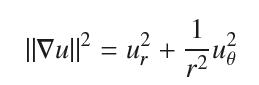
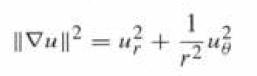
Let u = u(x, y), and let (r, θ) be polar coordinates. Verify the relationCompute the right-hand side by expressing uθ and ur in terms of ux and uy. 1 2 ||ull = up + p2
Let u(r, θ) = r2 cos2 θ. Use Eq. (8) to compute ΙΙ∇uΙΙ2. Then compute ΙΙ∇uΙΙ2 directly by observing that u(x, y) = x2, and compare. I + "= "All|
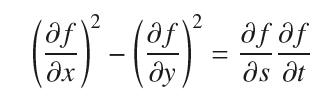
Let x = s + t and y = s − t. Show that for any differentiable function ƒ(x, y), 2 (2) -- = af af s t
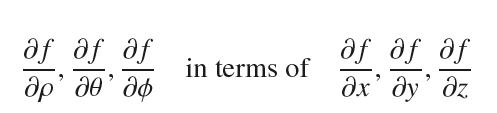
Express the derivativeswhere (ρ, θ, φ) are spherical coordinates. af of af ' ' , in terms of af af af ' z.
Calculate ∂z/∂x and ∂z/∂y at the points (3, 2, 1) and (3, 2, −1), where z is defined implicitly by the equation z4 + z2x2 − y − 8 = 0.
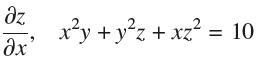
Calculate the partial derivative using implicit differentiation. z dx' xy + yz+xz = 10
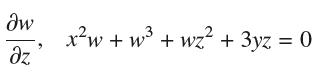
Calculate the partial derivative using implicit differentiation. dw z. xw + w + wz + 3yz = 0
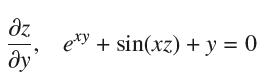
Calculate the partial derivative using implicit differentiation. z. exy + sin(xz) + y = 0
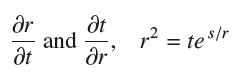
Calculate the partial derivative using implicit differentiation. r at and t ar' r2 = tes/r
Calculate the partial derivative using implicit differentiation. w 1 w2 + x2 + 1 w2 +y2 = 1 at (x, y, w) = (1,1,1)
Calculate the partial derivative using implicit differentiation. au/aT and OT/JU, (TU-V) In(W- UV) = In 2 at (T, U, V, W) = (1, 1, 2, 4)
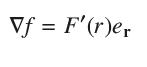
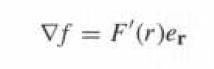
Let r = (x, y, z) and er =r/ ΙΙrΙΙ. Show that if a function ƒ(x, y, z) = F(r) depends only on the distance from the origin r = ΙΙrΙΙ= √x2 + y2 + z2, then Vf = F'(r)er
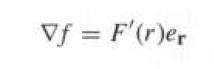
Let ƒ(x, y, z) = e−x2−y2−z2 = e−r2 , with r as in Exercise 35. Compute ∇ƒ directly and using Eq. (9).Data From Exercise 35Let r = (x, y, z) and er =r/ ΙΙrΙΙ. Show that if a function ƒ(x, y, z) = F(r) depends only on the distance from the origin r = ΙΙrΙΙ= √x2 + y2 + z2,
Use Eq. (9) to compute
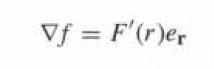
Use Eq. (9) to compute ∇(ln r). Vf = F'(r)er
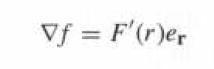
Figure 9 shows the graph of the equation Vf = F'(r)er
For all x > 0, there is a unique value y = r(x) that solves the equation y3 + 4xy = 16. (a) Show that dy/dx = 4y/(3y + 4x). (b) Let g(x) = f(x, r(x)), where f(x, y) is a function satisfying fx(1,2)=8, fy(1,2)= 10 Use the Chain Rule to calculate g' (1). Note that r(1) = 2 because (x, y) = (1, 2)
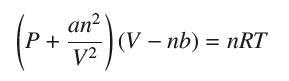
The pressure P, volume V, and temperature T of a van der Waals gas with n molecules (n constant) are related by the equationwhere a, b, and R are constant. Calculate ∂P/∂T and ∂V/∂P. (P + 1 ) (V V2 (V-nb) = nRT
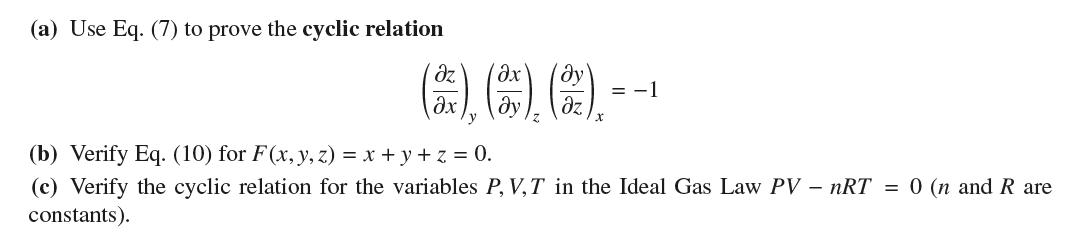
When x, y, and z are related by an equation F(x, y, z) = 0, we sometimes write (∂z/∂x)y in place of ∂z/∂x to indicate that in the differentiation, z is treated as a function of x with y held constant (and similarly for the other variables). (a) Use Eq. (7) to prove the cyclic relation dy
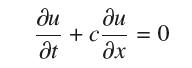
Show that if ƒ(x) is differentiable and c ≠ 0 is a constant, then u(x, t) = ƒ(x − ct) satisfies the so-called advection equation +c- t = 0
A function ƒ(x, y, z) is called homogeneous of degree n if ƒ(λx, λy, λz) = λn ƒ(x, y, z) for all λ ∈ R.Show that the following functions are homogeneous and determine their degree: (a) f(x, y, z) = xy + xyz (c) f(x, y, z) = ln (2) (b) f(x, y, z) = 3x + 2y = 8z (d) f(x, y, z) = z
Prove that if ƒ(x, y, z) is homogeneous of degree n, then ƒx(x, y, z) is homogeneous of degree n − 1. Either use the limit definition or apply the Chain Rule to ƒ(λx, λy, λz).
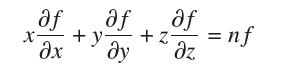
Prove that if ƒ(x, y, z) is homogeneous of degree n, thenLet F(t) = ƒ(tx, ty, tz) and calculate F'(1) using the Chain Rule. af + x af af z +2 =nf
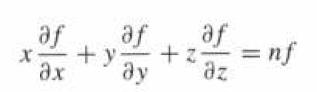
Verify Eq. (11) for the functions in Exercise 44.Data From Exercise 44A function ƒ(x, y, z) is called homogeneous of degree n if ƒ(λx, λy, λz) = λn ƒ(x, y, z) for all λ ∈ R.Show that the following functions are homogeneous and determine their degree: af af X +2 =nf z af ax
Suppose that ƒ is a function of x and y, where x = g(t, s), y = h(t, s). Show that ƒtt is equal to fxx x at +2 () () at + fyy at + fx 22x + fy 12 12
Use the Chain Rule to calculate d/dt ƒ(r(t)) at the value of t given. g(x, y, z) = xyz, r(t) = (e, t, 1), t = 1
Use the Chain Rule to calculate d/dt ƒ(r(t)) at the value of t given. g(x, y, z, w) = x + 2y + 3z +5w, r(t) = (1,t,t,t 2), t = 1
Calculate the directional derivative in the direction of v at the given point. Remember to use a unit vector in your directional derivative computation. f(x,y) = x + y, v = (4,3), P = (1, 2)
Calculate the directional derivative in the direction of v at the given point. Remember to use a unit vector in your directional derivative computation. f(x, y) = xy x, v=i-j, P=(2,-1) -
Calculate the directional derivative in the direction of v at the given point. Remember to use a unit vector in your directional derivative computation. f(x,y)=xy, v=i+j, P= (1,3)
Calculate the directional derivative in the direction of v at the given point. Remember to use a unit vector in your directional derivative computation. f(x, y) = sin(x - y), v= (1, 1), P = ( 73, 7)
Calculate the directional derivative in the direction of v at the given point. Remember to use a unit vector in your directional derivative computation. f(x, y) = tan-(xy), v= (1, 1), P = (3, 4)
Calculate the directional derivative in the direction of v at the given point. Remember to use a unit vector in your directional derivative computation. f(x, y) = exy-y V = = (12,-5), P = (2,2)
Calculate the directional derivative in the direction of v at the given point. Remember to use a unit vector in your directional derivative computation. f(x, y) = ln(x + y), = 3i - 2j, P = (1,0)
Calculate the directional derivative in the direction of v at the given point. Remember to use a unit vector in your directional derivative computation. g (x, y, z) = z - xy + 2y, v = (1, -2, 2), P = (2, 1,-3)
Calculate the directional derivative in the direction of v at the given point. Remember to use a unit vector in your directional derivative computation. g(x, y, z) = xe-y, v = (1, 1, 1), P = (1,2,0)
Calculate the directional derivative in the direction of v at the given point. Remember to use a unit vector in your directional derivative computation. g (x, y, z) = x ln(y+z), v= 2i -j+k, P=(2, e, e)
Find the directional derivative of ƒ (x, y) = x2 + 4y2 at the point P = (3, 2) in the direction pointing to the origin.
Find the directional derivative of ƒ(x, y, z) = xy + z3 at the point P = (3, −2, −1) in the direction pointing to the origin.
Determine the direction in which ƒ has maximum rate of increase from P, and give the rate of change in that direction. f(x,y) = xe", P = (2,0)
Determine the direction in which ƒ has maximum rate of increase from P, and give the rate of change in that direction. f(x, y) = x xy + y, P= (-1,4)
Determine the direction in which ƒ has maximum rate of increase from P, and give the rate of change in that direction. f(x, y, z) = P = (1, -1,3)
Determine the direction in which ƒ has maximum rate of increase from P, and give the rate of change in that direction. f(x, y, z) = xy z, P = (1,5,9)
Suppose that ∇ƒP = (2, −4, 4). Is ƒ increasing or decreasing at P in the direction v = (2, 1, 3)?
Let ƒ(x, y) = xex2−y and P = (1, 1). (a) Calculate ||Vfp||. (b) Find the rate of change of f in the direction Vfp. (c) Find the rate of change of f in the direction of a vector making an angle of 45 with Vfp.
Let ƒ(x, y, z) = sin(xy + z) and P = (0, −1, π). Calculate Du ƒ(P), where u is a unit vector making an angle θ = 30° with ∇ƒP.
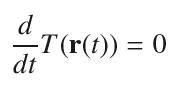
Let T(x, y) be the temperature at location (x, y) on a thin sheet of metal. Assume that ∇T = (y − 4, x + 2y). Let r(t) = (t2, t)be a path on the sheet. Find the values of t such that d dt T(r(t)) = 0
Find a vector normal to the surface x2 + y2 − z2 = 6 at P = (3, 1, 2).
Find a vector normal to the surface 3z3 + x2y − y2x = 1 at P = (1, −1, 1).
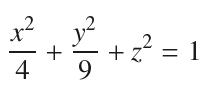
Find the two points on the ellipsoidwhere the tangent plane is normal to v = (1, 1, −2). 310 + + z = 1
Assume we have a local coordinate system at latitude L on the earth’s surface with east, north, and up as the x, y, and z directions, respectively. In this coordinate system, the earth’s angular velocity vector is Ω = (0, ω cos L, ω sin L). Let w = (w1,w2, 0) be a wind vector.(a) Determine
Use the geostrophic flow model to explain the following: In the Southern Hemisphere, winds blow with low pressure to the right, and the closer together the isobars, the stronger the winds. In particular, winds blow clockwise around low pressure systems and counterclockwise around high pressure
Use the Linear Approximation to ƒ(x, y) = √x/y at (9, 4) to estimate √9.1/3.9.
Use the Linear Approximation of ƒ(x, y) = ex2+y at (0, 0) to estimate ƒ(0.01, −0.02). Compare with the value obtained using a calculator.
Let ƒ(x, y) = x2/(y2 + 1). Use the Linear Approximation at an appropriate point (a, b) to estimate ƒ(4.01, 0.98).
Find the linearization of f (x, y, z) = z √x + y centered at (8, 4, 5).
Find the linearization of ƒ(x, y, z) = xy/z centered at (2, 1, 2). Use it to estimate ƒ(2.05, 0.9, 2.01) and compare with the value obtained from a calculator.
Estimate ƒ (2.1, 3.8) assuming that (2, 4) = 5, fx(2, 4) = 0.3, fy(2,4)= -0.2
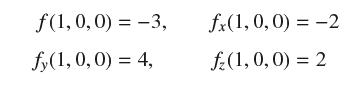
Estimate ƒ(1.02, 0.01, −0.03) assuming that f(1,0,0) = -3, fy(1, 0, 0) = 4, fx(1,0,0) = -2 f(1,0,0) = 2
Use the Linear Approximation to estimate the value. Compare with the value given by a calculator.(2.01)3(1.02)2
Use the Linear Approximation to estimate the value. Compare with the value given by a calculator.4.1/7.9
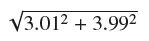
Use the Linear Approximation to estimate the value. Compare with the value given by a calculator. 3.01 + 3.992
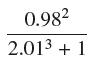
Use the Linear Approximation to estimate the value. Compare with the value given by a calculator. 0.98 2.013 + 1
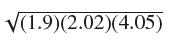
Use the Linear Approximation to estimate the value. Compare with the value given by a calculator. (1.9)(2.02)(4.05)
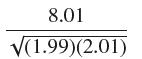
Use the Linear Approximation to estimate the value. Compare with the value given by a calculator. 8.01 (1.99)(2.01)
Suppose that the plane tangent to z = ƒ(x, y) at (−2, 3, 4) has equation 4x + 2y + z = 2. Estimate ƒ(−2.1, 3.1).
The vector n = (2, −3, 6) is normal to the tangent plane to z = h(x, y) at (1, −3, 5). Estimate h(0.85, −3.08).
Let I = W/H2 denote the BMI described in Example 6.A child has weight W = 34 kg and height H = 1.3 m. Use the linear approximation to estimate the change in I if (W, H) changes to (36, 1.32) EXAMPLE 6 Body Mass Index A person's BMI is I = W/H, where W is the body weight (in kilograms) and H is the
Let I = W/H2 denote the BMI described in Example 6.Suppose that (W, H) = (34, 1.3). Use the Linear Approximation to estimate the increase in H required to keep I constant if W increases to 35. EXAMPLE 6 Body Mass Index A person's BMI is I = W/H, where W is the body weight (in kilograms) and H is
Let I = W/H2 denote the BMI described in Example 6.(a) Show that ΔI ≈ 0 if ΔH/ΔW ≈ H/2W.(b) Suppose that (W, H) = (25, 1.1). What increase in H will leave I (approximately) constant if W is increased by 1 kg? EXAMPLE 6 Body Mass Index A person's BMI is I = W/H, where W is the body weight
Let I = W/H2 denote the BMI described in Example 6.Estimate the change in height that will decrease I by 1 if (W, H) = (25, 1.1), assuming that W remains constant. EXAMPLE 6 Body Mass Index A person's BMI is I = W/H, where W is the body weight (in kilograms) and H is the body height (in meters).
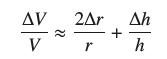
A cylinder of radius r and height h has volume V = πr2h.(a) Use the Linear Approximation to show that(b) Estimate the percentage increase in V if r and h are each increased by 2%.(c) The volume of a certain cylinder V is determined by measuring r and h. Which will lead to a greater error in V: a
Showing 1200 - 1300
of 8339
First
6
7
8
9
10
11
12
13
14
15
16
17
18
19
20
Last
Step by Step Answers

 Get 50% OFF
Claim Now
Get 50% OFF
Claim Now