New Semester
Started
Get
50% OFF
Study Help!
--h --m --s
Claim Now
Question Answers
Textbooks
Find textbooks, questions and answers
Oops, something went wrong!
Change your search query and then try again
S
Books
FREE
Study Help
Expert Questions
Accounting
General Management
Mathematics
Finance
Organizational Behaviour
Law
Physics
Operating System
Management Leadership
Sociology
Programming
Marketing
Database
Computer Network
Economics
Textbooks Solutions
Accounting
Managerial Accounting
Management Leadership
Cost Accounting
Statistics
Business Law
Corporate Finance
Finance
Economics
Auditing
Tutors
Online Tutors
Find a Tutor
Hire a Tutor
Become a Tutor
AI Tutor
AI Study Planner
NEW
Sell Books
Search
Search
Sign In
Register
study help
mathematics
calculus 4th
Calculus 4th Edition Jon Rogawski, Colin Adams, Robert Franzosa - Solutions
Prove the identities assuming that the appropriate partial derivatives exist and are continuous.Div(F + G) = div(F) + div(G)
Prove the identities assuming that the appropriate partial derivatives exist and are continuous.Curl(F + G) = curl(F) + curl(G)
Prove the identities assuming that the appropriate partial derivatives exist and are continuous.Div curl(F) = 0
Prove the identities assuming that the appropriate partial derivatives exist and are continuous.Div(F × G) = G · curl(F) − F · curl(G)
Prove the identities assuming that the appropriate partial derivatives exist and are continuous.If ƒ is a scalar function, then div(ƒF) = ƒ div(F) + F · ∇ƒ.
Prove the identities assuming that the appropriate partial derivatives exist and are continuous.Curl(ƒF) = ƒ curl(F) + (∇ƒ) × F
Prove the identities assuming that the appropriate partial derivatives exist and are continuous.div(∇ƒ× ∇g) = 0
Find (by inspection) a potential function for F = (x, 0) and prove that G = (y, 0) is not conservative.
Find a potential function for the vector field F by inspection or show that one does not exist.F = (x, y)
Find a potential function for the vector field F by inspection or show that one does not exist.F = (y, x)
Find a potential function for the vector field F by inspection or show that one does not exist.F = (y2z, 1 + 2xyz, xy2)
Find a potential function for the vector field F by inspection or show that one does not exist.F = (yz, xz, y)
Find a potential function for the vector field F by inspection or show that one does not exist.F = (yexy, xexy)
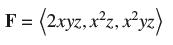
Find a potential function for the vector field F by inspection or show that one does not exist. F = (2xyz, xz, xyz)
Find a potential function for the vector field F by inspection or show that one does not exist.F = (yz2, xz2, 2xyz)
Find a potential function for the vector field F by inspection or show that one does not exist.F = (2xzex2,0, ex2)
Find a potential function for the vector field F by inspection or show that one does not exist.F =(yz cos(xyz), xz cos(xyz), xy cos(xyz))
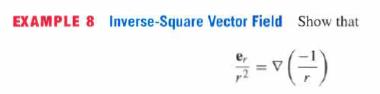
Find potential functions for F = er/r3 and G = er/r4 in R3. See Example 8. EXAMPLE 8 Inverse-Square Vector Field Show that -(-)
Show that F = (3, 1, 2) is conservative. Then prove more generally that any constant vector field F = (a, b, c) is conservative.
Calculate IxIx and I0I0 for the rectangle in Exercise 31 assuming a mass density of δ(x,y)=xδ(x,y)=x.Data From Exercise 31Let R be the rectangle [−a, a] × [b, −b] with uniform density and total mass M. Calculate:The mass density δ of RIx and I0The radius of gyration about the x-axis
Calculate IxIx and IyIy for the half-disk x2+y2≤R2,x≥0x2+y2≤R2,x≥0 (in meters), with total mass MM kilograms and uniform mass density.
Calculate the probability that X + Y ≤ 2 for random variables with joint probability density function as in Exercise 51.Data From Exercise 51Calculate Iz for the solid region W inside the hyperboloid x2 + y2 = z2 + 1 between z = 0 and z = 1.
Calculate the probability that \(X+Y \leq 2\) for random variables with joint probability density function as in Exercise 51.Data From Exercise 51Calculate \(P(0 \leq X \leq 2 ; 1 \leq Y \leq 2)\), where \(X\) and \(Y\) have joint probability density function\[p(x, y)= \begin{cases}\frac{1}{72}(2 x
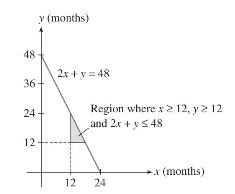
The lifetime (in months) of two components in a certain device are random variables XX and YY that have joint probability distribution functionp(x,y)={19216(48−2x−y) if x≥0,y≥0,2x+y≤480 otherwise p(x,y)={19216(48−2x−y) if x≥0,y≥0,2x+y≤480 otherwise Calculate the
Find a constant CC such thatp(x,y)={Cxy if 0≤x and 0≤y≤1−x0 otherwise p(x,y)={Cxy if 0≤x and 0≤y≤1−x0 otherwise is a joint probability density function. Then calculate:(a) P(X≤12;Y≤14)P(X≤12;Y≤14)(b) P(X≥Y)P(X≥Y)
Find a constant \(C\) such that\[p(x, y)= \begin{cases}C y & \text { if } 0 \leq x \leq 1 \text { and } x^{2} \leq y \leq x \\ 0 & \text { otherwise }\end{cases}\]is a joint probability density function. Then calculate the probability that \(Y \geq X^{3 / 2}\).
Numbers XX and YY between 0 and 1 are chosen randomly. The joint probability density is p(x,y)=1p(x,y)=1 if 0≤x≤10≤x≤1 and 0≤y≤10≤y≤1, and p(x,y)=0p(x,y)=0 otherwise. Calculate the probability PP that the product XYXY is at least 1212.
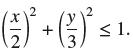
According to quantum mechanics, the xx - and yy-coordinates of a particle confined to the region R=R= [0,1]×[0,1][0,1]×[0,1] are random variables with joint probability density
The wave function for the \(1 \mathrm{~s}\) state of an electron in the hydrogen atom is\[\psi_{1 \mathrm{~s}}(ho)=\frac{1}{\sqrt{\pi a_{0}^{3}}} e^{-ho / a_{0}}\]where \(a_{0}\) is the Bohr radius. The probability of finding the electron in a region \(\mathcal{W}\) of \(\mathbf{R}^{3}\) is equal
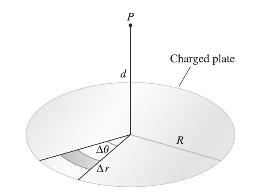
According to Coulomb's Law, the attractive force between two electric charges of magnitude \(q_{1}\) and \(q_{2}\) separated by a distance \(r\) is \(k q_{1} q_{2} / r^{2}\) ( \(k\) is a constant). Let \(F\) be the net force on a charged particle \(P\) of charge \(Q\) coulombs located \(d\)
Let DD be the annular region−π2≤θ≤π2,a≤r≤b−π2≤θ≤π2,a≤r≤bwhere b>a>0b>a>0. Assume that DD has a uniform charge distribution of ρρ coulombs per square meter. Let FF be the net force on a charged particle of charge QQ coulombs located at the origin (by symmetry, FF acts
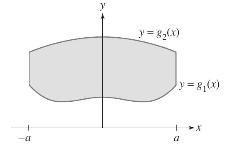
Let \(\mathcal{D}\) be the domain in Figure 22. Assume that \(\mathcal{D}\) is symmetric with respect to the \(y\)-axis; that is, both \(g_{1}(x)\) and \(g_{2}(x)\) are even functions.(a) Prove that the centroid lies on the \(y\)-axis-that is, that \(\bar{x}=0\).(b) Show that if the mass density
Pappus's Theorem Let \(A\) be the area of the region \(\mathcal{D}\) between two graphs \(y=g_{1}(x)\) and \(y=g_{2}(x)\) over the interval \([a, b]\), where \(g_{2}(x) \geq g_{1}(x) \geq 0\). Prove Pappus's Theorem: The volume of the solid obtained by revolving \(\mathcal{D}\) about the \(x\)-axis
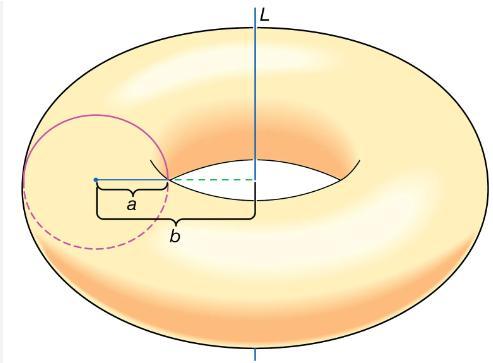
Use Pappus's Theorem in Exercise 62 to show that the torus obtained by revolving a circle of radius bb centered at (0,a)(0,a) about the xx-axis (where bV=2π2ab2V=2π2ab2.
Use Pappus's Theorem to compute ¯yy¯ for the upper half of the disk x2+y2≤a2,y≥0x2+y2≤a2,y≥0. Hint: The disk revolved about the xx-axis is a sphere. B- a b L
Parallel-Axis Theorem Let \(\mathcal{W}\) be a region in \(\mathbf{R}^{3}\) with center of mass at the origin. Let \(I_{z}\) be the moment of inertia of \(\mathcal{W}\) about the \(z\)-axis, and let \(I_{h}\) be the moment of inertia about the vertical axis through a point \(P=(a, b, 0)\), where
Let \(\mathcal{W}\) be a cylinder of radius \(10 \mathrm{~cm}\) and height \(20 \mathrm{~cm}\), with total mass \(M=500 \mathrm{~g}\). Use the Parallel-Axis Theorem (Exercise 65) and the result of Exercise 47 to calculate the moment of inertia of \(\mathcal{W}\) about an axis that is parallel to
Find the volume of the region lying above the cone ϕ = ϕ0 and below the sphere ρ = R.
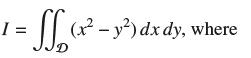
Calculate the integral ofover the part of the ball x2 + y2 + z2 ≤ 16 defined by z ≥ 2. f(x,y,z) = z(x + y +2)-3/2
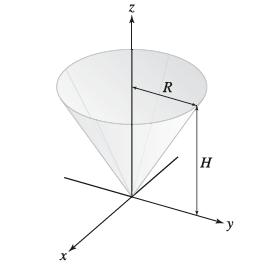
Calculate the volume of the cone in Figure 22, using spherical coordinates. X N R H
Calculate the volume of the sphere x2 + y2 + z2 = a2, using both spherical and cylindrical coordinates.
Let W be the region within the cylinder x2 + y2 = 2 between z = 0 and the cone z = x2 + y2. Calculate the integral of ƒ(x, y, z) = x2 + y2 over W, using both spherical and cylindrical coordinates.
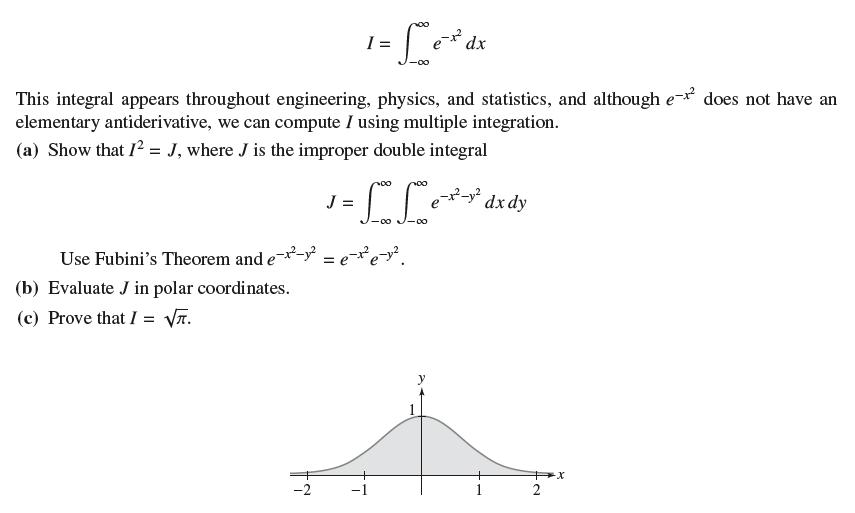
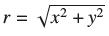
One of the key results in calculus is the computation of the area under the bellshaped curve (Figure 24): This integral appears throughout engineering, physics, and statistics, and although e- does not have an elementary antiderivative, we can compute I using multiple integration. (a) Show that I2
Show that a triple integral of (x2 + y2 + z2 + 1)−2 over all of R3 is equal to π2. This is an improper integral, so integrate first over ρ ≤ R and let R → ∞.
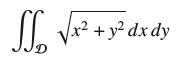
Recall that the improper integral converges if and only if a converge, where and D is the unit disk x2 + y2 ≤ 1? S xdx
Find the centroid of the given region assuming the density δ(x, y) = 1.Quarter circle x2 + y2 ≤ R2, y ≥ |x|
Find the centroid of the given region assuming the density δ(x, y) = 1.Infinite lamina bounded by the x- and y-axes and the graph of y = e−xInfinite lamina bounded by the x- and y-axes and the graph of y = e−x
Which of the following maps is linear?(a) (uv, v) (b) (u + v, u) (c) (3, eu)
Suppose that Φ is a linear map such that Φ(2, 0) = (4, 0) and Φ(0, 3) = (−3, 9). Find the images of:(a) Φ(1, 0) (b) Φ(1, 1) (c) Φ(2, 1)
What is the area of Φ(R) if R is a rectangle of area 9 and Φ is a mapping whose Jacobian has constant value 4?
Estimate the area of Φ(R), where R = [1, 1.2] × [3, 3.1] and Φ is a mapping such that Jac(Φ)(1, 3) = 3.
Determine the image under Φ(u, v) = (2u, u + v) of the following sets:(a) The u- and v-axes(b) The rectangle R = [0, 5] × [0, 7](c) The line segment joining (1, 2) and (5, 3)(d) The triangle with vertices (0, 1), (1, 0), and (1, 1)
Describe [in the form y = ƒ(x)] the images of the lines u = c and v = c under the mapping Φ(u, v) = (u/v, u2 − v2).
Let Φ(u, v) = (u2, v). Is Φ one-to-one? If not, determine a domain on which Φ is one-to-one. Find the image under Φ of:(a) The u- and v-axes(b) The rectangle R = [−1, 1] × [−1, 1](c) The line segment joining (0, 0) and (1, 1)(d) The triangle with vertices (0, 0), (0, 1), and (1, 1)
Let Φ(u, v) = (eu, eu+v).(a) Is Φ one-to-one? What is the image of Φ?(b) Describe the images of the vertical lines u = c and the horizontal lines v = c.
Let Φ(u, v) = (2u + v, 5u + 3v) be a map from the uv-plane to the xy-plane.Show that the image of the horizontal line v = c is the line with equation y = 5/2 x + 1/2c. What is the image (in slope-intercept form) of the vertical line u = c?
Describe the image of the line through the points (u, v) = (1, 1) and (u, v) = (1, −1) under Φ in slopeintercept form.
Describe the image of the line v = 4u under Φ in slope-intercept form.
Show that Φ maps the line v = mu to the line of slope (5 + 3m)/(2 + m) through the origin in the xy-plane.
Show that the inverse of Φ isShow that Φ(Φ−1(x, y)) = (x, y) and Φ−1(Φ(u, v)) = (u, v). (x, y) = (3x-y, -5x + 2y)
Use the inverse in Exercise 9 to find:(a) A point in the uv-plane mapping to (2, 1)(b) A segment in the uv-plane mapping to the segment joining (−2, 1) and (3, 4)Data From Exercise 9Show that the inverse of Φ isShow that Φ(Φ−1(x, y)) = (x, y) and Φ−1(Φ(u, v)) = (u, v). (x, y) = (3x-y,
Calculate Jac(Φ) = ∂(x, y)/∂(u, v).
Calculate Jac(Φ −1) = ∂(u, v)/∂(x, y).
Compute the Jacobian (at the point, if indicated). (u, v) = (3u + 4v,u 2v)
Compute the Jacobian (at the point, if indicated). (r,t) = (r sint,r - cost), (r, t)= (1,7)
Compute the Jacobian (at the point, if indicated). (r,t) = (r sint, r- cost), (r,t)= (1,7)
Compute the Jacobian (at the point, if indicated). Q(u, v) = (vlnu, uv), (u,v) = (1,2)
Compute the Jacobian (at the point, if indicated). (r, 0) = (r cos e,r sin 6), (r, 0) = (4,5)
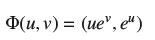
Compute the Jacobian (at the point, if indicated). (u, v) = (ue", e")
Find a linear mapping Φ that maps [0, 1] × [0, 1] to the parallelogram in the xy-plane spanned by the vectors (2, 3) and (4, 1).
Find a linear mapping Φ that maps [0, 1] × [0, 1] to the parallelogram in the xy-plane spanned by the vectors (−2, 5) and (1, 7).
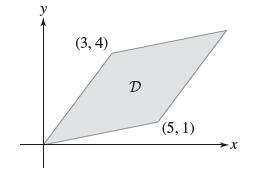
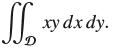
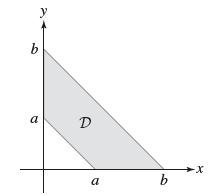
Let D be the parallelogram in Figure 13. Apply the Change of Variables Formula to the map Φ(u, v) = (5u + 3v, u + 4v) to evaluate xydx dy as an integral over Do = [0, 1] [0, 1]. D
Let Φ(u, v) = (u − uv, uv).(a) Show that the image of the horizontal line v = c is y = c / 1 − c x if c ≠ 1, and is the y-axis if c = 1.(b) Determine the images of vertical lines in the uv-plane.(c) Compute the Jacobian of Φ.(d) Observe that by the formula for the area of a triangle, the
Let Φ(u, v) = (3u + v, u − 2v). Use the Jacobian to determine the area of Φ(R) for:(a) R = [0, 3] × [0, 5](b) R = [2, 5] × [1, 7]
Find a linear map T that maps [0, 1] × [0, 1] to the parallelogram P in the xy-plane with vertices (0, 0), (2, 2), (1, 4), (3, 6). Then calculate the double integral of e2x−y over P via change of variables.
With Φ as in Example 3, use the Change of Variables Formula to compute the area of the image of [1, 4] × [1, 4]. EXAMPLE 3 Let G(u, v) = (uv, uv) for u> 0, v> 0. Determine the images of (b) [1,2] [1,2] (a) The lines u = c and v=c Find the inverse map G-
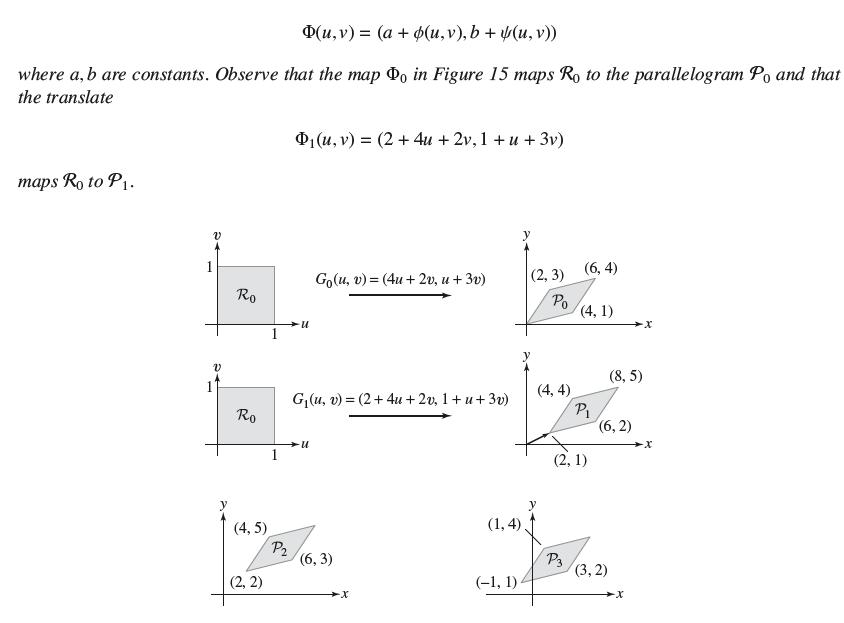
Let R0 = [0, 1] × [0, 1] be the unit square. The translate of a map Φ0(u, v) = (ϕ(u, v), ψ(u, v)) is a mapFind translates Φ2 and Φ3 of the mapping Φ0 in Figure 15 that map the unit square R0 to the parallelograms P2 and P3. D(u,v) (a + p(u,v), b + (u, v)) where a, b are constants. Observe
Let R0 = [0, 1] × [0, 1] be the unit square. The translate of a map Φ0(u, v) = (ϕ(u, v), ψ(u, v)) is a mapSketch the parallelogram P with vertices (1, 1), (2, 4), (3, 6), (4, 9) and find the translate of a linear mapping that maps R0 to P. D(u, v) = (a + d(u, v), b + y(u, v)) where a, b are
Find the translate of a linear mapping that maps R0 to the parallelogram spanned by the vectors (3, 9) and (−4, 6) based at (4, 2).
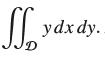
Let D = Φ(R), where Φ(u, v) = (u2, u + v) and R = [1, 2] × [0, 6]. Calculate It is not necessary to describe D. SS ydx dy..
Let D be the image of R = [1, 4] × [1, 4] under the map Φ(u, v) = (u2/v, v2/u).(a) Compute Jac(Φ).(b) Sketch D.(c) Use the Change of Variables Formula to compute Area(D) and f(x,y) dx dy, where f(x,y) = x + y.
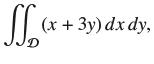
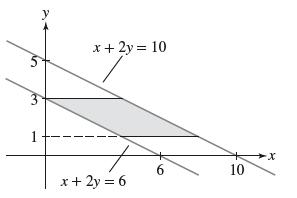
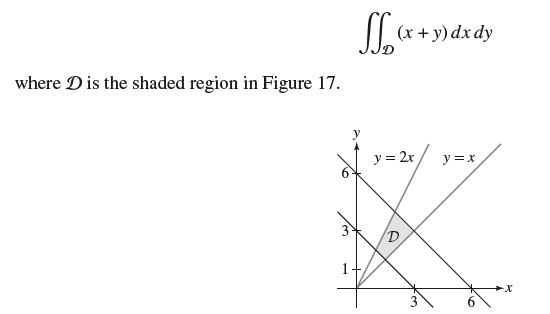
Compute where D is the shaded region in Figure 16. Hint: Use the map Φ(u, v) = (u − 2v, v). SS D (x + 3y) dx dy,
Use the map (u,y) = | v) (vri uv \v+1'v+1/ to compute
Show that T(u, v) = (u2 − v2, 2uv) maps the triangle D0 = {(u, v) : 0 ≤ v ≤ u ≤ 1} to the domain D bounded by x = 0, y = 0, and y2 = 4 − 4x. Use T to evaluate SS x + y dx dy
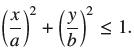
Find a mapping Φ that maps the disk u2 + v2 ≤ 1 onto the interior of the ellipse Then use the Change of Variables Formula to prove that the area of the ellipse is πab. (-) + 1.
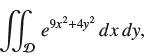
Calculate where D is the interior of the ellipse Spe D e9x +4y dx dy,
Let D be the region inside the ellipse x2 + 2xy + 2y2 − 4y = 8. Compute the area of D as an integral in the variables u = x + y, v = y − 2.
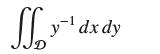
Sketch the domain D bounded by y = x2, y = 1/2 x2, and y = x. Use a change of variables with the map x = uv, y = u2 to calculateThis is an improper integral since ƒ(x, y) = y−1 is undefined at (0, 0), but it becomes proper after changing variables. JJD ydx dy
Find an appropriate change of variables to evaluate S(x + y) e dx dy where R is the square with vertices (1, 0), (0, 1), (-1,0), (0, -1).
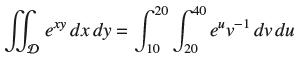
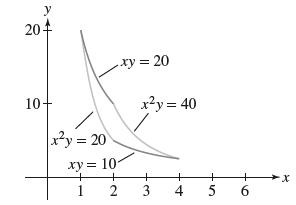
Let Φ be the inverse of the map F(x, y) = (xy, x2y) from the xy-plane to the uv-plane. Let D be the domain in Figure 18. Show, by applying the Change of Variables Formula to the inverse Φ = F−1, thatand evaluate this result. See Example 8. SS [ = exy dx dy = 20 40 10 20 ev dv du
Sketch the domain(a) Let F be the map u = x + y, v = y − 2x from the xy-plane to the uv-plane, and let Φ be its inverse. Use Eq. (14) to compute Jac(Φ).(b) Compute dx dy using the Change of Variables Formula with the map Φ. Hint: It is not necessary to solve for Φ explicitly. D = {(x,y): 1
Let (a) Show that the mapping u = xy, v = x − y maps D to the rectangle R = [2, 4] × [0, 3].(b) Compute ∂(x, y)/∂(u, v) by first computing ∂(u, v)/∂(x, y).(c) Use the Change of Variables Formula to show that I is equal to the integral of f (u, v) = v over R and evaluate. I = (x - y) dx
Derive formula (5) in Section 15.4 for integration in cylindrical coordinates from the general Change of Variables Formula.
Derive formula (8) in Section 15.4 for integration in spherical coordinates from the general Change of Variables Formula.
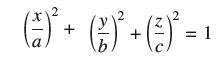
Use the Change of Variables Formula in three variables to prove that the volume of the ellipsoid is equal to abc × the volume of the unit sphere. + al b. 2 IN + TU = 1
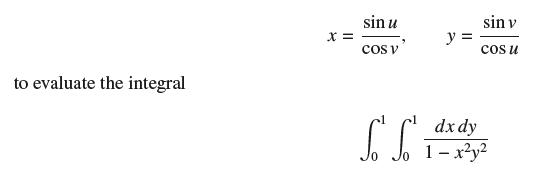
Use the mapThis integral is an improper integral since the integrand is infinite if x = ±1 and y = ± 1, but applying the Change of Variables Formula shows that the result is finite. to evaluate the integral X = sin u COS V y = sin v COS U dx dy 1-xy
Verify properties (1) and (2) for linear functions and show that any map satisfying these two properties is linear.
Let P and Q be points in R2. Show that a linear map Φ(u, v) = (Au + Cv, Bu + Dv) maps the segment joining P and Q to the segment joining Φ(P) to Φ(Q). The segment joining P and Q has parametrization (1-1)0P + 100 for 0t1
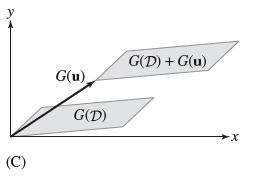
Let Φ be a linear map. Prove Eq. (6) in the following steps.(a) For any set D in the uv-plane and any vector u, let D + u be the set obtained by translating all points in D by u. By linearity, Φ maps D + u to the translate Φ(D) + Φ(u) [Figure 19(C)]. Therefore, if Eq. (6) holds for D, it also
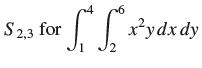
Calculate the Riemann sum using two choices of sample points: (a) Lower-left vertex(b) Midpoint of rectangleThen calculate the exact value of the double integral. 4 S S xy dx dy 2 S2,3 for
Showing 600 - 700
of 8339
1
2
3
4
5
6
7
8
9
10
11
12
13
14
15
Last
Step by Step Answers

 Get 50% OFF
Claim Now
Get 50% OFF
Claim Now


![(b) Calculate the probability that a particle with = 2, n = 3 lies in the region [0, 1] [0, }].](https://dsd5zvtm8ll6.cloudfront.net/images/question_images/1705/6/5/2/47165aa30f7126f31705652470712.jpg)








![xy dx dy as an integral over Do = [0, 1] [0, 1]. D](https://dsd5zvtm8ll6.cloudfront.net/images/question_images/1705/6/6/0/56665aa5096233fc1705660565767.jpg)
![EXAMPLE 3 Let G(u, v) = (uv, uv) for u> 0, v> 0. Determine the images of (b) [1,2] x [1,2] (a) The lines u =](https://dsd5zvtm8ll6.cloudfront.net/images/question_images/1705/6/6/1/92365aa55e396e2a1705661923233.jpg)