New Semester
Started
Get
50% OFF
Study Help!
--h --m --s
Claim Now
Question Answers
Textbooks
Find textbooks, questions and answers
Oops, something went wrong!
Change your search query and then try again
S
Books
FREE
Study Help
Expert Questions
Accounting
General Management
Mathematics
Finance
Organizational Behaviour
Law
Physics
Operating System
Management Leadership
Sociology
Programming
Marketing
Database
Computer Network
Economics
Textbooks Solutions
Accounting
Managerial Accounting
Management Leadership
Cost Accounting
Statistics
Business Law
Corporate Finance
Finance
Economics
Auditing
Tutors
Online Tutors
Find a Tutor
Hire a Tutor
Become a Tutor
AI Tutor
AI Study Planner
NEW
Sell Books
Search
Search
Sign In
Register
study help
mathematics
calculus 4th
Calculus 4th Edition Jon Rogawski, Colin Adams, Robert Franzosa - Solutions
In economics, the multiplier effect refers to the fact that when there is an injection of money to consumers, the consumers spend a certain percentage of it. That amount recirculates through the economy and adds additional income, which comes back to the consumers and of which they spend the same
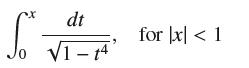
Express the integral as an infinite series. So dt √1-14 for x < 1
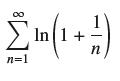
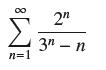
Determine convergence or divergence using any method covered so far. 00 n=1 2n 3n-n
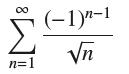
Determine convergence or divergence using any method covered in the text so far. 00 n=1 (-1)n-1 √n
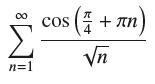
Determine whether the series converges absolutely. If it does not, determine whether it converges conditionally. 00 Σ n=1 COS · (# + πη) √n
Show that for |x| • + gx - x + x + x = x + √x + ₂x7 - x + 1 = 1 + x + x² 1 + 2x
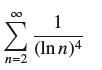
Determine convergence or divergence using any method covered so far. 18 n=2 1 (Inn)4
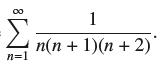
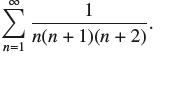
EvaluateFind constants A, B, and C such that and use the result to evaluate n=1 1 n(n + 1)(n + 2)
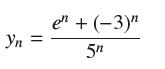
Use the appropriate limit laws and theorems to determine the limit of the sequence or show that it diverges. Уп = en +(-3)" 5n
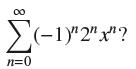
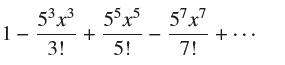
Which function has Maclaurin series 00 n=0 -1)"2"x"?
Let ƒ(x) = 3x3 + 2x2 − x − 4. Calculate Tj for j = 1, 2, 3, 4, 5 at both a = 0 and a = 1. Show that T3(x) = ƒ(x) in both cases.
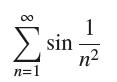
Determine convergence or divergence using any method covered in the text so far. 00 n=1 1 sin n²
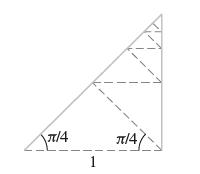
Find the total length of the infinite zigzag path in Figure 5 (each zag occurs at an angle of π/4). 714 1 JT/4/2
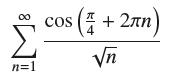
Determine whether the series converges absolutely. If it does not, determine whether it converges conditionally. 00 Σ n=1 cos ( + 2mn) √n
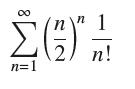
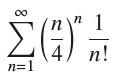
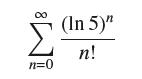
Find all values of x such that converges. 00 I=U n' n!
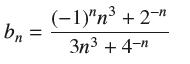
Use the appropriate limit laws and theorems to determine the limit of the sequence or show that it diverges. bn || (-1)"n³ + 2-n 3n³ + 4-n
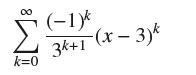
Which function has the following Maclaurin series?For which values of x is the expansion valid? 00 Σ k=0 (-1)k – 34+1 (x − 3)
Let Tn be the nth Taylor polynomial at x = a for a polynomial ƒ of degree n. Based on the result of Exercise 59, guess the value of |ƒ(x) − Tn(x)|. Prove that your guess is correct using the Error Bound.Data From Exercise 59Let ƒ(x) = 3x3 + 2x2 − x − 4. Calculate Tj for j = 1, 2, 3, 4,
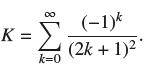
Catalan’s constant is defined by (a) How many terms of the series are needed to calculate K with an error of less than 10−6?(b) Carry out the calculation. K = Σ k=0 (-1) k (2k + 1)2°
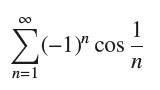
Determine convergence or divergence using any method covered in the text so far. n=1 (-1)" cos 1 n
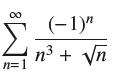
Use a computer algebra system to approximate to within an error of at most 10−5. 00 Σ n=1 (-1)" n³ + √n
Find all values of x such that the following series converges: F(x) = 1 + 3x + x² + 27x³ + x² +243x³ +...
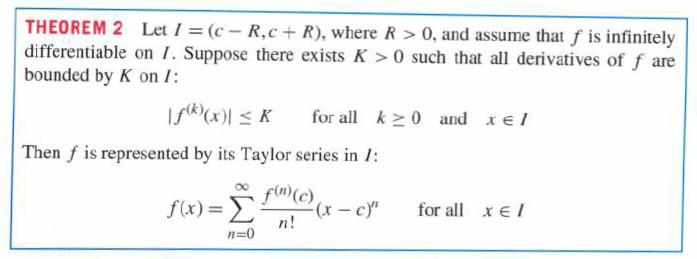
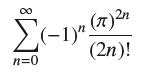
Use Theorem 2 to prove that the ƒ(x) is represented by its Maclaurin series for all x.Using Maclaurin series, determine to exactly what value the following series converges: THEOREM 2 Let I = (c-R,c + R), where R > 0, and assume that f is infinitely differentiable on 1. Suppose there exists K> 0
Use the appropriate limit laws and theorems to determine the limit of the sequence or show that it diverges.an = n sin π/n
Let s(t) be the distance of a truck to an intersection. At time t = 0, the truck is 60 m from the intersection, travels away from it with a velocity of 24 m/s, and begins to slow down with an acceleration of a = −3 m/s2. Determine the second Maclaurin polynomial of s, and use it to estimate the
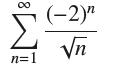
Determine convergence or divergence using any method covered in the text so far. 8 00 Σ n=1 (-2)" √n
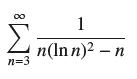
Determine convergence or divergence using any method covered so far. 8 Σ n=3 1 n(Inn)2 – η
Use the appropriate limit laws and theorems to determine the limit of the sequence or show that it diverges.bn = n!/πn
Use Theorem 2 to prove that the ƒ(x) is represented by its Maclaurin series for all x.Using Maclaurin series, determine to exactly what value the following series converges: THEOREM 2 Let I = (c-R,c + R), where R > 0, and assume that f is infinitely differentiable on 1. Suppose there exists K> 0
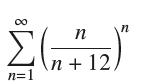
Determine convergence or divergence using any method covered in the text so far. Σ(12) n=1 n
A ball dropped from a height of 10 ft begins to bounce vertically. Each time it strikes the ground, it returns to two-thirds of its previous height. What is the total vertical distance traveled by the ball if it bounces infinitely many times?
A bank owns a portfolio of bonds whose value P(r) depends on the interest rate r (measured in percent; e.g., r = 5 means a 5% interest rate). The bank’s quantitative analyst determines thatIn finance, this second derivative is called bond convexity. Find the second Taylor polynomial of P(r)
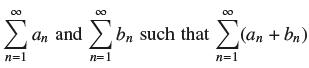
Give an example of conditionally convergent series converges absolutely. Σan and Σ bn such that Σ(an + bn) + n=1 η= | n=1
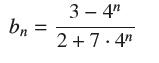
Use the appropriate limit laws and theorems to determine the limit of the sequence or show that it diverges. bn 3-4" 2+7.4n
Let be a positive series, and assume that 00 Σ n=0 an
Use Theorem 2 to prove that the ƒ(x) is represented by its Maclaurin series for all x.ƒ(x) = sin(x/2) + cos(x/3) THEOREM 2 Let I = (c-R,c + R), where R > 0, and assume that f is infinitely differentiable on 1. Suppose there exists K> 0 such that all derivatives of f are bounded by K on
Let C(x) = 1 − x2/2! + x4/4! − x6/6! + · · · .(a) Show that C(x) has an infinite radius of convergence.(b) Prove that C(x) and ƒ(x) = cos x are both solutions of y" = −y with initial conditions y(0) = 1, y'(0) = 0. This Initial Value Problem has a unique solution, so we have C(x) = cos x
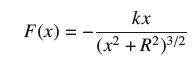
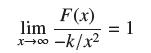
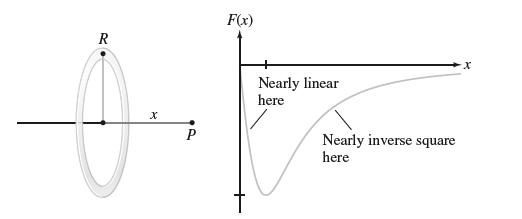
A narrow, negatively charged ring of radius R exerts a force on a positively charged particle P located at distance x above the center of the ring of magnitudewhere k > 0 is a constant (Figure 10).(a) Compute the third-degree Maclaurin polynomial for F.(b) Show that F ≈ −(k/R3)x to second
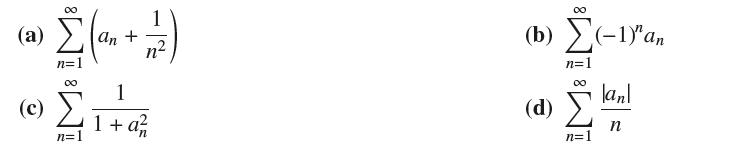
Let be an absolutely convergent series. Determine whether the following series are convergent or divergent: un I=u Σ 00
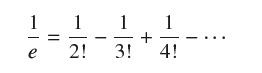
Use the power series for y = ex to show thatUse your knowledge of alternating series to find an N such that the partial sum SN approximates e−1 to within an error of at most 10−3. Confirm this using a calculator to compute both SN and e−1. 1 22- e 2! 1 + 3! 4!
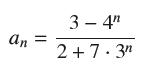
Use the appropriate limit laws and theorems to determine the limit of the sequence or show that it diverges. an = 3-4" 2+7.3n
Use Theorem 2 to prove that the ƒ(x) is represented by its Maclaurin series for all x.ƒ(x) = e−x THEOREM 2 Let I = (c-R,c + R), where R > 0, and assume that f is infinitely differentiable on 1. Suppose there exists K> 0 such that all derivatives of f are bounded by K on I: |f(k)(x)| ≤ K Then
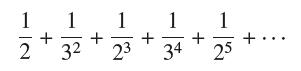
Show that the Ratio Test does not apply, but verify convergence using the Direct Comparison Test for the series 1 1 + 2 32 + 1 23 + 1 34 + 1 25 +
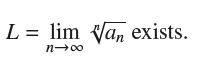
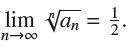
Let {an} be a positive sequence such that Determine whether the following series converge or diverge: lim Van = 1/2. n→∞
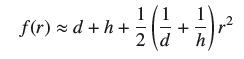
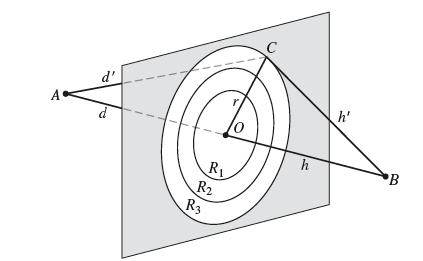
A light wave of wavelength λ travels from A to B by passing through an aperture (circular region) located in a plane that is perpendicular to AB (see Figure 11 for the notation). Let ƒ(r) = d' + h'; that is, ƒ(r) is the distance AC + CB as a function of r. (a) Show that ƒ(r) = √d2 + r2 +
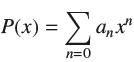
Let be a power series solution to y' = 2xy with initial condition y(0) = 1.(a) Show that the odd coefficients a2k+1 are all zero.(b) Prove that a2k = a2k−2/k and use this result to determine the coefficients a2k. P(x) = Σα n=0 an- 1 xh
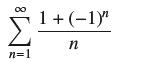
Determine convergence or divergence using any method covered so far. n=1 1 + (-1)" n
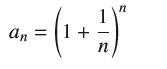
Use the appropriate limit laws and theorems to determine the limit of the sequence or show that it diverges. an 1 + n п
Let where c is a constant. 00 n=1 c"n! nn
Use Theorem 2 to prove that the ƒ(x) is represented by its Maclaurin series for all x.ƒ(x) = sinh x THEOREM 2 Let I = (c-R,c + R), where R > 0, and assume that f is infinitely differentiable on 1. Suppose there exists K> 0 such that all derivatives of f are bounded by K on I: |f(k)(x)| ≤ K Then
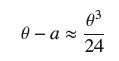
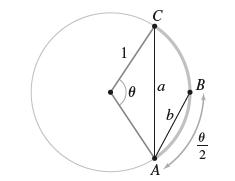
Referring to Figure 12, let a be the length of the chord A̅C̅ of angle θ of the unit circle. Derive the following approximation for the excess of the arc over the chord:Show that θ − a = θ − 2 sin(θ/2) and use the third Maclaurin polynomial as an approximation. D 0 A- as 24
Apply the Ratio Test to determine convergence or divergence, or state that the Ratio Test is inconclusive. 00 n Σ 5n n=1
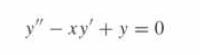
Find a power series satisfying Eq. (10) with initial condition y(0) = 0, y(0) = 1. y" - xy + y=0
Find a power series P(x) satisfying the differential equationy" − xy' + y = 0with initial condition y(0) = 1, y'(0) = 0. What is the radius of convergence of the power series?
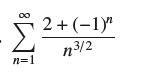
Determine convergence or divergence using any method covered so far. n=1 2 + (-1)" n³/2
Use the appropriate limit laws and theorems to determine the limit of the sequence or show that it diverges. ( ² ² + 1) = An
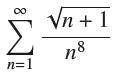
Apply the Ratio Test to determine convergence or divergence, or state that the Ratio Test is inconclusive. Μ8 Σ n=1 In + 1 ηδ
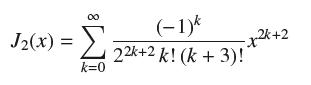
Prove thatis a solution of the Bessel differential equation of order 2: J₂(x) = Σ22k+2 k! (k + 3)! ¹ (-1) k k=0 -x²x+2
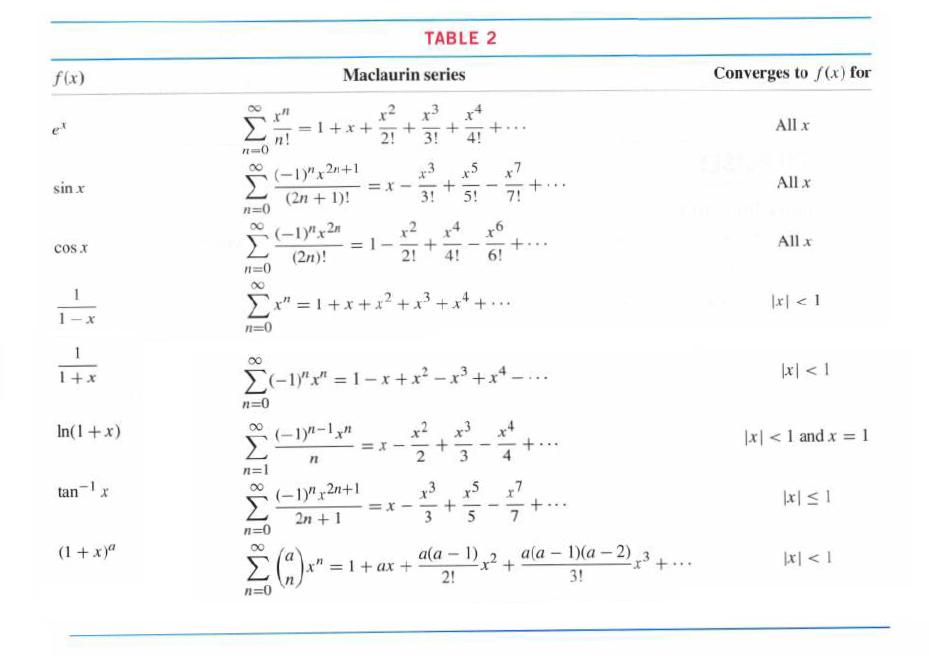
Find the functions with the following Maclaurin series (refer to Table 2). f(x) et sin x COS X -12 -15 + In(1+x) tan ¹x (1+x)a IM IM IM IM IMBIMBIM8 IM8 n! n=0 = 1+x+ (-1)" x 2n+1 (2n + 1)! (-1)"¹x2n (2n)! Maclaurin series = 1 n (-1)n-1n = TABLE 2 2! 3! (-1)^2n+1 2n +1 =X- + Σx"=1+x+x² + x³ +
Determine convergence or divergence using any method covered so far. 00 Σsin n=1 n
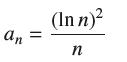
Find the limit of the sequence using L’Hôpital’s Rule. an = (Inn)² n
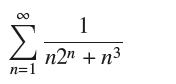
Apply the Ratio Test to determine convergence or divergence, or state that the Ratio Test is inconclusive. 8 n=1 1 n2n + n³
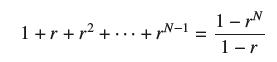
Use the formulaProfessor George Andrews of Pennsylvania State University observed that we can use Eq. (6) to calculate the derivative of ƒ(x) = xN (for N ≥ 0). Assume that a ≠ 0 and let x = ra. Show thatand evaluate the limit. 1+r+²++N-1 1-N 1-r
Show that the nth Maclaurin polynomial of ƒ(x) = arcsin x for n odd is 1x³ 1.3 x Tn(x)=x+ + 23 2.4 5 + 1.3.5 (n-2) x" 2.4.6(n-1) n
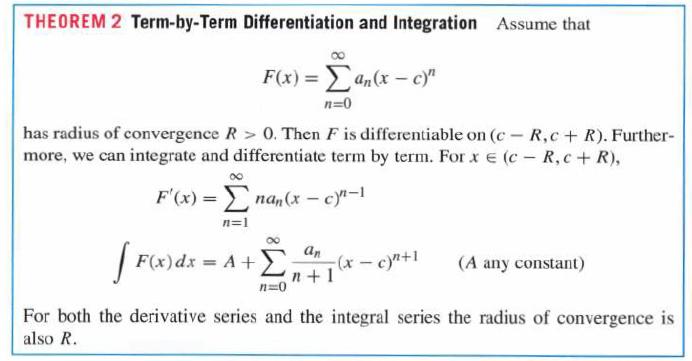
Why is it impossible to expand ƒ(x) = |x| as a power series that converges in an interval around x = 0? Explain using Theorem 2. THEOREM 2 Term-by-Term Differentiation and Integration Assume that F(x) = Σan(x-c)" n=0 has radius of convergence R > 0. Then F is differentiable on (c- R,c + R).
Let x ≥ 0 and assume that ƒ(n+1)(t) ≥ 0 for 0 ≤ t ≤ x. Use Taylor’s Theorem to show that the nth Maclaurin polynomial Tn satisfiesTn(x) ≤ ƒ(x), for all x ≥ 0
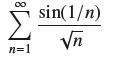
Determine convergence or divergence using any method covered so far. 00 n=1 sin(1/n)
Find the functions with the following Maclaurin series (refer to Table 2). f(x) et sin x COS X -12 -15 + In(1+x) tan ¹x (1+x)a IM IM IM IM IMBIMBIM8 IM8 n! n=0 = 1+x+ (-1)" x 2n+1 (2n + 1)! (-1)"¹x2n (2n)! Maclaurin series = 1 n (-1)n-1n = TABLE 2 2! 3! (-1)^2n+1 2n +1 =X- + Σx"=1+x+x² + x³ +
Find the limit of the sequence using L’Hôpital’s Rule. bn = √n] √n In 1+ n
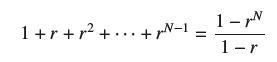
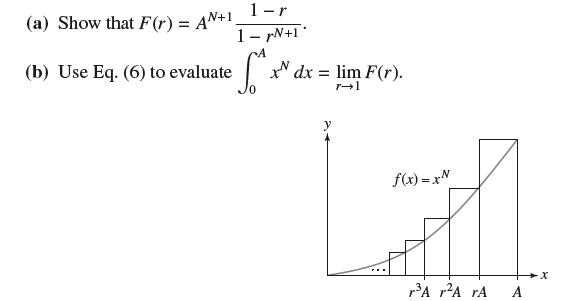
Use the formulaPierre de Fermat used geometric series to compute the area under the graph of ƒ(x) = xN over [0, A]. For 0 1+r+²++N-1 1-N 1-r
Apply the Ratio Test to determine convergence or divergence, or state that the Ratio Test is inconclusive. 00 n Σ n! n=1
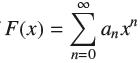
Suppose that the coefficients of are periodic; that is, for some whole number M > 0, we have aM+n = an. Prove that F(x) converges absolutely for |x| 00 F(x) = Σ anx" n=0
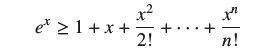
Use Exercise 68 to show that for x ≥ 0 and all n,Sketch the graphs of y = ex, y = T1(x), and y = T2(x) on the same coordinate axes. Does this inequality remain true for x Data From Exercise 68Let x ≥ 0 and assume that ƒ(n+1)(t) ≥ 0 for 0 ≤ t ≤ x. Use Taylor’s Theorem to show that the
Find the functions with the following Maclaurin series (refer to Table 2). f(x) et sin x COS X -12 -15 + In(1+x) tan ¹x (1+x)a IM IM IM IM IMBIMBIM8 IM8 n! n=0 = 1+x+ (-1)" x 2n+1 (2n + 1)! (-1)"¹x2n (2n)! Maclaurin series = 1 n (-1)n-1xn = TABLE 2 2! 3! (-1)^2n+1 2n +1 =X- + Σx"=1+x+x² + x³ +
Use the formulaVerify the Gregory–Leibniz formula in part (d) as follows.(a) Set r = −x2 in Eq. (6) and rearrange to show that(c) Use the Comparison Theorem for integrals to prove thatObserve that the integrand is ≤ x2N.(d) Prove thatUse (b) and (c) to show that the partial sums SN satisfy
Determine convergence or divergence using any method covered so far. 00 n=1 2n + 1 4n
Find the limit of the sequence using L’Hôpital’s Rule.cn = n(√n2 + 1 − n)
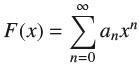
Let be a power series with radius of convergence R > 0. 00 F(x) = Σanx" n=0
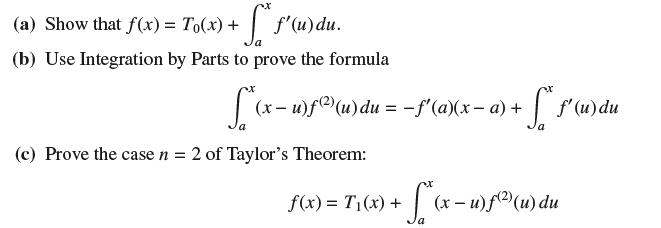
This exercise is intended to reinforce the proof of Taylor’s Theorem. (a) Show that f(x) = To(x) + + -S* f'(u)du. (b) Use Integration by Parts to prove the formula ~x (x-u)f(²)(u) du = -f'(a)(x-a) + + f²f' (u) du a (c) Prove the case n = 2 of Taylor's Theorem: f(x) = T₁(x) + f(x - u) f²) (u)
Find the functions with the following Maclaurin series (refer to Table 2). f(x) et sin x COS X -12 -15 + In(1+x) tan ¹x (1+x)a IM IM IM IM IMBIMBIM8 IM8 n! n=0 = 1+x+ (-1)" x 2n+1 (2n + 1)! (-1)"¹x2n (2n)! Maclaurin series = 1 n (-1)n-1n = TABLE 2 2! 3! (-1)^2n+1 2n +1 =X- + Σx"=1+x+x² + x³ +
Determine convergence or divergence using any method covered so far. 00 1 e √n n=3
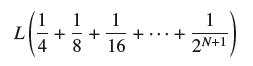
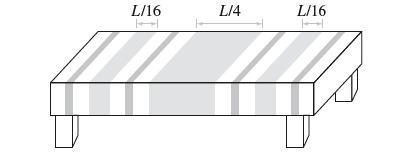
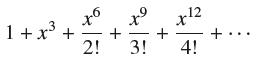
Use the formulaTake a table of length L (Figure 8). At Stage 1, remove the section of length L/4 centered at the midpoint. Two sections remain, each with length less than L/2. At Stage 2, remove sections of length L/42 from each of these two sections (this stage removes L/8 of the table). Now four
Find the limit of the sequence using L’Hôpital’s Rule.dn = n2 (3√n3 + 1 − n)
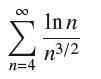
Apply the Ratio Test to determine convergence or divergence, or state that the Ratio Test is inconclusive. n=4 Inn n³/2
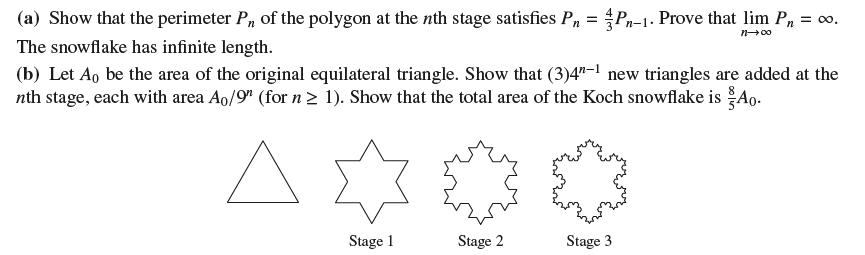
The Koch snowflake (described in 1904 by Swedish mathematician Helge von Koch) is an infinitely jagged “fractal” curve obtained as a limit of polygonal curves (it is continuous but has no tangent line at any point). Begin with an equilateral triangle (Stage 0) and produce Stage 1 by replacing
We estimate integrals using Taylor polynomials. 1/2 Find the fourth Maclaurin polynomial T4 for f(x) = ex², and calculate I = = 5¹² T4(x) dx as an estimate 1/2 for Se dx. A CAS yields the value 1 ≈ 0.461281. How large is the error in your approximation? T4 is obtained by substituting -x² in
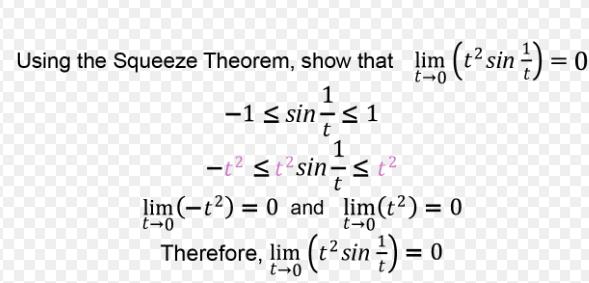
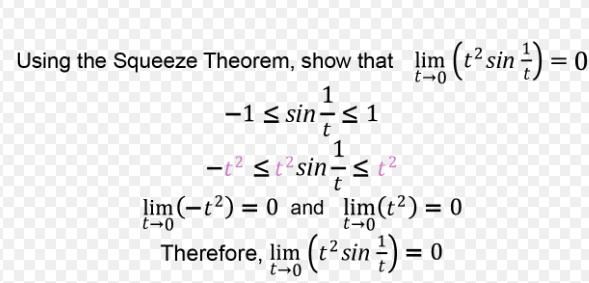
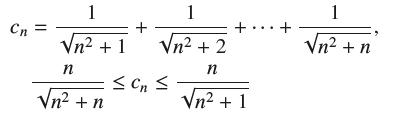
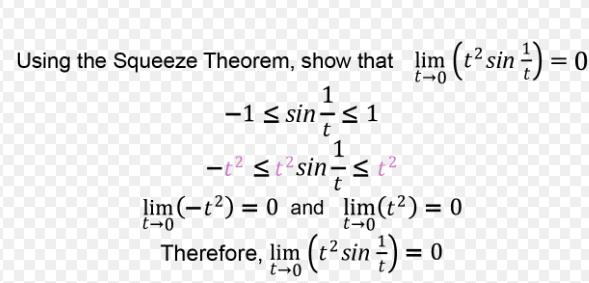
Use the Squeeze Theorem to evaluate by verifying the given inequality. lim an n→∞
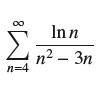
Determine convergence or divergence using any method covered so far. 00 n=4 Inn n²-3n
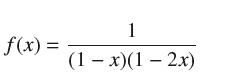
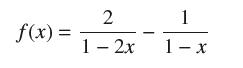
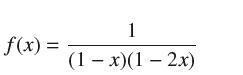
Find the Maclaurin series of ƒ(x) using the identity f(x) = 1 (1-x)(1-2x)
Apply the Ratio Test to determine convergence or divergence, or state that the Ratio Test is inconclusive. 00 Σ(3), n=1 1 n!
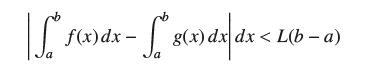
We estimate integrals using Taylor polynomials. Let L > 0. Show that if two functions ƒ and g satisfy |ƒ(x) − g(x)| L'o • f(x) dx - * 8(x) dx/dx < L(b-a
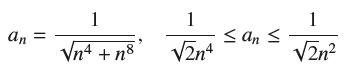
Use the Squeeze Theorem to evaluate by verifying the given inequality. lim an n→∞
Determine convergence or divergence using any method covered so far. Μ8 Σ(1-
Find the Taylor series for ƒ(x) at c = 2. Rewrite the identity of Exercise 71 asData From Exercise 71Find the Maclaurin series of ƒ(x) using the identity f(x) = 1 (1-x)(1-2x)
Use the Squeeze Theorem to evaluate by verifying the given inequality. lim an n→∞
Apply the Ratio Test to determine convergence or divergence, or state that the Ratio Test is inconclusive. Σ(3), n=1 1 n!
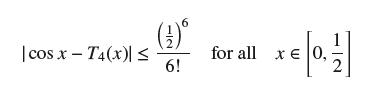
We estimate integrals using Taylor polynomials. Exercise 72 is used to estimate the error.Let T4 be the fourth Maclaurin polynomial for ƒ(x) = cos x.(a) Show thatT4(x) = T5(x).Data From Exercise 72Let L > 0. Show that if two functions ƒ and g satisfy |ƒ(x) − g(x)| | cos x - T4(x)|
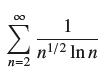
Determine convergence or divergence using any method covered so far. 00 Σ n=2 1 n1/2 Inn
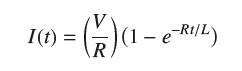
When a voltage V is applied to a series circuit consisting of a resistor R and an inductor L, the current at time t isExpand I(t) in a Maclaurin series. Show that I(t) ≈ Vt/L for small t. I (t) = ( 2 ) (1 - e-RI/L)
Apply the Root Test to determine convergence or divergence, or state that the Root Test is inconclusive. 00 n=1 1 4n
Showing 3800 - 3900
of 8339
First
32
33
34
35
36
37
38
39
40
41
42
43
44
45
46
Last
Step by Step Answers

 Get 50% OFF
Claim Now
Get 50% OFF
Claim Now












![(a) Prove that the series converges absolutely if [c] e. en! 27. Verify this numerically. nonn+1/2 (c) Use](https://dsd5zvtm8ll6.cloudfront.net/images/question_images/1702/7/0/9/547657d492b6a31f1702709549321.jpg)





![bn = n] n In 1+ n](https://dsd5zvtm8ll6.cloudfront.net/images/question_images/1702/4/5/4/56665796526537b91702454566050.jpg)



![1 1 + x (b) Show, by integrating over [0, 1], that 4 = 1 = = 1= x + x. 1 Pr + 3 5 1 7 + ..+(-1)-12N-2 + +](https://dsd5zvtm8ll6.cloudfront.net/images/question_images/1702/5/5/5/753657af069519041702555754072.jpg)