New Semester
Started
Get
50% OFF
Study Help!
--h --m --s
Claim Now
Question Answers
Textbooks
Find textbooks, questions and answers
Oops, something went wrong!
Change your search query and then try again
S
Books
FREE
Study Help
Expert Questions
Accounting
General Management
Mathematics
Finance
Organizational Behaviour
Law
Physics
Operating System
Management Leadership
Sociology
Programming
Marketing
Database
Computer Network
Economics
Textbooks Solutions
Accounting
Managerial Accounting
Management Leadership
Cost Accounting
Statistics
Business Law
Corporate Finance
Finance
Economics
Auditing
Tutors
Online Tutors
Find a Tutor
Hire a Tutor
Become a Tutor
AI Tutor
AI Study Planner
NEW
Sell Books
Search
Search
Sign In
Register
study help
mathematics
calculus 4th
Calculus 4th Edition Jon Rogawski, Colin Adams, Robert Franzosa - Solutions
Express in the form y = ƒ(x) by eliminating the parameter.x = t + 3, y = 4t
Express in the form y = ƒ(x) by eliminating the parameter.x = t−1, y = t−2
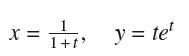
Express in the form y = ƒ(x) by eliminating the parameter. X = 1²y = tet 1+t'
Express in the form y = ƒ(x) by eliminating the parameter.x = t3 − 1, y = t2 + 1
Express in the form y = ƒ(x) by eliminating the parameter.x = e−2t, y = 6e4t
Express in the form y = ƒ(x) by eliminating the parameter.x = 1 + t−1, y = t2
Express in the form y = ƒ(x) by eliminating the parameter.x = ln t, y = 2 − t
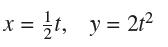
Graph the curve and draw an arrow specifying the direction corresponding to motion. x = ½ t, y= y = 2t²
Express in the form y = ƒ(x) by eliminating the parameter.x = cos t, y = csc t cot t
Graph the curve and draw an arrow specifying the direction corresponding to motion.x = 2 + 4t, y = 3 + 2t
Graph the curve and draw an arrow specifying the direction corresponding to motion.x = πt, y = sin t
Graph the curve and draw an arrow specifying the direction corresponding to motion.x = t2, y = t3
A particle follows the trajectorywith t in seconds and distance in centimeters.(a) What is the particle’s maximum height?(b) When does the particle hit the ground and how far from the origin does it land? x(t) = = t³ + 2t, 4 y(t) = 20t-t²
Find an interval of t-values such that c(t) = (cos t, sin t) traces the lower half of the unit circle.
Find an interval of t-values such that c(t) = (2t + 1, 4t − 5) parametrizes the segment from (0, −7) to (7, 7).
Find parametric equations for the given curve.y = 8x2 − 3x
Find parametric equations for the given curve.4x − y2 = 5
Find parametric equations for the given curve.x2 + y2 = 49
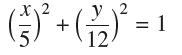
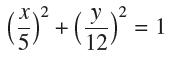
Find parametric equations for the given curve. X 2 y + (²1/12) ²³: = 1
Find parametric equations for the given curve.(x + 9)2 + (y − 4)2 = 49
Find parametric equations for the given curve.Line of slope 8 through (−4, 9)
Find parametric equations for the given curve.Line through (2, 5) perpendicular to y = 3x
Find parametric equations for the given curve. Line through (,) and (-7,3)
Find parametric equations for the given curve.Line through (3, 1) and (−5, 4)
Find parametric equations for the given curve.Segment joining (1, 1) and (2, 3)
Find parametric equations for the given curve.Segment joining (−3, 0) and (0, 4)
Find parametric equations for the given curve.Ellipse of Exercise 28, with its center translated to (7, 4)Data From Exercise 28Find parametric equations for the given curve. 2 (-3)² + (²/2) ³² = 12 1
Find parametric equations for the given curve.Circle of radius 4 with center (3, 9)
Find parametric equations for the given curve.y = x2, translated so that the minimum occurs at (−4, −8)
Find parametric equations for the given curve.y = cos x, translated so that a maximum occurs at (3, 5)
Find a parametrization c(t) of the curve satisfying the given condition.y = 3x − 4, c(0) = (2, 2)
Find a parametrization c(t) of the curve satisfying the given condition.y = 3x − 4, c(3) = (2, 2)
Find a parametrization c(t) of the curve satisfying the given condition.y = x2, c(0) = (3, 9)
Find a parametrization c(t) of the curve satisfying the given condition.x2 + y2 = 4, c(0) = (1, √3)
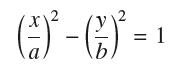
Find a parametrization of the right branch (x > 0) of the hyperbola using cosh t and sinh t. How can you parametrize the branch x 2 (²) ²³ - ()²³ = ₁ 1 b.
Find a parametrization of the top half of the ellipse 4x2 + 5y2 = 100, starting at (−5, 0) and ending at (5, 0).
Describe c(t) = (sec t, tan t) for 0 ≤ t < π/2 in the form y = ƒ(x). Specify the domain of x.
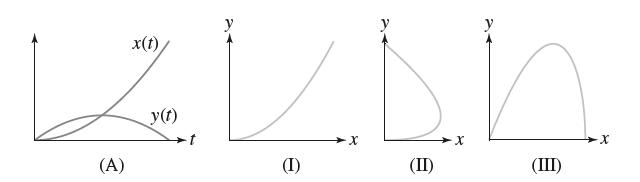
The graphs of x(t) and y(t) as functions of t are shown in Figure 16(A). Which of (I)–(III) is the plot of c(t) = (x(t), y(t))? Explain. (A) x(t) y(t) (I) Lh (II) (III)
Show that x = a + qt, y = b + pt, with q ≠ 0, parametrizes a line with slope m = p/q. What are the xand y-intercepts of the line?
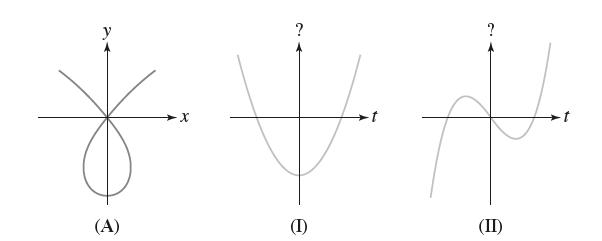
Which graph, (I) or (II), is the graph of x(t) and which is the graph of y(t) for the parametric curve in Figure 17(A)? 本来 (A) (1) ? (II)
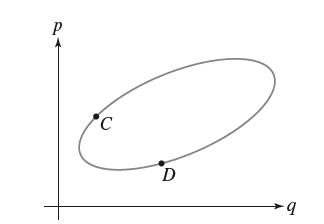
Figure 18 shows a parametric curve c(t) = (p(t), q(t)) that models the changing population sizes of a predator (p) and its prey (q).(a) Discuss how you expect the predator and prey populations to change as time increases at points C and D on the parametric curve.(b) As functions of t, sketch graphs
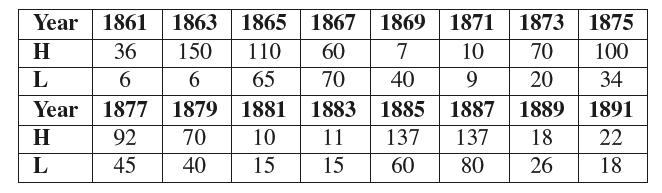
For many years, the Hudson’s Bay Company in Canada kept records of the number of snowshoe hare and lynx pelts traded each year. It is natural to expect that these values are roughly proportional to the sizes of the populations. Data for odd years between 1861 and 1891 appear in the table, where
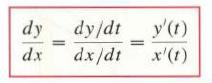
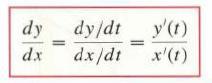
Use Eq. (6) to find dy/dx at the given point.(t3, t2 − 1), t = −4 dy_dy/dt dx/dt dx y' (t) x' (t)
Use Eq. (6) to find dy/dx at the given point.(2t + 9, 7t − 9), t = 1 dy dx dy/dt dx/dt y' (t) x' (t)
Use Eq. (6) to find dy/dx at the given point.(s−1 − 3s, s3), s = −1 dy dx dy/dt dx/dt y' (t) x' (t)
Use Eq. (6) to find dy/dx at the given point.(sin 2θ, cos 3θ), θ = π/6 dy dx dy/dt dx/dt y' (t) x' (t)
Use Eq. (6) to find dy/dx at the given point.(sin 3θ, cos θ), θ = π/4 dy_dy/dt dx/dt dx y' (t) x' (t)
Use Eq. (6) to find dy/dx at the given point.(ln t, 1/t), t = 4 dy dx dy/dt dx/dt y' (t) x' (t)
Use Eq. (6) to find dy/dx at the given point.(et, t2), t = 1 dy dx dy/dt dx/dt y' (t) x' (t)
Find an equation y = ƒ(x) for the parametric curve and compute dy/dx in two ways: using Eq. (6) and by differentiating ƒ(x).c(t) = (2t + 1, 1 − 9t) dy dx dy/dt dx/dt y' (t) x' (t)
Find an equation y = ƒ(x) for the parametric curve and compute dy/dx in two ways: using Eq. (6) and by differentiating ƒ(x). dy dx dy/dt dx/dt y' (t) x' (t)
Find an equation y = ƒ(x) for the parametric curve and compute dy/dx in two ways: using Eq. (6) and by differentiating ƒ(x).c(t) =(1/2t, 1/4t2 − t) dy dx dy/dt dx/dt y' (t) x' (t)
Find an equation y = ƒ(x) for the parametric curve and compute dy/dx in two ways: using Eq. (6) and by differentiating ƒ(x).x = cos θ, y = cos θ + sin2 θ dy_dy/dt dx/dt dx y' (t) x' (t)
Find an equation y = ƒ(x) for the parametric curve and compute dy/dx in two ways: using Eq. (6) and by differentiating ƒ(x).x = 1 − et, y = t − 1 dy dx dy/dt dx/dt y' (t) x' (t)
Find an equation y = ƒ(x) for the parametric curve and compute dy/dx in two ways: using Eq. (6) and by differentiating ƒ(x).x = 1 + ln t, y = 1/t dy dx dy/dt dx/dt y' (t) x' (t)
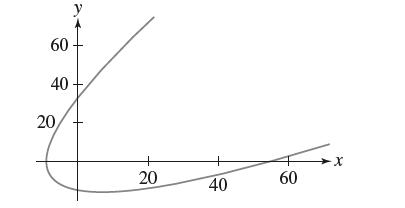
Let c(t) = (t2 − 9, t2 − 8t) (see Figure 19).Draw an arrow indicating the direction of motion, and determine the interval of t-values corresponding to the portion of the curve in each of the four quadrants. 60 40 20, 20 40 60 -X
Let c(t) = (t2 − 9, t2 − 8t) (see Figure 19).Find the equation of the tangent line at t = 4. 60 40 20, 20 40 60 -X
Let c(t) = (t2 − 9, t2 − 8t) (see Figure 19).Find the points where the tangent is horizontal or vertical. 60 40 20, 20 40 60 -X
Let c(t) = (t2 − 9, t2 − 8t) (see Figure 19).Find the points where the tangent has slope 1/2. 60 40 20, 20 40 60 -X
Find the points on the parametric curve c(t) = (3t2 − 2t, t3 − 6t) where the tangent line has slope 3.
Find the equation of the tangent line to the cycloid generated by a circle of radius 4 at t = π/2.
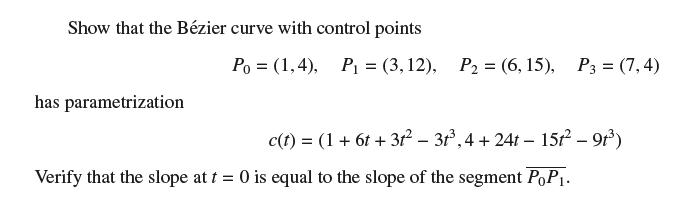
Refer to the B´ezier curve defined by Eqs. (7) and (8).Find an equation of the tangent line to the B´ezier curve in Exercise 73 at t = 1/3.Data From Exercise 73Refer to the B´ezier curve defined by Eqs. (7) and (8). x(1)= ao(1-1)³ +3a₁1(1-1)² + 3a21² (1-1) + a31³ y(t) = bo(1-1)³ +
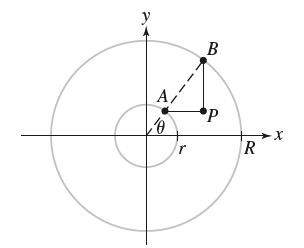
Let A and B be the points where the ray of angle θ intersects the two concentric circles of radii r A/ 0 B P R -X
Refer to the B´ezier curve defined by Eqs. (7) and (8). x(1) = a0(1-1)³ +3a₁1(1 - 1)²+3a21² (1-1) + a31³ y (t) = bo(1-1)³ + 3b₁t(1 - 1)² + 3b₂t² (1-1) + b3t³
Refer to the B´ezier curve defined by Eqs. (7) and (8).Find and plot the B´ezier curve c(t) with control points x(1) = a0(1-1)³ +3a₁1(1-1)² y(t) = bo(1-1)³ + 3b₁t(1-1)² + 3a21² (1-1) + a31³ + 3b₂t² (1-1) + b3t³
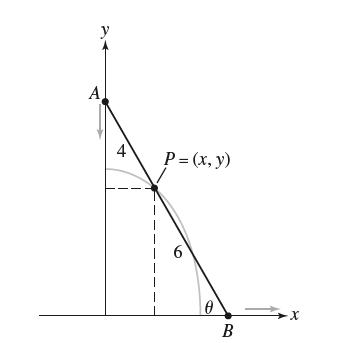
A 10-ft ladder slides down a wall as its bottom B is pulled away from the wall (Figure 21). Using the angle θ as a parameter, find the parametric equations for the path followed by(a) The top of the ladder A,(b) The bottom of the ladder B, and(c) The point P on the ladder, located 4 ft from the
Refer to the B´ezier curve defined by Eqs. (7) and (8).Show that a cubic B´ezier curve is tangent to the segment P2P3 at P3. x(1) = a0(1-1)³ +3a₁1(1-1)² y(t) = bo(1-1)³ + 3b₁t(11)² + 3a21² (1-1) + a31³ + 3b₂t²(1-1) + bzt³
A launched projectile follows the trajectory x = at, y = bt − 16t2 (a, b > 0) (2) ² a Show that the projectile is launched at an angle = tan-¹ ab 16 and lands at a distance from the origin.
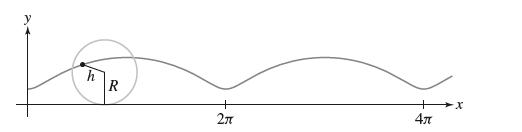
A curtate cycloid (Figure 23) is the curve traced by a point at a distance h from the center of a circle of radius R rolling along the x-axis where h h R 2π 47
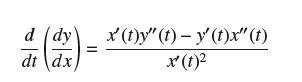
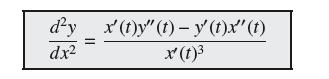
Given a parametrized curve c(t) = (x(t), y(t)), show thatUse this to prove the formula d (dy) dt dx x (t)y" (t)- y' (t)x"(t) z(1) xx
Use the results of Exercise 86 to show that the asymptote of the folium is the line x + y = −a. Show that lim (x + y) = -a.
Find the points with a horizontal tangent line on the cycloid with parametric equation (4). x(1) = 1 - sint, y(t) = 1 - cost
Use a computer algebra system to explore what happens when h > R in the parametric equations of Exercise 83. Describe the result.Data From Exercise 83A curtate cycloid (Figure 23) is the curve traced by a point at a distance h from the center of a circle of radius R rolling along the x-axis
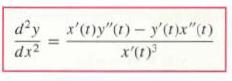
Use Eq. (11) to find d2y/dx2.x = 8t + 9, y = 1 − 4t, t = −3 d²y x'(1)y"(t)- y'(1)x"(t) dx² x' (1)³
Plot c(t) = (t3 − 4t, t4 − 12t2 + 48) for −3 ≤ t ≤ 3. Find the points where the tangent line is horizontal or vertical.
Find the equation of the tangent line at t = π/4 to the cycloid generated by the unit circle with parametric equation (4). x(1) = 1 - sint, y(t) = 1 - cost
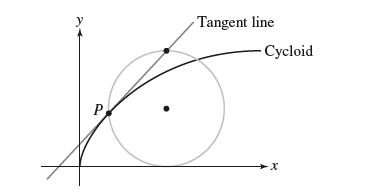
Prove that the tangent line at a point P on the cycloid always passes through the top point on the rolling circle as indicated in Figure 22. Assume the generating circle of the cycloid has radius 1. y P Tangent line - Cycloid -X
Plot the astroid x = cos3 θ, y = sin3 θ and find the equation of the tangent line at θ = π/3.
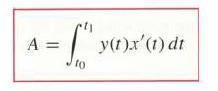
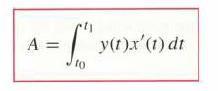
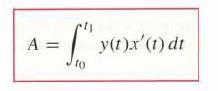
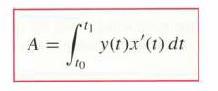
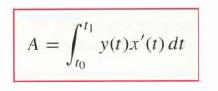
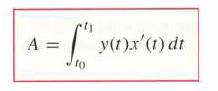
Calculate the area under y = x2 over [0, 1] using Eq. (9) with the parametrizations (t3, t6) and (t2, t4). A = = to y (1)x' (1) dt
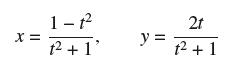
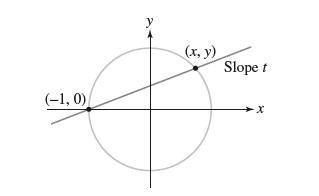
Show that the line of slope t through (−1, 0) intersects the unit circle in the point with coordinatesConclude that these equations parametrize the unit circle with the point (−1, 0) excluded (Figure 24). Show further that t = y/(x + 1). x = 1 - 1² 1² + 1' y = 2t 1² + 1
Use Eq. (11) to find d2y/dx2.x = cos θ, y = sin θ, θ = π/4 d²y x'(1)y"(t)- y'(1)x"(t) dx² x'(1)³
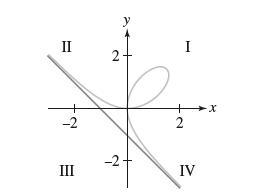
The folium of Descartes is the curve with equation x3 + y3 = 3axy, where a 0 is a constant (Figure 25).(a) Show that the line y = tx intersects the folium at the origin and at one other point P for all t ≠ −1, 0. Express the coordinates of P in terms of t to obtain a parametrization of the
What does Eq. (9) say if c(t) = (t, ƒ (t))? = [" y(t)x' (1) dt to A =
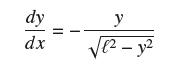
In Exercise 62 of Section 9.1, we described the tractrix by the differential equationShow that the parametric curve c(t) identified as the tractrix in Exercise 106 satisfies this differential equation. The derivative on the left is taken with respect to x, not t.Data From Exercise 106Verify that
Find a parametrization of x2n+1 + y2n+1 = axnyn, where a and n are constants.
Use Eq. (11) to find d2y/dx2.x = t3 + t2, y = 7t2 − 4, t = 2 d²y x' (t)y"(t)- y' (t)x"(t) dx² x'(1)³
Consider the curve c(t) = (t2, t3) for 0 ≤ t ≤ 1.(a) Find the area under the curve using Eq. (9).(b) Find the area under the curve by expressing y as a function of x and finding the area using the standard method. = [", y(t)x' (1) dt to A =
The second derivative of y = x2 is dy2/d2x = 2. Verify that Eq. (11) applied to c(t) = (t, t2) yields dy2/d2x = 2. In fact, any parametrization may be used. Check that c(t) = (t3, t6) and c(t) = (tan t, tan2 t) also yield dy2/d2x = 2
Use Eq. (11) to find d2y/dx2. d²y x' (t)y"(t)- y' (t)x"(t) dx² x'(1)³
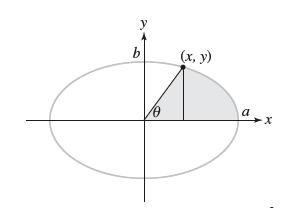
In the parametrization c(t) = (a cos t, b sin t) of an ellipse, t is not an angular parameter unless a = b (in which case, the ellipse is a circle). However, t can be interpreted in terms of area: Show that if c(t) = (x, y), then t = (2/ab)A, where A is the area of the shaded region in Figure
Sketch the graph of c(t) = (ln t, 2 − t) for 1 ≤ t ≤ 2 and compute the area under the graph using Eq. (9). = [", y(t)x (1) dt to A =
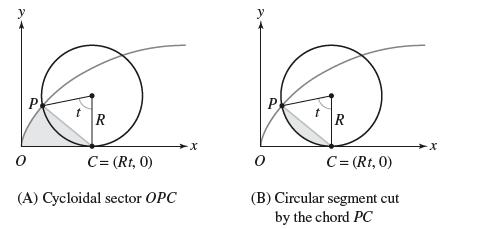
Prove the following generalization of Exercise 103: For all t > 0, the area of the cycloidal sector OPC is equal to three times the area of the circular segment cut by the chord PC in Figure 27. R C = (Rt, 0) (A) Cycloidal sector OPC R C = (Rt, 0) (B) Circular segment cut by the chord PC -X
Use Eq. (11) to find the t-intervals on which c(t) = (t2, t3 − 4t) is concave up. d²y x' (t)y"(t)- y' (t)x"(t) dx² x'(1)³
Use Eq. (11) to find the t-intervals on which c(t) = (t2, t4 − 4t) is concave up. d²y x'(1)y"(t)- y'(1)x"(t) dx² x'(1)³
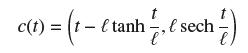
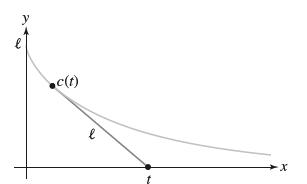
Verify that the tractrix curve (ℓ > 0)has the following property: For all t, the segment from c(t) to (t, 0) is tangent to the curve and has length ℓ (Figure 28). c(t) = (t - & tanh, & sech)
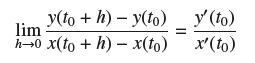
Derive the formula for the slope of the tangent line to a parametric curve c(t) = (x(t), y(t)) using a method different from that presented in the text. Assume that x'(t0) and y'(t0) exist and x'(t0) ≠ 0. Show thatThen explain why this limit is equal to the slope dy/dx. Draw a diagram showing
Compute the area under the parametrized curve c(t) = (et, t) for 0 ≤ t ≤ 1 using Eq. (9). A = = to y(t)x' (1) dt
Compute the area under the parametrized curve given by c(t) = (sin t, cos2 t) for 0 ≤ t ≤ π/2 using Eq. (9). A = = to y(t)x' (1) dt
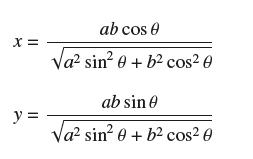
Show that the parametrization of the ellipse by the angle θ is X = y = ab cos 0 Va² sin² 0 + b² cos² 0 ab sin Va² sin² 0 + b² cos² 0
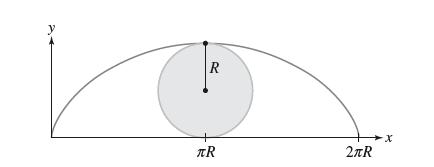
Galileo tried unsuccessfully to find the area under a cycloid. Around 1630, Gilles de Roberval proved that the area under one arch of the cycloid c(t) = (Rt − R sin t, R − R cos t) generated by a circle of radius R is equal to three times the area of the circle (Figure 26). Verify Roberval’s
Showing 3600 - 3700
of 8339
First
30
31
32
33
34
35
36
37
38
39
40
41
42
43
44
Last
Step by Step Answers

 Get 50% OFF
Claim Now
Get 50% OFF
Claim Now












![- Sbs S = b sinu a sinu du = ab Sinudu 1 Sc (2-3cos 24) du = ab | 2 - Sin24] 16 2ut = ab = ab |- - -sin2t_0=](https://dsd5zvtm8ll6.cloudfront.net/images/question_images/1703/0/5/5/588658290e4e05311703055588397.jpg)