New Semester
Started
Get
50% OFF
Study Help!
--h --m --s
Claim Now
Question Answers
Textbooks
Find textbooks, questions and answers
Oops, something went wrong!
Change your search query and then try again
S
Books
FREE
Study Help
Expert Questions
Accounting
General Management
Mathematics
Finance
Organizational Behaviour
Law
Physics
Operating System
Management Leadership
Sociology
Programming
Marketing
Database
Computer Network
Economics
Textbooks Solutions
Accounting
Managerial Accounting
Management Leadership
Cost Accounting
Statistics
Business Law
Corporate Finance
Finance
Economics
Auditing
Tutors
Online Tutors
Find a Tutor
Hire a Tutor
Become a Tutor
AI Tutor
AI Study Planner
NEW
Sell Books
Search
Search
Sign In
Register
study help
mathematics
calculus 4th
Calculus 4th Edition Jon Rogawski, Colin Adams, Robert Franzosa - Solutions
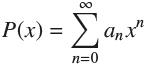
Find a power series that satisfies the Laguerre differential equation xy" + (1 − x)y' − y = 0 with initial condition satisfying P(0) = 1. 00 P(x) = Σ anx" n=0
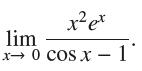
Use power series to evaluate x² ex lim x- 0 cos x1
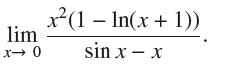
Use power series to evaluate lim x-0 x²(1 - In(x + 1)) sin x - x
Find the Taylor polynomial at x = a for the given function.ƒ(x) = x3, T3, a = 1
Find the Taylor polynomial at x = a for the given function.ƒ(x) = 3(x + 2)3 − 5(x + 2), T3, a = −2
Find the Taylor polynomial at x = a for the given function.ƒ(x) = x ln(x), T4, a = 1
Find the Taylor polynomial at x = a for the given function. ƒ(x) = (3x + 2)1/3, T3, a = 2
Find the Taylor polynomial at x = a for the given function. ƒ(x) = xe−x2 , T4, a = 0
Find the Taylor polynomial at x = a for the given function.ƒ(x) = ln(cos x), T3, a = 0
Find the nth Maclaurin polynomial for ƒ(x) = e3x.
Use the fifth Maclaurin polynomial of ƒ(x) = ex to approximate √e. Use a calculator to determine the error.
Use the third Taylor polynomial of ƒ(x) = tan−1 x at a = 1 to approximate ƒ(1.1). Use a calculator to determine the error.
Let T4 be the Taylor polynomial for ƒ(x) = √x at a = 16. Use the Error Bound to find the maximum possible size of |ƒ(17) − T4(17)|.
Find n such that |e − Tn(1)| < 10−8, where Tn is the nth Maclaurin polynomial for ƒ(x) = ex.
Verify that Tn(x) = 1 + x + x2 + · · · + xn is the nth Maclaurin polynomial of ƒ(x) = 1/(1 − x). Show using substitution that the nth Maclaurin polynomial for ƒ(x) = 1/(1 − x/4) is Tn(x) =1 + ax + What is the nth Maclaurin polynomial for g(x) = = 1 1 1 + x ? +...+ 1 pr 4n
Let T4 be the Taylor polynomial for ƒ(x) = x ln x at a = 1 computed in Exercise 115. Use the Error Bound to find a bound for |ƒ(1.2) − T4(1.2)|.Data From Exercise 115Find the Taylor polynomial at x = a for the given function.ƒ(x) = x ln(x), T4, a = 1
Find the Taylor series centered at c.ƒ(x) = e4x, c = 0
Find the Taylor series centered at c.ƒ(x) = e2x, c = −1
Find the Taylor series centered at c.ƒ(x) = x4, c = 2
Find the Taylor series centered at c.ƒ(x) = x3 − x, c = −2
Find the Taylor series centered at c.ƒ(x) = sin x, c = π
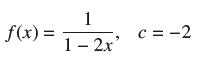
Find the Taylor series centered at c. f(x) = 1 1 - 2x² c = -2
Find the Taylor series centered at c.ƒ(x) = ex−1, c = −1
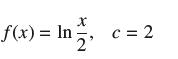
Find the Taylor series centered at c. f(x) = In X 2 c=2
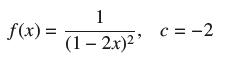
Find the Taylor series centered at c. f(x) = 1 (1-2x)²³ c = -2
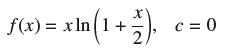
Find the Taylor series centered at c. ¹ (1 + - - ), f(x) = xln (1+ c=0
Find the first three terms of the Maclaurin series of ƒ(x) and use it to calculate ƒ(3)(0).ƒ(x) = (x2 − x)ex2
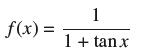
Find the first three terms of the Maclaurin series of ƒ(x) and use it to calculate ƒ(3)(0). 1 f(x) = 1 + tan x
Find the first three terms of the Maclaurin series of ƒ(x) and use it to calculate ƒ(3)(0).ƒ(x) = tan−1(x2 − x)
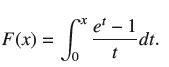
Find the Maclaurin series of the function F(x) = for et e¹ - 1 t -dt.
Find the first three terms of the Maclaurin series of ƒ(x) and use it to calculate ƒ(3)(0).ƒ(x) = (sin x)√1 + x
Calculate π/2 − π3233! + π5255! − π7277! + · · · .
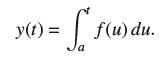
If ƒ is continuous on [a, b], then the solution to dy/dt = f (t) with initial condition y(a) = 0 is Show that Euler’s Method with time step h = (b − a)/N for N steps yields the Nth left-endpoint approximation to y(t) = [₁ f(u) du.
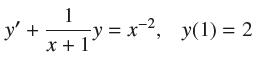
Solve the Initial Value Problem. 1 x² + x + y = x ²₁ y' 1 =x²², y(1) = 2
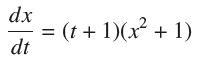
Use Separation of Variables to find the general solution. dx dt = (t + 1)(x² + 1)
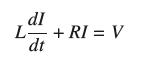
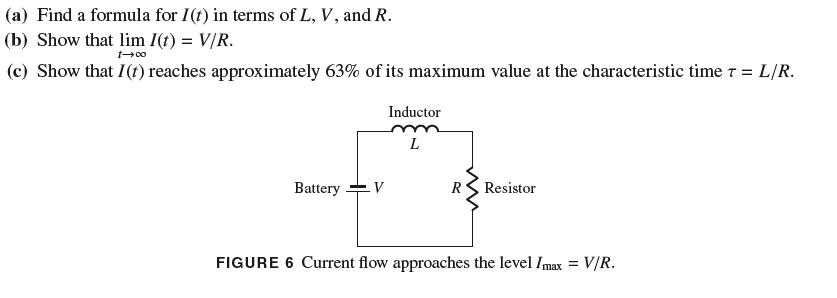
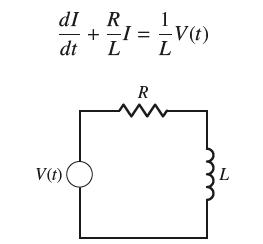
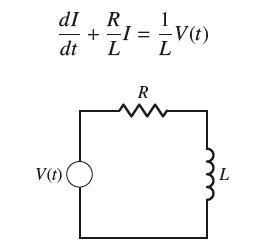
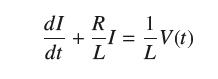
When the circuit in Figure 6 (which consists of a battery of V volts, a resistor of R ohms, and an inductor of L henries) is connected, the current I(t) flowing in the circuit satisfieswith the initial condition I(0) = 0. dI L+RI = V dt
Euler’s Midpoint Method is a variation on Euler’s Method that is significantly more accurate in general. For time step h and initial value y0 = y(t0), the values yk are defined successively byApply both Euler’s Method and the Euler Midpoint Method with h = 0.1 to estimate y(1.5), where y(t)
Solve using the appropriate method.y' + (tan x)y = cos2 x, y(π) = 2
Solve the Initial Value Problem.y' + y = sin x, y(0) = 1
Use Separation of Variables to find the general solution.(1 + x2)y'= x3y
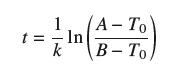
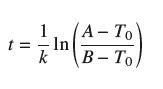
Show that by Newton’s Law of Cooling, the time required to cool an object from temperature A to temperature B iswhere T0 is the ambient temperature. t= 1 - In k A-To B-To
Solve using the appropriate method.xy' = 2y + x − 1, y(3/2) = 9
Use Euler’s Midpoint Method with the time step indicated to approximate the given value of y(t). y(0.5); dy dt =y+t, y(0) = 1, h = 0.1
Solve using the appropriate method.(y − 1)y' = t, y(1) = −3
Solve the Initial Value Problem.(sin x)y'= (cos x)y + 1, y(π/4) = 0
Show that by Newton’s Law of Cooling, the time required to cool an object from temperature A to temperature B iswhere T0 is the ambient temperature. 1 t = = ln k A- To B-To
Use Separation of Variables to find the general solution.y = x sec y
Use Euler’s Midpoint Method with the time step indicated to approximate the given value of y(t). y(2); dy dt = 1² y, y(1) = 3, h = 0.2
Solve using the appropriate method.(√y + 1)y'= ytet2 , y(0) = 1
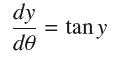
Use Separation of Variables to find the general solution. dy de || tan y
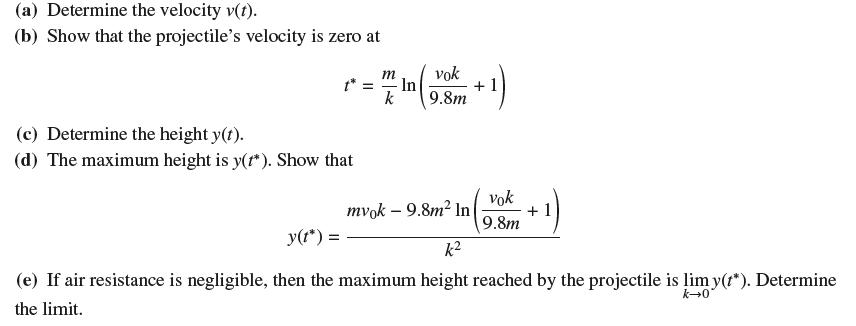
A projectile of mass m kg travels straight up from ground level with initial velocity v0 m/s. Suppose that the velocity v satisfies v'(t) = −9.8 − k/mv(t). (a) Determine the velocity v(t). (b) Show that the projectile's velocity is zero at (c) Determine the height y(t). (d) The maximum height
Solve the Initial Value Problem.y' + (sec t)y = sec t, y(π/4) = 1
Use Euler’s Midpoint Method with the time step indicated to approximate the given value of y(t). y(0.25); dy dt cos(y+t), y(0) = 1, h = 0.05
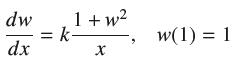
Solve using the appropriate method. dw 1+w² dx =k- w(1) = 1
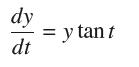
Use Separation of Variables to find the general solution. dy dt = y tan t
Solve the Initial Value Problem.y' + (tanh x)y = 1, y(0) = 3
Use Euler’s Midpoint Method with the time step indicated to approximate the given value of y(t). y(2.3); dy = y + f², y(2) = 1, h = 0.05 dt
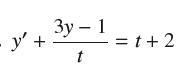
Solve using the appropriate method. y' + Зу - 1 t =t+2
Solve the Initial Value Problem. y' + 1 1 + x² = (1 + x²)3/2* X y(1) = 0
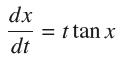
Use Separation of Variables to find the general solution. dx dt = ttan x
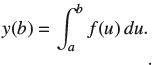
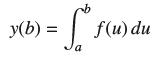
Aassume that f is continuous on [a, b]. Show that Euler’s Midpoint Method applied to dy/dt = ƒ(t) with initial condition y(a) = 0 and time step h = (b − a)/N for N steps yields the Nth midpoint approximation to y(b) = = Ja f(u) du
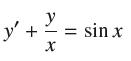
Solve using the appropriate method. y' + sin x y X
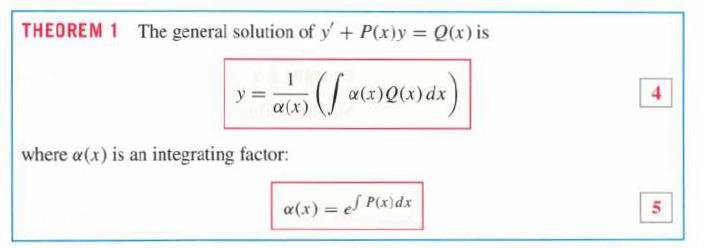
The differential equation dy/dx = x is directly integrable and also first-order linear. Show that solving the differential equation using Theorem 1 leads to solving it by direct integration.
Solve the Initial Value Problem.y' + 2y = 0, y(ln 5) = 3
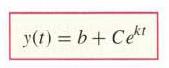
The differential equation dy/dx = 1 − y can be solved using Eq. (2) in Section 10.2 and using Theorem 1 in this section. Show that both approaches lead to the same general solution.Eq (2) Section 10.2 y(t) = b + Cekt
Find the solutions to y' = 4(y − 12) satisfying y(0) = 20 and y(0) = 0, and sketch their graphs.
Solve the Initial Value Problem.y' − 3y + 12 = 0, y(2) = 1
Find the solutions to y' = −2y + 8 satisfying y(0) = 3 and y(0) = 4, and sketch their graphs.
Solve the Initial Value Problem.yy' = xe−y2 , y(0) = −2
Find the general solution of y' + ny = emx for all m, n. The case m = −n must be treated separately.
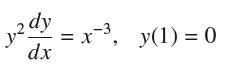
Solve the Initial Value Problem. -3 2 = x ²³, dx x-³, y(1) = 0 12 dy ܕܐ
Show that y = sin−1 x satisfies the differential equation y' = sec y with initial condition y(0) = 0.
Consider a series circuit (Figure 4) consisting of a resistor of R ohms, an inductor of L henries, and a variable voltage source of V(t) volts (time t in seconds). The current through the circuit I(t) (in amperes) satisfies the differential equationAssume that R = 110 ohms, L = 10 henries, and V(t)
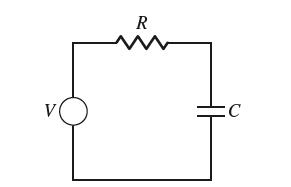
Assume in the circuit of Figure 13 that R = 200 ohms, C = 0.02 farad, and V = 12 volts. How many seconds does it take for the charge on the capacitor plates to reach half of its limiting value? R C
We might also guess that the volume V of a melting snowball decreases at a rate proportional to its surface area. Argue as in Exercise 59 to find a differential equation satisfied by V. Suppose the snowball has volume 1000 cm3 and that it loses half of its volume after 5 minutes. According to this
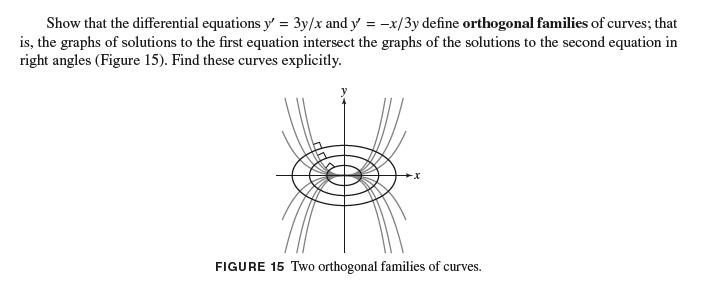
Find the family of curves satisfying y' = x/y and sketch several members of the family. Then find the differential equation for the orthogonal family (see Exercise 63), find its general solution, and add some members of this orthogonal family to your plot.Data From Exercise 63 Show that the
What is the limit if y(t) is a solution of each of the following? lim y(t) 00+1
Find the general solution of y' + ny = cos x for all n.
Solve the Initial Value Problem.y' = (x − 1)(y − 2), y(2) = 4
A 1000-liter tank contains 500 L of water with a salt concentration of 10 g/L. Water with a salt concentration of 50 g/L flows into the tank at a rate of Rin = 80 L/min. The fluid mixes instantaneously and is pumped out at a specified rate Rout. Let y(t) denote the quantity of salt in the tank at
Let P(t) denote the balance at time t (years) of an annuity that earns 5% interest continuously compounded and pays out $20,000/year continuously.Find the differential equation satisfied by P(t).
Solve the Initial Value Problem.y' = (x − 1)(y − 2), y(2) = 2
A 1000-liter tank contains 500 L of water with a salt concentration of 10 g/L. Water with a salt concentration of 50 g/L flows into the tank at a rate of Rin = 80 L/min. The fluid mixes instantaneously and is pumped out at a specified rate Rout. Let y(t) denote the quantity of salt in the tank at
Let P(t) denote the balance at time t (years) of an annuity that earns 5% interest continuously compounded and pays out $20,000/year continuously.Determine P(5) if P(0) = $200,000.
Solve the Initial Value Problem.y' = x(y2 + 1), y(0) = 0
A 1000-liter tank contains 500 L of water with a salt concentration of 10 g/L. Water with a salt concentration of 50 g/L flows into the tank at a rate of Rin = 80 L/min. The fluid mixes instantaneously and is pumped out at a specified rate Rout. Let y(t) denote the quantity of salt in the tank at
Solve the Initial Value Problem. dy (1-t)-y = 0, y(2) = -4 dt
Let P(t) denote the balance at time t (years) of an annuity that earns 5% interest continuously compounded and pays out $20,000/year continuously.When does the annuity run out of money if P(0) = $300,000?
A 1000-liter tank contains 500 L of water with a salt concentration of 10 g/L. Water with a salt concentration of 50 g/L flows into the tank at a rate of Rin = 80 L/min. The fluid mixes instantaneously and is pumped out at a specified rate Rout. Let y(t) denote the quantity of salt in the tank at
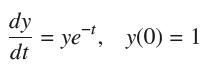
Solve the Initial Value Problem. dy dt = yet, y(0) = 1
Let P(t) denote the balance at time t (years) of an annuity that earns 5% interest continuously compounded and pays out $20,000/year continuously.What is the minimum initial balance that will allow the annuity to make payments indefinitely?
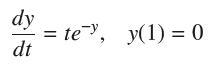
Solve the Initial Value Problem. dy dt te", y(1) = 0 = = y
Water flows into a tank at the variable rate of Rin = 20/(1 + t)gal/min and out at the constant rate Rout = 5 gal/min. Let V(t) be the volume of water in the tank at time t.(a) Set up a differential equation for V(t) and solve it with the initial condition V(0) = 100.(b) Find the maximum value of
State whether the differential equation can be solved using Separation of Variables, the method of integrating factors, both, or neither.(a) y' = y + x2(b) xy' = y + 1(c) y = y2 + x2 (d) xy' = y2
Solve the Initial Value Problem. dy dt - t = 1 +y +ty, y(1) = 0
A stream feeds into a lake at a rate of 1000 m3/day. The stream is polluted with a toxin whose concentration is 5 g/m3. Assume that the lake has volume 106 m3 and that water flows out of the lake at the same rate of 1000 m3/day.(a) Set up a differential equation for the concentration c(t) of toxin
Consider a series circuit (Figure 4) consisting of a resistor of R ohms, an inductor of L henries, and a variable voltage source of V(t) volts (time t in seconds). The current through the circuit I(t) (in amperes) satisfies the differential equationSolve Eq. (9) with initial condition I(0) = 0,
In the laboratory, the Escherichia coli bacteria grows such that the rate of change of the population is proportional to the population present. Assume that 500 bacteria are initially present, and 650 are present after 1 hour.(a) Determine P(t), the population after t hours.(b) How long does it
Solve the Initial Value Problem.√1 − x2 y' = y2 + 1, y(0) = 0
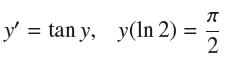
Solve the Initial Value Problem. y' = tan y, y(ln 2): = KIN 2
Showing 4000 - 4100
of 8339
First
34
35
36
37
38
39
40
41
42
43
44
45
46
47
48
Last
Step by Step Answers

 Get 50% OFF
Claim Now
Get 50% OFF
Claim Now