New Semester
Started
Get
50% OFF
Study Help!
--h --m --s
Claim Now
Question Answers
Textbooks
Find textbooks, questions and answers
Oops, something went wrong!
Change your search query and then try again
S
Books
FREE
Study Help
Expert Questions
Accounting
General Management
Mathematics
Finance
Organizational Behaviour
Law
Physics
Operating System
Management Leadership
Sociology
Programming
Marketing
Database
Computer Network
Economics
Textbooks Solutions
Accounting
Managerial Accounting
Management Leadership
Cost Accounting
Statistics
Business Law
Corporate Finance
Finance
Economics
Auditing
Tutors
Online Tutors
Find a Tutor
Hire a Tutor
Become a Tutor
AI Tutor
AI Study Planner
NEW
Sell Books
Search
Search
Sign In
Register
study help
mathematics
calculus 4th
Calculus 4th Edition Jon Rogawski, Colin Adams, Robert Franzosa - Solutions
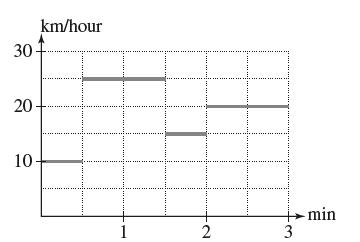
Figure 14 shows the velocity of an object over a 3-minute interval. Determine the distance traveled over the intervals [0, 3] and [1, 2.5] (remember to convert from kilometers per hour to kilometers per minute). 30 20 km/hour 10- 1 2 3 ننا -min
What are the right and left endpoints if [2, 5] is divided into six subintervals?
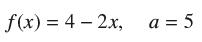
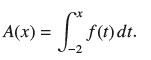
Compute an area function A(x) of ƒ(x) with lower limit a. Then, to verify the FTC II inverse relationship, compute A (x) and show that it equals ƒ(x). f(x) = 4-2x, a = 5
Let G(x) = ∫x 4 √t3 + 1 dt.(a) Is the FTC II needed to calculate G(4)?(b) Is the FTC II needed to calculate G'(4)?
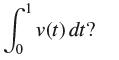
A plane travels 560 km from Los Angeles to San Francisco in 1 hour (h). If the plane’s velocity at time t is v(t) km/h, what is the value of 1 S v(t) dt?
Suppose that ƒ is a negative function with antiderivative F such that F(1) = 7 and F(3) = 4. What is the area (a positive number) between the x-axis and the graph of ƒ over [1, 3]?
Is there a difference between finding the general antiderivative of a function ƒ and evaluating ∫ ƒ(x) dx?
A population of insects increases at a rate of 200 + 10t + 0.25t2 insects per day (t in days). Find the insect population after three days, assuming that there are 35 insects at t = 0.
Find an appropriate choice of u for evaluating the following integrals by substitution: (a) [x(x² + 9)¹ dx (c) f sin sin x cos² x dx x² sin(x³) dx (b) x² s
Find the general antiderivative of ƒ and check your answer by differentiating.ƒ(x) = x−3/5
Sketch the region under the graph of the function and find its area using FTC I. f(x)=2x-x², [0,2]
Calculate du.u = 2x4 + 8x−1
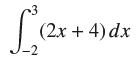
Draw a graph of the signed area represented by the integral and compute it using geometry. L₂ (2x J-2 (2x + 4) dx
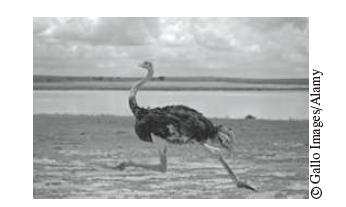
An ostrich (Figure 15) runs with velocity of 20 km/hour for 2 minutes (min), 12 km/h for 3 min, and 40 km/h for another 1 minute. Compute the total distance traveled and indicate with a graph how this quantity can be interpreted as an area. Ⓒ Gallo Images/Alamy
The interval [1, 5] is divided into eight subintervals.(a) What is the left endpoint of the last subinterval?(b) What are the right endpoints of the first two subintervals?
Which of the following is an antiderivative F of ƒ(x) = x2 satisfying F(2) = 0? (a) S 2t dt (b) So t² dt (c) S t² dt
Compute an area function A(x) of ƒ(x) with lower limit a. Then, to verify the FTC II inverse relationship, compute A (x) and show that it equals ƒ(x). [ -=D ₂x + x = (x)f
Does every continuous function have an antiderivative? Explain.
Which of the following quantities would be naturally represented as derivatives and which as integrals?(a) Velocity of a train(b) Rainfall during a 6-month period(c) Mileage per gallon of an automobile(d) Increase in the U.S. population from 1990 to 2010
Jacques was told that ƒ and g have the same derivative, and he wonders whether ƒ(x) = g(x). Does Jacques have sufficient information to answer his question?
Sketch the region under the graph of the function and find its area using FTC I. f(x) = x², [1,2]
A survey shows that a mayoral candidate is gaining votes at a rate of 2000t + 1000 votes per day, where t is the number of days since she announced her candidacy. How many supporters will the candidate have after 60 days, assuming that she had no supporters at t = 0?
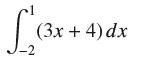
Draw a graph of the signed area represented by the integral and compute it using geometry. L³ (3x + 4) dx
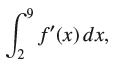
Evaluate where f is differentiable and ƒ(2) = ƒ(9) = 4. S 2 f'(x) dx,
Find the general antiderivative of ƒ and check your answer by differentiating.ƒ(x) = 9x + 15x−2
Compute an area function A(x) of ƒ(x) with lower limit a. Then, to verify the FTC II inverse relationship, compute A (x) and show that it equals ƒ(x). f(x) = x² - 8, a = 3
A factory produces bicycles at a rate of 95 + 3t2 − t bicycles per week (t in weeks). How many bicycles were produced from the beginning of week 2 to the end of week 3?
Sketch the region under the graph of the function and find its area using FTC I. f(x) = cos x, [0, 1]
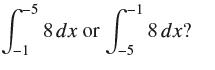
Which is negative, f' -1 8 dx or -1 J-5 8 dx?
Draw a graph of the signed area represented by the integral and compute it using geometry. S -2 4 dx
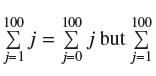
Explain: 1 is not equal to 100 100 100 Σ j = Σ j but Σ j=1 j=0 j=1
The velocity of an object is v(t) = 12t m/s. Use Eq. (2) and geometry to find the distance traveled over the time intervals [0, 2] and [2, 5].Equation 2 distance traveled = area under the graph of velocity over [11,12]
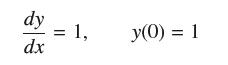
Is y = x a solution of the following initial value problem? dy = 1, dx y(0) = 1
Let ƒ(x) = x2 + 3x.Calculate R6, M6, and L6 for ƒ on the interval [2, 5]. Sketch the graph of ƒ and the corresponding rectangles for each approximation.
Find the general antiderivative of ƒ and check your answer by differentiating.ƒ(x) = 2 cos x − 9 sin x
Compute an area function A(x) of ƒ(x) with lower limit a. Then, to verify the FTC II inverse relationship, compute A (x) and show that it equals ƒ(x). f(x) = x² - sinx, a=0
Find the displacement of a particle moving in a straight line with velocity v(t) = 4t − 3 m/s over the time interval [2, 5].
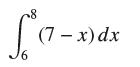
Draw a graph of the signed area represented by the integral and compute it using geometry. 8 S 6 (7 - x) dx
Calculate du.u = sin4θ
Evaluate the integral using FTC I. J3 x dx
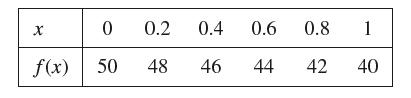
Compute R5 and L5 over [0, 1] using the following values: 0 0.2 0.4 0.6 f(x) 50 48 46 44 X 0.8 42 1 40
Explain why L100 ≥ R100 for ƒ(x) = x−2 on [3, 7].
Let ƒ(x) = x2 + 3x.Use FTC I to evaluate = £₁,50 f(t) dt. -2 A(x) =
Find the general antiderivative of ƒ and check your answer by differentiating.ƒ(x) = 4x7 − 3 cos x
Compute an area function A(x) of ƒ(x) with lower limit a. Then, to verify the FTC II inverse relationship, compute A (x) and show that it equals ƒ(x). f(x) = 1- x + cos x, a=0
Find the displacement over the time interval [1, 6] of a helicopter whose (vertical) velocity at time t is v(t) = 0.02t2 + t m/s.
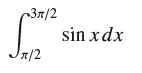
Draw a graph of the signed area represented by the integral and compute it using geometry. 3π/2 Jπ/2 sinxdx
Calculate du.u = t/t + 1
Evaluate the integral using FTC I. 9 S²² 2 dx
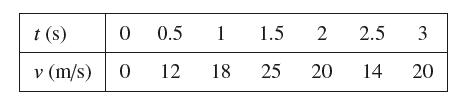
Compute R6, L6, and M3 to estimate the distance traveled over [0, 3] if the velocity at half-second intervals is as follows: t (s) v (m/s) 1 1.5 2 2.5 0 0.5 0 12 18 25 20 3 14 20
Compute or approximate the corresponding function values and derivative values for the given area function. In some cases, approximations will need to be done via a Riemann sum. = S₁² √² + t dt. Find F(0), F(3), F'(0), and F'(3). F(x) =
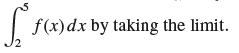
Let ƒ(x) = x2 + 3x.Find a formula for RN for f on [2, 5] and compute f(x) dx by taking the limit.
Find the general antiderivative of ƒ and check your answer by differentiating.ƒ(x) = sin 2x + 12 cos 3x
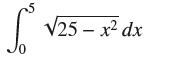
Draw a graph of the signed area represented by the integral and compute it using geometry. So √25 - x² dx
A cat falls from a tree (with zero initial velocity) at time t = 0. How far does the cat fall between t = 0.5 second and t = 1 s? Use Galileo’s formula v(t) = −9.8t m/s.
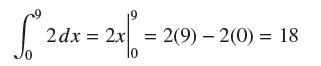
Evaluate the integral using FTC I. So 2dx = 2x = 2(9) 2(0) = 18 10 -
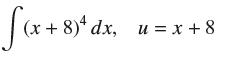
Write the integral in terms of u and du. Then evaluate. (x+8)¹ dx, u= x+8
Let ƒ(x) = 2x + 3.(a) Compute R6 and L6 over [0, 3].(b) Use geometry to find the exact area A and compute the errors |A − R6| and |A − L6| in the approximations.
Compute or approximate the corresponding function values and derivative values for the given area function. In some cases, approximations will need to be done via a Riemann sum. = S²₁ T(x) = tan 0 de. Find T(0), 7(7/3), T'(0), and T'(7/3).
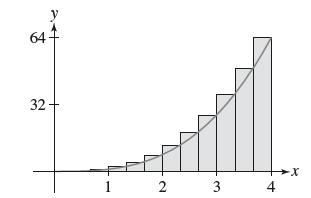
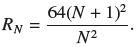
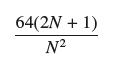
Let RN be the Nth right-endpoint approximation for ƒ(x) = x3 on [0, 4] (Figure 2).(a) Prove that (b) Prove that the area of the region within the right-endpoint rectangles above the graph is equal to 64 32 att 1 2 3 4
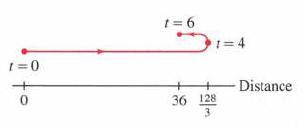
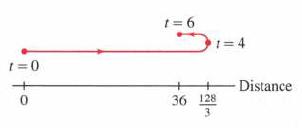
A particle moves in a straight line with the given velocity (in meters per second). Find the displacement and distance traveled over the time interval, and draw a motion diagram like Figure 3 (with distance and time labels).v(t) = 36 − 24t + 3t2, [0, 10]Figure 3 t=0 0 1=6 1=4 36 128 3 Distance
Draw a graph of the signed area represented by the integral and compute it using geometry. L3+x J-2 (3 + x - 2x]) dx
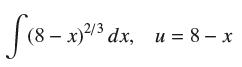
Write the integral in terms of u and du. Then evaluate. [(8 - x)2²/³3 dx, u=8-x
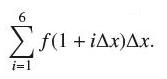
Let ƒ(x) = √x2 + 1 and Δx = 1/3. Sketch the graph of ƒ and draw the right-endpoint rectangles whose area is represented by the sum 6 Σ+1 + i4x)Δ.x. (1 i=1
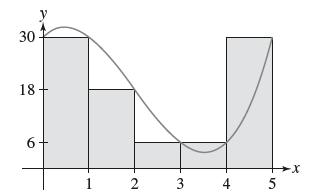
Which approximation to the area is represented by the shaded rectangles in Figure 3? Compute R5 and L5. 30 18 6 1 2 3 نيا 4 5 -
Find formulas for the functions represented by the integrals. 22 S ut du
A particle moves in a straight line with the given velocity (in meters per second). Find the displacement and distance traveled over the time interval, and draw a motion diagram like Figure 3 (with distance and time labels).v(t) = t−2 − 1, [0.5, 2]Figure 3 1=0 0 1=6 1=4 36 128 3 Distance
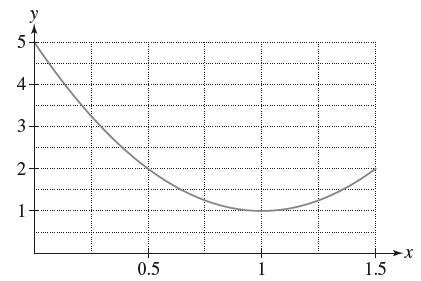
Estimate R3, M3, and L6 over [0, 1.5] for the function in Figure 16. 5 4 3 2 1 0.5 1 +X 1.5
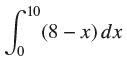
Calculate in two ways:(a) As the limit (b) By sketching the relevant signed area and using geometry 10 Soto & 0 (8 - x) dx
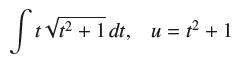
Write the integral in terms of u and du. Then evaluate. t√₁² +1dt, u = ²² +1
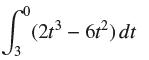
Evaluate the integral using FTC I. S₁2²³. (2t³ - 6t²2) dt J3
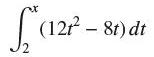
Find formulas for the functions represented by the integrals. 2 (127². (127² - 8t) dt
A particle moves in a straight line with the given velocity (in meters per second). Find the displacement and distance traveled over the time interval, and draw a motion diagram like Figure 3 (with distance and time labels).v(t) = cos t, [0, 3π]Figure 3 t=0 0 1=6 1=4 36 128 3 Distance
Calculate any two Riemann sums for ƒ(x) = x2 on the interval [2, 5], but choose partitions with at least five subintervals of unequal widths and intermediate points that are neither endpoints nor midpoints.
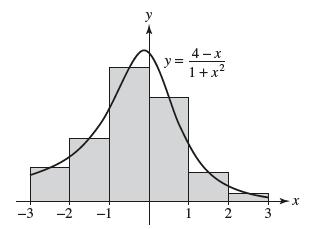
Calculate the area of the shaded rectangles in Figure 17. Which approximation do these rectangles represent? -3 -2 -1 y y: 4-x 1 + x² 1 2 3 نیا X
Write the integral in terms of u and du. Then evaluate. fox³. + 1) cos(x² + 4x) dx, u = x² + 4x
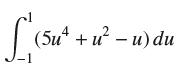
Evaluate the integral using FTC I. L' (su² + u² J-1 (5u²+u² - u) du
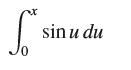
Find formulas for the functions represented by the integrals. Sos sin u du
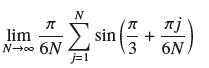
Express the limit as an integral (or multiple of an integral) and evaluate. π lim N→∞ 6N N Σsin( j=1 π + лј 6N
Find the net change in velocity over [1, 4] of an object with a(t) = 8t − t2 m/s2.
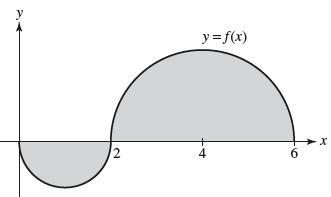
Evaluate: (a) ∫20 ƒ(x) dx (b) ∫60 ƒ(x) dx y 2 y = f(x) 4 6 -X
Let ƒ(x) = x2.(a) Sketch the function over the interval [0, 2] and the rectangles corresponding to L4. Calculate the area contained within them.(b) Sketch the function over the interval [0, 2] again but with the rectangles corresponding to R4. Calculate the area contained within them.(c) Make a
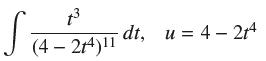
Write the integral in terms of u and du. Then evaluate. 73 (4-24)11 dt, u 4-214 =
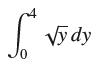
Evaluate the integral using FTC I. S Vydy
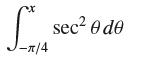
Find formulas for the functions represented by the integrals. x J-π/4 sec- Ꮎ ᏧᎾ
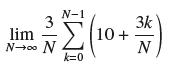
Express the limit as an integral (or multiple of an integral) and evaluate. 3 lim N-100 N N-1 k=0 10+ 3k N
Show that if acceleration is constant, then the change in velocity is proportional to the length of the time interval.
Let ƒ(x) = √x.(a) Sketch the function over the interval [0, 4] and the rectangles corresponding to L4. Calculate the area contained within them.(b) Sketch the function over the interval [0, 4] again but with the rectangles corresponding to R4. Calculate the area contained within them.(c) Make a
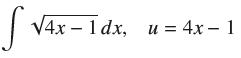
Write the integral in terms of u and du. Then evaluate. S √4x - 1 dx, √4x1dx, u = 4x - 1
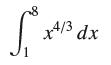
Evaluate the integral using FTC I. xp ε/tx £/1 J1
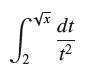
Find formulas for the functions represented by the integrals. J2 dt 12
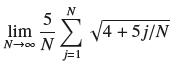
Express the limit as an integral (or multiple of an integral) and evaluate. 5 lim N→∞0 N N Σ j=1 √4 +5j/N
The traffic flow rate past a certain point on a highway is q(t) = 3000 + 2000t − 300t2 (t in hours), where t = 0 is 8 am. Howmany cars pass by in the time interval from 8 to 10 am?
Calculate the approximation for the given function and interval. L4, f(x)= √2-x, [0,2]
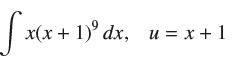
Write the integral in terms of u and du. Then evaluate. Sxx- x(x + 1)⁹ dx, u = x + 1
Evaluate ∫30 g(t) dt and ∫53 g(t) dt.
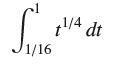
Evaluate the integral using FTC I. 1/16 1/4 dt
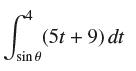
Find formulas for the functions represented by the integrals. sin e (5t + 9) dt
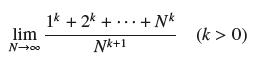
Express the limit as an integral (or multiple of an integral) and evaluate. lim N-00 1k + 2k + +Nk Nk+1 ... (k > 0)
The marginal cost of producing x tablet computers is C(x) = 120 − 0.06x + 0.00001x2. What is the additional cost of producing 3000 units if the set-up cost is $90,000? If production is set at 3000 units, what is the cost of producing 200 additional units?
Showing 6000 - 6100
of 8339
First
54
55
56
57
58
59
60
61
62
63
64
65
66
67
68
Last
Step by Step Answers

 Get 50% OFF
Claim Now
Get 50% OFF
Claim Now



![f(x)=2x-x, [0,2]](https://dsd5zvtm8ll6.cloudfront.net/images/question_images/1700/4/6/6/535655b0f67434ff1700466535213.jpg)


![f(x) = x, [1,2]](https://dsd5zvtm8ll6.cloudfront.net/images/question_images/1700/4/6/6/550655b0f763cde91700466550176.jpg)

![f(x) = cos x, [0, 1]](https://dsd5zvtm8ll6.cloudfront.net/images/question_images/1700/4/6/6/610655b0fb2146721700466609900.jpg)


![distance traveled = area under the graph of velocity over [11,12]](https://dsd5zvtm8ll6.cloudfront.net/images/question_images/1700/2/3/6/84765578e2fea0ca1700236848093.jpg)






![L3+x J-2 (3 + x - 2x]) dx](https://dsd5zvtm8ll6.cloudfront.net/images/question_images/1700/3/0/1/59665588b1ccb90d1700301599649.jpg)



![L4, f(x)= 2-x, [0,2]](https://dsd5zvtm8ll6.cloudfront.net/images/question_images/1700/2/8/7/5016558540d85fa91700287504198.jpg)