New Semester
Started
Get
50% OFF
Study Help!
--h --m --s
Claim Now
Question Answers
Textbooks
Find textbooks, questions and answers
Oops, something went wrong!
Change your search query and then try again
S
Books
FREE
Study Help
Expert Questions
Accounting
General Management
Mathematics
Finance
Organizational Behaviour
Law
Physics
Operating System
Management Leadership
Sociology
Programming
Marketing
Database
Computer Network
Economics
Textbooks Solutions
Accounting
Managerial Accounting
Management Leadership
Cost Accounting
Statistics
Business Law
Corporate Finance
Finance
Economics
Auditing
Tutors
Online Tutors
Find a Tutor
Hire a Tutor
Become a Tutor
AI Tutor
AI Study Planner
NEW
Sell Books
Search
Search
Sign In
Register
study help
mathematics
calculus 4th
Calculus 4th Edition Jon Rogawski, Colin Adams, Robert Franzosa - Solutions
Calculate g(b) and g'(b), where g is the inverse of ƒ(in the given domain, if indicated).ƒ(x) = x + cos x, b = 1
Calculate g(b) and g'(b), where g is the inverse of ƒ(in the given domain, if indicated). f(x)=√x² + 6x for x ≥ 0, b=4
Calculate g(b) and g'(b), where g is the inverse of ƒ(in the given domain, if indicated).ƒ(x) = 4x3 − 2x, b = −2
Calculate g(b) and g'(b), where g is the inverse of ƒ(in the given domain, if indicated). f(x)=√x² + 6x for x≤-6, b = 4
Find the critical points and determine whether they are local minima, maxima, or neither.ƒ(x) = ex − x
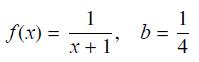
Calculate g(b) and g'(b), where g is the inverse of ƒ(in the given domain, if indicated). f(x) = 1 x + 1' b=
Find the critical points and determine whether they are local minima, maxima, or neither.ƒ(x) = x + e−x
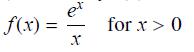
Find the critical points and determine whether they are local minima, maxima, or neither. f(x) = et X for x > 0
Calculate g(b) and g'(b), where g is the inverse of ƒ(in the given domain, if indicated).ƒ(x) = ex, b = e
Find the critical points and determine whether they are local minima, maxima, or neither.ƒ(x) = x2ex
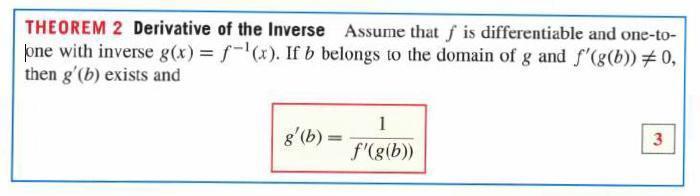
Let ƒ(x) = xn and g(x) = x1. Compute g'(x) using Theorem 2 and check your answer using the Power Rule. THEOREM 2 Derivative of the Inverse Assume that f is differentiable and one-to- one with inverse g(x) = f(x). If b belongs to the domain of g and f'(g(b)) #0, then g'(b) exists and g'
Prove that sinh−1 t = ln(t + √t2 + 1). Let t = sinh x. Prove that cosh x = √t2 + 1 and use the relation sinh x + cosh x = ex
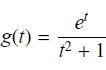
Find the critical points and determine whether they are local minima, maxima, or neither. g(t) e² = 2² +1
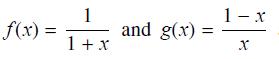
Show that are inverses. Then compute g(x) directly and verify that g'(x) =1/ ƒ'(g(x)). f(x) = 1 1 + x and g(x)= = 1-x X
The tangent line to the graph of y = ƒ(x) at x = 4 has equation y = −2x + 12. Find the equation of the tangent line to y = g(x) at x = 4, where g is the inverse of ƒ.
Find the critical points and determine whether they are local minima, maxima, or neither.g(t) = (t3 − 2t)et
Let ƒ(x) = xe−x.Plot ƒ and use the zoom feature to find two solutions of ƒ(x) = 0.3.
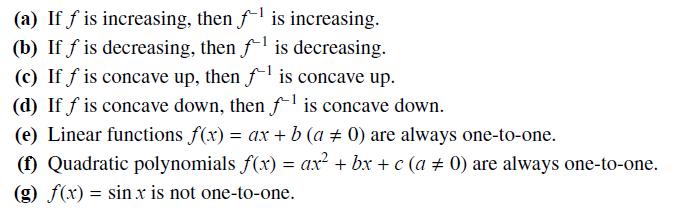
Use graphical reasoning to determine if the following statements are true or false. If false, modify the statement to make it correct. (a) If f is increasing, then f¹ is increasing. (b) If f is decreasing, then f¹ is decreasing. (c) If f is concave up, then f¹ is concave up. (d) If f is concave
Prove that tanh−1 t = 1/2 ln (1 + t/1 − t) for |t| < 1.
Find the critical points and points of inflection. Then sketch the graph y = xe−x
Let ƒ(x) = xe−x. Show that ƒ has an inverse on [1,∞). Let g be this inverse. Find the domain and range of g and compute g'(2e−2).
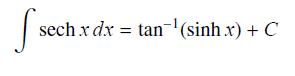
Use differentiation to prove fse sech x dx= tan¹ (sinh x) + C
Let ƒ(x) = xe−x. Show that ƒ(x) = c has two solutions if 0 < c < e−1.
Show that if ƒ is odd and ƒ−1 exists, then ƒ −1 is odd. Show, on the other hand, that an even function does not have an inverse.
Find the critical points and points of inflection. Then sketch the graphy = e−x + ex
Determine M, A, and k, for a logistic function ƒ(t) = M/1 + Ae−kt satisfying ƒ(0) = 1, ƒ(1) = 8, and ƒ(2) = 14. What are the horizontal asymptotes of ƒ?
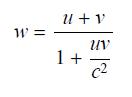
An (imaginary) train moves along a track at velocity v. Bionica walks down the aisle of the train with velocity u in the direction of the train’s motion. Compute the velocity w of Bionica relative to the ground using the laws of both Galileo and Einstein in the following cases.(a) v = 500 m/s and
Find the critical points and points of inflection. Then sketch the graph y=e* cos x on [-] 2
Let g be the inverse of a function ƒ satisfying ƒ'(x) = ƒ'(x). Show that g'(x) = x−1. This shows that the inverse of the exponential function ƒ(x) = ex is an antiderivative of x−1. That inverse is the natural logarithm function that we define in the next section.
Determine M, A, and k, for a logistic function p(t) = M/1 + Ae−kt satisfying p(0) = 10, p(4) = 35, and p(10) = 60. What are the horizontal asymptotes of p?
Show that the linearization of the function y = tanh−1 x at x = 0 is tanh−1 x ≈ x. Use this to explain the following assertion: Einstein’s Law of Velocity Addition [Eq. (2)] reduces to Galileo’s Law if the velocities are small relative to the speed of light.
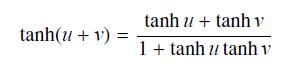
(a) Use the addition formulas for sinh x and cosh x to prove(b) Use (a) to show that Einstein’s Law of Velocity Addition [Eq. (2)] is equivalent to tanh(u+v) = tanh u + tanh v 1+tanh u tanh v
Find the critical points and points of inflection. Then sketch the graphy = e−x2
Find the local extrema of ƒ(x) = e2x − 4ex.
Find the critical points and points of inflection. Then sketch the graphy = ex − x
Find the points of inflection of ƒ(x) = ln(x2 + 1) and determine whether the concavity changes from up to down or vice versa.
Prove that ∫a−a cosh x sinh x dx = 0 for all a.
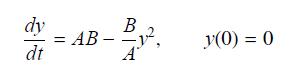
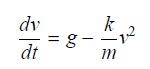
(a) Show that y = tanh t satisfies the differential equation dy/dt = 1 − y2 with initial condition y(0) = 0.(b) Show that for arbitrary constants A, B, the functiony = A tanh(Bt)satisfies(c) Let v(t) be the velocity of a falling object of mass m. For large velocities, air resistance is
Find the critical points and points of inflection. Then sketch the graphy = x2e−x
Find the local extrema and points of inflection, and sketch the graph over the interval specified. Use L’Hôpital’s Rule to determine the limits as x → 0+ or x → ± ∞ if necessary.y = x ln x, x > 0
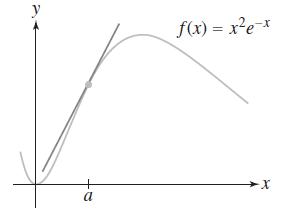
Find a > 0 such that the tangent line to the graph of ƒ(x) = x2e−x at x = a passes through the origin (Figure 6). y + a f(x) = x²e-x -X
Find the local extrema and points of inflection, and sketch the graph over the interval specified. Use L’Hôpital’s Rule to determine the limits as x → 0+ or x → ± ∞ if necessary.y = xe−x2/2
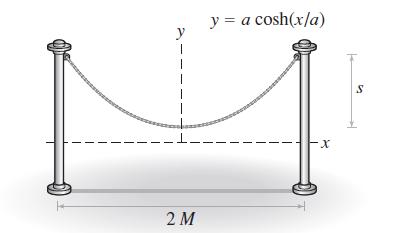
A flexible chain of length L is suspended between two poles of equal height separated by a distance 2M (Figure 10). By Newton’s laws, the chain describes a curve (called a catenary) with equation y = a cosh(x/a) + C. The constant C is arbitrary and a is the number such that L = 2a sinh(M/a). The
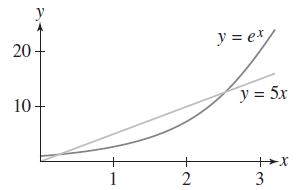
Use Newton’s Method to find the two solutions of ex = 5x to three decimal places (Figure 7). 20 10- 1 2 y = ex y = 5x 3
A flexible chain of length L is suspended between two poles of equal height separated by a distance 2M (Figure 10). By Newton’s laws, the chain describes a curve (called a catenary) with equation y = a cosh(x/a) + C. The constant C is arbitrary and a is the number such that L = 2a sinh(M/a). The
Find the local extrema and points of inflection, and sketch the graph over the interval specified. Use L’Hôpital’s Rule to determine the limits as x → 0+ or x → ± ∞ if necessary.y = x(ln x)2, x > 0
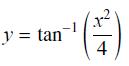
Find the local extrema and points of inflection, and sketch the graph over the interval specified. Use L’Hôpital’s Rule to determine the limits as x → 0+ or x → ± ∞ if necessary. y = tan 12 4
Compute the linearization of ƒ(x) = e−2x sin x at a = 0.
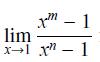
Evaluate for any numbers m, n ≠ 0. xm - 1 lim x1 x 1
A flexible chain of length L is suspended between two poles of equal height separated by a distance 2M (Figure 10). By Newton’s laws, the chain describes a curve (called a catenary) with equation y = a cosh(x/a) + C. The constant C is arbitrary and a is the number such that L = 2a sinh(M/a). The
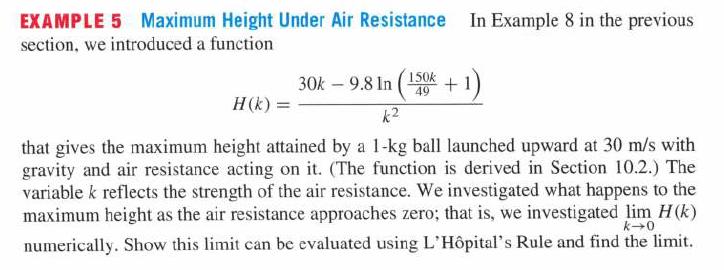
A ball is launched straight up in the air and is acted on by air resistance and gravity as in Example 5. The function H gives the maximum height that the projectile attains as a function of the air resistance parameter k. In each case, determine the maximum height as we let the air resistance term
Compute the linearization of ƒ(x) = xe6−3x at a = 2.
Prove that every function ƒ is the sum of an even function ƒ+ and an odd function ƒ−. ƒ±(x) = 1/2 (ƒ(x) ± ƒ(−x)). Express ƒ(x) = 5ex + 8e−x in terms of cosh x and sinh x.
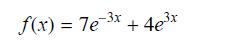
Use the method of the previous problem to expressin terms of sinh(3x) and cosh(3x). f(x) = 7e-³x + 4e³x
A ball is launched straight up in the air and is acted on by air resistance and gravity as in Example 5. The function H gives the maximum height that the projectile attains as a function of the air resistance parameter k. In each case, determine the maximum height as we let the air resistance term
Find the linearization of ƒ(x) = ex at a = 0 and use it to estimate e−0.1.
Use the linear approximation to estimate ƒ(1.03) − ƒ(1), where y = x1/3 ex−1.
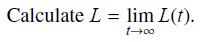
A 2005 study by the Fisheries Research Services in Aberdeen, Scotland, showed that the average length of the species Clupea Harengus (Atlantic herring) as a function of age t (in years) can be modeled by L(t) = 32(1 − e−0.37t) cm for 0 ≤ t ≤ 13.(a) How fast is the average length changing at
According to a 1999 study by Starkey and Scarnecchia, the average weight (in kg) at age t (in years) of channel catfish in the Lower Yellowstone River can be modeled byFind the rate at which weight is changing at age t = 10. W(t) = (3.46293-3.32173e -0.03456t) 3.4026
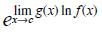
In each case, show that the form is indeterminate by showing that if has the form, then the limit in the exponent in has a known indeterminate form.(a) 1∞(b) ∞0 lim f(x)8(x) X→C
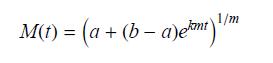
The functions in Exercises 55 and 56 are examples of the Von Bertalanffy growth functionintroduced in the 1930s by Austrian-born biologist Karl Ludwig Von Bertalanffy. Calculate M (0) in terms of the constants a, b, k, and m.Data From Exercises 55A 2005 study by the Fisheries Research Services in
Use the substitution u = 2x to evaluate dx 4.x² + 1
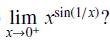
Can L’Hôpital’s Rule be applied to Does a graphical or numerical investigation suggest that the limit exists? lim xsin(1/x)? x→0+
Let ƒ(x) = x1/x for x > 0.(b) Find the maximum value of ƒ and determine the intervals on which ƒ is increasing or decreasing. (a) Calculate lim f(x) and lim f(x). X-0+ X→∞0
Find an approximation to m(4) using the limit definition and estimate the slope of the tangent line to y = 4x at x = 0 and x = 2.
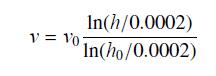
Over a flat open desert, the log wind profile is expressed asWith v0 = 20 m/s at h0 = 15 m, determine v and dv/dh at h = 80. In(h/0.0002) In(ho/0.0002) V = 107
Find an approximation to m(1/2) using the limit definition and estimate the slope of the tangent line to y = (1/2)x at x = 0 and x = 1.
(a) Use the results of Exercise 59 to prove that x1/x = c has a unique solution if 0 < c ≤ 1 or c = e1/e, has two solutions if 1 < c < e1/e, and has no solutions if c > e1/e.(b) Plot the graph of ƒ(x) = x1/x and verify that it confirms the conclusions of (a).Data From Exercise 59Let ƒ(x) = x1/x
Find approximations to m(2.71) and m(2.72) using the limit definition.
The energy (in ergs) associated with an earthquake of moment magnitude Mw satisfies log10 E = 16.1 + 1.5Mw. Calculate dE/dMw for Mw = 3 and for Mw = 7.
Determine whether ƒ ≪ g or g ≪ ƒ(or neither) for the functions ƒ(x) = log10 x and g(x) = ln x.
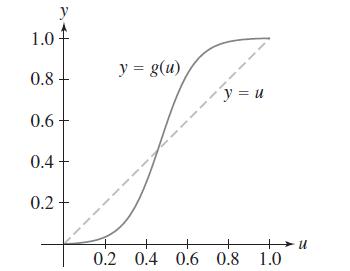
The intensity of a pixel in a digital image is measured by a number u between 0 and 1. Often, images can be enhanced by rescaling intensities, where pixels of intensity u are displayed with intensity g(u) for a suitable function g(u). An example is shown with a photograph of Amelia Earhart in
The decibel level D for the intensity of a sound is related to the sound intensity I (in watts per square meter) by log10 I = 12 − 0.1D. Calculate dI/dD for D = 40 and for D = 80.
Show that (ln x)3 ≪ x1/3 and (ln x)4 ≪ x1/10.
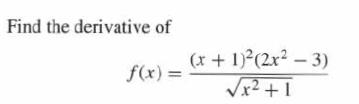
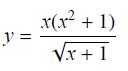
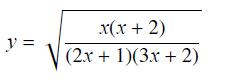
Find the derivative using logarithmic differentiation as in Example 7.Example 7y = (x + 5)(x + 9) Find the derivative of f(x) = (x + 1)²(2x²-3) √x² +1
Just as exponential functions are distinguished by their rapid rate of increase, the logarithm functions grow particularly slowly. Show that ln x ≪ xa for all a > 0.
Let N(t) be the size of a tumor (in units of 106 cells) at time t (in days). According to the Gompertz Model, dN/dt = N(a − b ln N), where a, b are positive constants. Show that the maximum value of N is ea/b and that the tumor increases most rapidly when N = ea/b−1.
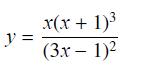
Find the derivative using logarithmic differentiation as in Example 7.Example 7y = (3x + 5)(4x + 9) Find the derivative of f(x) = (x + 1)²(2x²-3) √x² +1
Find the derivative using logarithmic differentiation as in Example 7.Example 7y = (x − 1)(x − 12)(x + 7) Find the derivative of f(x) = (x + 1)²(2x²-3) √x² +1
Show that (ln x)N ≪ xa for all N and all a > 0.
Determine whetherUse the substitution u = ln x instead of L’Hôpital’s Rule. √x
Find the derivative using logarithmic differentiation as in Example 7.Example 7 Find the derivative of f(x) = (x + 1)²(2x²-3) √x² +1
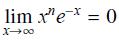
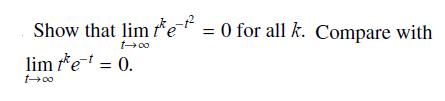
Show that for all whole numbers n > 0. lim xe * = 0 007-X
Find the derivative using logarithmic differentiation as in Example 7.Example 7 Find the derivative of f(x) = (x + 1)²(2x²-3) √x² +1
Suppose ƒ(x) = x(2 + sin x) and let g(x) = x2 + 1.Do (a) and (b) contradict L’Hôpital’s Rule? Explain. (a) Show directly that lim f(x)/g(x) = 0. X→∞0 (b) Show that lim f(x) = lim g(x) = ∞o, but lim f'(x)/g'(x) does not exist. X→00 X→∞0 X-00
Find the derivative using logarithmic differentiation as in Example 7.Example 7y = (2x + 1)(4x2) √x − 9 Find the derivative of f(x) = (x + 1)²(2x²-3) √x² +1
Find the derivative using logarithmic differentiation as in Example 7.Example 7 Find the derivative of f(x) = (x + 1)²(2x²-3) √x² +1
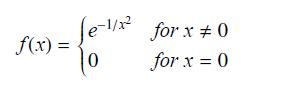
LetThese exercises show that ƒ has an unusual property: All of its derivatives at x = 0 exist and are equal to zero.Data From Exercise 70 -Je-1/2² 0 f(x) = for x # 0 for x = 0
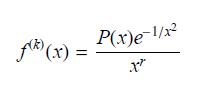
Show that for k ≥ 1 and x ≠ 0,for some polynomial P(x) and some exponent r ≥ 1. Use the result of Exercise 71 to show that ƒ (k)(0) exists and is equal to zero for all k ≥ 1.Data From Exercise 71LetThese exercises show that ƒ has an unusual property: All of its derivatives at x = 0 exist
Find the derivative using logarithmic differentiation as in Example 7.Example 7y = (x3 + 1)(x4 + 2)(x5 + 3)2 Find the derivative of f(x) = (x + 1)²(2x²-3) √x² +1
LetThese exercises show that ƒ has an unusual property: All of its derivatives at x = 0 exist and are equal to zero.Show that ƒ"(0) exists and is equal to zero. Also, verify that ƒ"(0) exists and is equal to zero. -Je-1/2² 0 f(x) = for x # 0 for x = 0
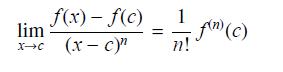
The Second Derivative Test for critical points fails if ƒ"(c) = 0. This exercise develops a Higher Derivative Test based on the sign of the first nonzero derivative. Suppose that(a) Show, by applying L’Hôpital’s Rule n times, thatwhere n! = n(n − 1)(n − 2) · · · (2)(1).(b) Use (a) to
Evaluate the integral using the methods covered in the text so far. Sve dy ye
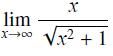
Show that L’Hôpital’s Rule applies to but that it does not help. Then evaluate the limit directly. lim x →∞0 X V.x² + 1
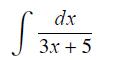
Evaluate the integral using the methods covered in the text so far. dx 3x + 5 S
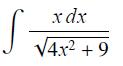
Evaluate the integral using the methods covered in the text so far. S x dx √4x²+9
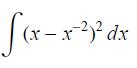
Evaluate the integral using the methods covered in the text so far. (x-x-²)² dx
Find the derivative using either method of Example 8.ƒ(x) = exx EXAMPLE 8 Differentiate (for x > 0): (a) f(x)=x* and (b) g(x)=xsin.x
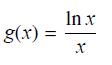
Find the local extreme values in the domain {x : x > 0} and use the Second Derivative Test to determine whether these values are local minima or maxima. g(x) = In x X
We expended a lot of effort to evaluate in Chapter 2. Show that we could have evaluated it easily using L’Hôpital’s Rule. Then explain why this method would involve circular reasoning. lim sin x X
Showing 5300 - 5400
of 8339
First
47
48
49
50
51
52
53
54
55
56
57
58
59
60
61
Last
Step by Step Answers

 Get 50% OFF
Claim Now
Get 50% OFF
Claim Now




![y=e* cos x on [-] 2](https://dsd5zvtm8ll6.cloudfront.net/images/question_images/1700/9/1/1/1836561d84f062991700911182482.jpg)