New Semester
Started
Get
50% OFF
Study Help!
--h --m --s
Claim Now
Question Answers
Textbooks
Find textbooks, questions and answers
Oops, something went wrong!
Change your search query and then try again
S
Books
FREE
Study Help
Expert Questions
Accounting
General Management
Mathematics
Finance
Organizational Behaviour
Law
Physics
Operating System
Management Leadership
Sociology
Programming
Marketing
Database
Computer Network
Economics
Textbooks Solutions
Accounting
Managerial Accounting
Management Leadership
Cost Accounting
Statistics
Business Law
Corporate Finance
Finance
Economics
Auditing
Tutors
Online Tutors
Find a Tutor
Hire a Tutor
Become a Tutor
AI Tutor
AI Study Planner
NEW
Sell Books
Search
Search
Sign In
Register
study help
mathematics
precalculus
Thomas Calculus Early Transcendentals 13th Edition Joel R Hass, Christopher E Heil, Maurice D Weir - Solutions
An aluminum beam was brought from the outside cold into a machine shop where the temperature was held at 65°F. After 10 min, the beam warmed to 35°F and after another 10 min it was 50°F. Use Newton’s Law of Cooling to estimate the beam’s initial temperature.
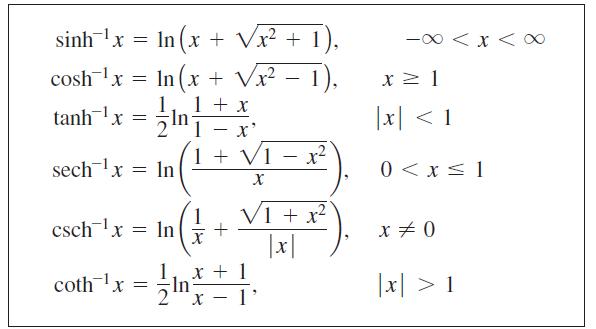
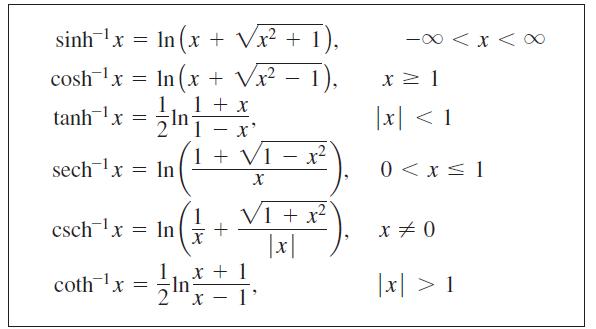
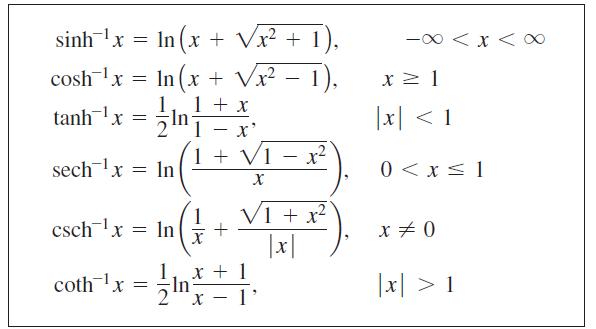
When hyperbolic function keys are not available on a calculator, it is still possible to evaluate the inverse hyperbolic functions by expressing them as logarithms, as shown here.Use the formulas in the box here to express the numbers in terms of natural logarithms.cosh-1 (5/3) sinh'x = In(x +
A pan of warm water (46°C) was put in a refrigerator. Ten minutes later, the water’s temperature was 39°C; 10 min after that, it was 33°C. Use Newton’s Law of Cooling to estimate how cold the refrigerator was.
The temperature of an ingot of silver is 60°C above room temperature right now. Twenty minutes ago, it was 70°C above room temperature. How far above room temperature will the silver bea. 15 min from now?b. 2 hours from now?c. When will the silver be 10°C above room temperature?
The charcoal from a tree killed in the volcanic eruption that formed Crater Lake in Oregon contained 44.5% of the carbon-14 found in living matter. About how old is Crater Lake?
To see the effect of a relatively small error in the estimate of the amount of carbon-14 in a sample being dated, consider this hypothetical situation:a. A bone fragment found in central Illinois in the year 2000 contains 17% of its original carbon-14 content. Estimate the year the animal died.b.
The oldest known frozen human mummy, discovered in the Schnalstal glacier of the Italian Alps in 1991 and called Otzi, was found wearing straw shoes and a leather coat with goat fur, and holding a copper ax and stone dagger. It was estimated that Otzi died 5000 years before he was discovered in the
A painting attributed to Vermeer (1632–1675), which should contain no more than 96.2% of its original carbon-14, contains 99.5% instead. About how old is the forgery?
Prehistoric cave paintings of animals were found in the Lascaux Cave in France in 1940. Scientific analysis revealed that only 15% of the original carbon-14 in the paintings remained. What is an estimate of the age of the paintings?
When hyperbolic function keys are not available on a calculator, it is still possible to evaluate the inverse hyperbolic functions by expressing them as logarithms, as shown here.Use the formulas in the box here to express the numbers in terms of natural logarithms.tanh-1 (-1/2) sinh'x = In(x +
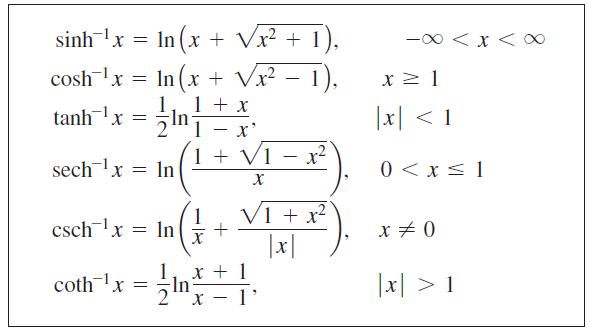
When hyperbolic function keys are not available on a calculator, it is still possible to evaluate the inverse hyperbolic functions by expressing them as logarithms, as shown here.Use the formulas in the box here to express the numbers in terms of natural logarithms.sech-1 (3/5) sinh'x = In(x +
The frozen remains of a young Incan woman were discovered by archeologist Johan Reinhard on Mt. Ampato in Peru during an expedition in 1995.a. How much of the original carbon-14 was present if the estimated age of the “Ice Maiden” was 500 years?b. If a 1% error can occur in the carbon-14
The region between the curve y = 1/x2 and the x-axis from x = 1/2 to x = 2 is revolved about the y-axis to generate a solid. Find the volume of the solid.
When hyperbolic function keys are not available on a calculator, it is still possible to evaluate the inverse hyperbolic functions by expressing them as logarithms, as shown here.Use the formulas in the box here to express the numbers in terms of natural logarithms.coth-1 (5/4) sinh'x = In(x +
Find the lengths of the curves.x = (y/4)2 - 2 ln (y/4), 4 ≤ y ≤ 12
Instead of approximating ln x near x = 1, we approximate ln (1 + x) near x = 0. We get a simpler formula this way.a. Derive the linearization ln (1 + x) ≈ x at x = 0.b. Estimate to five decimal places the error involved in replacing ln (1 + x) by x on the interval 30, 0.14 .c. Graph ln (1 + x)
a. Derive the linear approximation ex ≈ 1 + x at x = 0.b. Estimate to five decimal places the magnitude of the error involved in replacing ex by 1 + x on the interval [0, 0.2].c. Graph ex and 1 + x together for -2 ≤ x ≤ 2. Use different colors, if available. On what intervals does the
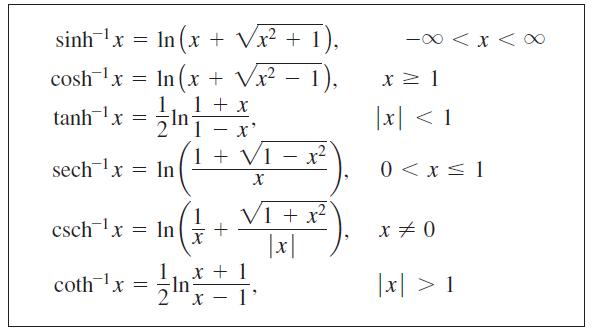
When hyperbolic function keys are not available on a calculator, it is still possible to evaluate the inverse hyperbolic functions by expressing them as logarithms, as shown here.Use the formulas in the box here to express the numbers in terms of natural logarithms.csch-1(-1/√3) sinh'x = In(x +
Graph y = ln |sin x| in the window 0 ≤ x ≤ 22, -2 ≤ y ≤ 0. Explain what you see. How could you change the formula to turn the arches upside down?
a. Graph y = sin x and the curves y = ln (a + sin x) for a = 2, 4, 8, 20, and 50 together for 0 ≤ x ≤ 23.b. Why do the curves flatten as a increases? Find an a-dependent upper bound for |y′|
Does the graph of y = √x - ln x, x > 0, have an inflection point? Try to answer the question (a) By graphing, (b) By using calculus.
The equation x2 = 2x has three solutions:x = 2, x = 4, and one other. Estimate the third solution as accurately as you can by graphing.
Could xln 2 possibly be the same as 2ln x for some x > 0? Graph the two functions and explain what you see.
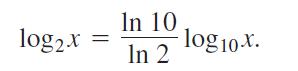
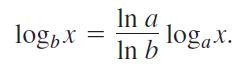
a. Show that the equation for converting base 10 logarithms to base 2 logarithms isb. Show that the equation for converting base a logarithms to base b logarithms is log2x = In 10 In 2 -log 10.x.
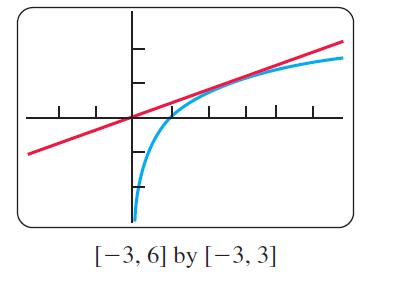
Calculators have taken some of the mystery out of this once-challenging question. You can answer the question without a calculator, though.a. Find an equation for the line through the origin tangent to the graph of y = ln x.b. Give an argument based on the graphs of y = ln x and the tangent line to
Show that if a function ƒ is defined on an interval symmetric about the origin (so that ƒ is defined at -x whenever it is defined at x), thenThen show that (ƒ(x) + ƒ(-x))/2 is even and that (ƒ(x) - ƒ(-x))/2 is odd. f(x) = f(x) + f(-x) 2 + f(x) = f(-x) 2 (1)
Most scientific calculators have keys for log10 x and ln x. To find logarithms to other bases, we use the equation loga x = (ln x)/(ln a). Find the following logarithms to five decimal places.a. log3 8b. log7 0.5c. log20 17d. log0.5 7e. ln x, given that log10 x = 2.3f. ln x, given that log2 x =
Show that the area of the region in the first quadrant enclosed by the curve y = (1/a) cosh ax, the coordinate axes, and the line x = b is the same as the area of a rectangle of height 1/a and length s, where s is the length of the curve from x = 0 to x = b. Draw a figure illustrating this result.
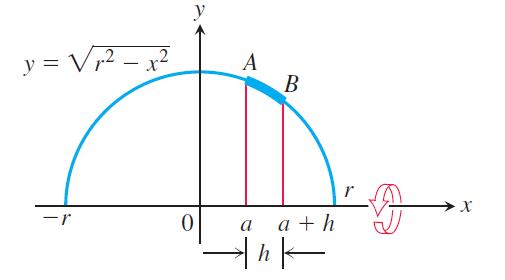
Did you know that if you cut a spherical loaf of bread into slices of equal width, each slice will have the same amount of crust? To see why, suppose the semicircle y = √r2 - x2 shown here is revolved about the x-axis to generate a sphere. Let AB be an arc of the semicircle that lies above an
How much work has to be performed on a 6.5-oz softball to pitch it 132 ft/sec (90 mph)?
A force of 200 N will stretch a garage door spring 0.8 m beyond its unstressed length. How far will a 300-N force stretch the spring? How much work does it take to stretch the spring this far from its unstressed length?
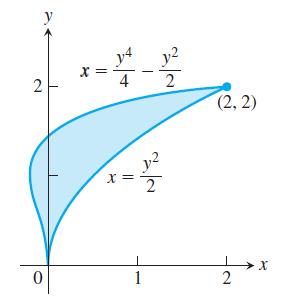
Use the shell method to find the volumes of the solids generated by revolving the shaded regions about the indicated axes.a. The x-axis b. The line y = 2c. The line y = 5 d. The line y = -5/8 2 0 X X || 1 2 (2, 2) 2 X
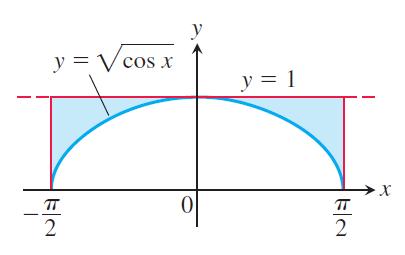
Find the volumes of the solids generated by revolving the regions bounded by the lines and curves about the x-axis. y = Vcos x, 0 ≤ x ≤ π/2, y = 0, x = 0
A right-circular conical tank, point down, with top radius 5 ft and height 10 ft is filled with a liquid whose weight-density is 60 lb/ft3. How much work does it take to pump the liquid to a point 2 ft above the tank? If the pump is driven by a motor rated at 275 ft-lb/sec (1/2 hp), how long will
Find the volumes of the solids generated by revolving the regions about the given axes. If you think it would be better to use washers in any given instance, feel free to do so.The triangle with vertices (1, 1), (1, 2), and (2, 2) abouta. The x-axis b. The y-axisc. The line x = 10/3 d.
Find the volumes of the solids generated by revolving the regions bounded by the lines and curve about the y-axis.The region enclosed by x = √5y2, x = 0, y = -1, y = 1
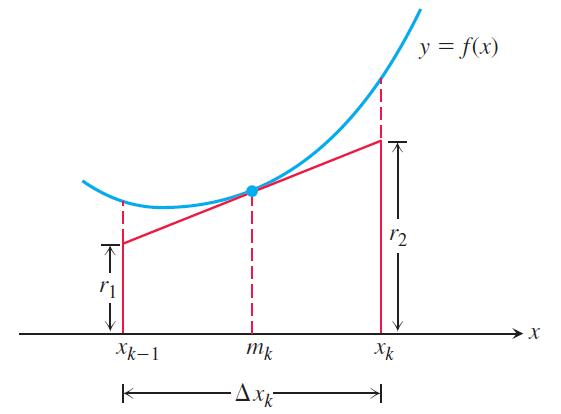
Assume ƒ is smooth on [a, b] and partition [a, b] in the usual way. In the kth subinterval [xk-1, xk], construct the tangent line to the curve at the midpoint mk = (xk-1 + xk)/2, as in the accompanying figure.a. Show thatb. Show that the length Lk of the tangent line segment in the kth subinterval
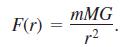
The strength of Earth’s gravitational field varies with the distance r from Earth’s center, and the magnitude of the gravitational force experienced by a satellite of mass m during and after launch isHere, M = 5.975 * 1024 kg is Earth’s mass, G = 6.6720 * 10-11 N · m2 kg-2 is the universal
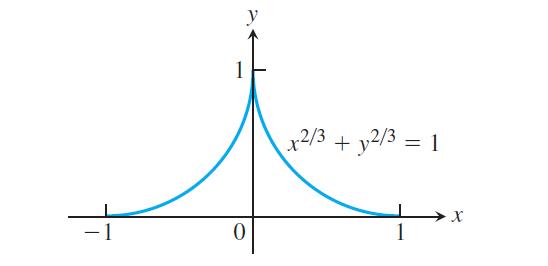
Find the area of the surface generated by revolving about the x-axis the portion of the astroid x2/3 + y2/3 = 1 shown in the accompanying figure. 1 y 0 x2/3 + y2/3 = 1 X
Find the volumes of the solids generated by revolving the regions bounded by the lines and curve about the y-axis.The region enclosed by x = y3/2, x = 0, y = 2
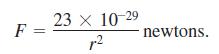
Two electrons r meters apart repel each other with a force ofa. Suppose one electron is held fixed at the point (1, 0) on the x-axis (units in meters). How much work does it take to move a second electron along the x-axis from the point (-1, 0) to the origin?b. Suppose an electron is held fixed at
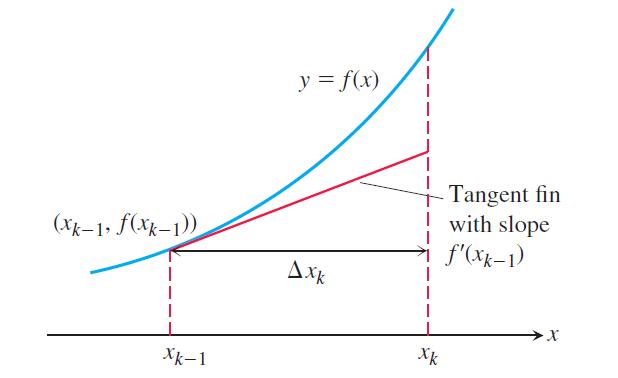
Assume that ƒ is smooth on [a, b] and partition the interval [a, b] in the usual way. In each subinterval [xk-1, xk], construct the tangent fin at the point (xk-1, ƒ(xk-1)), as shown in the accompanying figure.a. Show that the length of the kth tangent fin over the interval [xk-1, xk] equalsb.
A storage tank is a right-circular cylinder 20 ft long and 8 ft in diameter with its axis horizontal. If the tank is half full of olive oil weighing 57 lb/ft3, find the work done in emptying it through a pipe that runs from the bottom of the tank to an outlet that is 6 ft above the top of the tank.
Find the volumes of the solids generated by revolving the regions bounded by the lines and curve about the y-axis.The region enclosed by X = V2 sin 2y, 0≤ y ≤ π/2, x = 0
Find the volumes of the solids generated by revolving the regions about the given axes. If you think it would be better to use washers in any given instance, feel free to do so.The region in the first quadrant bounded by the curve x = y - y3 and the y-axis abouta. The x-axis b. The line y = 1
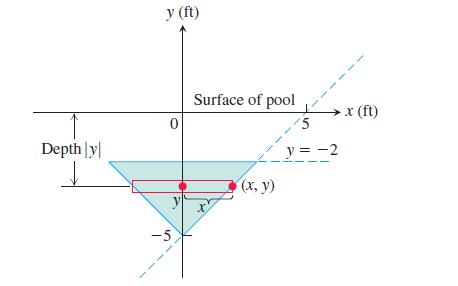
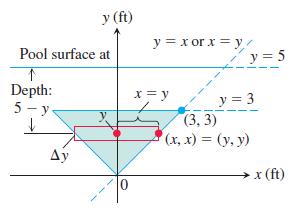
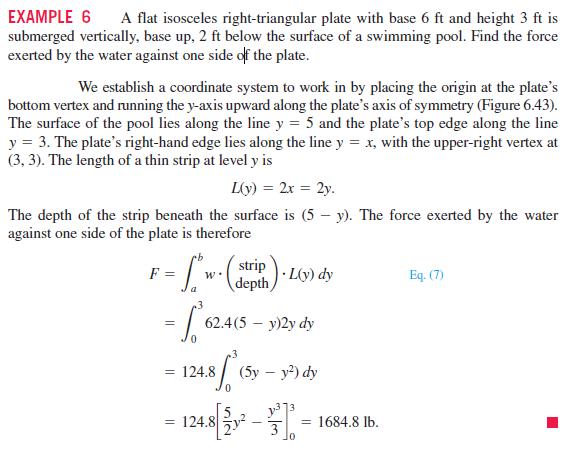
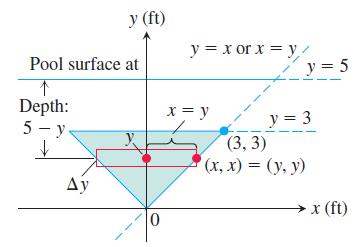
Calculate the fluid force on one side of the plate in Example 6 using the coordinate system shown here. Depth|y| y (ft) 0 Surface of pool y x -5 (x, y) 5 y = -2 x (ft)
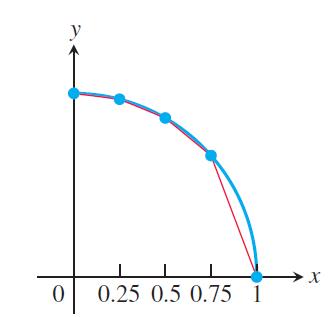
Approximate the arc length of one-quarter of the unit circle (which is π/2) by computing the length of the polygonal approximation with n = 4 segments (see accompanying figure). 0 0.25 0.5 0.75 1 X
Find the volumes of the solids generated by revolving the regions bounded by the lines and curve about the y-axis.The region enclosed by Vcos (πy/4), -2 ≤ y ≤ 0, x = 0
Find the centroid of a thin, flat plate covering the region enclosed by the parabolas y = 2x2 and y = 3 - x2.
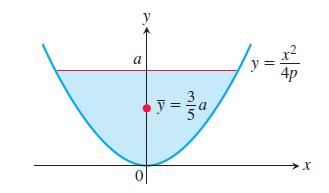
Whatever the value of π > 0 in the equation y = x2/(4p), the y-coordinate of the centroid of the parabolic segment shown here is ȳ = (3/5)a. a 0 y = /y = £ X<
Find the volumes of the solids generated by revolving the regions about the given axes. If you think it would be better to use washers in any given instance, feel free to do so.The region in the first quadrant bounded by x = y - y3, x = 1, and y = 1 abouta. The x-axis b. The y-axisc. The line
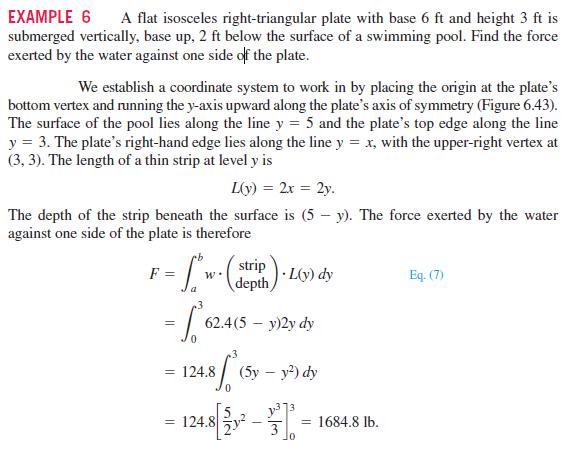
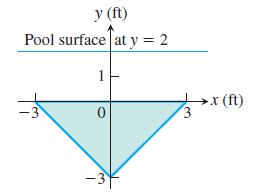
Calculate the fluid force on one side of the plate in Example 6 using the coordinate system shown here. y (ft) Pool surface at y = 2 -3 1 0 -3 3 →x (ft)
Assume that the two points (x1, y1) and (x2, y2) lie on the graph of the straight line y = mx + b. Use the arc length formula (Equation 3) to find the distance between the two points. -S₁- VI + [f'(x)]² dx = L= - Sº a 1 + dy dx dx. (3)
Find the centroid of a thin, flat plate covering the region enclosed by the x-axis, the lines x = 2 and x = -2, and the parabola y = x2.
Find the volumes of the solids generated by revolving the regions about the given axes. If you think it would be better to use washers in any given instance, feel free to do so.The region bounded by y = 2x and y = x2/8 abouta. The x-axis b. The y-axis
Find the volumes of the solids generated by revolving the regions bounded by the lines and curve about the y-axis.The region enclosed by x = 2/√y + 1₂ x = 0, y = 0, y = 3 1,
Find the volumes of the solids generated by revolving the regions bounded by the lines and curve about the y-axis. X = = V2y/(y² + 1), x = 0, y = 1
Use a theorem of Pappus to find the volume generated by revolving about the line x = 5 the triangular region bounded by the coordinate axes and the line 2x + y = 6.Data from in Exercise 9The region between the curve y = 1/x and the x-axis from x = 1 to x = 2. Give the coordinates to two decimal
Find the volumes of the solids generated by revolving the regions about the given axes. If you think it would be better to use washers in any given instance, feel free to do so. The region bounded by y = 2x - x2 and y = x abouta. The y-axis b. The line x = 1
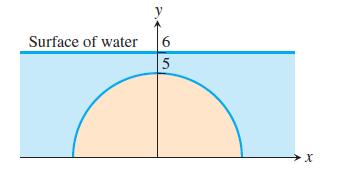
Calculate the fluid force on one side of a semicircular plate of radius 5 ft that rests vertically on its diameter at the bottom of a pool filled with water to a depth of 6 ft. Surface of water 6 5 → X
Find the centroid of a thin, flat plate covering the region enclosed by the parabola y2 = x and the line x = 2y.
The region in the first quadrant that is bounded above by the curve y = 1/x1/4, on the left by the line x = 1/16, and below by the line y = 1 is revolved about the x-axis to generate a solid. Find the volume of the solid bya. The washer method. b. The shell method.
Find the volumes of the solids generated by revolving the shaded regions about the indicated axes.The x-axis y = Vcos COS X πT 2 y y = 1 ㅠ 2 X
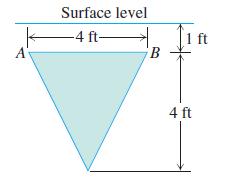
The isosceles triangular plate shown here is submerged vertically 1 ft below the surface of a freshwater lake.a. Find the fluid force against one face of the plate.b. What would be the fluid force on one side of the plate if the water were seawater instead of freshwater? Surface level -4 ft- B T1
Find the volume of the torus generated by revolving the circle (x - 2)2 + y2 = 1 about the y-axis.
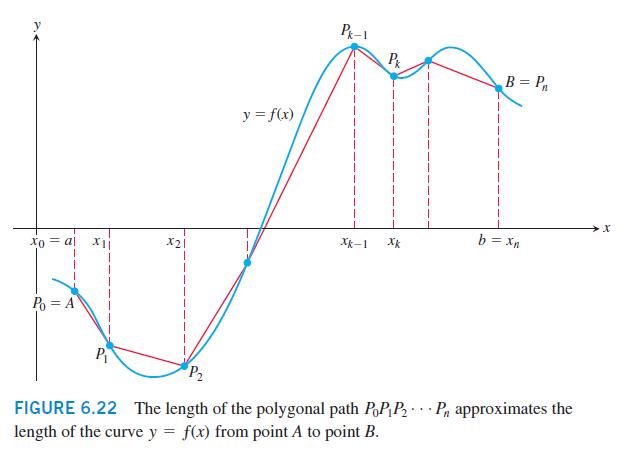
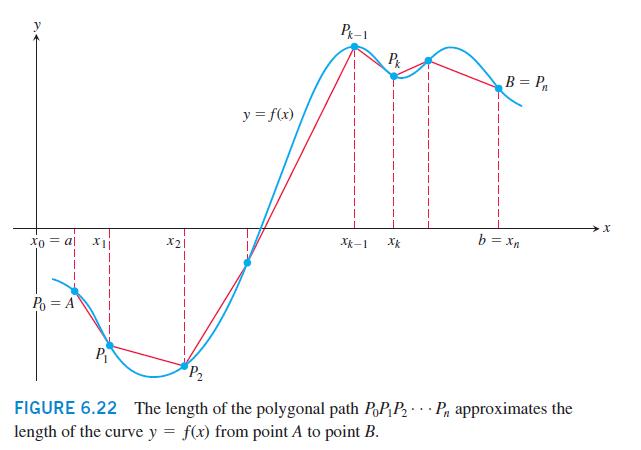
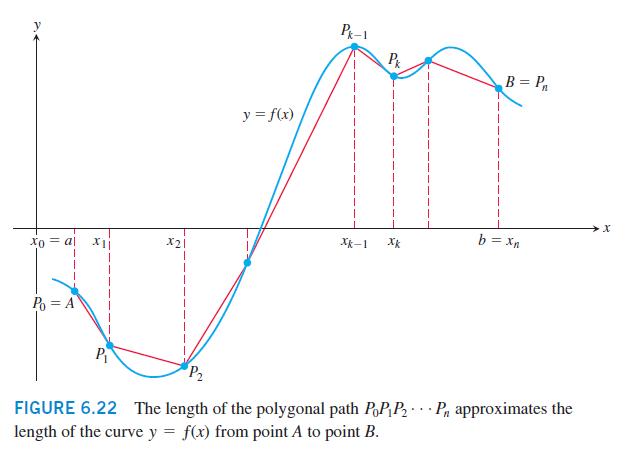
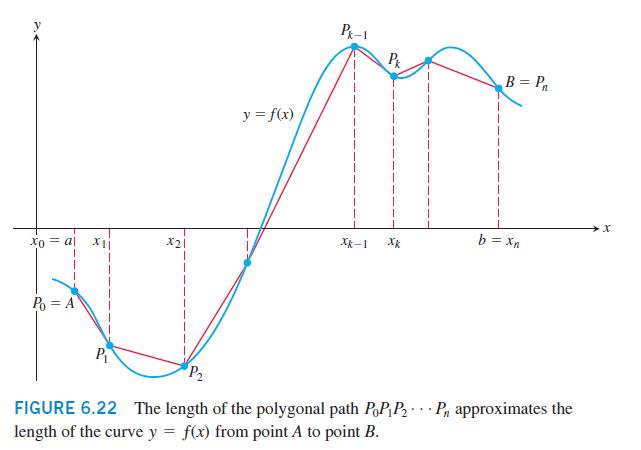
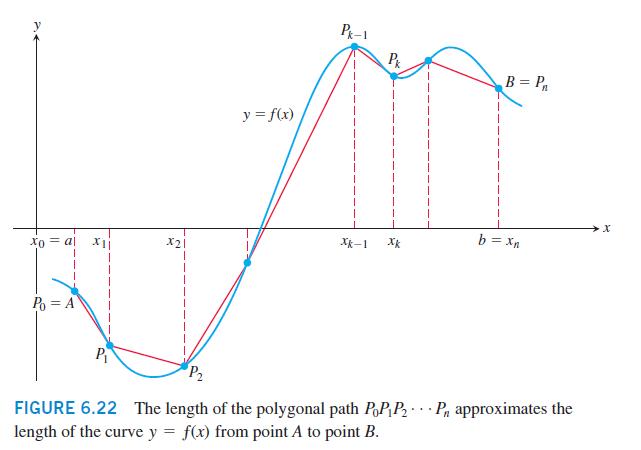
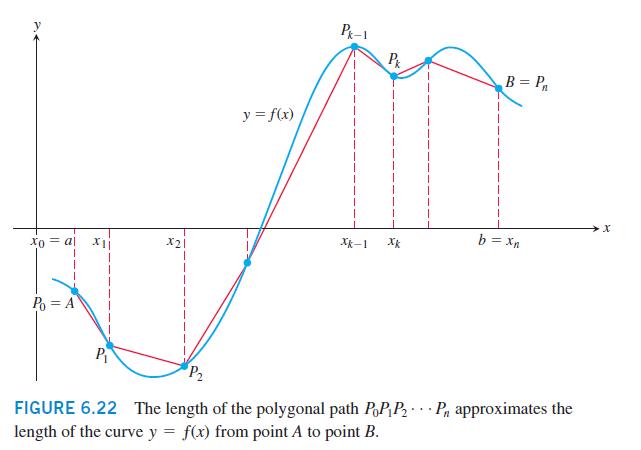
Use a CAS to perform the following steps for the given graph of the function over the closed interval.a. Plot the curve together with the polygonal path approximations for n = 2, 4, 8 partition points over the interval. (See Figure 6.22.)b. Find the corresponding approximation to the length of the
Use a CAS to perform the following steps for the given graph of the function over the closed interval.a. Plot the curve together with the polygonal path approximations for n = 2, 4, 8 partition points over the interval. (See Figure 6.22.)b. Find the corresponding approximation to the length of the
Find the center of mass of a thin, flat plate covering the region enclosed by the parabola y2 = x and the line x = 2y if the density function is d(y) = 1 + y.
The region in the first quadrant that is bounded above by the curve y = 1/√x, on the left by the line x = 1/4, and below by the line y = 1 is revolved about the y-axis to generate a solid. Find the volume of the solid bya. The washer method.b. The shell method.
Use the theorems of Pappus to find the lateral surface area and the volume of a right-circular cone.
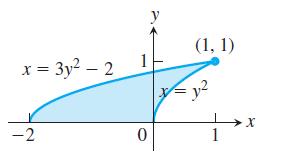
The region shown here is to be revolved about the x-axis to generate a solid. Which of the methods (disk, washer, shell) could you use to find the volume of the solid? How many integrals would be required in each case? Explain. x = 3y² - 2 -2 y 1 0 (1, 1) |x = y² 1 X
Use a CAS to perform the following steps for the given graph of the function over the closed interval.a. Plot the curve together with the polygonal path approximations for n = 2, 4, 8 partition points over the interval. (See Figure 6.22.)b. Find the corresponding approximation to the length of the
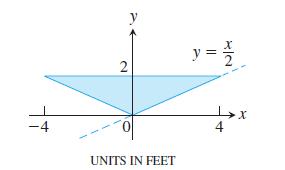
The vertical triangular plate shown here is the end plate of a trough full of water (w = 62.4). What is the fluid force against the plate? -4 2 UNITS IN FEET =즐 4
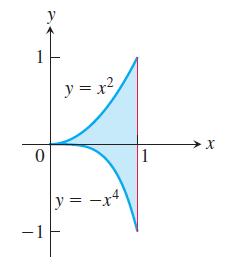
The region shown here is to be revolved about the y-axis to generate a solid. Which of the methods (disk, washer, shell) could you use to find the volume of the solid? How many integrals would be required in each case? Give reasons for your answers. - 1 0 y = x² y = -x4 1 > X
a. Find the center of mass of a thin plate of constant density covering the region between the curve y = 3/x3/2 and the x-axis from x = 1 to x = 9.b. Find the plate’s center of mass if, instead of being constant, the density is δ(x) = x.
Use a CAS to perform the following steps for the given graph of the function over the closed interval.a. Plot the curve together with the polygonal path approximations for n = 2, 4, 8 partition points over the interval. (See Figure 6.22.)b. Find the corresponding approximation to the length of the
Find the volumes of the solids generated by revolving the regions bounded by the lines and curve about the x-axis.y = x, y = 1, x = 0
Use a CAS to perform the following steps for the given graph of the function over the closed interval.a. Plot the curve together with the polygonal path approximations for n = 2, 4, 8 partition points over the interval. (See Figure 6.22.)b. Find the corresponding approximation to the length of the
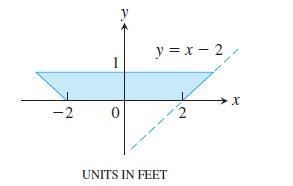
The vertical trapezoidal plate shown here is the end plate of a trough full of maple syrup weighing 75 lb/ft3. What is the force exerted by the syrup against the end plate of the trough when the syrup is 10 in. deep? -2 1 0 y=x-2/ UNITS IN FEET 2 → X
Use Pappus’s Theorem for surface area and the fact that the surface area of a sphere of radius a is 4πa2 to find the centroid of the semicircle y = √a2 - x2.
The viewing portion of the rectangular glass window in a typical fish tank at the New England Aquarium in Boston is 63 in. wide and runs from 0.5 in. below the water’s surface to 33.5 in. below the surface. Find the fluid force against this portion of the window. The weight-density of seawater is
Use a CAS to perform the following steps for the given graph of the function over the closed interval.a. Plot the curve together with the polygonal path approximations for n = 2, 4, 8 partition points over the interval. (See Figure 6.22.)b. Find the corresponding approximation to the length of the
Find the volumes of the solids generated by revolving the regions bounded by the lines and curve about the x-axis.y = 2√x, y = 2, x = 0
A semicircular plate 2 ft in diameter sticks straight down into freshwater with the diameter along the surface. Find the force exerted by the water on one side of the plate.
A bead is formed from a sphere of radius 5 by drilling through a diameter of the sphere with a drill bit of radius 3.a. Find the volume of the bead.b. Find the volume of the removed portion of the sphere.
Find the volumes of the solids generated by revolving the regions bounded by the lines and curve about the x-axis.y = x2 + 1, y = x + 3
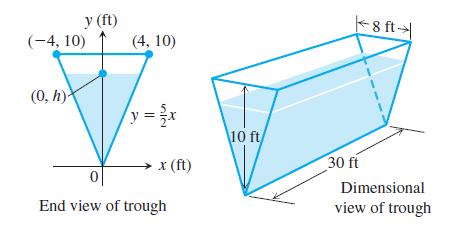
The end plates of the trough shown here were designed to withstand a fluid force of 6667 lb. How many cubic feet of water can the tank hold without exceeding this limitation? Round down to the nearest cubic foot. What is the value of h? y (ft) (-4, 10) (0, h) (4, 10) /y = 2x x (ft) End view of
The area of the region R enclosed by the semiellipse y = (b/a)√a2 - x2 and the x-axis is (1/2)πab, and the volume of the ellipsoid generated by revolving R about the x-axis is (4/3)πab2. Find the centroid of R. Notice that the location is independent of a.
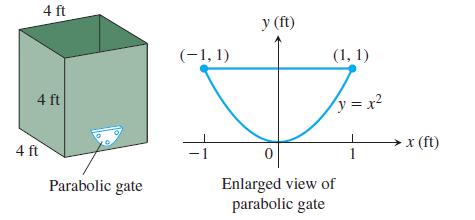
The cubical metal tank shown here has a parabolic gate held in place by bolts and designed to withstand a fluid force of 160 lb without rupturing. The liquid you plan to store has a weight-density of 50 lb/ft3.a. What is the fluid force on the gate when the liquid is 2 ft deep?b. What is the
Calculate the fluid force on one side of a 5 ft by 5 ft square plate if the plate is at the bottom of a pool filled with water to a depth of 8 ft anda. Lying flat on its 5 ft by 5 ft face.b. Resting vertically on a 5-ft edge.c. Resting on a 5-ft edge and tilted at 45° to the bottom of the pool.
A flat vertical gate in the face of a dam is shaped like the parabolic region between the curve y = 4x2 and the line y = 4, with measurements in feet. The top of the gate lies 5 ft below the surface of the water. Find the force exerted by the water against the gate (w = 62.4).
A Bundt cake, well known for having a ringed shape, is formed by revolving around the y-axis the region bounded by the graph of y = sin (x2 - 1) and the x-axis over the interval 1 ≤ x ≤ √1 + π. Find the volume of the cake.
Find the volumes of the solids generated by revolving the regions bounded by the lines and curve about the x-axis.y = 4 - x2, y = 2 - x
Calculate the fluid force on one side of a right-triangular plate with edges 3 ft, 4 ft, and 5 ft if the plate sits at the bottom of a pool filled with water to a depth of 6 ft on its 3-ft edge and tilted at 60° to the bottom of the pool.
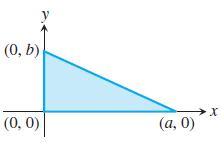
Use a theorem of Pappus to find the centroid of the given triangle. Use the fact that the volume of a cone of radius r and height h is V = 1/3 πr2h. (0, b) (0, 0) (a,0) X
You plan to store mercury (w = 849 lb/ft3) in a vertical rectangular tank with a 1 ft square base side whose interior side wall can withstand a total fluid force of 40,000 lb. About how many cubic feet of mercury can you store in the tank at any one time?
Derive the formula for the volume of a right circular cone of height h and radius r using an appropriate solid of revolution.
Find the volumes of the solids generated by revolving the regions bounded by the lines and curve about the x-axis.y = sec x, y = √2, -π/4 ≤ x ≤ π/4
Derive the equation for the volume of a sphere of radius r using the shell method.
Find the volumes of the solids generated by revolving the regions bounded by the lines and curve about the x-axis.y = sec x, y = tan x, x = 0, x = 1
Showing 11100 - 11200
of 29454
First
105
106
107
108
109
110
111
112
113
114
115
116
117
118
119
Last
Step by Step Answers

 Get 50% OFF
Claim Now
Get 50% OFF
Claim Now