New Semester
Started
Get
50% OFF
Study Help!
--h --m --s
Claim Now
Question Answers
Textbooks
Find textbooks, questions and answers
Oops, something went wrong!
Change your search query and then try again
S
Books
FREE
Study Help
Expert Questions
Accounting
General Management
Mathematics
Finance
Organizational Behaviour
Law
Physics
Operating System
Management Leadership
Sociology
Programming
Marketing
Database
Computer Network
Economics
Textbooks Solutions
Accounting
Managerial Accounting
Management Leadership
Cost Accounting
Statistics
Business Law
Corporate Finance
Finance
Economics
Auditing
Tutors
Online Tutors
Find a Tutor
Hire a Tutor
Become a Tutor
AI Tutor
AI Study Planner
NEW
Sell Books
Search
Search
Sign In
Register
study help
mathematics
precalculus
Thomas Calculus Early Transcendentals 13th Edition Joel R Hass, Christopher E Heil, Maurice D Weir - Solutions
Find the center of mass of a thin plate of constant density δ covering the given region.a. The region cut from the first quadrant by the circle x2 + y2 = 9b. The region bounded by the x-axis and the semicircle y = √9 - x2Compare your answer in part (b) with the answer in part (a).
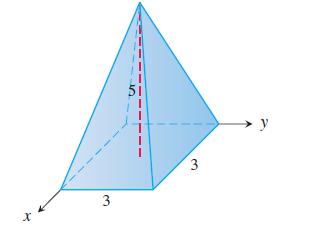
Find the volume of the given pyramid, which has a square base of area 9 and height 5. X 3 3 y
Find the centroid of the region bounded below by the x-axis and above by the curve y = 1 - xn, n an even positive integer. What is the limiting position of the centroid as n→ ∞?
Find the surface area of the cone frustum generated by revolving the line segment y = (x/2) + (1/2), 1 ≤ x ≤ 3, about the x-axis. Check your result with the geometry formula Frustum surface area = π(r1 + r2) * slant height.
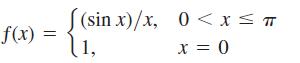
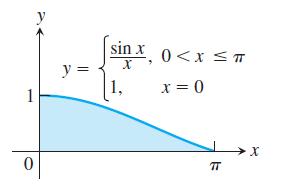
Leta. Show that xƒ(x) = sin x, 0 ≤ x ≤ π.b. Find the volume of the solid generated by revolving the shaded region about the y-axis in the accompanying figure. f(x) = (sin x)/x, 0 < x≤ T (1, x = 0
Use the shell method to find the volumes of the solids generated by revolving the regions bounded by the curves and lines about the y-axis.y = 2x - 1, y = √x, x = 0
Find the center of mass of a thin plate of constant density δ covering the given region.The region in the first and fourth quadrants enclosed by the curves y = 1/(1 + x2) and y = -1/(1 + x2) and by the lines x = 0 and x = 1
Find the lengths of the curves. If you have a grapher, you may want to graph these curves to see what they look like. X = So 0 Vsect 1 dt, π/4 ≤ y ≤ π/4 -
If you haul a telephone pole on a two-wheeled carriage behind a truck, you want the wheels to be 3 ft or so behind the pole’s center of mass to provide an adequate “tongue” weight. The 40-ft wooden telephone poles used by Verizon have a 27-in. circumference at the top and a 43.5-in.
Find the surface area of the cone frustum generated by revolving the line segment y = (x/2) + (1/2), 1 ≤ x ≤ 3, about the y-axis. Check your result with the geometry formula Frustum surface area = π(r1 + r2) * slant height.
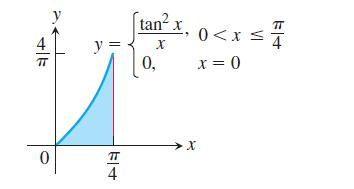
Leta. Show that x g(x) = (tan x)2, 0 ≤ x ≤ π/4.b. Find the volume of the solid generated by revolving the shaded region about the y-axis in the accompanying figure. g(x) = [(tan x)²/x, 0 < x≤ π/4 0, x = 0
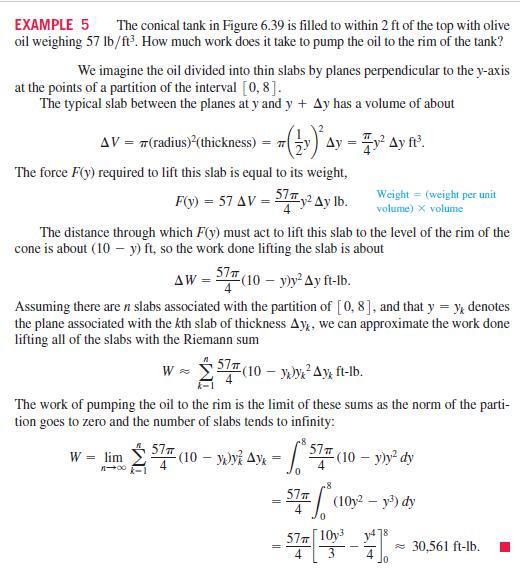
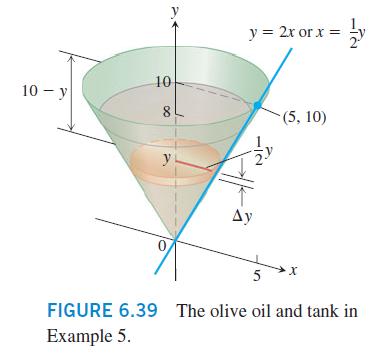
How much work would it take to pump oil from the tank in Example 5 to the level of the top of the tank if the tank were completely full? In Example 5 In Figure 6.39 EXAMPLE 5 The conical tank in Figure 6.39 is filled to within 2 ft of the top with olive oil weighing 57 lb/ft³. How much work does
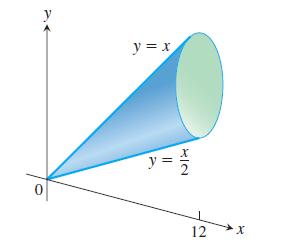
A solid lies between planes perpendicular to the x-axis at x = 0 and x = 12. The cross-sections by planes perpendicular to the x-axis are circular disks whose diameters run from the line y = x/2 to the line y = x as shown in the accompanying figure. Explain why the solid has the same volume as a
Use the shell method to find the volumes of the solids generated by revolving the regions bounded by the curves and lines about the y-axis.y = 3/(2√x), y = 0, x = 1, x = 4
Find the center of mass of a thin plate of constant density δ covering the given region.The region bounded by the parabolas y = 2x2 - 4x and y = 2x - x2
A square of side length s lies in a plane perpendicular to a line L. One vertex of the square lies on L. As this square moves a distance h along L, the square turns one revolution about L to generate a corkscrew-like column with square cross-sections.a. Find the volume of the column.b. What will
Find the lengths of the curves. If you have a grapher, you may want to graph these curves to see what they look like. X =[₁₂ √3₁² -2 y = V314-1 dt, -2 ≤ x ≤-1
Find the areas of the surfaces generated by revolving the curves about the indicated axes. If you have a grapher, you may want to graph these curves to see what they look like.y = x3/9, 0 ≤ x ≤ 2; x-axis
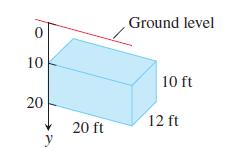
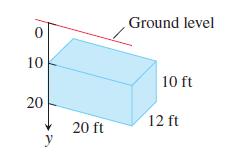
The rectangular cistern (storage tank for rainwater) shown has its top 10 ft below ground level. The cistern, currently full, is to be emptied for inspection by pumping its contents to ground level.a. How much work will it take to empty the cistern?b. How long will it take a 1/2-hp pump, rated at
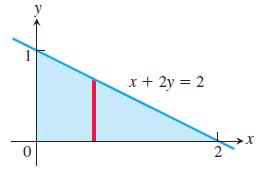
Find the volume of the solid generated by revolving the shaded region about the given axis.About the x-axis 0 x + 2y = 2 2
Find the center of mass of a thin plate of constant density δ covering the given region.The region between the curve y = 1/√x and the x-axis from x = 1 to x = 16
What are the answers to parts (a) through (c) in a location where water weighs 62.26 lb/ft3? 62.59 lb/ft3? 0 10 20 20 ft Ground level 10 ft 12 ft
Find the center of mass of a thin plate covering the region bounded by the curve y2 = 4ax and the line x = a, a = positive constant, if the density at (x, y) is directly proportional to (a) x, (b) |y|.
Find the areas of the surfaces generated by revolving the curves about the indicated axes. If you have a grapher, you may want to graph these curves to see what they look like.y = √x, 3/4 ≤ x ≤ 15/4; x-axis
a. Find the centroid of the region in the first quadrant bounded by two concentric circles and the coordinate axes, if the circles have radii a and b, 0 < a < b, and their centers are at the origin.b. Find the limits of the coordinates of the centroid as a approaches b and discuss the meaning
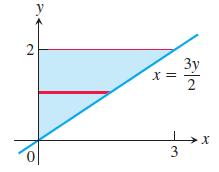
Find the volume of the solid generated by revolving the shaded region about the given axis.About the y-axis 2 3
Do the following.a. Set up an integral for the length of the curve.b. Graph the curve to see what it looks like.c. Use your grapher’s or computer’s integral evaluator to find the curve’s length numerically.y = x2, -1 ≤ x ≤ 2
Use the shell method to find the volumes of the solids generated by revolving the regions bounded by the curves and line about the x-axis.x = √y, x = -y, y = 2
Find the center of mass of a thin plate covering the region between the x-axis and the curve y = 2/x2, 1 ≤ x ≤ 2, if the plate’s density at the point (x, y) is δ(x) = x2.
A triangular corner is cut from a square 1 ft on a side. The area of the triangle removed is 36 in2. If the centroid of the remaining region is 7 in. from one side of the original square, how far is it from the remaining sides?
Find the areas of the surfaces generated by revolving the curves about the indicated axes. If you have a grapher, you may want to graph these curves to see what they look like. y = √x+1, 1 ≤x≤ 5; x-axis
Find the lengths of the curves.y = (x2/8) - ln x, 4 ≤ x ≤ 8
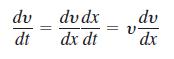
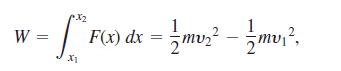
If a variable force of magnitude F(x) moves an object of mass m along the x-axis from x1 to x2, the object’s velocity y can be written as dx/dt (where t represents time). Use Newton’s second law of motion F = m(dy/dt) and the Chain Ruleto show that the net work done by the force in moving the
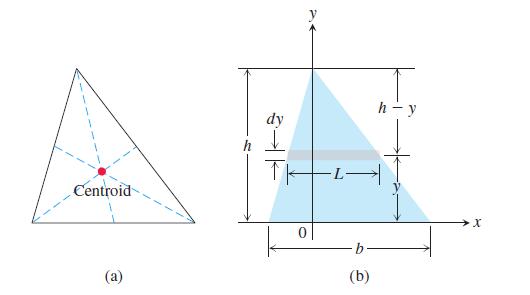
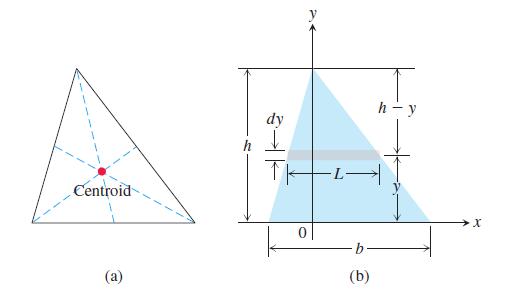
Use the result in Exercise 19 to find the centroids of the triangles whose vertices appear. Assume a, b > 0.(0, 0), (a, 0), (0, b)Exercise 19You may recall that the point inside a triangle that lies one-third of the way from each side toward the opposite vertex is the point where the
Do the following.a. Set up an integral for the length of the curve.b. Graph the curve to see what it looks like.c. Use your grapher’s or computer’s integral evaluator to find the curve’s length numerically. X -fv₂ = /sec²t - 1 dt, -π/3 ≤ y ≤ π/4
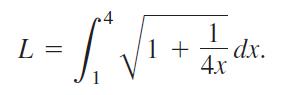
a. Find a curve with a positive derivative through the point (1, 1) whose length integral (Equation 3) isb. How many such curves are there? Give reasons for your answer. 4 1 • S₁ √ ₁ + + + + dx. 1 4x 1 L= =
Use the result in Exercise 19 to find the centroids of the triangles whose vertices appear. Assume a, b > 0.(0, 0), (a, 0), (a / 2, b)Data from in Exercise 19You may recall that the point inside a triangle that lies one-third of the way from each side toward the opposite vertex is the point
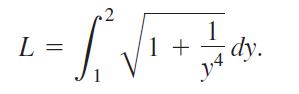
a. Find a curve with a positive derivative through the point (0, 1) whose length integral (Equation 4) isb. How many such curves are there? Give reasons for your answer. 2 1². L = 1 vidy. 1 +
Find the volumes of the solids generated by revolving the regions bounded by the lines and curves about the x-axis. y = = sec x, y = 0, x=-π/4, x = π₁ π/4 X
Use the shell method to find the volumes of the solids generated by revolving the regions bounded by the curves and line about the x-axis.y = √x, y = 0, y = 2 - x
Find the areas of the surfaces generated by revolving the curves about the indicated axes. If you have a grapher, you may want to graph these curves to see what they look like.x = (y4/4) + 1>(8y2), 1 ≤ y ≤ 2; x-axis
Show that the surface area of a sphere of radius a is still 4πa2 by using Equation (3) to find the area of the surface generated by revolving the curve y = √a2 - x2, -a ≤ x ≤ a, about the x-axis. dy S = = ["^2y √ 1 + (2) dx = [² dx 2π f(x) V1 + (f'(x))² dx. (3)
Use the shell method to find the volumes of the solids generated by revolving the regions bounded by the given curves about the given lines.y = 3x, y = 0, x = 2a. The y-axis b. The line x = 4c. The line x = -1 d. The x-axise. The line y = 7 f. The line y = -2
Write an integral for the area of the surface generated by revolving the curve y = cos x, -π/2 ≤ x ≤ π/2, about the x-axis. we will see how to evaluate such integrals.
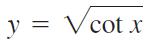
Find the volumes of the solids generated by revolving the regions bounded by the lines and curves about the x-axis.The region between the curveand the x-axis from x = π/6 to x = π/2 y = Vcotx
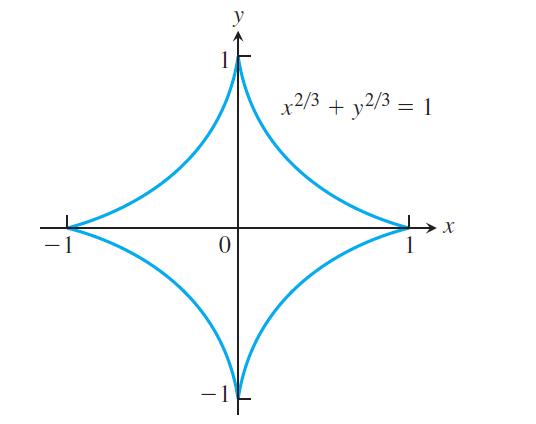
The graph of the equation x2/3 + y2/3 = 1 is one of a family of curves called astroids (not “asteroids”) because of their starlike appearance. Find the length of this particular astroid by finding the length of half the first-quadrant portion, y = (1 - x2/3)3/2, √2/4 ≤ x ≤ 1, and
A 2-oz tennis ball was served at 160 ft/sec (about 109 mph). How much work was done on the ball to make it go this fast? (To find the ball’s mass from its weight, express the weight in pounds and divide by 32 ft/sec2, the acceleration of gravity.)
Use the shell method to find the volumes of the solids generated by revolving the regions bounded by the given curves about the given lines.y = x3, y = 8, x = 0a. The y-axis b. The line x = 3c. The line x = -2 d. The x-axise. The line y = 8 f. The line y = -1
Find the moment about the x-axis of a wire of constant density that lies along the curve y = √x from x = 0 to x = 2.
Find the volumes of the solids generated by revolving the regions bounded by the lines and curves about the x-axis.y = e-x, y = 0, x = 0, x = 1
How many foot-pounds of work does it take to throw a baseball 90 mph? A baseball weighs 5 oz, or 0.3125 lb.
A rock climber is about to haul up 100 N (about 22.5 lb) of equipment that has been hanging beneath her on 40 m of rope that weighs 0.8 newton per meter. How much work will it take?
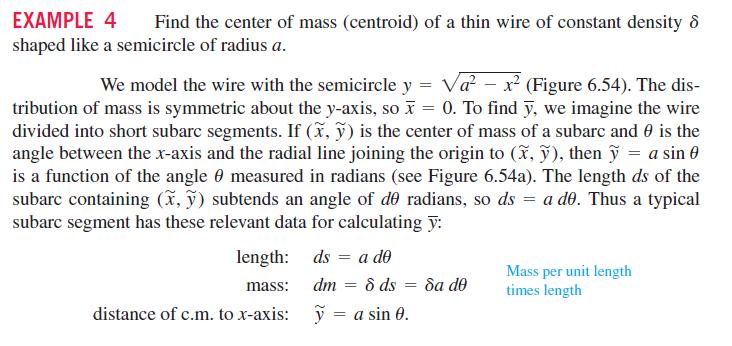
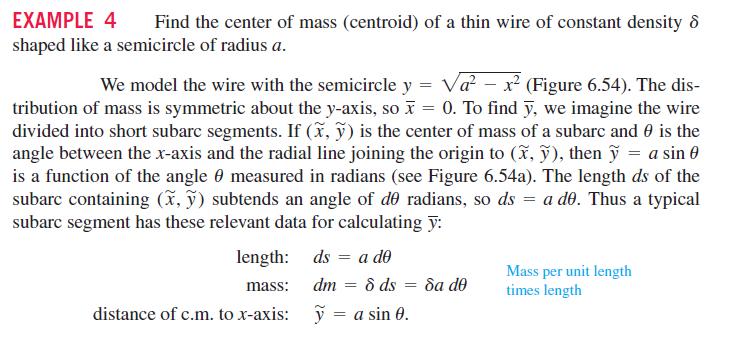
Suppose that the density of the wire in Example 4 is δ = k sin θ (k constant). Find the center of mass. EXAMPLE 4 Find the center of mass (centroid) of a thin wire of constant density 8 shaped like a semicircle of radius a. We model the wire with the semicircle y = Va²-x² (Figure 6.54). The
Use the shell method to find the volumes of the solids generated by revolving the regions bounded by the given curves about the given lines.y = x + 2, y = x2a. The line x = 2 b. The line x = -1c. The x-axis d. The line y = 4
Find the moment about the x-axis of a wire of constant density that lies along the curve y = x3 from x = 0 to x = 1.
The lateral (side) surface area of a cone of height h and base radius r should be πr√r2 + h2, the semiperimeter of the base times the slant height. Show that this is still the case by finding the area of the surface generated by revolving the line segment y = (r/h) x, 0 ≤ x ≤ h, about the
A 1.6-oz golf ball is driven off the tee at a speed of 280 ft/sec (about 191 mph). How many foot-pounds of work are done on the ball getting it into the air?
You drove an 800-gal tank truck of water from the base of Mt. Washington to the summit and discovered on arrival that the tank was only half full. You started with a full tank, climbed at a steady rate, and accomplished the 4750-ft elevation change in 50 min. Assuming that the water leaked out at a
Use the shell method to find the volumes of the solids generated by revolving the regions bounded by the given curves about the given lines.y = x4, y = 4 - 3x2a. The line x = 1 b. The x-axis
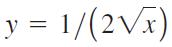
Find the volumes of the solids generated by revolving the regions bounded by the lines and curves about the x-axis.The region between the curveand the x-axis from x = 1/4 to x = 4 y = 1/(2√x)
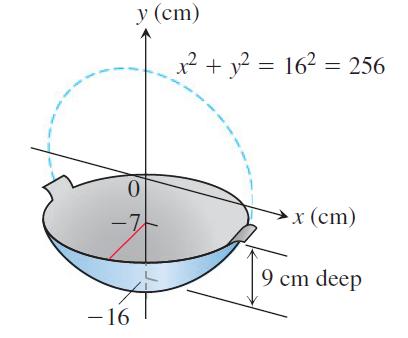
Your company decided to put out a deluxe version of a wok you designed. The plan is to coat it inside with white enamel and outside with blue enamel. Each enamel will be sprayed on 0.5 mm thick before baking. Your manufacturing department wants to know how much enamel to have on hand for a
Use the arc length formula (Equation 3) to find the length of the line segment y = 3 - 2x, 0 ≤ x ≤ 2. Check your answer by finding the length of the segment as the hypotenuse of a right triangle. -S VI + [f'(x)]² dx L= dy = - · 1² √ ₁ + ( 2 ) ² a 1 dx. dx a (3)
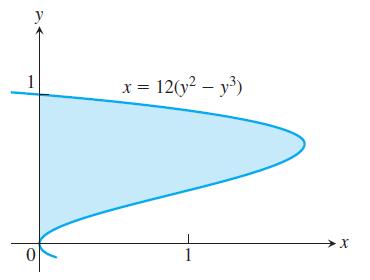
Use the shell method to find the volumes of the solids generated by revolving the shaded regions about the indicated axes.a. The x-axis b. The line y = 1c. The line y = 8/5 d. The line y = -2/5 1 0 X = 12(y² - y²) 1 > X
Suppose that the density of the wire in Example 4 is δ = 1 + k |cos θ| (k constant). Find the center of mass. EXAMPLE 4 Find the center of mass (centroid) of a thin wire of constant density 8 shaped like a semicircle of radius a. We model the wire with the semicircle y = Va²-x² (Figure 6.54).
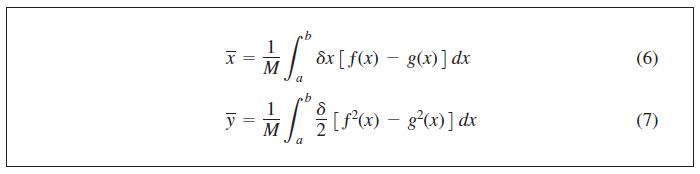
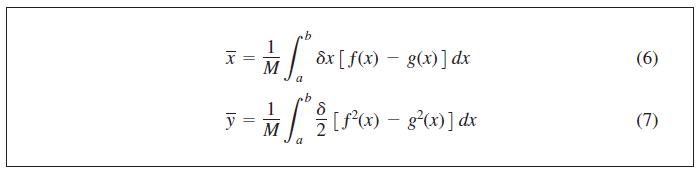
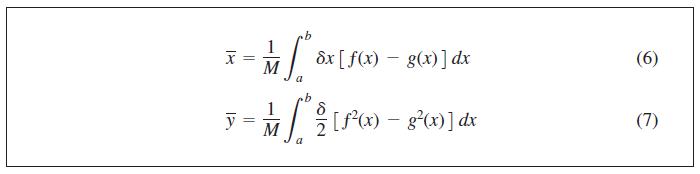
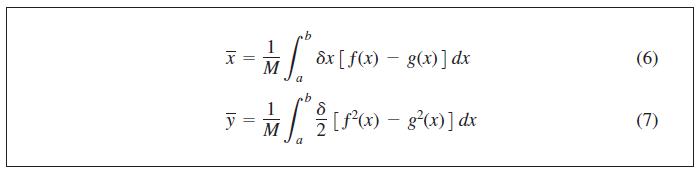
Find the centroid of the thin plate bounded by the graphs of the given functions. Use Equations (6) and (7) with δ = 1 and M = area of the region covered by the plate.g(x) = x2 and ƒ(x) = x + 6 3 - 1 1/² 2x [ X M y - dx [f(x) = g(x)] dx if * / [F²(x) - g² (x)] dx M (6) (7)
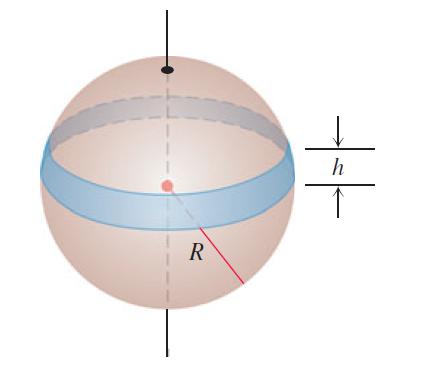
The shaded band shown here is cut from a sphere of radius R by parallel planes h units apart. Show that the surface area of the band is 2πRh. R ㅏ ↓ h
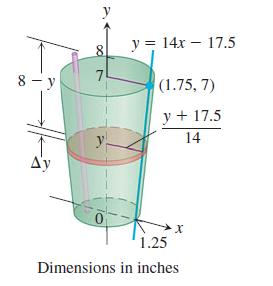
The truncated conical container shown here is full of strawberry milkshake that weighs 4/9 oz/in3. As you can see, the container is 7 in. deep, 2.5 in. across at the base, and 3.5 in. across at the top (a standard size at Brigham’s in Boston). The straw sticks up an inch above the top. About how
On June 11, 2004, in a tennis match between Andy Roddick and Paradorn Srichaphan at the Stella Artois tournament in London, England, Roddick hit a serve measured at 153 mi/h. How much work was required by Andy to serve a 2-oz tennis ball at that speed?
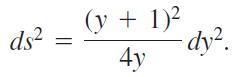
If 9x2 = y(y - 3)2, show that ds² = (y + 1)² 4y dy².
Find the centroid of the thin plate bounded by the graphs of the given functions. Use Equations (6) and (7) with δ = 1 and M = area of the region covered by the plate.g(x) = x2 (x + 1), ƒ(x) = 2, and x = 0 3 - 1 1/² 2x [ X M y - dx [f(x) = g(x)] dx if * / [F²(x) - g² (x)] dx M (6) (7)
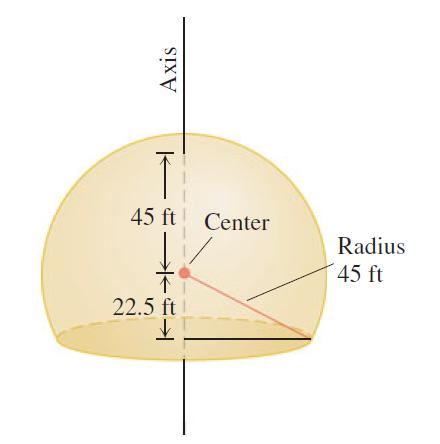
Here is a schematic drawing of the 90-ft dome used by the U.S. National Weather Service to house radar in Bozeman, Montana.a. How much outside surface is there to paint (not counting the bottom)?b. Express the answer to the nearest square foot. Axis K 45 ft Center ↑ 22.5 ft ↓ 4 Radius 45 ft
The force of attraction on an object below Earth’s surface is directly proportional to its distance from Earth’s center. Find the work done in moving a weight of w lb located a mi below Earth’s surface up to the surface itself. Assume Earth’s radius is a constant r mi.
For some regions, both the washer and shell methods work well for the solid generated by revolving the region about the coordinate axes, but this is not always the case. When a region is revolved about the y-axis, for example, and washers are used, we must integrate with respect to y. It may not be
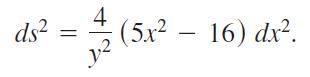
If 4x2 - y2 = 64, show that ds² = (5x² - 16) dx².
Find the volumes of the solids generated by revolving the regions bounded by the lines and curves about the x-axis.y = ex-1, y = 0, x = 1, x = 3
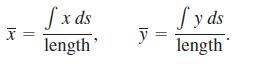
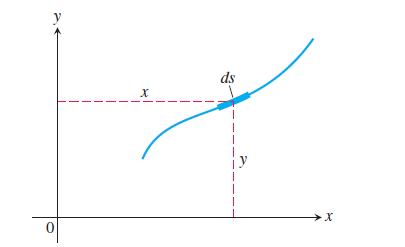
Verify the statements and formula.The coordinates of the centroid of a differentiable plane curve are * fx ds length' y fyds length
Find the centroid of the thin plate bounded by the graphs of the given functions. Use Equations (6) and (7) with δ = 1 and M = area of the region covered by the plate.g(x) = x2(x - 1) and ƒ(x) = x2 3 - 1 1/² 2x [ X M y - dx [f(x) = g(x)] dx if * / [F²(x) - g² (x)] dx M (6) (7)
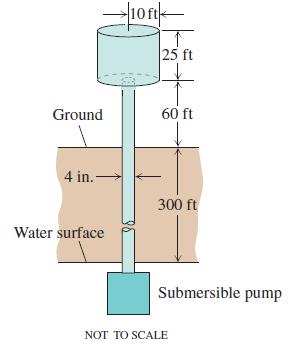
Your town has decided to drill a well to increase its water supply. As the town engineer, you have determined that a water tower will be necessary to provide the pressure needed for distribution, and you have designed the system shown here. The water is to be pumped from a 300-ft well through a
Find the centroid of the thin plate bounded by the graphs of the given functions. Use Equations (6) and (7) with δ = 1 and M = area of the region covered by the plate.g(x) = 0, ƒ(x) = 2 + sin x, x = 0, and x = 2π 3 - 1 1/² 2x [ X M y - dx [f(x) = g(x)] dx if * / [F²(x) - g² (x)] dx M (6) (7)
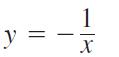
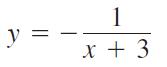
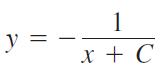
Show that each function y = ƒ(x) is a solution of the accompanying differential equation.y′ = y2a.b.c. y X
A reservoir shaped like a right-circular cone, point down, 20 ft across the top and 8 ft deep, is full of water. How much work does it take to pump the water to a level 6 ft above the top?
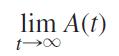
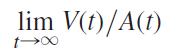
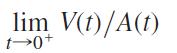
Let A(t) be the area of the region in the first quadrant enclosed by the coordinate axes, the curve y = e-x, and the vertical line x = t, t > 0. Let V(t) be the volume of the solid generated by revolving the region about the x-axis. Find the following limits.a.b.c. lim A(t) ∞
For some regions, both the washer and shell methods work well for the solid generated by revolving the region about the coordinate axes, but this is not always the case. When a region is revolved about the y-axis, for example, and washers are used, we must integrate with respect to y. It may not be
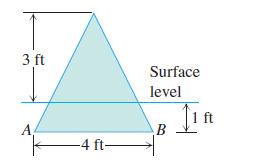
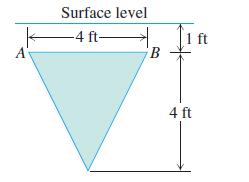
The plate in Exercise 37 is revolved 180° about line AB so that part of the plate sticks out of the lake, as shown here. What force does the water exert on one face of the plate now?Data from in Exercise 37The isosceles triangular plate shown here is submerged vertically 1 ft below the surface of
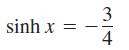
Gives a value of sinh x or cosh x. Use the definitions and the identity cosh2 x - sinh2 x = 1 to find the values of the remaining five hyperbolic functions. sinh x 3 4
Is there a smooth (continuously differentiable) curve y = ƒ(x) whose length over the interval 0 ≤ x ≤ a is always √2a? Give reasons for your answer.
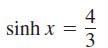
Gives a value of sinh x or cosh x. Use the definitions and the identity cosh2 x - sinh2 x = 1 to find the values of the remaining five hyperbolic functions. sinh x 4 3
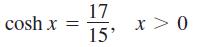
Gives a value of sinh x or cosh x. Use the definitions and the identity cosh2 x - sinh2 x = 1 to find the values of the remaining five hyperbolic functions. cosh x = 17 15' x > 0
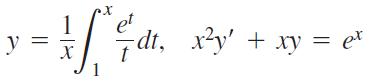
Show that each function y = ƒ(x) is a solution of the accompanying differential equation. et x = x fg ds. y X 7dt, x²y² + xy = et
Find the volumes of the solids generated by revolving the regions about the given axes. If you think it would be better to use washers in any given instance, feel free to do so.The region bounded by y = √x, y = 2, x = 0 abouta. The x-axis b. The y-axisc. The line x = 4 d. The line y = 2
The square region with vertices (0, 2), (2, 0), (4, 2), and (2, 4) is revolved about the x-axis to generate a solid. Find the volume and surface area of the solid.
In a pool filled with water to a depth of 10 ft, calculate the fluid force on one side of a 3 ft by 4 ft rectangular plate if the plate rests vertically at the bottom of the poola. On its 4-ft edge. b. On its 3-ft edge.
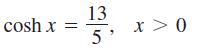
Gives a value of sinh x or cosh x. Use the definitions and the identity cosh2 x - sinh2 x = 1 to find the values of the remaining five hyperbolic functions. cosh x 13 5' x x> 0
Find the arc length function for the graph of ƒ(x) = 2x3/2 using (0, 0) as the starting point. What is the length of the curve from (0, 0) to (1, 2)?
Find the centroid of a thin, flat plate covering the “triangular” region in the first quadrant bounded by the y-axis, the parabola y = x2/4, and the line y = 4.
As found in Exercise 39, the centroid of the semicircle y = √a2 - x2 lies at the point (0, 2a/π). Find the area of the surface swept out by revolving the semicircle about the line y = a.Data from in Exercise 39Use Pappus’s Theorem for surface area and the fact that the surface area of a sphere
Show that each function y = ƒ(x) is a solution of the accompanying differential equation. 1 Y-VITAS VI 1 + x² y = V1 + 1 dt, y' + 2x3 1 + x4 = 1
How is the natural logarithm function defined as an integral? What are its domain, range, and derivative? What arithmetic properties does it have? Comment on its graph.
Show that each function y = ƒ(x) is a solution of the accompanying differential equation.2y′ + 3y = e-xa. y = e-x b. y = e-x + e-(3/2)xc. y = e-x + Ce-(3/2)x
a. Find lim loga 2 as a → 0+, 1-, 1+, and ∞.b. Graph y = loga 2 as a function of a over the interval 0 < a ≤ 4.
Showing 10900 - 11000
of 29454
First
103
104
105
106
107
108
109
110
111
112
113
114
115
116
117
Last
Step by Step Answers

 Get 50% OFF
Claim Now
Get 50% OFF
Claim Now