New Semester
Started
Get
50% OFF
Study Help!
--h --m --s
Claim Now
Question Answers
Textbooks
Find textbooks, questions and answers
Oops, something went wrong!
Change your search query and then try again
S
Books
FREE
Study Help
Expert Questions
Accounting
General Management
Mathematics
Finance
Organizational Behaviour
Law
Physics
Operating System
Management Leadership
Sociology
Programming
Marketing
Database
Computer Network
Economics
Textbooks Solutions
Accounting
Managerial Accounting
Management Leadership
Cost Accounting
Statistics
Business Law
Corporate Finance
Finance
Economics
Auditing
Tutors
Online Tutors
Find a Tutor
Hire a Tutor
Become a Tutor
AI Tutor
AI Study Planner
NEW
Sell Books
Search
Search
Sign In
Register
study help
physics
college physics a strategic approach 2nd
College Physics Essentials Electricity And Magnetism Optics Modern Physics Volume Two 8th Edition Jerry D. Wilson, Anthony J. Buffa, Bo Lou - Solutions
50. • What is the rms speed of the molecules in an oxygen sample at 0 °C?
49. IE • If the Celsius temperature of a monatomic gas is doubled, (a) will the thermal energy of the gas(1) double, (2) increase by less than a factor of 2, (3) be half as much, or (4) decrease by less than a factor of 2?Why? (b) If the temperature is raised from 20 °C to 40 °C, what is the
48. • What is the average kinetic energy per molecule in a monatomic gas sample at (a) 10 °C and (b) 90 °C?
47. • If the average kinetic energy per molecule of a monatomic gas sample is 7.0 × 10⁻²¹ J, what is the Celsius temperature of the gas?
46. ••• An aluminum rod is measured with a steel tape at 20 °C, and the length of the rod is found to be 75 cm. What length will the tape indicate when both the rod and the tape are at (a) −10 °C?(b) 50 °C? [Hint: Both the rod and tape will either expand or shrink as temperature changes.
45. ••• A brass rod has a circular cross-section of radius 5.00 cm. The rod fits into a circular hole in a copper sheet with a clearance of 0.010 mm completely around it when both the rod and the sheet are at 20 °C. (a) At what temperature will the clearance be zero? (b) Would such a tight
44. •• A copper block has an internal spherical cavity with a 10-cm diameter (▼ Figure 10.14). The block is heated in an oven from 20 °C to 500 K. (a) Does the cavity get larger or smaller? (b) What is the change in the cavity’s volume?
43. •• One morning, an employee at a rental car company fills a car’s steel gas tank to the top and then parks the car a short distance away. (a) That afternoon, when the temperature increases, will any gas overflow? Why? (b) If the temperatures in the morning and afternoon are, respectively,
42. IE •• A circular piece is cut from an aluminum sheet at room temperature. (a) When the sheet is then placed in an oven, will the hole (1) get larger,(2) get smaller, or (3) remain the same? Why? (b) If the diameter of the hole is 8.00 cm at 20 °C and the temperature of the oven is 150 °C,
41. •• A pie plate is filled up to the brim with pumpkin pie filling. The pie plate is made of Pyrex and its expansion can be neglected. It is a cylinder with an inside depth of 2.10 cm and an inside diameter of 30.0 cm. The pie is prepared at a room temperature of 68 °F and placed in an oven
40. •• A piece of copper tubing used in plumbing has a length of 60.0 cm and an inner diameter of 1.50 cm at 20 °C. When hot water at 85 °C flows through the tube, what are (a) the tube’s new length and (b) the change in its cross-sectional area?
39. •• What temperature change would cause a 0.20%increase in the volume of a quantity of water that was initially at 20 °C?
38. •• A circular steel plate of radius exactly 15.0 cm is cooled from 350 °C to 20 °C. By what percentage does the plate’s area decrease?
37. • A man’s gold wedding ring has an inner diameter of 2.4 cm at 20 °C. If the ring is dropped into boiling water, what will be the change in the inner diameter of the ring?
36. • Concrete highway slabs are poured in lengths of 5.0 m. How wide should the expansion gaps between the slabs be at a temperature of 20 °C to ensure that there will be no contact between adjacent slabs over a temperature range of −25 °C to 45 °C?
35. IE • An aluminum tape measure is accurate at 20 °C.(a) If the tape measure is placed in a freezer, would it read (1) high, (2) low, or (3) the same? Why? (b) If the temperature of the freezer is −5.0 °C, what would be the stick’s percentage error because of thermal contraction?
34. • A steel beam 10 m long is installed in a structure at 20 °C. What is the beam’s change in length when the temperature reaches (a) −25 °C and (b) 45 °C?
33. ••• Show that for Kelvin temperatures in the millions,(a) the Kelvin and Celsius temperatures are about the same and (b) both Kelvin and Celsius temperatures are about half the Fahrenheit temperature. (c) For a typical stellar interior temperature of 10 million K, what is the percentage
32. ••• A diver releases an air bubble of volume 2.0 cm3 from a depth of 15 m below the surface of a lake, where the temperature is 7.0 °C. What is the volume of the bubble when it reaches just below the surface of the lake, where the temperature is 20 °C?
31. IE •• The pressure on a low-density gas in a balloon is kept constant as its temperature is increased. (a) Does the volume of the gas (1) increase, (2) decrease, or(3) remain the same? Why? (b) If the temperature is increased from 10 °C to 40 °C, what is the percentage change in the
30. •• If 2.4 m3 of a gas initially at STP is compressed to 1.6 m3 and its temperature is raised to 30 °C, what is its final pressure?
29. IE •• (a) If the temperature of an ideal gas increases and its volume decreases, will the pressure of the gas(1) increase, (2) remain the same, or (3) decrease? Why?(b) The Kelvin temperature of an ideal gas is doubled and its volume is halved. How is the pressure affected?
28. •• A scuba diver takes a tank of air on a deep dive. The tank’s volume is 10 L and it is completely filled with air at an absolute pressure of 232 atm at the start of the dive. The air temperature at the surface is 94 °F and the diver ends up in deep water at 60 °F. Assuming thermal
27. •• A steel-belted radial automobile tire is inflated to a gauge pressure of 30.0 lb/in2 when the temperature is 61 °F. Later in the day, the temperature rises to 100 °F. Assuming the volume of the tire is constant, what is the tire’s pressure at the elevated temperature?
26. •• On a warm day (92 °F), an air-filled balloon occupies a volume of 0.200 m3 and has an absolute pressure of 20.0 lb/in2. If the balloon is cooled to 32 °F in a refrigerator while its pressure is reduced to 14.7 lb/in2, what is the volume of the air in the container?
25. •• An automobile tire is filled to an absolute pressure of 3.0 atm at a temperature of 30 °C. Later it is driven to a place where the temperature is only −20 °C. What is the absolute pressure of the tire at the cold place?(Assume that the air in the tire behaves as an ideal gas at
24. •• A husband buys a helium-filled anniversary balloon for his wife. The balloon has a volume of 3.5 L in the warm store at 74 °F. When he takes it outside, where the temperature is 48 °F, he finds it has shrunk. By how much has the volume decreased?
23. •• Is there a temperature that has the same numerical value on the Kelvin and the Fahrenheit scales? Justify your answer.
22. •• An athlete has a large lung capacity, 7.0 L. Assuming air to be an ideal gas, how many molecules of air are in the athlete’s lungs when the air temperature in the lungs is 37 °C under normal atmospheric pressure?
21. •• What volume is occupied by 160 g of oxygen under a pressure of 2.00 atm and a temperature of 300 K?
20. •• Show that 1.00 mol of ideal gas under STP occupies a volume of 0.0224 m3 = 22.4 L.
19. • If the pressure of an ideal gas is doubled while its absolute temperature is halved, what is the ratio of the final volume to the initial volume?
18. IE • (a) In a constant volume gas thermometer, if the pressure of the gas decreases, has the temperature of the gas (1) increased, (2) decreased, or (3) remained the same? Why? (b) The initial absolute pressure of a gas is 1000 Pa at room temperature (20 °C). If the pressure increases to
17. • How many moles are in (a) 40 g of water, (b) 245 g of CO2 (carbon dioxide), (c) 138 g of N2 (nitrogen), and(d) 56 g of O2 (oxygen) at STP*?
16. • When lightning strikes, it can heat the air around it to more than 30 000 K, five times the surface temperature of the Sun. (a) What is this temperature on the Fahrenheit and Celsius scales? (b) The temperature is sometimes reported to be 30 000 °C. Assuming that 30 000 K is correct, what
15. • (a) Derive an equation for converting Fahrenheit temperatures directly to absolute temperatures in kelvins. (b) Which is the lower temperature, 300 °F or 300 K?
14. • Convert the following temperatures to Celsius:(a) 0 K, (b) 250 K, (c) 273 K, and (d) 325 K.
13. • Convert the following temperatures to absolute temperatures in kelvins: (a) 0 °C, (b) 100 °C, (c) 20 °C, and(d) −35 °C.
12. •• (a) The largest temperature drop recorded in the United States in one day occurred in Browning, Montana, in 1916, when the temperature went from 7 °C to −49 °C. What is the corresponding change on the Fahrenheit scale? (b) On the Moon, the average surface temperature is 127 °C
11. IE •• There is one temperature at which the Celsius and Fahrenheit scales have the same reading. (a) To find that temperature, would you set (1) 5TF = 9TC,(2) 9TF = 5TC, or (3) TF = TC? Why? (b) Find the temperature.
10. IE •• The temperature drops from 60 °F during the day to 35 °F during the night. (a) The corresponding temperature drop on the Celsius scale is (1) greater than,(2) the same as, or (3) less than. Explain. (b) Compute the temperature drop on the Celsius scale.
9. •• In the troposphere (the lowest part of the atmosphere), the temperature decreases rather uniformly with altitude at a so-called “lapse” rate of about 6.5 °C/km. What are the temperatures (a) near the top of the troposphere (which has an average thickness of 11 km) and (b) outside a
8. •• During open-heart surgery it is common to cool the patient’s body down to slow body processes and gain an extra margin of safety. A drop of 8.5 °C is typical in these types of operations. If a patient’s normal body temperature is 98.2 °F, what is her final temperature in both
7. • The highest and lowest recorded air temperatures in the United States are, respectively, 134 °F (Death Valley, California, 1913) and –80 °F (Prospect Creek, Alaska, 1971). What are these temperatures on the Celsius scale?
6. • The highest and lowest offically recorded air temperatures in the world are, respectively, 58 °C (Libya, 1922) and −89 °C (Antarctica, 1983). What are these temperatures on the Fahrenheit scale?
5. • The coldest inhabited village in the world is Oymyakon, a town located in eastern Siberia, where it gets as cold as −94 °F. What is this temperature on the Celsius scale?
4. • Which is the lower temperature: (a) 245 °C or 245 °F?(b) 200 °C or 375 °F?
3. • Convert the following to Fahrenheit readings:(a) 120 °C, (b) 12 °C, and (c) −5 °C.
2. • Convert the following to Celsius readings: (a) 80 °F,(b) 0 °F, and (c) −10 °F.
1. • A person running a fever has a body temperature of 40 °C. What is this temperature on the Fahrenheit scale?
21. A monatomic and diatomic gas sample both have n moles at temperature T. What is the difference in their thermal energies? Express your answer in terms of n, R, and T.
20. Explain clearly why a diatomic gas has more thermal energy than the same quantity of a monatomic gas at the same temperature.
19. If a monatomic gas and a diatomic gas sample are both at room temperature, will they have the same average total kinetic energy per molecule? Explain.
18. Two separate samples of helium (He) and neon (Ne)are at the same temperature. The helium sample has twice the thermal energy as the neon sample. Explain how this can be.
17. Equal quantities of helium (He) and neon (Ne) are at the same temperature. Which has more thermal energy? Which has a higher average molecular speed?Explain.
16. Gas sample A has twice as much average translational kinetic energy per molecule as gas sample B. What can be said about the absolute temperatures of the gas samples?
15. We often use hot water to loosen tightly sealed metal lids on glass jars. Explain how this works.
14. A circular ring of iron has a tight-fitting iron bar across its diameter, as illustrated in ▼ Figure 10.13. If the arrangement is heated in an oven to a high temperature, will the circular ring be distorted? What if the bar is made of aluminum?
13. A physics professor is demonstrating thermal expansion using a spherical ball and a ring, both of the same material. At room temperature, the ball fits through the ring. When the ball alone is heated it then does not fit through the ring. However, if both the ball and the ring are heated, the
12. A solid flat circular metal disk rotates freely about a fixed axis perpendicular through its center. If the disk is heated while it is rotating, will there be any effect on the rate of rotation (the angular speed)? Explain.
11. A cube of ice sits on a bimetallic strip at room temperature(▶ Figure 10.12). What will happen if (a) the upper strip is aluminum and the lower strip is brass, and (b) the upper strip is iron and the lower strip is copper? (c) If the cube is made of a hot metal rather than ice and the two
10. How many moles of helium contain the same number of atoms as a mole of carbon dioxide?
9. Which contains more atoms, 1 mole of helium or 1 mole of oxygen? Explain.
8. Which contains more molecules, 1 mole of oxygen or 1 mole of nitrogen? Explain.
7. Excited about a New Year’s Eve party in Times Square, you pump up ten balloons in your warm apartment and take them to the cold square. However, you are very disappointed with your decorations. Why?
6. In terms of the ideal gas law, what would a temperature of absolute zero imply? How about a negative absolute temperature?
5. Describe how a constant pressure gas thermometer might be constructed.
4. A type of constant volume gas thermometer is shown in ▼ Figure 10.11. Describe how it operates.
3. What forms of energy make up the thermal energy of monatomic gases? How about diatomic gases?
2. When temperature changes during the day, which scale, Celsius or Fahrenheit, will register a smaller numerical change? Explain.
1. Heat flows spontaneously from a body at a higher temperature to one at a lower temperature that is in thermal contact with it. Does heat always flow from a body with more thermal energy to one with less thermal energy? Explain.
15. On average, is the thermal energy of a gas divided equally among (a) each molecule, (b) each degree of freedom, (c) translational motion, rotational motion, and vibrational motion, or (d) none of the preceding?
14. A diatomic gas at room temperature has an thermal energy of (a) (3/2)nRT, (b) (5/2)nRT, (c) (7/2)nRT, or(d) none of the preceding.
13. Which of the following is a diatomic molecule: (a) He,(b) N2, (c) CO2, or (d) Ne?
12. Two different gas samples are at the same temperature.The sample with the more massive molecules will have(a) a higher, (b) a lower, or (c) the same rms speed as that of the sample with less massive molecules.
11. If the temperature of a given amount of ideal gas is raised from 300 to 600 K, is the thermal energy of the gas (a) doubled, (b) halved, (c) unchanged, or (d) none of the preceding?
10. If the average translational kinetic energy of the molecules in an ideal monatomic gas, initially at 20 °C, doubles, what is the final temperature of the gas:(a) 10 °C, (b) 40 °C, (c) 313 °C, or (d) 586 °C?
9. Which of the following describes the behavior of water density from 0 °C to 4 °C: (a) it increases with increasing temperature, (b) it remains constant, (c) it decreases with increasing temperature, or (d) none of these?
8. The units of the thermal coefficient of linear expansion are: (a) m/°C, (b) m2/°C, (c) m·°C, or (d) 1/°C.
7. What is the predominant cause of thermal expansion:(a) atom sizes change, (b) atom shapes change, or (c) the average distances between atoms change?
6. When the temperature of a quantity of gas is increased,(a) the pressure must increase, (b) the volume must increase, (c) both the pressure and volume must increase, (d) none of the these is necessarily true.
5. If an ideal gas at constant volume were to reach absolute zero, (a) its pressure would reach zero, (b) its pressure would reach infinity, (c) its mass would disappear, or (d) its mass would be infinite.
4. The temperature in the ideal gas law must be expressed on which scale: (a) Celsius, (b) Fahrenheit, (c) Kelvin, or (d) any of the preceding?
3. An object at a higher temperature (a) must, (b) may, or(c) must not have more internal energy than another object at a lower temperature.
2. What types of energies can possibly contribute to the energy of a diatomic gas sample: (a) rotational kinetic energy, (b) translational kinetic energy, (c) vibrational kinetic energy, or (d) all of the preceding?
1. Temperature differences between objects are associated with (a) energy exchanges, (b) heat, (c) molecular energy differences, or (d) all of these.
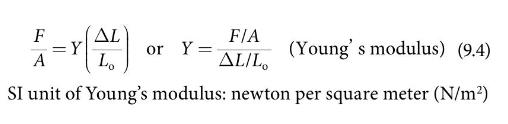
The femur (upper leg bone) is the longest and strongest bone in the body. Taking a typical femur to be approximately circular in cross-section with a radius of \(2.0 \mathrm{~cm}\), how much force would be required to extend a patient's femur by \(0.010 \%\) while in horizontal traction?THINKING IT
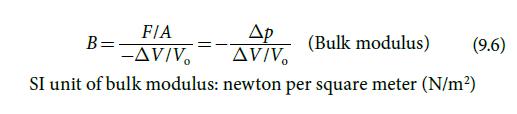
By how much should the pressure on a liter of water be changed to compress it by \(0.10 \%\)?THINKING IT THROUGH. Similarly to the fractional change in length, \(\Delta L / L_{o}\), the fractional change in volume is given by \(-\Delta V / V_{0}\), which may be expressed as a percentage. The
Suppose you are getting ready to take a nap, and you have a choice of lying stretched out on your back on (a) a bed of nails, (b) a hardwood floor, or (c) a couch. Which one would you choose for the most comfort, and why?
(a) What is the total pressure on the back of a scuba diver in a lake at a depth of \(8.00 \mathrm{~m}\) ? (b) What is the force on the diver's back due to the water alone? (Take the surface of the back to be a rectangle \(60.0 \mathrm{~cm}\) by \(50.0 \mathrm{~cm}\).THINKING IT THROUGH. (a) This
A garage lift has input and lift (output) pistons with diameters of 10 and \(30 \mathrm{~cm}\), respectively. The lift is used to hold up a car with a weight of \(1.4 \times 10^{4} \mathrm{~N}(3150 \mathrm{lb})\). (a) What is the magnitude of the force on the input piston? (b) What pressure is
Consider a hospital patient who receives an IV (intravenous) injection under gravity flow, as shown in Figure 9.12. If the blood gauge pressure in the vein is \(20.0 \mathrm{~mm} \mathrm{Hg}\), above what height should the bottle be placed for the IV blood transfusion to function properly?THINKING
A spherical helium-filled weather balloon has a radius of \(1.10 \mathrm{~m}\). (a) Does the buoyant force on the balloon depend on (1) the density of helium, (2) the density of air, or (3) the weight of the rubber "skin"? \(\left[ho_{\text {air }}=1.29 \mathrm{~kg} / \mathrm{m}^{3}\right.\) and
Air is a fluid and our bodies displace air. And so, a buoyant force is acting on each of us. Estimate the magnitude of the buoyant force on a \(75-\mathrm{kg}\) person due to the air displaced.THINKING IT THROUGH. The key word here is estimate because not much data is given. We know that the
A container of water with an overflow tube, similar to that shown in Figure 9.14b, sits on a scale that reads \(40 \mathrm{~N}\). The water level is just below the exit tube in the side of the container. (a) An \(8.0-\mathrm{N}\) cube of wood is placed in the container. The water displaced by the
A uniform solid cube of material \(10.0 \mathrm{~cm}\) on each side has a mass of \(700 \mathrm{~g}\).(a) Will the cube float in water?(b) If so, how much of its volume would be submerged?THINKING IT THROUGH.(a) The question is whether the density of the material the cube is made of is greater or
High cholesterol in the blood can cause fatty deposits called plaques to form on the walls of blood vessels. Suppose a plaque reduces the effective radius of an artery by \(25 \%\). How does this partial blockage affect the speed of blood through the artery?THINKING IT THROUGH. The flow rate
Blood flows at a rate of \(5.00 \mathrm{~L} / \mathrm{min}\) through an aorta with a radius of \(1.00 \mathrm{~cm}\). What is the speed of blood flow in the aorta?THINKING IT THROUGH. It is noted that the flow rate is a volume flow rate, which implies the use of the flow rate equation (Equation
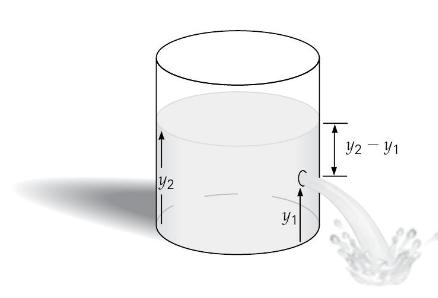
A cylindrical tank containing water has a small hole punched in its side below the water level, and water runs out (Figure 9.21). What is the approximate initial flow rate of water out of the tank in terms of the heights shown?THINKING IT THROUGH. Equation \(9.17\left(A_{1} v_{2}=A_{2}
The pressure on an elastic body is described by (a) a modulus, (b) work, (c) stress, (d) strain.
Showing 1800 - 1900
of 3511
First
12
13
14
15
16
17
18
19
20
21
22
23
24
25
26
Last
Step by Step Answers

 Get 50% OFF
Claim Now
Get 50% OFF
Claim Now