







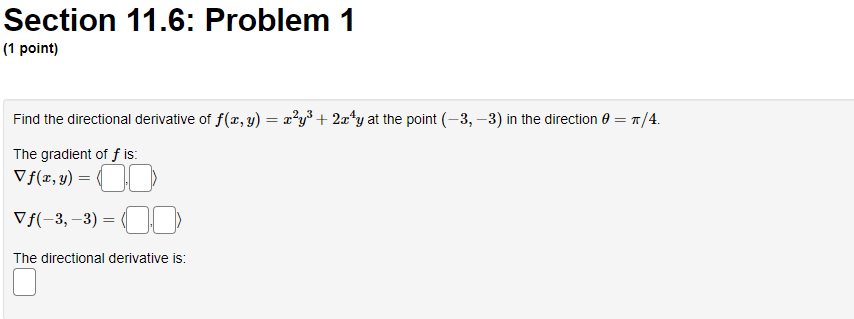
Question: calculus 3 : Section 11.6: Problem 1 [1 point} Find the directional derivative of x, 3:) = 12y3+ 2543,- at the point [3, 3} in
![= DE]: va, 3) = DE]: The directional derivative is: C] Section](https://s3.amazonaws.com/si.experts.images/answers/2024/06/667d07c8c1964_024667d07c8b1cee.jpg)
calculus 3 :

![11.6: Problem 3 [1 point] Find the directional derivative of x, 5:,](https://s3.amazonaws.com/si.experts.images/answers/2024/06/667d07cbbd8c9_027667d07cba7058.jpg)
![z) = :3 $23: at the point (4, 3, 2] in the](https://s3.amazonaws.com/si.experts.images/answers/2024/06/667d07cc0f500_027667d07cbf0650.jpg)
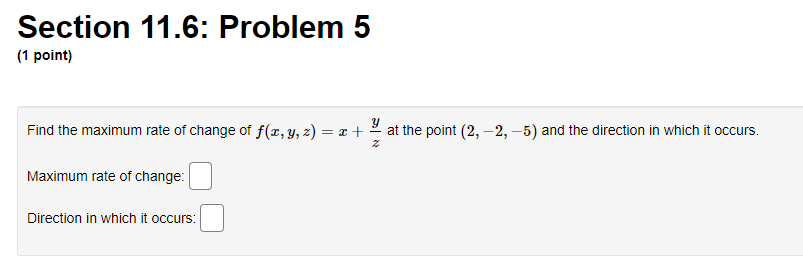
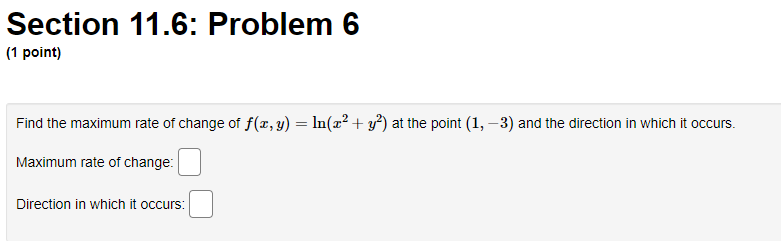
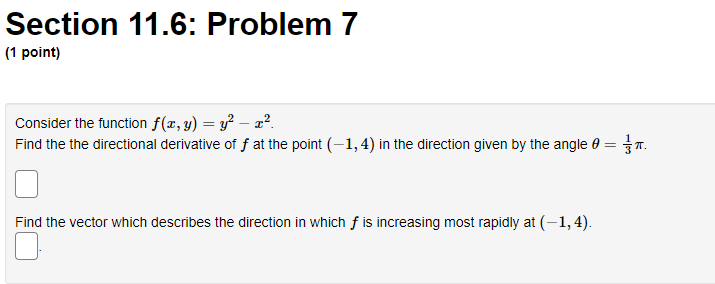
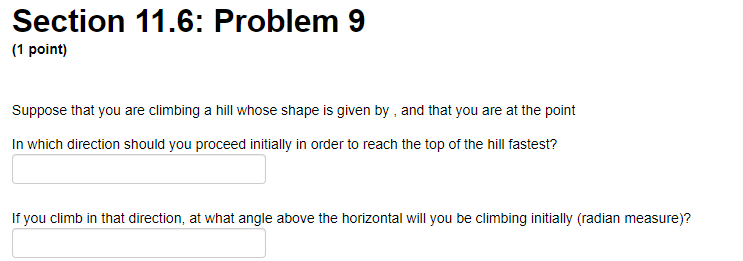
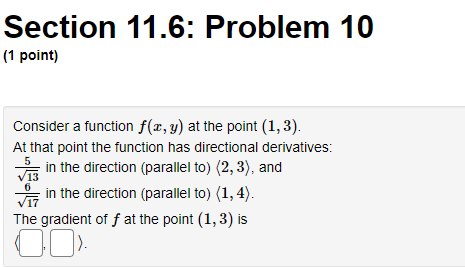
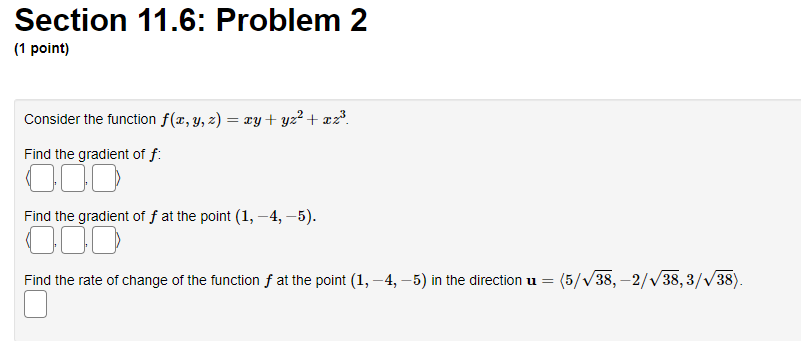
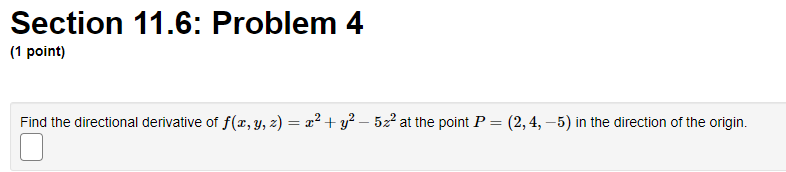
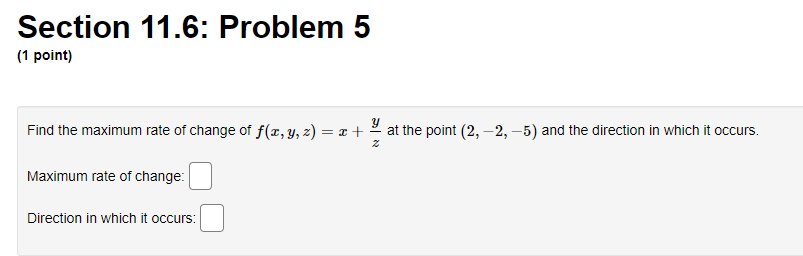
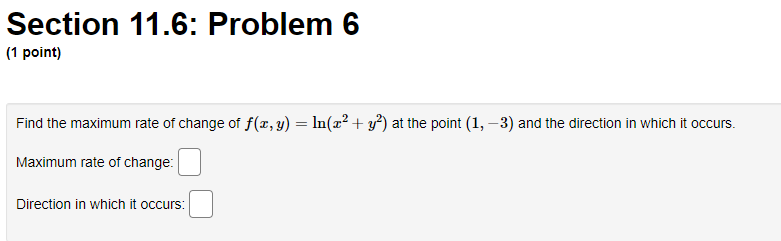
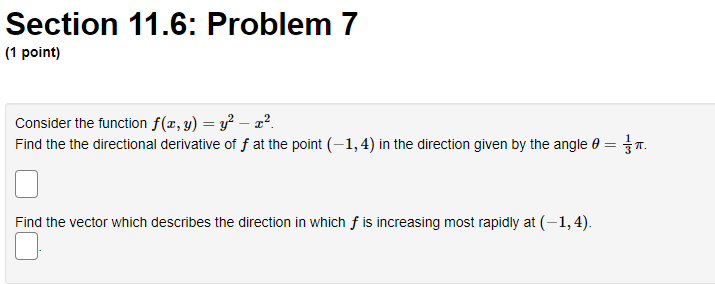
Section 11.6: Problem 1 [1 point} Find the directional derivative of x, 3:) = 12y3+ 2543,- at the point [3, 3} in the direction 3 = inf-1. The gradient off is: mm) = DE]: va, 3) = DE]: The directional derivative is: C] Section 11.6: Problem 10 (1 point) Consider a function f(x, y) at the point (1, 3). At that point the function has directional derivatives: 5 in the direction (parallel to) (2, 3), and 13 in the direction (parallel to) (1, 4). /17 The gradient of f at the point (1, 3) isSection 11.6: Problem 2 (1 point) Consider the function f(x, y, 2) = my + y2 + 12 Find the gradient of f: Find the gradient of f at the point (1, -4, -5). C Find the rate of change of the function f at the point (1, -4, -5) in the direction u = (5/v38, -2/v38, 3/V38).Section 11.6: Problem 3 [1 point] Find the directional derivative of x, 5:, z) = :3 $23: at the point (4, 3, 2] in the direction of the vector v = (1, 2, 1). C] Section 11.6: Problem 4 (1 point) Find the directional derivative of f(x, y, 2) = x + 2 - 52 at the point P = (2, 4, -5) in the direction of the origin.Section 11.6: Problem 5 [1 point]: Find the maximum rate of change of f{z,y, z] = z + E at the point {2, 2, 5) and the direction in which it occurs. 2".- Maximum rate of change: E] Direction in which it occurs: E] Section 11.6: Problem 6 (1 point) Find the maximum rate of change of f(x, y) = In(x + y") at the point (1, -3) and the direction in which it occurs. Maximum rate of change: Direction in which it occurs:Section 11.6: Problem 7 (1 point) Consider the function f(x, y) = y - x2. Find the the directional derivative of f at the point (-1, 4) in the direction given by the angle 0 = = Find the vector which describes the direction in which f is increasing most rapidly at (-1, 4).Section 11.6: Problem 8 [1 point]: Suppose f{z,y} = E ,P = (4,4) and v = 3i+ 2} y 1. Find the gradient of 1-". var, y) = D i+ Dr 2. Find the gradient of f at the point P. w = E] a: 3. Find the directional derivative of _f at P in the direction of v. Duf{P} = E] 4. Find the maximum rate of change of f at P. C] 5. Find the (unit) direction vector in which the maximum rate of change occurs at P. DHDJ Section 11.6: Problem 9 {1 point} Suppose that you are climbing a hill whose shape is given by , and that you are at the point In which direction should you proceed initially in orderto reach the top of the hill fastest? If you climb in that direction, at what angle above the horizontal will you be climbing initially [radian measure}
Step by Step Solution
There are 3 Steps involved in it

Get step-by-step solutions from verified subject matter experts
 Study Help