New Semester
Started
Get
50% OFF
Study Help!
--h --m --s
Claim Now
Question Answers
Textbooks
Find textbooks, questions and answers
Oops, something went wrong!
Change your search query and then try again
S
Books
FREE
Study Help
Expert Questions
Accounting
General Management
Mathematics
Finance
Organizational Behaviour
Law
Physics
Operating System
Management Leadership
Sociology
Programming
Marketing
Database
Computer Network
Economics
Textbooks Solutions
Accounting
Managerial Accounting
Management Leadership
Cost Accounting
Statistics
Business Law
Corporate Finance
Finance
Economics
Auditing
Tutors
Online Tutors
Find a Tutor
Hire a Tutor
Become a Tutor
AI Tutor
AI Study Planner
NEW
Sell Books
Search
Search
Sign In
Register
study help
sciences
chemistry for engineering students
Chemistry For Engineering Students 4th Edition Lawrence S. Brown, Tom Holme - Solutions
A fastball thrown by a professional baseball pitcher travels at about 100 mph. How does the kinetic energy of the baseball thrown at this speed compare to cosmic radiation at 15 MeV? (The mass of a baseball is about 145 g.)
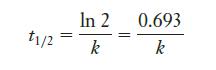
The half-life of carbon-14, used in radiocarbon dating, is 5730 years. What is the decay constant for carbon-14?StrategyThe half-life and the decay constant are alternative ways of characterizing the rate of decay, so knowing one allows us to find the other. The needed relationship is given in
A button case for a small battery must be silver plated. The button is a perfect cylinder with a radius of 3.0 mm and a height of 2.0 mm. For simplicity, assume that the silver solution used for plating is silver nitrate. (Industrial processes often use other solutions.) Assume that the silver
Copper(II) iodate has a solubility of 0.136 g per 100 g of water. Calculate its molar solubility in water and its Ksp.
In a particular experiment, the equilibrium constant measured for the reaction, Cl2(g) + NO2(g) ⇄ Cl2NO2(g), is 2.8.(a) Based on this measurement, calculate Go for this reaction.(b) Calculate ΔG° using data from Appendix E at the back of the book and discuss the agreement between your two
Use the web to find information on the composition of cosmic rays beyond hydrogen and helium.
Who would have greater exposure to cosmic rays: a commercial pilot or an engineer who helps build the runways the pilot uses? Explain your answer.
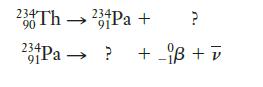
We have seen the nuclear equation for the beta decay involved in radiocarbon dating. Now complete the equations for each of the following 2 decay reactions, using 0 –1β to represent the beta particle:StrategyWe can use both the mass numbers and the charges given to determine the missing
Cosmic rays are sometimes referred to as corpuscular rays. How does this term distinguish them from other rays of the sun that reach the planet?
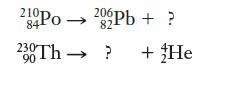
Complete the equations for each of the following nuclear decay processes:StrategyNuclear equations must be balanced with respect to both mass number and charge. As long as only one particle is missing from each equation, we can use these two criteria to determine its identity. 210 Po → 206Pb
Hydrofluoric acid is a weak acid used in the building industry to etch patterns into glass for elegant windows. Because it dissolves glass, it is the only inorganic acid that must be stored in plastic containers. A 0.1 M so- lution of HF has a pH of 2.1. Calculate [H3O+] in this solution.
The pH of a 0.129 M solution of a weak acid, HB, is 2.34. What is Ka for the weak acid?
Write the formula of the conjugate base of each of the following acids. (a) HNO3, (b) H2O, (c) HSO4 –, (d) H2CO3, (e) H3O+
For each of the following reactions, indicate the Brønsted– Lowry acids and bases. What are the conjugate acid–base pairs?(a) CN–(aq) + H2O(ℓ) ⇄ HCN(aq) + OH–(aq)(b) HCO3 –(aq) + H3O+(aq) ⇄ H2CO3(aq) + H2O(ℓ)(c) CH3COOH(aq) + HS–(aq) ⇄ CH3COO–(aq) + H2S(aq)
The following equilibrium is established in a closed container:How does the equilibrium shift in response to each of the following stresses?(a) The quantity of solid carbon is increased.(b) A small quantity of water is added, and CO2 dissolves in it.(c) The system is cooled.(d) The volume of the
Write the solubility product constant expression for calcium fluoride.Strategy Identify the formula for the salt and write the chemical equation that represents the solubility equilibrium. Write the solubility product constant expression based on the chemical equation.
How would a temperature increase affect each of the following equilibria?(a) AgNO3(s) ⇄ Ag+(aq) + NO3 –(aq), ΔH° = 22.6 kJ mol–1 (b) C(s) + O2(g) ⇄ 2 CO(g), ΔH° = −209 kJ mol–1
Write the Ksp expression for each of the following equilibria for dissolution of the salt in water.(a) AgI(s) ⇄ Ag+(aq) + I–(aq)(b) PbI2(s) ⇄ Pb2+(aq) + 2 I–(aq)(c) Hg2I2 ⇄ Hg2 2+(aq) + 2 I–(aq)(d) Cu(IO3)2 ⇄ Cu2+(aq) + 2 IO3 –(aq)
Write an equilibrium equation and a Ksp expression for the dissolution of each of the following in water. (a) AgBr, (b) Cu(OH)2, (c) BaSO4, (d) PbCrO4, (e) Mg3(PO4)2
Calculate the molar solubility of the following compounds.(a) MgF2, (b) Fe(OH)3,(c) Mg3(PO4)2
The Safe Drinking Water Act of 1974 established the maximum permitted concentration of silver ion at 0.05 ppm. What is the concentration of Ag+ in parts per million in a saturated solution of AgCl?
In Exercise 12.49, what is the allowed concentration of AgCl in g per 100 g of water?Data from exercise 12.49The Safe Drinking Water Act of 1974 established the maximum permitted concentration of silver ion at 0.05 ppm. What is the concentration of Ag+ in parts per million in a saturated solution
Calculate the solubility of ZnCO3 in (a) Water, (b) 0.050 M Zn(NO3)2, and (c) 0.050 M K2CO3. Ksp of ZnCO3 = 1.5 × 10⁻¹¹
Because barium sulfate is opaque to X-rays, it is suspended in water and taken internally to make the gastrointestinal tract visible in an X-ray photograph. Although barium ion is quite toxic, barium sulfate’s Ksp of 1.1 × 10⁻¹⁰ gives it such low solubility that it can be safely consumed.(a)
The ore cinnabar (HgS) is an important source of mercury. Cinnabar is a red solid whose solubility in water is 5.5 × 10⁻²⁷ mol L–1.(a) Calculate its Ksp.(b) What is its solubility in grams per 100 g of water?
Calculate the Ksp of the following compounds, given their molar solubilities. (a) AgCN, 7.73 × 10⁻⁹ M, (b) Ni(OH)2, 5.16 × 10⁻⁶ M, (c) Cu3(PO4)2, 1.67 × 10⁻⁸ M
From the solubility data given for the following compounds, calculate their solubility product constants.(a) CuBr, copper(I) bromide, 1.0 × 10⁻³ g/L (b) AgI, silver iodide, 2.8 × 10⁻⁸ g/10 mL(c) Pb3(PO4)2, lead(II) phosphate, 6.2 × 10⁻⁷ g/L(d) Ag2SO4, silver sulfate, 5.0 mg/mL
Solid Na2SO4 is added slowly to a solution that is 0.10 M in Pb(NO3)2 and 0.10 M in Ba(NO3)2. In what order will solid PbSO4 and BaSO4 form? Calculate the percentage of Ba2+ that precipitates just before PbSO4 begins to precipitate.
Use the web to look up boiler scale and explain chemically why it is a problem in equipment where water is heated (such as in boilers).
A student is studying a solution of the sparingly soluble salt Ag2SO4, for which the Ksp is 1.2 × 10⁻⁵. The solubility of Ag2SO4 is high enough that silver ions often encounter sulfate ions in solution. What would be the effect on the measurement of the solubility of Ag2SO4 if a large number of
Write the formula of the conjugate acid of each of the following bases. (a) OH–, (b) NH3, (c) CH3NH2, (d) HPO4 2–, (e) CO3 2–
Write chemical equations and equilibrium expressions for the reactions of each of the following weak acids with water. (a) Acetic acid, CH3COOH, (b) Propanoic acid, C2H5COOH,(c) Hydrofluoric acid, HF,(d) Hypochlorous acid, HClO,(e) Carbonic acid, H2CO3
Write chemical equations and equilibrium expressions for the reactions of each of the following weak bases with water. (a) Ammonia, NH3, (b) Methylamine, CH3NH2, (c) Acetate ion, CH3COO–, (d) Hydrogen carbonate ion, HCO3 –, (e) Aniline, C6H5NH2
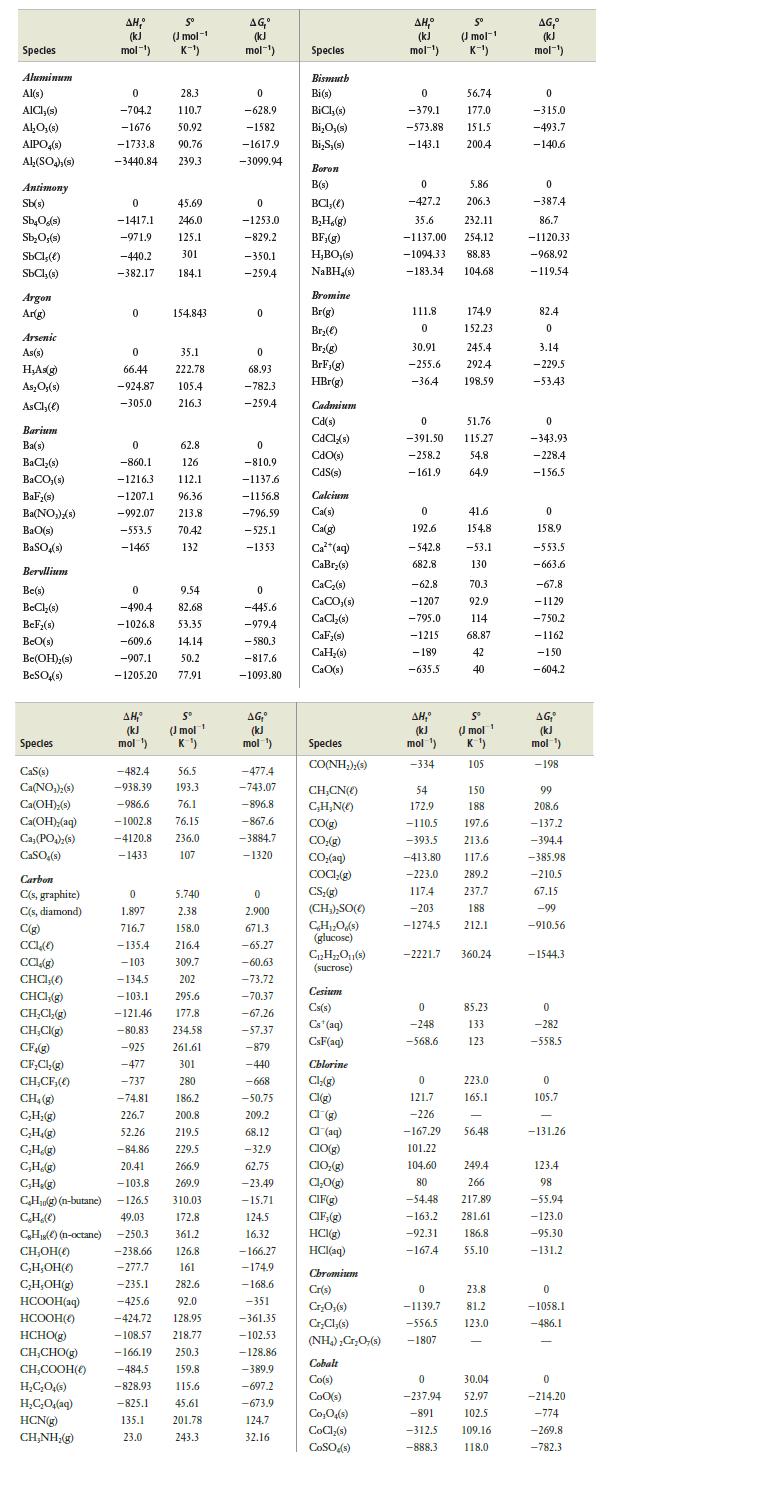
Use values from Appendix E at the back of the book to calculate the equilibrium constant, Kp, for the following gaseous reactions:(a) H2(g) + Cl2(g) ⇄ 2 HCl(g)(b) CH4(g) + H2O(g) ⇄ CO(g) + 3 H2(g)(c) SO2(g) + Cl2(g) ⇄ SO2Cl2(g)(d) 2 HCl(g) + F2(g) ⇄ 2 HF(g) + Cl2(g)Data from appendix E
Calculate the pH of a 0.10 M solution of propanoic acid and determine its percent ionization.
Find the pH of a 0.115 M solution of NH3(aq).
Acrylic acid is used in the polymer industry in the production of acrylates. Its Ka is 5.6 × 10⁻⁵. What is the pH of a 0.11 M solution of acrylic acid, CH2CHCOOH?
Morphine, an opiate derived from the opium poppy (genus Papaver), has the molecular formula C7H19NO3. It is a weakly basic amine, with a Kb of 1.6 × 10⁻⁶. What is the pH of a 0.0045 M solution of morphine?
Consider the titration of 50.0 mL of 0.250 M HNO3 with 0.500 M KOH. Calculate the pH of the solution at each of the following points.(a) Before any KOH has been added.(b) After enough KOH has been added to neutralize half of the acid.(c) At the equivalence point.(d) After 50.0 mL of KOH have been
Cyanic acid (HOCN) is a weak acid with Ka = 3.5 × 10⁻⁴. Consider the titration of 25.0 mL of 0.125 M HOCN with 0.125 M NaOH. Calculate the pH of the solution at each of the following points.(a) Before any NaOH has been added.(b) After 12.5 mL of NaOH has been added.(c) After 23.0 mL of NaOH has
For the reaction, PCl5(g) ⇄ PCl3(g) + Cl2(g), the measured equilibrium constant is 7.7 × 10⁻³ at 25°C.(a) Based on this information, predict if ΔG° is positive or negative. Explain your answer.(b) Calculate ΔG° from this information.
A group of students working on chemistry homework calculates the equilibrium constants for three reactions.Reaction 1 has ΔG° = −50 kJ, reaction 2 has ΔG° = −30 kJ, and reaction 3 has ΔG° = −10 kJ. The students are surprised when their answers for each reaction are very close to K = 1.
What is meant by the term crack propagation? How does crack propagation in a brittle material differ from that in a less brittle material?
Ductile materials, like metal wires, are quite different from brittle materials like concrete. If you have a piece of wire, and no wire cutters, how could you break it into two pieces? How does this differ from breaking a piece of brittle material like glass?
If bendable concrete were widely available, would it be ideal for all engineering designs that currently use concrete? What types of structures might benefit most from having bendable concrete? What types of designs would seem unlikely to benefit from replacing traditional concrete with an ECC
At a particular temperature, iodine vapor, I2, is added to a bulb containing gaseous H2. Describe what is happening to the concentrations of reactants on the molecular level.(a) At the moment I2 enters the reaction bulb.(b) As reaction proceeds.(c) At equilibrium.
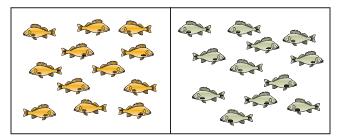
In the figure, orange fish are placed in one aquarium and green fish in an adjoining aquarium. The two tanks are separated by a removable partition that is initially closed.(a) Describe what happens in the first few minutes after the partition is opened.(b) What would you expect to see several
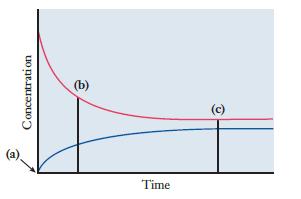
The graph represents the progress of the reaction, A(g) M B(g), which starts with only the reactant A present. Label the two lines to show which represents A and which represents b. Discuss what is occurring at each of the times indicated [(a), (b), and (c)]. Time Concentration (c) (b)
Which of the following is more likely to precipitate the hydroxide ion? Cu(OH)₂ (s) Ca(OH)₂(s) 2+ Cu²+ (aq) + 2 OH(aq) Ca²+ (aq) + 2 OH- (aq) K 1.6 X 10⁻¹⁹ K = 7.9 x 10⁻⁶
For each of the following, are products or reactants favored?(a) AgCl(s) ⇆Ag+(aq) + Cl–(aq) K = 1.8 × 10⁻¹⁰(b) Ca2+(aq) + CO3 2–(aq) ⇄ CaCO3(s) K = 2.1 × 10⁸(c) N2O4(g) ⇆ 2 NO2(g) K = 1.10
In the following equilibrium in a closed system, indicate how the equilibrium is shifted by the indicated stress:(a) Additional HF(g) is added to the system.(b) Water is added.(c) Ca(NO3)2 solution is added, and CaF2 precipitates.(d) The volume is reduced.(e) KOH is added.(f) A catalyst is added.
In each of the reactions, how does the equilibrium respond to an increase in pressure?(a) 2 SO2(g) + O2(g) ⇆ 2 SO3(g)(b) H2(g) + I2(g) ⇆ 2 HI(g)(c) 3 H2(g) + N2(g) ⇆ 2 NH3(g)
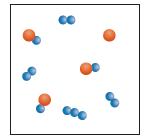
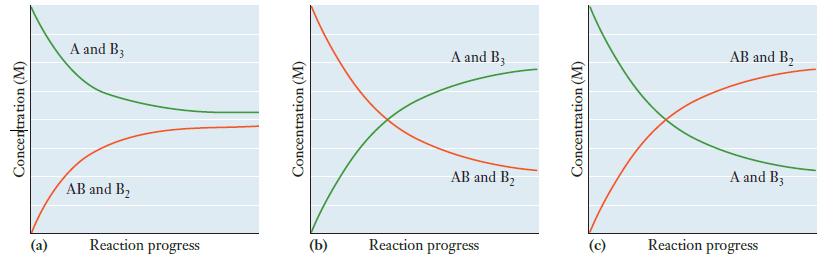
Equal amounts of two gases, A and B3, are placed in an evacuated container and react to form AB and B2.The molecular scale diagram represents the relative amounts of each substance present once equilibrium is reached.Which of the following graphs best describes the progress of the reaction as it
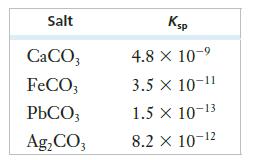
You are designing a process to remove carbonate ions from an aqueous system by precipitation. If the effectiveness of the process is the only concern (meaning there are no environmental or other issues involved), which of the following metal ions would be the best choice: Ca2+, Fe2+, Pb2+, or Ag+?
Consider two flasks. Both contain equal volumes of solution, and the molarities of the two solutions are also equal. Flask A contains a strong acid and Flask B contains a weak acid with Ka = 1 × 10⁻⁶. Each flask is titrated with 0.10 M NaOH. Fill in the blanks in the following statements with
Solid CaCO3 is placed in a closed container and heated to 800°C. What is the equilibrium concentration of CO2 in the following equilibrium, for which K = 2.5 × 10⁻³? CaCO3(s) CaO(s) + CO₂(g)
A chemical engineer is working to optimize the production of acrylonitrile to be used in the manufacture of carbon fibers. The reaction being used is the combination of propene gas, ammonia, and oxygen. The reaction is normally carried out at moderately high temperatures so all species are in the
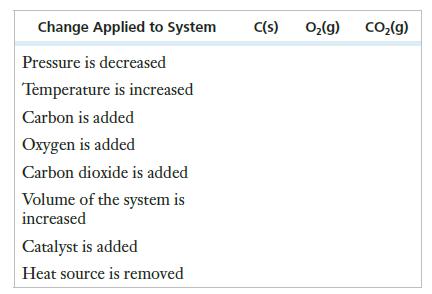
The following equilibrium is established in a closed container:Set up a table like the one that follows and indicate whether equilibrium concentrations increase, decrease, or remain the same. C(s) + O₂(g) → CO₂(g) AH° = -393 kJ
An engineer working on a design to extract petroleum from a deep thermal reservoir wishes to capture toxic hydrogen sulfide gases present by reaction with aqueous iron(II) nitrate to form solid iron(II) sulfide. (a) Write the chemical equation for this process, assuming that it reaches
Methanol, CH3OH, can be produced by the reaction of CO with H2, with the liberation of heat. All species in the reaction are gaseous. What effect will each of the following have on the equilibrium concentration of CO?(a) Pressure is increased,(b) Volume of the reaction container is decreased, (c)
Using the kinetic-molecular theory, explain why an increase in pressure produces more N2O4 in the following system: N₂O4(g) 2 NO₂(g)
The solubility of KCl is 34.7 g per 100 g of water at 20°C. Calculate its molar solubility in (a) Pure water and (b) 0.10 M NaCl.
To prepare community wastewater to be released to a lake, phosphate ions (among others) must be removed. Al2(SO4)3 can be used for this purpose, precipitating AlPO4, for which Ksp at 25°C is 1.3 × 10⁻²⁰. What mass of Al2(SO4)3 must be added per gallon of water to assure that the concentration
A nuclear engineer is considering the effect of discharging waste heat from a power plant into a lake and estimates that this may warm the water locally to 25°C. One question to be considered is the effect of this temperature change on the uptake of CO2 by the water. The equilibrium constant for
In Exercise 12.109, what do you predict would happen to an aqueous copper(II) iodate equilibrium if sulfide ion, S2–, were added? The Ksp of CuS is 8.7 × 10–36.Data from exercise 12.109Copper(II) iodate has a solubility of 0.136 g per 100 g of water. Calculate its molar solubility in water and
You have three white solids. What experiment could you carry out to rank them in order of increasing solubility?
You find a bottle in the laboratory. You know it is an acid and the label says it is a 1.05 M solution but doesn’t say what acid it is. Assuming the label is correct for the concentration, how could you determine what acid it is? What would have to be measured and what would you have to look up?
A mixture of 1.00 mole of PCl3 and 2.00 moles of PBr3 is placed in a 1.00-L reaction vessel. At the temperature of the experiment, K = 2.0 for the following reaction:(a) What is the equilibrium concentration of each species in the vessel?(b) Because the number of bonds is the same on both sides of
You find a bottle of acid in the laboratory and it is labeled H2C2O4. There is no concentration given and you don’t have the reagents to carry out a titration. What other measurement could be made and what information would you need to look up to determine the concentration of the acid?
Sulfur dioxide can be generated by the reaction of sodium hydrogen sulfite with hydrochloric acid. (a) Write the balanced chemical equation for the reaction, given that the other products are sodium chloride and water. (b) If 1.9 g of sodium hydrogen sulfite is reacted with excess HCl, what mass
You need to find the equilibrium constant for a reaction in an industrial process. Describe how you can estimate this value using only thermodynamic data.
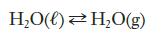
The vapor pressure of water at 80.0°C is 0.467 atm. Find the value of Kc for the processat this temperature. H₂O(l) H₂O(g)
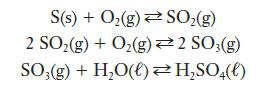
Although ammonia is made in enormous quantities by the Haber-Bosch process, sulfuric acid is made in even greater quantities by the contact process. A simplified version of this process can be represented by these three reactions:(a) Use tabulated data to calculate ΔH° for each reaction.(b) Which
Copper and iron (generally in the form of steel) are two of the many metals used in designing machines.(a) Using standard reduction potentials, identify the anode and the cathode and determine the cell potential for a galvanic cell composed of copper and iron. Assume standard conditions. (b) We
When you look at several older cars that are showing initial signs of rust formation, where do you expect to find the most rust? What does this observation imply about conditions that lead to corrosion?
Suppose that you work for a company that designs the drive mechanisms for large ships.The materials in this mechanism will obviously come into contact with environments that enhance corrosion. To estimate the difficulties that corrosion might cause, you decide to build a model electrochemical cell
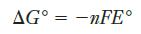
Suppose that we wish to study the possible galvanic corrosion between zinc and chromium, so we set up the following cell:What is the chemical reaction that takes place, and what is the standard free energy change for that reaction?StrategyTo calculate the free energy change, we must know two
What type of corrosion is associated with each of the following circumstances?(a) Two metals are touching each other.(b) A small crack separates two metals.(c) A metal automobile body rusts in the atmosphere.
Using the Internet, find three cases where corrosion was the cause of some sort of failure or malfunction of a device or a structure.
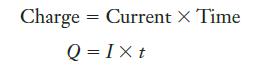
In a process called flash electroplating, a current of 2.50 × 10³ A passes through an electrolytic cell for 5.00 minutes. How many moles of electrons are driven through the cell?Strategy Because we know both the current and the time for which it was applied, we can use the relationship between
Using the Internet, find three cases where concern about corrosion is used to help advertise a product or to convince people to buy a product.
Suppose that a batch of parts is plated with copper in an electrolytic bath running at 0.15 V and 15.0 A for exactly 2 hours. What is the energy cost of this process if the electric utility charges the company $0.0500 per kWh?Strategy We can determine the energy expended because we know the
For the following oxidation–reduction reactions, identify the half-reactions and label them as oxidation or reduction.(a) Cu(s) + Ni2+(aq) → Ni(s) + Cu2+(aq)(b) 2 Fe3+(aq) + 3 Ba(s) → 3 Ba2+(aq) + 2 Fe(s)
An electrolysis cell that deposits gold (from Au+ ions) operates for 15.0 minutes at a current of 2.30 a. What mass of gold is deposited?Strategy As in any stoichiometry problem we need a balanced chemical equation, so we will start by writing the half-reaction for gold reduction. To determine
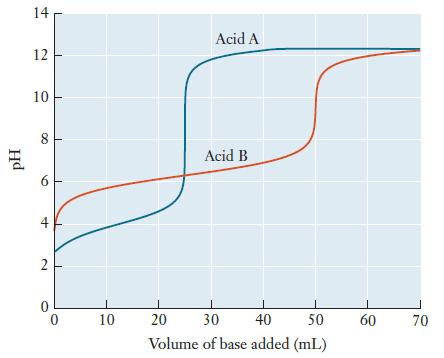
Two weak acids, A and B, are each titrated with the same solution of a strong base, producing the following titration curves.(a) Which acid has a larger Ka value, A or B? Explain.(b) Use the titration curves to estimate the pH at the equivalence point for each acid. Explain why these values are not
Which half-reaction takes place at the anode of an electrochemical cell? Which half-reaction takes place at the cathode?
Suppose that you have a part that requires a tin coating. You’ve calculated that you need to deposit 3.60 g of tin to achieve an adequate coating. If your electrolysis cell (using Sn2+) runs at 2.00 A, how long must you operate the cell to obtain the desired coating?StrategyThis problem again
The following oxidation–reduction reactions are used in electrochemical cells. Write them using cell notation.a.b.c.d. In a galvanic cell, one half-cell contains 0.010 M HCl and a platinum electrode, over which H2 is bubbled at a pressure of 1.0 atm. The other half-cell is composed of a zinc
If a salt bridge contains KNO3 as its electrolyte, which ions diffuse into solution in the anode compartment of the galvanic cell? Explain your answer.
Write a balanced chemical equation for the overall reaction in each of the following galvanic cells.(a) (b) (c) Ag(s) | Ag+ (aq) || Sn++ (aq), Sn²+ (aq) | Pt(s)
If a salt bridge contains KNO3 as its electrolyte, which ions diffuse into solution in the cathode compartment of the galvanic cell? Explain your answer.
For the reactions in parts (a) and (b) in the preceding problem, no anions at all are shown in the cell notation. Explain why this is not a concern.
Explain why the terms cell potential and electromotive force mean the same thing in electrochemical cells.
How does galvanic corrosion differ from uniform corrosion of iron?
How can each of the following serve as both the cathode and the anode of an electrochemical cell? (a) A single piece of metal, (b) Two connected pieces of metal
Based on the cell potential measured for the cellswhat potential should you expect to find for the following cell? Co(s) | Co²+ (aq) || Cu²+ (aq) | Cu(s) Fe(s) | Fe²+ (aq) || Cu²+ (aq) | Cu(s) E° = 0.614 V E = 0.777 V
A student who has mercury amalgam fillings in some of her teeth is eating a piece of candy. She accidentally bites down on a piece of the aluminum foil wrapper and experiences a sharp sensation in her mouth. Explain what has happened in terms of electrochemistry.
If the reaction at a standard hydrogen electrode is 2 H+ + 2 e– → H2, why is there a platinum foil in the system?
Using values from the table of standard reduction potentials, calculate the cell potentials of the following cells.(a) (b) (c) Ga(s) | Ga³+ (aq) || Ag+ (aq) | Ag(s)
In tables of standard reduction potentials that start from large positive values at the top and proceed through 0.0 V to negative values at the bottom, the alkali metals are normally at the bottom of the table. Use your chemical understanding of alkali metals and how they behave in bonding to
Showing 100 - 200
of 1536
1
2
3
4
5
6
7
8
9
10
11
12
13
14
15
Last
Step by Step Answers

 Get 50% OFF
Claim Now
Get 50% OFF
Claim Now