New Semester
Started
Get
50% OFF
Study Help!
--h --m --s
Claim Now
Question Answers
Textbooks
Find textbooks, questions and answers
Oops, something went wrong!
Change your search query and then try again
S
Books
FREE
Study Help
Expert Questions
Accounting
General Management
Mathematics
Finance
Organizational Behaviour
Law
Physics
Operating System
Management Leadership
Sociology
Programming
Marketing
Database
Computer Network
Economics
Textbooks Solutions
Accounting
Managerial Accounting
Management Leadership
Cost Accounting
Statistics
Business Law
Corporate Finance
Finance
Economics
Auditing
Tutors
Online Tutors
Find a Tutor
Hire a Tutor
Become a Tutor
AI Tutor
AI Study Planner
NEW
Sell Books
Search
Search
Sign In
Register
study help
sciences
chemistry for engineering students
Chemistry For Engineering Students 4th Edition Lawrence S. Brown, Tom Holme - Solutions
Which of the following is more likely to precipitate sulfate ions? PbSO4(s) Pb²+ (aq) + SO4 (aq) 2+ CaSO4(s) Ca²+ (aq) + SO4 (aq) K = 1.8 X 10⁻⁸ K = 9.1 x 10⁻⁶
Write equilibrium expressions for each of the following heterogeneous equilibria.(a) CaCO3(s) ⇄ Ca2+(aq) + CO3 2–(aq)(b) AgCl(s) ⇄ Ag+(aq) + Cl–(aq)(c) Mg3(PO4)2(s) ⇄ 3 Mg2+(aq) + 2 PO4 3–(aq)(d) Zn(s) + Cu2+(aq) ⇄ Cu(s) + Zn2+(aq)
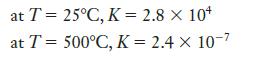
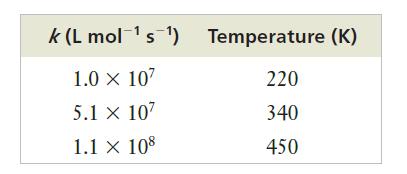
The reaction, 3 H2(g) + N2(g) ⇄ 2 NH3(g), has the following equilibrium constants at the temperatures given:(a) At which temperature are reactants favored?(b) At which temperature are products favored?(c) What can you say about the reaction if the equilibrium constant is 1.2 at 127°C? at T =
Write equilibrium expressions for each of the following equilibria.(a) 2 C(s) + O2(g) ⇄ 2 CO(g)(b) Zn2+(aq) + H2S(g) ⇄ ZnS(s) +2 H+(aq)(c) HCl(g) + H2O(ℓ) ⇄ H3O+(aq) + Cl–(aq)(d) H2(g) + ½O2(g) ⇄ H2O(g
For the equilibria given below, determine each of the following:(a) Equilibrium expressions for K1 and K2 (b) The equation for the reaction that is the sum of the two equations (c) The equilibrium expression, K3, for the sum of the two equations CO3(aq) + H+ (aq) → HCO3(aq) HCO, (aq) + H*(aq)
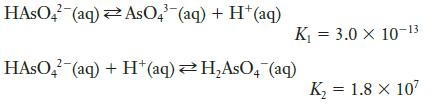
Using the equationsdetermine the equilibrium constant for the following reaction: HASO4 (aq) AsO4 (aq) + H+ (aq) K₁ = 3.0 X 10⁻¹³ HASO4 (aq) + H+ (aq)H₂AsO4 (aq) K₂ = 1.8 x 10²
For each of the following equations, write the equilibrium expression for the reverse reaction.(a) 2 C(s) + O2(g) ⇄ 2 CO(g)(b) AgCl(s) ⇄ Ag+(aq) + Cl–(aq)
(a) In Exercise 12.21, if K1 = 2.1 × 10¹⁰ and K2 = 2.3 × 10⁶, what is the value of K3?(b) What is the equilibrium constant, K3′ for the reverse reaction?Data from exercise 12.21For the equilibria given below, determine each of the following:Equilibrium expressions for K1 and K2The equation for
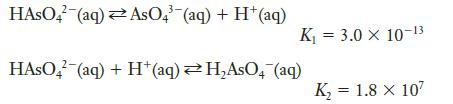
In Exercise 12.24, which reaction has the greater tendency to go to completion as written, reaction 1 or reaction 2?Data from Exercise 12.24Using the equationsdetermine the equilibrium constant for the following reaction: HASO4 (aq) AsO4³ (aq) + H+ (aq) K₁ = 3.0 X 10⁻¹³ HASO (aq) + H+
An engineer is considering the use of bacteria called methanotrophs to remediate the production of small amounts of methane at a mine site. The reaction that takes place can be summarized as CH4(g) + 2 O2(g) ⇄ CO2(g) + 2H2O(ℓ). What is the equilibrium constant expression for this reaction?
The following data were collected for the reaction, H2(g)+ I2(g) ⇄ 2 HI(g), at equilibrium at 25°C:[H2] = 0.10 mol L–1, [I2] = 0.20 mol L–1, [HI] = 4.0 mol L–1Calculate the equilibrium constant for the reaction at this temperature.
Hydrogen gas and iodine gas react via the following equation:If 0.050 mol HI is placed in an empty 1.0-L flask at 600 K, what are the equilibrium concentrations of HI, I2, and H2? H₂(g) + ₂(g) 2 HI(g) K 76 (at 600 K) =
The following data were collected for a system at equilibrium at 140°C. Calculate the equilibrium constant for the reaction, 3 H2(g) + N2(g) ⇄ 2 NH3(g) at this temperature. [H₂] = 0.10 mol L-¹, [N₂] = 1.1 mol L-¹, -1 [NH3] 3.6 x 10-² mol L-¹ =
Again the experiment in Exercise 12.33 was redesigned. This time, 0.15 mol each of N2 and O2 was injected into a 5.0-L container at 2500 K, at which the equilibrium constant is 3.6 × 10⁻³. What was the composition of the reaction mixture at equilibrium?Data from exercise 12.33The following
Nitrosyl chloride, NOCl, decomposes to NO and Cl2 at high temperatures:Suppose you place 2.00 mol NOCl in a 1.00-L flask and raise the temperature to 462°C. When equilibrium has been established, 0.66 mol NO is present. Calculate the equilibrium constant Kc for the decomposition reaction from
The reaction in Exercise 12.33 was repeated. This time, the reaction began when only NO was injected into the reaction container. If 0.200 mol L–1 NO was injected, what were the equilibrium concentrations of all species?Data from exercise 12.33The following reaction establishes equilibrium at
The equilibrium constant for the reaction, 3 H2(g) + N2(g) ⇄ 2 NH3(g), at a given temperature is 1.4 × 10⁻⁷. Calculate the equilibrium concentration of ammonia, if [H2] = 1.2 × 10⁻² mol L–1 and [N2] = 3.2 × 10⁻³ mol L–1.
A system consisting of 0.100 mole of oxygen gas, O2, is placed in a closed 1.00-L container and is brought to equilibrium at 600 K:What are the equilibrium concentrations of O and O2? O₂(g) 2 0(g) K = 2.8 X 10-39
The following reaction establishes equilibrium at 2000 K:If the reaction began with 0.100 mol L–1 of N2 and 0.100 mol L–1 of O2, what were the equilibrium concentrations of all species? N₂(g) + O₂(g) 2 NO K = 4.1 X 10⁻⁴
The equilibrium constant of the reaction of Cl2(g) with PCl3(g) to produce PCl5(g) is 51 at a particular temperature. If the initial concentration of PCl3 is 0.012 mol L–1 and the initial concentration of Cl2 is 0.125 mol L–1, what are the equilibrium concentrations of all species?
In the reaction in Exercise 12.33, another trial was carried out. The reaction began with an initial concentration of N2 equal to the initial concentration of NO. Each had a concentration of 0.100 mol L–1. What were the equilibrium concentrations of all species?Data from exercise 12.33The
The experiment in Exercise 12.33 was redesigned so that the reaction started with 0.15 mol each of N2 and O2 being injected into a 1.0-L container at 2500 k. The equilibrium constant at 2500 K is 3.6 × 10⁻³. What was the composition of the reaction mixture after equilibrium was attained?Data
At a particular temperature, the equilibrium constant, K, for the dissociation of N2O4 into NO2 is 133. If the initial concentration of N2O4 is 0.100 mol L–1, what are the concentrations of both species at equilibrium? N₂O4 2 NO₂
Because carbonic acid undergoes a second ionization, the student in Exercise 12.39 is concerned that the hydrogen ion concentration she calculated is not correct. She looks up the equilibrium constant for the reactionUpon finding that the equilibrium constant for this reaction is 4.8 × 10⁻¹¹,
A student is simulating the carbonic acid2hydrogen carbonate equilibrium in a lake:She starts with 0.1000 M carbonic acid. What are the concentrations of all species at equilibrium? H₂CO3(aq) H+ (aq) + HCO3(aq) K= 4.4 x 10⁻⁷
Because calcium carbonate is a sink for CO3 2– in a lake, the student in Exercise 12.39 decides to go a step further and examine the equilibrium between carbonate ion and CaCO3. The reaction is:The equilibrium constant for this reaction is 2.1 × 10⁸. If the initial calcium ion concentration is
The following reaction is in equilibrium in lake water:Predict the change in the reaction quotient, Q, for each disturbance below and use that prediction to explain how the equilibrium is shifted by the stress.(a) NaHCO3 is added to the lake.(b) H2CO3 is added.(c) NaOH is added. HCO3(aq) + H+ (aq)
In each of the reactions below, tell how the equilibrium responds to an increase in pressure.(a) CaCO3(s) ⇄ CaO(s) + CO2(g)(b) N2O4(g) ⇄ 2 NO2(g)(c) HCO3 –(aq) + H+(aq) ⇄ H2CO3(aq)
Ammonia is an important starting material for several industrial processes, including the production of fertilizers, polymers, and admixture components for cement. Thus the production of ammonia from nitrogen and hydrogen is one of the world’s most important industrial reactions:Write equilibrium
In what geographical region of the country would a civil engineer be most likely to use concrete with air entraining admixtures in a design? Explain your answer.
In Example Problem 12.2, we saw that hydroxide ions precipitate with calcium. Magnesium ions show similar behavior. The two pertinent equilibria are:Which ion is more likely to precipitate hydroxide from a solution, assuming roughly equal concentrations of calcium and magnesium ions?Strategy The
What fraction of the annual release of CO2(g) into the atmosphere is the result of concrete production? What is the main chemical step that leads to the production of CO2?
Calcium hydroxide will precipitate from solution by the following equilibrium:Write the equilibrium expression for this reaction.Strategy Write the equilibrium expression as before but do not include a term for the concentration of the solid calcium hydroxide product. 2+ Ca²+ (aq) + 2 OH(aq)
Explain why the hydration process for concrete is exothermic by considering the chemical bonds in the reactants and products.
Concrete used in smokestacks has to be designed to withstand sometimes caustic conditions. Sulfur oxides are produced in some cases, for example, and they would establish equilibrium if they did not disperse:Write the equilibrium expression for this reaction.Strategy We use the definition of the
Identify the first chemical step in the production of Portland cement. How is this reaction related to the chemistry that takes place in the carbonation of concrete?
Use the web to look up the rates of reaction for different alkali metals with water. How can you explain the trend in these rates in terms of the concepts presented?
Substances that poison a catalyst pose a major concern for many engineering designs, including those for catalytic converters. One design option is to add materials that react with potential poisons before they reach the catalyst. Among the commonly encountered catalyst poisons are silicon and
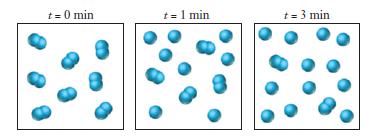
The following series of pictures represents the progress of a reaction in which A2 molecules dissociate into atoms: A2 → 2 A. Each picture represents a snapshot of the reaction mixture at the indicated time.Are these figures consistent with a first-order rate law?Explain. t = 0 min t = 1 min t =
The rate of photodecomposition of the herbicide picloram in aqueous systems was determined by exposure to sunlight for a number of days. One such experiment produced the following results. (Data from R.T. Hedlun and c.R. Youngson, “The Rates of Photodecomposition of Picloram in Aqueous
Show that the half-life of a second-order reaction is given by:In what fundamental way does the half-life of a second order reaction differ from that of a first-order reaction? t1/2 1 k[A]o
The production of NO2 from nitrogen and oxygen, N2 + 2 O2 → 2 NO2, was studied in an experiment, and the rate of nitrogen consumption was measured as 2.5 × 10 - 5 mol L-1 s-1. What was the rate of NO2 production in this experiment?Strategy Use the stoichiometry of the reaction to relate the
Why is smog appropriately labeled photochemical smog?
In the following rate laws, determine the orders with respect to each substance and the overall order of the reaction.(a) Rate = k[A]2[B], (b) Rate = k[A][B]1/2Strategy The order with respect to each individual species is the exponent, and the overall order is the sum of the individual orders.
List two types of chemical compounds that must be present in the air for photochemical smog to form. What are the most common sources of these compounds?
Earlier in the chapter we mentioned the decomposition of N2O5:Consider the following data for the kinetics of this reaction:Determine the rate law and rate constant for this reaction at the temperature of these experiments.Strategy To establish the rate law, determine the order with respect to the
What is a VOC? What role do VOCs play in photochemical smog?
In the sort of complex mixture of gases we might find in urban air, many chemical reactions may occur. For example, NO2, which we’ve mentioned as a key species in the formation of ozone, can also react with ozone.In a study of this reaction, three experiments were run at the same temperature, and
Why do ozone concentrations lag in time relative to other pollutants in photochemical smog?
The photodissociation of NO2 by ultraviolet wavelengths of sunlight initiates the formation of photochemical smog. It is a first-order reaction with a rate constant of 2.95 × 10⁻³ min–1 at a given level of light exposure.Consider a laboratory experiment in which a sample of nitrogen dioxide is
A student says nitrogen oxides normally don’t form in the atmosphere because there are not enough collisions between nitrogen and oxygen molecules. What has the student left out of this explanation?
Photodissociation by UV radiation is not the only possible fate of NO2 in urban air. An ordinary decomposition reaction, in which NO2 reacts to form NO and O2, is also possible. This reaction was studied at 370°C by a student, and the following data were obtained:Based on these data, determine the
Compared to 1990 when the Clean Air Act was last amended, how have the concentrations of criteria pollutants changed?
The rate of the photodissociation of ozone in the example shown in Figure 11.7 may seem slow. But it is actually tremendously faster than what we would see in the absence of ultraviolet light. The rate constant, k, for the thermal decomposition of ozone in the dark at 25°C is just 3 × 10–26
Asphalt is composed of a mixture of organic chemicals. Does an asphalt parking lot contribute directly to the formation of photochemical smog? Explain your answer.
Once ozone forms in photochemical smog, there are a number of reactions by which it is subsequently destroyed. One such reaction occurs when ozone molecules encounter hydroxyl radicals:The following values for the rate constant, k, for this reaction were measured in experiments at various
A newspaper article about air pollution implies that volatile organic compounds are called volatile because they react easily. Write a brief statement that might be appropriate for the comments section of the article explaining why this statement is misleading.
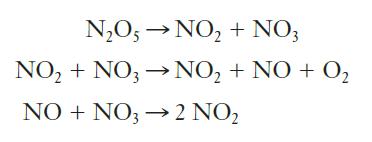
The decomposition of N2O5 is given by the equation:The following mechanism is proposed for this reaction:(a) Does this mechanism as written provide the correct stoichiometry? If not, how does it need adjustment? (b) Identify all intermediates in the mechanism. (c) Identify the molecularity of
In 2015, the EPA set the primary standard for ozone at 0.070 ppm. If a sample of air contains 8 ozone molecules for every 108 molecules of air, does it meet this standard? Explain your answer.
For each of the following, suggest appropriate rate units.(a) Driving from one place to another(b) Drying dishes by hand(c) The beating wings of a mosquito(d) Eyes blinking
For each of the following, suggest an appropriate rate unit.(a) Heart beating (b) Tree growing (c) Automobile wheels rotating (d) Gas evolving in a very fast chemical reaction
Rank the following in order of increasing reaction rate.(a) Dynamite exploding(b) Iron rusting(c) Paper burning
Distinguish between instantaneous rate and average rate. In each of the following situations, is the rate measured the instantaneous rate or the average rate?(a) In a hot dog eating contest, it took the winner only 4 minutes to eat 20 hot dogs, so he ate 5 hot dogs per minute.(b) At minute 1.0, the
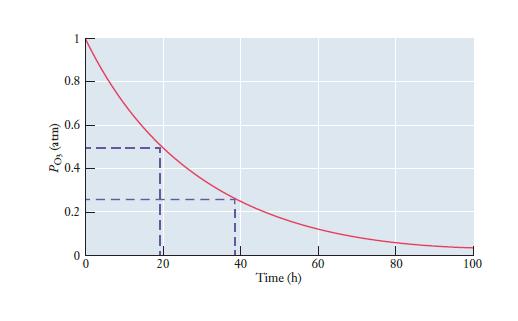
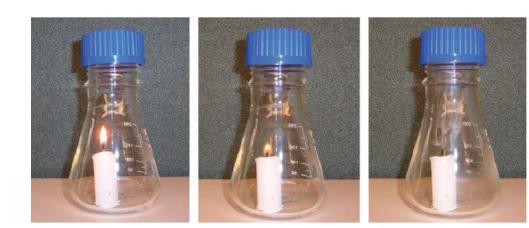
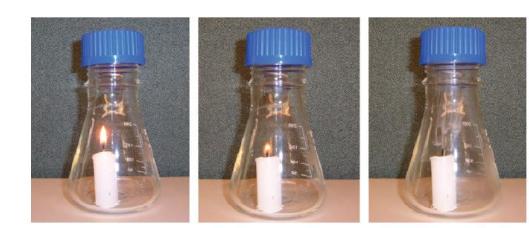
Candle wax is a mixture of hydrocarbons. In the reaction of oxygen with candle wax in Figure 11.2, the rate of consumption of oxygen decreased with time after the flask was covered, and eventually the flame went out.From the perspective of the kinetic-molecular theory, describe what is happening in
In the description of the candle in Figure 11.2, we mentioned the consumption of oxygen. Assuming that candle wax is a mixture of hydrocarbons with the general formula CnH2n+2, what other variables could be measured besides the concentration of oxygen to determine the rate of the reaction?Figure
The reaction for the Haber process, the industrial production of ammonia, is:Assume that under certain laboratory conditions ammonia is produced at the rate of 6.29 × 10⁻⁵ mol L–1 s–1. At what rate is nitrogen consumed? At what rate is hydrogen consumed? N₂(g) + 3 H₂(g) →→2 NH3(g)
Ammonia can react with oxygen to produce nitric oxide and water:If the rate at which ammonia is consumed in a laboratory experiment is 4.23 × 10⁻⁴ mol L–1 s–1, at what rate is oxygen consumed? At what rate is NO produced? At what rate is water vapor produced? 4 NH3(g) + 5 O₂(g) →4 NO(g)
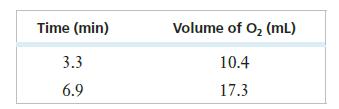
The following data were obtained in the decomposition of H2O2(aq) to O2(g) and H2O(ℓ). The rate at which oxygen gas was produced was measured. (No oxygen was present initially.)(a) Calculate the average rate in mL/min for the first 3.3 minutes.(b) Calculate the average rate in mL/min for the
A gas, AB, decomposes and the volume of B2 produced is measured as a function of time. The data obtained are as follows:What is the average rate of production of B2 for the first 8.3 min? For the first 19 min? Time (min) Volume (L) 0 0 8.3 4.2 15.4 8.6 19.0 11.5
Azomethane, CH3NNCH3, is not a stable compound, and once generated, it decomposes. The rate of decomposition was measured by monitoring the partial pressure of azomethane, in torr:Plot the data and determine the instantaneous rate of decomposition of azomethane at t = 20 min. Time (min) Pressure
In a method of initial rates experiment, is the measured rate an average rate or an instantaneous rate? Explain.
Second-order rate constants used in modeling atmospheric chemistry are commonly reported in units of cm3 molecule–1 s–1. Convert the following rate constants to L mol–1 s–1:(a) 3.5 × 10⁻¹⁴ cm3 molecule–1 s–1(b) 7.1 × 10⁻¹⁸ cm3 molecule–1 s–1(c) 6.1 × 10⁻³⁰ cm3 molecule–1
For each of the rate laws below, what is the order of the reaction with respect to the hypothetical substances X, Y, and Z? What is the overall order?(a) Rate = k[X][Y][Z], (b) Rate = k[X]2[Y]1/2[Z],(c) Rate = k[X]1.5[Y]–1, (d) Rate = k[X]/[Y]2
The reaction of CO(g) with NO2(g) is second order in NO2 and zero order in CO at temperatures less than 500 k.(a) Write the rate law for the reaction.(b) How will the reaction rate change if the NO2 concentration is halved?(c) How will the reaction rate change if the concentration of CO is doubled?
Show that if the units of rate are mol L–1 s–1, then the units of the rate constant for the following second-order reaction are L mol–1 s–1: H₂(g) + Br₂(g) → 2 HBr rate= k [H₂][Br₂]
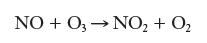
One reaction that destroys O3 molecules in the stratosphere is:When this reaction was studied in the laboratory, it was found to be first order with respect to both NO and O3, with a rate constant of 1.9 × 10⁴ L mol–1 s–1. If [NO] = 1.2 × 10⁻⁵ mol L–1 and [O3] = 2.0 × 10⁻⁵ mol L–1,
The hypothetical reaction, A + B → C, has the rate law:When [A] is doubled and [B] is held constant, the rate doubles. But the rate increases fourfold when [B] is doubled and [A] is held constant. What are the values of x and y? Rate = k[A]*[B]'
The rate of the decomposition of hydrogen peroxide, H2O2, depends on the concentration of iodide ion present. The rate of decomposition was measured at constant temperature and pressure for various concentrations of H2O2 and of KI. The data appear below. Determine the order of reaction for each
Give the order with respect to each reactant and the overall order for the hypothetical reaction:which obeys the rate law Rate = k[A][B]2. A + B + C D + E
The following experimental data were obtained for the reaction:Determine the reaction order for each reactant and the value of the rate constant. [A] (mol L-¹) 0.127 0.127 0.255 2 A+ 3B C + 2D [B] (mol L-¹) 0.15 0.30 0.15 Rate = A[C]/At (mol L-¹ s-¹) 0.033 0.132 0.066
The following experimental data were obtained for the reaction of NH4+ and NO2– in acidic solution.Determine the rate law for this reaction and calculate the rate constant. NH4+ (aq) + NO₂ (aq) → N₂(g) + 2 H₂O(l) [NH₂+] (mol L-¹) [NO₂ ] (mol L-¹) Rate = A[N₂]/At (mol
Rate data were obtained at 25°C for the following reaction. What is the rate law expression for this reaction? Expt. 1 2 3 4 A + 2B C + 2D Initial [A] (mol L-¹) 0.10 0.30 0.10 0.20 Initial [B] (mol L-¹) 0.10 0.30 0.30 0.40 Initial Rate of Formation of C (mol L-¹ min-¹) 3.0 x 10⁻⁴ 9.0 ×
The reaction:plays a role in the formation of nitrogen dioxide in automobile engines. Suppose that a series of experiments measured the rate of this reaction at 500 K and produced the following data:Derive a rate law for the reaction and determine the value of the rate constant. NO(g) + O₂(g) →
In a heterogeneous system such as wood burning in oxygen, the surface area of the solid can be a factor in the rate of the reaction. Increased surface area of the wood means more collisions with oxygen molecules. To understand how surface area increases when dividing a solid, do the following:(a)
In wheat-growing areas, such as the plains of the central United States and Canada, harvested wheat is stored in tall grain elevators that are visible for miles in the flat prairie.The wheat is dumped from trucks into a lower part of the elevator and then moved up the elevators into storage areas.
The decomposition of N2O5 in solution in carbon tetrachloride is a first-order reaction:The rate constant at a given temperature is found to be 5.25 × 10⁻⁴ s–1. If the initial concentration of N2O5 is 0.200 M, what is its concentration after exactly 10 minutes have passed? 2 N₂O5 → 4NO₂
In Exercise 11.39, if the initial concentration of N2O5 is 0.100 M, how long will it take for the concentration to drop to 0.0100 times its original value?Data from exercise 11.39The decomposition of N2O5 in solution in carbon tetrachloride is a first-order reaction:The rate constant at a given
For a drug to be effective in treating an illness, its levels in the bloodstream must be maintained for a period of time. One way to measure the level of a drug in the body is to measure its rate of appearance in the urine. The rate of excretion of penicillin is first order, with a half-life of
Amoxicillin is an antibiotic packaged as a powder. When it is used to treat babies and small animals, the pharmacist or veterinarian must suspend it in water, so that it can be administered orally with a medicine dropper. The label says to dispose of unused suspension after 14 days. It also points
As with any drug, aspirin (acetylsalicylic acid) must remain in the bloodstream long enough to be effective. Assume that the removal of aspirin from the bloodstream into the urine is a first-order reaction, with a half-life of about 3 hours. The instructions on an aspirin bottle say to take 1 or 2
A possible reaction for the degradation of the pesticide DDT to a less harmful compound was simulated in the laboratory. The reaction was found to be first order, with k = 4.0 × 10⁻⁸ s–1 at 25°C. What is the half-life for the degradation of DDT in this experiment, in years?
The initial concentration of the reactant in a first-order reaction A → products is 0.64 mol/L and the half-life is 30.0 s.(a) Calculate the concentration of the reactant exactly 60 s after initiation of the reaction.(b) How long would it take for the concentration of the reactant to drop to
A substance undergoes first-order decomposition. After 40.0 min at 500°C, only 12.5% of the original sample remains. What is the half-life of the decomposition? If the original sample weighed 243 g, how much would remain after 2.00 h?
The following data were collected for the decomposition of N2O5:(a) Use appropriate graphs to determine the rate constant for this reaction.(b) Find the half-life of the reaction. Time, t (min) 0 5 10 15 20 25 30 35 40 [N₂O5] (mol L-¹) 0.200 0.171 0.146 0.125 0.106 0.0909 0.0777 0.0664 0.0570
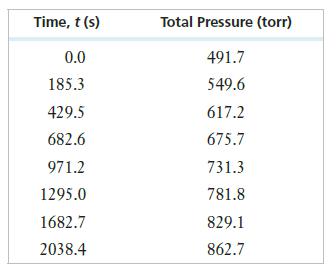
The rate of decomposition of SO2Cl2 according to the reaction:can be followed by monitoring the total pressure in the reaction vessel. Consider the following data:What must you do to convert these total pressures into changes in the pressure of the SO2Cl2? Manipulate the data as needed and then use
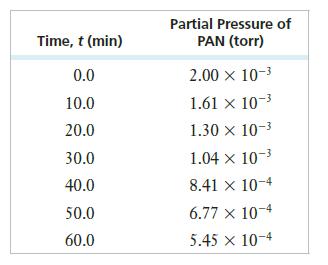
Peroxyacetyl nitrate (PAN) has the chemical formula C2H3NO5 and is an important lung irritant in photochemical smog. An experiment to determine the decomposition kinetics of PAN gave the data below. Determine the order of reaction and calculate the rate constant for the decomposition of PAN. Time,
The reaction in which CO2 decomposes to CO and a free radical oxygen atom, O, has an activation energy of 460 kJ mol–1. The frequency factor is 2 × 10¹¹ s–1. What is the rate constant for this reaction at 298 K?
Use the kinetic-molecular theory to explain why an increase in temperature increases reaction rate.
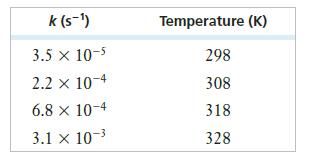
The following rate constants were obtained in an experiment in which the decomposition of gaseous N2O5 was studied as a function of temperature. The products were NO2 and NO3.Determine Ea for this reaction in kJ/mol. k (S-¹) 3.5 x 10⁻⁵ 2.2 x 10⁻⁴ 6.8 x 10⁻⁴ 3.1 x 10-³ Temperature
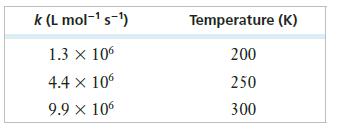
The table below presents measured rate constants for the reaction of NO with ozone at three temperatures. From these data, determine the activation energy of the reaction in kJ/mol. (Assume the temperatures all have at least two significant figures.) k (L mol-¹ s-¹) 1.3 X 10⁶ 4.4 x 10⁶ 9.9 ×
Showing 300 - 400
of 1536
1
2
3
4
5
6
7
8
9
10
11
12
13
14
15
Last
Step by Step Answers

 Get 50% OFF
Claim Now
Get 50% OFF
Claim Now








![[H] = 0.10 mol L-, [N] = 1.1 mol L-, -1 [NH3] 3.6 x 10- mol L- =](https://dsd5zvtm8ll6.cloudfront.net/images/question_images/1701/0/8/6/974656486fec56fa1701086974348.jpg)



















![Exposure Time, t (days) 0 7 14 21 28 35 42 49 56 [Picloram] (mol L-) 4.14 x 10⁻⁶ 3.70 x 10⁻⁶ 3.31 x 10⁻⁶ 2.94](https://dsd5zvtm8ll6.cloudfront.net/images/question_images/1701/0/6/9/0736564411159e5e1701069072171.jpg)
![t1/2 1 k[A]o](https://dsd5zvtm8ll6.cloudfront.net/images/question_images/1701/0/6/8/919656440775170d1701068918168.jpg)

![Experiment 1 2 Initial [NO5] (mol L-) 3.0 10- 9.0 10- Initial Rate of Reaction (mol L s ) 9.0 10-7 2.7 x](https://dsd5zvtm8ll6.cloudfront.net/images/question_images/1701/0/6/0/26965641eada74a71701060268770.jpg)

![Experiment 1 2 3 Initial [NO] (mol L-) 2.3 x 10⁻⁵ 4.6 x 10⁻⁵ 4.6 x 10⁻⁵ Initial [03] (mol L-) 3.0 10-5 3.0](https://dsd5zvtm8ll6.cloudfront.net/images/question_images/1701/0/6/0/44165641f59b038c1701060440806.jpg)

![Time (s) 0.0 5.0 10.0 15.0 20.0 25.0 30.0 [NO] (mol L-) 3.00 x 10⁻¹ 1.97 x 10⁻² 1.00 10- 7.00 10- 5.20 10-](https://dsd5zvtm8ll6.cloudfront.net/images/question_images/1701/0/6/0/741656420852b2ed1701060740232.jpg)






![H(g) + Br(g) 2 HBr rate= k [H][Br]](https://dsd5zvtm8ll6.cloudfront.net/images/question_images/1701/0/6/5/706656433ea7461b1701065705294.jpg)
![Rate = k[A]*[B]'](https://dsd5zvtm8ll6.cloudfront.net/images/question_images/1701/0/6/6/0436564353bb1d491701066042429.jpg)
![Rate (mL min-) 0.090 0.178 0.184 [HO] (mol L-) 0.15 0.30 0.15 [KI] (mol L-) 0.033 0.033 0.066](https://dsd5zvtm8ll6.cloudfront.net/images/question_images/1701/0/6/6/149656435a5687a41701066148284.jpg)

![[A] (mol L-) 0.127 0.127 0.255 2 A+ 3B C + 2D [B] (mol L-) 0.15 0.30 0.15 Rate = A[C]/At (mol L- s-) 0.033](https://dsd5zvtm8ll6.cloudfront.net/images/question_images/1701/0/6/7/33965643a4b2bb681701067338062.jpg)
![NH4+ (aq) + NO (aq) N(g) + 2 HO(l) [NH+] (mol L-) [NO ] (mol L-) Rate = A[N]/At (mol L-s-) 0.0092 0.0092](https://dsd5zvtm8ll6.cloudfront.net/images/question_images/1701/0/6/7/44265643ab2a2aa51701067441574.jpg)
![Expt. 1 2 3 4 A + 2B C + 2D Initial [A] (mol L-) 0.10 0.30 0.10 0.20 Initial [B] (mol L-) 0.10 0.30 0.30 0.40](https://dsd5zvtm8ll6.cloudfront.net/images/question_images/1701/0/6/7/75365643be9846931701067752182.jpg)

![[NO] (mol L-) 0.002 0.002 0.006 [0] (mol L-) 0.005 0.010 0.005 Rate = A[NO]/At (mol L-s-) 8.0 10-17 1.6](https://dsd5zvtm8ll6.cloudfront.net/images/question_images/1701/0/6/7/85965643c53b85d71701067858671.jpg)


![Time, t (min) 0 5 10 15 20 25 30 35 40 [NO5] (mol L-) 0.200 0.171 0.146 0.125 0.106 0.0909 0.0777 0.0664](https://dsd5zvtm8ll6.cloudfront.net/images/question_images/1701/0/6/9/005656440cda9d1f1701069004447.jpg)