New Semester
Started
Get
50% OFF
Study Help!
--h --m --s
Claim Now
Question Answers
Textbooks
Find textbooks, questions and answers
Oops, something went wrong!
Change your search query and then try again
S
Books
FREE
Study Help
Expert Questions
Accounting
General Management
Mathematics
Finance
Organizational Behaviour
Law
Physics
Operating System
Management Leadership
Sociology
Programming
Marketing
Database
Computer Network
Economics
Textbooks Solutions
Accounting
Managerial Accounting
Management Leadership
Cost Accounting
Statistics
Business Law
Corporate Finance
Finance
Economics
Auditing
Tutors
Online Tutors
Find a Tutor
Hire a Tutor
Become a Tutor
AI Tutor
AI Study Planner
NEW
Sell Books
Search
Search
Sign In
Register
study help
sciences
chemistry for engineering students
Chemistry For Engineering Students 4th Edition Lawrence S. Brown, Tom Holme - Solutions
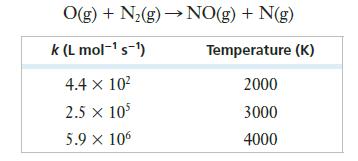
The table below presents rate constants measured at three temperatures for the following reaction, which is involved in the production of nitrogen oxides in internal combustion engines. (Assume the temperatures all have at least two significant figures.)Determine the activation energy of the
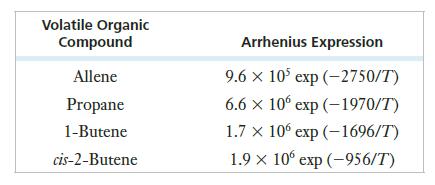
Many reactions occur in the formation of photochemical smog, including the reaction of ozone with various volatile organic compounds, or VOCs. The following table shows the Arrhenius expressions for four such reactions.(a) Which reaction is likely to be the fastest at 310 K?(b) Which reaction has
Can a reaction mechanism ever be proven, correct? Can it be proven incorrect?
Describe how the Chapman cycle is a reaction mechanism. What is the molecularity of each reaction in the Chapman cycle?
What are the reaction intermediates in the Chapman cycle?
The following mechanism is proposed for a reaction:(a) Write the overall equation for the reaction.(b) What is the rate-determining step?(c) What is the intermediate in this reaction?(d) What is the molecularity of each step of the reaction?(e) Write the rate expression for each step. NO + Br₂
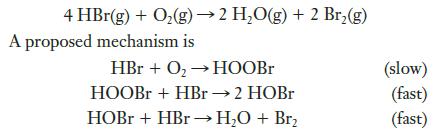
HBr is oxidized in the following reaction:(a) Show that this mechanism can account for the correct stoichiometry.(b) Identify all intermediates in this mechanism.(c) What is the molecularity of each elementary step?(d) Write the rate expression for each elementary step.(e) Identify the
In the process by which CFCs contribute to the depletion of stratospheric ozone, is light a catalyst? Why or why not?
What distinguishes homogeneous and heterogeneous catalysis?
Define the terms adsorbed and desorbed. Do the processes to which these terms refer occur only in heterogeneous catalysis?
In Chapter 3, we discussed the conversion of biomass into biofuels. One important area of research associated with biofuels is the identification and development of suitable catalysts to increase the rate at which fuels can be produced. Do a web search to find an article describing biofuel
The label on a bottle of 3% (by volume) hydrogen peroxide, H2O2, purchased at a grocery store, states that the solution should be stored in a cool, dark place. H2O2 decomposes slowly over time, and the rate of decomposition increases with an increase in temperature and in the presence of light.
What are the relative advantages and disadvantages of mobile versus stationary air quality monitoring?
The Clean Air Act hasn’t been substantially amended since 1990, but new air quality regulations are still devised and implemented. Use the Internet to research the process that is used to make changes in how air pollution is monitored and regulated without new laws being enacted.
The AQI includes both numerical ranges and a color scale to impart information. Which form of information is likely to be more useful in communicating with the general public and why?
The AQI includes six levels, including several that describe air that is not healthy to breathe. What are the possible advantages and disadvantages of proposing to collapse the AQI to only four levels?
Pollution monitoring in countries outside of the United States doesn’t necessarily use the AQI but can be translated into the same index. Use the Internet to determine what it means when a smoggy day is considered “beyond index.” Has a U.S. city ever recorded an AQI beyond index?
Suppose a politician has proposed that air quality monitoring only needs to be carried out in cities with 500,000 or more people, in hopes of saving money. Would the loss of monitoring capability in more rural areas have any possible consequences for understanding air quality? Explain your answer.
Suppose you were an engineer working on a project to be built in the Detroit area. Why might you need to consult international treaties related to air quality in your engineering designs?
Which of the following would be likely to have a very large rate constant? Which would have a very small rate constant?(a) Dynamite exploding (b) Iron rusting (c) Paper burning
What is the difference between an average rate and an instantaneous rate? Are there circumstances that require the use of one rate or the other in order to properly describe the kinetics of a reaction?
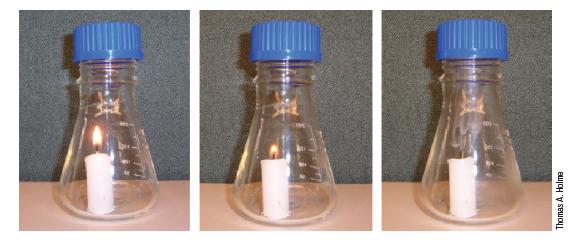
A student watches the burning candle in Figure 11.2 and observes that the flame gets smaller as the reaction progresses. Based on this observation, the student hypothesizes that decreasing temperature is causing the reaction to slow down. Propose an alternative hypothesis to explain this
The labels on most pharmaceuticals state that the medicine should be stored in a cool, dark place. In the context of this chapter, explain why this is sound advice.
Bacteria cause milk to go sour by generating lactic acid. Devise an experiment that could measure the activation energy for the production of lactic acid by bacteria in milk. Describe how your experiment will provide the information you need to determine this value. What assumptions must be made
Define the term intermediate in the context of reaction mechanisms.
Propane is used as a household fuel in areas where natural gas is not available. The combustion of propane is given by the equation:Does this equation represent a probable mechanism for the reaction? Defend your answer. C₂Hg + 5 O₂ →3 CO₂ + 4H₂O
Five people are responsible for cleaning up after a very large banquet. Two are clearing the tables, while one washes the dishes and two dry. Which step is likely to be rate determining?
If a textbook defined a catalyst as “a substance that increases the rate of a reaction,” would that definition be adequate?
The word catalyst has been adopted outside of science. In sports, a reserve who enters the game might be described as the catalyst for a comeback victory. Discuss how this use of the word is similar to the scientific use of the word. How is it different from the scientific use of the word?
What would the action of a catalyst do to a reaction that is the reverse of some reaction that we say is catalyzed?
Draw a hypothetical activation energy diagram for an uncatalyzed reaction. On the same set of coordinates, draw a similar graph for the catalyzed reaction. Why does reaction rate increase with the use of the catalyst?
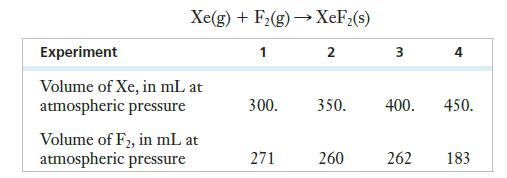
According to an article published in 1966 in the Journal of Chemical Education, xenon reacts photochemically with fluorine at room temperature (298 K) to produce XeF2. A portion of a table showing ratios of gases in the reaction vessel for four experiments is reproduced below. (Assume that
In the previous problem, the reaction to produce XeF2 occurs photochemically at room temperature. However, to produce XeF4(s), higher temperature and pressure are required. Production of XeF6 requires even higher pressures. Discuss the differences in reaction conditions for these three reactions in
On a particular day, the ozone level in Milwaukee exceeded the EPA’s 1-hour standard of 0.12 ppm by 10 ppb. How many ozone molecules would be present in 1 liter of air at the detection site?
The EPA’s 8-hour ozone standard for communities is 0.075 ppm. On a certain day, the concentration of ozone in the atmosphere in Denver was 1.5 × 10⁻⁹ mol/L. Was Denver in compliance with EPA regulations that day?
The following is a thought experiment. Imagine that you put a little water in a test tube and add some NaF crystals. Immediately after you add NaF, you observe that the crystals begin dissolving. The quantity of solid NaF decreases, but before long, it appears that no more NaF is dissolving. The
The Haber process, which produces ammonia from nitrogen and hydrogen, is one of the world’s most important industrial chemical reactions:For this reaction, both ΔH° and ΔS° are negative, meaning that product formation is thermodynamically favored by low temperatures. Yet the industrial
Experiments show that the reaction of nitrogen dioxide with fluorine,The reaction is thought to occur in two steps.(a) Show that the sum of this sequence of reactions gives the balanced equation for the overall reaction.(b) Which step is rate determining? 2 NO₂(g) + F₂(g) → 2 FNO₂(g) has
Chemical engineering design often uses mol% as a measure of concentration. A combustion reactor has an inlet flow of 5.50 mol% propane in air. Analysis of the product stream from the reactor finds 6.25 mol% CO2. Does this measurement indicate complete combustion? What other species might you
The flashing of fireflies is the result of a chemical reaction, and the rate of flashing can be described by the Arrhenius equation. A certain batch of fireflies were observed to flash at a rate of 16.0 times per minute at 25°C and at a rate of 5.5 times per minute at 15°C. Use these data to find
Suppose that you are studying a reaction and need to determine its rate law. Explain what you would need to measure in order to accomplish this in a single experiment, and how you could use graphical methods to get from the experimental data to a complete rate law.
You measure an archeological specimen and find that the count rate from 14C is x% of that seen in living organisms.How does this information allow you to establish the age of the artifact? What would you have to know or look up?
At room temperature, it takes about 3 days for a container of milk to turn sour. An identical container stored in a refrigerator turns sour only after 11 days. How could you use this information to estimate the activation energy of the chemical reaction that turns milk sour? What information would
You are designing a self-heating food package. The chemicals you are using seem to be used up too quickly. What experiments could be run to devise conditions that would allow the heating pack to last longer?
Fluorine often reacts explosively. What does this fact suggest about fluorine reactions at the molecular level?
In Chapter 4, we noted that compressibility is an important factor for fuels, and that some hydrocarbons are more compressible than others. If a fuel is not very compressible, what can we infer about the activation energy for its combustion reaction?
A free radical is often used as a catalyst for polymerization reactions. Such reactions normally need to be carried out at higher temperatures. Explain this fact from the molecular perspective in terms of the activation energy of the reactants.
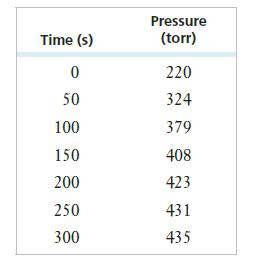
When formic acid is heated, it decomposes to hydrogen and carbon dioxide in a first-order decay:The rate of reaction is monitored by measuring the total pressure in the reaction container.Calculate the rate constant and half-life in seconds for the reaction. At the start of the reaction (time = 0),
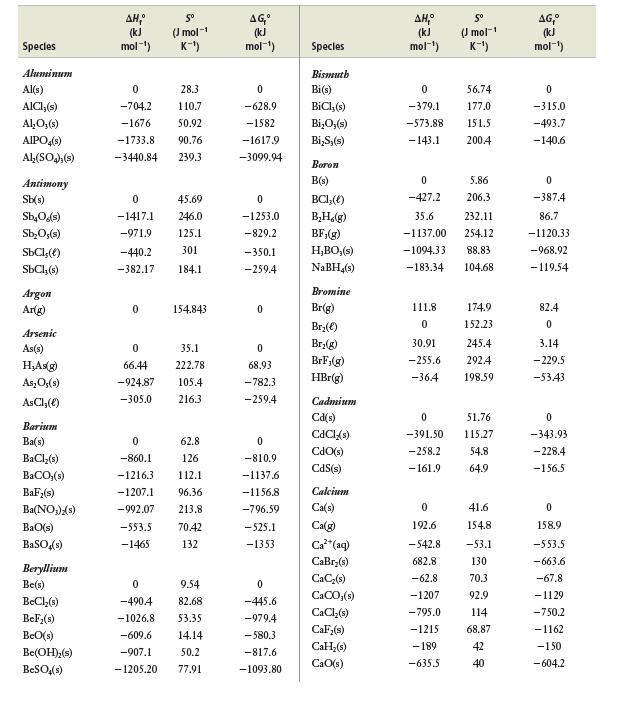
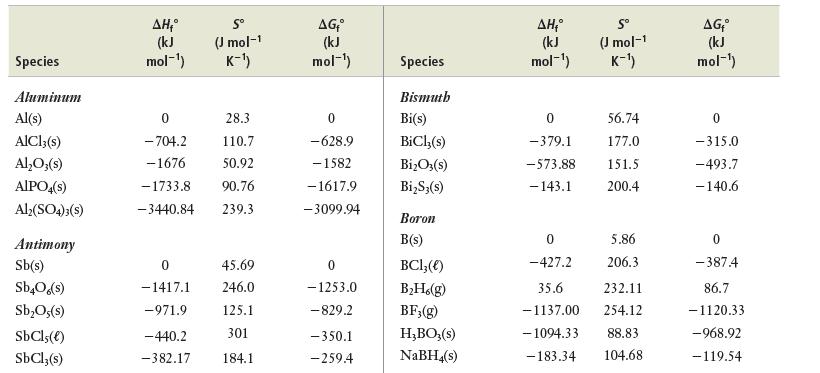
You have a table of thermodynamic variables that includes heats of formation and standard entropies but not free energies of formation. How could you use the information you have to estimate the free energy of formation of a substance that is listed in your table?Data from table of thermodynamic
On the basis of your experience, predict which of the following reactions are spontaneous.(a) CO2(s) → CO2(g) at 25°C(b) NaCl(s) → NaCl(ℓ) at 25°C(c) 2 NaCl(s) → 2 Na(s) + Cl2(g)(d) CO2(g) → C(s) + O2(g)
The heat of fusion of crystalline polyethylene is approximately 7.7 kJ/mol, and the corresponding entropy change for melting is 19 J mol-1 K-1. Use these data to estimate the melting point of polyethylene.Strategy Because ΔH and ΔS are both positive, we know that ΔG must be positive at low
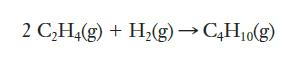
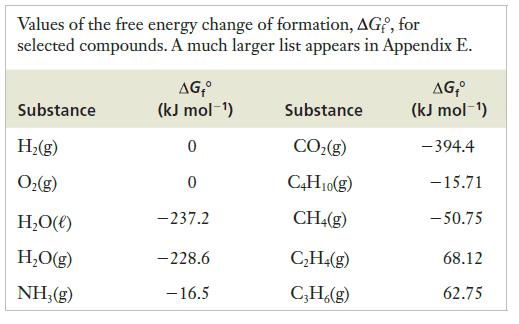
In Example Problem 10.1, we considered an addition reaction involving two ethylene molecules and found that the entropy change was negative. We suggested at the time that this reaction would still be spontaneous because it is strongly exothermic. Confirm this by calculating the standard free energy
Use the web to research a company that specializes in the recycling of plastics. Does the material on their website emphasize environmental, scientific, or economic concerns? Write a brief essay on the company’s positions, explaining how they fit with the ideas expressed in this chapter.
Use the web to learn how many pounds of plastics are recycled in your area each year. How has this value changed during the past decade?
Identify each of the processes listed as spontaneous or nonspontaneous. For each nonspontaneous process, describe the corresponding spontaneous process in the opposite direction.(a) A group of cheerleaders builds a human pyramid.(b) Table salt dissolves in water.(c) A cup of cold coffee in a room
Athletic trainers use instant ice packs that can be cooled quickly on demand. Squeezing the pack breaks an inner container, allowing two components to mix and react. This reaction makes the pack become cold. Describe the heat flow for this spontaneous process.
What happens to the entropy of the universe during a spontaneous process?
One statement of the second law of thermodynamics is that heat cannot be turned completely into work. Another is that the entropy of the universe always increases. How are these two statements related?
When a reaction is exothermic, how does that influence ΔS of the system? Of the surroundings?
Suppose that you find out that a system has an absolute entropy of zero. What else can you conclude about that system?
Look up the value of the standard entropy for the following molecules: CH4(g), C2H5OH(ℓ), H2C2O4(s). Rank the compounds in order of increasing entropy and then explain why this ranking makes sense.
Under what conditions does ΔG allow us to predict whether a process is spontaneous?
There is another free energy state function, the Helmholtz free energy (A), defined as A = E – TS. Comparing this to the definition of G, we see that internal energy has replaced enthalpy in the definition. Under what conditions would this free energy tell us whether or not a process is
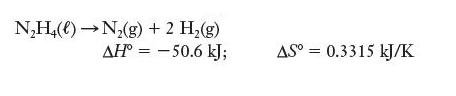
Discuss the effect of temperature change on the spontaneity of the following reactions at 1 atm.(a) (b) (c) Al₂O3(s) +2 Fe(s)→2 Al(s) + Fe₂O3(s) ΔΗ° = 851.5 kJ; AS = 38.5 J/K
The combustion of acetylene was used in welder’s torches for many years because it produces a very hot flame:(a) Use data in Appendix E to calculate ΔS° for this reaction.(b) Calculate ΔG° and show that the reaction is spontaneous at 25°C.(c) Is there any temperature range in which this
Natural gas (methane) is being used in experimental vehicles as a clean-burning fuel.(a) Write the equation for the combustion of CH4(g), assuming that all reactants and products are in the gas phase.(b) Use data from Appendix E to calculate ΔS° for this reaction.(c) Calculate ΔG° and show that
Using tabulated thermodynamic data, calculate ΔG° for these reactions.(a) Fe(s) + 2 HCl(g) → FeCl2(s) + H2(g)(b) 3 NO2(g) + H2O(ℓ) → 2 HNO3(ℓ) + NO(g)(c) 2 K(s) + Cl2(g) → 2 KCl(s)(d) Cl2(g) + 2 NO(g) → 2 NOCl(g)(e) SiCl4(g) → Si(s) + 2 Cl2(g)
Calculate ΔG° for the dissolution of both sodium chloride and silver chloride using data from Appendix e. Explain how the values you obtain relate to the solubility rules for these substances.
The vessel on the left contains a mixture of oxygen and nitrogen at atmospheric pressure. The vessel on the right is evacuated.(a) Describe what will happen when the stopcock is opened.(b) If you could see the individual molecules, what would you observe after a period of time has passed?(c)
When ice melts, its volume decreases. Despite this fact, the entropy of the system increases. Explain (a) why the entropy increases and (b) why under most circumstances, a decrease in volume results in an entropy decrease.
If a sample of air were separated into nitrogen and oxygen molecules (ignoring other gases present), what would be the sign of ΔS for this process? Explain your answer. The next four questions relate to the following paragraph [Frank l. Lambert, Journal of Chemical Education, 76(10), 1999, 1385].
A student opens a stack of new playing cards and shuffles them. In light of the quoted paragraph, have the cards increased in entropy? Explain your answer in terms of thermodynamics. Explain why the agent (the shuffler) undergoes an increase in entropy.
Some say that the job of an engineer is to fight nature and the tendencies of entropy. (a) Does this statement seem accurate in any way? (b) How can any engineering design create order without violating the second law of thermodynamics?
Why is it usually easier to use ΔG to determine the spontaneity of a process rather than ΔSu?
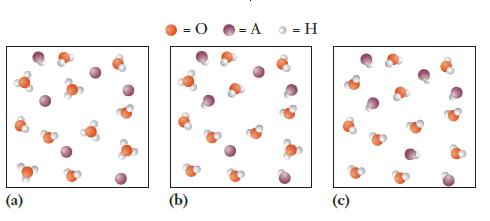
The molecular scale pictures below show snapshots of a strong acid at three different instants after it is added to water. Place the three pictures in the correct order so that they show the progress of the spontaneous process that takes place as the acid dissolves in the water. Explain your answer
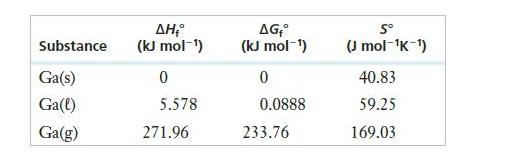
Gallium metal has a melting point of 29.8ºC. Use the information below to estimate the boiling point of gallium in °C. Substance Ga(s) Ga(l) Ga(g) ΔΗ,° (kJ mol-¹) 0 5.578 271.96 AG, (kJ mol-¹) 0 0.0888 233.76 Sº (J mol-¹K-¹) 40.83 59.25 169.03
The enthalpy of vaporization for water is 40.65 kJ mol-1. As a design engineer for a project in a desert climate, you are exploring the option of using evaporative cooling.(a) If the air has an average volumetric heat capacity of 0.00130 J cm-3 K-1, what is the minimum mass of water that would need
Nickel metal reacts with carbon monoxide to form tetracarbonyl nickel, Ni(CO)4:This reaction is exploited in the Mond process in order to separate pure nickel from other metals. The reaction above separates nickel from impurities by dissolving it into the gas phase. Conditions are then changed so
Suppose that you need to know the heat of formation of 2-pentene, C5H10, but the tables you have do not provide the value. You have a sample of the chemical. What could you do to determine the heat of formation?
You have a table of thermodynamic variables that includes standard entropies and free energies of formation but not heats of formation. How could you use the information you have to estimate the heat of formation of a substance that is listed in your table?
Place these types of radiation in order of increasing energy per photon. (a) Green light from a mercury lamp,(b) X-rays from a dental X-ray, (c) Microwaves in a microwave oven,(d) An FM music station broadcasting at 89.1 MHz
“Reduce, reuse, recycle” is a common slogan among environmentalists, and the order of the three words indicates their perceived relative benefits. Why is recycling the least desirable of these three approaches to waste reduction?
For the following chemical reactions, predict the sign of ΔS for the system. (That this should not require any detailed calculations.)(a) Fe(s) + 2 HCl(g) → FeCl2(s) + H2(g)(b) 3 NO2(g) + H2O(ℓ) → 2 HNO3(ℓ) + NO(g)(c) 2 K(s) + Cl2(g) → 2 KCl(s)(d) Cl2(g) + 2 NO(g) → 2 NOCl(g)(e)
Why do we need to consider the surroundings of a system when applying the second law of thermodynamics?
According to the second law of thermodynamics, how does the sign of ΔSu relate to the concept that some energy is wasted or lost to the surroundings when we attempt to convert heat into work?
Which reaction occurs with the greater increase in entropy? Explain your reasoning.(a) 2 H2O(ℓ) → 2 H2(g) + O2(g)(b) C(s) + O2(g) → CO2(g)
Which reaction occurs with the greater increase in entropy? Explain your reasoning.(a) 2 NO(g) → N2(g) + O2(g)(b) Br2(g) + Cl2(g) → 2 BrCl(g)
Methanol is burned as fuel in some race cars. This makes it clear that the reaction is spontaneous once methanol is ignited. Yet the entropy change for the reaction 2 CH3OH(ℓ) + 3 O2(g) → 2 CO2(g) + 4 H2O(ℓ) is negative. Why doesn’t this violate the second law of thermodynamics?
Limestone is predominantly CaCO3, which can undergo the reaction CaCO3(s) → CaO(s) + CO2(g). We know from experience that this reaction is not spontaneous, yet ΔS for the reaction is positive. How can the second law of thermodynamics explain that this reaction is not spontaneous?
Use tabulated thermodynamic data to calculate the standard entropy change of each of the reactions listed below.(a) Fe(s) + 2 HCl(g) → FeCl2(s) + H2(g)(b) 3 NO2(g) + H2O(ℓ) → 2 HNO3(ℓ) + NO(g)(c) 2 K(s) + Cl2(g) → 2 KCl(s)(d) Cl2(g) + 2 NO(g) → 2 NOCl(g)(e) SiCl4(g) → Si(s) + 2 Cl2(g)
If you scan the values for S° in Appendix E, you will see that some aqueous ions have values that are less than zero. The third law of thermodynamics states that for a pure substance the entropy goes to zero only at 0 k. Use your understanding of the solvation of ions in water to explain how a
Calculate ΔS° for the dissolution of magnesium chloride: MgCl2(s) → Mg2+(aq) + 2 Cl-(aq). Use your understanding of the solvation of ions at the molecular level to explain the sign of ΔS°.
Calculate the standard entropy change for the reaction CO2(g) + 2 H2O(ℓ) → CH4(g) + 2 O2(g). What does the sign of S8 say about the spontaneity of this reaction?
Through photosynthesis, plants build molecules of sugar containing several carbon atoms from carbon dioxide. In the process, entropy is decreased. The reaction of CO2 with formic acid to form oxalic acid provides a simple example of a reaction in which the number of carbon atoms in a compound
Find websites describing two different attempts to reach the coldest temperature on record. What features do these experiments have in common?
Look up the value of the standard entropy for the following molecules: SiO2(s), NH3(g), C2H6(g). Rank the compounds in order of increasing entropy and then explain why this ranking makes sense.
Calculate ΔG° at 45°C for reactions for which(a) ΔH° = 293 kJ; ΔS° = –695 J/K(b) ΔH° = –1137 kJ; ΔS° = 0.496 kJ/K(c) ΔH° = –86.6 kJ; ΔS° = –382 J/K
Why is the free energy change of a system equal to the maximum work rather than just the work?
Distinguish between a reversible and an irreversible process.
For the reaction NO(g) + NO2(g) → N2O3(g), use tabulated thermodynamic data to calculate ΔH°and ΔS°. Then use those values to answer the following questions.(a) Is this reaction spontaneous at 25°C? Explain your answer.(b) If the reaction is not spontaneous at 258C, will it become
Showing 400 - 500
of 1536
1
2
3
4
5
6
7
8
9
10
11
12
13
14
15
Last
Step by Step Answers

 Get 50% OFF
Claim Now
Get 50% OFF
Claim Now





![2 NO(g) + F(g) 2 FNO(g) has the rate law Rate = k[NO][F]](https://dsd5zvtm8ll6.cloudfront.net/images/question_images/1701/0/7/4/96965645819936b91701074968278.jpg)