New Semester
Started
Get
50% OFF
Study Help!
--h --m --s
Claim Now
Question Answers
Textbooks
Find textbooks, questions and answers
Oops, something went wrong!
Change your search query and then try again
S
Books
FREE
Study Help
Expert Questions
Accounting
General Management
Mathematics
Finance
Organizational Behaviour
Law
Physics
Operating System
Management Leadership
Sociology
Programming
Marketing
Database
Computer Network
Economics
Textbooks Solutions
Accounting
Managerial Accounting
Management Leadership
Cost Accounting
Statistics
Business Law
Corporate Finance
Finance
Economics
Auditing
Tutors
Online Tutors
Find a Tutor
Hire a Tutor
Become a Tutor
AI Tutor
AI Study Planner
NEW
Sell Books
Search
Search
Sign In
Register
study help
sciences
essential university physics
Essential University Physics 3rd Edition Volume 2 Richard Wolfsonby - Solutions
Calculate the electric fields in Example 21.2 directly, using the superposition principle and integration. Consider the shell to be composed of charge elements that are coaxial rings, whose axes pass through the field point, which is a distance r from the center.
A charged slab extends infinitely in two dimensions and has thickness d in the third dimension, as shown in Fig. 21.36. The slab carries a uniform volume charge density r. Find expressions for the electric field (a) inside and (b) outside the slab, as functions of the distance x from the center
The disk in Fig. 21.22 has area 0.14 m2 and is uniformly charged to 5.0 μC. Find the approximate field strength (a) 1 mm from the disk, not near the edge, (b) 2.5 m from the disk.
The net charge shown in Fig. 21.33 is +Q. Identify each of the charges A, B, and C shown. A B C Figure 21.33 Exercise 19 Section 21.2 Electric Field and Electric Flux
In Example 20.2, find the position on the y-axis where Q will experience the greatest force.
Use the binomial theorem to show that, for x >> R,the result of Problem 73 reduces to the field of a point charge whose total charge is the charge density times the disk area.
An electrostatic analyzer like that of Example 20.8 has b = 7.5 cm.What value of E0 will enable the device to select protons moving at 84 m/s?
Prove that, with the Hamiltonian (4.39), Hamilton's equations give the expected equation of motion. H = 2m (p=qA(r, t)) + q (r, t) (4.39)
We consider, in three dimensions, a particle of mass \(m\) placed in a potential \(V(\mathbf{r})\), whose Hamiltonian is \(H=p^{2} / 2 m+V(\mathbf{r})\). We assume that the particle is in a bound state with a given energy \(E\).1.Consider the physical quantity \(A=\mathbf{r} \cdot \mathbf{p} \equiv
Consider a massive string of constant linear mass density μ and length L whose endpoints are fixed at A (x = 0, z = z0) and B (x = a, z = z1). The string lies in the vertical plane (x, z), and it is in the gravitational field, oriented along the vertical z axis. Determine the shape of the string
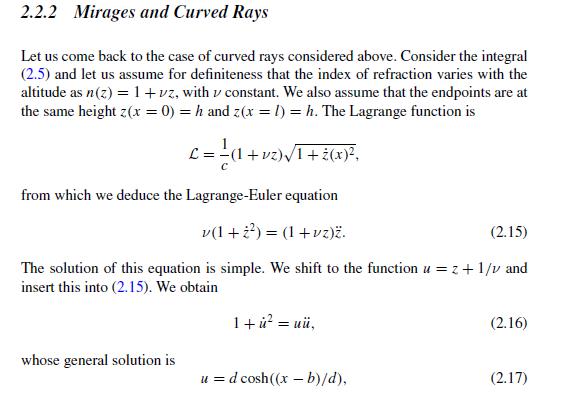
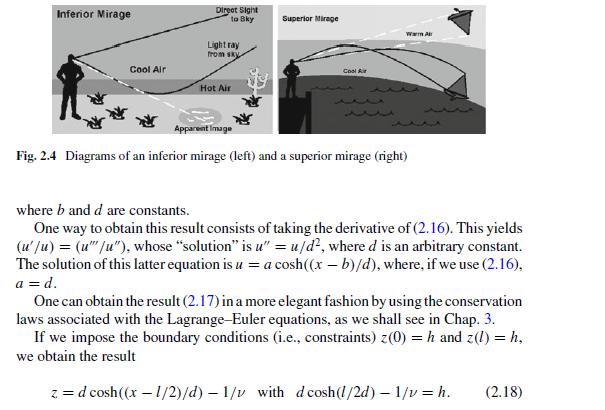
In the calculation of bent rays (Sect. 2.2.2) or the massive string above, show that the quantity Г(z) = r/√1 + ˙r (z)2 is constant along the path (or string). From that observation, deduce the solution of the problem.
Reconsider the massive string exercise above using Lagrange multipliers in order to express the constraints; i.e., the length of the string and the positions of the endpoints.Exercises Q4 In the calculation of bent rays (Sect. 2.2.2) or the massive string above, show that the quantity Г(z) =
What is the equation of the optimal trajectory?A skier slides down a snowy plane slope. The plane makes an angle α with respect to the horizontal direction. The skier is in the vertical field of gravity, of acceleration g. The skier starts with a zero velocity from some point O and wants to reach
Show that along the optimal trajectory the quantityis a constant. Deduce from this that along the trajectory the quantity f (t) = ˙y/x is a constant K, and express its value in terms of C, g, and α.A skier slides down a snowy plane slope. The plane makes an angle α with respect to the horizontal
Check that the parametric form x(θ) = (1 − cos 2θ)/(2C2) and y(θ) = (2θ − sin 2θ)/(2C2) is a solution. Use the result of the previous question to calculate the function θ(t).A skier slides down a snowy plane slope. The plane makes an angle α with respect to the horizontal direction. The
What kind of curve is it? Draw the trajectory qualitatively in the case y′(A) ≫ 1.A skier slides down a snowy plane slope. The plane makes an angle α with respect to the horizontal direction. The skier is in the vertical field of gravity, of acceleration g. The skier starts with a zero
Explain the result physically.A skier slides down a snowy plane slope. The plane makes an angle α with respect to the horizontal direction. The skier is in the vertical field of gravity, of acceleration g. The skier starts with a zero velocity from some point O and wants to reach a given point A,
Consider a pendulum of length l and mass m2 hanging on a point of mass m1 that moves horizontally without friction on a rail.We note x the abscissa of m1 and φ the angle with the vertical direction. Write the Lagrangian of this system.
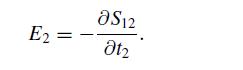
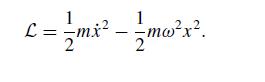
1.We consider a free particle of Lagrangian L = m ˙ x2/2. Calculate the action along the physical trajectory in terms of the positions and times of departure (x1, t1)and arrival (x2, t2).2.Consider a harmonic oscillator L = (m/2)( ˙ x2 − ω2x2). Calculate the action, setting T = t2 −
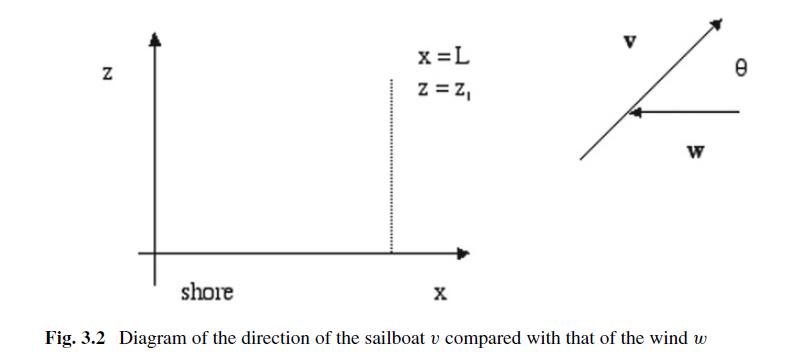
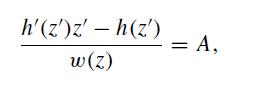
We first assume thewind is uniform (w =constant,w1 = 0).Write the expression of the velocity of the boat along the axis of the wind vx = ˙x in terms of w and h(tan θ). For what values of θ and z′ is this velocity maximum? What is its value?A sailboat has velocity v(θ), which is a function of
We assume that z′ ≥ 0 for all t (i.e. the boat never changes tack). We want to determine the fastest trajectory z(x). Write the expression of the time dt to go, on this trajectory, from x to x + dx in terms of the functions w and h. Give the value of the total time T between the starting point
Calculate the value of z′ = dz/dx as a function of z.We assume that z1 ≪ L and z1 ≪ z0. Do you think the result corresponds to the best strategy? If not, what modifications must the skipper make?A sailboat has velocity v(θ), which is a function of the angle θ between the direction of the
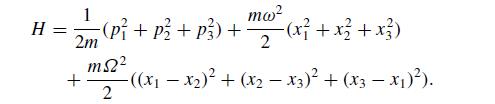
The problem of three coupled oscillators is treated in analogous manner as the twobody case of Sect. (4.3) with the Jacobi variables.The Hamiltonian isThe canonical transformation (Jacobi variables) isCalculate The poisson brackets {Xi , Pj }.Describe the three-body trajectory (or manifold) in
Consider a one dimensional harmonic oscillator of Hamiltonianwhere x and p are Lagrange conjugate variables.1.We set x = X/ √mω and p = P √mω.Write the expression of the Hamiltonian in terms of X and P, and calculate the Poisson bracket {X, P}.2.We introduce the functions a and a∗, the
We assume that at time t = 0 we have yN (0) = 1, ˙yN (0) = 0 and {yn(0) =0, ˙yn(0) = 0, ∀n ≠ N}. Calculate {xn(t)} and interpret the result.
Propagation of waves.We now assume, for simplicity, that ω = 0.We also assume that N ≫ 1, so that sin(k/N)~ (k/N) for k < < N. We assume that for t = 0 we have yN-1 = 1, y = 1, yn = 0 if n (1 or N-1), and y = 0 Vn.
Neutron transport in matter The equation for neutron transport in matter has the formcalled the telegraph equation (see, for instance, Appendix D of [16]) which shows a propagation term of the neutron density, of individual velocities v which we assume to be the same and constant here. In the
Consider the metric\[d s^{2}=\frac{R^{2}}{ho^{2}-R^{2}} d ho^{2}+ho^{2} d \theta^{2}+ho^{2} \sin ^{2} \theta d \phi^{2}\]which can be considered to be derived from a "Lorentzian" metric\[d s^{2}=d x^{2}+d y^{2}+d z^{2}-d w^{2}\]by the three-dimensional
Consider the metric\[d s^{2}=\frac{R^{2}}{ho^{2}+R^{2}} d ho^{2}+ho^{2} d \theta^{2}+ho^{2} \sin ^{2} \theta d \phi^{2}\]where \(R\) is a positive characteristic length.Notice that one considers this metric as deriving from a "Lorentzian" metric, if one changes the sign of \(R\)\[d s^{2}=d x^{2}+d
Consider the Euclidean plane of the motion (i.e., \(x=ho \cos \phi, y=ho \sin \phi\) ). For simplicity, we choose the initial parameters as \(t_{0}=0, \phi_{0}=0\), and we have\[x=R \cos \omega t \quad y=\gamma R \sin \omega t .\]The trajectory is an ellipse of equation \(x^{2}+y^{2} /
The point \(ho=R\) (i.e., the boundary of the space) is always reached, whatever the initial conditions on the energy and the angular momentum. If \(A=0\), the angular momentum vanishes and the motion is linear and sinusoidal. If \(\gamma=1\), the motion is uniform on a circle of radius
In this Euclidean plane, the energy of the particle is\[E=\frac{1}{2} m\left(\dot{x}^{2}+\dot{y}^{2}ight)+V\]where the "effective potential" \(V\) is energy dependent:\[V=\frac{1}{2} m \frac{ho^{2} \dot{ho}^{2}}{R^{2}-ho^{2}}=\frac{E ho^{2}}{R^{2}}\]Therefore, the motion also appears as a
Of course, if the square of the velocity is a constant in the curved fourdimensional space, this is not the case if one visualizes the phenomenon in a Euclidean plane.Consider the case of free motion on the three-dimensional "spherical" space of a sphere \(\mathbf{S}^{3}\) imbedded in
The simplicity of the result is intuitive. Quite obviously, as one can see in the definition (7.3), the symmetry of the problem is much larger than the sole rotation in \(\mathcal{R}^{3}\). There is a rotation invariance in \(\mathcal{R}^{4}\). The solutions of maximal symmetry correspond to a
We consider a non-relativistic particle of mass m in a central potential V(r), where r =√x2 + y2 + z2. We denote the velocity v ≡ ˙r and v2 its square. We study the problem in spherical coordinates (r, θ, φ) defined byThe square of the velocity is1. Write the Lagrangian of the particle in
We denoteShow that z = tan θ.A sailboat has velocity v(θ), which is a function of the angle θ between the direction of the wind and the direction of the boat and also of the norm w of the velocity of the wind.We assume that the velocity of the boat v is proportional to the velocity of the wind
A popular problem for mathematicians of the 17th century was the brachistochrone curve. Consider two points A and B in a vertical plane, joined by a curve C. In A, a massive particle is dropped with zero initial velocity, and it slides without friction along the curve under the effect of
Show that the translation invariance of the problem along the x direction yieldswhere A is a constant.A sailboat has velocity v(θ), which is a function of the angle θ between the direction of the wind and the direction of the boat and also of the norm w of the velocity of the wind.We assume that
Deduce from (3) the equation that determines the optimal trajectory (which minimizes T ).A sailboat has velocity v(θ), which is a function of the angle θ between the direction of the wind and the direction of the boat and also of the norm w of the velocity of the wind.We assume that the velocity
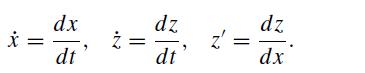
Calculate the time it takes to go from O to A if the skier follows a trajectory defined by a function y(x) (note y ≡ dy/dx).A skier slides down a snowy plane slope. The plane makes an angle α with respect to the horizontal direction. The skier is in the vertical field of gravity, of acceleration
Use the previous result to calculate the trajectory in the form of a function x(z) (and not a function z(x)). Fix the value of the constant A.A sailboat has velocity v(θ), which is a function of the angle θ between the direction of the wind and the direction of the boat and also of the norm w of
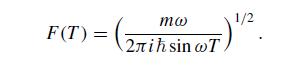
The Lagrangian of a one-dimensional harmonic oscillator isShow that the corresponding propagator iswhere T = tb − ta and where c = {m -{maxx, L 2
Write the expression of the skier’s total energy at a given time. We denote ˙ x ≡ dx/dt, ˙y ≡ dy/dt. What is the relation between the potential energy and the kinetic energy owing to energy conservation?A skier slides down a snowy plane slope. The plane makes an angle α with respect to the
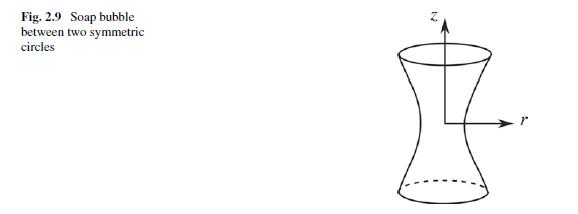
The potential energy of a soap bubble of total area A is V = σA, where σ is the surface tension constant of the soap.We consider a soap bubble between two circles of the same axis and same radius R, as in Fig. 2.9. The z axis is the common axis perpendicular to the two circles, which are centered
Use the previous expression to express the square of the time interval dt between two positions, (x, y) and (x + dx, y + dy), of the skier, in terms of dx2, dy2, x, y, g, and α.A skier slides down a snowy plane slope. The plane makes an angle α with respect to the horizontal direction. The skier
Calculate the Poisson brackets of the three components of the angular momentum L = r × p.
Define the following complex variableswhose inverse relations are(a) Show that(b) Show that(c) Show that N Yk Delikna/N n=l Ex", qk N n=l 2ikna/N pn (4.44)
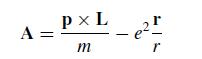
We consider Kepler’s problem H = p2/2m − e2/r. Calculate the Poisson brackets of the components of the Lenz vectorbetween each other, with the components of the angular momentum and with the Hamiltonian. What can one conclude on the number of unknowns in that problem? A = || PXL m e- r
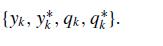
Equations of motion and their solutions(a) Write the Hamiltonian (4.43) in terms of the variables(b) Calculate the following Poisson brackets(c) Write the differential equations satisfied by the variables (d) Write the general expression of {yk(t)}; deduce from it the expression of {xn(t)}. {yk,
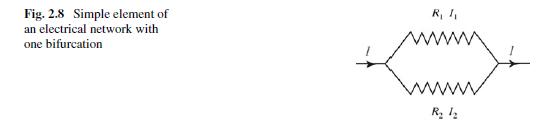
We want to determine the relative intensities I1 and I2 of the electric current in the two legs of the simple electric circuit shown in Fig. 2.8, whose resistances are R1 and R2. The incoming current has an intensity I . The well-known result is easily obtained with the Ohm–Kirchhoff laws.Show
Check that with this definition of the variable x, the potential energy of the skier at point (x, y) is V = −mgx sin α.A skier slides down a snowy plane slope. The plane makes an angle α with respect to the horizontal direction. The skier is in the vertical field of gravity, of acceleration g.
Pions are the lightest mesons, with mass some 270 times that of the electron. Charged pions decay typically into a muon and a neutrino or antineutrino. This makes pion beams useful for producing beams of neutrinos, which physicists use to study those elusive particles. In a medical application
Pions are the lightest mesons, with mass some 270 times that of the electron. Charged pions decay typically into a muon and a neutrino or antineutrino. This makes pion beams useful for producing beams of neutrinos, which physicists use to study those elusive particles. In a medical application
Pions are the lightest mesons, with mass some 270 times that of the electron. Charged pions decay typically into a muon and a neutrino or antineutrino. This makes pion beams useful for producing beams of neutrinos, which physicists use to study those elusive particles. In a medical application
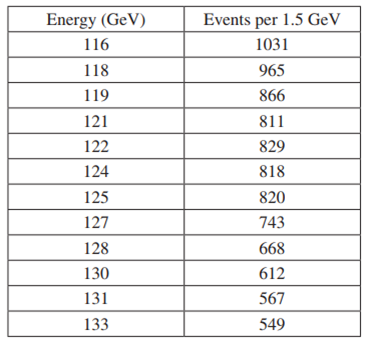
When physicists ?discover? a new particle, it isn?t by finding the particle itself in their detectors. Rather, they look for events that might indicate the particle?s decay. For a given type of event, they plot the frequency of events (number per unit energy interval) versus energy. The particle
Your roommate is writing a science-fiction novel set very far in the future, 60 Gy after the Big Bang. One of the characters is a cosmologist, and your roommate wants to know what the cosmologist will measure for the Hubble constant. What’s your answer, assuming a steady expansion rate?
A friend believes that the universe is less than 10,000 years old. Based on Hubble’s law, how would you argue that the universe is older? What would the Hubble constant be for a 10,000-year-old universe?
At the time the cosmic microwave background radiation originated, the temperature of the universe was about 3000 K. What were(a) The median wavelength of the newly formed radiation (Equation 34.2b) (b) The corresponding photon energy? AmedianT = 4.11 mm· K (34.2b)
(a) By what factor must the magnetic field in a proton synchrotron be increased as the proton energy increases by a factor of 10? Assume the protons are highly relativistic, so g W 1.(b) By what factor must the diameter of the accelerator be increased to raise the energy by a factor of 10 without
A so-called muonic atom is a hydrogen atom with the electron replaced by a muon; the muon’s mass is 207 times the electron’s. Find(a) the size(b) the ground-state energy of a muonic atom.
A baryon called the neutral lambda particle has mass 1116 MeV/c2. Find the minimum speed necessary for the particles in a proton–antiproton collider to produce lambda–antilambda pairs.
Estimate the diameter to which the Sun would have to be expanded for its average density to be the critical density found in Problem 48.Data From Problem 48Estimate the critical density of the universe.
Estimate the critical density of the universe.
In 2015 the proton energy in the Large Hadron Collider was doubled, from 7 TeV to 14 TeV. In working this problem, keep just two significant figures.(a) How did this energy change affect the protons’ speed?(b) What is the new speed?(c) How long does it take a 14-TeV proton to circle the LHC’s
(a) Find the relativistic factor γ for a 14-TeV proton in the Large Hadron Collider.(b) Find the proton’s speed, expressed as a decimal fraction of c, and accurate to 10 significant figures (you might need the binomial theorem here).
The Tevatron at Fermilab accelerates protons to energy of 1 TeV.(a) How much is this in joules?(b) How far would a 1-g mass have to fall in Earth’s gravitational field to gain this much energy?
List all the possible quark triplets formed from any combination of up, down, and charmed quarks, along with the charge of each.
The J/ψ particle is an uncharmed meson that nevertheless includes charmed quarks. Determine its quark composition.
Consider systems described by wave functions that are proportional to the terms (a) xy2z, (b) x2yz, and (c) xyz, where x, y, and z are the spatial coordinates. Which pairs of these systems could be transformed into each other under a parity-conserving interaction?
Some grand unification theories suggest that the decay p → π0 + e+ may be possible, in which case all matter may eventually become radiation. Are(a) baryon number(b) electric charge conserved in this hypothetical proton decay?
Both the neutral kaon and the neutral ρ meson can decay to a pion–antipion pair. Which of these decays is mediated by the weak force? How can you tell?
Which of the following reactions is not possible, and why not?(a) Λ0 → π+ + π-;(b) K0 → π+ + π-
The mass of the photon is assumed to be zero, but experiments put only an upper limit of 5x10-63 kg on the photon mass. What would the range of the electromagnetic force be if the photon mass were actually at this upper limit?
Find the recession speed of a galaxy 360 Mly from Earth.
Find the distance to a galaxy whose redshift reveals that it’s receding from us at 2.5x10⁴ km/s.
Estimate the temperature in a gas of particles such that the thermal energy kT is high enough to make electromagnetism and the weak force appear as a single phenomenon.
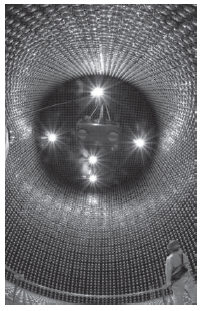
Estimate the volume of the 50,000 tons of water used in the Super Kamiokande experiment shown in Fig. 39.8.
The Σ+ and Σ- have quark compositions uus and dds, respectively. Are the Σ+ and Σ- each other’s antiparticles? If not, give the quark compositions of their antiparticles.
The Eightfold Way led Gell-Mann to predict a baryon with strangeness -3. Determine this particle’s quark composition.
Determine the quark composition of the π-.
Is the interaction p + p → p + π+ allowed? If not, what conservation law does it violate?
Are either or both of these decay schemes possible for the tau particle: (a) τ- → e- + ve ̅+ vτ; (b) τ- → e- + π e ̅+ π0 vτ;?
The η0 particle is a neutral nonstrange meson that can decay to a positive pion, a negative pion, and a neutral pion. Write the reaction for this decay, and verify that it conserves charge, baryon number, and strangeness.
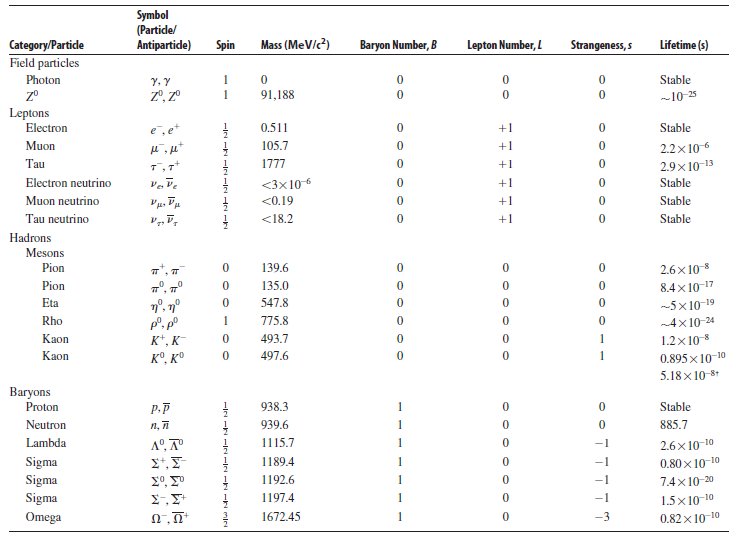
Use Table 39.1 to find the total strangeness before and after the decay ?0 ? ?- + p, and use your answer to determine which force is involved in this reaction. Symbol (Partide/ Antipartidle) Category/Partide Spin Mass (MeVIc?) Baryon Number, B Lepton Number, L Strangeness, s Lifetime (s) Field
Write the equation for the decay of a positive pion to a muon and a neutrino, being sure to label the type of neutrino.
Some scientists have speculated on a possible “fifth force,” with a range of about 100 m. Following Yukawa’s reasoning, what would be the mass of the field particle mediating such a force?
How long could a virtual photon of 633-nm red laser light exist without violating conservation of energy?
In 1972, a worker at a nuclear fuel plant in France found that uranium from a mine in Oklo, in the African Republic of Gabon, had less U-235 than the normal 0.7% a quantity known from meteorites and Moon rocks to be constant throughout the solar system. Further analysis showed the presence of
In 1972, a worker at a nuclear fuel plant in France found that uranium from a mine in Oklo, in the African Republic of Gabon, had less U-235 than the normal 0.7% a quantity known from meteorites and Moon rocks to be constant throughout the solar system. Further analysis showed the presence of
In 1972, a worker at a nuclear fuel plant in France found that uranium from a mine in Oklo, in the African Republic of Gabon, had less U-235 than the normal 0.7% a quantity known from meteorites and Moon rocks to be constant throughout the solar system. Further analysis showed the presence of
In 1972, a worker at a nuclear fuel plant in France found that uranium from a mine in Oklo, in the African Republic of Gabon, had less U-235 than the normal 0.7% a quantity known from meteorites and Moon rocks to be constant throughout the solar system. Further analysis showed the presence of
(a) Example 38.6 explains that the number of fission events in a chain reaction increases by a factor k with each generation. Show that the total number of fission events in n generations is N = (kn+1 – 1)/(k – 1).(b) In a typical nuclear explosive, k is about 1.5 and the generation time is
Nucleus A decays into B with decay constant λA and λB decays into a stable product C with decay constant λB. A pure sample starts with N0 nuclei A at t = 0. Find an expression for the total activity of the sample at time t.
The probability that a radioactive nucleus will have lifetime t is the probability that it will survive from time 0 to time t multiplied by the probability that it will decay in the interval from t to t + dt. Use this to show that the average lifetime of a nucleus is equal to the inverse of the
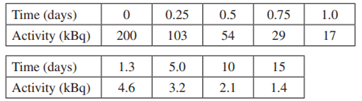
A mix of two isotopes, one of them from Table 38.1, is observed over a period of 15 days, and the total radioactivity is tabulated below. Determine a quantity that, when plotted against time, should yield one or more straight lines. Make your plot and use it to determine the half-lives of the
A family member is about to have a brain scan using technetium-99m, an excited isotope with 6.01-hour half-life. The hospital makes Tc-99m from the decay of molybdenum-99 (t1/2 = 2.7 days), then delivers it to the nuclear medicine department. You?re told that the Tc-99m will arrive 90 minutes after
Of the neutrons emitted in each fission event in a light-water reactor, an average of 0.6 neutron is absorbed by 238U, leading to the formation of 239Pu.(a) Assuming 200 MeV per fission, how much 239Pu forms each year in a 30%-efficient nuclear plant whose electric power output is 1.0 GW?(b) With
A laser-fusion fuel pellet has mass 1.0 mg and consists of equal parts (by mass) of deuterium and tritium.(a) If half the deuterons and an equal number of tritons participate in D-T fusion, how much energy is released?(b) At what rate must pellets be fused in a power plant with 3000-MW thermal
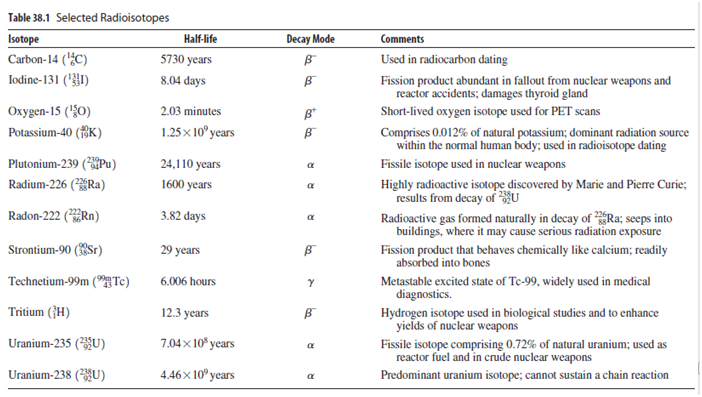
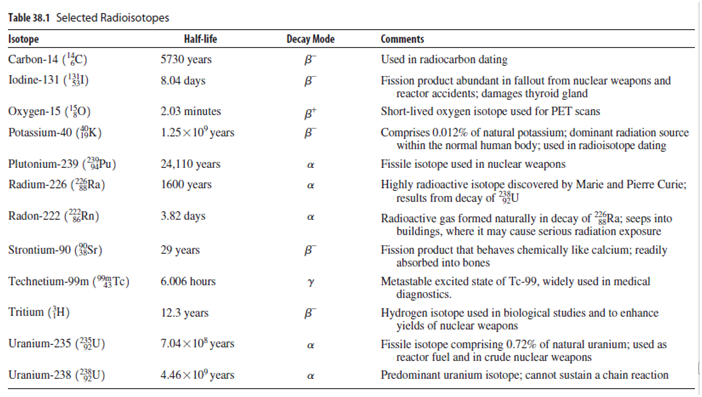
The dominant naturally occurring radioisotopes in the typical human body include 16mg of 40K and 16 ng of 14C. Using half-lives from Table 38.1, estimate the body?s natural radioactivity. Table 38.1 Selected Radioisotopes Decay Mode Isotope Carbon-14 (¿C) Half-life Comments 5730 years Used in
Nickel-65 beta decays by electron emission with decay constant l = 0.275 h-1.(a) Identify the daughter nucleus.(b) In a sample of initially pure Ni-65, find the time when there are twice as many daughter nuclei as parents.
Showing 100 - 200
of 1601
1
2
3
4
5
6
7
8
9
10
11
12
13
14
15
Last
Step by Step Answers

 Get 50% OFF
Claim Now
Get 50% OFF
Claim Now