New Semester
Started
Get
50% OFF
Study Help!
--h --m --s
Claim Now
Question Answers
Textbooks
Find textbooks, questions and answers
Oops, something went wrong!
Change your search query and then try again
S
Books
FREE
Study Help
Expert Questions
Accounting
General Management
Mathematics
Finance
Organizational Behaviour
Law
Physics
Operating System
Management Leadership
Sociology
Programming
Marketing
Database
Computer Network
Economics
Textbooks Solutions
Accounting
Managerial Accounting
Management Leadership
Cost Accounting
Statistics
Business Law
Corporate Finance
Finance
Economics
Auditing
Tutors
Online Tutors
Find a Tutor
Hire a Tutor
Become a Tutor
AI Tutor
AI Study Planner
NEW
Sell Books
Search
Search
Sign In
Register
study help
sciences
optics
Optics 5th edition Eugene Hecht - Solutions
A classic 35-mm film camera has a single thin lens having a 50.0-mm focal length. A woman 1.7 m tall stands 10.0 m in front of the camera.(a) Show that the lens-film distance must be 50.3 mm.(b) How tall is her image on the film?
Prove that the minimum separation between conjugate real object and image points for a thin positive lens is 4ƒ.
An object 2 cm high is positioned 5 cm to the right of a positive thin lens with a focal length of 10 cm. Describe the resulting image completely, using both the Gaussian and Newtonian equations.
Make a rough graph of the Gaussian Lens Equation; that is, plot si versus s0, using unit intervals of ƒ along each axis. (Get both segments of the curve.)
A parallel bundle of rays from a very distant point source is incident on a thin negative lens having a focal length of -50.0 cm. The rays make an angle of 6.0° with the optical axis of the lens. Locate the image of the source.
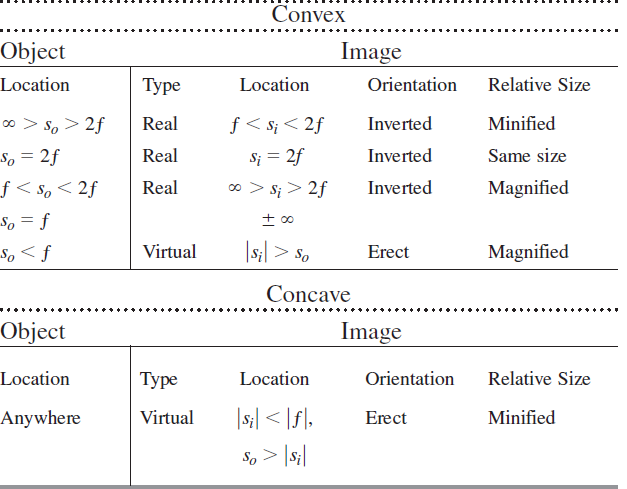
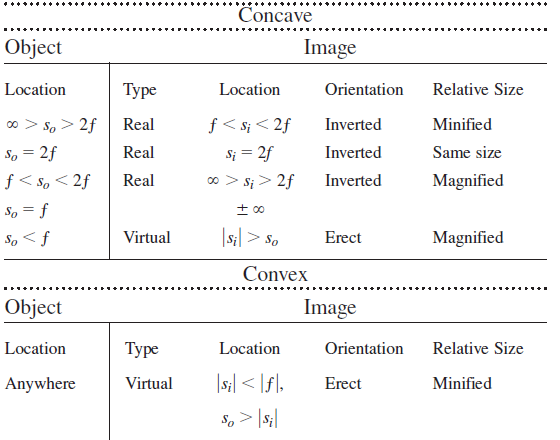
An LED is on the central axis 30.0 cm in front of a thin lens. The resulting image, which is virtual, is 10.0 cm from the lens. Determine the focal length of the lens. Using Table 5.3, explain why the lens must be negative even though a positive lens could also form a virtual image.Table 5.3 Convex
What must the focal length of a thin negative lens be for it to form a virtual image 50 cm away (measured from the lens) of an ant located 100 cm away (measured from the lens)? Given (just as a change of pace) that the ant is to the right of the lens, locate and describe its image.
A candle flame is 18.0 cm in front of a thin positive lens. Its image appears three times farther away from the lens than if the same candle were on a very distant mountain. Determine the lens’s focal length.
Compute the focal length in air of a thin biconvex lens (nl = 1.5) having radii of 20 and 40 cm. Locate and describe the image of an object 40 cm from the lens.
Determine the focal length of a planar-concave lens (nl = 1.5) having a radius of curvature of 10 cm. What is its power in diopters?
The focal length of a planar-convex thin lens in air is 250.0 cm. The glass it is made of has an index of 1.530. Determine the radii of curvature of its surfaces. What would happen to the radii if n was reduced to 1.500?
An object essentially at infinity is moved to a distance of 90 cm in front of a thin positive lens. In the process its image distance triples. Determine the focal length of the lens.
Determine the focal length in air of a thin spherical planar convex lens having a radius of curvature of 50.0 mm and an index of 1.50. What, if anything, would happen to the focal length if the lens were placed in a tank of water?
A point source S of light is on the central axis of a thin positive lens. It is at a distance l1 in front of the lens, and a real image of S appears at P, a distance l2 from the lens. Is it possible to move the lens along the axis to a new location and not finally change the positions of S and P?
An object on the central axis is 40 cm in front of a thin positive lens. Its image appears on a screen 80 cm beyond the lens. Now move the lens to a new location on the axis such that the image is again on the screen. Describe what happens, if anything, to the size and orientation of the image as a
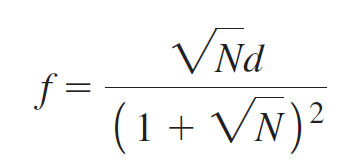
With the previous two problems in mind, imagine a selfluminous object on the central axis of a thin positive lens. The object is a distance d from the screen on which the image appears. Now suppose the lens is moved toward the object to a new location, whereupon the image on the screen is N times
We would like to place an object 45 cm in front of a lens and have its image appear on a screen 90 cm behind the lens. What must be the focal length of the appropriate positive lens?
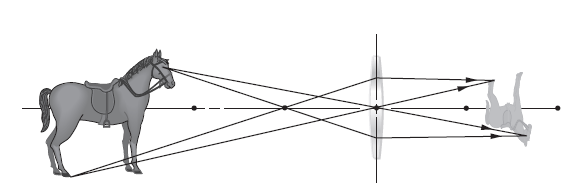
The horse in Fig. 5.29 is 2.25 m tall, and it stands with its face 15.0 m from the plane of the thin lens whose focal length is 3.00 m.(a) Determine the location of the image of the equine nose.(b) Describe the image in detail€”type, orientation, and magnification.(c) How tall is the
A candle that is 6.00 cm tall is standing 10 cm from a thin concave lens whose focal length is -30 cm. Determine the location of the image and describe it in detail. Draw an appropriate ray diagram.
The image projected on a viewing screen by an equiconvex lens (n = 1.50) of a frog 5.0 cm tall, who is located 0.60 from the screen, is to be 25 cm high. Please compute the necessary radii of the lens.
A biconvex thin lens located 127 cm from a screen projects onto it an image 5.80 times the size of the luminous object. Determine the focal length of the lens.
We wish to project an image of a frog on a screen. The image is to be twice life-size. If a thin convex-planar lens has a radius of curvature of 100 cm and is made of glass (ng = 1.50), and if it is used to create the image, how far from the screen must we position the frog? Draw a ray diagram.
Consider a thin equiconvex lens made of glass (n = 1.50), in air. A very distant luminous object is relocated to 180.0 cm in front of the lens. The resulting image distance increases to just about three times its original value. Determine the radii of curvature of the lens.
A thin, straight piece of wire 4.00 mm long is located in a plane perpendicular to the optical axis and 60.0 cm in front of a thin lens. The sharp image of the wire formed on a screen is 2.00 mm long. What is the focal length of the lens? When the screen is moved farther from the lens by 10.0 mm,
A thin double-convex glass lens (with an index of 1.56) while surrounded by air has a 10-cm focal length. If it is placed under water (having an index of 1.33) 100 cm beyond a small fish, where will the guppy’s image be formed?
Consider a homemade television projection system that uses a large positive lens to cast the image of the TV screen onto a wall. The projected picture is enlarged three times, and although dim, it’s nice and clear. If the lens has a focal length of 60 cm, what should be the distance between the
Write an expression for the focal length (ƒw) of a thin lens immersed in water (nw = 4/3 ) in terms of its focal length when it’s in air (ƒα).
Observe the three vectors vector A, vector B, and vector C in Fig. P.5.41, each of which has a length of 0.10Æ’ where Æ’ is the focal length of the thin positive lens. The plane formed by vector A and vector B is at a distance of 1.10Æ’ from the lens. Describe the
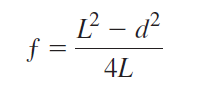
A convenient way to measure the focal length of a positive lens makes use of the following fact. If a pair of conjugate object and (real) image points (S and P) are separated by a distance L > 4Æ’, there will be two locations of the lens, a distance d apart, for which the same pair of
Two positive lenses with focal lengths of 0.30 m and 0.50 m are separated by a distance of 0.20 m. A small butterfly rests on the central axis 0.50 m in front of the first lens. Locate the resulting image with respect to the second lens.
In the process of constructing a doublet, an equiconvex thin lens L1 is positioned in intimate contact with a thin negative lens, L2, such that the combination has a focal length of 50 cm in air. If their indices are 1.50 and 1.55, respectively, and if the focal length of L2 is -50 cm, determine
Verify Eq. (5.34), which gives MT for a combination of two thin lenses.
A blade of grass standing 10.0 mm tall is 150 mm in front of a thin positive lens having a 100 mm focal length; 250 mm behind that first lens is a thin negative lens with a focal length of -75.0 mm.(a) Show that the first lens forms an image 300 mm behind it.(b) Describe that image.(c) What’s its
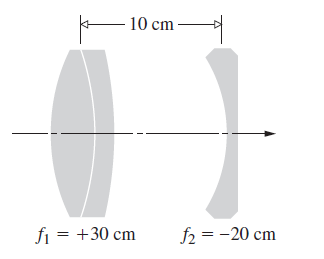
Compute the image location and magnification of an object 30 cm from the front doublet of the thin-lens combination in Fig. P.5.47. Do the calculation by finding the effect of each lens separately. Make a sketch of appropriate rays.Fig P.5.47 10 cm fi = +30 cm f2 = -20 cm
Two thin lenses having focal lengths of +15.0 cm and -15.0 cm are positioned 60.0 cm apart. A page of print is held 25.0 cm in front of the positive lens. Describe, in detail, the image of the print (i.e., insofar as it’s paraxial).
Draw a ray diagram for the combination of two positive lenses wherein their separation equals the sum of their respective focal lengths. Do the same thing for the case in which one of the lenses is negative.
Two positive lenses are to be used as a laserbeam expander. An axial 1.0-mm-diameter beam enters a short focal length positive lens, which is followed by a somewhat longer focal length positive lens from which it emerges with a diameter of 8.0 mm. Given that the first lens has a 50.0 mm focal
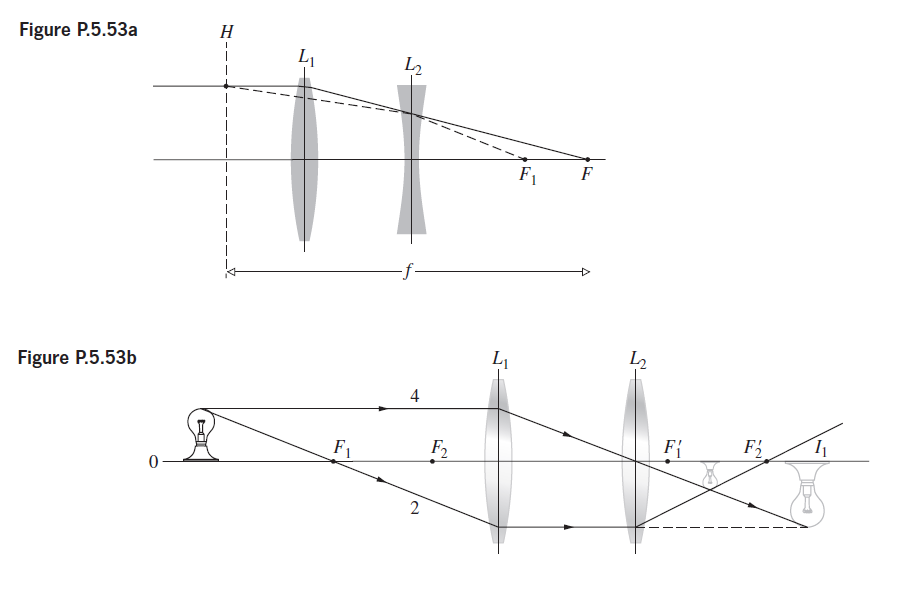
Figures P.5.53a and P.5.53b are taken from an introductory physics book. What€™s wrong with them? Н Figure P.5.53a L2 F1 Figure P.5.53b 4 F; F{ F2 F1 2.
Galileo’s best telescope had an eyepiece of -40 mm focal length, along with a biconvex objective about 30 mm in diameter. That objective formed real intermediate images of stars roughly 120 cm down the tube. Determine the magnification of that instrument and the focal ratio (ƒ/# ) of its
Consider the case of two positive thin lenses, L1 and L2, separated by 5 cm. Their diameters are 6 and 4 cm, respectively, and their focal lengths are ƒ1 = 9 cm and ƒ2 = 3 cm. If a diaphragm with a hole 1 cm in diameter is located between them, 2 cm from L2, find (a) the aperture stop and (b) the
A thin convex lens L is positioned midway between two diaphragms: D1, 4.0 cm to its left, and D2, 4.0 cm to its right. The lens has a diameter of 12 cm and a focal length of 12 cm. The holes in D1 and D2 have diameters of 12 cm and 8.0 cm, respectively. An axial object point is 20 cm to the left of
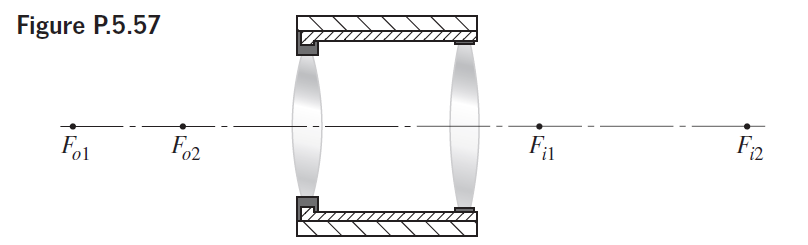
Make a sketch roughly locating the aperture stop and entrance and exit pupils for the lens in Fig. P.5.57. Figure P.5.57 FiR F2 F1 Fo2 Fol
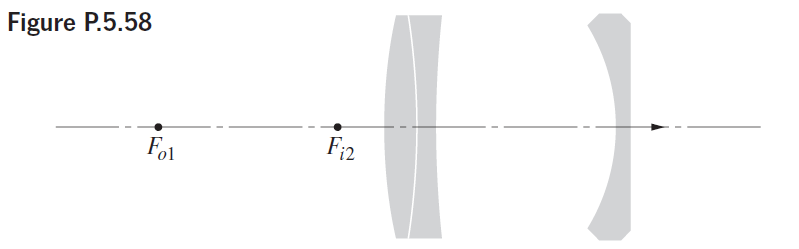
Make a sketch roughly locating the aperture stop and entrance and exit pupils for the lens in Fig. P.5.58, assuming the object point to be beyond (to the left of) Fo1. Figure P.5.58 Fol F;2
A refracting astronomical telescope has an objective lens 50 mm in diameter. Given that the instrument has a magnification of 10 ×, determine the diameter of the eye-beam (the cylinder of light impinging on the eye). Under conditions of darkness the acclimated human eye has a pupil diameter of
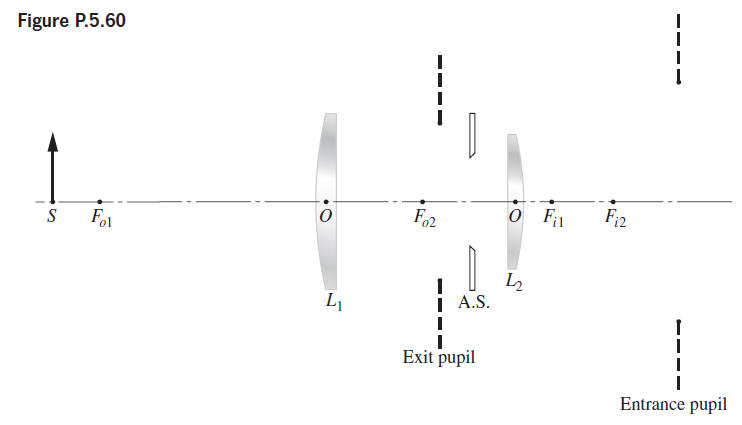
Figure P.5.60 shows a lens system, an object, and the appropriate pupils. Diagrammatically locate the image. Figure P.5.60 O F1 Fo1 Fo2 F;2 L1 A.S. Exit pupil Entrance pupil
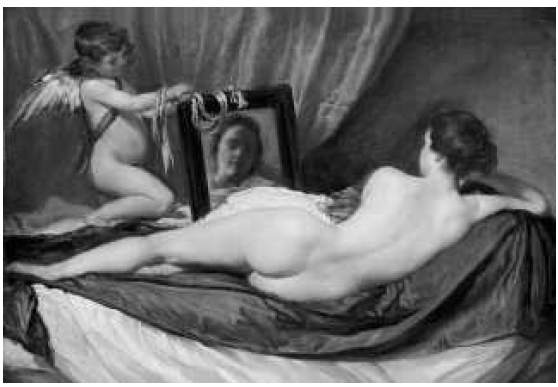
Examine Velásquez€™s painting of Venus and Cupid (Fig. P.5.62). Is Venus looking at herself in the mirror? Explain.Fig. P.5.62
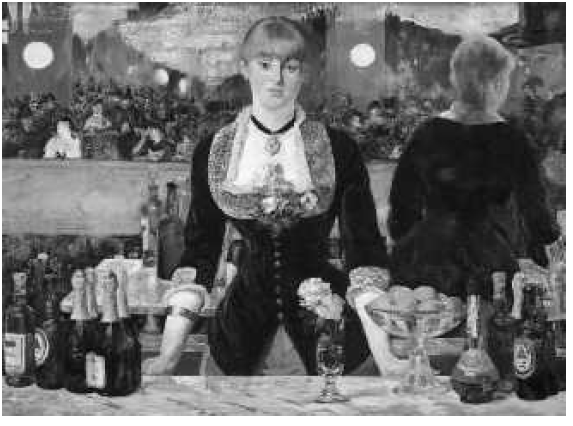
Manet۪s painting A Bar at the Folies Berg̬res (Fig. P.5.63) shows a girl standing in front of a large planar mirror. Reflected in it is her back and a man in evening dress with whom she appears to be talking. It would seem that Manet۪s intent was to give the
Show that Eq. (5.48) for a spherical surface is equally applicable to a plane mirror.
A woman is standing 600 cm in front of a large flat vertical mirror. She sees the image of a tree 1200 cm from her face. Where is the actual tree located? Describe the image in detail.
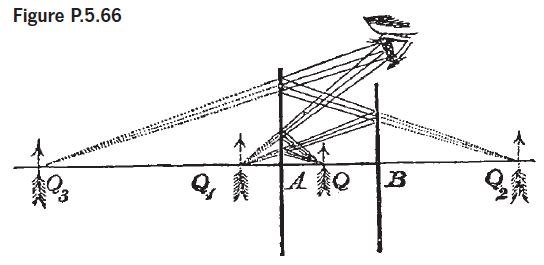
Figure P.5.66 was taken from an optics textbook by S. Parkinson published in 1884. It depicts two €œparallel plane mirrors€ between which, at Q, is a €œluminous point.€ Explain what€™s happening in detail. What is the relationship of Q1and Q2? Of
Considering the two mirrors (A and B) in the previous problem, suppose they are 20.0 cm apart and a small candle is placed at Q 8.0 cm from A. Locate the images at Q1, Q2, and Q3 with respect to A.
A coin of diameter DC is 300 cm in front of a parallel wall on which is hung a circular flat mirror of diameter DM. A person stands 900 cm from the wall. Show that DM = 3/4 DC is the smallest-diameter mirror in which the observer can just see the reflected edge of the coin (i.e., the image of the
Consider Example 5.9, on p. 238, where the person’s eye is 2.0 m from the mirror. Suppose the bottom of the mirror is 1.45 m above the floor and the axis of the eye is 1.25 m above the floor. Locate the height of the bottom edge of the eye chart.
A small planar mirror is attached to a thin vertical wire so that the mirror is parallel to a wall 1.0 m away. A horizontal scale is mounted flat on the wall opposite the mirror, whose center is directly opposite the zero mark on the scale. A horizontal laserbeam reflects off the mirror and hits
Locate the image of a paperclip 100 cm away from a convex spherical mirror having a radius of curvature of 80 cm.
Imagine that you are standing 5 feet from, and looking directly toward, a brass ball 1 foot in diameter hanging in front of a pawn shop. Describe the image you would see in the ball.
A thin lens having a focal length of +50.0 cm is positioned 250 cm in front of (i.e., to the left of) a plane mirror. An ant sits on the central axis 250 cm in front of (i.e., to the left of) the lens. Locate the three images of the ant.
The image of a red rose is formed by a concave spherical mirror on a screen 100 cm away. If the rose is 25 cm from the mirror, determine its radius of curvature.
From the image configuration determine the shape of the mirror hanging on the back wall in van Eyck€™s painting of John Arnolfini and His Wife (Fig. P.5.75).Fig. P.5.75
A 1.00-cm-tall tack is 35.0 cm in front of a concave spherical mirror whose focal length is 30.0 cm.(a) Locate the image.(b) Is it real or virtual?(c) Determine the magnification.(d) Is the image erect?(e) How big is the image?(f) Find R, the radius of curvature of the mirror.
There are several varieties of retro-reflector that are commercially available; one type is composed of transparent spheres, the backs of which are silvered. Light is refracted at the front surface, focused onto the rear surface, and there reflected back out in the direction it came. Determine the
Design an eye for a robot using a concave spherical mirror such that the image of an object 1.0 m tall and 10 m away fills its 1.0-cm square photosensitive detector (which is movable for focusing purposes). Where should this detector be located with respect to the mirror? What should be the focal
An LED 0.60 cm tall is on the central axis 30.0 cm in front of a convex spherical mirror. If the radius of curvature of the mirror is 12.0 cm determine the location of the image, describe it, and draw a ray diagram.How big is the image?
Design a little dentist’s mirror to be fixed at the end of a shaft for use in the mouth of some happy soul. The requirements are (1) that the image be erect as seen by the dentist and (2) that when held 1.5 cm from a tooth the mirror produces an image twice life-size.
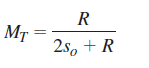
An object is located at a distance s0from a spherical mirror of radius R.Show that the resulting image will be magnified by an amount R MT = 2s, + R
A device used to measure the radius of curvature of the cornea of the eye is called a keratometer. This is useful information when fitting contact lenses. In effect, an illuminated object is placed a known distance from the eye, and the image reflected off the cornea is observed. The instrument
Considering the operation of a spherical mirror, prove that the locations of the object and image are given by - F(Mr – 1) s, 3 - fMт — 1) and Si = So — f(Mт - 1)/мт and %3|
In an amusement park a large upright convex spherical mirror is facing a plane mirror 10.0 m away. A girl 1.0 m tall standing midway between the two sees herself twice as tall in the plane mirror as in the spherical one. In other words, the angle subtended at the observer by the image in the plane
A man whose face is 25 cm away looks into the bowl of a soup-spoon and sees his image reflected with a magnification of -0.064. Determine the radius of curvature of the spoon.
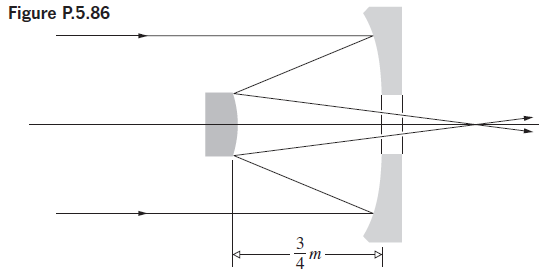
A homemade telephoto €œlens€ (Fig. P.5.86) consists of two spherical mirrors. The radius of curvature is 2.0 m for the primary (the big mirror) and 60 cm for the secondary (the small mirror). How far from the smaller mirror should the film plane be located if the object is a
A point source S sitting on the central axis of a positive thin lens is located (to the left) between one and two focal lengths from the lens. A concave spherical mirror is to be positioned to the right of the lens so that the final real image also lies at point S. Where should the mirror be
Suppose you have a concave spherical mirror with a focal length of 10 cm. At what distance must an object be placed if its image is to be erect and one and a half times as large? What is the radius of curvature of the mirror? Check with Table 5.5.Table 5.5 Concave Object Image Location Type
Describe the image that would result for an object 3 inches tall placed 20 cm from a spherical concave shaving mirror having a radius of curvature of -60 cm.
A thin positive lens of focal length ƒL is positioned very close to and in front of a front-silvered concave spherical mirror of radius RM. Write an expression approximating the effective focal length of the combination in terms of ƒL and RM.
Parallel rays along the central axis enter a biconcave lens, both of whose radii of curvature are equal. Some of the light is reflected from the first surface, and the remainder passes through the lens. Show that, if the index of refraction of the lens (which is surrounded by air) is 2.00, the
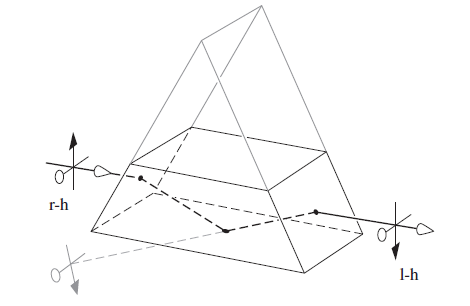
Referring to the Dove prism in Fig. 5.73, rotate it through 90° about an axis along the ray direction. Sketch the new configuration and determine the angle through which the image is rotated.Fig. 5.73 r-h of- l-h
Determine the numerical aperture of a single clad optical fiber, given that the core has an index of 1.62 and the clad 1.52. When immersed in air, what is its maximum acceptance angle? What would happen to a ray incident at, say, 45°?
A stepped-index multi-mode glass fiber has indices of 1.481 and 1.461. Its core diameter is 100 μm. Determine the fiber’s acceptance angle when immersed in air.
A stepped-index fiber has indices of 1.451 and 1.457. If the core radius is 3.5 mm, determine the cut-off wavelength above which the fiber will sustain only the fundamental mode.
A stepped-index single-mode fiber has a diameter of 8.0 μm and a numerical aperture of 0.13. Find its cut-off frequency below which the fiber operates in single mode.
A multi-mode stepped-index glass fiber has a core index of 1.50 and a cladding index of 1.48. Given that the core has a radius of 50.0 μm and operates at a vacuum wavelength of 1300 nm, find the number of modes it sustains.
Determine the inter-modal delay (in ns/km) for a stepped-index fiber with a cladding of index 1.485 and a core of index 1.500.
Compute the approximate size (in millimeters) of the image of the Moon as cast on the retina. The Moon has a diameter of 2160 miles and is roughly 230000 miles from here, although this, of course, varies.
An object 20 m from the objective (ƒ0 = 4 m) of an astronomical telescope is imaged 30 cm from the eyepiece (ƒ0 = 60 cm). Find the total linear magnification of the scope.
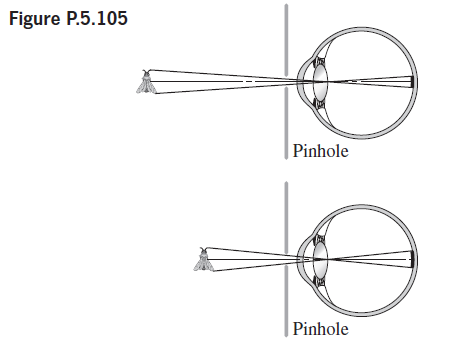
Figure P.5.105 shows a pinhole in an opaque screen being used for something practical. Explain what€™s happening and why it works. Try it. Figure P.5.105 |Pinhole | Pinhole
The field of view of a simple two-element astronomical telescope is restricted by the size of the eye-lens. Make a ray sketch showing the vignetting that arises.
If a photograph of a moving merry-go-round is perfectly exposed, but blurred, at 1/30 s and ƒ/11, what must the diaphragm setting be if the shutter speed is raised to 1/120 s in order to “stop” the motion?
A field-lens, as a rule, is a positive lens placed at (or near) the intermediate image plane in order to collect the rays that would otherwise miss the next lens in the system. In effect, it increases the field of view without changing the power of the system. Redraw the ray diagram of the previous
Describe completely the image that results when a bug sits at the vertex of a thin positive lens. How does this relate directly to the manner in which a field-lens works? (See Problem 5.108.)Data from Prob. 5.108A field-lens, as a rule, is a positive lens placed at (or near) the intermediate image
It is determined that a patient has a near point at 50 cm. If the eye is approximately 2.0 cm long.(a) How much power does the refracting system have when focused on an object at infinity? when focused at 50 cm?(b) How much accommodation is required to see an object at a distance of 50 cm?(c) What
An optometrist finds that a farsighted person has a near point at 125 cm. What power will be required for contact lenses if they are effectively to move that point inward to a more workable distance of 25 cm so that a book can be read comfortably? Use the fact that if the object is imaged at the
We wish to correct the vision of a 7D my ope, whose both eyes are the same, with spectacles worn 15 mm from the eye. Determine the appropriate power.
The vision of a hyperope is corrected with a +9D spectacle lens worn 12 mm from the cornea. Determine the appropriate power of a replacement contact lens.
A 6 D myope has a far point 16.67 cm from the eye. Prescribe a spectacle lens to be worn 12 mm from the eye that will correct his vision.
A person who is farsighted has her near point at 100 cm and her far point is where it should normally be. Determine the prescription for a contact lens that will fix the problem. Locate her new far point.
A farsighted person can see very distant mountains with relaxed eyes while wearing +3.0–D contact lenses. Prescribe spectacle lenses that will serve just as well when worn 17 mm in front of the cornea. Locate and compare the far point in both cases.
A jeweler is examining a diamond 5.0 mm in diameter with a loupe having a focal length of 25.4 mm.(a) Determine the maximum angular magnification of the loupe.(b) How big does the stone appear through the magnifier?(c) What is the angle subtended by the diamond at the unaided eye when held at the
Suppose we wish to make a microscope (that can be used with a relaxed eye) out of two positive lenses, both with a focal length of 25 mm. Assuming the object is positioned 27 mm from the objective(a) How far apart should the lenses be.(b) What magnification can we expect?
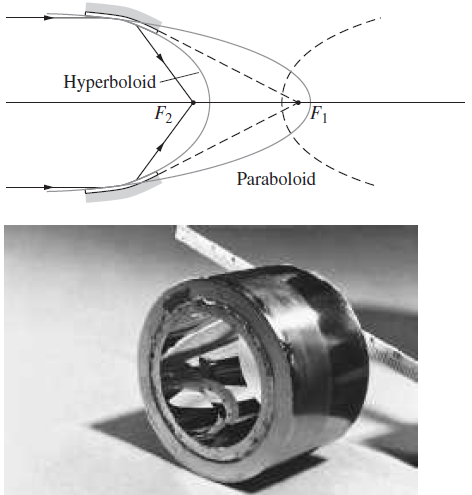
Figure P.5.120 shows a glancing-incidence X-ray focusing system designed in 1952 by Hans Wolter. Fill in the missing portion of each ray. How many reflections does each ray undergo? How does the device work? Microscopes with this type of system have been used to photograph, in X-rays, the implosion
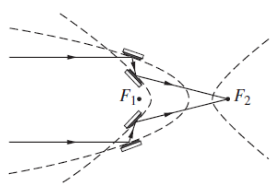
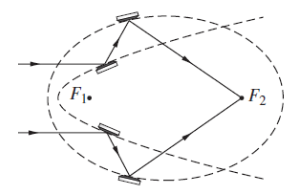
The two glancing-incidence aspherical mirror systems depicted in Fig. P.5.121 are designed to focus X-rays. Explain how each works: identify the shapes of the mirrors, discuss the locations of their various foci, and so on.Fig. P.5.121a.b. F2 F» F2
Showing 500 - 600
of 829
1
2
3
4
5
6
7
8
9
Step by Step Answers

 Get 50% OFF
Claim Now
Get 50% OFF
Claim Now