New Semester
Started
Get
50% OFF
Study Help!
--h --m --s
Claim Now
Question Answers
Textbooks
Find textbooks, questions and answers
Oops, something went wrong!
Change your search query and then try again
S
Books
FREE
Study Help
Expert Questions
Accounting
General Management
Mathematics
Finance
Organizational Behaviour
Law
Physics
Operating System
Management Leadership
Sociology
Programming
Marketing
Database
Computer Network
Economics
Textbooks Solutions
Accounting
Managerial Accounting
Management Leadership
Cost Accounting
Statistics
Business Law
Corporate Finance
Finance
Economics
Auditing
Tutors
Online Tutors
Find a Tutor
Hire a Tutor
Become a Tutor
AI Tutor
AI Study Planner
NEW
Sell Books
Search
Search
Sign In
Register
study help
sciences
optics
Optics 5th edition Eugene Hecht - Solutions
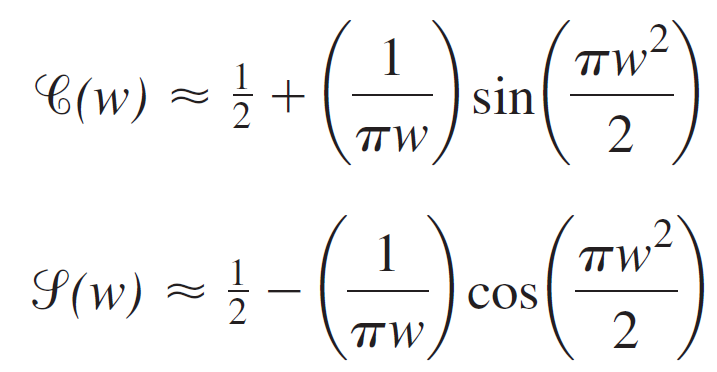
The Fresnel integrals have the asymptotic forms (corresponding to large values of w) given byUsing this fact, show that the irradiance in the shadow of a semi-infinite opaque screen decreases in proportion to the inverse square of the distance to the edge, as z1 and therefore v1 become large. w²
No lens can focus light down to a perfect point because there will always be some diffraction. Estimate the size of the minimum spot of light that can be expected at the focus of a lens. Discuss the relationship among the focal length, the lens diameter, and the spot size. Take the ƒ-number of the
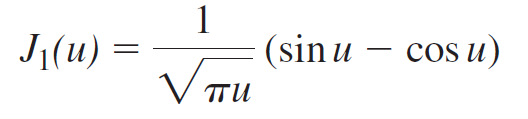
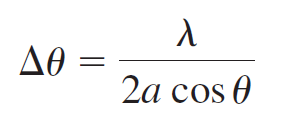
For large values of uUse that relationship to show that the angular separation (Δθ) between consecutive minima far from the center of an Airy pattern is given byWrite an expression for sin u and take the derivative of it with respect to m, where for consecutive minima
Verify that the peak irradiance I1of the first €œring€ in the Airy pattern for far-field diffraction at a circular aperture is such that I1/I(0) = 0.0175. You might want to use the fact that Gu) + - 3!4! Gu)? + J1(u) 2 1 2!3! 1!2!
Imagine that you are staring at a star. You have dilated pupils, each with a diameter of 6.00 mm. The retina is about 21.0 mm from the pupil in a typical eye. Considering that the index of refraction of the vitreous humor is 1.337, determine the size of the Airy disk on your retina. Assume a mean
We wish to use the 15-cm-diameter objective from an amateur telescope to form an image on a CCD of a distant star. Assuming a mean wavelength of 540 nm and a focal length of +140 cm, determine the size of the resulting Airy disk. How would that change if we doubled the lens diameter, keeping all
A 2.4-cm-diameter positive lens with a focal length of 100 cm forms an image of a small far-away red (656 nm) hydrogen lamp. Determine the linear size of the central circular spot appearing on the focal plane.
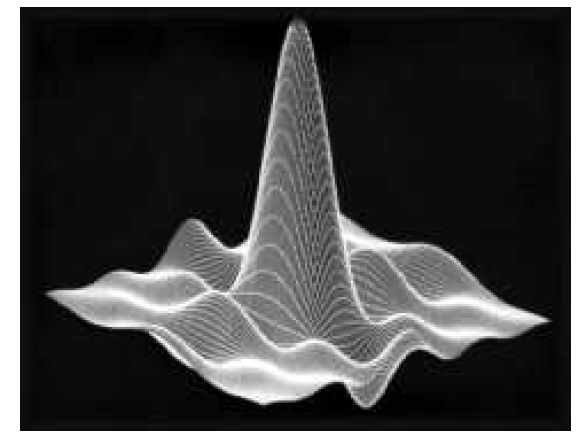
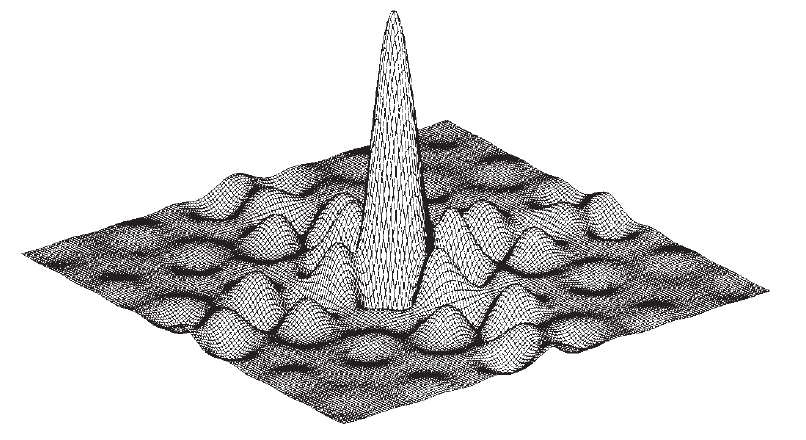
In light of the five previous questions, identify Fig. P.10.32, explaining what it is and what aperture gave rise to it.Fig. P.10.32
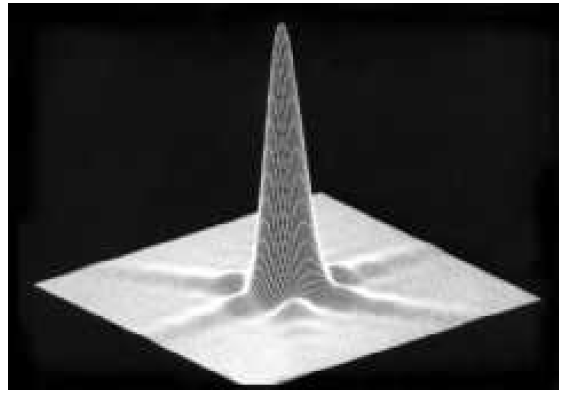
Figure P.10.31 is the electric-field distribution in the far field for a hole of some sort in an opaque screen. Describe the aperture that would give rise to such a pattern and give your reasoning in detail.Figure P.10.31
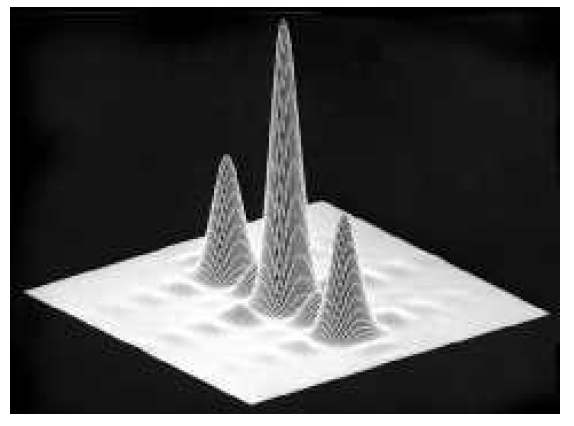
Figure P.10.30 is a computer-generated Fraunhofer irradiance distribution. Describe the aperture that would give rise to such a pattern and give your reasoning in detail.Figure P.10.30
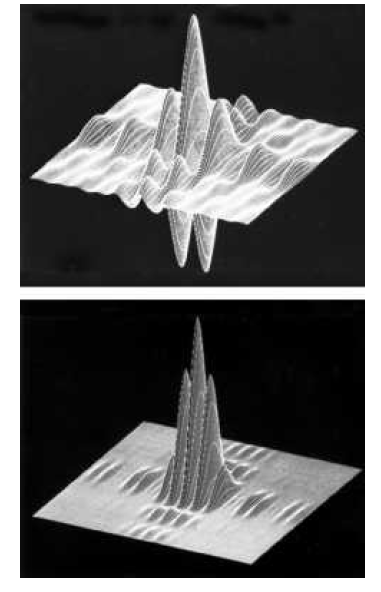
In Fig. P.10.29a and b are the electric field and irradiance distributions, respectively, in the far field for a configuration of elongated rectangular apertures. Describe the arrangement of holes that would give rise to such patterns and discuss your reasoning.Fig. P.10.29
Figure P.10.28 is the irradiance distribution in the far field for a configuration of elongated rectangular apertures. Describe the arrangement of holes that would give rise to such a pattern and give your reasoning in detail.Figure P.10.28
With the results of Problem 10.25 in mind, discuss the symmetries that would be evident in the Fraunhofer diffraction pattern of an aperture that is itself symmetrical about a line (assuming normally incident quasimonochromatic plane waves).Data from Prob. 10.25Show that Fraunhofer diffraction
Show that Fraunhofer diffraction patterns have a center of symmetry [i.e., I(Y, Z) = I(-Y, -Z)], regardless of the configuration of the aperture, as long as there are no phase variations in the field over the region of the hole. Begin with Eq. (10.41). We€™ll see later (Chapter 11) that
Consider the Fraunhofer diffraction pattern of a rectangular aperture 0.200 mm (in the y-direction) by 0.100 mm (in the z-direction). It is formed in 543-nm light from a helium–neon laser, on a screen 10.0 m away. Determine the relative irradiance 1.00 mm from the center of the pattern along the
An opaque screen contains a rectangular hole 0.199 mm (along the z-axis) by 0.100 mm (along the y-axis). It is illuminated by light at 543 nm from a helium–neon laser. A big positive lens with a 1.00-m focal length forms a Fraunhofer pattern on its focal plane. Locate the first minima along the
Starting with the irradiance expression for a finite slit, shrink the slit down to a minuscule area element and show that it emits equally in all directions.
Consider the Fraunhofer diffraction pattern for eight very narrow parallel slits under monochromatic illumination.(a) Sketch the resulting irradiance distribution.(b) Explain why the first minimum occurs, from a phasor perspective.(c) Why is the electric field zero midway between principal
Suppose we have 15 parallel long narrow slits in an opaque screen. Furthermore, suppose each slit is separated from the next by a center-to-center distance that is equal to 4 slit widths. Given that a Fraunhofer diffraction pattern appears on a screen, determine the ratio of the irradiance of the
Imagine two aperture screens arranged to produce two Fraunhofer diffraction patterns. One contains 8 very narrow closely spaced parallel slits, the other 16 such slits. All else being equal, compare the two irradiance distributions. That is, how many subsidiary maxima between consecutive principal
Let E01 be the electric-field amplitude on a distant screen due to each one of three very narrow parallel slits illuminated by monochromatic plane waves. Compare the amplitude of the central subsidiary maximum to the amplitude of the zeroth-order principal maximum in the resulting Fraunhofer
What is the relative irradiance of the subsidiary maxima in a three-slit Fraunhofer diffraction pattern? Draw a graph of the irradiance distribution, when α = 2b, for two and then three slits.
In a two-slit setup, each slit is 0.020 mm wide. These apertures are illuminated by plane waves of yellow sodium light (λ = 589.6 nm). The resulting Fraunhofer fringe pattern consists of 11 narrow bright fringes that gradually decrease in irradiance with distance from the central maximum.
Two long slits 0.10 mm wide, separated by 0.20 mm, in an opaque screen are illuminated by light with a wavelength of 500 nm. If the plane of observation is 2.5 m away, will the pattern correspond to Fraunhofer or Fresnel diffraction? How many Young’s fringes will be seen within the central bright
Show that for a double-slit Fraunhofer pattern, if α = mb, the number of bright fringes (or parts thereof) within the central diffraction maximum will be equal to 2m.
A long narrow slit 0.20 mm wide is illuminated normally with collimated blue hydrogen light (λ = 486.1 nm). Immediately behind the slit is a large positive lens of focal length 60.0 cm. It produces a diffraction pattern on a screen in its focal plane. How far apart are the first and second zeros
Plane waves of green light (λ = 546.1 nm) impinge normally on a long narrow slit (0.15 mm wide) in an opaque screen. A large lens with a focal length of +62.0 cm placed just behind the slit produces a Fraunhofer diffraction pattern on a screen at its focal plane. Determine the width of the central
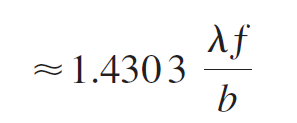
Consider the single-slit Fraunhofer diffraction pattern formed on a screen by a lens of focal length Æ’. Show that the peak of the first subsidiary bright band is a distance Y (measured from the central axis) on the viewing screen, given by Af =1.4303
Plane waves from a magnesium lamp (λ = 518.36 nm) arrive perpendicularly on an opaque screen containing a long 0.250-mm-wide slit. A large nearby positive lens forms a sharp image of the Fraunhofer diffraction pattern on a screen. The center of the fourth dark fringe is found to be 1.20 mm from
A collimated beam of microwaves impinges on a metal screen that contains a long horizontal slit that is 20 cm wide. A detector moving parallel to the screen in the far-field region locates the first minimum of irradiance at an angle of 36.87° above the central axis. Determine the wavelength of the
A narrow single slit (in air) in an opaque screen is illuminated by infrared from a He–Ne laser at 1152.2 nm, and it is found that the center of the tenth dark band in the Fraunhofer pattern lies at an angle of 6.2° off the central axis. Determine the width of the slit. At what angle will the
A single slit in an opaque screen 0.10 mm wide is illuminated (in air) by plane waves from a krypton ion laser (λ0 = 461.9 nm). If the observing screen is 1.0 m away, determine whether or not the resulting diffraction pattern will be of the far-field variety and then compute the angular width of
The angular distance between the center and the first minimum of a single-slit Fraunhofer diffraction pattern is called the half-angular breadth; write an expression for it. Find the corresponding half-linear width when no focusing lens is present and the distance from the slit to the viewing
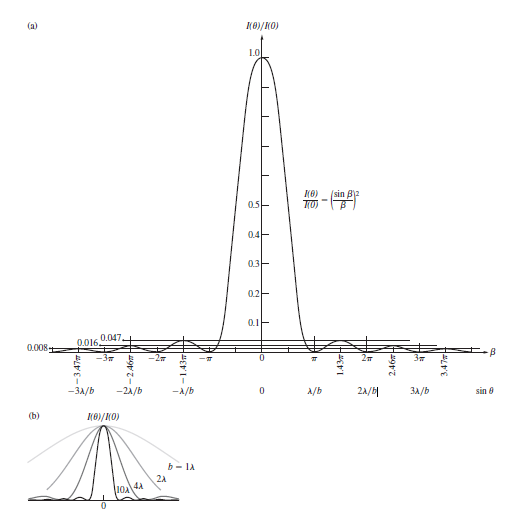
Consider the case of single-slit Fraunhofer diffraction. Calculate the ratio of the irradiance of the central maximum to the irradiance of the first secondary maximum on either side of it. Check your answer with Fig. 10.13.Fig. 10.13. (a) кө)/ко) 1.0 sin B кө) T0) 0.5- 0.4- 0.3- 0.2- 0.1
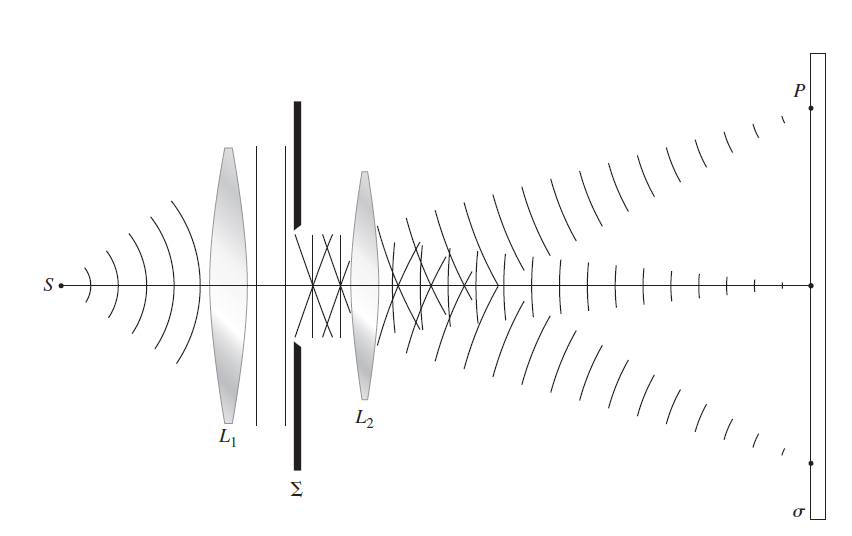
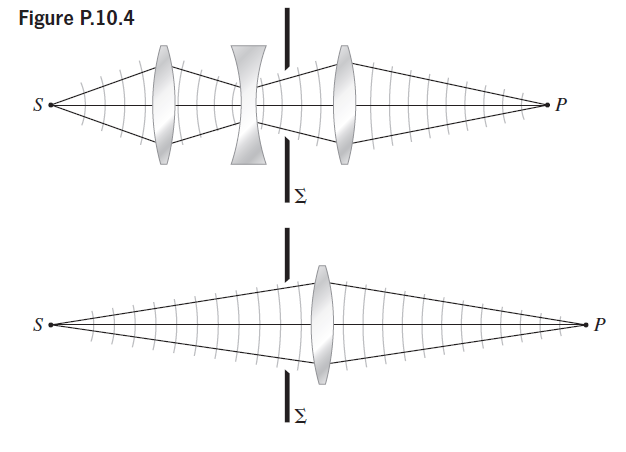
Examine the setup of Fig. 10.3 in order to determine what is happening in the image space of the lenses; in other words, locate the exit pupil and relate it to the diffraction process. Show that the configurations in Fig. P.10.4 are equivalent to those of Fig. 10.3 and will therefore result in
Referring back to the multiple antenna system on p. 456, compute the angular separation between successive lobes or principal maxima and the width of the central maximum.
In Section 10.1.3 we talked about introducing an intrinsic phase shift ε between oscillators in a linear array. With this in mind, show that Eq. (10.18) becomeswhen the incident plane wave makes an angle θi with the plane of the slit. B = (kb/2) sin0 (10.18)
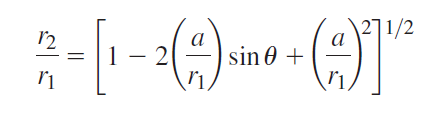
To examine the conditions under which the approximations of Eq. (9.23) are valid:(a) Apply the law of cosines to triangle S1S2P in Fig. 9.11c to get(b) Expand this in a Maclaurin series yielding(c) In light of Eq. (9.17), show that if (r1 - r2) is to equal α sin θ, it is
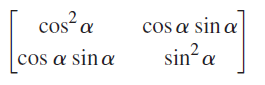
An optical filter can be described by a Jones matrix(a) Obtain the form of the emerging beam when the incident light is plane polarized at angle θ to the horizontal (see Problem 8.75).(b) Deduce from the result of part (a) the nature of the filter.(c) Confirm your deduction above with
Two light waves Ex = E0 cos (kz - ωt) and Ey = -E0 cos (kz - ωt) overlap in space. Show that the resultant is linear light and determine its amplitude and tilt angle θ.
Two waves Ez = 4 sin (ky - ωt) and Ex = 3 in (ky - ωt), both in SI units, overlap in space. Describe completely the state of polarization of the resultant.
Consider the following two waves expressed in SI units: Ex = 8 sin (ky - ωt + π/2) and Ez = 8 sin (ky - ωt). Which wave leads, and by how much? Describe the resultant wave. What is the value of its amplitude?
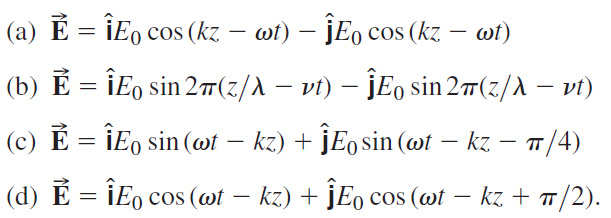
Describe completely the state of polarization of each of the following waves: (a) É = ÎEo cos (kz – wt) – jE, cos (kz – wt) |(b) E = ÎEo sin 2#(z/A – vt) – jEo sin 27(z/A – vt) (c) É = ¡Eo sin (wt – kz) + jEo sin (@t – kz – 1/4) TT (d) É = ¡Eo cos (@t – kz) + jEo cos (wt
Consider the disturbance given by the expression vector E(z, t) = [iˆ cos ωt + jˆ cos (ωt - π/2)]E0 sin kz. What kind of wave is it? Draw a rough sketch showing its main features.
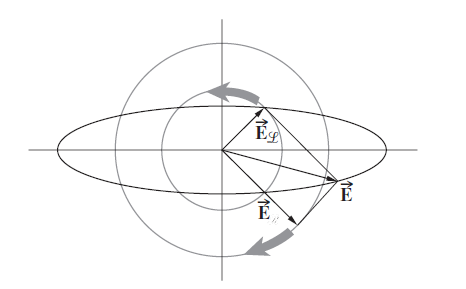
Analytically, show that the superposition of an R- and an L-state having different amplitudes will yield an E-state, as shown in Fig. 8.11. What must ε be to duplicate that figure? Fig. 8.11 Eg
Write an expression for a P-state lightwave of angular frequency ω and amplitude E0 propagating along the x- xis with its plane-of-vibration at an angle of 25° to the xy-plane. The disturbance is zero at t = 0 and x = 0.
Write an expression for a P-state lightwave of angular frequency ω and amplitude E0 propagating along a line in the xy‑plane at 45° to the x-axis and having its plane-of-vibration corresponding to the xy-plane. At t = 0, y = 0, and x = 0 the field is zero.
Write an expression for an R-state lightwave of frequency ω propagating in the positive x-direction such that at t = 0 and x = 0 the vector E-field points in the negative z-direction.
A beam of linearly polarized light with its electric field vertical impinges perpendicularly on an ideal linear polarizer with a vertical transmission axis. If the incoming beam has an irradiance of 200 W/m2, what is the irradiance of the transmitted beam?
Given that 300 W/m2 of light from an ordinary tungsten bulb arrives at an ideal linear polarizer, what is its radiant flux density on emerging?
A beam of vertically polarized linear light is perpendicularly incident on an ideal linear polarizer. Show that if its transmission axis makes an angle of 60° with the vertical only 25% of the irradiance will be transmitted by the polarizer.
The transmittance of a real linear polarizer illuminated by linear light making an angle of θ with its transmission axis is given by Tl = (T0 - T90) cos 2θ + T90where T0 and T90 are the maximum and minimum values of transmittance, respectively. Show that this
Suppose 1000 W/m2 of natural light is incident perpendicularly on a sheet of HN-22 polarizer. Describe the light leaving the filter. What is its irradiance?
If light that is initially natural and of flux density Ii passes through two sheets of HN-32 whose transmission axes are parallel, what will be the flux density of the emerging beam?
What will be the irradiance of the emerging beam if the analyzer of the previous problem is rotated 30°?
Two sheets of HN-38S linear polarizer are in series one behind the other with their transmission axes aligned. The first is illuminated by 1000 W/m2 of natural light. Determine the approximate emerging irradiance. What is the value of the resulting transmittance of the pair?
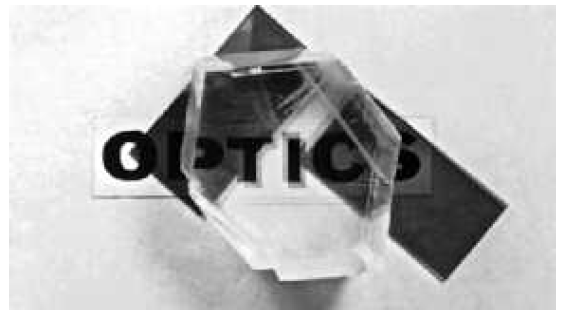
Discuss in detail what you see in Fig. P.8.33. The crystal in the photograph is calcite, and it has a blunt corner at the upper left. The two Polaroids have their transmission axes parallel to their short edges. Fig. P.8.33
Show by direct calculation, using Mueller matrices, that a unitirradiance beam of natural light passing through a linear polarizer with its transmission axis at +45° is converted into a P-state at +45°. Determine its relative irradiance and degree of polarization.
Show by direct calculation, using Mueller matrices, that a beam of horizontal P-state light passing through a 1/4 λ-plate with its fast axis horizontal emerges unchanged.
With Lloyd’s mirror, X-ray fringes were observed, the spacing of which was found to be 0.002 5 cm. The wavelength used was 8.33 Å. If the source–screen distance was 3 m, how high above the mirror plane was the point source of X-rays placed?
A thin film of ethyl alcohol (n = 1.36) spread on a flat glass plate and illuminated with white light shows a color pattern in reflection. If a region of the film reflects only green light (500 nm) strongly, how thick is it?
One of the mirrors of a Michelson Interferometer is moved, and 1000 fringe-pairs shift past the hairline in a viewing telescope during the process. If the device is illuminated with 500-nm light, how far was the mirror moved?
The irradiance of a beam of natural light is 400 W/m2. It impinges on the first of two consecutive ideal linear polarizers whose transmission axes are 40.0° apart. How much light emerges from the two?
Imagine four HN-32 Polaroids one behind the other with their transmission axes all parallel. If the irradiance of natural light incident on the first filter is Ii, what is the transmitted irradiance emerging from the stack?
Natural light of irradiance Ii is incident normally on an HN-32 polarizer.(a) How much light emerges from it?(b) A second identical polarizer is placed parallel to and behind the first. How much light emerges when the two transmission axes are at 45°?
Natural light of irradiance Ii is incident normally on three identical sheet linear polarizers aligned with parallel transmission axes. If each has a principal transmittance of 64% and a high extinction ratio, show that the transmitted irradiance is about 13% Ii.
As we saw in Section 8.10, substances such as sugar and insulin are optically active; they rotate the plane of polarization in proportion to both the path length and the concentration of the solution. A glass vessel is placed between a pair of crossed HN-50 linear polarizers, and 50% of the natural
The light from an ordinary flashlight is passed through a linear polarizer with its transmission axis vertical. The resulting beam, having an irradiance of 200 W/m2, is incident normally on a vertical HN-50 linear polarizer whose transmission axis is tilted at 30° above the horizontal. How much
Linearly polarized light (with an irradiance of 200 W/m2) aligned with its electric-field vector at +55° from the vertical impinges perpendicularly on an ideal sheet polarizer whose transmission axis is at +10° from the vertical. What fraction of the incoming light emerges?
Two ideal linear sheet polarizers are arranged with respect to the vertical with their transmission axis at 10° and 60°, respectively. If a linearly polarized beam of light with its electric field at 40° enters the first polarizer, what fraction of its irradiance will emerge?
Imagine a pair of crossed polarizers with transmission axes vertical and horizontal. The beam emerging from the first polarizer has flux density I1, and of course no light passes through the analyzer (i.e., I2 = 0). Now insert a perfect linear polarizer (HN-50) with its transmission axis at 45° to
Imagine that you have two identical perfect linear polarizers and a source of natural light. Place them one behind the other and position their transmission axes at 0° and 50°, respectively. Now insert between them a third linear polarizer with its transmission axes at 25°. If 1000/m2 of light
Given that 200 W/m2 of randomly polarized light is incident normally on a tack of ideal linear polarizers that are positioned one behind the other with the transmission axis of the first vertical, the second at 30°, the third at 60°, and the fourth at 90°. How much light emerges?
Two ideal HN-50 linear polarizers are positioned one behind the other. What angle should their transmission axes make if an incident unpolarized 100 W/m2 beam is to be reduced to 30.0 W/m2 on emerging from the pair?
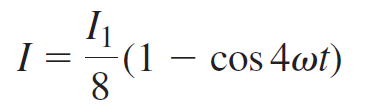
An ideal polarizer is rotated at a rate ω between a similar pair of stationary crossed polarizers. Show that the emergent flux density will be modulated at four times the rotational frequency. In other words, show thatwhere I1 is the flux density emerging from the first polarizer and I
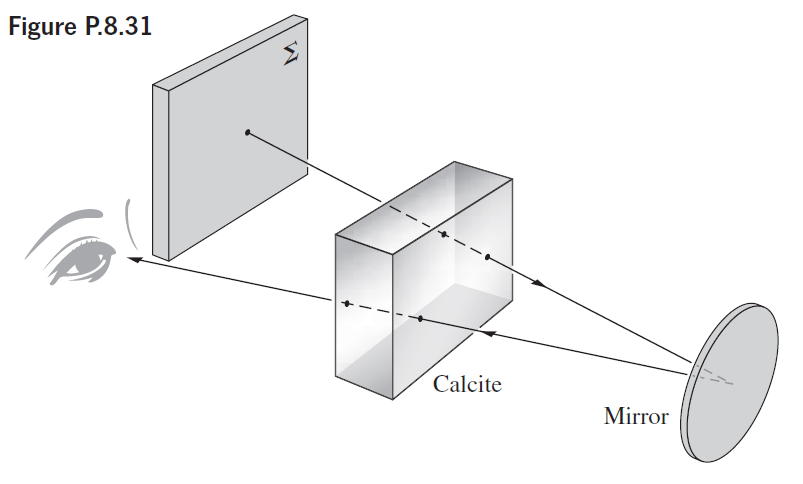
Figure P.8.31 shows a ray traversing a calcite crystal at nearly normal incidence, bouncing off a mirror, and then going through the crystal again. Will the observer see a double image of the spot on Σ? Figure P.8.31 Σ Calcite Mirror
A pencil mark on a sheet of paper is covered by a calcite crystal. With illumination from above, isn’t the light impinging on the paper already polarized, having passed through the crystal? Why then do we see two images? Test your solution by polarizing the light from a flashlight and then
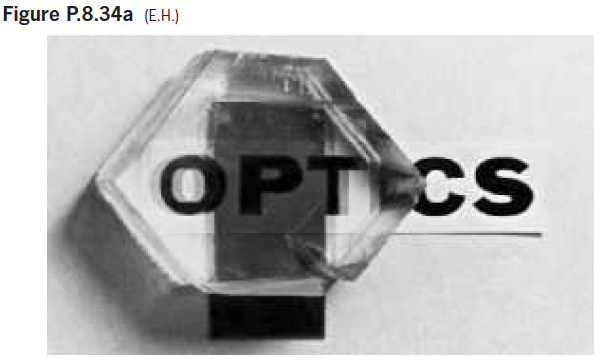
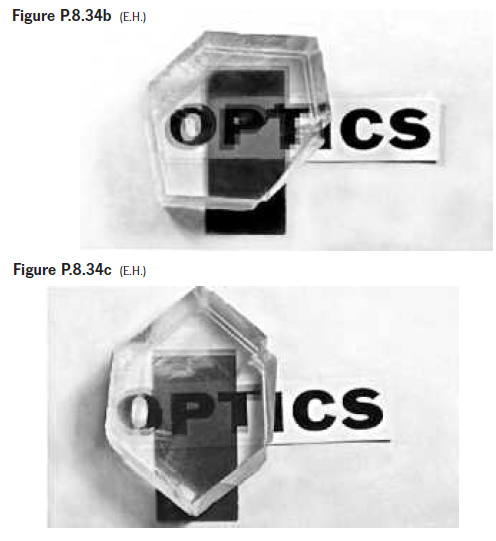
The calcite crystal in Fig. P.8.34 is shown in three different orientations. Its blunt corner is on the left in (a), the lower left in (b), and the bottom in (c). The Polaroid€™s transmission axis is horizontal. Explain each photograph, particularly (b). Figure P.8.34a (Е.Н.) OPT CS
In discussing calcite, we pointed out that its large birefringence arises from the fact that the carbonate groups lie in parallel planes (normal to the optic axis). Show in a sketch and explain why the polarization of the group will be less when vector E is perpendicular to the CO3 plane than when
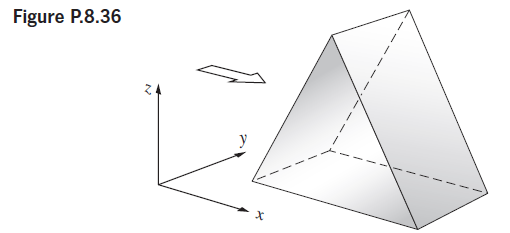
A beam of light enters a calcite prism from the left, as shown in Fig. P.8.36. There are three possible orientations of the optic axis of particular interest, and these correspond to the x-, y-, and z-directions. Imagine that we have three such prisms. In each case sketch the entering and emerging
Compute the critical angle for the ordinary ray, that is, the angle for total internal reflection at the calcite–balsam layer of a Nicol prism.
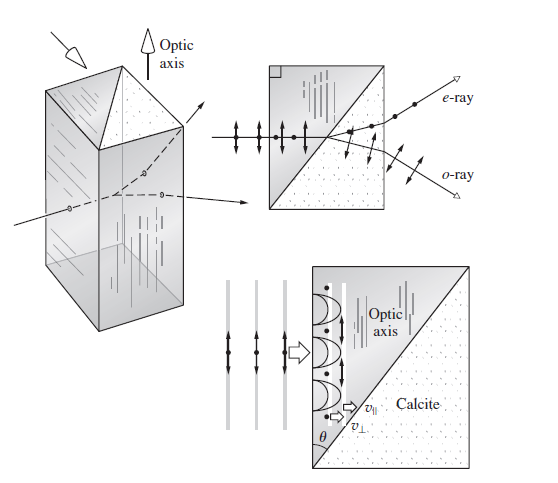
A Wollaston prism is made of two 45° quartz prisms much like Fig. 8.34. Given that λ0= 589.3 nm, determine the angle separating the two emerging rays. As compared to a calcite Wollaston, the e-ray and o-ray are interchanged.Fig. 8.34. Optic axis e-гаy 0-гау Optic axis Calcite
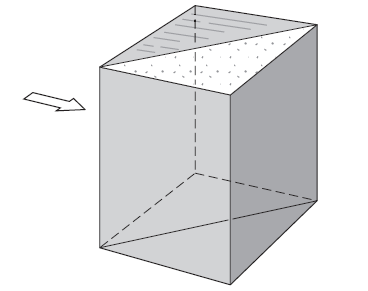
The prism shown in Fig. P.8.40 is known as a Rochon polarizer. Sketch all the pertinent rays, assuming(a) Why might such a device be more useful than a dichroic polarizer when functioning with high€“flux density laser light?(b) What valuable feature of the Rochon is lacking in the
Imagine that we have a transmitter of microwaves that radiates a linearly polarized wave whose vector E-field is known to be parallel to the dipole direction. We wish to reflect as much energy as possible off the surface of a pond (having an index of refraction of 9.0). Find the necessary incident
At what angle will the reflection of the sky coming off the surface of a pond (n = 1.33) completely vanish when seen through a Polaroid filter?
What is Brewster’s angle for reflection of light from the surface of a piece of glass (ng = 1.65) immersed in water (nw = 1.33)?
Given that the critical angle for some transparent material in air is 41.0°, determine its polarization angle.
A beam of light is reflected off the surface of some unknown liquid, and the light is examined with a linear sheet polarizer. It is found that when the central axis of the polarizer (that is, the perpendicular to the plane of the sheet) is tilted down from the vertical at an angle of 54.30°, the
Light reflected from a glass (ng = 1.65) plate immersed in ethyl alcohol (ne = 1.36) is found to be completely linearly polarized. At what angle will the partially polarized beam be transmitted into the plate?
A beam of natural light is incident on an air–glass interface (nti = 1.5) at 40°. Compute the degree of polarization of the reflected light.
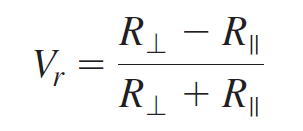
Prove that the degree of polarization (Vr) of reflected light can be expressed as[Hint: For unpolarized reflected light Ir|| = IrŠ¥, whereas for polarized reflected light Ip = IrŠ¥ - Ir||. R R1 V, = T, R + R||
A beam of natural light incident in air on a glass (n = 1.5) interface at 70° is partially reflected. Compute the overall reflectance. How would this compare with the case of incidence at, say, 56.3°? Explain.
A narrow beam of natural light is incident at 56.0° on a glass plate (n = 1.50) in air. The reflected light is partially polarized. Determine the degree of polarization.
A narrow beam of light strikes the surface of a block of clear material and it is determined that the reflected light is totally polarized. If the total reflectance is 10% find the transmittance at the air–block interface.
A ray of yellow light is incident on a calcite plate at 50°. The plate is cut so that the optic axis is parallel to the front face and perpendicular to the plane-of-incidence. Find the angular separation between the two emerging rays.
A beam of light is incident normally on a quartz plate whose optic axis is perpendicular to the beam. If λ0 = 589.3 nm, compute the wavelengths of both the ordinary and extraordinary waves. What are their frequencies?
The electric-field vector of an incident P-state makes an angle of +30° with the horizontal fast axis of a quarter-wave plate. Describe, in detail, the state of polarization of the emergent wave.
Take two ideal Polaroids (the first with its axis vertical and the second, horizontal) and insert between them a stack of 10 half-wave plates, the first with its fast axis rotated π/40 rad from the vertical, and each subsequent one rotated π/40 rad from the previous one. Determine the ratio of
Suppose you were given a linear polarizer and a quarter-wave plate. How could you determine which was which, assuming you also had a source of natural light?
Linear light at 135° to the horizontal, oscillating in the second and fourth quadrants, passes through a π/2 retarder having its fast axis vertical. Describe the polarization state of the emerging light. How must the linear light be rotated (clockwise or counterclockwise) if it is to be aligned
Showing 200 - 300
of 829
1
2
3
4
5
6
7
8
9
Step by Step Answers

 Get 50% OFF
Claim Now
Get 50% OFF
Claim Now