New Semester
Started
Get
50% OFF
Study Help!
--h --m --s
Claim Now
Question Answers
Textbooks
Find textbooks, questions and answers
Oops, something went wrong!
Change your search query and then try again
S
Books
FREE
Study Help
Expert Questions
Accounting
General Management
Mathematics
Finance
Organizational Behaviour
Law
Physics
Operating System
Management Leadership
Sociology
Programming
Marketing
Database
Computer Network
Economics
Textbooks Solutions
Accounting
Managerial Accounting
Management Leadership
Cost Accounting
Statistics
Business Law
Corporate Finance
Finance
Economics
Auditing
Tutors
Online Tutors
Find a Tutor
Hire a Tutor
Become a Tutor
AI Tutor
AI Study Planner
NEW
Sell Books
Search
Search
Sign In
Register
study help
sciences
optics
Optics 5th edition Eugene Hecht - Solutions
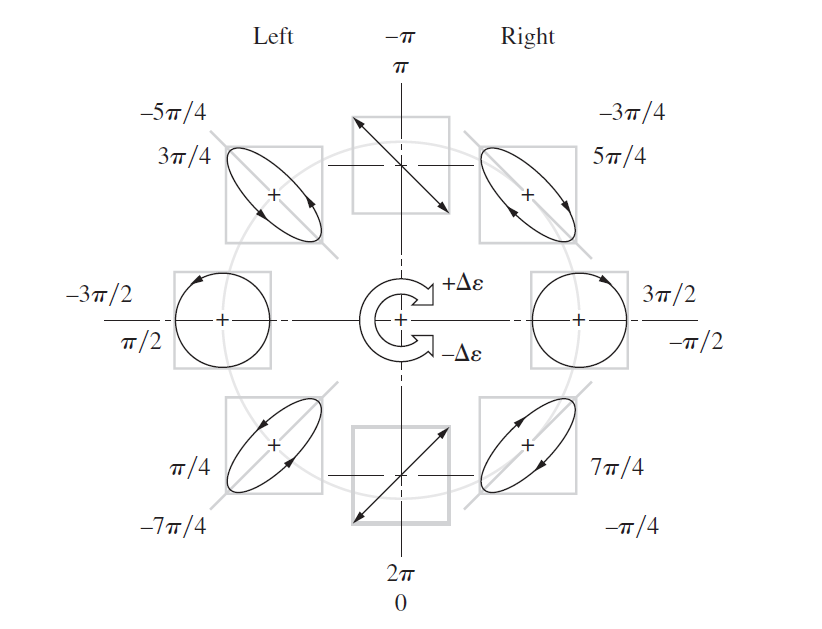
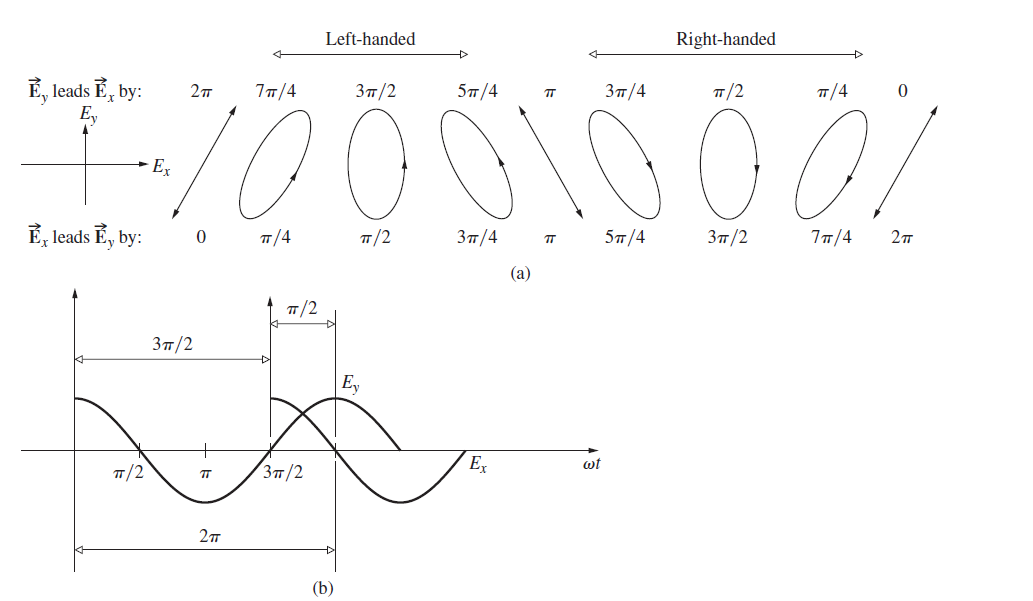
Right-circular light passes through a λ/4 retarder whose fast axis is vertical. Describe the emerging polarization state. Did the polarization state shift one quarter of the way around the circle in Fig. 8.42?Fig. 8.42 Right Left — т п -5п/4 -3п/4 5п/4 Зп /4 +Д8 -Зп/2
Right-circular light passes through a quarter-wave plate with a horizontal fast axis. Explain why you can expect the light to emerge linearly polarized at 45° in the first and third quadrants.
Linear light oscillating at 135° in the second and fourth quadrants passes through a half-wave plate whose fast axis is vertical. Explain why you can expect the emerging light to be linear in the first and third quadrants.
Right-circular light passes through a half-wave plate whose fast axis is vertical. Describe the emerging polarization state.
Linear light oscillating at 60° above the horizontal x-axis in the first and third quadrants passes through a quarter-wave plate with its fast axis horizontal. Explain why the light emerges as left elliptical with its major axis vertical.
Left-circular light of wavelength 590 nm traveling in the z-direction is to be converted into right-circular light by passing perpendicularly through a plate of quartz. The quartz has been cut and polished so that the optic axis is in the y-direction (no = 1.5443, ne = 1.5534) and the face of the
An L-state traverses an eighth-wave plate having a horizontal fast axis. What is its polarization state on emerging?
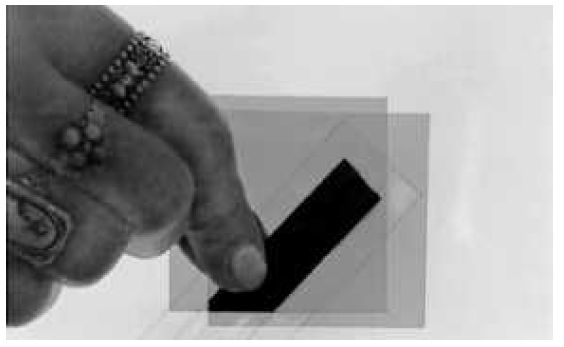
Figure P.8.67 shows two Polaroid linear polarizers and between them a microscope slide to which is attached a piece of cellophane tape. Explain what you see.Figure P.8.67
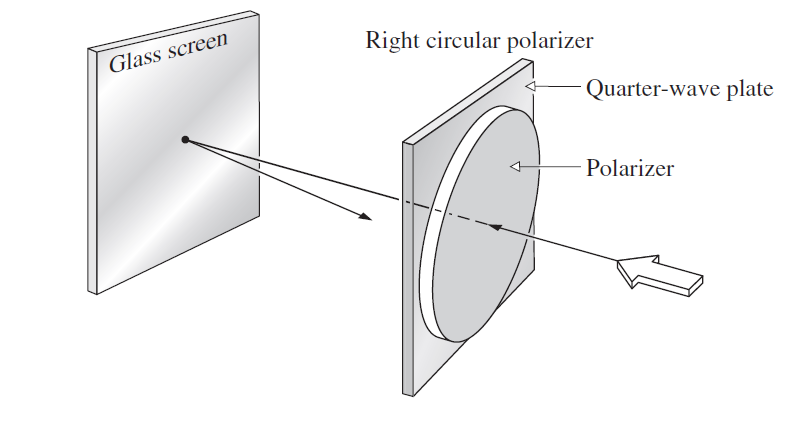
Imagine that we have randomly polarized room light incident almost normally on the glass surface of a radar screen. A portion of it would be specularly reflected back toward the viewer and would thus tend to obscure the display. Suppose now that we cover the screen with a right-circular polarizer,
A Babinet compensator is positioned at 45° between crossed linear polarizers and is being illuminated with sodium light. When a thin sheet of mica (indices 1.599 and 1.594) is placed on the compensator, the black bands all shift by one quarter of the space separating them. Compute the retardance
Is it possible for a beam to consist of two orthogonal incoherent P-states and not be natural light? Explain. How might you arrange to have such a beam?
The specific rotatory power for sucrose dissolved in water at 20°C (λ0 = 589.3 nm) is +66.45° per 10 cm of path traversed through a solution containing 1 g of active substance (sugar) per cm3 of solution. A vertical P-state (sodium light) enters at one end of a 1-m tube containing 1000 cm3 of
On examining a piece of stressed photoelastic material between crossed linear polarizers, we would see a set of colored bands (isochromatics) and, superimposed on these, a set of dark bands (isoclinics). How might we remove the isoclinics, leaving only the isochromatics? Explain your solution.
Consider a Kerr cell whose plates are separated by a distance d. Let „“ be the effective length of those plates (slightly different from the actual length because of fringing of the field). Show that
Compute the half-wave voltage for a longitudinal Pockels cell made of ADA (ammonium dihydrogen arsenate) at λ0 ≈ 550 nm, where r63 = 5.5 × 10⁻¹² and no = 1.58.
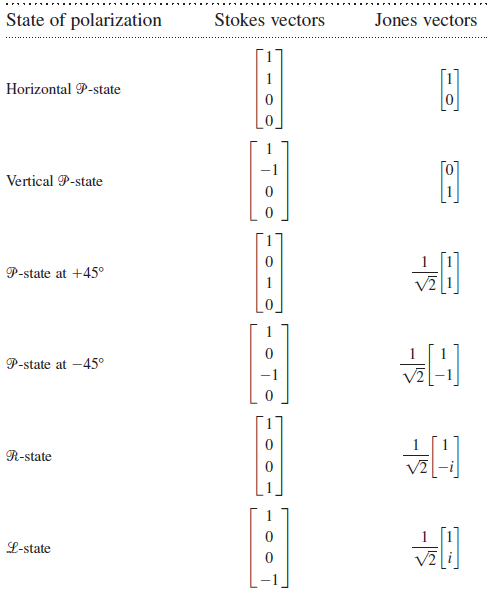
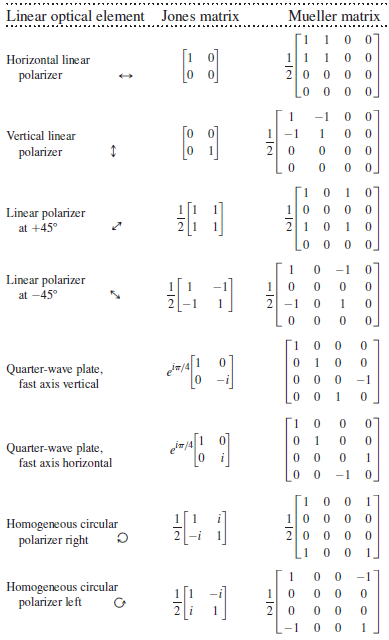
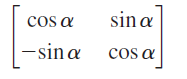
The Jones vector for an arbitrary linearly polarized state at an angle θ with respect to the horizontal isProve that this matrix is in agreement with the one in Table 8.5 for a P-state at +45°.Table 8.5 [cose sin 0 State of polarization Stokes vectors Jones vectors Horizontal
Two incoherent lightbeams represented by (1, 1, 0, 0) and (3, 0, 0, 3) are superimposed.(a) Describe in detail the polarization states of each of these.(b) Determine the resulting Stokes parameters of the combined beam and describe its polarization state.(c) What is its degree of polarization?(d)
Show by direct calculation, using Mueller matrices, that a unitirradiance beam of natural light passing through a vertical linear polarizer is converted into a vertical P-state. Determine its relative irradiance and degree of polarization.
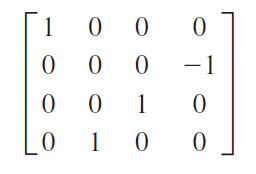
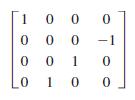
Confirm that the matrixwill serve as a Mueller matrix for a quarter-wave plate with its fast axis at +45°. Shine linear light polarized at 45° through it. What happens? What emerges when a horizontal P-state enters the device? -1
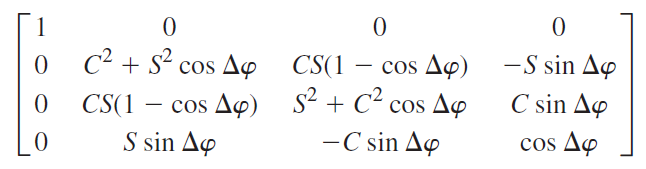
The Mueller matrixin which C = cos 2a and S = sin 2a, represents an arbitrary wave plate having a retardance Δφ and a fast axis at an angle a measured with respect to the horizontal. Use it to derive the matrix given in the previous problem.Data from Prob. 81 C² + s? cos Aq -S sin Aç CS(1 cos
Beginning with the Mueller matrix for an arbitrary retarder provided in the previous problem, show that it agrees with the matrix in Table 8.6 for a quarter-wave plate with a vertical fast axis.Table 8.6 Linear optical element Jones matrix Mueller matrix 1 [1 o] Horizontal linear polarizer 1 -1 1
Derive the Mueller matrix for a quarter-wave plate with its fast axis at -45°. Check that this matrix effectively cancels the one in Problem 8.81, so that a beam passing through the two wave plates successively remains unaltered.Data from Prob. 8.81Confirm that the matrixwill serve as a Mueller
Pass a beam of horizontally polarized linear light through each one of the 14 λ-plates in the two previous questions and describe the states of the emerging light. Explain which field component is leading which and how Fig. 8.9 compares with these results. Fig. 8.9 Left-handed
Use Table 8.6 to derive a Mueller matrix for a half-wave plate having a vertical fast axis. Utilize your result to convert an R-state into an L-state. Verify that the same wave plate will convert an L- to an R-state. Advancing or retarding the relative phase by π/2 should have the same
Construct one possible Mueller matrix for a right-circular polarizer made out of a linear polarizer and a quarter-wave plate. Such a device is obviously an in homogeneous two-element train and will differ from the homogeneous circular polarizer of Table 8.6. Test your matrix to determine that it
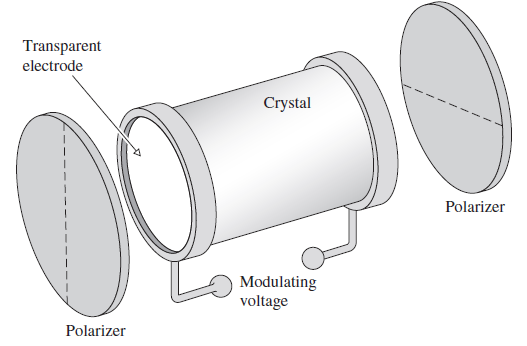
If the Pockels cell modulator shown in Fig. 8.65 is illuminated by light of irradiance Ii, it will transmit a beam of irradiance It such that It= Iisin2(Δφ/2).Make a plot of It/Ii versus applied voltage. What is the significance of the voltage that corresponds to maximum
Construct a Jones matrix for an isotropic plate of absorbing material having an amplitude transmission coefficient of t. It might sometimes be desirable to keep track of the phase, since even if t = 1, such a plate is still an isotropic phase retarder. What is the Jones matrix for a region of
Construct a Mueller matrix for an isotropic plate of absorbing material having an amplitude transmission coefficient of t. What Mueller matrix will completely depolarize any wave without affecting its irradiance? (It has no physical counterpart.)
Keeping Eq. (8.33) in mind, write an expression for the randomly polarized flux density component (In) of a partially polarized beam in terms of the Stokes parameters. To check your result, add a randomly polarized Stokes vector of flux density 4 to an R-state of flux density 1. Then see if you get
An optical filter can be described by a Jones matrixObtain the form of the emerging light for each of the following incident beams:(a) A plane polarized beam polarized at angle θ to the horizontal (see Problem 8.75).(b) A left-circularly polarized beam.(c) A right-circularly polarized
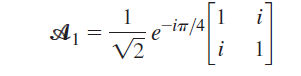
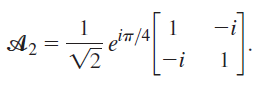
Two linear optical filters have Jones matricesandIdentify these filters. 1 e¯im/4 1 A2 pİT/4
A liquid cell containing an optically active sugar solution has a Jones matrix given by(a) Determine the polarization of the emerging light if the incident beam is a horizontal P-state.(b) Determine the polarization of the emerging light if the incident beam is a vertical P-state. [1+ V3 2V2 1 ] -1
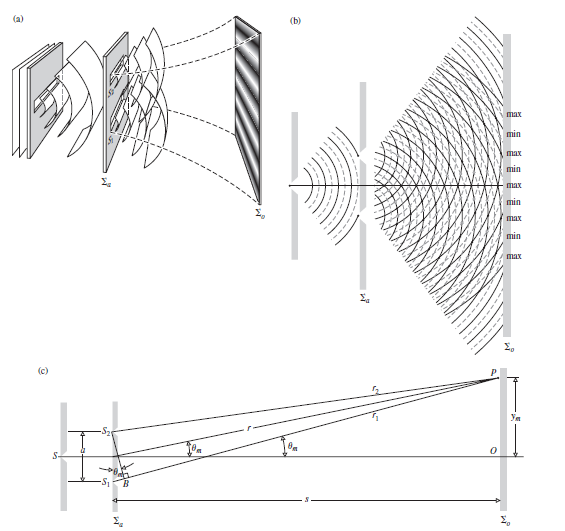
Will we get an interference pattern in Young€™s Experiment (Fig. 9.11) if we replace the source slit S by a single long-filament lightbulb? What would occur if we replaced the slits S1and S2 by these same bulbs?Fig 9.11 (a) (b) WWWW.M max min max mun max min max min max (c) Ул
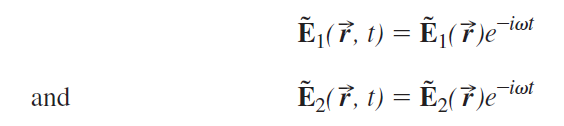
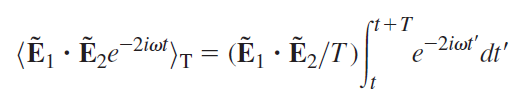
Returning to Section 9.1, letwhere the wavefront shapes are not explicitly specified, and E˜1 and E˜2 are complex vectors depending on space and initial phase angle. Show that the interference term is then given byYou will have to evaluate terms of the formfor T >>
In Section 9.1 we considered the spatial distribution of energy for two point sources. We mentioned that for the case in which the separation α >> λ, I12 spatially averages to zero. Why is this true? What happens when a is much less than λ?
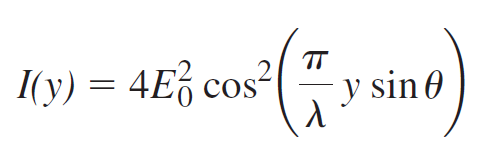
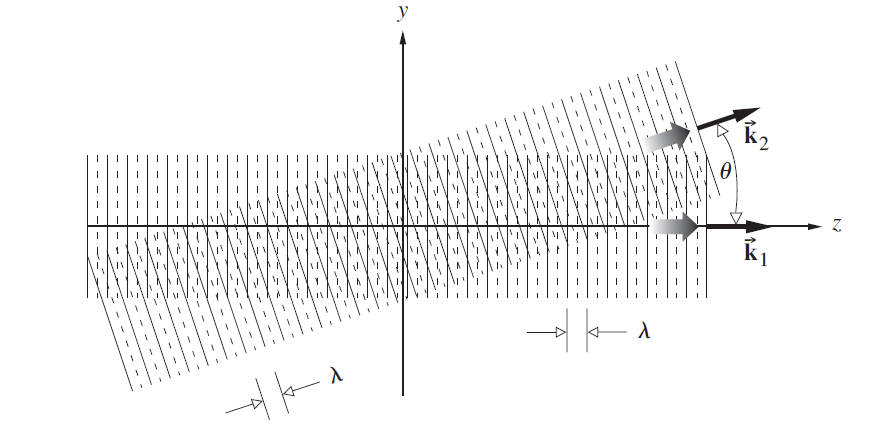
Return to Fig. 2.25 and prove that if two electromagnetic plane waves making an angle θ have the same amplitude, E0, the resulting interference pattern on the yx-plane is a cosine-squared irradiance distribution given byLocate the zeros of irradiance. What is the value of the fringe
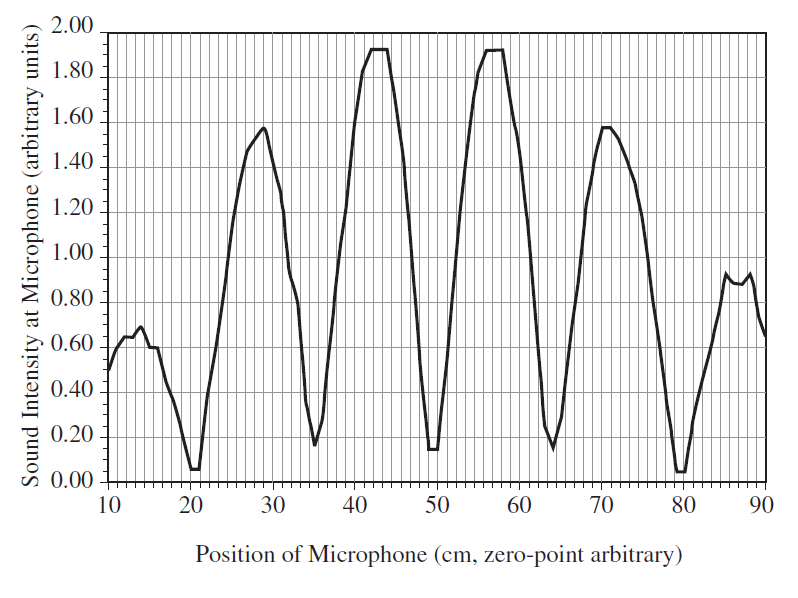
Figure P.9.5 shows an output pattern that was measured by a tiny microphone when two small piezo-loudspeakers separated by 15 cm were pointed toward the microphone at a distance of 1.5 m away. Given that the speed of sound at 20°C is 343 m/s, determine the approximate frequency at which the
Two 1.0-MHz radio antennas emitting in-phase are separated by 600 m along a north–south line. A radio receiver placed 2.0 km east is equidistant from both transmitting antennas and picks up a fairly strong signal. How far north should that receiver be moved if it is again to detect a signal
Two parallel narrow slits in an opaque screen are separated by 0.100 mm. They are illuminated by plane waves of wavelength 589 nm. A cosine-squared fringe pattern wherein consecutive maxima are 3.00 mm apart appears on a viewing screen. How far from the aperture screen is the viewing screen?
Suppose the separation of the narrow slits in Young’s Experiment is 1.000 mm and the viewing screen is 5.000 m away. Plane waves of monochromatic 589.3-nm light illuminate the slits and the whole setup is in air where n = 1.00029. What would happen to the fringe separation if all the air was
An expanded beam of red light from a He–Ne laser (λ0 = 632.8 nm) is incident on a screen containing two very narrow horizontal slits separated by 0.200 mm. A fringe pattern appears on a white screen held 1.00 m away.(a) How far (in radians and millimeters) above and below the central axis are
Two pinholes in a thin sheet of aluminum are 1.00 mm apart and immersed in a large tank of water (n = 1.33). The holes are illuminated by λ0 = 589.3 nm plane waves, and the resulting fringe system is observed on a screen in the water, 3.00 m from the holes. Determine the locations of the centers
Red plane waves from a ruby laser (λ0 = 694.3 nm) in air impinge on two parallel slits in an opaque screen. A fringe pattern forms on a distant wall, and we see the fourth bright band 1.0° above the central axis. Calculate the separation between the slits.
A 3 × 5 card containing two pinholes, 0.08 mm in diameter and separated center to center by 0.10 mm, is illuminated by parallel rays of blue light from an argon ion laser (λ0 = 487.99 nm). If the fringes on an observing screen are to be 10 mm apart, how far away should the screen be?
White light falling on two long narrow slits emerges and is observed on a distant screen. If red light (λ0 = 780 nm) in the first-order fringe overlaps violet in the second-order fringe, what is the latter’s wavelength?
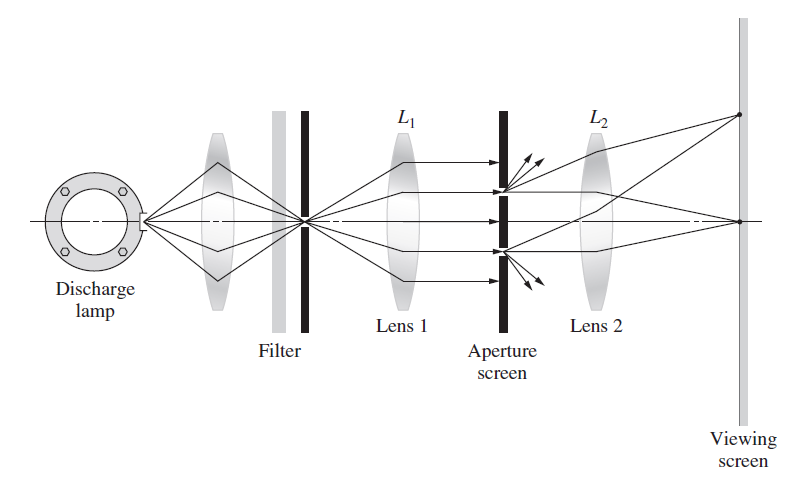
Consider the physical setup shown in Fig. 9.14. If the focal length of the second lens is ƒ, prove that maxima are located at ym, where ym= mƒ(λ/α). Draw a line from the center of the lens-2 to a point a height ymabove the central axis; it makes an
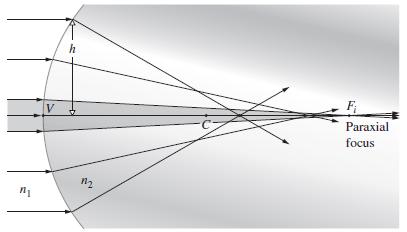
Using the setup of Fig. 9.14, where the second lens has a focal length of f, determine an expression (in terms of f, λ, and a) for the separation between the centers of the first minima above and below the central axis.Fig 9.14 h V F Paraxial focus
Considering the double-slit experiment, derive an equation for the distance ym' from the central axis to the m'th irradiance minimum, such that the first dark bands on either side of the central maximum correspond to m' = ±1. Identify and justify all your approximations.
Two narrow slits in a thin metal sheet are 2.70 mm apart centerto-center. When illuminated directly by plane waves (in air) a fringe pattern appears on a screen 4.60 m away. It is found that measuring from the center of any one dark fringe to the center of the minimum five dark fringes away is a
With regard to Young’s Experiment, derive a general expression for the shift in the vertical position of the mth maximum as a result of placing a thin parallel sheet of glass of index n and thickness d directly over one of the slits. Identify your assumptions.
Sunlight incident on a screen containing two long narrow slits 0.20 mm apart casts a pattern on a white sheet of paper 2.0 m beyond. What is the distance separating the violet (λ0 = 400 nm) in the first-order band from the red (λ0 = 600 nm) in the second-order band?
Plane waves of monochromatic light impinge at an angle θi on a screen containing two narrow slits separated by a distance α. Derive an equation for the angle measured from the central axis that locates the mth maximum.
A stream of electrons, each having an energy of 0.5 eV, impinges on a pair of extremely thin slits separated by 10-2 mm. What is the distance between adjacent minima on a screen 20 m behind the slits? (me = 9.108 × 10⁻³¹ kg, 1 eV = 1.602 × 10⁻¹⁹ J.)
It is our intention to produce interference fringes by illuminating some sort of arrangement (Young’s Experiment, a thin film, the Michelson Interferometer, etc.) with light at a mean wavelength of 500 nm, having a linewidth of 2.5 × 10⁻³ nm. At approximately what optical path length difference
Imagine that you have an opaque screen with three horizontal very narrow parallel slits in it. The second slit is a center-to-center distance a beneath the first, and the third is a distance 5α/2 beneath the first. (a) Write a complex exponential expression in terms of δ
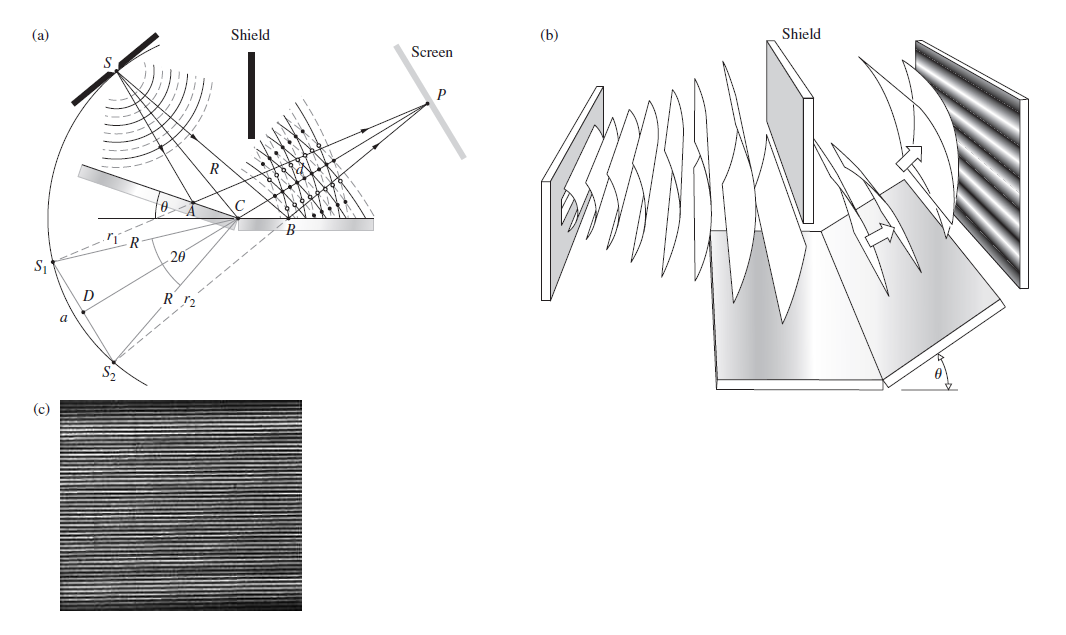
Imagine a Fresnel double mirror (in air) illuminated by monochromatic light at 600.0 nm. The source slit is parallel to and 1.000 m from the line of intersection of the mirrors. If the bright fringes on a viewing screen 3.900 m from the mirror intersection are spaced 2.00 mm apart, determine the
In the Fresnel double mirror s = 2 m, λ0 = 589 nm, and the separation of the fringes was found to be 0.5 mm. What is the angle of inclination of the mirrors, if the perpendicular distance of the actual point source to the intersection of the two mirrors is 1 m?
Show that α for the Fresnel biprism of Fig. 9.23 is given by α = 2d(n - 1)α.Fig. 9.23 Shield (a) Shield (b) Screen 20 R ry S, (c)
The Fresnel biprism is used to obtain fringes from a point source that is placed 2 m from the screen, and the prism is midway between the source and the screen. Let the wavelength of the light be λ0 = 500 nm and the index of refraction of the glass be n = 1.5. What is the prism angle, if the
What is the general expression for the separation of the fringes of a Fresnel biprism of index n immersed in a medium having an index of refraction n'?
A line source of sodium light (λ0 = 589.3 nm) illuminates a Lloyd’s mirror 10.0 mm above its surface. A viewing screen is 5.00 m from the source and the whole apparatus is in air. How far apart are the first and third maxima?
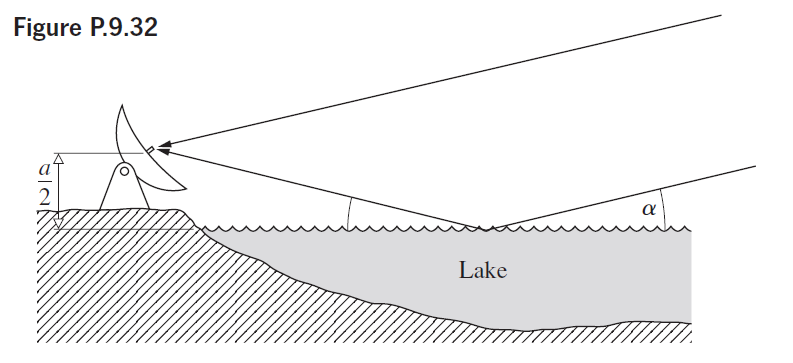
Imagine that we have an antenna at the edge of a lake picking up a signal from a distant radio star (Fig. P.9.32), which is just coming up above the horizon. Write expressions for δ and for the angular position of the star when the antenna detects its first maximum. Figure P.9.32 2 Lake
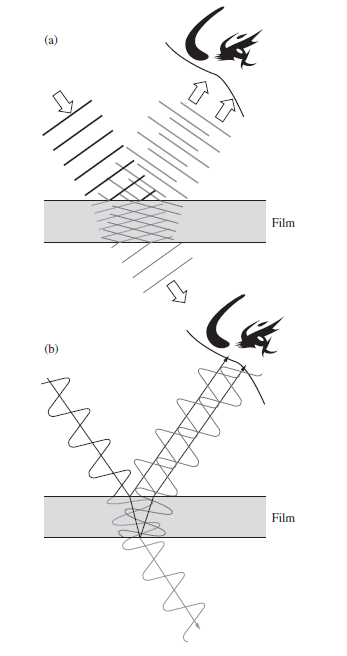
If the plate in Fig. 9.27 is glass in air, show that the amplitudes of E1r, E2r, and E3rare, respectively, 0.2E0i, 0.192E0i, and 0.008E0i, where E0iis the incident amplitude. Make use of the Fresnel coefficients at normal incidence, assuming no absorption. You might repeat the calculation for a
A soap film surrounded by air has an index of refraction of 1.34. If a region of the film appears bright red (λ0 = 633 nm) in normally reflected light, what is its minimum thickness there?
A soap film in air of index 1.34 has a region where it is 550.0 nm thick. Determine the wavelengths of the radiation that is not reflected when the film is illuminated from above with sunlight.
A thin uniform layer of water (n = 1.333) 25.0 nm thick exists on top of a sheet of clear plastic (n = 1.59). At what incident angle will the water strongly reflect blue light (λ0= 460 nm)? Modify Eq. (9.34).] Απi (9.34) -d cos θ, π δ- λο
Consider the circular pattern of Haidinger’s fringes resulting from a film with a thickness of 2 mm and an index of refraction of 1.5. For monochromatic illumination of λ0 = 600 nm, find the value of m for the central fringe (θt = 0). Will it be bright or dark?
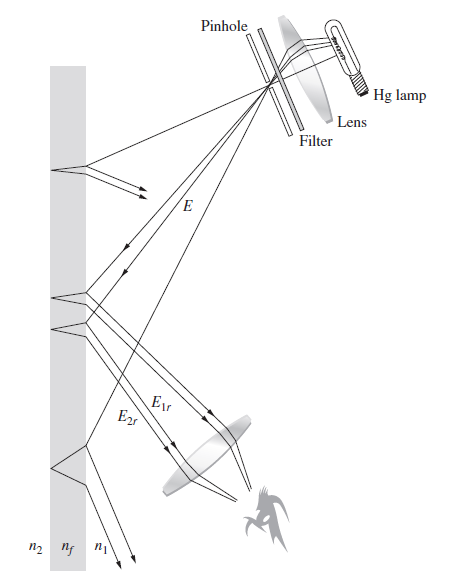
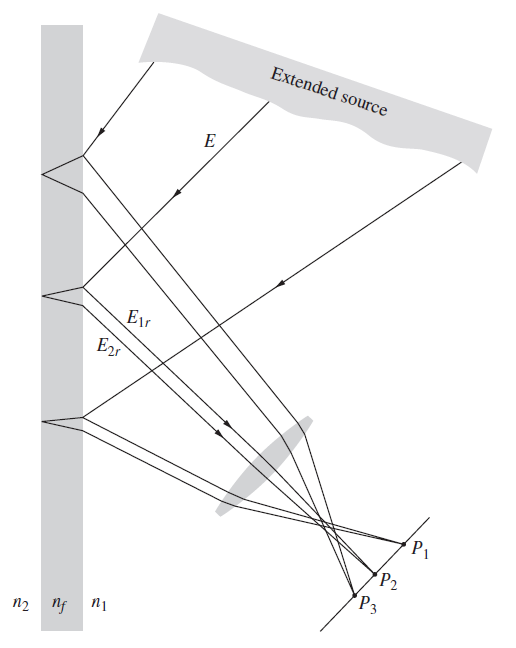
Illuminate a microscope slide (or even better, a thin cover-glass slide). Colored fringes can easily be seen with an ordinary fluorescent lamp (although some of the newer versions don€™t work well at all) serving as a broad source or a mercury street light as a point source. Describe the
Fringes are observed when a parallel beam of light of wavelength 500 nm is incident perpendicularly onto a wedge-shaped film with an index of refraction of 1.5. What is the angle of the wedge if the fringe separation is 1/3 cm?
Suppose a wedge-shaped air film is made between two sheets of glass, with a piece of paper 7.618 × 10⁻⁵ m thick used as the spacer at their very ends. If light of wavelength 500 nm comes down from directly above, determine the number of bright fringes that will be seen across the wedge.
A wedge-shaped air film between two flat sheets of glass is illuminated from above by sodium light (λ0 = 589.3 nm). How thick will the film be at the center of the 173rd bright fringe (counted from the contact line of the two glass sheets).
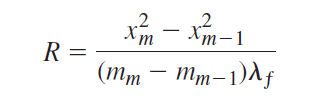
Figure P.9.43 illustrates a setup used for testing lenses. Show thatwhen d1 and d2 are negligible in comparison with 2R1 and 2R2, respectively. (Recall the theorem from plane geometry that relates the products of the segments of intersecting chords.) Prove that the radius of the mth dark fringe is
Newton’s rings are observed on a film with quasimonochromatic light that has a wavelength of 500 nm. If the 20th bright ring has a radius of 1.00 cm, what is the radius of curvature of the lens forming one part of the interfering system?
When dust gets between the glass elements of a Newton€™s ring setup, it can cause an unknown shift in the film thickness Δd, and a corresponding change in the fringe pattern. The path difference is then 2(d + Δd) = mλƒ, and because of the
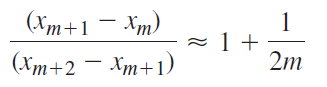
Examining photos of Newton€™s rings we observe that fringes at large values of m seem to be nearly equally spaced. To see that analytically, show thatWhen m is large, the spacings between consecutive fringes are approximately equal. (Xm+1 (Хт+1 — Хт) 1 - 2m (Xm+2 – Xm+1)
A Michelson Interferometer is illuminated with monochromatic light. One of its mirrors is then moved 2.35 × 10⁻⁵ m, and it is observed that 92 fringe-pairs, bright and dark, pass by in the process. Determine the wavelength of the incident beam.
Quasimonochromatic light with an average wavelength of 500 nm illuminates a Michelson Interferometer. The movable mirror-M1 is farther from the beamsplitter than is fixed mirror-M2 by a distance d. Decreasing d by 0.100 mm causes a number of fringe- airs to sweep past a hairline in a viewing
Suppose we place a chamber 10.0 cm long with flat parallel windows in one arm of a Michelson Interferometer that is being illuminated by 600-nm light. If the refractive index of air is 1.000 29 and all the air is pumped out of the cell, how many fringe-pairs will shift by in the process?
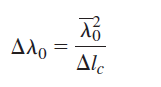
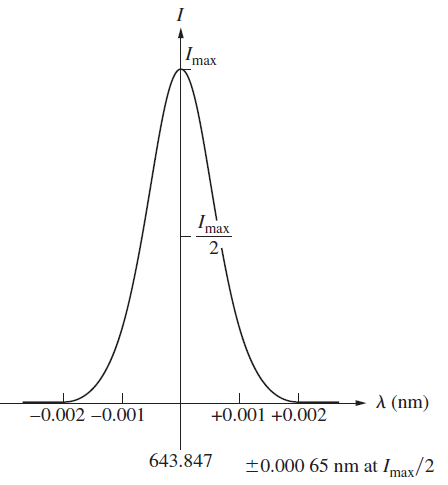
Cadmium red light has a mean wavelength of λ̅0= 643.847 nm (see Fig. 7.45) and a linewidth of 0.001 3 nm. When used to illuminate a Michelson Interferometer it is found that increasing the mirror separation from zero to some amount D causes the fringes to vanish. Show
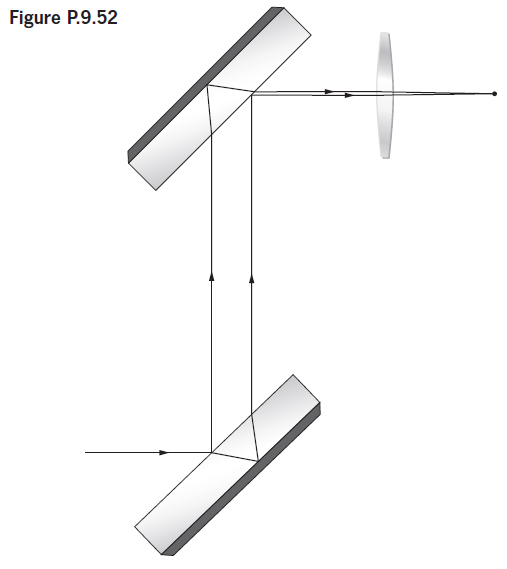
A form of the Jamin Interferometer is illustrated in Fig. P.9.52. How does it work? To what use might it be put? Figure P.9.52
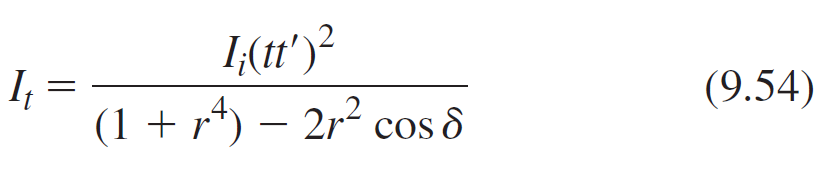
Starting with Eq. (9.53) for the transmitted wave, compute the flux density, that is, Eq. (9.54). Ế, = Egelo tt' Eoeiot 1 – pPe-ið (9.53) 14(t')? I; (1 + r4) – 2r² (9.54) cos 8
A point source S is a perpendicular distance R away from the center of a circular hole of radius a in an opaque screen. If the distance from S to the periphery of the hole is (R + ℓ), show that Fraunhofer diffraction will occur on a very distant screen whenλR >> α2/2What is the smallest
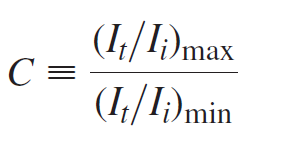
Given that the mirrors of a Fabry€“Perot Interferometer have an amplitude reflection coefficient of r = 0.894 4, find(a) The coefficient of finesse,(b) The half-width,(c) The finesse, and,(d) The contrast factor defined by (I;/I)max C : (1;/I)min
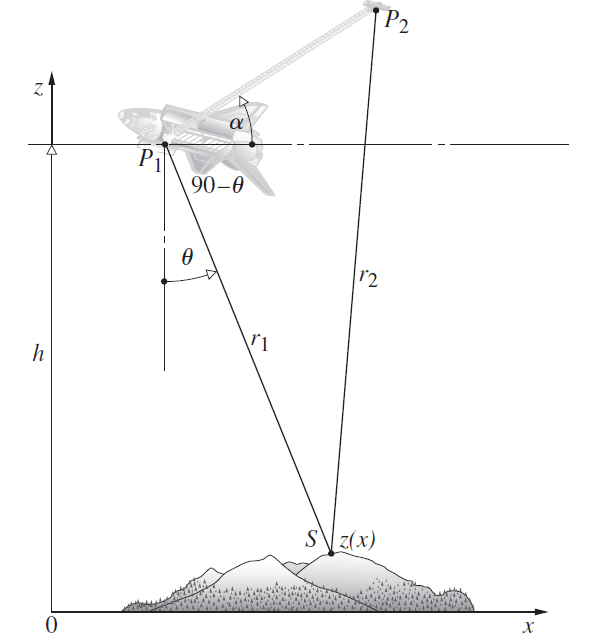
Using Fig. 9.73, which depicts the geometry of the Shuttle radar interferometer, show thatz(x) = h - r1 cos θThen use the Law of Cosines to establish that Eq. (9.108) is correct.Fig. 9.73 (A$/2)? – a² 2a sin (α - θ ) -( φ/2π) cos 0 (9.108) z(x) = h P2 Z. P1 90-0 r2 s\z(x) х
A glass camera lens with an index of 1.55 is to be coated with a cryolite film (n ≈ 1.30) to decrease the reflection of normally incident green light (λ0 = 500 nm). What thickness should be deposited on the lens?
A glass microscope lens having an index of 1.55 is to be coated with a magnesium fluoride film to increase the transmission of normally incident yellow light (λ0 = 500 nm). What minimum thickness should be deposited on the lens?
Determine the refractive index and thickness of a film to be deposited on a glass surface (ng = 1.54) such that no normally incident light of wavelength 540 nm is reflected.
Verify that the reflectance of a substrate can be increased by coating it with a λƒ/4, high-index layer, that is, n1 > ns. Show that the reflected waves interfere constructively. The quarter-wave stack g(HL)mHα can be thought of as a series of such structures.
Satisfy yourself of the fact that a film of thickness λƒ/4 and index n1 will always reduce the reflectance of the substrate on which it is deposited, as long as ns > n1 > n0. Consider the simplest case of normal incidence and n0 = 1. Show that this is equivalent to saying that the waves
Consider the interference pattern of the Michelson Interferometer as arising from two beams of equal flux density. Using Eq. (9.17), compute the half-width. What is the separation, in δ, between adjacent maxima? What then is the finesse? I = 21o(1 + cos 8) = 4lo 410 cos“ 2 (9.17) 2
To fill in some of the details in the derivation of the smallest phase increment separating two resolvable Fabry€“Perot fringes, that is,satisfy yourself thatShow that Eq. (9.72) can be rewritten asWhen F is large γ is small, and sin (Δδ) =
Suppose we spread white light out into fan of wavelengths by means of a diffraction grating and then pass a small select region of that spectrum out through a slit. Because of the width of the slit, a band of wavelengths 1.2 nm wide centered on 500 nm emerges. Determine the frequency bandwidth and
A filter passes light with a mean wavelength of λ̅0 = 500 nm. If the emerging wavetrains are roughly 20λ̅0 long, what is the frequency bandwidth of the exiting light?
Suppose that we have a filter with a pass band of 1.0 Å centered at 600 nm, and we illuminate it with sunlight. Compute the coherence length of the emerging wave.
Imagine that we chop a continuous laserbeam (assumed to be monochromatic at λ0 = 632.8 nm) into 0.1-ns pulses, using some sort of shutter. Compute the resultant in width Δλ, bandwidth, and coherence length. Find the bandwidth and linewidth that would result if we could chop at 1015 Hz.
A magnetic-field technique for stabilizing a He–Ne laser to 2 parts in 1010 has been patented. At 632.8 nm, what would be the coherence length of a laser with such a frequency stability?
The first* experiment directly measuring the bandwidth of a laser (in this case a continuous-wave Pb0.88Sn0.12 Te diode laser) was carried out in 1969. The laser, operating at λ0 = 10 600 nm, was heterodyned with a CO2 laser, and bandwidths as narrow as 54 kHz were observed. Compute the
Consider a photon in the visible region of the spectrum emitted during an atomic transition of about 10-8 s. How long is the wave packet? Keeping in mind the results of the previous problem (if you’ve done it), estimate the linewidth of the packet (λ̅0 = 500 nm). What can you say about its
A blue-light LED with a mean vacuum wavelength of 446 nm has a linewidth of 21 nm. Determine its coherence time and coherence length.
Derive an expression for the coherence length (in vacuum) of a wavetrain that has a frequency bandwidth Δv; express your answer in terms of the line width Δλ0 and the mean wavelength λ̅0 of the train.
Showing 300 - 400
of 829
1
2
3
4
5
6
7
8
9
Step by Step Answers

 Get 50% OFF
Claim Now
Get 50% OFF
Claim Now




![Linear optical element Jones matrix Mueller matrix 1 [1 o] Horizontal linear polarizer 1 -1 1 -1 Vertical linear polariz](https://dsd5zvtm8ll6.cloudfront.net/si.question.images/images/question_images/1546/9/6/3/4285c34c9e48c23c1546946044802.jpg)
![TABLE 8.6 Jones and Mueller Matrices Linear optical element Jones matrix Mueller matrix [1 0] Horizontal linear polarizer 20 -1 Vertical linear [o o] 1 -1 1 polarizer 1 Linear polarizer 10 at +45° 21 1 1 -1 Linear polarizer at -45° 2 -1 1 [1 Quarter-wave plate, fast axis](https://dsd5zvtm8ll6.cloudfront.net/si.question.images/images/question_images/1607/6/6/8/4665fd312f2618cb1607668465250.jpg)

![[1+ V3 2V2 1 ] -1 + V3 1+ V3 [1 - V3](https://dsd5zvtm8ll6.cloudfront.net/si.question.images/images/question_images/1546/9/6/4/8405c34cf68b66c41546947456691.jpg)





![Xm = [R¡R2mAf/(R2 – R1)]/²](https://dsd5zvtm8ll6.cloudfront.net/si.question.images/images/question_images/1547/0/3/8/5645c35ef649c3da1547021188084.jpg)




![4.2/VF (A8) [9.73]](https://dsd5zvtm8ll6.cloudfront.net/si.question.images/images/question_images/1547/0/4/2/3225c35fe1239e5e1547024945435.jpg)
![[A(0)]s=8±A8/2 = [A(0)]s=A8/2](https://dsd5zvtm8ll6.cloudfront.net/si.question.images/images/question_images/1547/0/4/2/3385c35fe223eba71547024961592.jpg)



