New Semester
Started
Get
50% OFF
Study Help!
--h --m --s
Claim Now
Question Answers
Textbooks
Find textbooks, questions and answers
Oops, something went wrong!
Change your search query and then try again
S
Books
FREE
Study Help
Expert Questions
Accounting
General Management
Mathematics
Finance
Organizational Behaviour
Law
Physics
Operating System
Management Leadership
Sociology
Programming
Marketing
Database
Computer Network
Economics
Textbooks Solutions
Accounting
Managerial Accounting
Management Leadership
Cost Accounting
Statistics
Business Law
Corporate Finance
Finance
Economics
Auditing
Tutors
Online Tutors
Find a Tutor
Hire a Tutor
Become a Tutor
AI Tutor
AI Study Planner
NEW
Sell Books
Search
Search
Sign In
Register
study help
sciences
optics
Optics 5th edition Eugene Hecht - Solutions
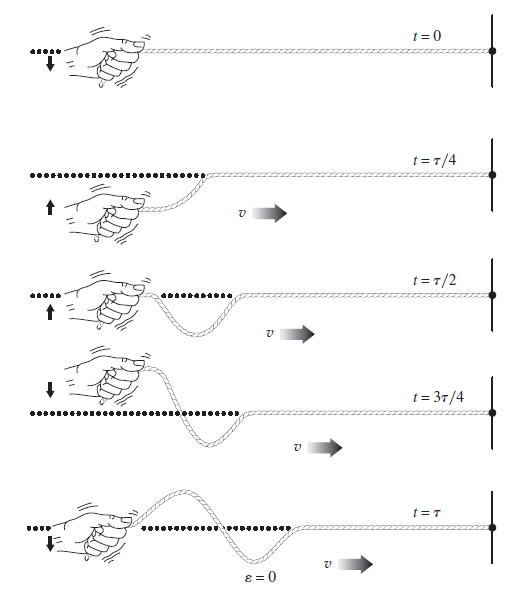
Show that if the displacement of the string in Fig. 2.12 is given byy(x, t) = A sin [kx - ωt + ε]then the hand generating the wave must be moving vertically in simple harmonic motion.Fig. 2.12 t = 0 .t.. t=7/4 t=7/2 t = 37/4 ... t= T ɛ = 0
Write the expression for the wavefunction of a harmonic wave of amplitude 103 V/m, period 2.2 × 10⁻¹⁵ s, and speed 3 × 10⁸ m/s. The wave is propagating in the negative x-direction and has a value of 103 V/m at t = 0 and x = 0.
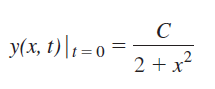
Consider the pulse described in terms of its displacement at t = 0 bywhere C is a constant. Draw the wave profile. Write an expression for the wave, having a speed v in the negative x-direction, as a function of time t. If v = 1 m/s, sketch the profile at t = 2 s. y(x, t)|1 =0 = 2 + x?
Determine the magnitude of the wavefunction Ψ(z, t) = A cos [k(z + vt) + π] at the point z = 0, when t = τ/2 and when t = 3π/4.
Use Eq. (2.33) to calculate the speed of the wave whose representation in SI units isψ(y, t) = A cos Ï€(3 × 10⁶y + 9 × 10¹⁴t) дх (2.33) tv ot Ф
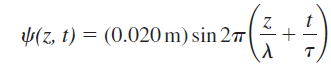
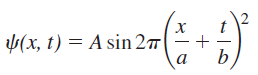
The displacement of a wave on a string is given bywhere the wave travels at 2.00 m/s and has a period of 1/4 s. Determine the displacement of the string 1.50 m from the origin at a time t = 2.2 s. z, t) 3 (0.020 m) sin 2т т
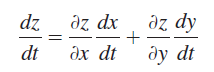
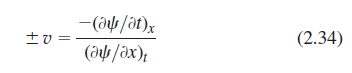
Begin with the following theorem: If z = Æ’(x, y) and x = g(t), y = h(t), thenDerive Eq. (2.34). хр 20 дz dy dz ду dt дх dt dt || -(a /at)x 土ひ= (ap /əx); (2.34)
Using the results of the previous problem, show that for a harmonic wave with a phase φ(x, t) = k(x - vt) we can determine the speed by setting dφ/dt = 0. Apply the technique to Problem 2.32 to find the speed of that wave.Data from Prob. 2.32Use Eq. (2.33) to calculate the
A Gaussian wave has the form Ψ(x, t) = Ae-α(bx+ct)2. Use the fact that Ψ(x, t) = f(x ∓ vt) to determine its speed and then verify your answer using Eq. (2.34). (y, t) = A cos T(3 × 10°y + 9 x 1041)
Determine which of the following describe traveling waves:(a)(b)(c)(d)Where appropriate, draw the profile and find the speed and direction of motion. (y, t) = ea*y²+b²r²–2abty) | V(z, t) = A sin (az² – bť²)
Given the traveling wave Ψ(x, t) = 5.0 exp (-αx2 - bt2 - 2√αb xt), determine its direction of propagation. Calculate a few values of Ψ and make a sketch of the wave at t = 0, taking α = 25 m-2 and b = 9.0 s-2. What is the speed of the wave?
Imagine a sound wave with a frequency of 1.10 kHz propagating with a speed of 330 m/s. Determine the phase difference in radians between any two points on the wave separated by 10.0 cm.
Consider a lightwave having a phase velocity of 3 × 10⁸ m/s and a frequency of 6 × 10¹⁴ Hz. What is the shortest distance along the wave between any two points that have a phase difference of 30°? What phase shift occurs at a given point in 10-6 s, and how many waves have passed by in that time?
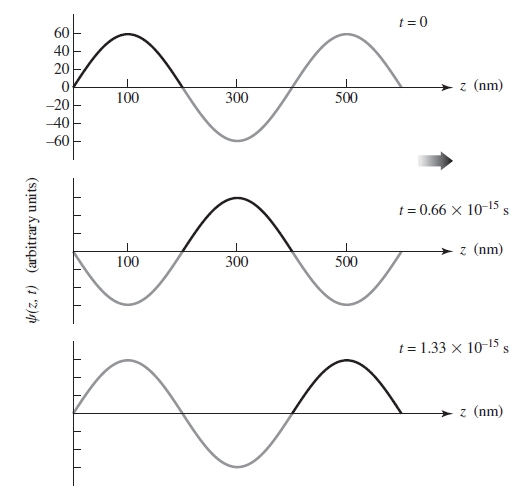
Write an expression for the wave shown in Fig. P.2.43. Find its wavelength, velocity, frequency, and period.Fig. P.2.43 t = 0 60 40 20 z (nm) 100 500 300 -20 -40 -60 t = 0.66 x 10⁻¹⁵ s z (nm) 100 300 500 t = 1.33 x 10⁻¹⁵ s z (nm) b(z, t) (arbitrary units)
Working with exponentials directly, show that the magnitude of Ψ = Aeiωt is A. Then re-derive the same result using Euler’s formula. Prove that eiαeiβ = ei(α+β).
Show that the imaginary part of a complex number z˜ is given by (z˜ - z˜*)/2i.
Take the complex quantities zËœ1= (x1+ iy1) and zËœ2= (x2+ iy2) and show that Re (ž1 + ž2) = Re (ž1) + Re (ž2)
Take the complex quantities zËœ1= (x1+ iy1) and zËœ2=(x2+ iy2) and show that Re (ž) X Re (ž2) # Re (ž¡ × ž2)
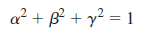
Beginning with Eq. (2.51), verify thatand thatDraw a sketch showing all the pertinent quantities. (x, y, z, t) = Aek»x+k,y+k_z#wt) (2.51) a² + B² + y? = 1
Show that Eqs. (2.64) and (2.65), which are plane waves of arbitrary form, satisfy the three-dimensional differential wave equation. (x, y, z, t) = f(æx + By + yz – vt) b(x, y, z, t) = g(ax + By + yz + vt) (2.64) %3D (2.65)
Make up a table with columns headed by values of θ running from -π/2 to 2π in intervals of π/4. In each column place the corresponding value of sin θ, and beneath those the values of 2 sin θ. Next add these, column by column, to yield the corresponding values of the function sin θ + 2 sin
Make up a table with columns headed by values of θ running from -π/2 to 2π in intervals of π/4. In each column place the corresponding value of sin θ, and beneath those the values of sin (θ - π/2). Next add these, column by column, to yield the corresponding values of the function sin θ +
With the last two problems in mind, draw a plot of the three functions(a) sin θ(b) sin (θ - 3/4)(c) sin θ + sin (θ - 3π/4).Compare the amplitude of the combined function (c) in this case with that of the previous problem.
Show that Ψ(vector k• vector r, t) may represent a plane wave where vector k is normal to the wavefront. [Let vector r1 and vector r2 be position vectors drawn to any two points on the plane and show that ψ( vector r1, t) = ψ( vector r2, t).]
Show explicitly, that the functiondescribes a wave provided that v = ω/k yT, t) = Aexp[i(k•i + ot + £)]
Write an expression in Cartesian coordinates for a harmonic plane wave of amplitude A and frequency ω propagating in the positive x-direction.
Write an expression in Cartesian coordinates for a harmonic plane wave of amplitude A and frequency ω propagating in the direction of the vector k, which in turn lies on a line drawn from the origin to the point (4, 2, 1). [First determine vector k and then dot it with vector r.]
De Broglie’s hypothesis states that every particle has associated with it a wavelength given by Planck’s constant (h = 6.6 × 10⁻³⁴ J · s) divided by the particle’s momentum. Compare the wavelength of a 6.0-kg stone moving at a speed of 1.0 m/s with that of light.
Consider the functionwhere A, α, and b are all constants, and they have appropriate SI units. Does this represent a wave? If so, what is its speed and direction of propagation? 2,2 2_2 (z, t) = Aexp[-(a²z? + b*² + 2abzt)]
Showing 800 - 900
of 829
1
2
3
4
5
6
7
8
9
Step by Step Answers

 Get 50% OFF
Claim Now
Get 50% OFF
Claim Now










![yT, t) = Aexp[i(k•i + ot + £)]](https://dsd5zvtm8ll6.cloudfront.net/si.question.images/images/question_images/1546/0/7/6/4875c2741475c83c1546005080375.jpg)
![2,2 2_2 (z, t) = Aexp[-(a²z? + b*² + 2abzt)]](https://dsd5zvtm8ll6.cloudfront.net/si.question.images/images/question_images/1546/0/7/6/3715c2740d312b721546004964379.jpg)


