New Semester
Started
Get
50% OFF
Study Help!
--h --m --s
Claim Now
Question Answers
Textbooks
Find textbooks, questions and answers
Oops, something went wrong!
Change your search query and then try again
S
Books
FREE
Study Help
Expert Questions
Accounting
General Management
Mathematics
Finance
Organizational Behaviour
Law
Physics
Operating System
Management Leadership
Sociology
Programming
Marketing
Database
Computer Network
Economics
Textbooks Solutions
Accounting
Managerial Accounting
Management Leadership
Cost Accounting
Statistics
Business Law
Corporate Finance
Finance
Economics
Auditing
Tutors
Online Tutors
Find a Tutor
Hire a Tutor
Become a Tutor
AI Tutor
AI Study Planner
NEW
Sell Books
Search
Search
Sign In
Register
study help
sciences
optics
Optics 5th edition Eugene Hecht - Solutions
White light falls normally on a transmission grating that contains 1000 lines per centimeter. At what angle will red light (λ0 = 650 nm) emerge in the first-order spectrum?
A transmission grating whose lines are separated by 3.0 × 10⁻⁶ m is illuminated by a narrow beam of red light (l0 = 694.3 nm) from a ruby laser. Spots of diffracted light, on both sides of the undeflected beam, appear on a screen 2.0 m away. How far from the central axis is each of the two
We’d like to read a license plate (numbers about 5.0 cm × 5.0 cm) at a distance of 161 km (about 100 mi). How big an objective mirror would a spy satellite need? Assume a mean wavelength of 550 nm.
A telescope having an objective lens with a diameter of 10.0 cm will be used to view two equally bright small sources of 550-nm light.(a) Determine the angular separation of the sources if they are just resolvable. Use Rayleigh’s criterion.(b) How far apart can they be at a distance of 1000 km?
The Mount Palomar telescope has an objective mirror with a 508-cm diameter. Determine its angular limit of resolution at a wavelength of 550 nm, in radians, degrees, and seconds of arc. How far apart must two objects be on the surface of the Moon if they are to be resolvable by the Palomar
If you peered through a 0.75-mm hole at an eye chart, you would probably notice a decrease in visual acuity. Compute the angular limit of resolution, assuming that it’s determined only by diffraction; take λ0 = 550 nm. Compare your results with the value of 1.7 × 10⁻⁴ rad, which
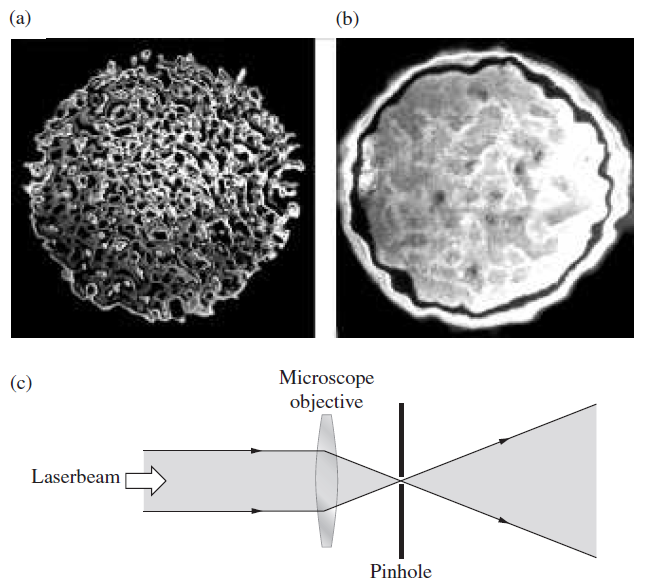
What would happen to the speckle pattern if a laserbeam were projected onto a suspension such as milk rather than onto a smooth wall?
The arrangement shown in Fig. P.13.53 is used to convert a collimated laserbeam into a spherical wave. The pinhole cleans up the beam; that is, it eliminates diffraction effects due to dust and the like on the lens. How does it manage it?Fig. P.13.53 (a) (b) Microscope objective (c) Laserbeam
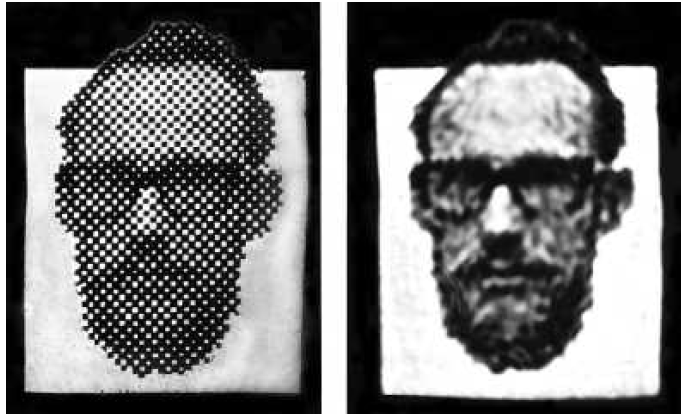
Imagine that we have a large photographic transparency on which there is a picture of a student made up of a regular array of small circular dots, all of the same size, but each with its own density, so that it passes a spot of light with a particular field amplitude. Considering the transparency
Imagine that we have an opaque mask into which are punched an ordered array of circular holes, all of the same size, located as if at the corners of the boxes of a checkerboard. Now suppose our robot puncher goes mad and makes an additional batch of holes essentially randomly all across the mask.
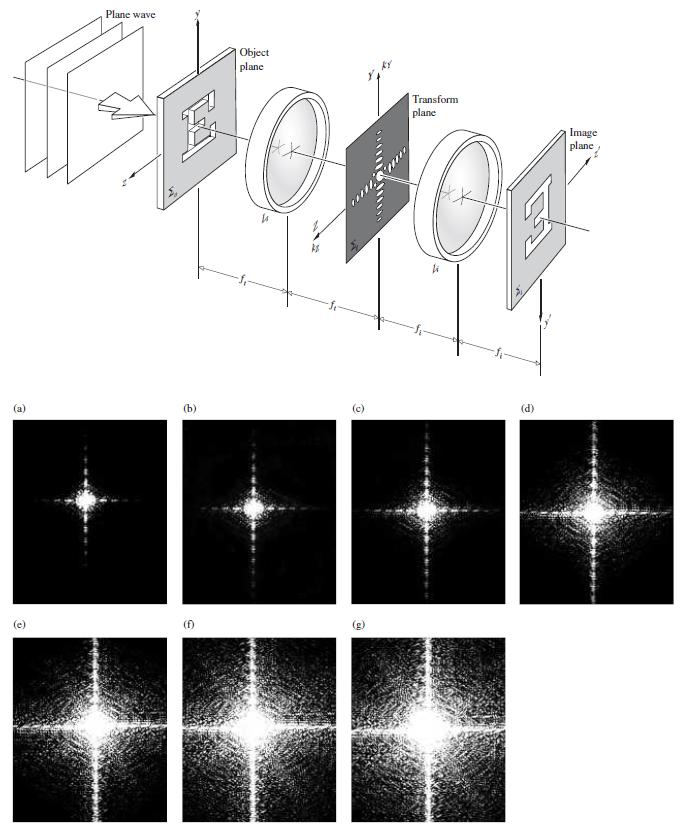
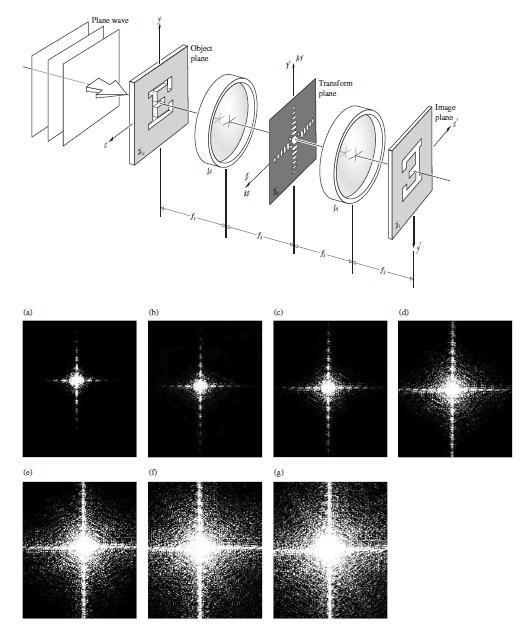
A fine square wire mesh with 50 wires per cm is placed vertically in the object plane of the optical computer of Fig. 13.50. If the lenses each have 1.00-m focal lengths, what must be the illuminating wavelength, if the diffraction spots on the transform plane are to have a horizontal and vertical
Replace the cosine grating in the previous problem with a €œsquare€ bar grating, that is, a series of many fine alternating opaque and transparent bands of equal width. We now filter out all terms in the transform plane but the zeroth and the two first-order diffraction spots.
Suppose we insert a mask in the transform plane of the previous problem, which obscures everything but the m = +1 diffraction contribution. What will the reformed image look like on Σi? Explain your reasoning. Now suppose we remove only the m = +1 or the m = -1 term. What will the re-formed image
Imagine that you have a cosine grating (i.e., a transparency whose amplitude transmission profile is cosinusoidal varying between 0 and 1) with a spatial period of 0.01 mm. The grating is illuminated by quasimonochromatic plane waves of λ = 500 nm, and the setup is the same as that of Fig. 13.36,
A diffraction grating having a mere 50 grooves per cm is the object in the optical computer shown in Fig. 13.41. If it is coherently illuminated by plane waves of green light (543.5 nm) from a He-Ne laser and each lens has a 100-cm focal length, what will be the spacing of the diffraction spots on
With Fig. 13.36 in mind, show that the transverse magnification of the system is given by -ƒi/ƒtand draw the appropriate ray diagram. Draw a ray up through the center of the first lens at an angle θ with the axis. From the point where that ray intersects
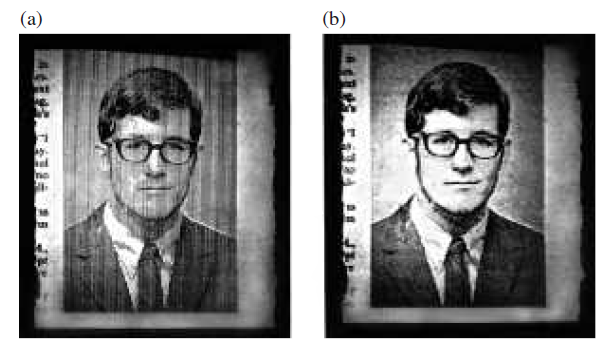
Returning to Fig. 13.37, what kind of spatial filter would produce each of the patterns shown in Fig. P.13.43?Fig. 13.37P.13.43? (b) (a) (a) (b)
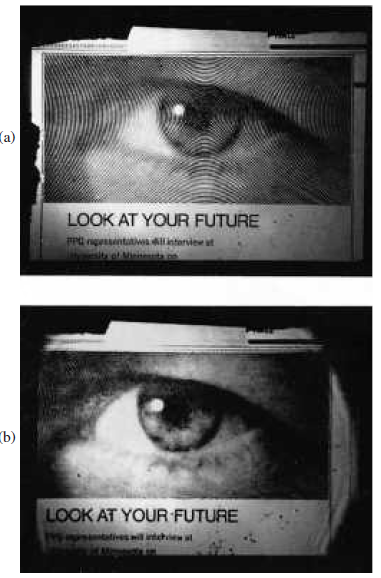
Repeat the previous problem using Fig. P.13.42 this time.Fig. P.13.42 (a) LOOK AT YOUR FUTURE ngsentatiwa iintervie at b) LOOK AT YOUR FUTURE
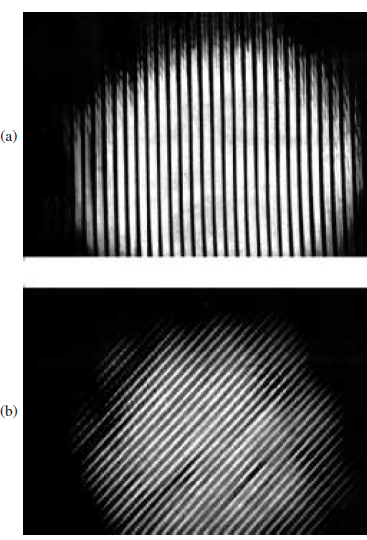
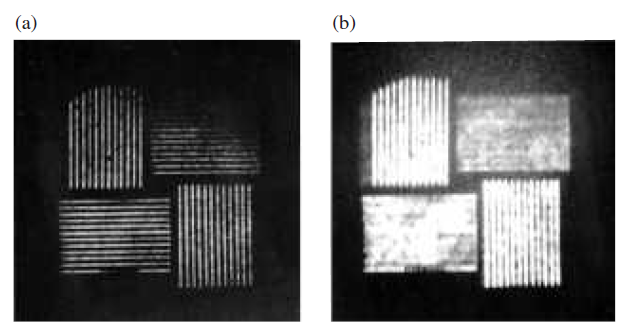
Repeat the previous problem using Fig. P.13.41 instead.previous problem Make a rough sketch of the Fraunhofer diffraction pattern that would arise if a transparency of Fig. P.13.40a served as the object. How would you filter it to get Fig. P.13.40b?Fig. P.13.41 (a) (b)
Make a rough sketch of the Fraunhofer diffraction pattern that would arise if a transparency of Fig. P.13.40a served as the object. How would you filter it to get Fig. P.13.40b? Fig. P.13.40a and bP.13.40b (a) (b)
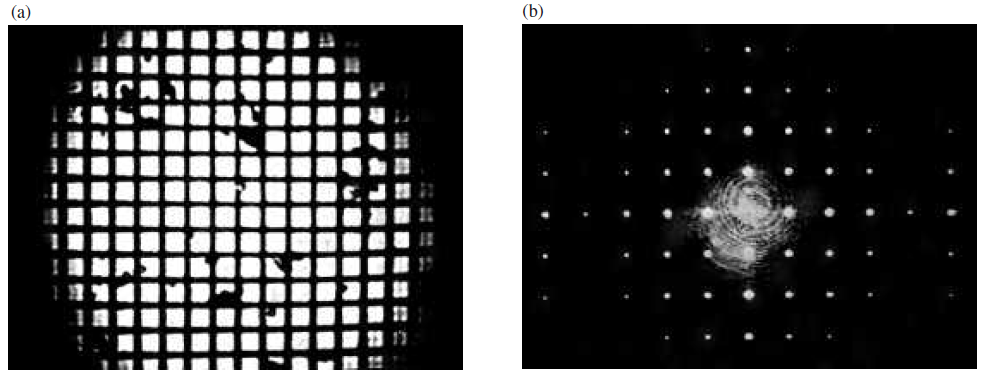
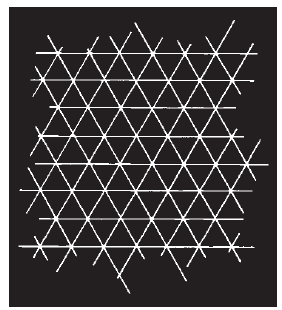
What would the pattern look like for a laserbeam diffracted by the three crossed gratings of Fig. P.13.39?Fig. P.13.39?
A He-Ne laser operating at 632.8 nm has an internal beam waist diameter of 0.60 mm. Calculate the full-angular width, or divergence, of the beam.
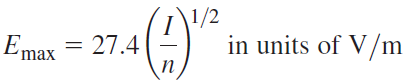
Show that the maximum electric-field intensity, Emax, that exists for a given irradiance I iswhere n is the refractive index of the medium. 1/2 in units of V/m Emax 27.4 max
Determine the threshold gain coefficient for a semiconductor laser where α ≈ 10 cm-1, the resonator is 0.03 cm long, and the “mirror” reflectances are both only 0.4.
A He-Ne c-w laser has a Doppler-broadened transition bandwidth of about 1.4 GHz at 632.8 nm. Assuming n = 1.0, determine the maximum cavity length for single-axial mode operation. Make a sketch of the transition line width and the corresponding cavity modes.
A gas laser has a Fabry–Perot cavity of length 40 cm. The index 13.41 of refraction of the gas is 1.0. Operating at 600 nm, determine the mode number, that is, the number of half-cycles fitting within the cavity.
The 488.0-nm line from an argon ion laser is Doppler broadened to 2.7 × 10⁹ Hz. Given that the laser’s mirrors are 1.0 m apart, determine the approximate number of longitudinal modes. Assume the index of refraction of the gas is 1.0.
Determine the frequency difference between adjacent axial resonant cavity modes for a typical gas laser 25 cm long (n ≈ 1).
Given that a ruby laser operating at 694.3 nm has a frequency bandwidth of 50 MHz, what is the corresponding linewidth?
A solid-state laser has an active region consisting of a rod 10 mm in diameter and 0.20 m long that is operating with an efficiency of 2.0%. The rod contains 4.0 × 10¹⁹ participating ions per cubic centimeter. The laser emits pulses at 701 nm. Determine the energy of a single such pulse.
What is the transition rate for the neon atoms in a He-Ne laser if the energy drop for the 632.8 nm emission is 1.96 eV and the power output is 1.0 mW?
Make a rough estimate of the amount of energy that can be delivered by a ruby laser whose crystal is 5.0 mm in diameter and 0.050 m long. Assume the pulse of light lasts 5.0 × 10⁻⁶s. The density of aluminum oxide (Al2O3) is 3.7 × 10³kg/m3. Use the data in the discussion of
The beam (λ = 632.8 nm) from a He-Ne laser, which is initially 3.0 mm in diameter, shines on a perpendicular wall 100 m away. Given that the system is aperture (diffraction) limited, how large is the circle of light on the wall?
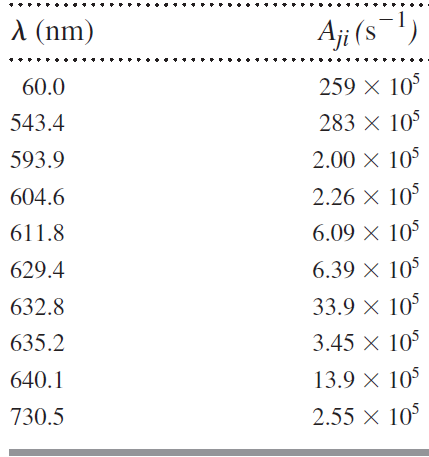
The helium-neon laser is famous for its red-light emission at 632.8 nm. But electrons in that same high-energy level can jump down to nine other lower levels (each with appreciable probabilities), emitting radiant energy at wavelengths shown in Table 13.3. Determine the lifetime of that upper
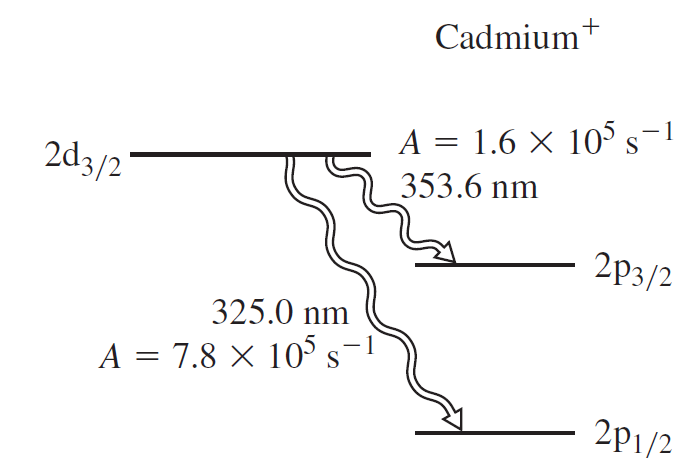
Referring to Fig. 13.6, which shows two transitions for the He-Cd laser, determine the lifetime of the higher-energy d-state.Fig. 13.6 Cadmium+ A = 1.6 × 10 s-1 2d3/2 353.6 nm 2p3/2 325.0 nm A = 7.8 × 10 s-1 2p1/2
With the Example 13.7 in mind, determine the average power per cubic meter radiated by the Nd:YAG laser rod, given that the transition occurs with an upper-level lifetime of 230 μs.
Radiation at 21 cm pours down on the Earth from outer space. Its origin is great clouds of hydrogen gas. Taking the background temperature of space to be 3.0 K, determine the ratio of the transition rates of stimulated emission to spontaneous emission and discuss the result.
For a system of atoms (in equilibrium) having two energy levels, show that at high temperatures where kBT >> Ej - Ei, the number densities of the two states tend to become equal.
Determine the rate at which stimulated emission is happening in a 100-mW He-Cd laser emitting at 441.56 nm.
Given a two-level atomic system where level-2 is more energetic than the ground state level-1, what is the meaning of the expressionWhen in thermal equilibrium show thatA21N2 + B21uvN2 = B12uvN1 dN2 B124,N1 – B214,N2 – A2¡N2 dt - %3D
Redo the previous problem for a temperature of 30.0 × 10³ Κ and compare the results of both calculations.
A system of atoms in thermal equilibrium is emitting and absorbing 2.0-eV light photons. Determine the ratio of the transition rates of stimulated emission to spontaneous emission at a temperature of 300 K. Discuss the implications of your answer.
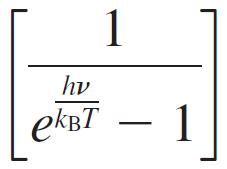
Show that for a system of atoms and photons in equilibrium at a temperature T the ratio of the transition rates of stimulated to spontaneous emission is given by hv - 1 eквт
A 50.0-cm3 chamber is filled with argon gas to a pressure of 20.3 Pa at a temperature of 0°C. All but a negligible number of these atoms are initially in their ground states. A flash tube surrounding the sample energizes 1.0% of the atoms into the same excited state having a mean life of 1.4 ×
The solar constant is the radiant flux density at a spherical surface centered on the Sun having a radius equal to that of the Earth’s mean orbital radius; it has a value of 0.133–0.14 W/cm2. If we assume an average wavelength of about 700 nm, how many photons at most will arrive on each square
Suppose we have a 100-W yellow lightbulb (550 nm) 100 m away from a 3-cm-diameter shuttered aperture. Assuming the bulb to have a 2.5% conversion to radiant power, how many photons will pass through the aperture if the shutter is opened for 1/1000 s?
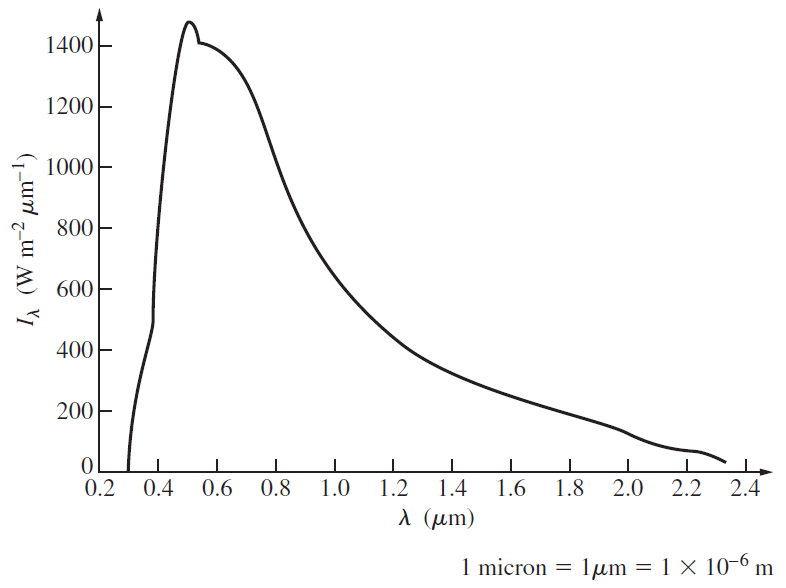
Figure P.13.13 shows the spectral irradiance impinging on a horizontal surface, for a clear day, at sea level, with the Sun at the zenith. What is the most energetic photon we can expect to encounter (in eV and in J)?Figure P.13.13 1400- 1200 1000 800 600- 400 200 0.2 0.4 0.6 0.8 1.0 1.2 1.4 1.6
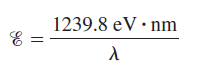
In the atomic domain, energy is often measured in electronvolts. Arrive at the following expression for the energy of a light-quantum in eV when the wavelength is in nanometers:What is the energy of a quantum of 600-nm light? 1239.8 eV• nm
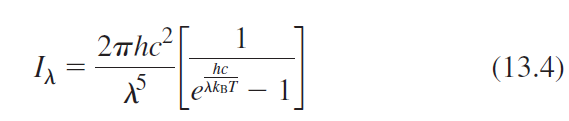
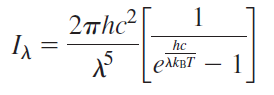
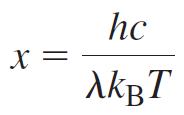
Start with Eq. (13.4) and show that it€™s equivalent towhere λ is in meters, T is in kelvins, and the wavelength interval Δλ should be in nanometers. Then Iλ is the number of joules per second, per meter-squared, per nanometer. 1 2ahc?
The energy per unit area per unit time per unit wavelength interval emitted by a blackbody at a temperature T is given byAt a specific temperature, the total power radiated per unit area of the blackbody is equal to the area under the corresponding Iλ versus λ curve. Use
An object resembling a blackbody emits a maximum amount of energy per unit wavelength in the red end of the visible spectrum (λ = 680 nm). What is its surface temperature?
When the Sun’s spectrum is photographed, using rockets to range above the Earth’s atmosphere, it is found to have a peak in its spectral exitance at roughly 465 nm. Compute the Sun’s surface temperature, assuming it to be a blackbody. This approximation yields a value that is about 400 K too
The surface temperature of a class O blue-white star is around 40 × 103 K. At what frequency will it radiate most of its energy?
What is the wavelength that carries away the most energy when an object resembling a blackbody radiates energy into a room-temperature (20°C) environment?
Your average skin temperature is about 33°C. Assuming you radiate as does a blackbody at that temperature, at what wavelength do you emit the most energy?
The temperature of an object resembling a blackbody is raised from 200 K to 2000 K. By how much does the amount of energy it radiates increase?
Suppose that we measure the emitted exitance from a small hole in a furnace to be 22.8 W/cm2, using an optical pyrometer of some sort. Compute the internal temperature of the furnace.
A somewhat typical person has a total naked area of about 1.4 m2 and an average skin temperature of 33°C. Determine the net power radiated per unit area, the irradiance or more precisely the exitance, if the person’s total emissivity is 97% and the environment is room temperature (20°C).
After a while, a cube of rough steel (10 cm on a side) reaches equilibrium inside a furnace at a temperature of 400°C. Knowing that its total emissivity is 0.97, determine the rate at which the cube radiates energy from each face.
While studying the star Arcturus with a Michelson stellar interferometer the fringes vanished when the two mirrows were 24 ft apart. Assuming light of a mean wavelength of 500 nm, what angle did the star subtend at the Earth? Give your answer in arcseconds.
Consider the Michelson stellar interferometer. Under what conditions will the fringes vanish when the light comes from two equally bright stars? Compare this to the situation in which there is only one uniformly bright star of adequately large angular size. Write expressions for the angles
Earlier as an example we used dc‰ˆ λ̅0/θsto calculate the approximate lateral coherence distance for sunlight. Now find that same quantity, the diameter of the coherence area for a circular thermal source, using the more conservative notions that
Imagine that we have a wide quasimonochromatic source (λ = 500 nm) consisting of a series of vertical, incoherent, infinitesimally narrow line sources, each separated by 500 μm. This is used to illuminate a pair of exceedingly narrow vertical slits in an aperture screen 2.0 m away. How far apart
Show that Eqs. (12.34) and (12.35) follow from Eqs. (12.32) and (12.33). (12.34) (A1(t + t)A½(t))t = |ř12(7)|? (Ah(t + t)Ab(t))T = (1)t(12)T|Ÿ12(7)|? (12.35)
Look at the Young€™s Experiment depicted in Fig. 9.10. Thermal quasimonochromatic light, filtered to a mean of 500 nm, impinges from the left on the 0.10-mm-diameter hole in the source screen. Roughly how far apart at most will the two pinhole apertures be if fringes are to start being
Suppose we set up Young’s double-pinhole experiment with a small circular hole of diameter 0.1 mm in front of a sodium lamp (λ̅0 = 589.3 nm) as the source. If the distance from the source to the aperture screen is 1 m, how far apart will the pinholes be when the fringe pattern disappears?
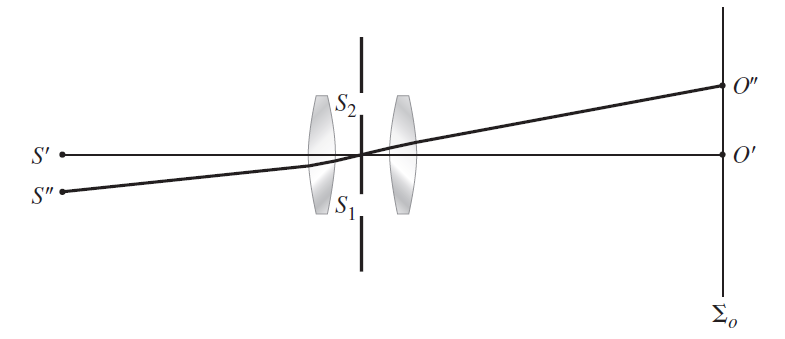
Under what circumstances will the irradiance on Σoin Fig. P.12.15 be equal to 4I0, where I0is the irradiance due to either uncorrelated point source alone?Fig. P.12.15 O" S2. S' O' S" Σο
Carry out the details leading to the expression for the visibility given by Eq. (12.22). 2Vī, Vī, |ĩ12(7)| (12.22) I + I½
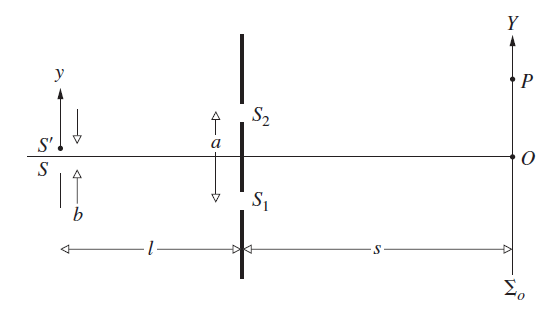
Referring to the slit source and pinhole screen arrangement of Fig. P.12.13, show by integration over the source thatFig. P.12.13 sin (па/Al)b cos (2παΥ/As) I(Ү) с b + па/Al S2 S' S1 Σο
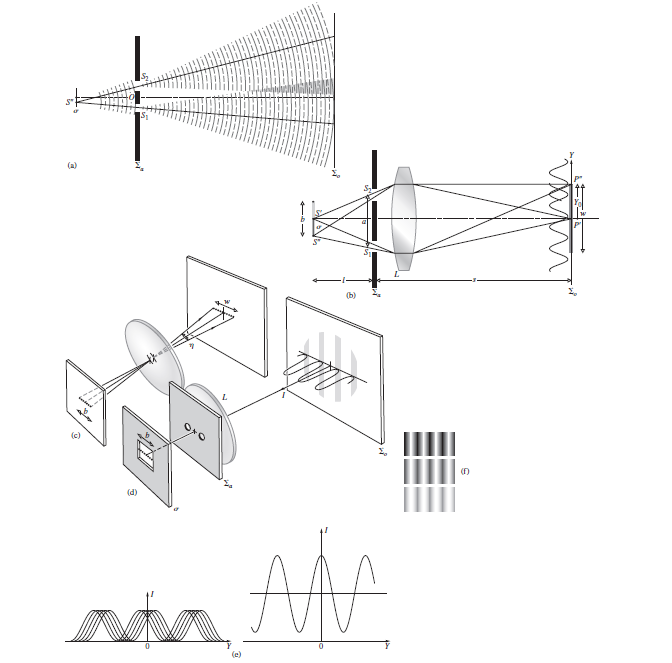
Imagine that we have the arrangement depicted in Fig. 12.8. If the separation between fringes (max. to max.) is 1 mm and if the projected width of the source slit on the screen is 0.5 mm, compute the visibility. Fig. 12.8 (a) (b) (c) (f) (d) (e)
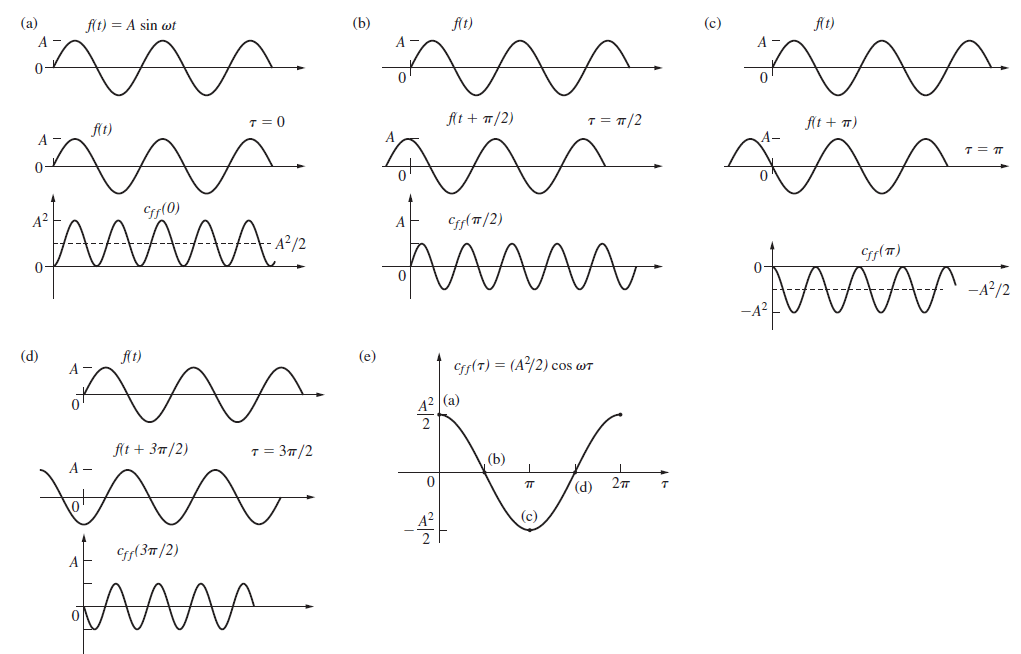
With the previous problem in mind, return to the autocorrelation of a sine function, shown in Fig. 11.51. Now suppose we have a signal composed of a great many sinusoidal components. Imagine that you take the autocorrelation of this complicated signal and plot the result (use three or four
With the previous problem in mind, now consider things spread across space at a given moment in time. Each wave separately would result in an irradiance distribution I1 and I2. Plot both on the same space axis and then draw their sum I1+ I2. Discuss the meaning of your results. Compare your
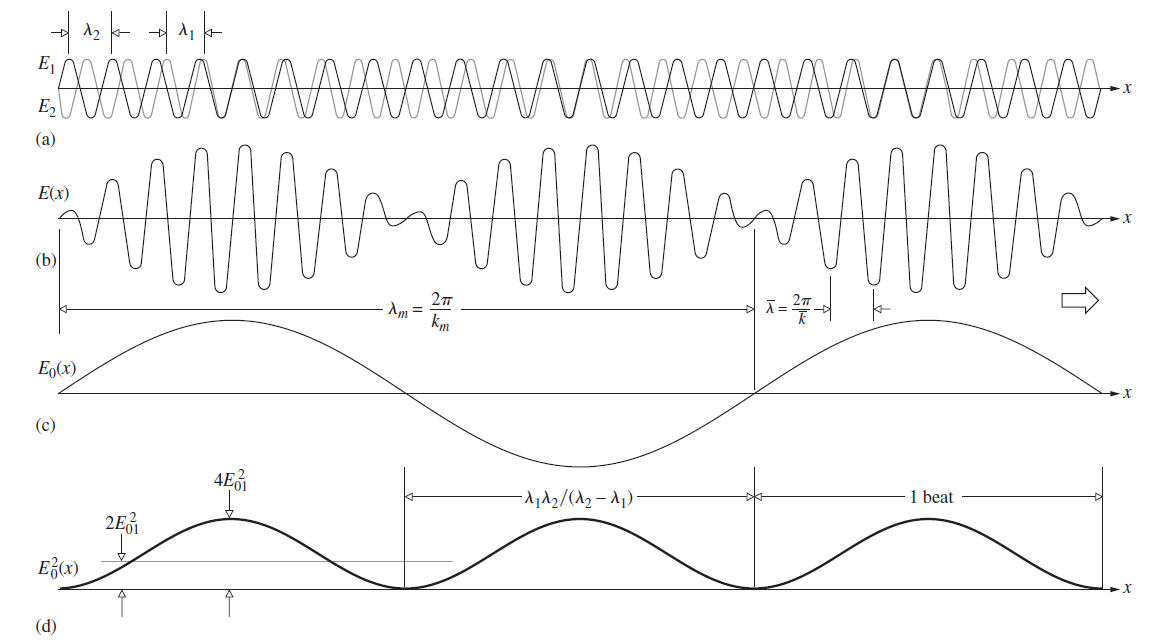
We wish to examine the irradiance produced on the plane of observation in Young’s Experiment when the slits are illuminated simultaneously by two monochromatic plane waves of somewhat different frequency, E1 and E2. Sketch these against time, taking λ1 = 0.8 λ2. Now draw the product
Suppose we set up a fringe pattern using a Michelson Interferometer with a mercury vapor lamp as the source. Switch on the lamp in your mind’s eye and discuss what will happen to the fringes as the mercury vapor pressure builds to its steady-state value.
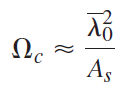
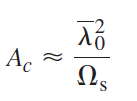
Even though the coherence area increases as Σαmoves away from Σs, there is a quantity that doesn€™t change; that€™s the solid angle Ωcsubtended by the coherence area at the center of the source. Justify the expressionfor a
The Sun’s disk subtends an angle of about 9.3 × 10⁻³ rad as seen from the Earth’s surface. If sunlight is filtered to a mean wavelength of 550 nm, roughly what is the area of coherence on an Earth based aperture screen? How far apart will the pinholes in that screen be when the interference
Let Ωsbe the solid angle subtended by the source when viewed from the center of the aperture screen. Show thatrepresents the coherence area. This equation is useful when we don€™t know the distance to the source. Notice that the smaller the source, the larger is the coherence
A small thermal source of quasimonochromatic light with a mean wavelength of 500 nm, and an area of 1.0 × 10⁻⁶ m2, is used to illuminate an opaque screen containing two pinholes, each 0.10 mm in diameter. Two meters in front of this screen is the disk-shaped, uniform-irradiance source. Determine
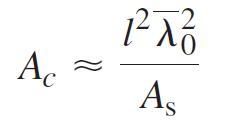
Show that Eq. (12.2)is reasonable. Then approximating As as d2s, show thatNotice that Ac gets larger as l gets larger. Ac = (Ao/0,)? (12.2) Ac
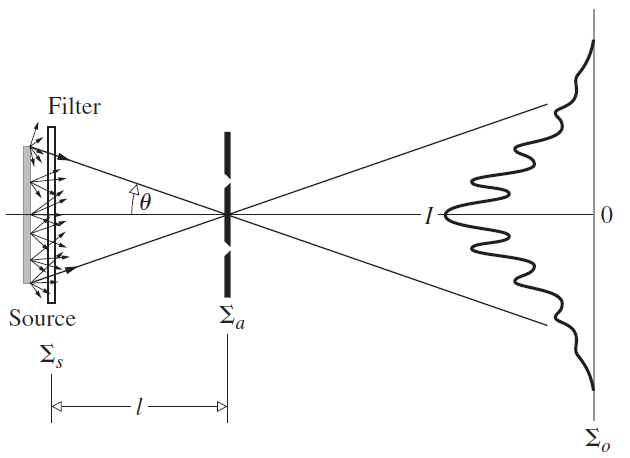
With Fig. 12.3 in mind, establish that when two incoherent cosine-squared fringe systems, each of the form I0 cos2 α, overlap so that peaks fall on troughs, the resultant is I = I0 - a uniform illumination.Fig. 12.3 Filter ө Σο Source Σ
Two monochromatic point sources radiate in-phase. At the usual distant plane of observation (parallel to the line connecting the sources) the irradiance from one of them is 100 times the irradiance from the other. Show that in general the fringe pattern is such thatImax = (√I1 + √I2)2andImin =
Consider the function in Fig. 11.49 as a cosine carrier multiplied by an exponential envelope. Use the frequency convolution theorem to evaluate its Fourier transform.Fig. 11.49
Imagine two uniformly illuminated small circular holes in an opaque screen, as shown in Fig. P.11.48. Construct its autocorrelation. Discuss the irradiance distribution for each resulting individual patch of light in the autocorrelation. Indicate the relative irradiances of the several patches of
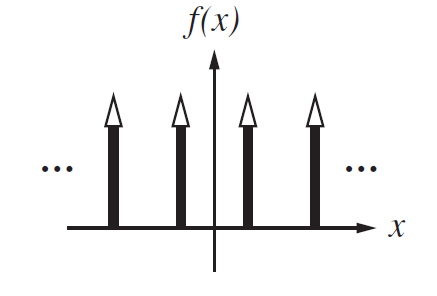
Figure P.11.47 shows a function Æ’(x) consisting of a periodic array of equally spaced delta functions. Construct its autocorrelation and discuss whether or not it is periodic.Figure P.11.47 f(x)
Given that F{ƒ(x)} = F(κ) and F{h(x)} = H(κ), if α and b are constants, determine F{αƒ(x) + bh(x)}.
Show that if Æ’(x) is real and even, its transform is real and even. Start with Eq. (11.5), use the Euler formula from Section 2.5, and assume that Æ’(x) has both a real and an imaginary part. F(k) f(x)ekx dx (11.5)
With the previous problem in mind show that the inverse transform of
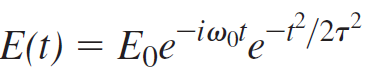
Consider the functionand first check that the exponents are unitless. Then show that the Fourier transform of E(t) isYou might want to use the integral identity ,-ίωρ! E(t) = Ege-i@ote-7/27² E(@) = V2E0TE(w-ww°/2 w-w²/2
Determine the Fourier transform of the function ƒ(x) = A cos κ0x.
Show that F{1} = 2πδ(κ).
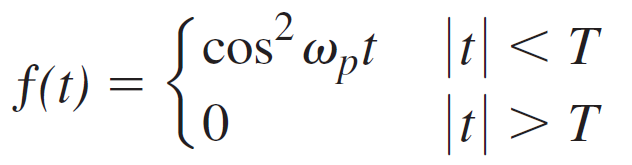
Determine the Fourier transform ofMake a sketch of F(ω), then sketch its limiting form as T†’ ±ˆž. Scos w,t |1| T
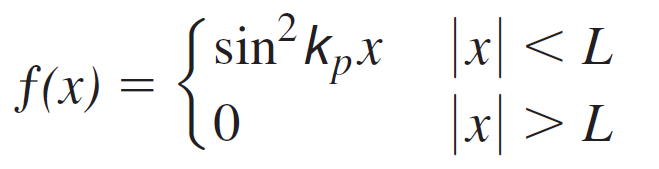
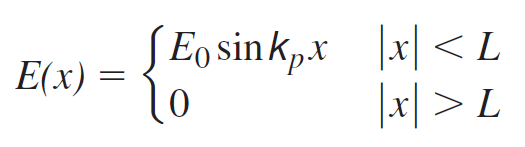
Determine the Fourier transform ofMake a sketch of it. |x| < L |x| > L S sin-kpx f(x) =
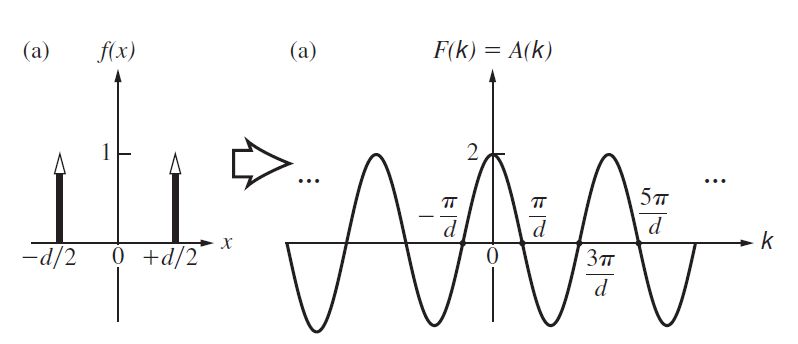
Determine the Fourier transform of the functionMake a sketch of F{E(x)}. Discuss its relationship to Fig. 11.11.Fig. 11.11 |x| < L |x|> L SEo sinkp.x E(x) = (a) f(x) (a) F(k) = A(k) %3D 5т т п х -d/2 0 +d/2 Зп
A long narrow horizontal opaque rectangular object of width 0.70 mm is illuminated by 600-nm light. Consider a point-P, at the level of the lower edge of the object, 1.0 m from it. Determine the ratio of the irradiance at P with and without the obstacle in place.
A long horizontal narrow slit of width 0.70 mm is illuminated with 600-nm light. A point-P, 1.0 m away from the aperture screen, is opposite the lower edge of the screen. If 100 W/m2 arrives at P with no screen in place, determine the approximate irradiance there when the light passes through
A long narrow slit 0.10 mm wide is illuminated by light of wavelength 500 nm coming from a point source 0.90 m away. Determine the irradiance at a point 2.0 m beyond the screen when the slit is centered on, and perpendicular to, the line from the source to the point of observation. Write your
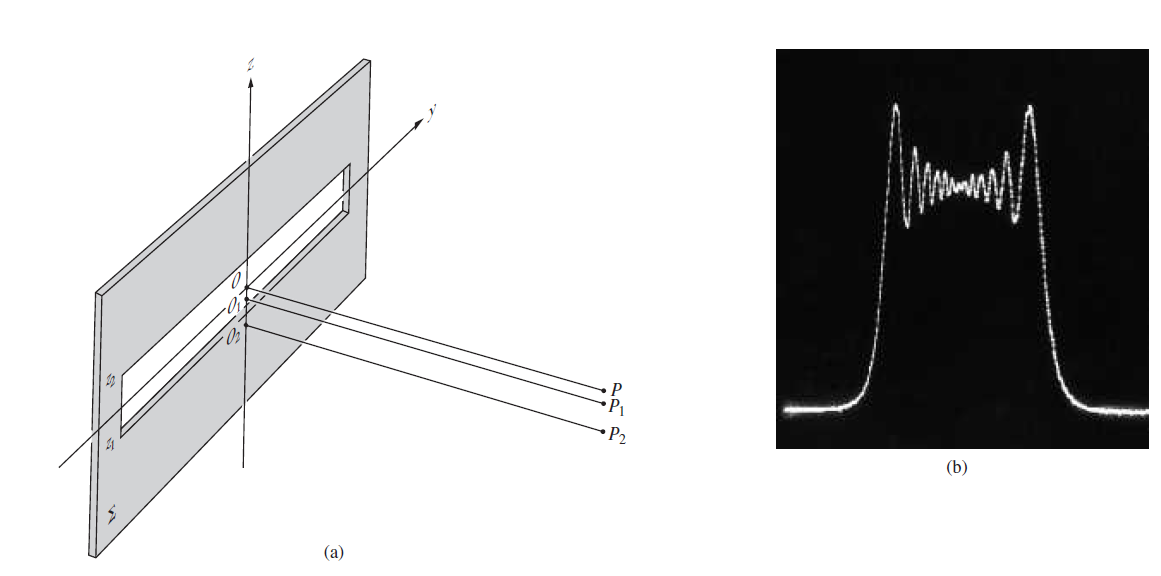
Suppose the slit in Fig. 10.76 is made very wide. What will the Fresnel diffraction pattern look like?Fig. 10.76 P2 (b) (a)
Make a rough sketch of a possible Fresnel diffraction pattern arising from each of the indicated apertures (Fig. P.10.89).Fig. P.10.89
Plane waves from a collimated He–Ne laserbeam (λ0 = 632.8 nm) impinge on a steel rod with a 2.5-mm diameter. Draw a rough graphic representation of the diffraction pattern that would be seen on a screen 3.16 m from the rod.
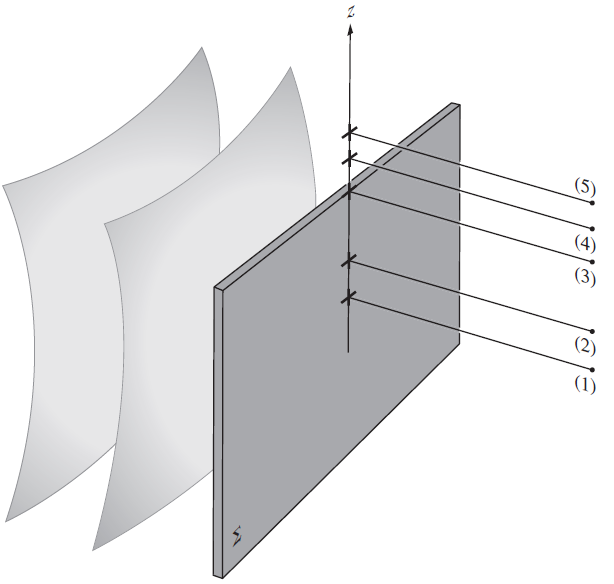
What would you expect to see on the plane of observation if the half-plane Σ in Fig. 10.81 were semi€‘transparent?Fig. 10.81 (5) (4) (3)
Showing 100 - 200
of 829
1
2
3
4
5
6
7
8
9
Step by Step Answers

 Get 50% OFF
Claim Now
Get 50% OFF
Claim Now