New Semester
Started
Get
50% OFF
Study Help!
--h --m --s
Claim Now
Question Answers
Textbooks
Find textbooks, questions and answers
Oops, something went wrong!
Change your search query and then try again
S
Books
FREE
Study Help
Expert Questions
Accounting
General Management
Mathematics
Finance
Organizational Behaviour
Law
Physics
Operating System
Management Leadership
Sociology
Programming
Marketing
Database
Computer Network
Economics
Textbooks Solutions
Accounting
Managerial Accounting
Management Leadership
Cost Accounting
Statistics
Business Law
Corporate Finance
Finance
Economics
Auditing
Tutors
Online Tutors
Find a Tutor
Hire a Tutor
Become a Tutor
AI Tutor
AI Study Planner
NEW
Sell Books
Search
Search
Sign In
Register
study help
sciences
optics
Optics 5th edition Eugene Hecht - Solutions
The orbiting Hubble Space Telescope has a 2.4-m primary, which we will assume to be diffraction-limited. Suppose we wanted to use it to read the print on the side of a distant Russian satellite. Assuming that a resolution of 1.0 cm at the satellite will do, how far away could it be from the HST?
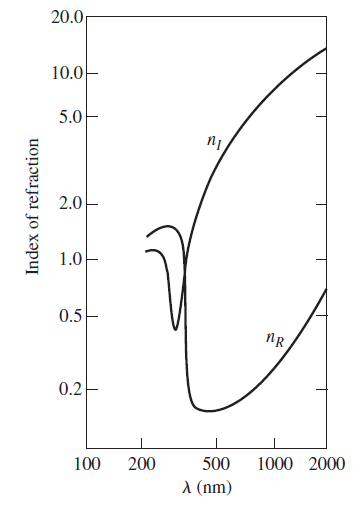
Figure P.4.95 is a plot of nI and nRversus λ for a common metal. Identify the metal by comparing its characteristics with those considered in the chapter and discuss its optical properties.Figure P.4.95 20.0 10.0 5.0 2.0 1.0 0.5- 0.2 100 200 500 1000 2000 A (nm) Index of refraction
A fish looking straight up toward the smooth surface of a pond receives a cone of rays and sees a circle of light filled with the images of sky and birds and whatever else is up there. This right circular field is surrounded by darkness. Explain what is happening and compute the cone angle.
A glass block having an index of 1.55 is covered with a layer of water of index 1.33. For light traveling in the glass, what is the critical angle at the interface?
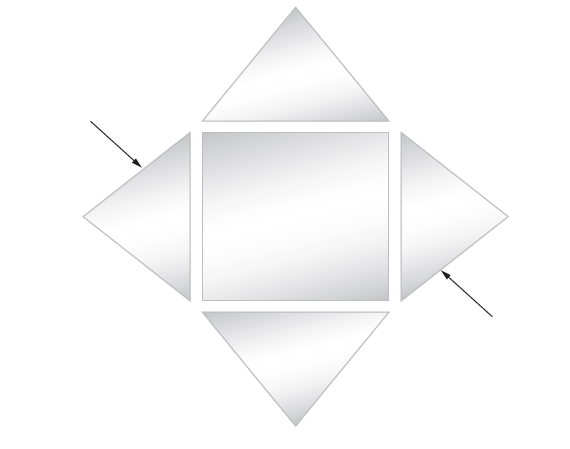
Figure P.4.93 depicts a glass cube surrounded by four glass prisms in very close proximity to its sides. Sketch in the paths that will be taken by the two rays shown and discuss a possible application for the device.Figure P.4.93
A large block of diamond is covered, on top, by a layer of water. A narrow beam of light travels upward in the solid and strikes the solid–liquid interface. Determine the minimum incident angle that would result in the complete reflection of the light back into the diamond.
Derive an expression for the speed of the evanescent wave in the case of internal reflection. Write it in terms of c, ni, and θi.
Light having a vacuum wavelength of 600 nm, traveling in a glass (ng = 1.50) block, is incident at 45° on a glass–air interface. It is then totally internally reflected. Determine the distance into the air at which the amplitude of the evanescent wave has dropped to a value of 1/e of its maximum
A beam of light from an argon laser (λ0 = 500 nm) traveling in a glass block (ng = 3/2) is totally internally reflected at the flat air–glass interface. If the beam strikes the interface at 60.0° to the normal, how deep will the light penetrate into the air before its amplitude drops to about
A large crystal of Fabulite is covered by a layer of carbon tetrachloride. A beam of light comes up through the crystal and impinges on the solid–liquid interface. At what incident angle (at minimum) will the light be completely reflected back into the crystal?
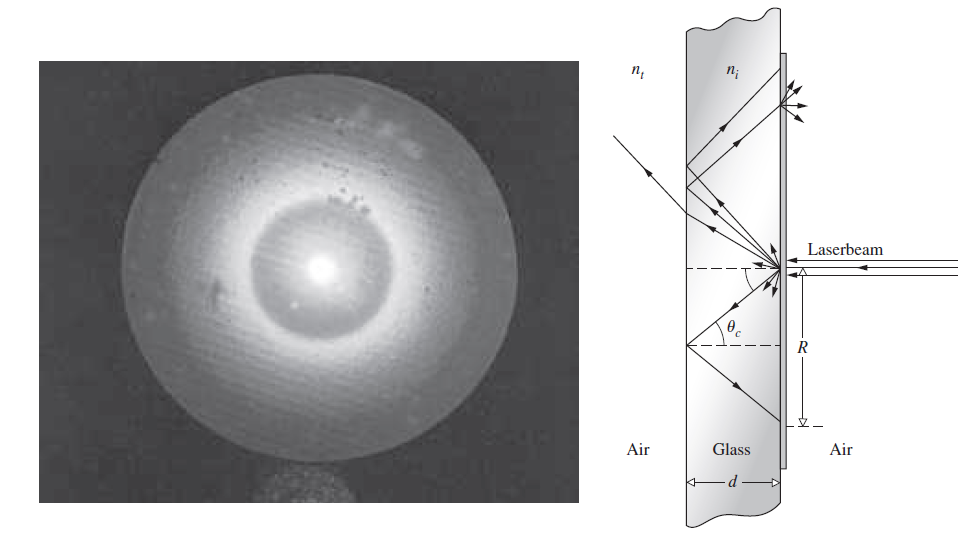
Figure P.4.91 shows a laserbeam incident on a wet piece of filter paper atop a sheet of glass whose index of refraction is to be measured€”the photograph shows the resulting light pattern. Explain what is happening and derive an expression for niin terms of R and d.Figure P.4.91 п,
Consider the common mirage associated with an in homogeneous distribution of air situated above a warm roadway. Envision the bending of the rays as if it were instead a problem in total internal reflection. If an observer, at whose head nα = 1.000 29, sees an apparent wet spot at θi ≥ 88.7°
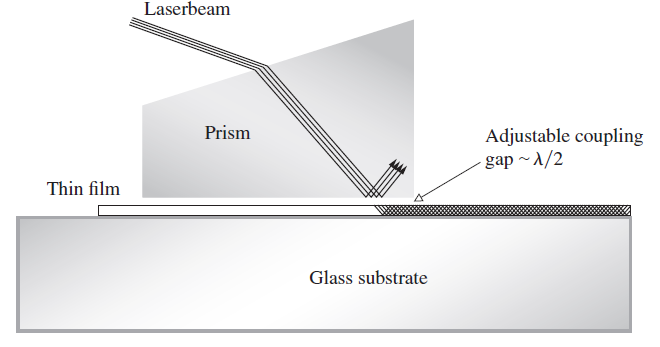
Figure P.4.94 shows a prism-coupler arrangement developed at the Bell Telephone Laboratories. Its function is to feed a laserbeam into a thin (0.000 01-inch) transparent film, which then serves as a sort of waveguide. One application is that of thin-film laserbeam circuitry€”a kind of
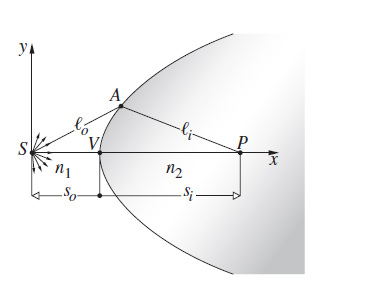
The shape of the interface pictured in Fig. P.5.1 is known as a Cartesian oval after Ren̩ Descartes, who studied it in the 1600s. It۪s the perfect configuration to carry any ray from S to the interface to P. Prove that the defining equation isShow that this is equivalent
Someone views a flag through a yellow filter. The flag has five colored horizontal bands, which are, starting from the top, blue, cyan, magenta, yellow, and white. What colors, if any, will she see through the filter?
A wall is painted with stripes of red, cyan, white, yellow, green, and magenta. A person wearing yellow sunglasses views the wall through a piece of cyan-colored stained glass. What colors, if any, will the stripes appear?
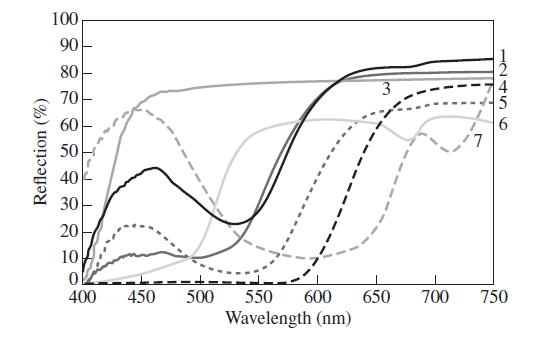
The graphs in Fig. P.4.98 are the reflection spectra for several roses seen in white light. The flowers were white, yellow, light pink, dark pink, blue, orange, and red. Associate each graph with a specific color. Fig P.4.98 100 90 80 70 60 50 40 30 20 10 450 650 400 500 550 600 700 750
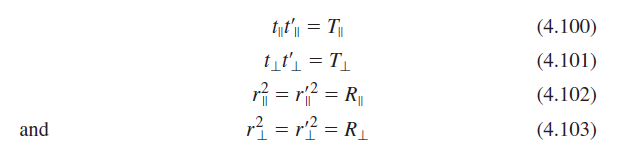
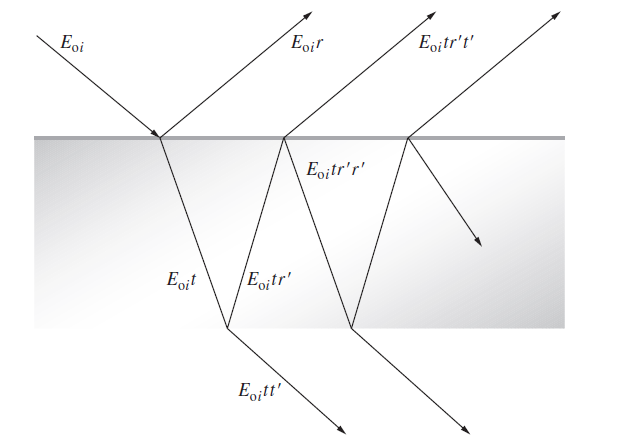
Figure P.4.99 depicts a ray being multiply reflected by a transparent dielectric plate (the amplitudes of the resulting fragments are indicated). As in Section 4.10, we use the primed coefficient notation because the angles are related by Snell€™s Law. Finish labeling the amplitudes of
A wave, linearly polarized in the plane-of-incidence, impinges on the interface between two dielectric media. If ni> ntand θi= θ'p, there is no reflected wave, that is, r'||(θ'p) = 0. Using Stokes€™s technique, start from scratch to show that
Making use of the Fresnel Equations, show that t||(θp)t'p||(θ'p) = 1, as in the previous problem.Data from Prob. 4.100A wave, linearly polarized in the plane-of-incidence, impinges on the interface between two dielectric media. If ni > nt and θi =
A prism, ABC, is configured such that angle BCA = 90° and angle CBA = 45°. What is the minimum value of its index of refraction if, while immersed in air, a beam traversing face AC is to be totally internally reflected from face BC?
Using a block of a transparent, unknown material, it is found that a beam of light inside the material is totally internally reflected at the air–block interface at an angle of 48.0°. What is its index of refraction?
What is the critical angle for total internal reflection for diamond in air? What, if anything, does the critical angle have to do with the luster of a well-cut diamond?
Referring back to Problem 4.21, note that as θi increases θt increases. Prove that the maximum value θt may have is θc.Data from Prob. 4.21Make a plot of θi versus θt for an air– glass boundary where ngα = 1.5. Discuss the shape of the curve.
Calculate the critical angle beyond which there is total internal reflection at an air–glass (ng = 1.5) interface.
Show that when θi > θc at a dielectric interface, r|| and r⊥ are complex and r⊥r*⊥ = r||r*|| = 1.
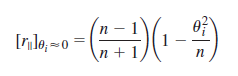
Establish that at near-normal incidence the equationis a good approximation. [Use the results of the previous problem, Eq. (4.43), and the power series expansions of the sine and cosine functions.] (n - n + 1 [le; -0 п tan (0; – 0) (4.43) tan (0; + 0) %3|
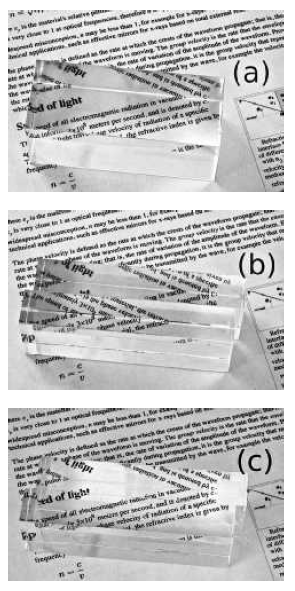
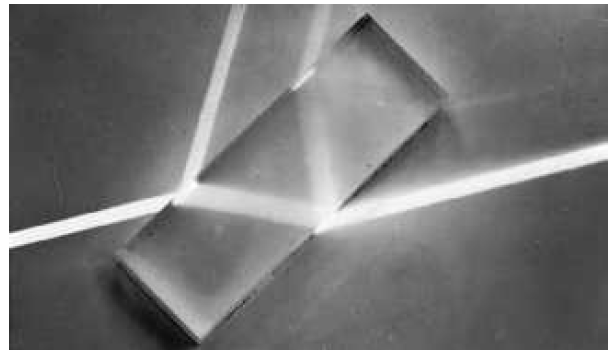
Examine the three photos in Fig. P. 4.41. Part(a) Shows a single wide block of Plexiglas.(b) Shows two narrow blocks of Plexiglas, each half as wide as the first, pressed lightly against one another.(c) Shows the same two blocks, this time separated by a thin layer of castor oil. Describe what you
According to the mathematician Hermann Schwarz, there is one triangle that can be inscribed within an acute triangle such that it has a minimal perimeter. Using two planar mirrors, a laserbeam, and Fermat’s Principle, explain how you can show that this inscribed triangle has its vertices at the
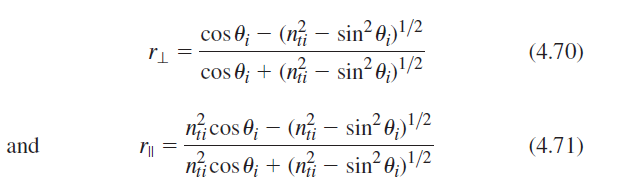
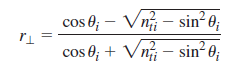
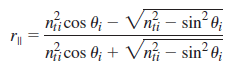
Derive the expressions for rŠ¥and r|| given by Eqs. (4.70) and (4.71). cos 6; – (n – sin² 0;)'/² cos 0; + (n – sin² 0;)'/2 (4.70) ni cos 0; – (ni – sin² e,)'/2 n cos e; + (ni – sin²0;}'/2 and (4.71)
Show that at normal incidence on the boundary between two dielectrics, as nti S → 1, R → 0, and T → 1. Moreover, prove that as nti → 1, R → 0, and T → 1 Moreover, prove that as nti → 1, R|| → 0, R⊥ → 0, T|| → 1, and T⊥ → 1 for all θt. Thus as the two media take
Making use of the expressionI(y) = I0e-αy [4.78]for an absorbing medium, we define a quantity called the unit transmittance T1. At normal incidence, Eq. (4.55), T = It/Ii, and thus when y = 1, T1 = I(1)/I0. If the total thickness of the slides in the
Suppose that we look at a source perpendicularly through a stack of N microscope slides. The source seen through even a dozen slides will be noticeably darker. Assuming negligible absorption, show that the total transmittance of the stack is given byTt = (1 - R)2Nand evaluate Tt for three slides in
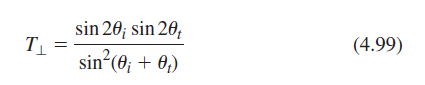
Using the results of Problem 4.72, that is, Eqs. (4.98) and (4.99), show thatData from Prob. 4.72Show thatand sin 20; sin 20, т (4.98) sin?(0; + 0,) cos²(0; – 6,) sin 20; sin 20, T1 sin (0; + 0) (4.99)
Make a sketch of R⊥ and R|| for ni = 1.5 and nt = 1 (i.e., internal reflection) versus the incident angle.
Show thatand sin 20; sin 20, т (4.98) sin?(0; + 0,) cos²(0; – 6,) sin 20; sin 20, T1 sin (0; + 0) (4.99)
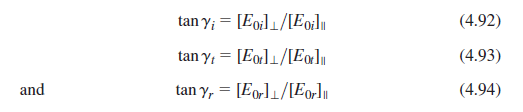
Making use of the definitions of the azimuthal angles in Problem 4.69, show that
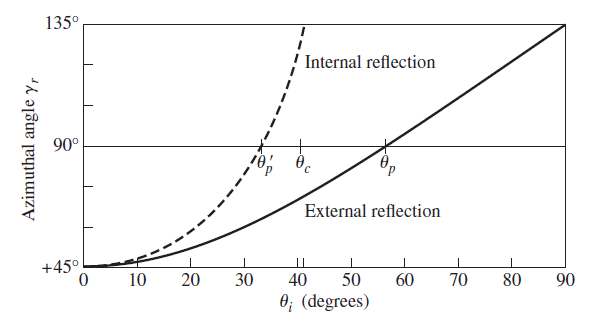
It is often useful to work with the azimuthal angle γ, which is defined as the angle between the plane-of-vibration and the plane-of-incidence. Thus for linearly polarized light,Figure P.4.69 is a plot of γr versus θi for internal and external reflection at an
Show that the polarization angles for internal and external reflection at a given interface are complementary, that is, θp + θ'p = 90° (see Problem 4.66).Data from Prob. 4.66Show that tan θp = nt/ni and calculate the polarization angle for external incidence on a plate of crown glass (ng =
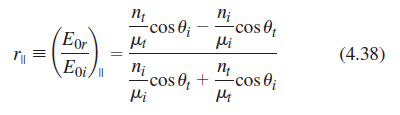
Beginning with Eq. (4.38), show that for two dielectric media, in general tan θp= [ϵt(ϵtμi- ϵiμt)>/ϵi(ϵtμt- ϵiμi)]1/2. п; -cos 0, Mi п, п, -cos 0; Eor
Show that tan θp = nt/ni and calculate the polarization angle for external incidence on a plate of crown glass (ng = 1.52) in air.
Use the Fresnel Equations to prove that light incident at θp = 1/2π - θt results in a reflected beam that is indeed polarized.
Verify thatfor θi = 30° at a crown glass€“air interface (nti = 1.52). [4.49] ti +(-r1) = 1
Prove thatfor all θi, first from the boundary conditions and then from the Fresnel Equations. ti +(-r1) = 1 [4.49]
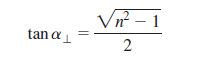
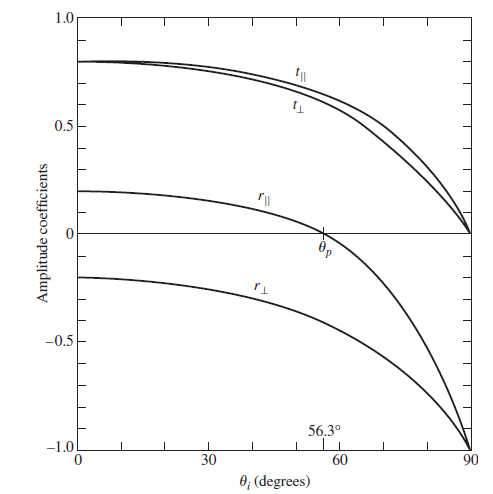
In Fig. 4.49 the curve of rŠ¥approaches -1.0 as the angle-of-incidence approaches 90°. Prove that if αŠ¥is the angle the curve makes with the vertical at θi= 90°, then [First show that dθt/dθi = 0.] V – 1 tan a1 2
Prove that for a vacuum-dielectric interface at glancing incidence rŠ¥†’-1, as in Fig. 4.49. Fig. 4.49. 1.0 0.5 -0.5 56.3° -1.0 30 90 0; (degrees) Amplitude coefficients
Use Eq. (4.42) and the power series expansion of the sine function to establish that at near-normal incidence we can obtain a better approximation than the one in Problem 4.45, which is [-rŠ¥]θi‰ˆ0= (n - 1)/(n + 1), namely, sin (0; – 0,) [4.42] sin (0; + 0,)
Compare the amplitude reflection coefficients for an air–water (nw = 4/3) interface with that of an air–crownglass (ng = 3/2) interface, both at near-normal incidence. What are the corresponding ratios of the reflected to the incident irradiances?
Quasimonochromatic light having an irradiance of 400 W/m2 is incident normally on the cornea (nc = 1.376) of the human eye. If the person is swimming under the water (nw = 1.33), determine the transmitted irradiance into the cornea.
Show that energy is conserved in the previous problem.
A beam of unpolarized light carries 2000 W/m2 down onto an air–plastic interface. It is found that of the light reflected at the interface 300 W/m2 is polarized with its E-field perpendicular to the plane of incidence and 200 W/m2 parallel to the plane of incidence. Determine the net
We know that 1000 W/m2 of unpolarized light is incident in air on an air–glass interface where nti = 3/2. If the transmittance for light with its E-field perpendicular to the plane of incidence is 0.80, how much of that light is reflected?
Considering the previous problem calculate R⊥, R||, T⊥, T||, and the net transmittance T and reflectance R.
Unpolarized light is incident in air on the flat surface of a sheet of glass of index 1.60 at an angle of 30.0° to the normal. Determine both amplitude coefficients of reflection. What is the significance of the signs? Check out the previous problem.
Using the Fresnel Equations show thatand cos 0; – Vn – sin² 0; cos 0; + Vn – sin² 0; nị cos 0; - Vni – sin' 0; ni cos 0; + Vni – sin² 0;
A beam of quasimonochromatic light having an irradiance of 500 W/m2 is incident in air perpendicularly on the surface of a tank of water (nw = 1.333). Determine the transmitted irradiance.
Light is incident in air perpendicularly on a sheet of crown glass having an index of refraction of 1.522. Determine both the reflectance and the transmittance.
Considering the previous problem, compute the corresponding values of the amplitude coefficients of reflection for both the normal transits of light from air-to-glass and glass-to-air. Show that Eq. (4.49), t⊥ + (-r⊥) = 1, applies to both.t⊥ + (-r⊥) = 1 (4.49)
A nearly monochromatic laserbeam polarized with its electric field perpendicular to the plane of incidence impinges normally in air on glass (nt = 1.50). Determine the amplitude coefficient of transmission. Redo the calculation with the beam going perpendicularly from glass to air. See the
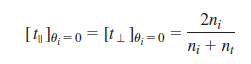
Prove that at normal incidence on the boundary between two dielectrics 2n; [4 le, = 0 = [t1 lo, = 0 ° n¡ + n;
A laserbeam is incident on the interface between air and some dielectric of index n. For small values of θi show that θt = θi/n. Use this and Eq. (4.42) to establish that at near-normal incidence [-r⊥]θi ≈ (n - 1)/(n + 1). r sin (0-0) sin (0 + 0) [4.42]
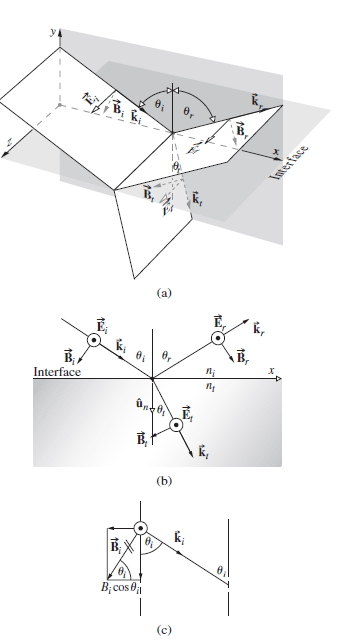
A beam of light in air strikes the surface of a smooth piece of plastic having an index of refraction of 1.55 at an angle with the normal of 22.0°. The incident light has component E-field amplitudes parallel and perpendicular to the plane-of-incidence of 10.0 V/m and 20.0 V/m, respectively.
Derive Eqs. (4.42) through (4.45) for rŠ¥, r||, tŠ¥, and t||. sin (0; – 0;) sin (0; + 0,) (4.42)
Suppose a lightwave that is linearly polarized in the plane-of incidence impinges at 30° on a crown-glass (ng= 1.52) plate in air. Compute the appropriate amplitude reflection and transmission coefficients at the interface. Compare your results with Fig. 4.47.Fig. 4.47. (a) Interface п; (b) k;
Discuss the results of Problem 4.38 in the light of Fermat€™s Principle; that is, how does the relative index n21affect things? To see the lateral displacement, look at a broad source through a thick piece of glass ( ‰ˆ 1/4 inch) or a stack (four will do) of microscope slides
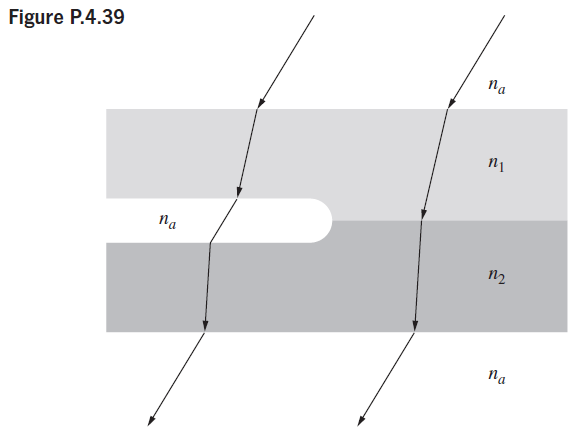
Show that the two rays that enter the system in Fig. P.4.39 parallel to each other emerge from it being parallel. Figure P.4.39 na П na П2 Па
Show analytically that a beam (in a medium of index n1) entering a planar transparent plate (of index n2and thickness d ), as in Fig. P.4.38, emerges parallel to its initial direction. Derive an expression for the lateral displacement (α) of the beam. Incidentally, the incoming and
Derive the Law of Reflection, θi = θr, by using the calculus to minimize the transit time, as required by Fermat’s Principle.
In the case of reflection from a planar surface, use Fermat’s Principle to prove that the incident and reflected rays share a common plane with the normal Ûn, namely, the plane-of-incidence.
Derive a vector expression equivalent to the Law of Reflection. As before, let the normal go from the incident to the transmitting medium, even though it obviously doesn’t really matter.
Starting with Snell€™s Law, prove that the vector refraction equation has the form n, k, – n;k = (n,cos 0; – n;cos 0;) û, [4.7]
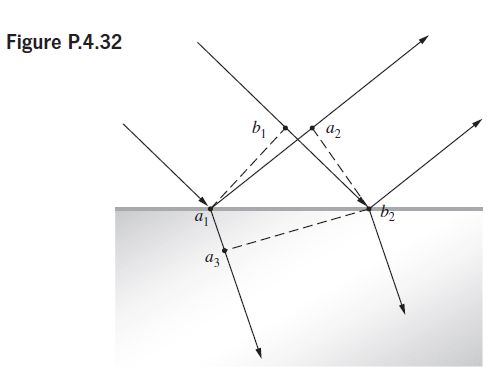
Making use of the ideas of equal transit times between corresponding points and the orthogonality of rays and wavefronts, derive the Law of Reflection and Snell€™s Law. The ray diagram of Fig. P.4.32 should be helpful. Figure P.4.32 az
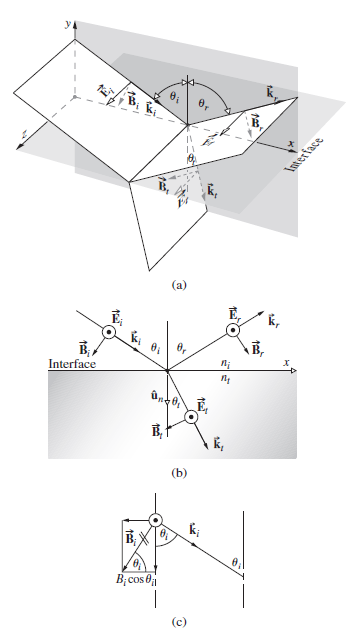
With the previous problem in mind, return to Eq. (4.19) and take the origin of the coordinate system in the plane-of-incidence and on the interface (Fig. 4.47). Show that that equation is then equivalent to equating the x- components of the various propagation vectors. Show that it is also
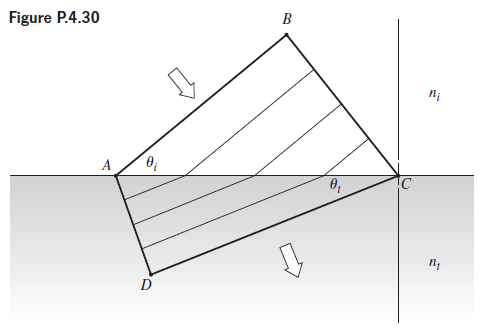
In Fig. P.4.30 the wavefronts in the incident medium match the fronts in the transmitting medium every where on the interface€”a concept known as wave front continuity. Write expressions for the number of waves per unit length along the interface in terms of θiand
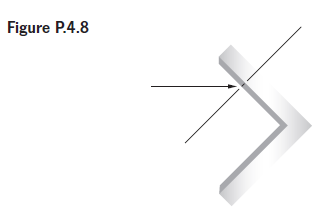
Figure P.4.8 shows what€™s called a corner mirror. Determine the direction of the exiting ray with respect to the incident ray. Figure P.4.8
A coin is resting on the bottom of a tank of water (nW = 1.33) 1.00 m deep. On top of the water floats a layer of benzene (nb = 1.50), which is 20.0 cm thick. Looking down nearly perpendicularly, how far beneath the topmost surface does the coin appear? Draw a ray diagram.
Suppose that you focus a camera with a close-up bellows attachment directly own on a letter printed on this page. The letter is then covered with a 1.00-mm-thick microscope slide (n = 1.55). How high must the camera be raised in order to keep the letter in focus?
Light is incident in the air on an air–glass interface. If the index of refraction of the glass is 1.70, find the incident angle such that the transmission angle is to equal 1/2θi.
A laserbeam impinges on the top surface of a 2.00-cm-thick parallel glass (n = 1.50) plate at an angle of 35°. How long is the actual path through the glass?
A block of glass of index 3/2 has a small flaw 3.0 cm below its flat horizontal top surface. A camera lens is 8.0 cm above the surface in air, looking straight down. How far will the flaw appear to be from the lens?
A bowl 10.0 cm deep is filled with olive oil. A coin on the bottom of the bowl is viewed directly from above. How far beneath the surface will the coin appear?
An exceedingly narrow beam of white light is incident at 60.0° on a sheet of glass 10.0 cm thick in air. The index of refraction for red light is 1.505 and for violet light it’s 1.545. Determine the approximate diameter of the emerging beam.
A laserbeam having a diameter D in air strikes a piece of glass (ng) at an angle θi. What is the diameter of the beam in the glass?
Make a plot of θi versus θt for an air– glass boundary where ngα = 1.5. Discuss the shape of the curve.
An underwater swimmer shines a beam of light up toward the surface. It strikes the air–water interface at 35°. At what angle will it emerge into the air?
A laserbeam impinges on an air–liquid interface at an angle of 55°. The refracted ray is observed to be transmitted at 40°. What is the refractive index of the liquid?
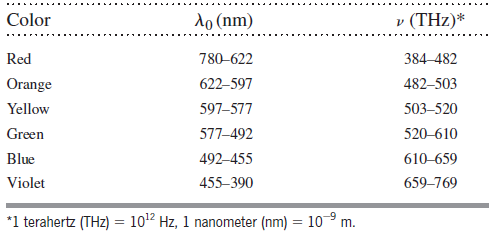
Light of wavelength 600 nm in vacuum enters a block of glass where ng= 1.5. Compute its wavelength in the glass.What color would it appear to someone embedded in the glass (see Table 3.4)?Table 3.4 v (THz)* Color λο (nm) 780-622 384-482 Red 482–503 Orange 622–597 Yellow 597-577 503–520
A beam of 12-cm planar microwaves strikes the surface of a dielectric at 45°. If nti = 4/3 compute(a) The wavelength in the transmitting medium.(b) The angle θt.
Given an interface between water (nw = 4/3 ) and glass (ng = 3/2), compute the transmission angle for a beam incident in the water at 45°. If the transmitted beam is reversed so that it impinges on the interface, show that θt = 45°.
A ray of yellow light from a sodium discharge lamp falls on the surface of a diamond in air at 45°. If at that frequency nd = 2.42, compute the angular deviation suffered upon transmission.
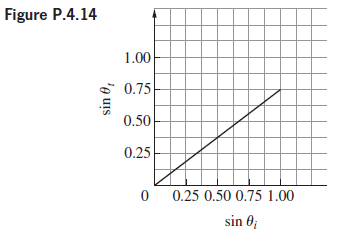
Figure P.4.14 is a plot of the sine of the angle-of-incidence versus the sine of the transmission angle measured as light passed from air into a more optically dense medium. Discuss the curve. What is the significance of the slope of the line? Guess at what the dense medium might be. Figure P.4.14
A laserbeam in air strikes the flat surface of a sheet of glass (ng = 1.50) at an angle of incidence of 30.0°. Rather than continuing straight into the glass the beam bends toward the normal through an angle θd, called the deviation angle. Determine that angle.
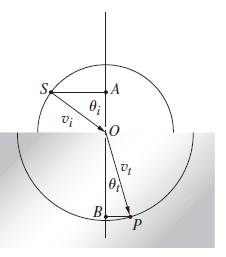
The construction in Fig. P.4.12 corresponds to Descartes€™s erroneous derivation of the Law of Refraction. Light moves from S to O in the same time it travels from O to P. Moreover, its transverse momentum is unchanged on traversing the interface. Use all of this to
Calculate the transmission angle for a ray incident in air at 30° on a block of crown glass (ng = 1.52).
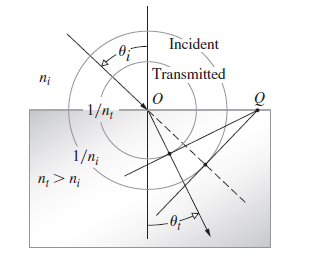
Return to Fig. 4.33 and Huygens€™s refraction method and prove that it leads to Snell€™s Law.Figure 4.33 Incident Transmitted 1/n; 1/ni n, > n;
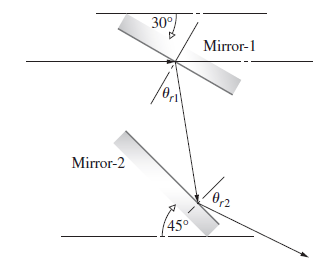
A beam of light strikes mirror-1 and then mirror-2 in Fig. P.4.9. Determine angles θr1and θr2.Figure P.4.9 30° Mirror-1 Mirror-2 45°
On entering the tomb of FRED the Hero of Nod, you find yourself in a dark closed chamber with a small hole in a wall 3.0 m up from the floor. Once a year, on FRED’s birthday, a beam of sunlight enters via the hole, strikes a small polished gold disk on the floor 4.0 m from the wall and reflects
A very narrow laserbeam is incident at an angle of 58° on a horizontal mirror. The reflected beam strikes a wall at a spot 5.0 m away from the point of incidence where the beam hit the mirror. How far horizontally is the wall from that point of incidence?
Imagine that we have a nonabsorbing glass plate of index n and thickness Δy, which stands between a source S and an observer P.(a) If the unobstructed wave (without the plate present) is Eu = E0 exp iω(t - y/c), show that with the plate in place the observer sees a
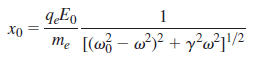
The equation for a driven damped oscillator is(a) Explain the significance of each term.(b) Let E = E0eiωt and x = x0ei(ωt-α), where E0 and x0 are real quantities. Substitute into the above expression and show that (c) Derive an expression for the phase lag,
Showing 600 - 700
of 829
1
2
3
4
5
6
7
8
9
Step by Step Answers

 Get 50% OFF
Claim Now
Get 50% OFF
Claim Now



![n1(x + y)/2 + n2[y° + ($, + s¡ – x²)]'/2 = constant](https://dsd5zvtm8ll6.cloudfront.net/si.question.images/images/question_images/1546/4/2/7/0965c2c9ad848b051546409705268.jpg)






![[4.49] ti +(-r1) = 1](https://dsd5zvtm8ll6.cloudfront.net/si.question.images/images/question_images/1546/3/4/2/3255c2b4fb58f53d1546324930909.jpg)
![ti +(-r1) = 1 [4.49]](https://dsd5zvtm8ll6.cloudfront.net/si.question.images/images/question_images/1546/3/4/2/2845c2b4f8c2269d1546324889748.jpg)
![sin (0; – 0,) [4.42] sin (0; + 0,)](https://dsd5zvtm8ll6.cloudfront.net/si.question.images/images/question_images/1546/3/4/1/6445c2b4d0c5584e1546324249881.jpg)
![sin (0; – 0,) [4.42] sin (0; + 0,) ||](https://dsd5zvtm8ll6.cloudfront.net/si.question.images/images/question_images/1607/6/6/6/7905fd30c6696cf81607666789588.jpg)

![n, k, – n;k = (n,cos 0; – n;cos 0;) û, [4.7]](https://dsd5zvtm8ll6.cloudfront.net/si.question.images/images/question_images/1546/3/3/9/3305c2b4402152fa1546321935409.jpg)

![Eo exp io [t - (п - 1)Ду/с — у/c] d,](https://dsd5zvtm8ll6.cloudfront.net/si.question.images/images/question_images/1546/3/3/7/5935c2b3d39c41f71546320199482.jpg)