New Semester
Started
Get
50% OFF
Study Help!
--h --m --s
Claim Now
Question Answers
Textbooks
Find textbooks, questions and answers
Oops, something went wrong!
Change your search query and then try again
S
Books
FREE
Study Help
Expert Questions
Accounting
General Management
Mathematics
Finance
Organizational Behaviour
Law
Physics
Operating System
Management Leadership
Sociology
Programming
Marketing
Database
Computer Network
Economics
Textbooks Solutions
Accounting
Managerial Accounting
Management Leadership
Cost Accounting
Statistics
Business Law
Corporate Finance
Finance
Economics
Auditing
Tutors
Online Tutors
Find a Tutor
Hire a Tutor
Become a Tutor
AI Tutor
AI Study Planner
NEW
Sell Books
Search
Search
Sign In
Register
study help
engineering
materials science engineering
Fundamentals of Materials Science and Engineering An Integrated Approach 4th Edition David G. Rethwisch - Solutions
Cite four factors that determine what fabrication technique is used to form polymeric materials.
Contrast compression, injection, and transfer molding techniques that are used to form plastic materials.
Why must fiber materials that are melt spun and then drawn be thermoplastic? Cite two reasons.
Which of the following polyethylene thin films would have the better mechanical characteristics: (1) formed by blowing, or (2) formed by extrusion and then rolled? Why?
(a) List several advantages and disadvantages of using transparent polymeric materials for eyeglass lenses.(b) Cite four properties (in addition to being transparent) that are important for this application.(c) Note three polymers that may be candidates for eyeglass lenses, and then tabulate values
Write an essay on polymeric materials that are used in the packaging of food products and drinks. Include a list of the general requisite characteristics of materials that are used for these applications. Now cite a specific material that is utilized for each of three different container types and
Write an essay on the replacement of metallic automobile components by polymers and composite materials. Address the following issues:(1) Which automotive components (e.g., crankshaft) now use polymers and/or composites?(2) Specifically what materials (e.g., high-density polyethylene) are now being
The mechanical properties of aluminum may be improved by incorporating fine particles of aluminum oxide (Al2O3). Given that the moduli of elasticity of these materials are, respectively, 69 GPa (10 ( 106 psi) and 393 GPa (57 ( 106 psi), plot modulus of elasticity versus the volume percent of Al2O3
Estimate the maximum and minimum thermal conductivity values for a cermet that contains 85 vol% titanium carbide (TiC) particles in a cobalt matrix. Assume thermal conductivities of 27 and 69 W/m-K for TiC and Co, respectively.
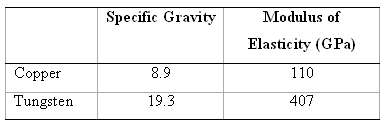
A large-particle composite consisting of tungsten particles within a copper matrix is to be prepared. If the volume fractions of tungsten and copper are 0.60 and 0.40, respectively, estimate the upper limit for the specific stiffness of this composite given the data thatfollow.
(a) What is the distinction between cement and concrete?(b) Cite three important limitations that restrict the use of concrete as a structural material.(c) Briefly explain three techniques that are utilized to strengthen concrete by reinforcement.
Cite one similarity and two differences between precipitation hardening and dispersion strengthening.
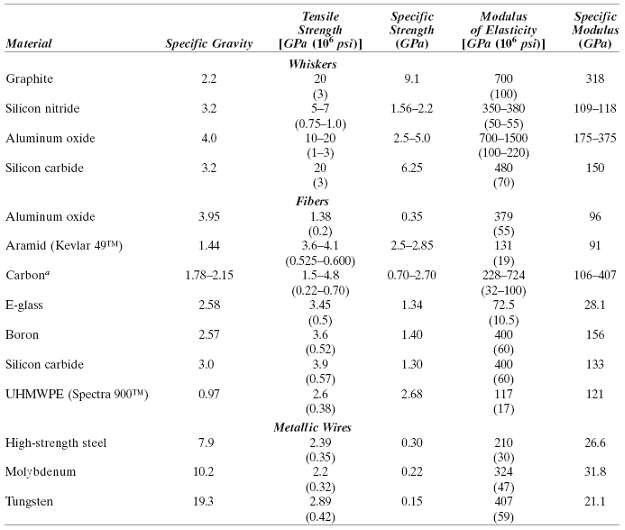
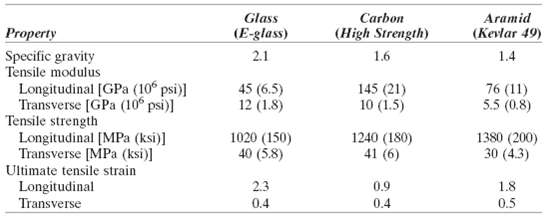
For some glass fiber-epoxy matrix combination, the critical fiber length-fiber diameter ratio is 50. Using the data in Table 16.4, determine the fiber-matrix bond strength.
(a) For a fiber-reinforced composite, the efficiency of reinforcement ? is dependent on fiber length l according to where x represents the length of the fiber at each end that does not contribute to the load transfer. Make a plot of ? versus l to l = 40 mm (1.6 in.) assuming that x = 0.75 mm (0.03
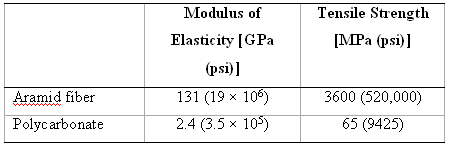
A continuous and aligned fiber-reinforced composite is to be produced consisting of 30 vol% aramid fibers and 70 vol% of a polycarbonate matrix; mechanical characteristics of these two materials are as follows: Also, the stress on the polycarbonate matrix when the aramid fibers fail is 45MPa
Is it possible to produce a continuous and oriented aramid fiber-epoxy matrix composite having longitudinal and transverse moduli of elasticity of 57.1GPa (8.28 ( 106psi) and 4.12GPa (6 ( 105psi), respectively? Why or why not? Assume that the modulus of elasticity of the epoxy is 2.4GPa (3.50 (
For a continuous and oriented fiber-reinforced composite, the moduli of elasticity in the longitudinal and transverse directions are 19.7 and 3.66GPa (2.8 ( 106 and 5.3 ( 105psi), respectively. If the volume fraction of fibers is 0.25, determine the moduli of elasticity of fiber and matrix phases.
(a) Verify that Equation 16.11, the expression for the fiber load???matrix load ratio (Ff/Fm), is valid. (b) What is the Ff/Fc ratio in terms of Ef, Em, andVf?
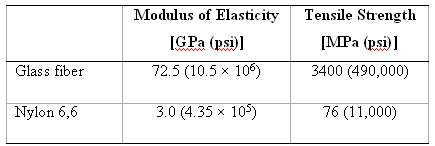
In an aligned and continuous glass fiber-reinforced nylon 6,6 composite, the fibers are to carry 94% of a load applied in the longitudinal direction. (a) Using the data provided, determine the volume fraction of fibers that will be required. (b) What will be the tensile strength of this composite?
Assume that the composite described in Problem 16.8 has a cross-sectional area of 320 mm2 (0.50 in.2) and is subjected to a longitudinal load of 44,500 N (10,000lbf).(a) Calculate the fiber–matrix load ratio.(b) Calculate the actual loads carried by both fiber and matrix phases.(c) Compute the
A continuous and aligned fiber-reinforced composite having a cross-sectional area of 1130 mm2 (1.75 in.2) is subjected to an external tensile load. If the stresses sustained by the fiber and matrix phases are 156MPa (22,600psi) and 2.75MPa (400psi), respectively, the force sustained by the fiber
Compute the longitudinal strength of an aligned carbon fiber-epoxy matrix composite having a 0.25 volume fraction of fibers, assuming the following: (1) an average fiber diameter of 10 ( 10-3 mm (3.94 ( 10-4 in.), (2) an average fiber length of 5 mm (0.20 in.), (3) a fiber fracture strength of
It is desired to produce an aligned carbon fiber-epoxy matrix composite having a longitudinal tensile strength of 750MPa (109,000psi). Calculate the volume fraction of fibers necessary if (1) the average fiber diameter and length are 1.2 ( 10-2 mm (4.7 ( 10-4 in.) and 1 mm (0.04 in.), respectively;
Compute the longitudinal tensile strength of an aligned glass fiber-epoxy matrix composite in which the average fiber diameter and length are 0.010 mm (4 ( 10-4 in.) and 2.5 mm (0.10 in.), respectively, and the volume fraction of fibers is 0.40. Assume that (1) the fiber-matrix bond strength is
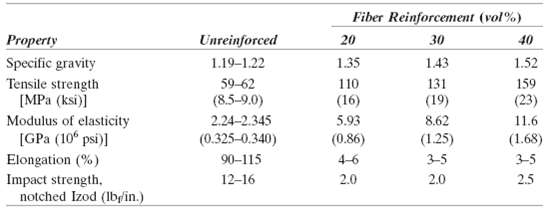
(a) From the moduli of elasticity data in Table 16.2 for glass fiber-reinforced polycarbonate composites, determine the value of the fiber efficiency parameter for each of 20, 30, and 40 vol% fibers. (b) Estimate the modulus of elasticity for 50 vol% glass fibers.
For a polymer-matrix fiber-reinforced composite,(a) List three functions of the matrix phase.(b) Compare the desired mechanical characteristics of matrix and fiber phases.(c) Cite two reasons why there must be a strong bond between fiber and matrix at their interface.
(a) What is the distinction between matrix and dispersed phases in a composite material?(b) Contrast the mechanical characteristics of matrix and dispersed phases for fiber-reinforced composites.
(a) Calculate and compare the specific longitudinal strengths of the glass-fiber, carbon-fiber, and aramid-fiber reinforced epoxy composites in Table 16.5 with the following alloys: tempered (315(C) 440A martensitic stainless steel, normalized 1020 plain-carbon steel, 2024-T3 aluminum alloy,
(a) List four reasons why glass fibers are most commonly used for reinforcement.(b) Why is the surface perfection of glass fibers so important?(c) What measures are taken to protect the surface of glass fibers?
Cite the distinction between carbon and graphite.
(a) Cite several reasons why fiberglass-reinforced composites are utilized extensively.(b) Cite several limitations of this type of composite.
(a) What is a hybrid composite?(b) List two important advantages of hybrid composites over normal fiber composites.
(a) Write an expression for the modulus of elasticity for a hybrid composite in which all fibers of both types are oriented in the same direction.(b) Using this expression, compute the longitudinal modulus of elasticity of a hybrid composite consisting of aramid and glass fibers in volume fractions
Derive a generalized expression analogous to Equation 16.16 for the transverse modulus of elasticity of an aligned hybrid composite consisting of two types of continuous fibers.
Briefly describe pultrusion, filament winding, and prepreg production fabrication processes; cite the advantages and disadvantages of each.
Briefly describe laminar composites. What is the prime reason for fabricating these materials?
(a) Briefly describe sandwich panels.(b) What is the prime reason for fabricating these structural composites?(c) What are the functions of the faces and the core?
Composite materials are now being utilized extensively in sports equipment.(a) List at least four different sports implements that are made of, or contain composites.
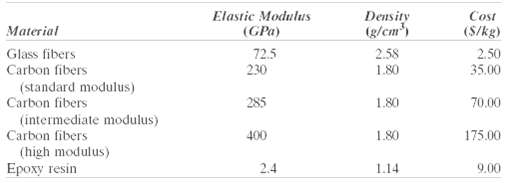
It is desired to produce an aligned and continuous fiber-reinforced epoxy composite having a maximum of 50vol% fibers. In addition, a minimum longitudinal modulus of elasticity of 50GPa (7.3 ( 106psi) is required, as well as a minimum tensile strength of 1300MPa (189,000psi). Of E-glass, carbon
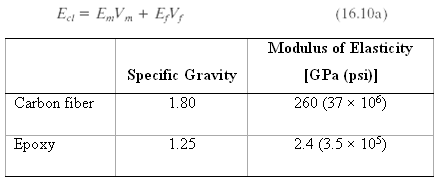
It is desired to produce a continuous and oriented carbon fiber-reinforced epoxy having a modulus of elasticity of at least 83GPa (12 ( 106psi) in the direction of fiber alignment. The maximum permissible specific gravity is 1.40. Given the following data, is such a composite possible? Why or why
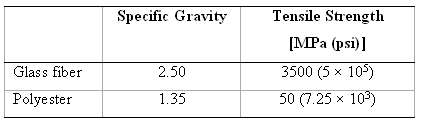
It is desired to fabricate a continuous and aligned glass fiber-reinforced polyester having a tensile strength of at least 1400MPa (200,000 psi) in the longitudinal direction. The maximum possible specific gravity is 1.65. Using the following data, determine if such a composite is possible. Justify
It is necessary to fabricate an aligned and discontinuous carbon fiber-epoxy matrix composite having a longitudinal tensile strength of 1900MPa (275,000 psi) using 0.45 volume fraction of fibers. Compute the required fiber fracture strength assuming that the average fiber diameter and length are 8
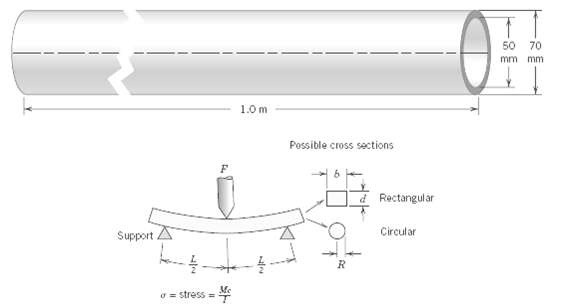
A tubular shaft similar to that shown in Figure 16.11 is to be designed that has an outside diameter of 80 mm (3.15 in) and a length of 0.75 m (2.46 ft), the mechanical characteristic of prime importance is bending stiffness in terms of the longitudinal modulus of elasticity. Stiffness is to be
(a) Briefly explain the difference between oxidation and reduction electrochemical reactions.(b) Which reaction occurs at the anode and which at the cathode?
(a) Write the possible oxidation and reduction half-reactions that occur when magnesium is immersed in each of the following solutions: (i) HCl, (ii) an HCl solution containing dissolved oxygen, (iii) an HCl solution containing dissolved oxygen and, in addition, Fe2+ ions.(b) In which of these
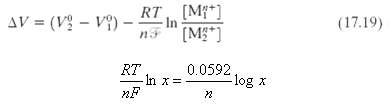
Demonstrate that (a) The value of ? in Equation 17.19 is 96,500 C/mol, and (b) At 25°C (298 K),
(a) Compute the voltage at 25°C of an electrochemical cell consisting of pure cadmium immersed in a 2 ( 10-3 M solution of Cd2+ ions, and pure iron in a 0.4 M solution of Fe2+ ions.(b) Write the spontaneous electrochemical reaction.
A Zn/Zn2+ concentration cell is constructed in which both electrodes are pure zinc. The Zn2+ concentration for one cell half is 1.0 M , for the other, 10-2 M . Is a voltage generated between the two cell halves? If so, what is its magnitude and which electrode will be oxidized? If no voltage is
An electrochemical cell is composed of pure copper and pure lead electrodes immersed in solutions of their respective divalent ions. For a 0.6 M concentration of Cu2+, the lead electrode is oxidized yielding a cell potential of 0.507 V. Calculate the concentration of Pb2+ ions if the temperature is
An electrochemical cell is constructed such that on one side a pure nickel electrode is in contact with a solution containing Ni2+ ions at a concentration of 3 ( 10-3 M. The other cell half consists of a pure Fe electrode that is immersed in a solution of Fe2+ ions having a concentration of 0.1 M.
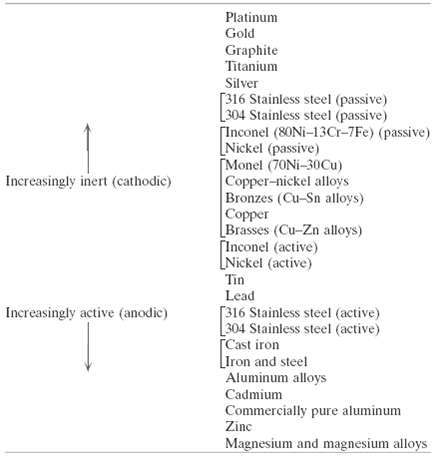
For the following pairs of alloys that are coupled in seawater, predict the possibility of corrosion; if corrosion is probable, note which metal/alloy will corrode.(a) Aluminum and magnesium(b) Zinc and a low-carbon steel(c) Brass (60Cu–40Zn) and Monel (70Ni–30Cu)(d) Titanium and 304 stainless
(a) From the galvanic series (Table 17.2), cite three metals or alloys that may be used to galvanically protect 304 stainless steel in the active state.(b) As Concept Check 17.4(b) notes, galvanic corrosion is prevented by making an electrical contact between the two metals in the couple and a
Demonstrate that the constant K in Equation 17.23 will have values of 534 and 87.6 for the CPR in units of mpy and mm/yr,respectively.
A piece of corroded steel plate was found in a submerged ocean vessel. It was estimated that the original area of the plate was 10 in.2 and that approximately 2.6 kg had corroded away during the submersion. Assuming a corrosion penetration rate of 200 mpy for this alloy in seawater, estimate the
A thick steel sheet of area 400 cm2 is exposed to air near the ocean. After a one-year period it was found to experience a weight loss of 375 g due to corrosion. To what rate of corrosion, in both mpy and mm/yr, does this correspond?
(a) Demonstrate that the CPR is related to the corrosion current density i (A/cm2) through the expression where K is a constant, A is the atomic weight of the metal experiencing corrosion, n is the number of electrons associated with the ionization of each metal atom, and ? is the density of the
Using the results of Problem 17.13, compute the corrosion penetration rate, in mpy, for the corrosion of iron in citric acid (to form Fe2+ ions) if the corrosion current density is 1.15 ( 10-5 A/cm2.
(a) Cite the major differences between activation and concentration polarizations.(b) Under what conditions is activation polarization rate controlling?(c) Under what conditions is concentration polarization rate controlling?
(a) Describe the phenomenon of dynamic equilibrium as it applies to oxidation and reduction electrochemical reactions.(b) What is the exchange current density?
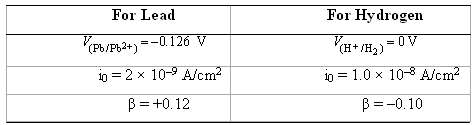
Lead experiences corrosion in an acid solution according to the reaction The rates of both oxidation and reduction half-reactions are controlled by activation polarization. (a) Compute the rate of oxidation of Pb (in mol/cm2-s) given the following activation polarization data: (b) Compute the
The corrosion rate is to be determined for some divalent metal M in a solution containing hydrogen ions. The following corrosion data are known about the metal and solution:(a) Assuming that activation polarization controls both oxidation and reduction reactions, determine the rate of corrosion of
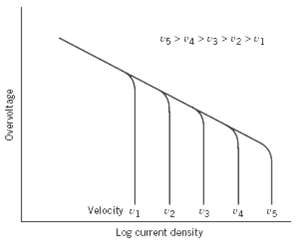
The influence of increasing solution velocity on the over voltage-versus-log current density behavior for a solution that experiences combined activation???concentration polarization is indicated in Figure. On the basis of this behavior, make a schematic plot of corrosion rate versus solution
Briefly describe the phenomenon of passivity. Name two common types of alloy that passivate.
Why does chromium in stainless steels make them more corrosion resistant in many environments than plain carbon steels?
Briefly explain why cold-worked metals are more susceptible to corrosion than noncold-worked metals.
Briefly explain why, for a small anode-to-cathode area ratio, the corrosion rate will be higher than for a large ratio.
For a concentration cell, briefly explain why corrosion occurs at that region having the lower concentration.
(a) What are inhibitors?(b) What possible mechanisms account for their effectiveness?
Briefly describe the two techniques that are used for galvanic protection.
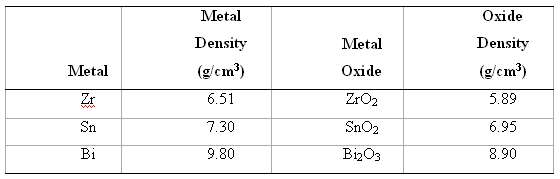
For each of the metals listed in the table, compute the Pilling???Bedworth ratio. Also, on the basis of this value, specify whether or not you would expect the oxide scale that forms on the surface to be protective, and then justify your decision. Density data for both the metal and its oxide are
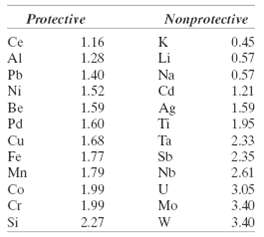
According to Table 17.3, the oxide coating that forms on silver should be nonprotective, and yet Ag does not oxidize appreciably at room temperature and in air. How do you explain this apparentdiscrepancy?
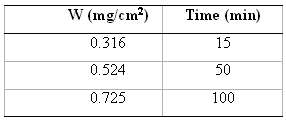
In the table, weight gain-time data for the oxidation of copper at an elevated temperature are tabulated. (a) Determine whether the oxidation kinetics obey a linear, parabolic, or logarithmic rate expression. (b) Now compute W after a time of 450min.
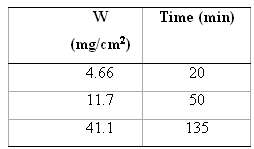
In the table, weight gain???time data for the oxidation of some metal at an elevated temperature are tabulated. (a) Determine whether the oxidation kinetics obey a linear, parabolic, or logarithmic rate expression. (b) Now compute W after a time of 1000min.
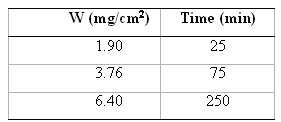
In the table weight gain???time data for the oxidation of some metal at an elevated temperature are tabulated. (a) Determine whether the oxidation kinetics obey a linear, parabolic, or logarithmic rate expression. (b) Now compute W after a time of 3500min.
A brine solution is used as a cooling medium in a steel heat exchanger. The brine is circulated within the heat exchanger and contains some dissolved oxygen. Suggest three methods, other than cathodic protection, for reducing corrosion of the steel by the brine. Explain the rationale for each
Suggest an appropriate material for each of the following applications, and, if necessary, recommend corrosion prevention measures that should be taken. Justify your suggestions.(a) Laboratory bottles to contain relatively dilute solutions of nitric acid(b) Barrels to contain benzene(c) Pipe to
(a) Compute the electrical conductivity of a 5.1-mm (0.2-in.) diameter cylindrical silicon specimen 51 mm (2 in.) long in which a current of 0.1 A passes in an axial direction. A voltage of 12.5 V is measured across two probes that are separated by 38 mm (1.5 in.).(b) Compute the resistance over
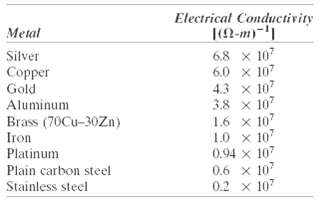
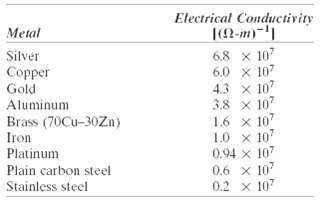
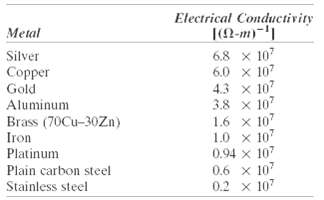
A copper wire 100 m long must experience a voltage drop of less than 1.5 V when a current of 2.5 A passes through it. Using the data in Table 18.1, compute the minimum diameter of thewire.
An aluminum wire 4 mm in diameter is to offer a resistance of no more than 2.5. Using the data in Table 18.1, compute the maximum wire length.
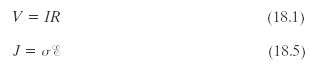
Demonstrate that the two Ohm's law expressions, Equations 18.1 and 18.5, areequivalent.
(a) Using the data in Table 18.1, compute the resistance of a copper wire 3 mm (0.12 in.) in diameter and 2 m (78.7 in.) long. (b) What would be the current flow if the potential drop across the ends of the wire is 0.05 V? (c) What is the current density? (d) What is the magnitude of the electric
What is the distinction between electronic and ionic conduction?
How does the electron structure of an isolated atom differ from that of a solid material?
In terms of electron energy band structure, discuss reasons for the difference in electrical conductivity between metals, semiconductors, and insulators.
Briefly tell what is meant by the drift velocity and mobility of a free electron.
(a) Calculate the drift velocity of electrons in germanium at room temperature and when the magnitude of the electric field is 1000 V/m.(b) Under these circumstances, how long does it take an electron to traverse a 25-mm (1-in.) length of crystal?
At room temperature the electrical conductivity and the electron mobility for copper are 6.0 X 10⁷ (-m)-1 and 0.0030 m2/V-s, respectively. (a) Compute the number of free electrons per cubic meter for copper at room temperature. (b) What is the number of free electrons per copper atom? Assume a
(a) Calculate the number of free electrons per cubic meter for gold assuming that there are 1.5 free electrons per gold atom. The electrical conductivity and density for Au are 4.3 x 10⁷ (-m)-1 and 19.32 g/cm3, respectively.(b) Now compute the electron mobility for Au.
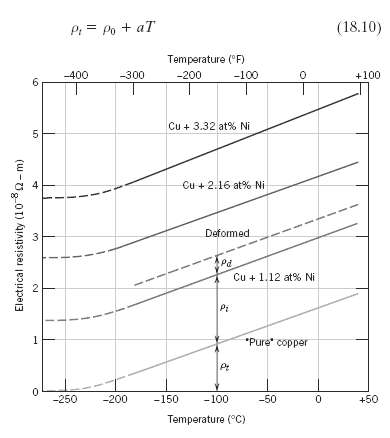
From figure estimate the value of A in Equation 18.11 for zinc as an impurity in copper???zincalloys.
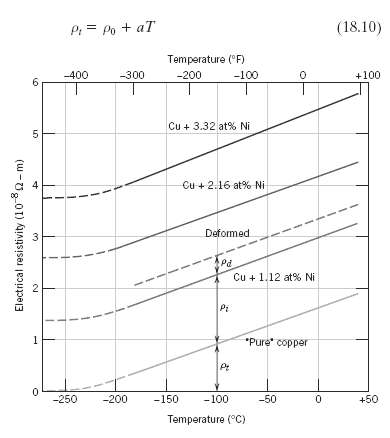
(a) Using the data in Figure, determine the values of ?0 and a from Equation 18.10 for pure copper. Take the temperature T to be in degrees Celsius. (b) Determine the value of A in Equation 18.11 for nickel as an impurity in copper, using the data in Figure. (c) Using the results of parts (a) and
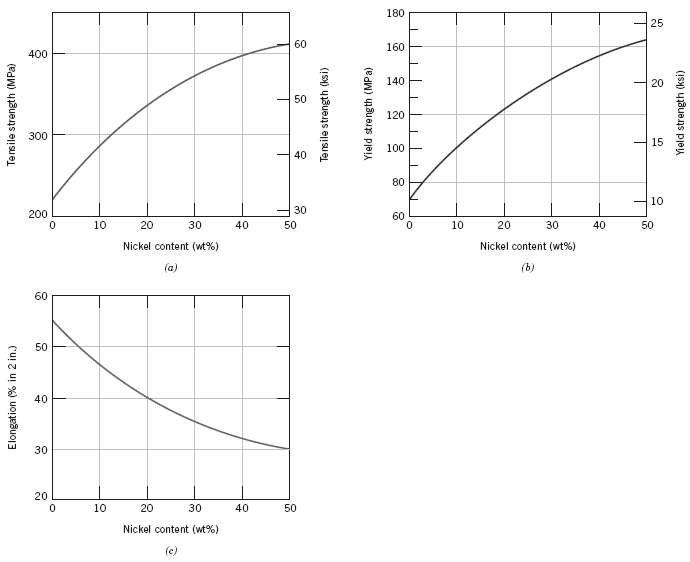
Determine the electrical conductivity of a Cu-Ni alloy that has a yield strength of 125MPa (18,000psi). You will find Figurehelpful.
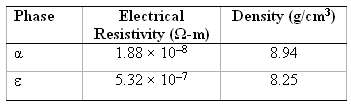
Tin bronze has a composition of 92 wt% Cu and 8 wt% Sn, and consists of two phases at room temperature: an a phase, which is copper containing a very small amount of tin in solid solution, and an e phase, which consists of approximately 37 wt% Sn. Compute the room temperature conductivity of this
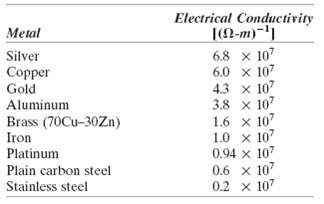
A cylindrical metal wire 2 mm (0.08 in.) in diameter is required to carry a current of 10 A with a minimum of 0.03 V drop per foot (300 mm) of wire. Which of the metals and alloys listed in Table 18.1 are possiblecandidates?
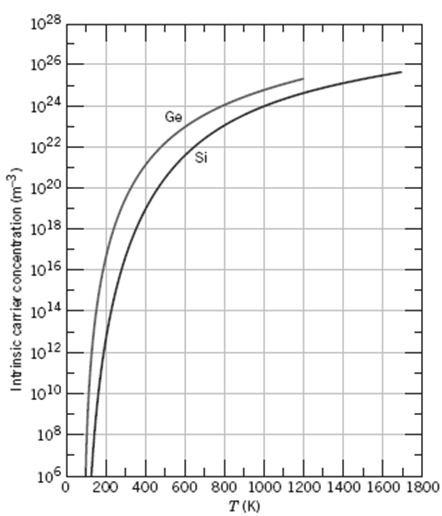
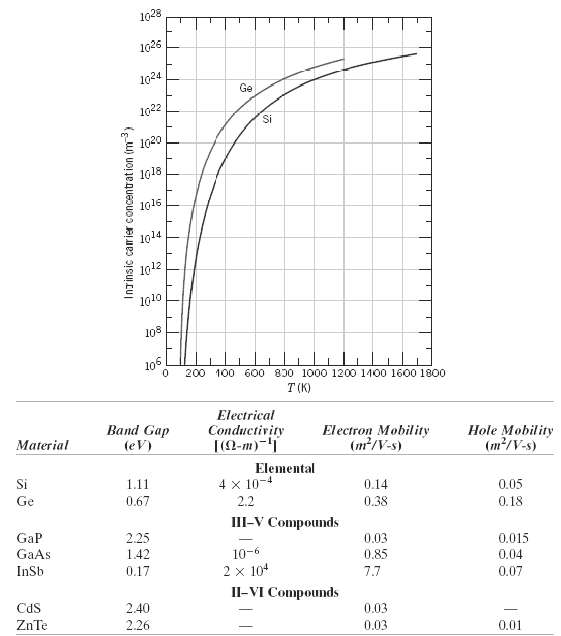
(a) Using the data presented in Figure, determine the number of free electrons per atom for intrinsic germanium and silicon at room temperature (298 K). The densities for Ge and Si are 5.32 and 2.33 g/cm3, respectively.(b) Now explain the difference in these free-electron-per-atom values.
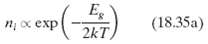
For intrinsic semiconductors, the intrinsic carrier concentration ni depends on temperature as follows: or taking natural logarithms, Thus, a plot of ln ni versus 1/T (K)???1 should be linear and yield a slope of ???Eg/2k. Using this information and the data presented in Figure, determine the
Briefly explain the presence of the factor 2 in the denominator of Equation 18.35a.
At room temperature the electrical conductivity of PbTe is 500 (Ω-m)–1, whereas the electron and hole mobilities are 0.16 and 0.075 m2/V-s, respectively. Compute the intrinsic carrier concentration for PbTe at room temperature.
Is it possible for compound semiconductors to exhibit intrinsic behavior? Explain your answer.
For each of the following pairs of semiconductors, decide which will have the smaller band gap energy, Eg, and then cite the reason for your choice. (a) ZnS and CdSe, (b) Si and C (diamond), (c) Al2O3 and ZnTe, (d) InSb and ZnSe, (e) GaAs and AlP.
Define the following terms as they pertain to semiconducting materials: intrinsic, extrinsic, compound, elemental. Now provide an example of each.
Showing 600 - 700
of 2249
1
2
3
4
5
6
7
8
9
10
11
12
13
14
15
Last
Step by Step Answers

 Get 50% OFF
Claim Now
Get 50% OFF
Claim Now