New Semester
Started
Get
50% OFF
Study Help!
--h --m --s
Claim Now
Question Answers
Textbooks
Find textbooks, questions and answers
Oops, something went wrong!
Change your search query and then try again
S
Books
FREE
Study Help
Expert Questions
Accounting
General Management
Mathematics
Finance
Organizational Behaviour
Law
Physics
Operating System
Management Leadership
Sociology
Programming
Marketing
Database
Computer Network
Economics
Textbooks Solutions
Accounting
Managerial Accounting
Management Leadership
Cost Accounting
Statistics
Business Law
Corporate Finance
Finance
Economics
Auditing
Tutors
Online Tutors
Find a Tutor
Hire a Tutor
Become a Tutor
AI Tutor
AI Study Planner
NEW
Sell Books
Search
Search
Sign In
Register
study help
engineering
materials science engineering
Fundamentals of Materials Science and Engineering An Integrated Approach 4th Edition David G. Rethwisch - Solutions
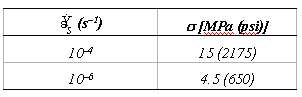
Steady-state creep rate data are given below for nickel at 1000(C (1273 K): If it is known that the activation energy for creep is 272,000 J/mol, compute the steady-state creep rate at a temperature of 850(C (1123 K) and a stress level of 25MPa(3625psi).
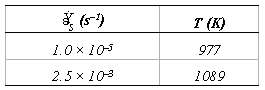
Steady-state creep data taken for a stainless steel at a stress level of 70MPa (10,000psi) are given If it is known that the value of the stress exponent n for this alloy is 7.0, compute the steady-state creep rate at 1250 K and a stress level of 50MPa(7250psi).
Cite three metallurgical/processing techniques that are employed to enhance the creep resistance of metal alloys.
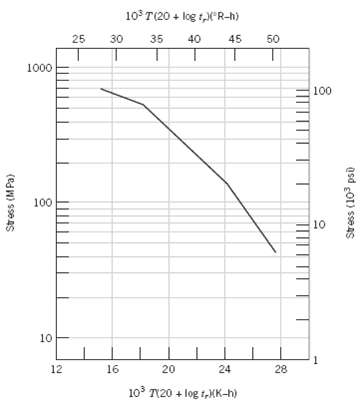
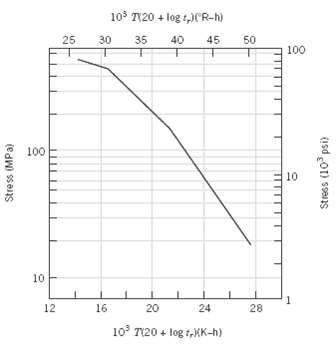
An S-590 alloy component (Figure) must have a creep rupture lifetime of at least 100 days at 500(C (773 K). Compute the maximum allowable stress level.
Consider an S-590 alloy component (Figure) that is subjected to a stress of 200MPa (29,000psi). At what temperature will the rupture lifetime be 500h?
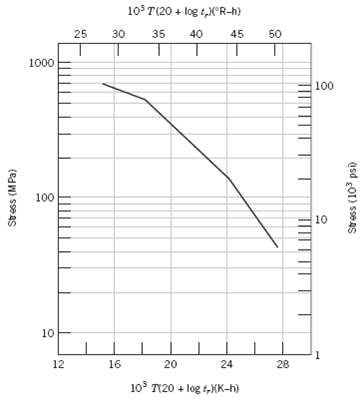
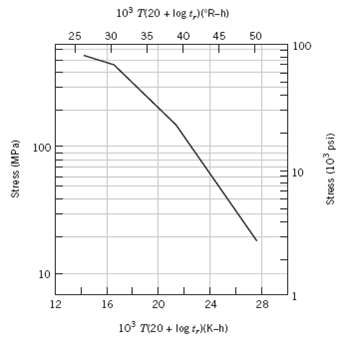
For an 18-8 Mo stainless steel (Figure), predict the time to rupture for a component that is subjected to a stress of 80MPa (11,600psi) at 700?C (973 K).
Consider an 18-8 Mo stainless steel component (Figure) that is exposed to a temperature of 500(C (773 K). What is the maximum allowable stress level for a rupture lifetime of 5 years? 20 years?
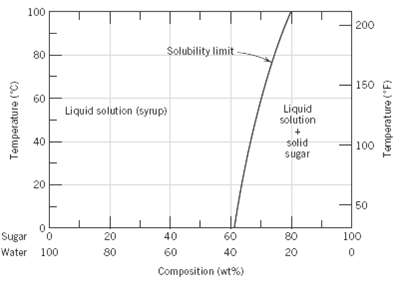
Consider the sugar?water phase diagram of Figure. (a)?How much sugar will dissolve in 1500 g water at 90?C (194?F)? (b) If the saturated liquid solution in part (a) is cooled to 20?C (68?F), some of the sugar will precipitate out as a solid. What will be the composition of the saturated liquid
At 500°C (930°F), what is the maximum solubility(a) Of Cu in Ag?(b) Of Ag in Cu?
Cite three variables that determine the microstructure of an alloy.
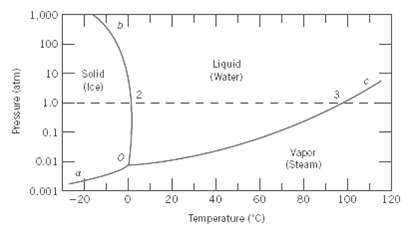
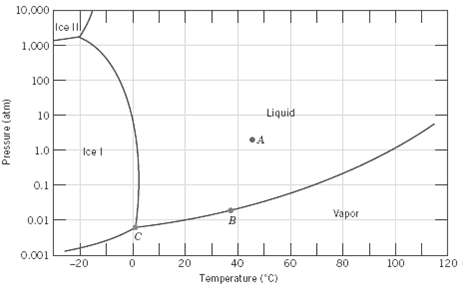
Consider a specimen of ice that is at 210(C and 1 atm pressure. Using Figure, the pressure???temperature phase diagram for H2O, determine the pressure to which the specimen must be raised or lowered to cause it (a) To melt, And (b) To sublime.
At a pressure of 0.01 atm, determine(a) The melting temperature for ice, and(b) The boiling temperature for water.
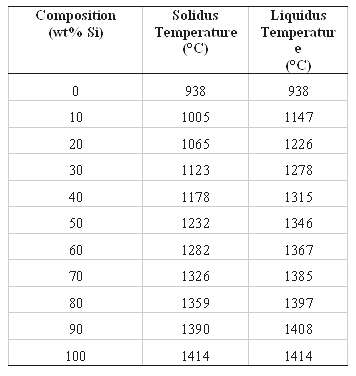
Given here are the solidus and liquidus temperatures for the germanium-silicon system. Construct the phase diagram for this system and label eachregion.
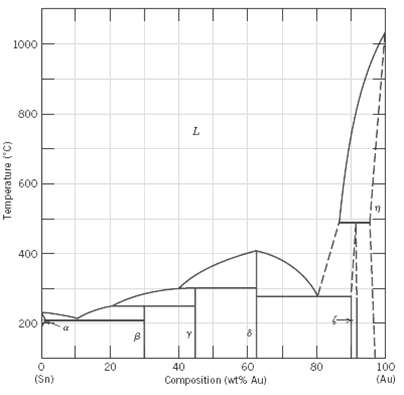
Cite the phases that are present and the phase compositions for the following alloys:(a) 90 wt% Zn-10 wt% Cu at 400(C (750(F)(b) 75 wt% Sn-25 wt% Pb at 175(C (345(F)(c) 55 wt% Ag-45 wt% Cu at 900(C (1650(F)(d) 30 wt% Pb-70 wt% Mg at 425(C (795(F)(e) 2.12 kg Zn and 1.88 kg Cu at 500(C (930(F)(f) 37
Is it possible to have a copper–nickel alloy that, at equilibrium, consists of a liquid phase of composition 20 wt% Ni–80 wt% Cu and also an a phase of composition 37 wt% Ni–63 wt% Cu? If so, what will be the approximate temperature of the alloy? If this is not possible, explain why.
Is it possible to have a copper-zinc alloy that, at equilibrium, consists of an e phase of composition 80 wt% Zn-20 wt% Cu, and also a liquid phase of composition 95 wt% Zn-5 wt% Cu? If so, what will be the approximate temperature of the alloy? If this is not possible, explain why.
A copper-nickel alloy of composition 70 wt% Ni-30 wt% Cu is slowly heated from a temperature of 1300(C (2370(F).(a) At what temperature does the first liquid phase form?(b) What is the composition of this liquid phase?(c) At what temperature does complete melting of the alloy occur?(d) What is the
A 50 wt% Pb-50 wt% Mg alloy is slowly cooled from 700(C (1290(F) to 400(C (750(F).(a) At what temperature does the first solid phase form?(b) What is the composition of this solid phase?(c) At what temperature does the liquid solidify?(d) What is the composition of this last remaining liquid phase?
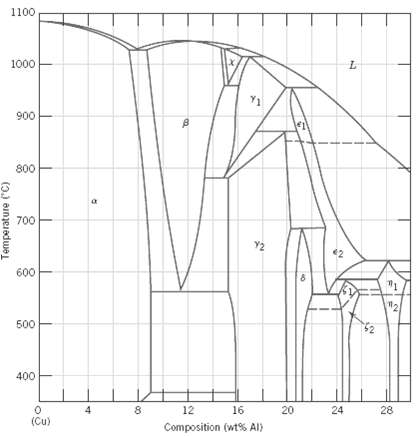
For an alloy of composition 74 wt% Zn-26 wt% Cu, cite the phases present and their compositions at the following temperatures: 850(C, 750(C, 680(C, 600(C, and 500(C.
Determine the relative amounts (in terms of mass fractions) of the phases for the alloys and temperatures given in Problem 9.8.(a) 90 wt% Zn-10 wt% Cu at 400(C (750(F)(b) 75 wt% Sn-25 wt% Pb at 175(C (345(F)(c) 55 wt% Ag-45 wt% Cu at 900(C (1650(F)(d) 30 wt% Pb-70 wt% Mg at 425(C (795(F)(e) 2.12 kg
A 1.5-kg specimen of a 90 wt% Pb???10 wt% Sn alloy is heated to 250oC (480oF); at this temperature it is entirely an a-phase solid solution (Figure). The alloy is to be melted to the extent that 50% of the specimen is liquid, the remainder being the a phase. This may be accomplished either by
A magnesium-lead alloy of mass 5.5 kg consists of a solid α phase that has a composition that is just slightly below the solubility limit at 200oC (390oF).(a) What mass of lead is in the alloy?(b) If the alloy is heated to 350oC (660oF), how much more lead may be dissolved in the α phase without
A 90 wt% Ag-10 wt% Cu alloy is heated to a temperature within the b + liquid phase region. If the composition of the liquid phase is 85 wt% Ag, determine:(a) The temperature of the alloy(b) The composition of the b phase(c) The mass fractions of both phases
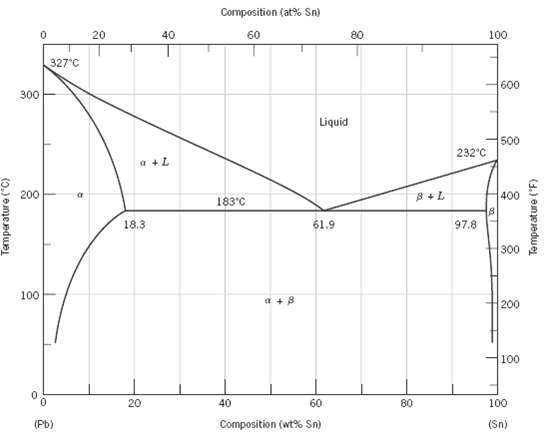
A 30 wt% Sn-70 wt% Pb alloy is heated to a temperature within the a + liquid phase region. If the mass fraction of each phase is 0.5, estimate:(a) The temperature of the alloy(b) The compositions of the two phases
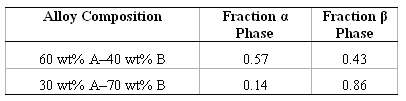
For alloys of two hypothetical metals A and B, there exist an ?, A-rich phase and a ?, B-rich phase. From the mass fractions of both phases for two different alloys provided in the table below, (which are at the same temperature), determine the composition of the phase boundary (or solubility
A hypothetical A–B alloy of composition 55 wt% B–45 wt% A at some temperature is found to consist of mass fractions of 0.5 for both α and β phases. If the composition of the β phase is 90 wt% B–10 wt% A, what is the composition of the α phase?
Is it possible to have a copper-silver alloy of composition 50 wt% Ag-50 wt% Cu, which, at equilibrium, consists of α and β phases having mass fractions W = 0.60 and W β = 0.40? If so, what will be the approximate temperature of the alloy? If such an alloy is not possible, explain why.
For 11.20 kg of a magnesium-lead alloy of composition 30 wt% Pb-70 wt% Mg, is it possible, at equilibrium, to have α and Mg2Pb phases having respective masses of 7.39 kg and 3.81 kg? If so, what will be the approximate temperature of the alloy? If such an alloy is not possible, explain why.
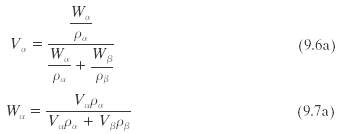
Derive Equations 9.6a and 9.7a, which may be used to convert mass fraction to volume fraction, and viceversa.
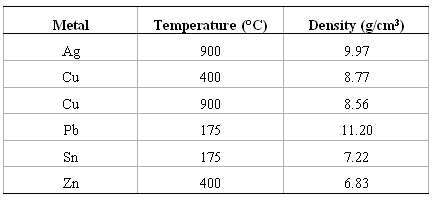
Determine the relative amounts (in terms of volume fractions) of the phases for the alloys and temperatures given in Problem 9.8a, b, and c. Below are given the approximate densities of the various metals at the alloy temperatures: (a) 90 wt% Zn-10 wt% Cu at 400(C (750(F) (b) 75 wt% Sn-25 wt% Pb at
(a) Briefly describe the phenomenon of coring and why it occurs.(b) Cite one undesirable consequence of coring.
It is desirable to produce a copper-nickel alloy that has a minimum noncold-worked tensile strength of 350MPa (50,750psi) and a ductility of at least 48%EL. Is such an alloy possible? If so, what must be its composition? If this is not possible, then explain why.
A 45 wt% Pb–55 wt% Mg alloy is rapidly quenched to room temperature from an elevated temperature in such a way that the high-temperature microstructure is preserved. This microstructure is found to consist of the α phase and Mg2Pb, having respective mass fractions of 0.65 and 0.35. Determine the
Briefly explain why, upon solidification, an alloy of eutectic composition forms a microstructure consisting of alternating layers of the two solid phases.
What is the difference between a phase and a microconstituent?
Is it possible to have a copper-silver alloy in which the mass fractions of primary β and total β are 0.68 and 0.925, respectively, at 775oC (1425oF)? Why or why not?
For 6.70 kg of a magnesium-lead alloy, is it possible to have the masses of primary α and total α of 4.23 kg and 6.00 kg, respectively, at 460oC (860oF)? Why or why not?
For a copper-silver alloy of composition 25 wt% Ag-75 wt% Cu and at 775oC (1425oF) do the following:(a) Determine the mass fractions of α and β phases.(b) Determine the mass fractions of primary α and eutectic microconstituents.(c)Determine the mass fraction of eutectic α.
The microstructure of a lead-tin alloy at 180oC (355oF) consists of primary β and eutectic structures. If the mass fractions of these two micro constituents are 0.57 and 0.43, respectively, determine the composition of the alloy.
For an 85 wt% Pb-15 wt% Mg alloy, make schematic sketches of the microstructure that would be observed for conditions of very slow cooling at the following temperatures: 600°C (1110°F), 500°C (930°F), 270°C (520°F), and 200°C (390°F). Label all phases and indicate their approximate
For a 68 wt% Zn-32 wt% Cu alloy, make schematic sketches of the microstructure that would be observed for conditions of very slow cooling at the following temperatures: 1000°C (1830°F), 760°C (1400°F), 600°C (1110°F), and 400°C (750°F). Label all phases and indicate their approximate
For a 30 wt% Zn-70 wt% Cu alloy, make schematic sketches of the microstructure that would be observed for conditions of very slow cooling at the following temperatures: 1100°C (2010°F), 950°C (1740°F), 900°C (1650°F), and 700°C (1290°F). Label all phases and indicate their approximate
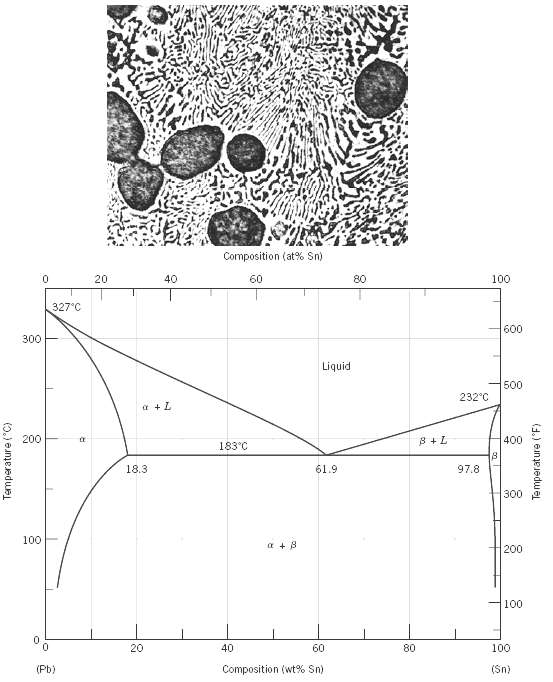
On the basis of the photomicrograph (i.e., the relative amounts of the microconstituents) for the lead?tin alloy shown in Figure and the Pb?Sn phase diagram (Figure), estimate the composition of the alloy, and then compare this estimate with the composition given in the figure legend of Figure.
The room-temperature tensile strengths of pure lead and pure tin are 16.8MPa and 14.5MPa, respectively.(a) Make a schematic graph of the room-temperature tensile strength versus composition for all compositions between pure lead and pure tin.(b) On this same graph schematically plot tensile
Two intermetallic compounds, AB and AB2, exist for elements A and B. If the compositions for AB and AB2 are 34.3 wt% A–65.7 wt% B and 20.7 wt% A–79.3 wt% B, respectively, and element A is potassium, identify element B.
What is the principal difference between congruent and incongruent phase transformations?
Figure is the aluminum-neodymium phase diagram, for which only single-phase regions are labeled. Specify temperature-composition points at which all eutectics, eutectoids, peritectics, and congruent phase transformations occur. Also, for each, write the reaction upon cooling.
Figure is a portion of the titanium-copper phase diagram for which only single-phase regions are labeled. Specify all temperature-composition points at which eutectics, eutectoids, peritectics, and congruent phase transformations occur. Also, for each, write the reaction upon cooling.
Construct the hypothetical phase diagram for metals A and B between temperatures of 600°C and 1000°C given the following information:● The melting temperature of metal A is 940°C.
In Figure is shown the pressure?temperature phase diagram for H2O. Apply the Gibbs phase rule at points A, B, and C; that is, specify the number of degrees of freedom at each of the points?that is, the number of externally controllable variables that need be specified to completely define the
Compute the mass fractions of α ferrite and cementite in pearlite.
(a) What is the distinction between hypoeutectoid and hypereutectoid steels?(b) In a hypoeutectoid steel, both eutectoid and proeutectoid ferrite exist. Explain the difference between them. What will be the carbon concentration in each?
What is the carbon concentration of an iron–carbon alloy for which the fraction of total ferrite is 0.94?
What is the proeutectoid phase for an iron–carbon alloy in which the mass fractions of total ferrite and total cementite are 0.92 and 0.08, respectively? Why?
Consider 1.0 kg of austenite containing 1.15 wt% C, cooled to below 727(C (1341(F).(a) What is the proeutectoid phase?(b) How many kilograms each of total ferrite and cementite form?(c) How many kilograms each of pearlite and the proeutectoid phase form?(d) Schematically sketch and label the
Consider 2.5 kg of austenite containing 0.65 wt% C, cooled to below 727(C (1341°F).(a) What is the proeutectoid phase?(b) How many kilograms each of total ferrite and cementite form?(c) How many kilograms each of pearlite and the proeutectoid phase form?(d) Schematically sketch and label the
Compute the mass fractions of proeutectoid ferrite and pearlite that form in an iron–carbon alloy containing 0.25 wt% C.
The microstructure of an iron–carbon alloy consists of proeutectoid ferrite and pearlite; the mass fractions of these two microconstituents are 0.286 and 0.714, respectively. Determine the concentration of carbon in this alloy.
The mass fractions of total ferrite and total cementite in an iron-carbon alloy are 0.88 and 0.12, respectively. Is this a hypoeutectoid or hypereutectoid alloy? Why?
The microstructure of an iron-carbon alloy consists of proeutectoid ferrite and pearlite; the mass fractions of these microconstituents are 0.20 and 0.80, respectively. Determine the concentration of carbon in this alloy.
Consider 2.0 kg of a 99.6 wt% Fe–0.4 wt% C alloy that is cooled to a temperature just below the eutectoid.(a) How many kilograms of proeutectoid ferrite form?(b) How many kilograms of eutectoid ferrite form?(c) How many kilograms of cementite form?
Compute the maximum mass fraction of proeutectoid cementite possible for a hypereutectoid iron–carbon alloy.
Is it possible to have an iron-carbon alloy for which the mass fractions of total ferrite and proeutectoid cementite are 0.846 and 0.049, respectively? Why or why not?
Is it possible to have an iron-carbon alloy for which the mass fractions of total cementite and pearlite are 0.039 and 0.417, respectively? Why or why not?
Compute the mass fraction of eutectoid ferrite in an iron-carbon alloy that contains 0.43 wt% C.
The mass fraction of eutectoid cementite in an iron-carbon alloy is 0.104. On the basis of this information, is it possible to determine the composition of the alloy? If so, what is its composition? If this is not possible, explain why.
The mass fraction of eutectoid ferrite in an iron-carbon alloy is 0.82. On the basis of this information, is it possible to determine the composition of the alloy? If so, what is its composition? If this is not possible, explain why.
For an iron-carbon alloy of composition 5 wt% C-95 wt% Fe, make schematic sketches of the microstructure that would be observed for conditions of very slow cooling at the following temperatures: 1175°C (2150°F), 1145°C (2095°F), and 700°C (1290°F). Label the phases and indicate their
Often, the properties of multiphase alloys may be approximated by the relationship where E represents a specific property (modulus of elasticity, hardness, etc.), and V is the volume fraction. The subscripts ? and ? denote the existing phases or micro constituents. Employ the relationship above
A steel alloy contains 97.5 wt% Fe, 2.0 wt% Mo, and 0.5 wt% C.(a) What is the eutectoid temperature of this alloy?(b) What is the eutectoid composition?(c) What is the proeutectoid phase?Assume that there are no changes in the positions of other phase boundaries with the addition of Mo.
A steel alloy is known to contain 93.8 wt% Fe, 6.0 wt% Ni, and 0.2 wt% C.(a) What is the approximate eutectoid temperature of this alloy?(b) What is the proeutectoid phase when this alloy is cooled to a temperature just below the eutectoid?(c) Compute the relative amounts of the proeutectoid phase
Name the two stages involved in the formation of particles of a new phase. Briefly describe each.
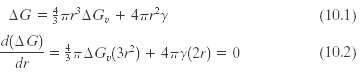
(a) Rewrite the expression for the total free energy change for nucleation (Equation 10.1) for the case of a cubic nucleus of edge length a (instead of a sphere of radius r). Now differentiate this expression with respect to a (per Equation 10.2) and solve for both the critical cube edge length,
If copper (which has a melting point of 1085°C) homogeneously nucleates at 849°C, calculate the critical radius given values of –1.77 × 10⁹ J/m3 and 0.200 J/m2, respectively, for the latent heat of fusion and the surface free energy.
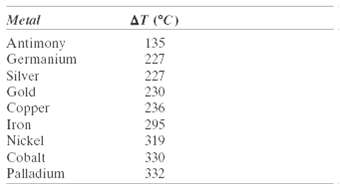
(a) For the solidification of iron, calculate the critical radius r* and the activation free energy ?G* if nucleation is homogeneous. Values for the latent heat of fusion and surface free energy are ???1.85 ?? 109 J/m3 and 0.204 J/m2, respectively. Use the supercooling value found in Table
(a) Assume for the solidification of iron (Problem 10.4) that nucleation is homogeneous, and the number of stable nuclei is 106 nuclei per cubic meter. Calculate the critical radius and the number of stable nuclei that exist at the following degrees of supercooling: 200 K and 300 K.(b) What is
For some transformation having kinetics that obey the Avrami equation (Equation 10.17), the parameter n is known to have a value of 1.7. If, after 100 s, the reaction is 50% complete, how long (total time) will it take the transformation to go to 99%completion?
Compute the rate of some reaction that obeys Avrami kinetics, assuming that the constants n and k have values of 3.0 and 7 ( 10-3, respectively, for time expressed in seconds.
It is known that the kinetics of recrystallization for some alloy obey the Avrami equation and that the value of n in the exponential is 2.5. If, at some temperature, the fraction recrystallized is 0.40 after 200 min, determine the rate of recrystallization at this temperature.
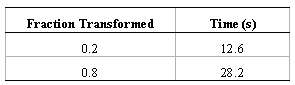
The kinetics of the austenite-to-pearlite transformation obey the Avrami relationship. Using the fraction transformed?time data given here, determine the total time required for 95% of the austenite to transform to pearlite:
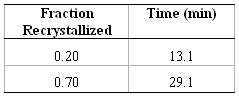
The fraction recrystallized?time data for the recrystallization at 600?C of a previously deformed steel are tabulated here. Assuming that the kinetics of this process obey the Avrami relationship, determine the fraction recrystallized after a total time of 22.8 min.
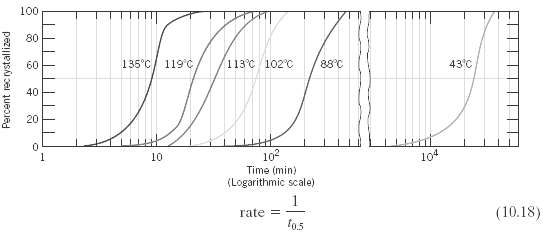
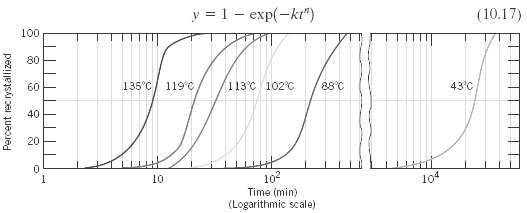
(a) From the curves shown in Figure and using Equation 10.18, determine the rate of recrystallization for pure copper at the several temperatures. (b) Make a plot of ln(rate) versus the reciprocal of temperature (in K???1), and determine the activation energy for this recrystallization process.
Determine values for the constants n and k (Equation 10.17) for the recrystallization of copper (Figure 10.11) at 102?C.
In terms of heat treatment and the development of microstructure, what are two major limitations of the iron–iron carbide phase diagram?
(a) Briefly describe the phenomena of superheating and supercooling.(b) Why do these phenomena occur?
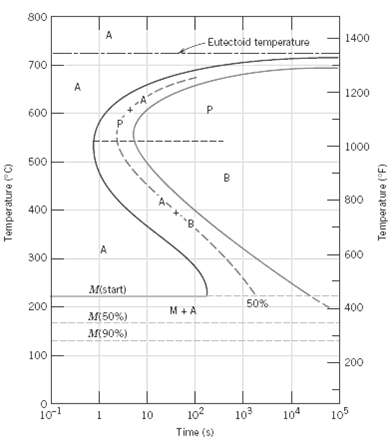
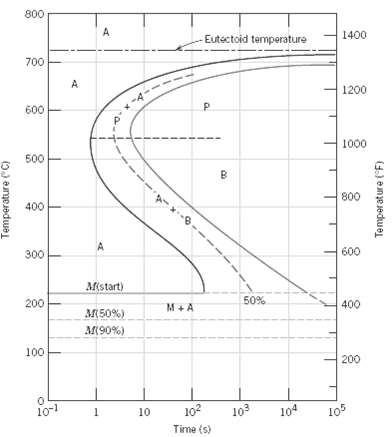
Suppose that a steel of eutectoid composition is cooled to 550°C (1020°F) from 760°C (1400°F) in less than 0.5 s and held at this temperature.(a) How long will it take for the austenite-to-pearlite reaction to go to 50% completion? To 100% completion?(b) Estimate the hardness of the alloy that
Briefly cite the differences between pearlite, bainite, and spheroidite relative to microstructure and mechanical properties.
Using the isothermal transformation diagram for an iron?carbon alloy of eutectoid composition (Figure), specify the nature of the final microstructure (in terms of micro constituents present and approximate percentages of each) of a small specimen that has been subjected to the following
Make a copy of the isothermal transformation diagram for an iron???carbon alloy of eutectoid composition (Figure) and then sketch and label time???temperature paths on this diagram to produce the following microstructures: (a) 100% fine pearlite (b) 100% tempered martensite (c) 50% coarse
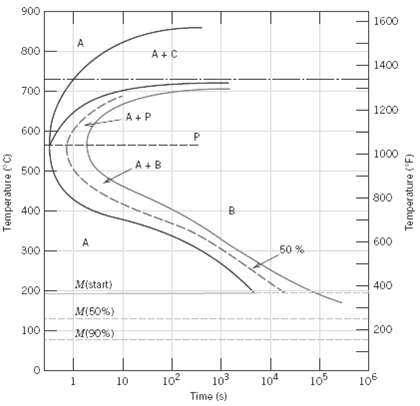
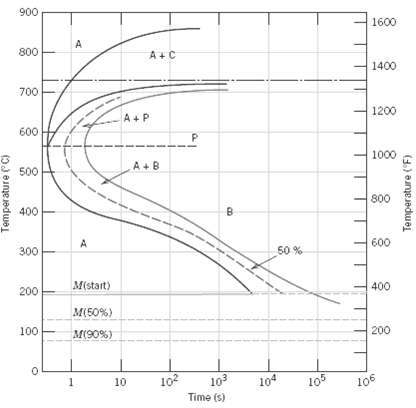
Using the isothermal transformation diagram for a 0.45 wt% C steel alloy (Figure), determine the final microstructure (in terms of just the microconstituents present) of a small specimen that has been subjected to the following time-temperature treatments. In each case assume that the specimen
For parts (a), (c), (d), (f), and (h) of Problem 10.20, determine the approximate percentages of the microconstituents that form.(a) Rapidly cool to 250(C (480(F), hold for 103 s, then quench to room temperature.(c) Rapidly cool to 400(C (750(F), hold for 500 s, then quench to room temperature.(d)
Make a copy of the isothermal transformation diagram for a 0.45 wt% C iron-carbon alloy (Figure), and then sketch and label on this diagram the time-temperature paths to produce the following microstructures: (a) 42% proeutectoid ferrite and 58% coarse pearlite (b) 50% fine pearlite and 50%
Name the microstructural products of eutectoid iron–carbon alloy (0.76 wt% C) specimens that are first completely transformed to austenite, then cooled to room temperature at the following rates:(a) 200°C/s,(b) 100°C/s, and(c) 20°C/s.
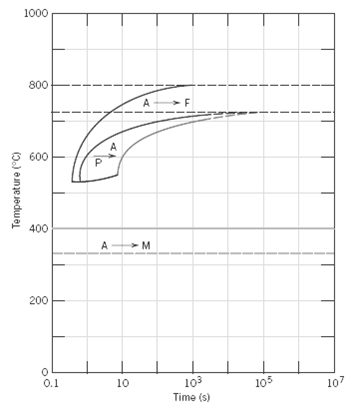
Figure shows the continuous cooling transformation diagram for a 1.13 wt% C iron-carbon alloy. Make a copy of this figure and then sketch and label continuous cooling curves to yield the following microstructures:(a) Fine pearlite and proeutectoid cementite(b) Martensite(c) Martensite and
Cite two important differences between continuous cooling transformation diagrams for plain carbon and alloy steels.
Briefly explain why there is no bainite transformation region on the continuous cooling transformation diagram for an iron–carbon alloy of eutectoid composition.
Name the micro structural products of 4340 alloy steel specimens that are first completely transformed to austenite, then cooled to room temperature at the following rates:(a) 10°C/s,(b) 1°C/s,(c) 0.1°C/s, and(d) 0.01°C/s.
Briefly describe the simplest continuous cooling heat treatment procedure that would be used in converting a 4340 steel from one microstructure to another.(a) (Martensite + bainite) to (ferrite + pearlite)(b) (Martensite + bainite) to spheroidite(c) (Martensite + bainite) to (martensite + bainite +
On the basis of diffusion considerations, explain why fine pearlite forms for the moderate cooling of austenite through the eutectoid temperature, whereas coarse pearlite is the product for relatively slow cooling rates.
Showing 300 - 400
of 2249
1
2
3
4
5
6
7
8
9
10
11
12
13
14
15
Last
Step by Step Answers

 Get 50% OFF
Claim Now
Get 50% OFF
Claim Now