New Semester
Started
Get
50% OFF
Study Help!
--h --m --s
Claim Now
Question Answers
Textbooks
Find textbooks, questions and answers
Oops, something went wrong!
Change your search query and then try again
S
Books
FREE
Study Help
Expert Questions
Accounting
General Management
Mathematics
Finance
Organizational Behaviour
Law
Physics
Operating System
Management Leadership
Sociology
Programming
Marketing
Database
Computer Network
Economics
Textbooks Solutions
Accounting
Managerial Accounting
Management Leadership
Cost Accounting
Statistics
Business Law
Corporate Finance
Finance
Economics
Auditing
Tutors
Online Tutors
Find a Tutor
Hire a Tutor
Become a Tutor
AI Tutor
AI Study Planner
NEW
Sell Books
Search
Search
Sign In
Register
study help
engineering
materials science engineering
Fundamentals of Materials Science and Engineering An Integrated Approach 4th Edition David G. Rethwisch - Solutions
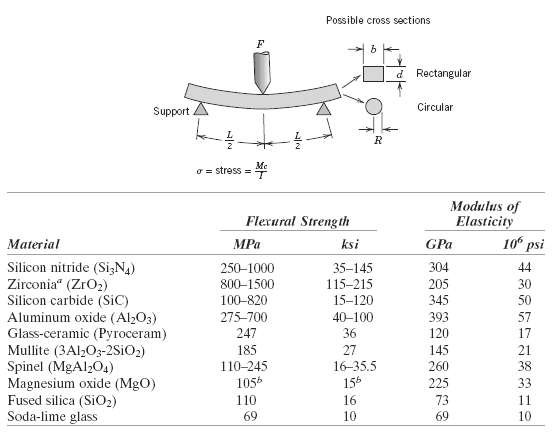
(a) A three-point transverse bending test is conducted on a cylindrical specimen of aluminum oxide having a reported flexural strength of 390MPa (56,600psi). If the specimen radius is 2.5 mm (0.10 in.) and the support point separation distance is 30 mm (1.2 in.), predict whether or not you would
The modulus of elasticity for beryllium oxide (BeO) having 5vol% porosity is 310GPa (45 ( 106psi).(a) Compute the modulus of elasticity for the nonporous material.(b) Compute the modulus of elasticity for 10vol% porosity.
The modulus of elasticity for boron carbide (B4C) having 5vol% porosity is 290GPa (42 ( 106psi).(a) Compute the modulus of elasticity for the nonporous material.(b) At what volume percent porosity will the modulus of elasticity be 235GPa (34 ( 106psi)?
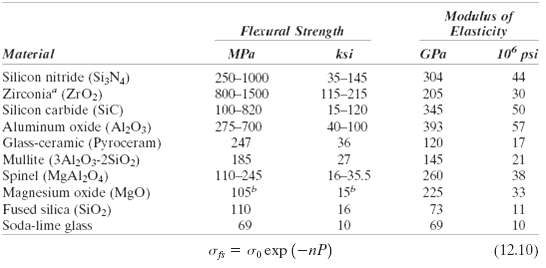
Using the data in Table 12.5, do the following: (a) Determine the flexural strength for nonporous MgO assuming a value of 3.75 for n in Equation 12.10. (b) Compute the volume fraction porosity at which the flexural strength for MgO is 62MPa(9000psi).
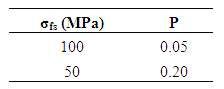
The flexural strength and associated volume fraction porosity for two specimens of the same ceramic material are as follows: (a) Compute the flexural strength for a completely nonporous specimen of this material. (b) Compute the flexural strength for a 0.10 volume fractionporosity.
Gallium arsenide (GaAs) and gallium phosphide (GaP) both have the zinc blende crystal structure and are soluble in one another at all concentrations. Determine the concentration in weight percent of GaP that must be added to GaAs to yield a unit cell edge length of 0.5570 nm. The densities of GaAs
It is necessary to select a ceramic material to be stressed using a three-point loading scheme (Figure). The specimen must have a circular cross section and a radius of 2.5 mm (0.10 in.), and must not experience fracture or a deflection of more than 6.2 ( 10-2 mm (2.4 ( 10-3 in.) at its center when
(a) What is crystallization?(b) Cite two properties that may be improved by crystallization.
For refractory ceramic materials, cite three characteristics that improve with and two characteristics that are adversely affected by increasing porosity.
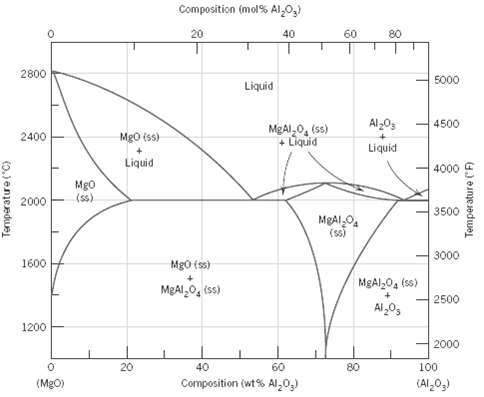
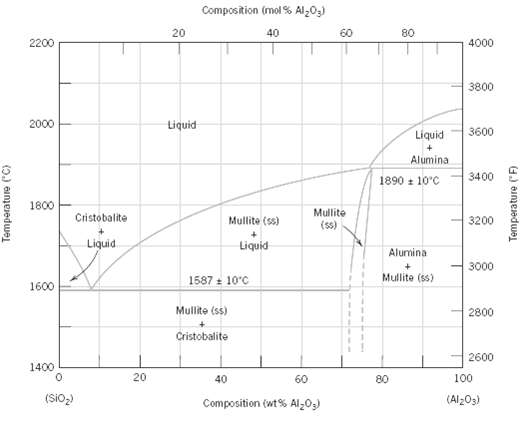
Find the maximum temperature to which the following two magnesia???alumina refractory materials may be heated before a liquid phase will appear. (a) A spinel-bonded alumina material of composition 95 wt% Al2O3-5 wt% MgO. (b) A magnesia-alumina spinel of composition 65 wt% Al2O3-35 wt% MgO. Consult
Upon consideration of the SiO2???Al2O3 phase diagram, Figure, for each pair of the following list of compositions, which would you judge to be the more desirable refractory? Justify your choices. (a) 20 wt% Al2O3-80 wt% SiO2 and 25 wt% Al2O3-75 wt% SiO2 (b) 70 wt% Al2O3-30 wt% SiO2 and 80 wt%
Compute the mass fractions of liquid in the following refractory materials at 1600°C (2910°F):(a) 6 wt% Al2O3-94 wt% SiO2(b) 10 wt% Al2O3-90 wt% SiO2(c) 30 wt% Al2O3-70 wt% SiO2(d) 80 wt% Al2O3-20 wt% SiO2
For the MgO–Al2O3 system, what is the maximum temperature that is possible without the formation of a liquid phase? At what composition or over what range of compositions will this maximum temperature be achieved?
Compare the manner in which the aggregate particles become bonded together in clay-based mixtures during firing and in cements during setting.
Soda and lime are added to a glass batch in the form of soda ash (Na2CO3) and limestone (CaCO3). During heating, these two ingredients decompose to give off carbon dioxide (CO2), the resulting products being soda and lime. Compute the weight of soda ash and limestone that must be added to 100 lbm
What is the distinction between glass transition temperature and melting temperature?
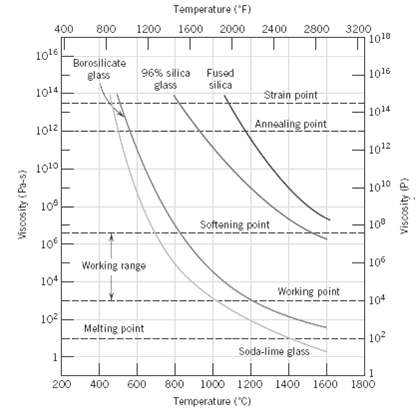
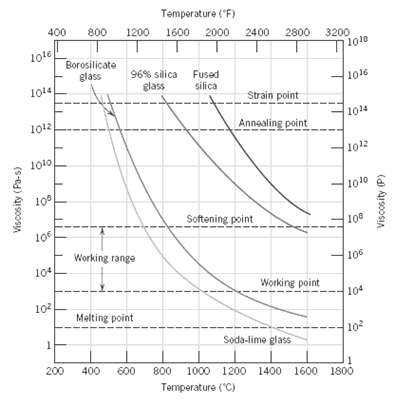
Compare the temperatures at which soda–lime, borosilicate, 96% silica, and fused silica may be annealed.
Compare the softening points for 96% silica, borosilicate, and soda–lime glasses.
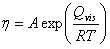
The viscosity ? of a glass varies with temperature according to the relationship where Qvis is the energy of activation for viscous flow, A is a temperature-independent constant, and R and T are, respectively, the gas constant and the absolute temperature. A plot of ln ? versus l/T should be
For many viscous materials, the viscosity ? may be defined in terms of the expression where ? and d?/dt are, respectively, the tensile stress and the strain rate. A cylindrical specimen of a soda-lime glass of diameter 5 mm (0.2 in.) and length 100 mm (4 in.) is subjected to a tensile force of 1
(a) Explain why residual thermal stresses are introduced into a glass piece when it is cooled.(b) Are thermal stresses introduced upon heating? Why or why not?
Borosilicate glasses and fused silica are resistant to thermal shock. Why is this so?
Glass pieces may also be strengthened by chemical tempering. With this procedure, the glass surface is put in a state of compression by exchanging some of the cations near the surface with other cations having a larger diameter. Suggest one type of cation that, by replacing Na+, will induce
Cite the two desirable characteristics of clay minerals relative to fabrication processes.
From a molecular perspective, briefly explain the mechanism by which clay minerals become hydroplastic when water is added.
(a) What are the three main components of a whiteware ceramic such as porcelain?(b) What role does each component play in the forming and firing procedures?
(a) Why is it so important to control the rate of drying of a ceramic body that has been hydro plastically formed or slip cast?(b) Cite three factors that influence the rate of drying, and explain how each affects the rate.
Cite one reason why drying shrinkage is greater for slip cast or hydroplastic products that have smaller clay particles.
(a) Name three factors that influence the degree to which vitrification occurs in clay-based ceramic wares.(b) Explain how density, firing distortion, strength, corrosion resistance, and thermal conductivity are affected by the extent of vitrification.
Some ceramic materials are fabricated by hot-isostatic pressing. Cite some of the limitations and difficulties associated with this technique.
Some of our modern kitchen cookware is made of ceramic materials.(a) List at least three important characteristics required of a material to be used for this application.(b) Make a comparison of three ceramic materials as to their relative properties and, in addition, to cost.(c) On the basis of
On the basis of the structures presented in this chapter, sketch repeat unit structures for the following polymers:(a) Polychlorotrifluoroethylene, And(b) Poly (vinyl alcohol).
Compute repeat unit molecular weights for the following:(a) poly(vinyl chloride),(b) poly(ethylene terephthalate),(c) polycarbonate, and(d) polydimethylsiloxane.
The number-average molecular weight of a polypropylene is 1,000,000 g/mol. Compute the degree of polymerization.
(a) Compute the repeat unit molecular weight of polystyrene.(b) Compute the number-average molecular weight for a polystyrene for which the degree of polymerization is 25,000.
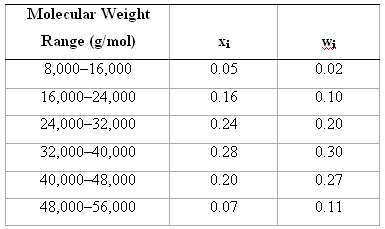
Below, molecular weight data for a polypropylene material are tabulated. Compute (a) The number-average molecular weight, (b) The weight-average molecular weight, and (c) The degree of polymerization.
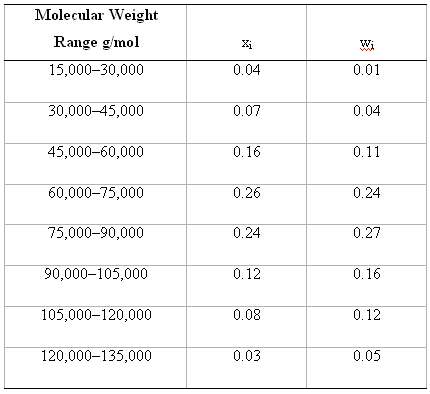
Molecular weight data for some polymer are tabulated here. Compute (a) The number-average molecular weight, and (b) The weight-average molecular weight. (c) If it is known that this material's degree of polymerization is 710, which one of the polymers listed in Table 14.3 is this polymer? Why?
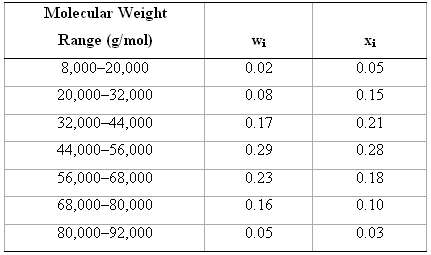
Is it possible to have a poly (methyl methacrylate) homopolymer with the following molecular weight data and a of polymerization of 527? Why or why not?
High-density polyethylene may be chlorinated by inducing the random substitution of chlorine atoms for hydrogen.(a) Determine the concentration of Cl (in wt%) that must be added if this substitution occurs for 5% of all the original hydrogen atoms.(b) In what ways does this chlorinated polyethylene
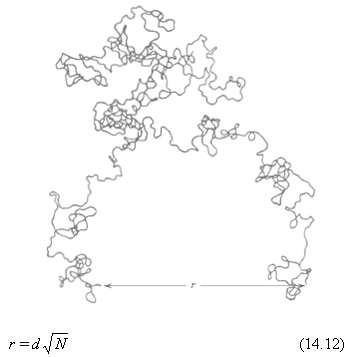
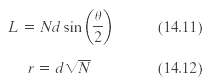
For a linear polymer molecule, the total chain length L depends on the bond length between chain atoms d, the total number of bonds in the molecule N, and the angle between adjacent backbone chain atoms ?, as follows. Furthermore, the average end-to-end distance for a series of polymer molecules
Using the definitions for total chain molecule length, L (Equation 14.11) and average chain end-to-end distance r (Equation 14.12), for a linear polyethylene determine: (a) The number-average molecular weight for L = 2500 nm; (b) The number-average molecular weight for r = 20nm.
Sketch portions of a linear polystyrene molecule that are(a) Syndiotactic,(b) Atactic, and(c) Isotactic. Use two-dimensional schematics per footnote 8 of this chapter.
Sketch cis and trans structures for(a) Butadiene, and(b) Chloroprene. Use two-dimensional schematics per footnote 11 of this chapter.
Make comparisons of thermoplastic and thermosetting polymers(a) On the basis of mechanical characteristics upon heating, and(b) According to possible molecular structures.
(a) Is it possible to grind up and reuse phenol-formaldehyde? Why or why not?(b) Is it possible to grind up and reuse polypropylene? Why or why not?
Sketch the repeat structure for each of the following alternating copolymers:(a) Poly (butadiene-chloroprene),(b) Poly (styrene-methyl methacrylate), (c) Poly(acrylonitrile-vinyl chloride).
The number-average molecular weight of a poly (styrene-butadiene) alternating copolymer is 1,350,000 g/mol; determine the average number of styrene and butadiene repeat units per molecule.
Calculate the number-average molecular weight of a random nitrile rubber [poly(acrylonitrile-butadiene) copolymer] in which the fraction of butadiene repeat units is 0.30; assume that this concentration corresponds to a degree of polymerization of 2000.
An alternating copolymer is known to have a number-average molecular weight of 250,000 g/mol and a degree of polymerization of 3420. If one of the repeat units is styrene, which of ethylene, propylene, tetrafluoroethylene, and vinyl chloride is the other repeat unit? Why?
(a) Determine the ratio of butadiene to styrene repeat units in a copolymer having a number-average molecular weight of 350,000 g/mol and degree of polymerization of 4425.(b) Which type(s) of copolymer(s) will this copolymer be, considering the following possibilities: random, alternating, graft,
Crosslinked copolymers consisting of 60 wt% ethylene and 40 wt% propylene may have elastic properties similar to those for natural rubber. For a copolymer of this composition, determine the fraction of both repeat unit types.
A random poly(isobutylene-isoprene) copolymer has a number-average molecular weight of 200,000 g/mol and a degree of polymerization of 3000. Compute the fraction of isobutylene and isoprene repeat units in this copolymer.
Explain briefly why the tendency of a polymer to crystallize decreases with increasing molecular weight.
For each of the following pairs of polymers, do the following: (1) state whether or not it is possible to determine whether one polymer is more likely to crystallize than the other; (2) if it is possible, note which is the more likely and then cite reason(s) for your choice; and (3) if it is not
For each of the following pairs of polymers, do the following: (1) state whether or not it is possible to determine whether one polymer is more likely to crystallize than the other; (2) if it is possible, note which is the more likely and then cite reason(s) for your choice; and (3) if it is not
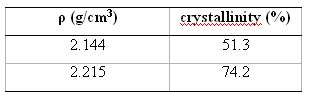
The density and associated percent crystallinity for two polytetrafluoroethylene materials are as follows: (a) Compute the densities of totally crystalline and totally amorphous polytetrafluoroethylene. (b) Determine the percent crystallinity of a specimen having a density of 2.26g/cm3.
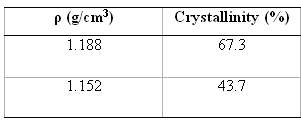
The density and associated percent crystallinity for two nylon 6,6 materials are as follows: (a) Compute the densities of totally crystalline and totally amorphous nylon 6,6. (b) Determine the density of a specimen having 55.4%crystallinity.
Consider the diffusion of water vapor through a polypropylene (PP) sheet 2 mm thick. The pressures of H2O at the two faces are 1 kPa and 10 kPa, which are maintained constant. Assuming conditions of steady state, what is the diffusion flux [in [(cm3 STP)/cm2-s] at 298 K?
Argon diffuses through a high density polyethylene (HDPE) sheet 40 mm thick at a rate of 4.0 × 10⁻⁷ (cm3 STP)/cm2-s at 325 K. The pressures of argon at the two faces are 5000 kPa and 1500 kPa, which are maintained constant. Assuming conditions of steady state, what is the permeability
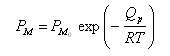
The permeability coefficient of a type of small gas molecule in a polymer is dependent on absolute temperature according to the following equation: where and Qp are constants for a given gas-polymer pair. Consider the diffusion of hydrogen through a poly (dimethyl siloxane) (PDMSO) sheet 20 mm
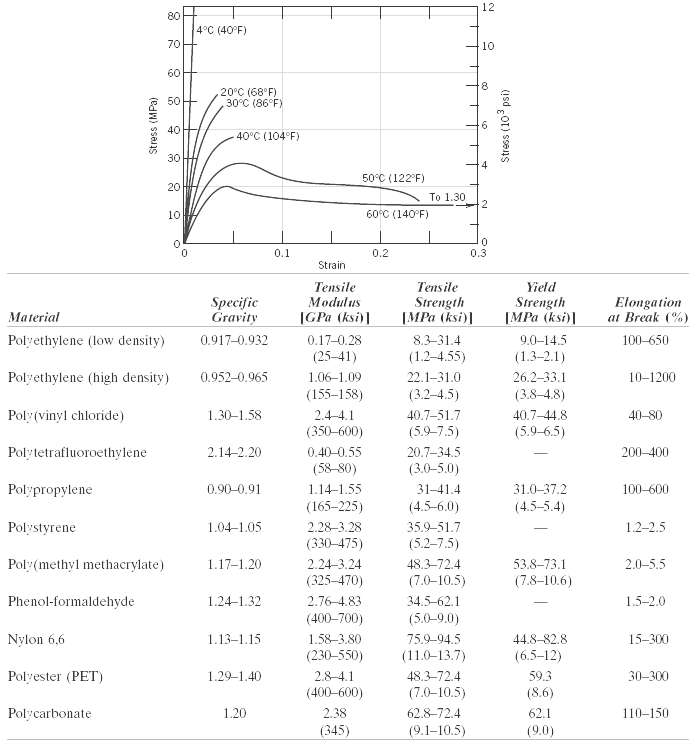
From the stress???strain data for poly (methyl methacrylate) shown in Figure, determine the modulus of elasticity and tensile strength at room temperature [20°C (68°F)], and compare these values with those given in Table15.1.
Compute the elastic moduli for the following polymers, whose stress-strain behaviors may be observed in the "Tensile Tests" module of Virtual Materials Science and Engineering (VMSE): (a) High-density polyethylene, (b) Nylon, and (c) Phenol-formaldehyde (bakelite). How do these values compare with
For the nylon polymer, whose stress strain behavior may be observed in the "Tensile Tests" module of Virtual Materials Science and Engineering (VMSE), determine the following: (a) The yield strength, and (b) The approximate ductility, in percent elongation. How do these values compare with those
For the phenol-formaldehyde (Bakelite) polymer, whose stress strain behavior may be observed in the "Tensile Tests" module of Virtual Materials Science and Engineering (VMSE), determine the following: (a) The tensile strength, and (b) The approximate ductility, in percent elongation. How do these
For some viscoelastic polymers that are subjected to stress relaxation tests, the stress decays with time according to where ?(t) and ?(0) represent the time-dependent and initial (i.e., time = 0) stresses, respectively, and t and ? denote elapsed time and the relaxation time; ? is a
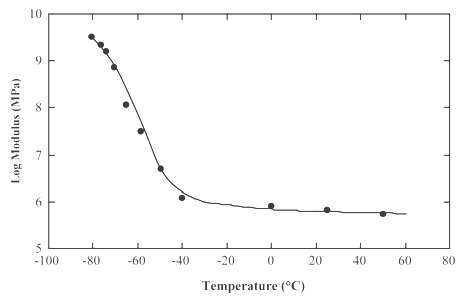
In Figure, the logarithm of Er(t) versus the logarithm of time is plotted for polyisobutylene at a variety of temperatures. Make a plot of Er(10) versus temperature and then estimate its Tg.
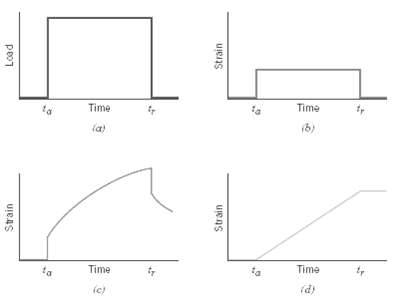
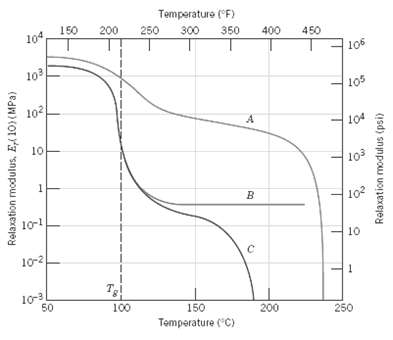
On the basis of the curves in Figure, sketch schematic strain?time plots for the following polystyrene materials at the specified temperatures: (a)?Amorphous at 120?C (b)?Crosslinked at 150?C (c)?Crystalline at 230?C (d)?Crosslinked at 50?C
(a) Contrast the manner in which stress relaxation and viscoelastic creep tests are conducted.(b) For each of these tests, cite the experimental parameter of interest and how it is determined.
Make two schematic plots of the logarithm of relaxation modulus versus temperature for an amorphous polymer (curve C in Figure). (a) On one of these plots demonstrate how the behavior changes with increasing molecular weight. (b) On the other plot, indicate the change in behavior with increasing
For thermoplastic polymers, cite five factors that favor brittle fracture.
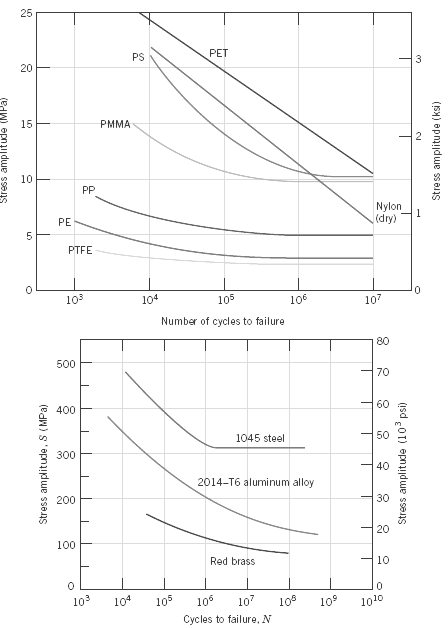
(a) Compare the fatigue limits for polystyrene (Figure) and the cast iron for which fatigue data are given in Problem 8.20. (b) Compare the fatigue strengths at 106 cycles for poly(ethylene terephthalate) (PET, Figure) and red brass(Figure).
Briefly explain how each of the following influences the tensile modulus of a semicrystalline polymer and why:(a) Molecular weight(b) Degree of crystallinity(c) Deformation by drawing(d) Annealing of an undeformed material(e) Annealing of a drawn material
Briefly explain how each of the following influences the tensile or yield strength of a semicrystalline polymer and why:(a) Molecular weight(b) Degree of crystallinity(c) Deformation by drawing(d) Annealing of an undeformed material
Normal butane and isobutane have boiling temperatures of –0.5 and –12.3°C (31.1 and 9.9°F), respectively. Briefly explain this behavior on the basis of their molecular structures, as presented in Section 14.2.
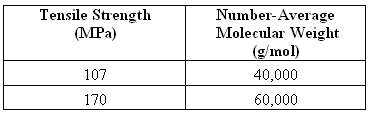
The tensile strength and number-average molecular weight for two poly(methyl methacrylate) materials are as follows: Estimate the tensile strength at a number-average molecular weight of 30,000g/mol.
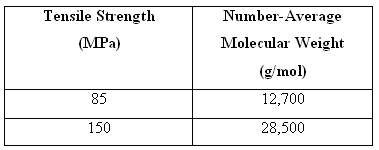
The tensile strength and number-average molecular weight for two polyethylene materials are as follows: Estimate the number-average molecular weight that is required to give a tensile strength of195MPa.
For each of the following pairs of polymers, do the following: (1) state whether or not it is possible to decide whether one polymer has a higher tensile modulus than the other; (2) if this is possible, note which has the higher tensile modulus and then cite the reason(s) for your choice; and (3)
For each of the following pairs of polymers, do the following: (1) state whether or not it is possible to decide whether one polymer has a higher tensile strength than the other; (2) if this is possible, note which has the higher tensile strength and then cite the reason(s) for your choice; and (3)
Would you expect the tensile strength of polychlorotrifluoroethylene to be greater than, the same as, or less than that of a polytetrafluoroethylene specimen having the same molecular weight and degree of crystallinity? Why?
For each of the following pairs of polymers, plot and label schematic stress–strain curves on the same graph [i.e., make separate plots for parts (a), (b), and (c)].(a) Isotactic and linear polypropylene having a weight-average molecular weight of 120,000 g/mol; atactic and linear polypropylene
List the two molecular characteristics that are essential for elastomers.
Which of the following would you expect to be elastomers and which thermosetting polymers at room temperature? Justify each choice.(a) Epoxy having a network structure(b) Lightly crosslinked poly(styrene-butadiene) random copolymer that has a glass-transition temperature of -50(C(c) Lightly
Ten kilogram of polybutadiene is vulcanized with 4.8 kg sulfur. What fraction of the possible crosslink sites is bonded to sulfur crosslinks, assuming that, on the average, 4.5 sulfur atoms participate in each crosslink?
Compute the weight percent sulfur that must be added to completely crosslink an alternating chloroprene-acrylonitrile copolymer, assuming that five sulfur atoms participate in each crosslink.
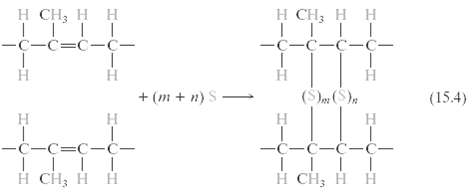
The vulcanization of polyisoprene is accomplished with sulfur atoms according to Equation 15.4. If 57 wt% sulfur is combined with polyisoprene, how many crosslinks will be associated with each isoprene repeat unit if it is assumed that, on the average, six sulfur atoms participate in eachcrosslink?
For the vulcanization of polyisoprene, compute the weight percent of sulfur that must be added to ensure that 8% of possible sites will be crosslinked; assume that, on the average, three sulfur atoms are associated with each crosslink.
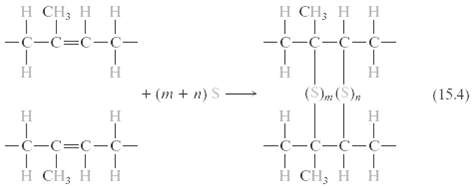
Demonstrate, in a manner similar to Equation 15.4, how vulcanization may occur in a butadienerubber.
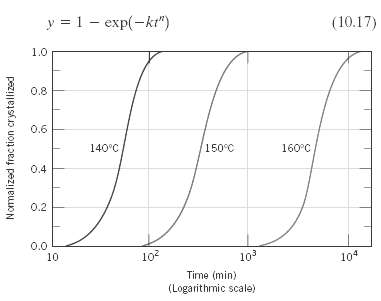
Determine values for the constants n and k (Equation 10.17) for the crystallization of polypropylene (Figure) at 160?C.
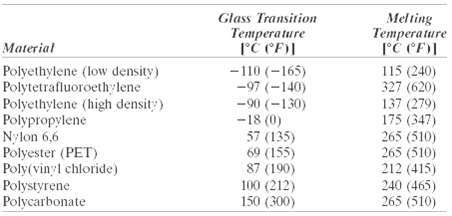
Name the following polymer(s) that would be suitable for the fabrication of cups to contain hot coffee: polyethylene, polypropylene, poly (vinyl chloride), PET polyester, and polycarbonate. Why?
Of those polymers listed in Table 15.2, which polymer(s) would be best suited for use as ice cube trays? Why?
For each of the following pairs of polymers, plot and label schematic specific volume versus temperature curves on the same graph [i.e., make separate plots for parts (a), (b), and (c)].(a) Spherulitic polypropylene, of 25% crystallinity, and having a weight-average molecular weight of 75,000
For each of the following pairs of polymers, do the following: (1) state whether or not it is possible to determine whether one polymer has a higher melting temperature than the other; (2) if it is possible, note which has the higher melting temperature and then cite reason(s) for your choice; and
Make a schematic plot showing how the modulus of elasticity of an amorphous polymer depends on the glass transition temperature. Assume that molecular weight is held constant.
Briefly explain the difference in molecular chemistry between silicone polymers and other polymeric materials.
List two important characteristics for polymers that are to be used in fiber applications.
Cite five important characteristics for polymers that are to be used in thin-film applications.
Cite the primary differences between addition and condensation polymerization techniques.
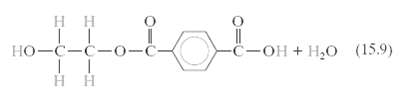
(a) How much ethylene glycol must be added to 47.3 kg of terephthalic acid to produce a linear chain structure of poly(ethylene terephthalate) according to Equation 15.9? (b) What is the mass of the resultingpolymer?
Nylon 6, 6 may be formed by means of a condensation polymerization reaction in which hexamethylene diamine [NH2—(CH2)6—NH2] and adipic acid react with one another with the formation of water as a byproduct. What masses of hexamethylene diamine and adipic acid are necessary to yield 37.5 kg of
What is the distinction between dye and pigment colorants?
Showing 500 - 600
of 2249
1
2
3
4
5
6
7
8
9
10
11
12
13
14
15
Last
Step by Step Answers

 Get 50% OFF
Claim Now
Get 50% OFF
Claim Now