New Semester
Started
Get
50% OFF
Study Help!
--h --m --s
Claim Now
Question Answers
Textbooks
Find textbooks, questions and answers
Oops, something went wrong!
Change your search query and then try again
S
Books
FREE
Study Help
Expert Questions
Accounting
General Management
Mathematics
Finance
Organizational Behaviour
Law
Physics
Operating System
Management Leadership
Sociology
Programming
Marketing
Database
Computer Network
Economics
Textbooks Solutions
Accounting
Managerial Accounting
Management Leadership
Cost Accounting
Statistics
Business Law
Corporate Finance
Finance
Economics
Auditing
Tutors
Online Tutors
Find a Tutor
Hire a Tutor
Become a Tutor
AI Tutor
AI Study Planner
NEW
Sell Books
Search
Search
Sign In
Register
study help
mathematics
numerical analysis
Numerical Methods For Engineers 5th Edition Steven C. Chapra, Raymond P. Canale - Solutions
Develop the user-friendly program in either a high-level or macro language of your choice to obtain a solution for a tridiagonal system with the Thomas algorithm (Figure). Test your program by duplicating the results of Example 11.1.
Develop a user-friendly program in either a high-level or macro language of your choice for Cholesky decomposition based on (Figure). Test your program by duplicating the results of Example 11.2.
Develop a user-friendly program in either a high-level or macro language of your choice for the Gauss-Seidel method based on (Figure). Test your program by duplicating the results of Example 11.3.
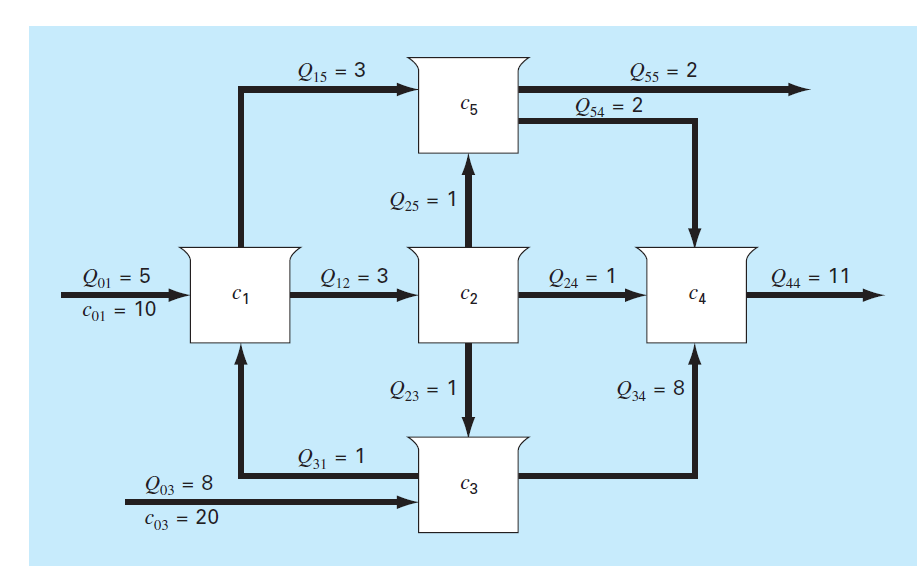
Perform the same computation as in Sec. 12.1, but change c01 to 40 and c03 to 10. Also change the following flows: Q01 = 6, Q12 = 4, Q24 = 2, and Q44 = 12.
If the input to reactor 3 in Sec. 12.1 is decreased 25 percent, use the matrix inverse to compute the percent change in the concentration of reactors 1 and 4?
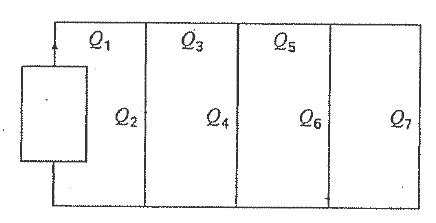
Because the system shown in figure is at steady state, what can be said regarding the four flows: Q01, Q03, Q44, and Q55?
Recompute the concentrations for the five reactors shown in figure, if the flows are change to:Q01 = 5Q31 = 3Q25 = 2Q23 = 2Q15 = 4Q55 = 3Q54 = 3Q34 = 7Q12 = 4Q03 = 8Q24 = 0 Q44 = 10
Solve the same system as specified in Prob. 12.4, but set Q12 = Q54 = 0 and Q15 = Q34 = 3. Assume that the inflows (Q01, Q03) and outflows (Q44, Q55) are the same. Use conservation of flows to recompute the values for the other flows.
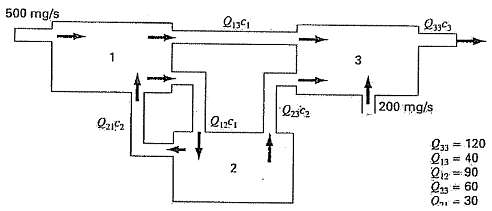
Figure shows three reactors linked by pipes. As indicated, the rate of transfer of chemicals through each pipe is equal to a flows rate (Q, with units of cubic meters per second) multiplied by the concentration of the reactor from which the flow originates (c, with units of milligrams per cubic
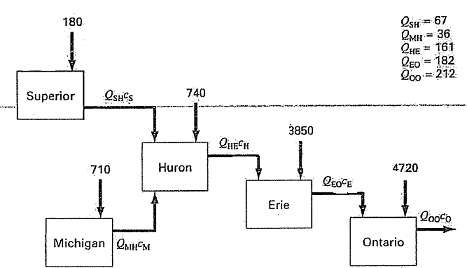
Employing the same basic approach as in Sec. 12.1, determine the concentration of chloride in each of the Great Lakes using the information shows inFigure.
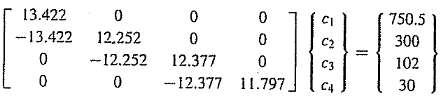
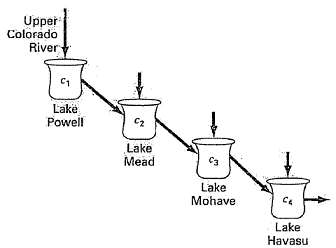
The Lower Colorado River consists of a series of four reservoirs as shown in Figure. Mass balances can be written for each reservoir and the following set of simultaneous linear algebraic equation results: Where the right-hand-side vector consists of the loadings of chloride to each of the four
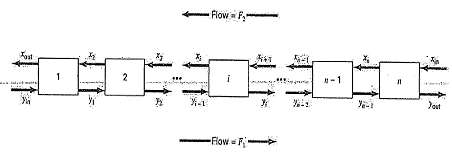
A stage extraction process is depicted in Figure. In such systems, a stream containing a weight fraction Yin of a chemical enters from the left at a mass flow rate of F1. Simultaneously, a solvent carrying a weight fraction Xin of the same chemical enters from the right at a flow rate of F2. Thus,
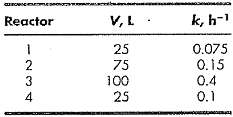
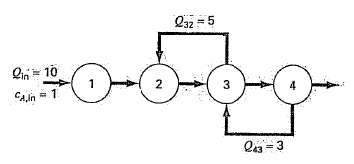
An irreversible, first-order reaction (see Sec. 28.1) takes place in four well-mixed reactors (figure), Thus, the rate at which A is transformed to B can be represented asRαb = k VcThe reactors have different volumes, and because they are operated at different temperatures, each has a different
A peristaltic pump delivers a unit flow (Q1) of a highly viscous fluid. The network is depicted in Figure. Every pipe section has the same length and diameter. The mass and mechanical energy balance can be simplified to obtain the flows in every pipe. Solve the following system of equations to
Figure depicts a chemical exchange process consisting of a series of reactors in which a gas following from left to right is passed over a liquid flowing from right to left. The transfer of a chemical from the gas into the liquid occurs at a rate that is proportional to the difference between the
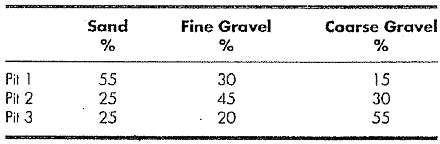
A civil engineer involved in construction requires 4800, 5800, and 5700 m3 of sand, fine gravel, and coarse gravel, respectively, for a building project. There are three pits from which these materials can be obtained. The composition of these pits is How many cubic meters must be hauled from
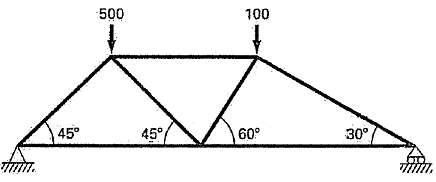
Perform the same computation as in Sec. 12, but for the truss depicted inFigure.
Perform the same computation as in Sec. 12.2, but for the truss depicted inFigure.
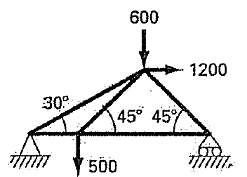
Calculate the forces and reactions for the truss in Figure. If a downward force of 2500 kg and a horizontal force to the right 2000 kg are applied at node 1.
In the example for Figure, where a 1000-lb downward force is applied at node 1, the external reactions V2 and V3 were calculated. But if the lengths of the truss members had been given, we could have calculated V2 and V3 by utilizing the fact that V2 + V3 must equal 1000 and by summing moments
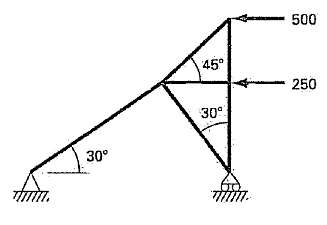
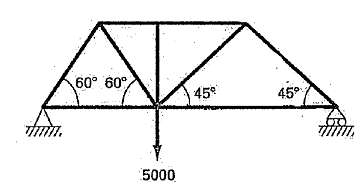
Employing the same methods as used to analyze Figure. Determine the forces and reactions for the truss shown inFigure.
Solve for the forces and reaction for the truss in Figure. Determine the matrix inverse for the system. Does the vertical-member force in the middle member seem reasonable?Why?
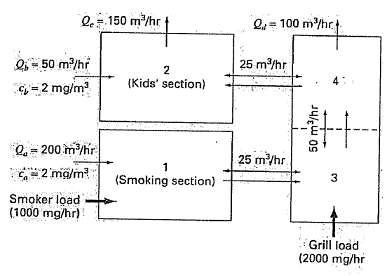
As the name implies, indoor air pollution deals with air contamination in enclosed spaces such as homes, offices, work areas, etc. Suppose that you are designing a ventilation system for a restaurant as shown in figure. The restaurant serving area consists of two square rooms and one elongated
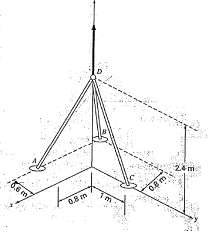
An upward force of 20 kN is applied at the top of a tripod as depicted in Figure. Determine the forces in the legs of the tripod.
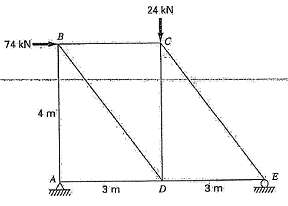
A truss is loaded as shown in Figure. Using the following set of equations, solve for the 10 unknowns: AB, BC, AD, BD, CD, DE, CE, Ax, Ay and Ey. Ax + AD = 0? ? ? ? ? ? ? ? ? ? ? ? ? ? ? ? ? ? ? ??24 ? CD ? (4/5) CE = 0 Ay + AB = 0 ? ? ? ? ? ? ? ? ? ? ? ? ? ? ? ? ? ? ? ??AD + DE? (3/5) BD = 0 74
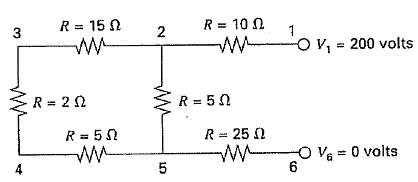
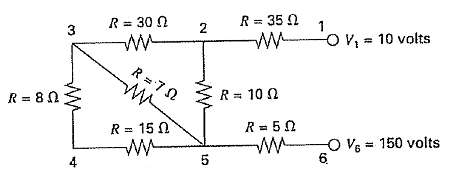
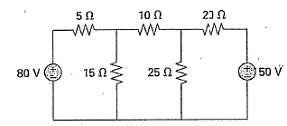
Perform the same computation as in Sec. 12.3, but for the circuit depicted inFigure.
Perform the same computation as in Sec. 12.3, but for the circuit depicted inFigure.
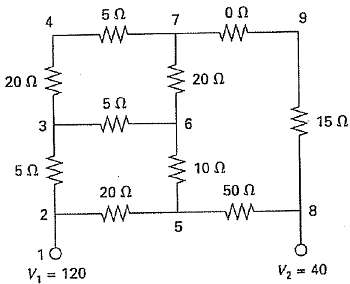
Solve the circuit in figure, for the currents in each wire. Use Gauss elimination with pivoting.
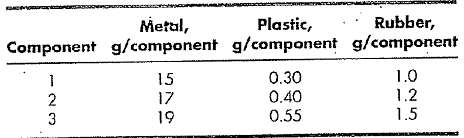
An electrical engineer supervises the production of three types of electrical components. Three kinds of material-metal, plastic and rubber-are required for production. The amounts needed to produce each component are If totals of 3.89, 0.095, and 0.282 kg of metal, plastic, and rubber,
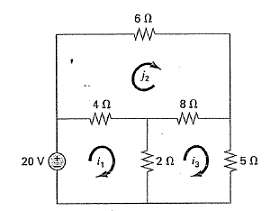
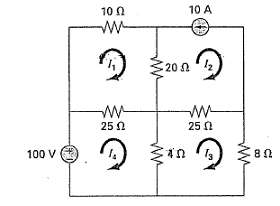
Determine the currents for the circuit inFigure.
Determine the currents for the circuit inFigure.
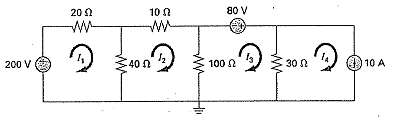
The following system of equations was generated by applying the mesh current law to the circuit in Figure. 55l1 ? 25l4 = ? 200 ?37l3 ? 4l4 = ? 250 ?25l1 4l3+ 29l4 = ? 100 Solve for l1, l3, and l4.
The following system of equations was generated by applying the mesh current law to the circuit in Figure. 60l1 ? 40l2 = 200 ?40l1 + 150l2 ? 100l3 = 0 ? 100l2 + 130l3 = 230 Solve for l1, l2, and l3. x
Perform the same computation as in Sec. 12.4, but add a third spring between masses 1 and 2 triple k for all springs.
Perform the same computation as in Sec. 12.4, but change the masses from 2, 3, and 2.5 kg, to 10, 3.5, and 2 kg, respectively.
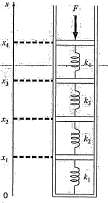
Idealized spring-mass systems have numerous applications throughout engineering. Figure shows an arrangement of four springs in series being depressed with a force of 1500 kg. At equilibrium, force-balance equations can be developed defining the interrelationships between the springs, k2(x2 ? x1) =
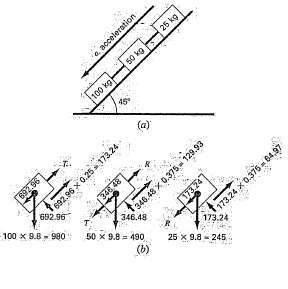
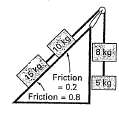
Three blocks are connected by a weightless cord and rest on an inclined plane (Figure). Employing a procedure similar to the one used in the analysis of the falling parachutists in Example 9.11 yields the following set of simultaneous equations (free-body) diagrams are shown in Figure: 100? = T? ?
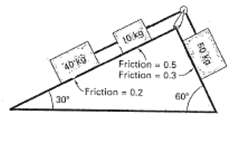
Perform a computation similar to that called for in Prob. 12.34, but for the system shown inFigure.
Perform the computation as in Prob. 12.34, but for the system depicted in figure (angle are45o)
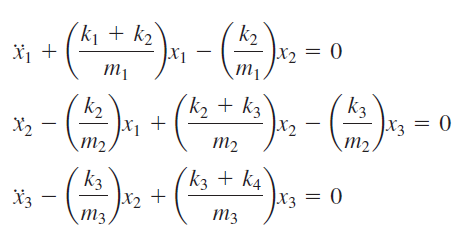
Consider the three mass-four spring system in Figure. Determining the equations of motion from ∑Fx = mα, for each mass using its free-body diagram results in the following differential equations:Where k1 = k4 = 10 N/m, k2 = k3 = 30 N/m, and m1 = m2 = m3 = m4 2 kg. Write the three equations
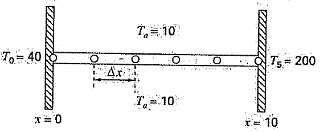
Linear algebraic equations can arise in the solution of differential equations. For example, the following differential equation derives from a heat balance for a long, thin rod (Figure):? d2T/dx2 + h? (T? ? T) = 0 Where T = temperature (oC), x = distance along the rod (m), h? = a heat transfer
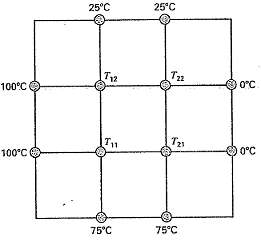
The steady-state distribution of temperature on a heated plate can be modeled by the Laplace equation, 0 = ?2T/?x2 + ?2T/?y2 If the plate is represented by a series of nodes (Figure), centered finite-divided differences can be substituted for the second derivatives, which results in a system of
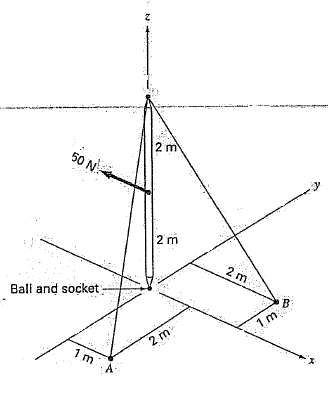
A rod on a ball and socket joint is attached to cables A and B as in Figure. (a) If a 50-N force is exerted on the massless rod at G, what is the tensile force at cables A and B? (b) Solve for the reactant forces at the base of the rod. Call the base pointP.
Given the formulaƒ(x) = –x2 + 8x – 12(a) Determine the maximum and the corresponding value of x for this function analytically (i.e., using differentiation).(b) Verify that Eq. (13.7) yields the same results based on initial guesses of x0 = 0, x1 = 2, and x2 = 6.
Givenƒ(x) = -1.5x6 – 2x4 + 12x(a) Plot the function.(b) Use analytical methods to prove that the function is concave for all values of x.(c) Differentiate the function and then use a root-location method to solve for the maximum ƒ(x) and the corresponding value of x.
Solve for the value of x that maximize ƒ(x) in Prob. 13.2 using the golden-section search. Employ initial guesses of x1 = 0 and xu = 2 and perform three iterations.
Repeat Prob. 13.3, except use quadratic interpolation. Employ initial guesses of x0 = 0, x1 = 1, and x2 = 2 and perform three iterations.
Repeat Prob. 13.3, but use Newton’s method. Employ an initial guesses of x0 = 2, and perform three iterations.
Discuss the advantages and disadvantages of golden-section search, quadratic interpolation, and Newton’s method for locating an optimum value in one dimension.
Employ the following methods to find the maximum ofƒ(x) = 4x – 1.8x2 + 1.2x3 – 0.3x4(a) Golden-section search (x1 = –2, xu = 4, εs = 1%).(b) Quadratic interpolation (x0 = 1.75, x1 = 2, x2 = 2.5, iterations = 4).(c) Newton’s method (x0 = 3, εs = 1%).
Consider the following function:ƒ(x) = –x4 – 2x3 – 8x2 – 5xUse analytical and graphical methods to show the function has a maximum for some value of x in the range –2≤ x ≤ 1.
Employ the following methods to find the maximum of the function from Prob.13.8:(a) Golden-section search (x1 = –2, xu = 1, εs = 1%).(b) Quadratic interpolation (x0 = –2, x1 = –1, x2 = 1, iterations = 4).(c) Newton’s method (x0 = –1, εs = 1%).
Consider the following function:ƒ(x) = 2x + 3/xPerform 10 iterations of quadratic interpolation to locate the minimum. Comment on the convergence of your results. (x0 = 0.1, x1 = 0.5, x2 = 5)
Consider the following function:ƒ(x) = 3 + 6x + 5x2 + 3x3 4x4Locate the minimum by finding the root of the derivative of this function. Use bisection with initial guesses of xl = -2 and xu = 1.
Determine the minimum of the function from Prob. 13.11 with the following methods:(a) Newton’s method (x0 = –1, εx = 1%).(b) Newton’s method, but using a finite difference approximation for the derivative estimates.ƒ’(x) = ƒ(xi + δxi) – ƒ(xi – δxi)/2δxiƒ’’(x) = ƒ(xi + δxi)
Develop a program using a programming or macro language to implement the golden-section search algorithm. Design the program so that it is expressly designed to locate a maximum. The subroutine should have the following features:Iterate until the relative error falls below a stopping criterion or
Develop a program as described in Prob. 13.13, but make it perform minimization or maximization depending on the user’s preference.
Develop a program using a programming or macro language to implement the quadratic interpolation algorithm. Design the program so that it is expressly designed to locate a maximum. The subroutine should have the following features:Base it on two initial guesses, and have the program generate the
Develop a program using a programming or macro language to implement Newton’s method. The subroutine should have the following features:Iterate until the relative error falls below a stopping criterion or exceeds a maximum number of iteration.Returns both the optimal x and ƒ(x).Test your program
Pressure measurements are taken at certain points behind an airfoil over time. The data best fits the curve y = 6 cos x – 1.5 sin x from x = 0 to 6s. Use four iterations of the golden-search method to find the minimum pressure. Set xl = 2 and xu = 4.
The trajectory of a ball can be computed with Where y = the height (m), ?0 = the initial angle (radians), ?0 = the initial velocity (m/s), g = the gravitational constant = 9.81 m/s2, and y0 = the initial height (m). Use the golden-section search to determine the maximum height given y0 = 1 m, ?0
The deflection of a uniform beem subject to a linearly increasing distributed load can be computed asy = w0/120EIL (– x5 + 2L2 x3 – L4x)Given that L = 600 cm, E = 50,000 kN/cm2, I = 30,000 cm4, and w0 = 2.5 kN/cm, determine the point of maximum deflection(a) Graphically,(b) Using the
An object with a mass of 100 kg is projected upward from the surface of the earth at a velocity of 50 m/s. If the object is subject to linear drag (c = 15 kg/s), use the golden-section search to determine the maximum height the object attains.
The normal distribution is a bell-shaped curve defined byY = e–x2Use the golden-section search to determine the location of the inflection point of this curve for positive x.
Repeat Example 14.2 for the following function at the point (0.8, 1.2).ƒ(x , y) = 2xy + 1.5y – 1.25x2 – 2y2 + 5
Find the directional derivative ofƒ(x , y) = x2 + 2y2at x = 2 and y = 2 in the direction of h = 2i + 3j.
Find the gradient vector and Hessian matrix for each of the following function:(a) ƒ(x , y) = 3xy2 + 2exy(b) ƒ(x , y, z) = 2x2 + y2 +z2(c) ƒ(x, y) = In(x2 + 3xy + 2y2)
Givenƒ(x, y) = 2.25xy + 1.75y – 1.5x2 – 2y2Construct and solve a system of linear algebraic equations that maximizes ƒ(x). Note that this is done by setting the partial derivatives of ƒ with respect to both x and y to zero.
(a) Start with an initial guess of x = 1 and y = 1 and apply two applications of the steepest ascent method to ƒ(x, y) from Prob. 14.4.(b) Construct a plot from the results of (a) showing the path of the search.
Find the minimum value ofƒ(x, y) = (x – 3)2 + (y – 2)2Starting at x = 1 and y = 1. Using the steepest descent method with a stopping criterion of εs = 1%. Explain your results.
Perform one iteration of the steepest ascent method to locate the maximum ofƒ(x, y) = 4x + 2y + x2 – 2x4 + 2xy -3y2Using initial guesses x = 0 and y = 0. Employ bisection to find the optimal step size in the gradient search direction.
Perform one iteration of the optimal gradient steepest descent method to locate the minimum ofƒ(x, y) = – 8x + x2 + 12y + 4y2 –2xyUsing initial guesses x = 0 and y = 0.
Develop a program using a programming or macro language to implement the random search method. Design the subprogram so that it is expressly designed to locate a maximum. Test the program with ƒ(x, y) from Prob. 14.7. Use a range of – 2 to 2 for both x and y.
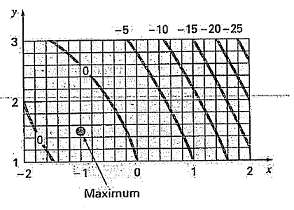
The grid search is another brute force approach to optimization. The two-dimensional version is depicted in Figure. The x and y dimensions are divided into increments to create a grid. The function is then evaluated at each node of the grid. The denser the grid, the more likely it would be to
Develop a one-dimensional equation in the pressure gradient direction at the point (4, 2). The pressure function isƒ(x, y) = 6x2y – 9y2 – 8x2
A temperature function isƒ(x, y) = 2x3y2 – 7xy + x2 + 3yDevelop a one-dimensional function in the temperature gradient direction at the point (1, 1).
A company makes two types of products, A and B. These products are produced during a 40-hour work week and then shipped out at the end of the week. They require 20 and 5 kg of raw material per kg of product, respectively, and the company has access to 9500 kg of raw material per week. Only one
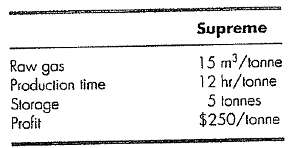
Suppose that for Example 15.1, the gas-processing plant decides to produce a third grade of product with the following characteristics: In addition, suppose that a new source of raw gas has been discovered so that the total available is doubled to 154 m3/week.(a) Set up the linear programming
Consider the linear programming problem:Maximize ƒ(x, y) = 1.75x + 1.25ySubject to1.2x + 2.25y ≤ 14x + 1.1y ≤ 82.5x + y ≤ 9x ≥ 0y ≥ 0Obtain solution:(a) Graphically.(b) Using the simplex method.(c) Using an appropriate package or software library (for example, Excel, MATLAB, IMSL).
Consider the linear programming problem:Maximize ƒ(x, y) = 6x + 8ySubject to5x + 2y ≤ 406x + 6y ≤ 602x + 4y ≤ 32x ≥ 0y ≥ 0Obtain the solution:(a) Graphically.(b) Using the simplex method.(c) Using an appropriate package or software library (for example, Excel, MATLAB, IMSL).
Use a package or software library (for example, Excel, MATLAB, IMSL) to solve the following constrained nonlinear optimization problem:Maximize ƒ(x, y) = 1.2x + 2y - y3Subject to2x + y ≤ 2x ≥ 0y ≥ 0
Use a package or software library (for example, Excel, MATLAB, IMSL) to solve the following constrained nonlinear optimization problem:Maximize ƒ(x, y) = 15x + 15ySubject tox2 + y2 ≤ 1x + 2y ≤ 2.1x ≥ 0y ≥ 0
Consider the following constrained nonlinear optimization problem:Maximize ƒ(x, y) = (x - 3)2 + (y - 3)2Subject tox + 2y = 4(a) Use a graphical approach to estimate the solution.(b) Use a package or software library (for example, Excel) to obtain a more accurate estimate.
Use a package or software library to determine the maximum ofƒ(x, y) = 2.25xy + 1.75y – 1.5x2 – 2y2
Use a package or software library to determine the maximum ofƒ(x, y) = 4x + 2y + x2 - 2x4 + 2xy – 3y3
Given the following function,ƒ(x, y) = -8x + x2 + 12y + 4y2 – 2xyUse a package or software library to determine the minimum:(a) Graphically.(b) Numerically.(c) Substitute the result of (b) back into the function to determine the minimum ƒ(x, y).(d) Determine the Hessian and its determinant, and
You are asked to design a covered conical pit to store 50 m3 of waste liquid. Assume excavation costs at $100/m3, side lining costs at $50/m2, and cover cost at 25/m2. Determine the dimensions of the pit that minimize cost(a) If the side slope is unconstrained and(b) If the side slope must me less
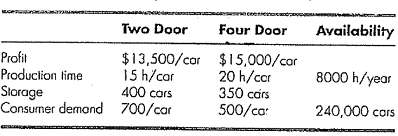
An automobile company has two versions of the same model car for sale, a two-door coupe and the full-size four door. (a) Graphically solve how many cars of each design should be produced to maximize profit and what that profit is. (b) Solve the same problem withExcel.
Og is the leader of the surprisingly mathematically advanced, though technologically run-of-the-mill, Calm Waters caveman tribe. He must decide on the number of stone clubs and stone axes to be produced for the upcoming battle against the neighboring Peaceful Sunset tribe. Experience has taught him
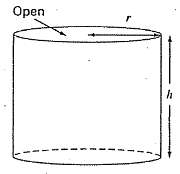
Design the optimal cylindrical container (Figure) that is open at one end has walls of negligible thickness. The container is to hold 0.5 m3. Design it so that the areas of its bottom and sides areminimized.
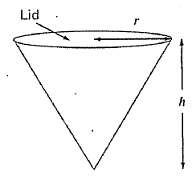
(a) Design the optimal conical container (Figure) that has a cover and has walls of negligible thickness. The container is to hold 0.5 m3. Design it so that the areas of its top and sides are minimized. (b) Repeat (a) but for a conical container without acover
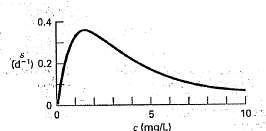
The specific growth rate of a yeast that produces an antibiotic is a function of the food concentration c, g = 2c/4 + 0.8c + c2 0.2c3 As depicted in Figure, growth goes to zero at very low concentrations due to food limitation. It also goes to zero at high concentrations due to toxicity effects.
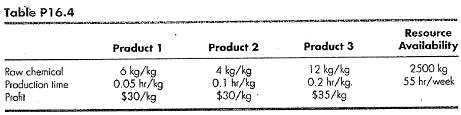
A chemical plant makes three major products on a weekly basis. Each of these products requires a certain quantity of raw chemical and different production times, and yields different profits. The pertinent information is in Table P16.4. Note that there is sufficient warehouse space at the plant to
Recently chemical engineers have become involved in the area knows as waste minimization. This involves the operation of a chemical plant so that impacts on the environment are minimized. Suppose a refinery develops a product Z1 made from two raw materials X and Y. The production of 1 metric tonne
A mixture of benzene and toluene are to be separated in a flash tank. At what temperature should the tank be operated to get the highest purity toluene in the liquid phase (maximizing xT)? The pressure in the flash tank is 800 mm Hg. The units for Antoine’s equation are mm Hg and °C for pressure
A computed A will be converted into B in a stirred tank reactor. The product B and unreacted A are purified in a separation unit. Unreacted A is recycled to the rector. A process engineer has found that the initial cost of the system is a function of the conversion xA. Find the conversion that will
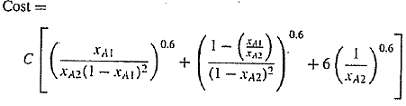
In problem 16.7, only one reactor is used. If two reactors are used in series, the governing equation for the system changes. Find the conversions for both reactors (xA1 and xA2 such that the total cost of the system is minimized.
For the reaction:2A + B ↔ CEquilibrium can be expressed as:K = [C]/[A]2[B] = [C]/[A0 – 2C]2[B0 - C]If K = 2 M–1, the initial concentration of A (A0) can be varied. The initial concentration of B is fixed by the process, B0 = 100. A costs $1/M and C sells for $10/M. What would be the optimum
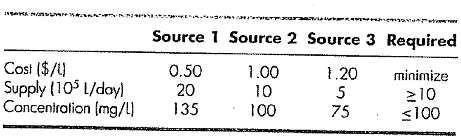
A chemical plant requires 106 L/day of a solution. Three sources are available at different prices and supply rates. Each source also has a different concentration of an impurity that must be kept below a minimum level to prevent interference with the chemical. The data for the three sources
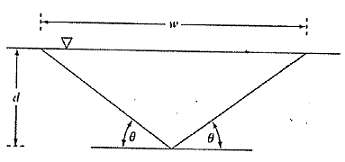
You must design a triangular open channel to carry a waste stream from a chemical plant to a waste stabilization pond (Figure). The mean velocity increases with the hydraulic radius Rh = A/p, where A is the cross-sectional area and p equals the wetted perimeter. Because the maximum flow rate
Showing 300 - 400
of 3402
1
2
3
4
5
6
7
8
9
10
11
12
13
14
15
Last
Step by Step Answers

 Get 50% OFF
Claim Now
Get 50% OFF
Claim Now