New Semester
Started
Get
50% OFF
Study Help!
--h --m --s
Claim Now
Question Answers
Textbooks
Find textbooks, questions and answers
Oops, something went wrong!
Change your search query and then try again
S
Books
FREE
Study Help
Expert Questions
Accounting
General Management
Mathematics
Finance
Organizational Behaviour
Law
Physics
Operating System
Management Leadership
Sociology
Programming
Marketing
Database
Computer Network
Economics
Textbooks Solutions
Accounting
Managerial Accounting
Management Leadership
Cost Accounting
Statistics
Business Law
Corporate Finance
Finance
Economics
Auditing
Tutors
Online Tutors
Find a Tutor
Hire a Tutor
Become a Tutor
AI Tutor
AI Study Planner
NEW
Sell Books
Search
Search
Sign In
Register
study help
mathematics
statistics
Basic Statistics for the Behavioral Sciences 6th edition Gary W. Heiman - Solutions
What is the design of the study when we compute the z-test and t-test versus when we compute a correlation coefficient?
(a) What does a correlation coefficient tell you? (b) When do you compute r? (c) When do you compute rS? (d) When is linear regression used?
Study A reports a result with p = .031. Study B reports results with p < .001. What is the difference between the results of A and B in terms of(a) how significant they are?(b) Their critical values?(c) Their region of rejection?(d) The probability of a statistical error?
(a) What is the difference between SX and σX? (b) How is their use the same?
(a) What do we mean by the restriction of range? (b) Why is it a problem for the size of correlation coefficient? (c) Why is it a problem for the power of a correlation coefficient?
For the following, specify which descriptive and inferential procedures should be performed, explain what is being compared, and identify the key to answering the researcher’s question. (a) A researcher measures a group of participants using standard tests of “social nervousness” and
(a) Why are there different values of tcrit when samples have different Ns? (b) What must you compute in order to find tcrit?
(a) What is the symbol for the Pearson correlation coefficient in the population? (b) What is the symbol for the Spearman correlation coefficient in the population? (c) Summarize the steps involved in analyzing a Pearson correlational study.
Summarize the steps involved in analyzing the results of a one-sample experiment.
Say that you have a sample mean of 44 in a study.(a) Estimate the corresponding µ using point estimation.(b) What would a confidence interval for this µ tell you?(c) Why is computing a confidence interval better than using a point estimate?(d) What is the difference between reporting an estimate
(a) What is power? (b) What outcome should cause you to worry about having sufficient power? (c) Why? (d) At what stage do you build in power?
(a) What is the final step when completing an experiment? (b) Why is effect size useful at this stage?
For the following, which type of t-test is required? (a) Studying the effects of a memory drug on Alzheimer’s patients, testing a group of patients before and after administration of the drug. (b) Studying whether men and women rate the persuasiveness of an argument delivered by a female speaker
We study the relationship between hot or cold baths and the amount of relaxation they produce. The relaxation scores from two independent samples areSample 1 (hot): X = 43, sX = 22.79, n = 15 Sample 2 (cold): X = 39, sX = 24.6, n = 15(a) What are H0 and Ha?(b) Compute tobt(c) With a = .05, what is
We investigate if a period of time feels longer or shorter when people are bored compared to when they are not bored. Using independent samples, we obtain these estimates of the time period (in minutes):Sample 1 (bored):X= 14.5, sX= 10.22,n=28Sample 2 (not bored): X= 9.0, sX= 14.6, n=34(a) What are
A researcher asks if people score higher or lower on a questionnaire measuring their well-being when they are exposed to much sunshine compared to when they’re exposed to little sunshine. A sample of 8 people is measured under both levels of sunshine and produces these well-being scores:Low: 14
(a) Subtracting A - B, what are H0 and Ha?(b) What is tobt?(c) With a = .05, are the results significant?(d) Report the results using the correct format.(e) What should she conclude about the relationship in nature between type of music and irritability?(f) What other statistics should be computed?
We predict that children exhibit more aggressive acts after watching a violent television show. The scores for ten participants before and after watching the show are(a) Subtracting before from after, what are H0 and Ha? (b) Compute tobt (c) With a = .05, what is tcrit? (d) What should the
You investigate whether the older or younger male in pairs of brothers tends to be more extroverted. You obtain the following extroversion scores:(a) What are H0 and Ha?(b) Compute tobt(c) With a = .05, what is tcrit?(d) What should you conclude about this relationship?(e) Which of our approaches
How is a data warehouse different from a database? How are they similar?
With a = .05 and df = 40, a significant independent-samples tobt was +4.55. How would you report this in the literature?
An experimenter investigated the effects of a sensitivity training course on a policeman€™s effectiveness at resolving domestic disputes (using independent samples who had or had not completed the course). The dependent variable was the ability to resolve a domestic dispute. These success
When reading a research article, you encounter the following statements. For each, identify the N, the design, the statistical procedure performed and the result, the relationship, and if a Type I or Type II error is possibly being made.(a) “The t-test indicated a significant difference between
How do you distinguish the independent variable from the dependent variable?
What is the difference between an experiment versus a correlational study in terms of (a) The design? (b) How we examine the relationship? (c) How sampling error might play a role?
(a) When do you perform parametric inferential procedures in experiments? (b) What are the four parametric inferential procedures for experiments that we have discussed and what is the design in which each is used?
In recent chapters, you have learned about three different versions of a confidence interval. (a) What are they called? (b) How are all three similar in terms of what they communicate? (c) What are the differences between them?
(a) What does it mean to “account for variance”? (b) How do we predict scores in an experiment? (c) Which variable in an experiment is potentially the good predictor and important? (d) When does that occur?
(a) In an experiment, what are the three ways to try to maximize power? (b) What does maximizing power do in terms of our errors? (c) For what outcome is it most important for us to have maximum power and why?
(a) What are the two ways to create related samples? (b) What other assumptions must be met before using either two-sample t-test?
For the following, identify the inferential procedure to perform and the key information for answering the research question. If no inferential procedure is appropriate, indicate why. (a) Ten students are tested for accuracy of distance estimation when using one or both eyes. (b) We determine that
(a) What is SX -X ?(b) What is SD?(c) What is the difference between n and N?
(a) What does effect size indicate? (b) What does d indicate? (c) What does rpb indicate?
What does each of the following terms mean? (a) ANOVA (b) One-way design (c) Factor (d) Level (e) Treatment (f) Between subjects (g) Within subjects
(a) Why should Fobt equal 1 if the data represent the H0 situation?(b) Why is Fobt greater than 1 when the data represent the Ha situation?(c) What does a significant Fobt indicate about differences between the levels of a factor?
A researcher conducts an experiment with three levels of the independent variable.(a) Which two versions of a parametric procedure are available to her?(b) How does she choose between them?
(a) In a study comparing four conditions, what is H0 for the ANOVA? (b) What is Ha in the same study? (c) Describe in words what H0 and Ha say for this study.
Foofy obtained a significant Fobt from an experiment with five levels. She therefore concludes that changing each condition of the independent variable results in a significant change in the dependent variable.(a) Is she correct? Why or why not?(b) What must she now do?
(a) Poindexter computes an Fobt of .63. How should this be interpreted? (b) He computes another Fobt of —1.7. How should this be interpreted?
A report says that the between-subjects factor of participants’ salary produced significant differences in self-esteem. (a) What does this tell you about the design? (b) What does it tell you about the results?
A researcher investigated the number of viral infections people contract as a function of the amount of stress they experienced during a 6-month period.She obtained the following data:(a) What are H0 and Ha?(b) Compute Fobt and complete the ANOVA summary table.(c) With a = .05, what is Fcrit?(d)
Here are data from an experiment studying the effect of age on creativity scores:(a) Compute Fobt and create an ANOVA summary table.(b) With a = .05, what do you conclude about Fobt?(c) Perform the appropriate post hoc comparisons. What should you conclude about this relationship?(d) Statistically,
(a) What is the difference between n and N? (b) What does k stand for?
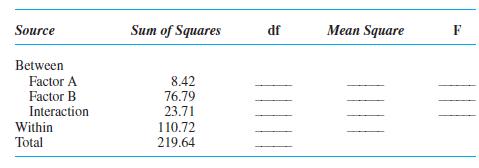
In a study in which k = 3, n = 21, X1 = 45.3, X2 = 16.9, and X3 = 8.2, you compute the following sums of squares:(a) Complete the ANOVA summary table.(b) With a = .05, what do you conclude about Fobt?(c) Report your results in the correct format.(d) Perform the appropriate post hoc comparisons.
A researcher investigated the effect of volume of background noise on participants€™ accuracy rates while performing a boring task. He tested three groups of randomly(a) Complete the ANOVA(b) At a = .05, what is Fcrit?(c) Report the statistical results in the proper format.(d) Perform the
(a) How do we create related samples? (b) In part (a) what two inferential procedures are appropriate? (c) How do we create independent samples? (d) In part (c) what two inferential procedures are appropriate?
(a) In this chapter we tested the relationship between performance scores and perceived difficulty. Describe this relationship using “as a function of.” (b) An experimenter computes the mean anxiety level for samples of freshmen, sophomores, juniors, and seniors. To graph these results, how
(a) Name and explain the error that power prevents. (b) Why is it important to maximize the power of any experiment? (c) How is this done in a design using ANOVA? (d) How does influencing the differences between and within conditions influence the sizeof Fobt and its likelihood of being significant.
(a) How do you identify which variable in a study is the factor? (b) How do you identify the levels of a factor? (c) How do you identify the variable that is the dependent variable?
For the following, identify the inferential procedure to perform and the key information for answering the research question. Note: If no inferential procedure is appropriate, indicate why.(a) Doing well in statistics should reduce students’ math phobia. We measure their math phobia after
In question 28, identify the levels of the factor and the dependent variable in experiments, and the predictor/criterion variables in correlational studies. In question 28, (a) Doing well in statistics should reduce students’ math phobia. We measure their math phobia after selecting groups who
(a) What are error variance and treatment variance? (b) What are the two types of mean squares, and what does each estimate?
(a) What is the experiment-wise error rate? (b) Why does ANOVA solve the problem with the experiment-wise error rate created by multiple t-tests?
Summarize the steps involved in analyzing an experiment when k > 2.
(a) When is it necessary to perform post hoc comparisons? Why? (b) When is it unnecessary to perform post hoc comparisons?
When do you use each of the two post hoc tests discussed in this chapter?
(a) When is it appropriate to compute the effect size in a two-way ANOVA?(b) For each effect, what does the effect size tell you?
Below are the cell means of three experiments. For each experiment, compute the main effect means and decide whether there appears to be an effect of A, B, and/or A X B.
In question 11, if you label the X axis with factor A and graph the cell means, what pattern will we see for each interaction?In question 11
After performing a 3 × 4 ANOVA with equal ns, you find that all Fs are significant. What other procedures should you perform?
In an experiment, you measure the popularity of two brands of soft drinks (factor A), and for each brand you test males and females (factor B). The following table shows the(a) Describe the graph of the interaction when factor A is on the axis.(b) Does there appear to be an interaction effect? Why?
A researcher examines performance on an eye€“hand coordination task as a function of three levels of reward and three levels of practice, obtaining the following cell means:(a) What are the main effect means for reward, and what do they appear to indicate about this factor? (b) What are
(a) In question 17, why does the interaction contradict your conclusions about the effect of reward? (b) Why does the interaction contradict your conclusions about practice?
A study compared the performance of males and females tested by either a male or a(a) Using a = .05, perform an ANOVA and complete the summary table. (b) Compute the main effect means and interaction means. (c) Perform the appropriate post hoc comparisons. (d) What do you conclude about the
According to Gray and Vander Wal (2014) connected companies have a lot in common with large cities. Describe the characteristics of successful companies.
You conduct an experiment involving two levels of self-confidence (Aj is low and A2 is high) and examine participants’ anxiety scores after they speak to one of four groups of differing sizes (Bx through B4 represent speaking to a small, medium, large, or extremely large group, respectively). You
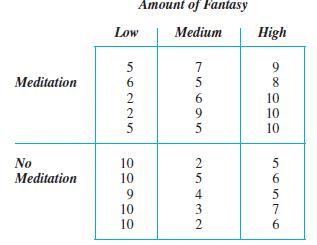
You measure the dependent variable of participants’ relaxation level as a function of whether they meditate before being tested, and whether they were shown a film containing a low, medium, or high amount of fantasy. Perform all appropriate statistical analyses, and determine what you should
(a) How do you recognize the independent variable in a study? (b) How do you recognize the levels in a study? (c) How do you recognize the dependent variable in a study?
(a) How do you recognize a two-sample t-test design? (b) What must be true about the dependent variable? (c) Which versions of the t-test are available?
(a) How do you recognize a correlational design? (b) To select a correlation coefficient, what must you ask about the variables? (c) What is the parametric correlation coefficient? (d) What is the nonparametric correlation coefficient?
(a) How do you recognize a design that requires a one-way ANOVA? (b) What must be true about the dependent variable? (c) Which versions of ANOVA are available?
(a) How do you recognize a design that fits a two-way ANOVA? (b) What must be true about the dependent variable?
What is the difference between a main effect mean and a cell mean?
For the following, identify the factor(s), the primary inferential procedure to perform and the key findings we’d look for. If a correlational design, indicate the predictor and criterion. If no parametric procedure can be used, indicate why. (a) We measure babies’ irritability when their
Which type of ANOVA is used in a two-way design when (a) Both factors are tested using independent samples? (b) One factor involves independent samples and one factor involves related samples? (c) Both factors involve related samples?
(a) What is a confounded comparison, and when does it occur? (b) What is an unconfounded comparison, and when does it occur? (c) Why don’t we perform post hoc tests on confounded comparisons?
For a 2 × 2 ANOVA, describe the following in words: (a) The statistical hypotheses for factor A, (b) The statistical hypotheses for factor B, and (c) The statistical hypotheses for A × B.
(a) What does a significant main effect indicate? (b) What does a significant interaction effect indicate? (c) Why do we usually base the interpretation of a two-way design on the interaction effect when it is significant?
One more time, using a factorial design, we study the effect of changing the dose for one, two, three, or four smart pills and test participants who are 10-, 15-, and 20-years old. We test ten participants in each cell. (a) Using two numbers, describe this design. (b) When computing the main
What is the nonparametric version of each of the following? (a) A one-way, between- subjects ANOVA (b) An independent-samples t-test (n < 20) (c) A related-samples t-test (d) An independent-samples t-test (n > 20) (e) A one-way, within-subjects ANOVA (f) Fisher’s protected t-test (g) Tukey’s
In the population, political party affiliation is 30% Republican, 55% Democratic, and 15% other. To determine whether this distribution is also found among the elderly, in a sample of 100 senior citizens, we find 18 Republicans, 64 Democrats, and 18 other. (a) What procedure should we perform? (b)
A survey finds that, given the choice, 34 females prefer males much taller than themselves, and 55 females prefer males only slightly taller than themselves.(a) What procedure should we perform?(b) What are H0 and Ha?(c) With a = .05, what do you conclude about the preference of females in the
Foofy counts the students who like Professor Demented and those who like Professor Randomsampler. She then performs a one-way x2 to determine if there is a significant difference between the frequency with which students like each professor. (a) Why is this approach incorrect? (b) How should she
The following data reflect the frequency with which people voted in the last election and(a) What procedure should we perform?(b) What are H0 and Ha?(c) What is fe in each cell?(d) Compute xo2bt.(e) With a = .05, what do you conclude about the correlation between these variables?(f) How consistent
A study determines the frequency of the different political party affiliations for male and(a) What procedure should we perform? (b) What are H0 and Ha? (c) What is fe in each cell? (d) Compute x2bt. (e) With a = .05, what do you conclude about gender and party affiliation in the population of
Select the noparametric procedure to use when we study:(a) The effect of a pain reliever on rankings of the emotional content of words describing pain. One group is tested before and after taking the drug.(b) The effect of eight colors of spaghetti sauce on its tastiness. A different sample tastes
After testing 40 participants, a significant xobt of 13.31 was obtained. With a = .05 and df = 2, how would this result be reported in a publication?
We compare the attitude scores of people tested in the morning to their scores when tested in the afternoon. We obtain the following interval data but it does not have homogeneous variance. With a = .05, is there a significant difference in scores as a function of testing times?(a) Do the groups
We measure the maturity level of students who have completed statistics and students who have not. Maturity scores tend to be skewed. For the following interval scores,
(a) Which variable in an experiment determines whether to use parametric or nonparametric procedures?(b) In terms of the dependent variable, what are the two categories into which all nonparametric procedures can be grouped?
A therapist evaluates a sample in a new treatment program after 1 month, after 2 months, and again after 3 months. Such data do not have homogeneous variance.(a) What procedure should be used? Why?(b) What must the therapist do to the data first?(c) If the results are significant, what procedure
An investigator evaluated the effectiveness of a therapy on three types of patients. She collected the following improvement ratings, but these data form skewed distributions.(a) Which procedure should be used? Why? (b) What should the investigator do to the data first? (c) If the results are
A report indicates that the Friedman x2 test was significant. (a) What does this test indicate about the design of the study? (b) What does it indicate about the raw scores? (c) What two procedures do you also expect to be reported? (d) What will you learn about the relationship?
A report indicates that the Wilcoxon T test was significant. (a) What does this test indicate about the design of the study? (b) What does it indicate about the raw scores? (c) What will you learn about the relationship here?
You show participants a picture of a person either smiling, frowning, or smirking. For each, they indicate whether the person was happy or sad.(a) What are the factor(s) and level(s) in this design, and(b) What is the dependent variable?(c) How will you analyze the results?(d) What potential flaw
Thinking back on the previous few chapters, what three aspects of your independent variable(s) and one aspect of your dependent variable determine the specific inferential procedure to perform in a particular experiment?
For the following, what inferential statistical procedures should be performed and what is the key information for answering the research question? Unless described otherwise, assume scores are parametric.(a) To test the influence of dietary fat levels on visual accuracy, rats are placed on one of
(a) Which two scales of measurement always require nonparametric procedures? (b) What two things can be “wrong” with interval/ratio scores that lead to nonparametric procedures (c) What must you do to the interval/ratio scores first?
(a) Why, if possible, should we design a study that meets the assumptions of a parametric procedure?(b) Why shouldn’t you use parametric procedures for data that clearly violate their assumptions?
(a) When do you use the one-way chi square? (b) When do you use the two-way chi square?
Showing 37100 - 37200
of 88243
First
365
366
367
368
369
370
371
372
373
374
375
376
377
378
379
Last
Step by Step Answers

 Get 50% OFF
Claim Now
Get 50% OFF
Claim Now


.png)
.png)
.png)
.png)
.png)
.png)
.png)
.png)
.png)
.png)
.png)
.png)
.png)
.png)
.png)
.png)
.png)


