New Semester
Started
Get
50% OFF
Study Help!
--h --m --s
Claim Now
Question Answers
Textbooks
Find textbooks, questions and answers
Oops, something went wrong!
Change your search query and then try again
S
Books
FREE
Study Help
Expert Questions
Accounting
General Management
Mathematics
Finance
Organizational Behaviour
Law
Physics
Operating System
Management Leadership
Sociology
Programming
Marketing
Database
Computer Network
Economics
Textbooks Solutions
Accounting
Managerial Accounting
Management Leadership
Cost Accounting
Statistics
Business Law
Corporate Finance
Finance
Economics
Auditing
Tutors
Online Tutors
Find a Tutor
Hire a Tutor
Become a Tutor
AI Tutor
AI Study Planner
NEW
Sell Books
Search
Search
Sign In
Register
study help
physics
mechanics
Physics 5th edition James S. Walker - Solutions
The L-shaped object in FIGURE 11-41 consists of three masses connected by light rods. What torque must be applied to this object to give it an angular acceleration of 1.20 rad/s2 if it is rotated about(a) The x axis,(b) The y axis,(c) The z axis (which is through the origin and perpendicular to the
The L-shaped object described in the previous problem can be rotated in one of the following three ways: case A, about the x axis; case B, about the y axis; and case C, about the z axis (which passes through the origin perpendicular to the plane of the figure). If the same torque t is applied in
A motorcycle accelerates from rest, and both the front and rear tires roll without slipping.(a) Is the force exerted by the ground on the rear tire in the forward or in the backward direction? Explain.(b) Is the force exerted by the ground on the front tire in the forward or in the backward
A torque of 13 N # m is applied to the rectangular object shown in FIGURE 11-42. The torque can act about the x axis, the y axis, or the z axis, which passes through the origin and points out of the page.(a) In which case does the object experience the greatest angular acceleration? The least
The gardening tool shown in FIGURE 11-37 is used to pull weeds. If a 1.23-N ∙ m torque is required to pull a given weed, what force did the weed exert on the tool?
Suppose the person in Example 11-11 climbs higher on the ladder.(a) As a result, is the ladder more likely, less likely, or equally likely to slip?(b) Choose the best explanation from among the following:I. The forces are the same regardless of the person's position.II. The magnitude of Æ’2 must
A string that passes over a pulley has a 0.321-kg mass attached to one end and a 0.635-kg mass attached to the other end. The pulley, which is a disk of radius 9.40 cm, has friction in its axle. What is the magnitude of the frictional torque that must be exerted by the axle if the system is to be
To loosen the lid on a jar of jam 7.6 cm in diameter, a torque of 11 N ∙ m must be applied to the circumference of the lid. If a jar wrench whose handle extends 15 cm from the center of the jar is attached to the lid, what is the minimum force required to open the jar?
Referring to the person holding a baseball in Problem 6, suppose the biceps exert just enough upward force to keep the system in static equilibrium.(a) Is the force exerted by the biceps more than, less than, or equal to the combined weight of the forearm, hand, and baseball? Explain.(b) Determine
To determine the location of her center of mass, a physics student lies on a lightweight plank supported by two scales 2.50 m apart, as indicated in FIGURE 11-43. If the left scale reads 435 N, and the right scale reads 183 N, find(a) The student's mass(b) The distance from the student's head to
A set of fossilized triceratops footprints discovered in Texas show that the front and rear feet were 3.2 m apart. The rear footprints were observed to be twice as deep as the front footprints. Assuming that the rear feet pressed down on the ground with twice the force exerted by the front feet,
A schoolyard teeter-totter with a total length of 6.4 m and a mass of 41 kg is pivoted at its center. A 21-kg child sits on one end of the teeter-totter.(a) Where should a parent push vertically downward with a force of 210 N in order to hold the teeter-totter level?(b) Where should the parent push
A 0.122-kg remote control 23.0 cm long rests on a table, as shown in FIGURE 11-44, with a length L overhanging its edge. To operate the power button on this remote requires a force of 0.365 N. How far can the remote control extend beyond the edge of the table and still not tip over when you press
A 0.16-kg meterstick is held perpendicular to a vertical wall by a 2.5-m string going from the wall to the far end of the stick.(a) Find the tension in the string.(b) If a shorter string is used, will its tension be greater than, less than, or the same as that found in part (a)?(c) Find the tension
Babe Ruth steps to the plate and casually points to left center field to indicate the location of his next home run. The mighty Babe holds his bat across his shoulder, with one hand holding the small end of the bat. The bat is horizontal, and the distance from the small end of the bat to the
A person slowly lowers a 3.6-kg crab trap over the side of a dock, as shown in FIGURE 11-38. What torque does the trap exert about the person's shoulder?
A uniform metal rod, with a mass of 2.0 kg and a length of 1.5 m, is attached to a wall by a hinge at its base. A horizontal wire bolted to the wall 0.70 m above the base of the rod holds the rod at an angle of 28° above the horizontal. The wire is attached to the top of the rod.(a) Find the
A rigid, vertical rod of negligible mass is connected to the floor by a bolt through its lower end, as shown in FIGURE 11-45. The rod also has a wire connected between its top end and the floor. If a horizontal force F is applied at the midpoint of the rod, find(a) The tension in the wire,(b) The
In figure 11-46 two acrobats perform a balancing maneuver. The arms of the top acrobat (in yellow), together with the weight of his head and shoulders, provide a downward force at a distance of 28 cm from the pivot point to balance the torque produced by his lower body. If the lower body of the top
In FIGURE 11-47 we see the forces acting on a sprinter's foot just before she takes off at the start of the race. Find the magnitude of the force exerted on the heel by the Achilles tendon, FH, and the magnitude of the force exerted on the foot at the ankle joint, FJ.
A stick with a mass of 0.214 kg and a length of 0.436 m rests in contact with a bowling ball and a rough floor, as shown in FIGURE 11-48. The bowling ball has a diameter of 21.6 cm, and the angle the stick makes with the horizontal is 30.0°. You may assume there is no friction between the stick
A hand-held shopping basket 62.0 cm long has a 1.81-kg carton of milk at one end, and a 0.722-kg box of cereal at the other end. Where should a 1.80-kg container of orange juice be placed so that the basket balances at its center?
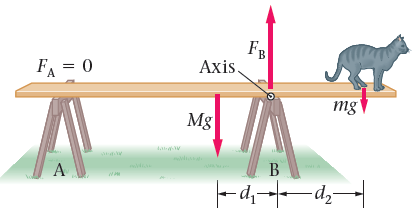
If the cat in Example 11-9 has a mass of 3.9 kg, how far to the right of sawhorse B can it walk before the plank begins to tip?
A 0.34-kg meterstick balances at its center. If a necklace is suspended from one end of the stick, the balance point moves 9.5 cm toward that end.(a) Is the mass of the necklace more than, less than, or the same as that of the meterstick? Explain.(b) Find the mass of the necklace.
Three identical, uniform books of length L are stacked one on top the other. Find the maximum overhang distanced in FIGURE 11-49 such that the books do not fall over.
A baseball bat balances 71.1 cm from one end. If a 0.560-kg glove is attached to that end, the balance point moves 24.7 cm toward the glove. Find the mass of the bat.
A squirrel-proof bird feeder has a lever that closes to protect the seeds when a 0.42-kg squirrel sits on it, but not when a 0.077-kg bird perches there.(a) If the lever radius is 9.6 cm, what torques do the squirrel and the bird each exert on it?(b) The torque produced by the animal is balanced by
A 2.85-kg bucket is attached to a rope wrapped around a disk shaped pulley of radius 0.121 m and mass 0.742 kg. If the bucket is allowed to fall,(a) What is its linear acceleration?(b) What is the angular acceleration of the pulley?(c) How far does the bucket drop in 1.50 s?
A child exerts a tangential 53.4-N force on the rim of a diskshaped merry-go-round with a radius of 2.29 m. If the merry-go-round starts at rest and acquires an angular speed of 0.125 rev/s in 3.50 s, what is its mass?
You pull downward with a force of 28 N on a rope that passes over a disk-shaped pulley of mass 1.2 kg and radius 0.075 m. The other end of the rope is attached to a 0.67-kg mass.(a) Is the tension in the rope the same on both sides of the pulley? If not, which side has the greater tension?(b) Find
One elevator arrangement includes the passenger car, a counterweight, and two large pulleys, as shown in FIGURE 11-50. Each pulley has a radius of 1.2 m and a moment of inertia of 380 kg ∙ m2. The top pulley is driven by a motor. The elevator car plus passengers has a mass of 3100 kg, and the
An Atwood's machine consists of two masses, m1 and m2, connected by a string that passes over a pulley. If the pulley is a disk of radius R and mass M, find the acceleration of the masses.
A 1.4-kg bicycle tire with a radius of 33 cm rotates with an angular speed of 155 rpm. Find the angular momentum of the tire, assuming it can be modeled as a hoop.
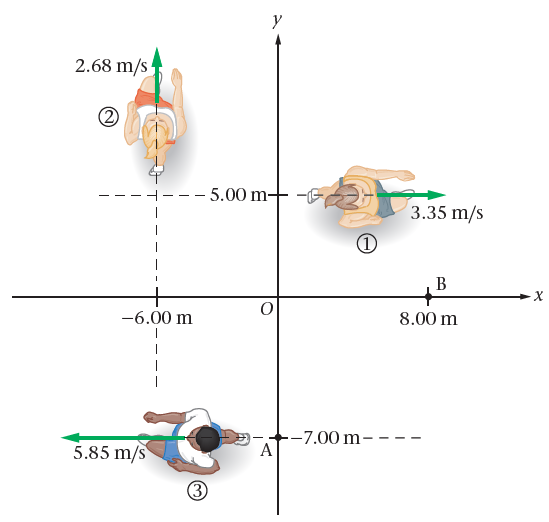
Jogger 1 in FIGURE 11-51 has a mass of 65.3 kg and runs in a straight line with a speed of 3.35 m/s.(a) What is the magnitude of the jogger's linear momentum?(b) What is the magnitude of the jogger's angular momentum with respect to the origin, O?
Suppose jogger 3 in Figure 11-51 has a mass of 62.2 kg and a speed of 5.85 m/s.(a) Is the magnitude of the jogger's angular momentum greater with respect to point A or point B? Explain.(b) Is the magnitude of the jogger's angular momentum with respect to point B greater than, less than, or the same
A torque of 0.12 N ∙ m is applied to an egg beater.(a) If the egg beater starts at rest, what is its angular momentum after 0.65 s?(b) If the moment of inertia of the egg beater is 2.5 × 10⁻³ kg ∙ m2, what is its angular speed after 0.65 s?
A windmill has an initial angular momentum of 8500 kg ∙ m2/s. The wind picks up, and 5.86 s later the windmill's angular momentum is 9700 kg ∙ m2/s. What was the torque acting on the windmill, assuming it was constant during this time?
At one position during its cycle, the foot pushes straight down with a 440-N force on a bicycle pedal arm that is rotated an angle Ï• = 65 from the vertical, as shown in FIGURE 11-39. If the force is applied r = 0.17 m from the axis of rotation, what torque is produced?
Two gerbils run in place with a linear speed of 0.55 m/s on an exercise wheel that is shaped like a hoop. Find the angular momentum of the system if each gerbil has a mass of 0.22 kg and the exercise wheel has a radius of 9.5 cm and a mass of 5.0 g.
(a) A student rotates on a frictionless piano stool with his arms outstretched, a heavy weight in each hand. Suddenly he lets go of the weights, and they fall to the floor. As a result, does the student's angular speed increase, decrease, or stay the same?(b) Choose the best explanation from among
A puck on a horizontal, frictionless surface is attached to a string that passes through a hole in the surface, as shown in FIGURE 11-52. As the puck rotates about the hole, the string is pulled downward, bringing the puck closer to the hole. During this process, do the puck's(a) Linear speed,(b)
A puck on a horizontal, frictionless surface is attached to a string that wraps around a pole of finite radius, as shown in FIGURE 11-53.(a) As the puck moves along the spiral path, does its speed increase, decrease, or stay the same? Explain.(b) Does its angular momentum increase, decrease, or
As an ice skater begins a spin, his angular speed is 3.04 rad/s. After pulling in his arms, his angular speed increases to 5.24 rad/s. Find the ratio of the skater's final moment of inertia to his initial moment of inertia.
A disk-shaped merry-go-round of radius 2.63 m and mass 155 kg rotates freely with an angular speed of 0.641 rev/s. A 59.4-kg person running tangential to the rim of the merry-go-round at 3.41 m/s jumps onto its rim and holds on. Before jumping on the merry-go-round, the person was moving in the
A student sits at rest on a piano stool that can rotate without friction. The moment of inertia of the student-stool system is 4.1 kg ∙ m2. A second student tosses a 1.5-kg mass with a speed of 2.7 m/s to the student on the stool, who catches it at a distance of 0.40 m from the axis of rotation.
A turntable with a moment of inertia of 5.4 ∙ 10-3 kg ∙ m2 rotates freely with an angular speed of 3313 rpm. Riding on the rim of the turntable, 15 cm from the center, is a cute, 32-g mouse.(a) If the mouse walks to the center of the turntable, will the turntable rotate faster, slower, or at
A student on a piano stool rotates freely with an angular speed of 2.95 rev/s. The student holds a 1.25-kg mass in each outstretched arm, 0.759 m from the axis of rotation. The combined moment of inertia of the student and the stool, ignoring the two masses, is 5.43 kg ∙ m2, a value that remains
A child of mass m stands at rest near the rim of a stationary merry-go-round of radius R and moment of inertia I. The child now begins to walk around the circumference of the merry-go-round with a tangential speed v with respect to the merry-go-round's surface.(a) What is the child's speed with
A person holds a 1.42-N baseball in his hand, a distance of 34.0 cm from the elbow joint, as shown in FIGURE 11-40. The biceps, attached at a distance of 2.75 cm from the elbow, exerts an upward force of 12.6 N on the forearm. Consider the forearm and hand to be a uniform rod with a mass of 1.20
(a) Two spheres of equal mass and radius are rolling across the floor with the same speed. Sphere 1 is a uniform solid; sphere 2 is hollow. Is the work required to stop sphere 1 greater than, less than, or equal to the work required to stop sphere 2?(b) Choose the best explanation from among the
Turning a doorknob through 0.25 of a revolution requires 0.14 J of work. What is the torque required to turn the doorknob?
A person exerts a tangential force of 36.1 N on the rim of a diskshaped merry-go-round of radius 2.74 m and mass 167 kg. If the merry-go-round starts at rest, what is its angular speed after the person has rotated it through an angle of 32.5°?
To prepare homemade ice cream, a crank must be turned with a torque of 3.95 N ∙ m. How much work is required for each complete turn of the crank?
A popular make of dental drill can operate at a speed of 42,500 rpm while producing a torque of 3.68 oz ∙ in. What is the power output of this drill? Give your answer in watts.
For a home repair job you must turn the handle of a screwdriver 27 times.(a) If you apply an average force of 13 N tangentially to the 3.0-cm-diameter handle, how much work have you done?(b) If you complete the job in 24 seconds, what was your average power output?
The L-shaped object in Figure 11-40 consists of three masses connected by light rods. Find the work that must be done on this object to accelerate it from rest to an angular speed of 2.35 rad/s about(a) The x axis,(b) The y axis,(c) The z axis (which is through the origin and perpendicular to the
The rectangular object in Figure 11-41 consists of four masses connected by light rods. What power must be applied to this object to accelerate it from rest to an angular speed of 2.5 rad/s in 6.4 s about(a) The x axis,(b) The y axis,(c) The z axis (which is through the origin and perpendicular to
A circular saw blade accelerates from rest to an angular speed of 3620 rpm in 6.30 revolutions.(a) Find the torque exerted on the saw blade, assuming it is a disk of radius 15.2 cm and mass 0.755 kg.(b) Is the angular speed of the saw blade after 3.15 revolutions greater than, less than, or equal
A uniform disk stands upright on its edge, and rests on a sheet of paper placed on a tabletop. If the paper is pulled horizontally to the right, as in FIGURE 11-54,(a) Does the disk rotate clockwise or counterclockwise about its center? Explain.(b) Does the center of the disk move to the right,
At the local playground, a 21-kg child sits on the right end of a horizontal teeter-totter, 1.8 m from the pivot point. On the left side of the pivot an adult pushes straight down on the teeter-totter with a force of 151 N. In which direction (clockwise or counterclockwise) does the teeter-totter
Consider the two rotating systems shown in FIGURE 11-55, each consisting of a mass m attached to a rod of negligible mass pivoted at one end. On the left, the mass is attached at the midpoint of the rod; to the right, it is attached to the free end of the rod. The rods are released from rest in the
(a) A disk and a hoop (bicycle wheel) of equal radius and mass each have a string wrapped around their circumferences. Hanging from the strings, halfway between the disk and the hoop, is a block of mass m, as shown in FIGURE 11-56. The disk and the hoop are free to rotate about their centers. When
A beetle sits at the rim of a turntable that is at rest but is free to rotate about a vertical axis. Suppose the beetle now begins to walk around the perimeter of the turntable. Does the beetle move forward, backward, or does it remain in the same location relative to the ground? Answer for two
After getting a drink of water, a hamster jumps onto an exercise wheel for a run. A few seconds later the hamster is running in place with a speed of 1.3 m/s. Find the work done by the hamster to get the exercise wheel moving, assuming it is a hoop of radius 0.13 m and mass 6.5 g.
A 47.0-kg uniform rod 4.25 m long is attached to a wall with a hinge at one end. The rod is held in a horizontal position by a wire attached to its other end. The wire makes an angle of 30.0° with the horizontal, and is bolted to the wall directly above the hinge. If the wire can withstand a
A puck attached to a string moves in a circular path on a frictionless surface, as shown in Figure 11-52. Initially, the speed of the puck is v and the radius of the circle is r. If the string passes through a hole in the surface, and is pulled downward until the radius of the circular path is
The masseter muscle, the principal muscle for chewing, is one of the strongest muscles for its size in the human body. It originates on the lower edge of the zygomatic arch (cheekbone) and inserts in the angle of the mandible. Referring to the lower diagram in FIGURE 11-57, where d = 7.60 cm, h =
You are designing exercise equipment to operate as shown in FIGURE 11-58, where a person pulls upward on an elastic cord. The cord behaves like an ideal spring and has an unstretched length of 31 cm. If you would like the torque about the elbow joint to be 81 N ∙ m in the position shown, what
Paleontologists believe that Tyrannosaurus rex stood and walked with its spine almost horizontal, as indicated in FIGURE 11-59, and that its tail was held off the ground to balance its upper body about the hip joint. Given that the total mass of T. rex was 5400 kg, and that the placement of the
In Example 11-11, suppose the ladder is uniform, 4.0 m long, and weighs 60.0 N. Find the forces exerted on the ladder when the person is(a) Halfway up the ladder(b) Three-fourths of the way up the ladder.
Consider the pulley-block systems shown in Conceptual Example 11-5.(a) Is the tension in the string on the left-hand rotating system (the one with the moveable masses at the ends of the rod) greater than, less than, or equal to the weight of the mass attached to that string?(b) Choose the best
When you arrive at Duke’s Dude Ranch, you are greeted by the large wooden sign shown in FIGURE 11-60. The left end of the sign is held in place by a bolt, the right end is tied to a rope that makes an angle of 20.0° with the horizontal. If the sign is uniform, 3.20 m long, and has a mass of 16.0
A 67.0-kg person stands on a lightweight diving board supported by two pillars, one at the end of the board, the other 1.10 m away. The pillar at the end of the board exerts a downward force of 828 N.(a) How far from that pillar is the person standing?(b) Find the force exerted by the second pillar.
A woman might wear a pair of flat shoes to work during the day, as in FIGURE 11-61(a), But a pair of high heels, FIGURE 11-61(b), When going out for the evening. Assume that each foot supports half her weight, w = W/2 = 279 N, and that the forces exerted by the floor on her feet occur at the points
A young girl sits at the edge of a dock by the bay, dipping her feet in the water. At the instant shown in FIGURE 11-62, she holds her lower leg stationary with her quadriceps muscle at an angle of 39° with respect to the horizontal. Use the information given in the figure, plus the fact that
A crossing guard holds a STOP sign at arm’s length, as shown in FIGURE 11-63. Her arm is horizontal, and we assume that the deltoid muscle is the only muscle supporting her arm. The weight of her upper arm is Wu = 18 N, the weight of her lower arm is Wl = 11 N, the weight of her hand is Wh = 4.0
To determine the force a person's triceps muscle can exert, a doctor uses the procedure shown in FIGURE 11-64, where the patient pushes down with the palm of his hand on a force meter. Given that the weight of the lower arm is Mg = 15.6 N, and that the force meter reads F = 89.0 N, what is the
Suppose partial melting of the polar ice caps increases the moment of inertia of the Earth from 0.331 MERE2 to 0.332 MERE2.(a) Would the length of a day (the time required for the Earth to complete one revolution about its axis) increase or decrease? Explain.(b) Calculate the change in the length
A bicycle wheel of radius R and mass M is at rest against a step of height 3R/4, as illustrated in FIGURE 11-65. Find the minimum horizontal force F that must be applied to the axle to make the wheel start to rise up over the step.
A 0.101-kg yo-yo has an outer radius R that is 5.60 times greater than the radius r of its axle. The yo-yo is in equilibrium if a mass m is suspended from its outer edge, as shown in FIGURE 11-66. Find the tension in the two strings, T1 and T2, and the mass m.
The downward force produced by the quadriceps muscles during the power stroke of bicycle-pedaling motion is shown in FIGURE 11-67 as a function of the crank angle Ï• (see Figure 11-39). The force from these muscles decreases linearly, but the torque depends on the crank angle according to t = r
Suppose a torque rotates your body about one of three different axes of rotation: case A, an axis through your spine; case B, an axis through your hips; and case C, an axis through your ankles. Rank these three axes of rotation in increasing order of the angular acceleration produced by the torque.
A cylinder of mass m and radius r has a string wrapped around its circumference. The upper end of the string is held fixed, and the cylinder is allowed to fall. Show that its linear acceleration is (2/3)g.
Consider a system of four uniform bricks of length L stacked as shown in FIGURE 11-68. What is the maximum distance, x, that the middle bricks can be displaced outward before they begin to tip?
The two solid lines in Figure 11-69 (b) represent the two forces applied to the tooth. Which of the following statements about the two lines is correct?A. Line I = F1y, line II = F2y.B. The force indicated by line I changes sign.C. Line I = F2y, line II = F1y.D. The magnitude of the force indicated
What is the value of the torque that corresponds to one of the forces being equal to zero?A. 0.0023 N ∙ mB. 0.0058 N ∙ mC. 0.0081 N ∙ mD. 0.017 N ∙ m
Find the values of F1y and F2y required to give zero net torque.A. F1y = -1.2 N, F2y = 3.0 NB. F1y = 1.1 N, F2y = 0.75 NC. F1y = -0.73 N, F2y = 2.5 ND. F1y = 0.52 N, F2y = 1.3 N
Find the values of F1y and F2y required to give a net torque of 0.0099 N ∙ m. This is a torque that would be effective at rotating the tooth.A. F1y = -1.7 N, F2y = 3.5 NB. F1y = -3.8 N, F2y = 5.6 NC. F1y = -0.23 N, F2y = 2.0 ND. F1y = 4.0 N, F2y = -2.2 N
Suppose the mass of the pulley is doubled, to 0.160 kg, and that everything else in the system remains the same.(a) Do you expect the value of T2 to increase, decrease, or stay the same? Explain.(b) Calculate the value of T2 for this case.
Suppose the mass of the cart is doubled, to 0.62 kg, and that everything else in the system remains the same.(a) Do you expect the value of T2 to increase, decrease, or stay the same? Explain.(b) Calculate the value of T2 for this case.
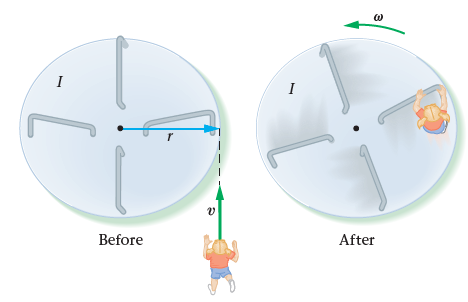
Suppose the child runs with a different initial speed, but that everything else in the system remains the same. What initial speed does the child have if the angular speed of the system after the collision is 0.425 rad/s?
Suppose everything in the system is as described in Quick Example 11-22 except that the child approaches the merry-go-round in a direction that is not tangential. Find the angle u between the direction of motion and the outward radial direction that is required if the final angular speed of the
If you light a candle on the International Space Station-which would not be a good idea-would it burn the same as on the Earth? Explain.
The Earth and Moon exert gravitational forces on one another as they orbit the Sun. As a result, the path they follow is not the simple circular orbit you would expect if either one orbited the Sun alone. Occasionally you will see a suggestion that the Moon follows a path like a sine wave centered
Does the radius vector of Mars sweep out the same amount of area per time as that of the Earth? Why or why not?
One day in the future you may take a pleasure cruise to the Moon. While there you might climb a lunar mountain and throw a rock horizontally from its summit. If, in principle, you could throw the rock fast enough, it might end up hitting you in the back. Explain.
System A has masses m and m separated by a distance r; system B has masses m and 2m separated by a distance 2r; system C has masses 2m and 3m separated by a distance 2r; and system D has masses 4m and 5m separated by a distance 3r. Rank these systems in order of increasing gravitational force.
Three 7.25-kg masses are at the corners of an equilateral triangle and located in space far from any other masses.(a) If the sides of the triangle are 0.610 m long, find the magnitude of the net force exerted on each of the three masses.(b) How does your answer to part (a) change if the sides of
Four masses are positioned at the corners of a rectangle, as indicated in FIGURE 12-35.(a) Find the magnitude and direction of the net force acting on the 2.0-kg mass.(b) How do your answers to part (a) change (if at all) if all sides of the rectangle are doubled in length?
Suppose that three astronomical objects (1, 2, and 3) are observed to lie on a line, and that the distance from object 1 to object 3 is D. Given that object 1 has four times the mass of object 3 and seven times the mass of object 2, find the distance between objects 1 and 2 for which the net force
Showing 19900 - 20000
of 21795
First
193
194
195
196
197
198
199
200
201
202
203
204
205
206
207
Last
Step by Step Answers

 Get 50% OFF
Claim Now
Get 50% OFF
Claim Now


.png)
.png)
.png)
.png)
.png)
.png)
.png)
.png)
.png)
.png)
.png)
.png)
.png)
.png)
.png)
.png)
.png)
.png)
.png)
.png)
.png)
.png)
.png)
.png)
.png)
.png)
.png)
.png)
-2.png)
.png)
.png)
.png)
.png)
.png)
.png)
.png)
.png)
.png)
.png)
.png)
.png)
.png)
.png)


