New Semester
Started
Get
50% OFF
Study Help!
--h --m --s
Claim Now
Question Answers
Textbooks
Find textbooks, questions and answers
Oops, something went wrong!
Change your search query and then try again
S
Books
FREE
Study Help
Expert Questions
Accounting
General Management
Mathematics
Finance
Organizational Behaviour
Law
Physics
Operating System
Management Leadership
Sociology
Programming
Marketing
Database
Computer Network
Economics
Textbooks Solutions
Accounting
Managerial Accounting
Management Leadership
Cost Accounting
Statistics
Business Law
Corporate Finance
Finance
Economics
Auditing
Tutors
Online Tutors
Find a Tutor
Hire a Tutor
Become a Tutor
AI Tutor
AI Study Planner
NEW
Sell Books
Search
Search
Sign In
Register
study help
physics
modern physics
Physics 10th edition David Young, Shane Stadler - Solutions
If the speed of every atom in a monatomic ideal gas were doubled, by what factor would the Kelvin temperature of the gas be multiplied? (a) 4 (b) 2 (c) 1 (d) 1/2 (e) 1/4
The atomic mass of a nitrogen atom (N) is 14.0 u, while that of an oxygen atom (O) is 16.0 u. Three diatomic gases have the same temperature: nitrogen (N2), oxygen (O2), and nitric oxide (NO). Rank these gases in ascending order (smallest first), according to the values of their translational rms
The pressure of a monatomic ideal gas is doubled, while the volume is cut in half. By what factor is the internal energy of the gas multiplied? (a) 1/4 (b) 1/2 (c) 1 (d) 2 (e) 4
The following statements concern how to increase the rate of diffusion (in kg/s). All but one statement are always true. Which one is not necessarily true? (a) Increase the cross-sectional area of the diffusion channel, keeping constant its length and the difference in solute concentrations
A cylindrical glass of water (H2O) has a radius of 4.50 cm and a height of 12.0 cm. The density of water is 1.00 g/cm3. How many moles of water molecules are contained in the glass?
It takes 0.16 g of helium (He) to fill a balloon. How many grams of nitrogen (N2) would be required to fill the balloon to the same pressure, volume, and temperature?
A 0.030-m3 container is initially evacuated. Then, 4.0 g of water is placed in the container, and, after some time, all the water evaporates. If the temperature of the water vapor is 388 K, what is its pressure?
An ideal gas at 15.5 °C and a pressure of 1.72 × 10⁵ Pa occupies a volume of 2.81 m3. (a) How many moles of gas are present? (b) If the volume is raised to 4.16 m3 and the temperature raised to 28.2 8C, what will be the pressure of the gas?
Four closed tanks, A, B, C, and D, each contain an ideal gas. The table gives the absolute pressure and volume of the gas in each tank. In each case, there is 0.10 mol of gas. Using this number and the data in the table, compute the temperature of the gas in each tank.
A young male adult takes in about 5.0 × 10⁻⁴ m3 of fresh air during a normal breath. Fresh air contains approximately 21% oxygen. Assuming that the pressure in the lungs is 1.0 × 10⁵ Pa and that air is an ideal gas at a temperature of 310 K, find the number of oxygen molecules in a normal breath.
A Goodyear blimp typically contains 5400 m3 of helium (He) at an absolute pressure of 1.1 × 10⁵ Pa. The temperature of the helium is 280 K. What is the mass (in kg) of the helium in the blimp?
A clown at a birthday party has brought along a helium cylinder, with which he intends to fill balloons. When full, each balloon contains 0.034 m3 of helium at an absolute pressure of 1.2 × 10⁵ Pa. The cylinder contains helium at an absolute pressure of 1.6 × 10⁷ Pa and has a volume of 0.0031 m3.
The volume of an ideal gas is held constant. Determine the ratio P2/P1 of the final pressure to the initial pressure when the temperature of the gas rises (a) from 35.0 to 70.0 K and (b) from 35.0 to 70.0 °C.
Manufacturers of headache remedies routinely claim that their own brands are more potent pain relievers than the competing brands. Their way of making the comparison is to compare the number of molecules in the standard dosage. Tylenol uses 325 mg of acetaminophen (C8H9NO2) as the standard dose,
Two ideal gases have the same mass density and the same absolute pressure. One of the gases is helium (He), and its temperature is 175 K. The other gas is neon (Ne). What is the temperature of the neon?
A tank contains 0.85 mol of molecular nitrogen (N2). Determine the mass (in grams) of nitrogen that must be removed from the tank in order to lower the pressure from 38 to 25 atm. Assume that the volume and temperature of the nitrogen in the tank do not change
Multiple-Concept Example 4 reviews the principles that play roles in this problem. A primitive diving bell consists of a cylindrical tank with one end open and one end closed. The tank is lowered into a freshwater lake, open end downward. Water rises into the tank, compressing the trapped air,
A tank contains 11.0 g of chlorine gas (Cl2) at a temperature of 82°C and an absolute pressure of 5.60 × 10⁵ Pa. The mass per mole of Cl2 is 70.9 g/mol. (a) Determine the volume of the tank. (b) Later, the temperature of the tank has dropped to 31°C and, due to a leak, the pressure has
The dimensions of a room are 2.5 m × 4.0 m × 5.0 m. Assume that the air in the room is composed of 79% nitrogen (N2) and 21% oxygen (O2). At a temperature of 22°C and a pressure of 1.01 × 10⁵ Pa, what is the mass (in grams) of the air?
The drawing shows an ideal gas confined to a cylinder by a massless piston that is attached to an ideal spring. Outside the cylinder is a vacuum. The crosssectional area of the piston is A = 2.50 × 10⁻³m2. The initial pressure, volume, and temperature of the gas are, respectively, P0, V0 = 6.00
Multiple-Concept Example 4 and Conceptual Example 3 are pertinent to this problem. A bubble, located 0.200 m beneath the surface in a glass of beer, rises to the top. The air pressure at the top is 1.01 × 10⁵ Pa. Assume that the density of beer is the same as that of fresh water. If the
The relative humidity is 55% on a day when the temperature is 30.0 °C. Using the graph that accompanies Problem 75 in Chapter 12, determine the number of moles of water vapor per cubic meter of air.Graph From Problem 75 Chapter12
One assumption of the ideal gas law is that the atoms or molecules themselves occupy a negligible volume. Verify that this assumption is reasonable by considering gaseous xenon (Xe). Xenon has an atomic radius of 2.0 × 10⁻¹⁰ m. For STP conditions, calculate the percentage of the total volume
A mass of 135 g of a certain element is known to contain 30.1 × 10²³ atoms. What is the element?
A spherical balloon is made from an amount of material whose mass is 3.00 kg. The thickness of the material is negligible compared to the 1.50-m radius of the balloon. The balloon is filled with helium (He) at a temperature of 305 K and just floats in air, neither rising nor falling. The density of
The mass of a hot-air balloon and its occupants is 320 kg (excluding the hot air inside the balloon). The air outside the balloon has a pressure of 1.01 × 10⁵ Pa and a density of 1.29kg/m3. To lift off, the air inside the balloon is heated. The volume of the heated balloon is 650 m3. The pressure
Four tanks A, B, C, and D are filled with monatomic ideal gases. For each tank, the mass of an individual atom and the rms speed of the atoms are expressed in terms of m and vrms, respectively (see the table). Suppose that m = 3.32 × 10⁻²⁶ kg, and vrms = 12-3 m/s. Find the temperature
Suppose a tank contains 680 m3 of neon (Ne) at an absolute pressure of 1.01 × 10⁵ Pa. The temperature is changed from 293.2 to 294.3 K. What is the increase in the internal energy of the neon?
Two moles of an ideal gas are placed in a container whose volume is 8.5 × 10⁻³ m3. The absolute pressure of the gas is 4.5 × 10⁵ Pa. What is the average translational kinetic energy of a molecule of the gas?
The average value of the squared speed v̅2 does not equal the square of the average speed (v̅)2. To verify this fact, consider three particles with the following speeds: v1 = 3.0 m/s, v2 5 7.0 m/s, and v3 = 9.0 m/s. Calculate (a) v2 = 1/3 (v12 + v22 + v32 ) and (b) (v̅)2 5 [1/3 (v1 + v2 + v3 )]2.
Two gas cylinders are identical. One contains the monatomic gas argon (Ar), and the other contains an equal mass of the monatomic gas krypton (Kr). The pressures in the cylinders are the same, but the temperatures are different. Determine the ratio K̅E̅Krypton/ K̅E̅Argon of the average kinetic
An oxygen molecule is moving near the earth's surface. Another oxygen molecule is moving in the ionosphere (the uppermost part of the earth's atmosphere) where the Kelvin temperature is three times greater. Determine the ratio of the translational rms speed in the ionosphere to the translational
A certain element has a mass per mole of 196.967 g/mol. What is the mass of a single atom in (a) atomic mass units and (b) kilograms? (c) How many moles of atoms are in a 285-g sample?
A container holds 2.0 mol of gas. The total average kinetic energy of the gas molecules in the container is equal to the kinetic energy of an 8.0 × 10⁻³-kg bullet with a speed of 770 m/s. What is the Kelvin temperature of the gas?
The temperature near the surface of the earth is 291 K. A xenon atom (atomic mass 5 131.29 u) has a kinetic energy equal to the average translational kinetic energy and is moving straight up. If the atom does not collide with any other atoms or molecules, how high up will it go before coming to
Compressed air can be pumped underground into huge caverns as a form of energy storage. The volume of a cavern is 5.6 × 10⁵ m3, and the pressure of the air in it is 7.7 × 10⁶ Pa. Assume that air is a diatomic ideal gas whose internal energy U is given by U = 5/2 nRT. If one home uses 30.0 kW? h
A cubical box with each side of length 0.300 m contains 1.000 moles of neon gas at room temperature (293 K). What is the average rate (in atoms/s) at which neon atoms collide with one side of the container? The mass of a single neon atom is 3.35 × 10⁻²⁶ kg.
Insects do not have lungs as we do, nor do they breathe through their mouths. Instead, they have a system of tiny tubes, called tracheae, through which oxygen diff uses into their bodies. The tracheae begin at the surface of an insect's body and penetrate into the interior. Suppose that a trachea
A tube has a length of 0.015 m and a cross-sectional area of 7.0 × 10⁻⁴ m2. The tube is filled with a solution of sucrose in water. The diffusion constant of sucrose in water is 5.0 × 10⁻¹⁰ m2/s. A difference in concentration of 3.0 × 10⁻³ kg/m3 is maintained between the ends of the tube. How
Review Conceptual Example 6 before working this problem. For water vapor in air at 293 K, the diffusion constant is D = 2.4 × 10⁻⁵ m2/s. As outlined in Problem 51(a), the time required for the first solute molecules to traverse a channel of length L is t = L2/(2D), according to Fick's
The diffusion constant for the amino acid glycine in water has a value of 1.06 × 10⁻⁹ m2/s. In a 2.0-cm-long tube with a cross-sectional area of 1.5 × 10⁻⁴ m2, the mass rate of diffusion is m/t = 4.2 × 10⁻¹⁴ kg/s, because the glycine concentration is maintained at a value of 8.3 × 10⁻³ kg/m3 at
The active ingredient in the allergy medication Claritin contains carbon (C), hydrogen (H), chlorine (Cl), nitrogen (N), and oxygen (O). Its molecular formula is C22H23ClN2O2. The standard adult dosage utilizes 1.572 × 10¹⁹ molecules of this species. Determine the mass (in grams) of the active
Carbon tetrachloride (CCl4) is diff using through benzene (C6H6), as the drawing illustrates. The concentration of CCl4 at the left end of the tube is maintained at 1.00 × 10⁻² kg/m3, and the diffusion constant is 20.0 × 10⁻¹⁰ m2/s. The CCl4 enters the tube at a mass rate
The drawing shows a container that is partially filled with 2.0 grams of water. The temperature is maintained at a constant 20 °C. The space above the liquid contains air that is completely saturated with water vapor. A tube of length 0.15 m and cross-sectional area 3.0 × 10⁻⁴ m2
At the start of a trip, a driver adjusts the absolute pressure in her tires to be 2.81 × 10⁵ Pa when the outdoor temperature is 284 K. At the end of the trip she measures the pressure to be 3.01 × 10⁵Pa. Ignoring the expansion of the tires, find the air temperature inside the tires at the end of
When you push down on the handle of a bicycle pump, a piston in the pump cylinder compresses the air inside the cylinder. When the pressure in the cylinder is greater than the pressure inside the inner tube to which the pump is attached, air begins to flow from the pump to the inner tube. As a
When a gas is diff using through air in a diffusion channel, the diffusion rate is the number of gas atoms per second diff using from one end of the channel to the other end. The faster the atoms move, the greater is the diffusion rate, so the diffusion rate is proportional to the rms speed of the
Near the surface of Venus, the rms speed of carbon dioxide molecules (CO2) is 650 m/s. What is the temperature (in kelvins) of the atmosphere at that point?
The chlorophyll-a molecule (C55H72MgN4O5) is important in photosynthesis. (a) Determine its molecular mass (in atomic mass units). (b) What is the mass (in grams) of 3.00 moles of chlorophyll-a molecules?
At the normal boiling point of a material, the liquid phase has a density of 958 kg/m3, and the vapor phase has a density of 0.598 kg/m3. The average distance between neighboring molecules in the vapor phase is dvapor. The average distance between neighboring molecules in the liquid phase is
The pressure of sulfur dioxide (SO2) is 2.12 × 10⁴ Pa. There are 421 moles of this gas in a volume of 50.0 m3. Find the translational rms speed of the sulfur dioxide molecules.
Helium (He), a monatomic gas, fills a 0.010-m3 container. The pressure of the gas is 6.2 × 10⁵ Pa. How long would a 0.25-hp engine have to run (1 hp = 746 W) to produce an amount of energy equal to the internal energy of this gas?
When perspiration on the human body absorbs heat, some of the perspiration turns into water vapor. The latent heat of vaporization at body temperature (37 °C) is 2.42 × 10⁶ J/kg. The heat absorbed is approximately equal to the average energy E̅ given to a single water molecule (H2O) times the
A gas fills the right portion of a horizontal cylinder whose radius is 5.00 cm. The initial pressure of the gas is 1.01 × 10⁵ Pa. A frictionless movable piston separates the gas from the left portion of the cylinder, which is evacuated and contains an ideal spring, as the drawing
Air is primarily a mixture of nitrogen N2 (molecular mass = 28.0 u) and oxygen O2 (molecular mass = 32.0 u). Assume that each behaves like an ideal gas and determine the rms speed of the nitrogen and oxygen molecules when the air temperature is 293 K.
The figure shows three identical chambers containing a piston and a spring whose spring constant is k = 5.8 3 104 N/m. The chamber in part a is completely evacuated, and the piston just touches its left end. In this position, the spring is unstrained. In part b of the drawing, 0.75 mol of ideal gas
In outer space the density of matter is extremely low, about one atom per cm3. The matter is mainly hydrogen atoms (m = 1.67 × 10⁻²⁷ kg) whose rms speed is 260 m/s. A cubical box, 2.0 m on a side, is placed in outer space, and the hydrogen atoms are allowed to enter. Concepts: (i) Why do hydrogen
A runner weighs 580 N (about 130 lb), and 71% of this weight is water. (a) How many moles of water are in the runner's body? (b) How many water molecules (H2O) are there?
Consider a mixture of three different gases: 1.20g of argon (molecular mass = 39.948 g/mol), 2.60 g of neon (molecular mass = 20.180 g/mol), and 3.20 g of helium (molecular mass = 4.0026 g/mol). For this mixture, determine the percentage of the total number of atoms that corresponds to each of the
As the amplitude of a sound wave in air decreases to zero, ________________. (a) Nothing happens to the condensations and rarefactions of the wave (b) The condensations and rarefactions of the wave occupy more and more distance along the direction in which the wave is traveling (c) The
A horn on a boat sounds a warning, and the sound penetrates the water. How does the frequency of the sound in the air compare to its frequency in the water? How does the wavelength in the air compare to the wavelength in the water? (a) The frequency in the air is smaller than the frequency in the
A red car and a blue car can move along the same straight one-lane road. Both cars can move only at one speed when they move (e.g., 60 mph). The driver of the red car sounds his horn. In which one of the following situations does the driver of the blue car hear the highest horn frequency? (a) Both
What happens to the Doppler effect in air (i.e., the shift in frequency of a sound wave) as the temperature increases? (a) It is greater at higher temperatures, but only in the case of a moving source and a stationary observer. (b) It is greater at higher temperatures, but only in the case of a
A transverse wave on a string has an amplitude A. A tiny spot on the string is colored red. As one cycle of the wave passes by, what is the total distance traveled by the red spot? (a) A (b) 2A (c) 1/2 A (d) 4A (e) 1/4 A
As a wave moves through a medium at a speed v, the particles of the medium move in simple harmonic motion about their undisturbed positions. The maximum speed of the simple harmonic motion is vmax. When the amplitude of the wave doubles, ________________. (a) V doubles, but vmax remains the
A rope is attached to a hook in the ceiling and is hanging straight down. The rope has a mass m, and nothing is attached to the free end of the rope. As a transverse wave travels down the rope from the top, ________________. (a) The speed of the wave does not change (b) The speed of the wave
A jetskier is moving at 8.4 m/s in the direction in which the waves on a lake are moving. Each time he passes over a crest, he feels a bump. The bumping frequency is 1.2 Hz, and the crests are separated by 5.8 m. What is the wave speed?
Argon (molecular mass = 39.9 u) is a monatomic gas. Assuming that it behaves like an ideal gas at 298 K (γ = 1.67), find (a) The rms speed of argon atoms (b) The speed of sound in argon.
The sound intensity level at a rock concert is 115 dB, while that at a jazz fest is 95 dB. Determine the ratio of the sound intensity at the rock concert to the sound intensity at the jazz fest.
An amplified guitar has a sound intensity level that is 14 dB greater than the same unamplified sound. What is the ratio of the amplified intensity to the unamplified intensity?
In a discussion person A is talking 1.5 dB louder than person B, and person C is talking 2.7 dB louder than person A. What is the ratio of the sound intensity of person C to the sound intensity of person B?
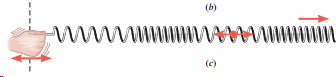
In Figure 16.3c the colored dot exhibits simple harmonic motion as the longitudinal wave passes. The wave has an amplitude of 5.4 × 10⁻³ m and a frequency of 4.0 Hz. Find the maximum acceleration of the dot.Figure 16.3c:
(a) A uniform rope of mass m and length L is hanging straight down from the ceiling. A small-amplitude transverse wave is sent up the rope from the bottom end. Derive an expression that gives the speed v of the wave on the rope in terms of the distance y above the bottom end of the rope and the
A spider hangs from a strand of silk whose radius is 4.0 × 10⁻⁶ m. The density of the silk is 1300 kg/m3. When the spider moves, waves travel along the strand of silk at a speed of 280 m/s. Ignore the mass of the silk strand, and determine the mass of the spider.
A jet is flying horizontally, as the drawing shows. When the plane is directly overhead at B, a person on the ground hears the sound coming from A in the drawing. The average temperature of the air is 20 8C. If the speed of the plane at A is 164 m/s, what is its speed at B, assuming that it has a
A water-skier is moving at a speed of 12.0 m/s. When she skis in the same direction as a traveling wave, she springs upward every 0.600 s because of the wave crests. When she skis in the direction opposite to the direction in which the wave moves, she springs upward every 0.500 s in response to the
Review Multiple-Concept Example 4 for background pertinent to this problem. A team of geophysicists is standing on the ground. Beneath their feet, at an unknown distance, is the ceiling of a cavern. The floor of the cavern is a distance h below this ceiling. To measure h, the team places
A speedboat, starting from rest, moves along a straight line away from a dock. The boat has a constant acceleration of 13.00 m/s2 (see the figure). Attached to the dock is a siren that is producing a 755-Hz tone. If the air temperature is 20 °C, what is the frequency of the sound heard by a person
The figure shows waves traveling on two strings. Each string is attached to a wall at one end and to a box that has a weight of 28.0 N at the other end. String 1 has a mass of 8.00 g and a length of 4.00 cm, and string 2 has a mass of 12.0 g and a length of 8.00 cm. Concepts:(i) Is the tension the
A siren, mounted on a tower, emits a sound whose frequency is 2140 Hz. A person is driving a car away from the tower at a speed of 27.0 m/s. As the figure illustrates, the sound reaches the person by two paths: the sound reflected from the building in front of the car, and the sound coming directly
The mass of a string is 5.0 × 10⁻³ kg, and it is stretched so that the tension in it is 180 N. A transverse wave traveling on this string has a frequency of 260 Hz and a wavelength of 0.60 m. What is the length of the string?
A wire is stretched between two posts. Another wire is stretched between two posts that are twice as far apart. The tension in the wires is the same, and they have the same mass. A transverse wave travels on the shorter wire with a speed of 240 m/s. What would be the speed of the wave on the longer
To measure the acceleration due to gravity on a distant planet, an astronaut hangs a 0.055-kg ball from the end of a wire. The wire has a length of 0.95 m and a linear density of 1.2 × 10⁻⁴ kg/m. Using electronic equipment, the astronaut measures the time for a transverse pulse to travel the
Two wires are parallel, and one is directly above the other. Each has a length of 50.0 m and a mass per unit length of 0.020 kg/m. However, the tension in wire A is 6.00 × 10² N, and the tension in wire B is 3.00 × 10² N. Transverse wave pulses are generated simultaneously, one at the left end of
A steel cable has a cross-sectional area 2.83 × 10⁻³ m2 and is kept under a tension of 1.00 × 10⁴ N. The density of steel is 7860 kg/m3. Note that this value is not the linear density of the cable. At what speed does a transverse wave move along the cable?
The drawing shows a graph of two waves traveling to the right at the same speed.(a) Using the data in the drawing, determine the wavelength of each wave.(b) The speed of the waves is 12 m/s; calculate the frequency of each one.(c) What is the maximum speed for a particle attached to each wave?
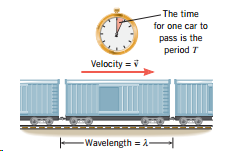
Consider the freight train in Figure 16.6. Suppose that 15 boxcars pass by in a time of 12.0 s and each has a length of 14.0 m.(a) What is the frequency at which each boxcar passes?(b) What is the speed of the train?Figure 16.6:
Review Conceptual Example 3 before starting this problem. The amplitude of a transverse wave on a string is 4.5 cm. The ratio of the maximum particle speed to the speed of the wave is 3.1. What is the wavelength (in cm) of the wave?
The drawing shows a frictionless incline and pulley. The two blocks are connected by a wire (mass per unit length = 0.0250 kg/m) and remain stationary. A transverse wave on the wire has a speed of 75.0 m/s. Neglecting the weight of the wire relative to the tension in the wire, find the masses m1
A copper wire, whose cross-sectional area is 1.1 × 10⁻⁶ m2, has a linear density of 9.8 × 10⁻³ kg/m and is strung between two walls. At the ambient temperature, a transverse wave travels with a speed of 46 m/s on this wire. The coefficient of linear expansion for copper is 17 × 10-6 (C°)-1, and
The drawing shows a 15.0-kg ball being whirled in a circular path on the end of a string. The motion occurs on a frictionless, horizontal table. The angular speed of the ball is ω = 12.0 rad/s. The string has a mass of 0.0230 kg. How much time does it take for a wave on the string to
A wave traveling along the x axis is described mathematically by the equation y = 0.17 sin (8.2pt + 0.54px), where y is the displacement (in meters), t is in seconds, and x is in meters. What is the speed of the wave?
A wave has the following properties: amplitude 5 0.37 m, period = 0.77 s, wave speed = 12 m/s. The wave is traveling in the - x direction. What is the mathematical expression (similar to Equation 16.3 or 16.4) for the wave?
The drawing shows a graph that represents a transverse wave on a string. The wave is moving in the + x direction with a speed of 0.15 m/s. Using the information contained in the graph, write the mathematical expression (similar to Equation 16.3 or 16.4) for the wave.
A transverse wave is traveling on a string. The displacement y of a particle from its equilibrium position is given by y = (0.021 m) sin (25t - 2.0 x). Note that the phase angle 25t - 2.0x is in radians, t is in seconds, and x is in meters. The linear density of the string is 1.6 × 10²² kg/m. What
A woman is standing in the ocean, and she notices that after a wave crest passes, five more crests pass in a time of 50.0 s. The distance between two successive crests is 32 m. Determine, if possible, the wave's (a) Period, (b) Frequency, (c) Wavelength, (d) Speed, (e) Amplitude. If it is not
A transverse wave on a string has an amplitude of 0.20 m and a frequency of 175 Hz. Consider the particle of the string at x = 0 m. It begins with a displacement of y = 0 m when t = 0 s, according to Equation 16.3 or 16.4. How much time passes between the first two instants when this particle has a
To navigate, a porpoise emits a sound wave that has a wavelength of 1.5 cm. The speed at which the wave travels in seawater is 1522 m/s. Find the period of the wave.
At what temperature is the speed of sound in helium (ideal gas, γ = 1.67, atomic mass = 4.003 u) the same as its speed in oxygen at 0 °C?
Have you ever listened for an approaching train by kneeling next to a railroad track and putting your ear to the rail? Young's modulus for steel is Y = 2.0 × 10¹¹ N/m2, and the density of steel is r = 7860 kg/m3. On a day when the temperature is 20 °C, how many times greater is the speed of sound
Showing 4300 - 4400
of 8241
First
37
38
39
40
41
42
43
44
45
46
47
48
49
50
51
Last
Step by Step Answers

 Get 50% OFF
Claim Now
Get 50% OFF
Claim Now


.png)
.png)
.png)
.png)
.png)
.png)
.png)
.png)
.png)
.png)
.png)
.png)
.png)
.png)
.png)
.png)


