New Semester
Started
Get
50% OFF
Study Help!
--h --m --s
Claim Now
Question Answers
Textbooks
Find textbooks, questions and answers
Oops, something went wrong!
Change your search query and then try again
S
Books
FREE
Study Help
Expert Questions
Accounting
General Management
Mathematics
Finance
Organizational Behaviour
Law
Physics
Operating System
Management Leadership
Sociology
Programming
Marketing
Database
Computer Network
Economics
Textbooks Solutions
Accounting
Managerial Accounting
Management Leadership
Cost Accounting
Statistics
Business Law
Corporate Finance
Finance
Economics
Auditing
Tutors
Online Tutors
Find a Tutor
Hire a Tutor
Become a Tutor
AI Tutor
AI Study Planner
NEW
Sell Books
Search
Search
Sign In
Register
study help
physics
modern physics
Physics 10th edition David Young, Shane Stadler - Solutions
A solenoid is formed by winding 25.0 m of insulated silver wire around a hollow cylinder. The turns are wound as closely as possible without overlapping, and the insulating coat on the wire is negligibly thin. When the solenoid is connected to an ideal (no internal resistance) 3.00-V battery, the
The figure shows two parallel, straight wires that are very long. The wires are separated by a distance of 0.065 m and carry currents of I1 = 15 A and I2 = 7.0 A. Find the magnitude and direction of the force that the magnetic field of wire 1 applies to a 1.5-m section of wire 2 when the currents
The figure shows a particle that carries a charge of q0 = -2.80 × 10⁻⁶ C. It is moving along the +y axis at a speed of v = 4.8 × 10⁶ m/s. A magnetic field of magnitude 3.35 × 10⁻⁵ T is directed along the +z axis, and an electric field of magnitude 123 N/C
A 125-turn rectangular coil of wire is hung from one arm of a balance, as the figure shows. With the magnetic field turned off, an object of mass M is added to the pan on the other arm to balance the weight of the coil.Concepts:(i) In a balanced, or equilibrium, condition the device has no angular
The drawing shows a parallel plate capacitor that is moving with a speed of 32 m/s through a 3.6-T magnetic field. The velocity is perpendicular to the magnetic field. The electric field within the capacitor has a value of 170 N/C, and each plate has an area of 7.5 × 10⁻⁴ m2. What is
You have a fixed length of conducting wire. From it you can construct a single-turn flat coil that has the shape of a square, a circle, or a rectangle with the long side twice the length of the short side. Each can be used with the same magnetic field to produce a generator that operates at the
An electric motor is plugged into a standard wall socket and is running at normal speed. Suddenly, some dirt prevents the shaft of the motor from turning quite so rapidly. What happens to the back emf of the motor, and what happens to the current that the motor draws from the wall socket? (a) The
Inductor 1 stores the same amount of energy as inductor 2, although it has only one-half the inductance of inductor 2. What is the ratio I1/I2 of the currents in the two inductors? (a) 2.000 (b) 1.414 (c) 4.000 (d) 0.500 (e) 0.250
The primary coil of a step-up transformer is connected across the terminals of a standard wall socket, and resistor 1 with a resistance R1 is connected across the secondary coil. The current in the resistor is then measured. Next, resistor 2 with a resistance R2 is connected directly across the
You have three light bulbs; bulb A has a resistance of 240 Ω, bulb B has a resistance of 192 Ω, and bulb C has a resistance of 144 Ω. Each of these bulbs is used for the same amount of time in a setup like the one in the drawing. In each case the speed of the rod and the magnetic field
The drawing shows a cube. The dashed lines in the drawing are perpendicular to faces 1, 2, and 3 of the cube. Magnetic fields are oriented with respect to these faces as shown, and each of the three fields 1, 2, and 3 has the same magnitude. Note that 2 is parallel to face 2 of the cube. Rank the
The drawing shows three fl at coils, one square and two rectangular, that are each being pushed into a region where there is a uniform magnetic field directed into the page. Outside of this region the magnetic field is zero. In each case the magnetic field within the region has the same magnitude,
A long, vertical, straight wire carries a current I. The wire is perpendicular to the plane of a circular metal loop and passes through the center of the loop (see the drawing). The loop is allowed to fall and maintains its orientation with respect to the straight wire while doing so. In what
The drawing shows a top view of two circular coils of conducting wire lying on a flat surface. The centers of the coils coincide. In the larger coil there are a switch and a battery. The smaller coil contains no switch and no battery. Describe the induced current that appears in the smaller coil
A 0.80-m aluminum bar is held with its length parallel to the east-west direction and dropped from a bridge. Just before the bar hits the river below, its speed is 22 m/s, and the emf induced across its length is 6.5 × 10⁻⁴ V. Assuming the horizontal component of the earth's magnetic field at the
Review Conceptual Example 3 and Figure 22.7b. A conducting rod slides down between two frictionless vertical copper tracks at a constant speed of 4.0 m/s perpendicular to a 0.50-T magnetic field. The resistance of the rod and tracks is negligible. The rod maintains electrical contact with the
Two fl at surfaces are exposed to a uniform, horizontal magnetic field of magnitude 0.47 T. When viewed edge-on, the first surface is tilted at an angle of 12° from the horizontal, and a net magnetic flux of 8.4 × 10⁻³ Wb passes through it. The same net magnetic flux passes through the second
A loop of wire has the shape shown in the drawing. The top part of the wire is bent into a semicircle of radius r = 0.20 m. The normal to the plane of the loop is parallel to a constant magnetic field (Ï• = 0°) of magnitude 0.75 T. What is the change ˆ†Ð¤F in the
A magnetic field has a magnitude of 0.078 T and is uniform over a circular surface whose radius is 0.10 m. The field is oriented at an angle of ϕ = 25° with respect to the normal to the surface. What is the magnetic flux through the surface?
A square loop of wire consisting of a single turn is perpendicular to a uniform magnetic field. The square loop is then re-formed into a circular loop, which also consists of a single turn and is also perpendicular to the same magnetic field. The magnetic flux that passes through the square loop is
A five-sided object, whose dimensions are shown in the drawing, is placed in a uniform magnetic field. The magnetic field has a magnitude of 0.25 T and points along the positive y direction. Determine the magnetic flux through each of the five sides.
A magnetic field passes through a stationary wire loop, and its magnitude changes in time according to the graph in the drawing. The direction of the field remains constant, however. There are three equal time intervals indicated in the graph: 0-3.0 s, 3.0-6.0 s, and 6.0-9.0 s. The loop consists of
A rectangular loop of wire with sides 0.20 and 0.35 m lies in a plane perpendicular to a constant magnetic field (see part a of the drawing). The magnetic field has a magnitude of 0.65 T and is directed parallel to the normal of the loop's surface. In a time of 0.18 s, one-half of the loop is then
Near San Francisco, where the vertically downward component of the earth's magnetic field is 4.8 × 10⁻⁵ T, a car is traveling forward at 25 m/s. The width of the car is 2.0 m. (a) Find the emf induced between the two sides of the car. (b) Which side of the car is positive-the driver's side or the
Magnetic resonance imaging (MRI) is a medical technique for producing pictures of the interior of the body. The patient is placed within a strong magnetic field. One safety concern is what would happen to the positively and negatively charged particles in the body fluids if an equipment failure
The magnetic flux that passes through one turn of a 12-turn coil of wire changes to 4.0 from 9.0 Wb in a time of 0.050 s. The average induced current in the coil is 230 A. What is the resistance of the wire?
A constant magnetic field passes through a single rectangular loop whose dimensions are 0.35 m × 0.55 m. The magnetic field has a magnitude of 2.1 T and is inclined at an angle of 65° with respect to the normal to the plane of the loop. (a) If the magnetic field decreases to zero in a time of
A uniform magnetic field is perpendicular to the plane of a single-turn circular coil. The magnitude of the field is changing, so that an emf of 0.80 V and a current of 3.2 A are induced in the coil. The wire is then re-formed into a single-turn square coil, which is used in the same magnetic field
A copper rod is sliding on two conducting rails that make an angle of 19° with respect to each other, as in the drawing. The rod is moving to the right with a constant speed of 0.60 m/s. A 0.38-T uniform magnetic field is perpendicular to the plane of the paper. Determine the magnitude of the
A flat coil of wire has an area A, N turns, and a resistance R. It is situated in a magnetic field, such that the normal to the coil is parallel to the magnetic field. The coil is then rotated through an angle of 90°, so that the normal becomes perpendicular to the magnetic field. The coil has an
A flat circular coil with 105 turns, a radius of 4.00 × 10⁻² m, and a resistance of 0.480 Ω is exposed to an external magnetic field that is directed perpendicular to the plane of the coil. The magnitude of the external magnetic field is changing at a rate of ∆B/∆t = 0.783 T/s, thereby
The drawing shows a coil of copper wire that consists of two semicircles joined by straight sections of wire. In part a the coil is lying fl at on a horizontal surface. The dashed line also lies in the plane of the horizontal surface. Starting from the orientation in part a, the smaller semicircle
In 1996, NASA performed an experiment called the Tethered Satellite experiment. In this experiment a 2.0 × 10⁴-m length of wire was let out by the space shuttle Atlantis to generate a motional emf. The shuttle had an orbital speed of 7.6 × 10³ m/s, and the magnitude of the earth's magnetic field
A conducting coil of 1850 turns is connected to a galvanometer, and the total resistance of the circuit is 45.0 Ω. The area of each turn is 4.70 × 10⁻⁴ m2. This coil is moved from a region where the magnetic field is zero into a region where it is nonzero, the normal to the coil being kept
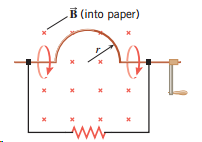
Starting from the position indicated in the drawing, the semicircular piece of wire rotates through half a revolution in the direction shown. Which end of the resistor is positive-the left or the right end? Explain your reasoning.
The drawing shows a straight wire carrying a current I. Above the wire is a rectangular loop that contains a resistor R. If the current I is decreasing in time, what is the direction of the induced current through the resistor R-left-to-right or right-to-left?
The drawing shows that a uniform magnetic field is directed perpendicularly into the plane of the paper and fills the entire region to the left of the y axis. There is no magnetic field to the right of the y axis. A rigid right triangle ABC is made of copper wire. The triangle rotates
A circular loop of wire rests on a table. A long, straight wire lies on this loop, directly over its center, as the drawing illustrates. The current I in the straight wire is decreasing. In what direction is the induced current, if any, in the loop? Give your reasoning.
The drawing shows a bar magnet falling through a metal ring. In part a the ring is solid all the way around, but in part b it has been cut through.(a) Explain why the motion of the magnet in part a is retarded when the magnet is above the ring and below the ring as well. Draw any induced currents
A wire loop is suspended from a string that is attached to point P in the drawing. When released, the loop swings downward, from left to right, through a uniform magnetic field, with the plane of the loop remaining perpendicular to the plane of the paper at all times.(a) Determine the direction of
The drawing shows a type of flow meter that can be used to measure the speed of blood in situations when a blood vessel is sufficiently exposed (e.g., during surgery). Blood is conductive enough that it can be treated as a moving conductor. When it flows perpendicularly with respect to a magnetic
A 120.0-V motor draws a current of 7.00 A when running at normal speed. The resistance of the armature wire is 0.720 Ω. (a) Determine the back emf generated by the motor. (b) What is the current at the instant when the motor is just turned on and has not begun to rotate? (c) What series resistance
You need to design a 60.0-Hz ac generator that has a maximum emf of 5500 V. The generator is to contain a 150-turn coil that has an area per turn of 0.85 m2. What should be the magnitude of the magnetic field in which the coil rotates?
The maximum strength of the earth's magnetic field is about 6.9 × 10⁻⁵ T near the south magnetic pole. In principle, this field could be used with a rotating coil to generate 60.0-Hz ac electricity. What is the minimum number of turns (area per turn = 0.022 m2) that the coil must have to produce
A vacuum cleaner is plugged into a 120.0-V socket and uses 3.0 A of current in normal operation when the back emf generated by the electric motor is 72.0 V. Find the coil resistance of the motor.
A generator uses a coil that has 100 turns and a 0.50-T magnetic field. The frequency of this generator is 60.0 Hz, and its emf has an rms value of 120 V. Assuming that each turn of the coil is a square (an approximation), determine the length of the wire from which the coil is made
The coil of a generator has a radius of 0.14 m. When this coil is unwound, the wire from which it is made has a length of 5.7 m. The magnetic field of the generator is 0.20 T, and the coil rotates at an angular speed of 25 rad/s. What is the peak emf of this generator?
A motor is designed to operate on 117 V and draws a current of 12.2 A when it first starts up. At its normal operating speed, the motor draws a current of 2.30 A. Obtain (a) The resistance of the armature coil, (b) The back emf developed at normal speed, and (c) The current drawn by the motor at
The current through a 3.2-mH inductor varies with time according to the graph shown in the drawing. What is the average induced emf during the time intervals(a) 0-2.0 ms,(b) 2.0-5.0 ms, and(c) 5.0-9.0 ms?
Two coils of wire are placed close together. Initially, a current of 2.5 A exists in one of the coils, but there is no current in the other. The current is then switched off in a time of 3.7 × 10⁻² s. During this time, the average emf induced in the other coil is 1.7 V. What is the mutual
During a 72-ms interval, a change in the current in a primary coil occurs. This change leads to the appearance of a 6.0-mA current in a nearby secondary coil. The secondary coil is part of a circuit in which the resistance is 12 Ω. The mutual inductance between the two coils is 3.2 mH. What is the
Mutual induction can be used as the basis for a metal detector. A typical setup uses two large coils that are parallel to each other and have a common axis. Because of mutual induction, the ac generator connected to the primary coil causes an emf of 0.46 V to be induced in the secondary coil. When
A constant current of I = 15 A exists in a solenoid whose inductance is L = 3.1 H. The current is then reduced to zero in a certain amount of time. (a) If the current goes from 15 to 0 A in a time of 75 ms, what is the emf induced in the solenoid? (b) How much electrical energy is stored in the
Suppose you wish to make a solenoid whose self-inductance is 1.4 mH. The inductor is to have a cross-sectional area of 1.2 × 10⁻³ m2 and a length of 0.052 m. How many turns of wire are needed?
A long, current-carrying solenoid with an air core has 1750 turns per meter of length and a radius of 0.0180 m. A coil of 125 turns is wrapped tightly around the outside of the solenoid, so it has virtually the same radius as the solenoid. What is the mutual inductance of this system?
A 5.40 × 10⁻⁵ H solenoid is constructed by wrapping 65 turns of wire around a cylinder with a cross sectional area of 9.0 × 10⁻⁴ m2. When the solenoid is shortened by squeezing the turns closer together, the inductance increases to 8.60 × 10⁻⁵ H. Determine the change in the length of the
A long solenoid (cross-sectional area = 1.0 × 10⁻⁶ m2, number of turns per unit length = 2400 turns/m) is bent into a circular shape so it looks like a donut. This wire-wound donut is called a toroid. Assume that the diameter of the solenoid is small compared to the radius of the toroid, which is
Coil 1 is a fl at circular coil that has N1 turns and a radius R1. At its center is a much smaller flat, circular coil that has N2 turns and radius R2. The planes of the coils are parallel. Assume that coil 2 is so small that the magnetic field due to coil 1 has nearly the same value at all points
Two circuits contain an emf produced by a moving metal rod, like that shown in Figure 22.4b. The speed of the rod is the same in each circuit, but the bulb in circuit 1 has one-half the resistance of the bulb in circuit 2. The circuits are otherwise identical. The resistance of the light bulb in
The battery charger for an MP3 player contains a step-down transformer with a turns ratio of 1:32, so that the voltage of 120 V available at a wall socket can be used to charge the battery pack or operate the player. What voltage does the secondary coil of the transformer provide?
The secondary coil of a step-up transformer provides the voltage that operates an electrostatic air filter. The turns ratio of the transformer is 50:1. The primary coil is plugged into a standard 120-V outlet. The current in the secondary coil is 1.7 × 10⁻³ A. Find the power consumed by the air
The rechargeable batteries for a laptop computer need a much smaller voltage than what a wall socket provides. Therefore, a transformer is plugged into the wall socket and produces the necessary voltage for charging the batteries. The batteries are rated at 9.0 V, and a current of 225 mA is used to
The resistances of the primary and secondary coils of a transformer are 56 and 14 Ω, respectively. Both coils are made from lengths of the same copper wire. The circular turns of each coil have the same diameter. Find the turns ratio Ns/Np.
A transformer consisting of two coils wrapped around an iron core is connected to a generator and a resistor, as shown in the drawing. There are 11 turns in the primary coil and 18 turns in the secondary coil. The peak voltage across the resistor is 67 V. What is the peak emf of the generator?
In a television set the power needed to operate the picture tube comes from the secondary of a transformer. The primary of the transformer is connected to a 120-V receptacle on a wall. The picture tube of the television set uses 91 W, and there is 5.5 mA of current in the secondary coil of the
Suppose there are two transformers between your house and the high-voltage transmission line that distributes the power. In addition, assume that your house is the only one using electric power. At a substation the primary coil of a step-down transformer (turns ratio = 1:29) receives the voltage
A generator is connected across the primary coil (Np turns) of a transformer, while a resistance R2 is connected across the secondary coil (Ns turns). This circuit is equivalent to a circuit in which a single resistance R1 is connected directly across the generator, without the transformer. Show
Refer to the drawing that accompanies Check Your Understanding Question 14. Suppose that the voltage of the battery in the circuit is 3.0 V, the magnitude of the magnetic field (directed perpendicularly into the plane of the paper) is 0.60 T, and the length of the rod between the rails is 0.20 m.
In each of two coils the rate of change of the magnetic flux in a single loop is the same. The emf induced in coil 1, which has 184 loops, is 2.82 V. The emf induced in coil 2 is 4.23 V. How many loops does coil 2 have?
A planar coil of wire has a single turn. The normal to this coil is parallel to a uniform and constant (in time) magnetic field of 1.7 T. An emf that has a magnitude of 2.6 V is induced in this coil because the coil's area A is shrinking. What is the magnitude of DA/Dt, which is the rate (in m2/s)
In some places, insect "zappers," with their blue lights, are a familiar sight on a summer's night. These devices use a high voltage to electrocute insects. One such device uses an ac voltage of 4320 V, which is obtained from a standard 120.0-V outlet by means of a transformer. If the primary coil
At its normal operating speed, an electric fan motor draws only 15.0% of the current it draws when it just begins to turn the fan blade. The fan is plugged into a 120.0-V socket. What back emf does the motor generate at its normal operating speed?
Parts a and b of the drawing show the same uniform and constant (in time) magnetic field directed perpendicularly into the paper over a rectangular region. Outside this region, there is no field. Also shown is a rectangular coil (one turn), which lies in the plane of the paper. In part a the long
Indicate the direction of the electric field between the plates of the parallel plate capacitor shown in the drawing if the magnetic field is decreasing in time. Give your reasoning.
Multiple-Concept Example 2 discusses the concepts that are used in this problem. Suppose that the magnetic field in Figure 22.5 has a magnitude of 1.2 T, the rod has a length of 0.90 m, and the hand keeps the rod moving to the right at a constant speed of 3.5 m/s. If the current in the circuit is
The purpose of this problem is to show that the work W needed to establish a final current If in an inductor is W = 1/2 LI2f (Equation 22.10). In Section 22.8 we saw that the amount of work ˆ†W needed to change the current through an inductor by an amount ˆ†I is ˆ†W =
A solenoid has a cross-sectional area of 6.0 × 10⁻⁴ m2, consists of 400 turns per meter, and carries a current of 0.40 A. A 10-turn coil is wrapped tightly around the circumference of the solenoid. The ends of the coil are connected to a 1.5-Ω resistor. Suddenly, a switch is opened, and the
A 60.0-Hz generator delivers an average power of 75 W to a single light bulb. When an induced current exists in the rotating coil of a generator, a torque-called a countertorque-is exerted on the coil. Determine the maximum countertorque in the generator coil.
A circular coil of radius 0.11 m contains a single turn and is located in a constant magnetic field of magnitude 0.27 T. The magnetic field has the same direction as the normal to the plane of the coil. The radius increases to 0.30 m in a time of 0.080 s. Concepts: (i) Why is there an emf induced
The graph in the figure shows the emf produced by a generator as a function of time t. The coil for the generator has an area of A = 0.15 m2 and consists of N = 10 turns. The coil rotates in a field of magnitude 0.27 T.Concepts:(i) Can the period of the rotating coil be determined from the
A circuit contains an ac generator and a resistor. What happens to the average power dissipated in the resistor when the frequency is doubled and the rms voltage is tripled? (a) Nothing happens, because the average power does not depend on either the frequency or the rms voltage. (b) The
A capacitor and an inductor are connected to an ac generator in two ways: in series and in parallel (see the drawing). At low frequencies, which circuit has the greater current? (a) The series circuit, because the impedance of the circuit is small due to the small reactances of both the
In an RCL circuit a second capacitor is added in parallel to the capacitor already present. Does the resonant frequency of the circuit increase, decrease, or remain the same? (a) The resonant frequency increases, because it depends inversely on the square root of the capacitance, and the
What happens to the capacitive reactance XC and the inductive reactance XL if the frequency of the ac voltage is doubled? (a) XC increases by a factor of 2, and XL decreases by a factor of 2. (b) XC and XL both increase by a factor of 2. (c) XC and XL do not change. (d) XC and
An inductor has an inductance of 0.080 H. The voltage across this inductor is 55 V and has a frequency of 650 Hz. What is the current in the inductor?
An inductor is to be connected to the terminals of a generator (rms voltage = 15.0 V) so that the resulting rms current will be 0.610 A. Determine the required inductive reactance.
An ac generator has a frequency of 7.5 kHz and a voltage of 39 V. When an inductor is connected between the terminals of this generator, the current in the inductor is 42 mA. What is the inductance of the inductor?
A 40.0-µF capacitor is connected across a 60.0-Hz generator. An inductor is then connected in parallel with the capacitor. What is the value of the inductance if the rms currents in the inductor and capacitor are equal?
An ac generator has a frequency of 2.2 kHz and a voltage of 240 V. An inductance L1 = 6.0 mH is connected across its terminals. Then a second inductance L2 = 9.0 mH is connected in parallel with L1. Find the current that the generator delivers to L1 and to the parallel combination.
Two inductors are connected in parallel across the terminals of a generator. One has an inductance of L1 = 0.030 H, and the other has an inductance of L2 = 0.060 H. A single inductor, with an inductance L, is connected across the terminals of a second generator that has the same frequency and
A series RCL circuit contains a 47.0-Ω resistor, a 2.00-µF capacitor, and a 4.00-mH inductor. When the frequency is 2550 Hz, what is the power factor of the circuit?
Two identical capacitors are connected in parallel to an ac generator that has a frequency of 610 Hz and produces a voltage of 24 V. The current in the circuit is 0.16 A. What is the capacitance of each capacitor?
An ac series circuit has an impedance of 192 V, and the phase angle between the current and the voltage of the generator is ϕ = -75°. The circuit contains a resistor and either a capacitor or an inductor. Find the resistance R and the capacitive reactance XC or the inductive reactance XL,
When only a resistor is connected across the terminals of an ac generator (112 V) that has a fixed frequency, there is a current of 0.500 A in the resistor. When only an inductor is connected across the terminals of this same generator, there is a current of 0.400 A in the inductor. When both the
A 2700-Ω resistor and a 1.1-µF capacitor are connected in series across a generator (60.0 Hz, 120 V). Determine the power delivered to the circuit.
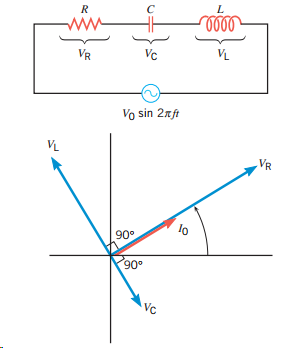
Suppose that the inductance is zero (L = 0H) in the series RCL circuit shown in Figure 23.10. The rms voltages across the generator and the resistor are 45 and 24 V, respectively. What is the rms voltage across the capacitor?
Part a of the drawing shows a resistor and a charged capacitor wired in series. When the switch is closed, the capacitor discharges as charge moves from one plate to the other. Part b shows the amount q of charge remaining on each plate of the capacitor as a function of time. In part c of the
In one measurement of the body's bioelectric impedance, values of Z = 4.50 × 10² V and ϕ = -9.80° are obtained for the total impedance and the phase angle, respectively. These values assume that the body's resistance R is in series with its capacitance C and that there is no inductance L.
A series RCL circuit contains only a capacitor (C = 6.60 µF), an inductor (L = 7.20 mH), and a generator (peak voltage = 32.0 V, frequency = 1.50 × 10³ Hz). When t = 0 s, the instantaneous value of the voltage is zero, and it rises to a maximum one-quarter of a period later. (a) Find the
An 84.0-mH inductor and a 5.80-µF capacitor are connected in series with a generator whose frequency is 375 Hz. The rms voltage across the capacitor is 2.20 V. Determine the rms voltage across the inductor.
Showing 4800 - 4900
of 8241
First
42
43
44
45
46
47
48
49
50
51
52
53
54
55
56
Last
Step by Step Answers

 Get 50% OFF
Claim Now
Get 50% OFF
Claim Now


.png)
.png)
.png)
.png)
.png)
.png)
.png)
.png)
.png)
.png)
.png)
.png)
.png)
.png)
.png)
.png)
.png)
.png)
.png)
.png)
.png)
.png)
.png)
.png)
.png)
.png)
.png)
.png)
.png)
.png)
.png)
.png)
.png)


