New Semester
Started
Get
50% OFF
Study Help!
--h --m --s
Claim Now
Question Answers
Textbooks
Find textbooks, questions and answers
Oops, something went wrong!
Change your search query and then try again
S
Books
FREE
Study Help
Expert Questions
Accounting
General Management
Mathematics
Finance
Organizational Behaviour
Law
Physics
Operating System
Management Leadership
Sociology
Programming
Marketing
Database
Computer Network
Economics
Textbooks Solutions
Accounting
Managerial Accounting
Management Leadership
Cost Accounting
Statistics
Business Law
Corporate Finance
Finance
Economics
Auditing
Tutors
Online Tutors
Find a Tutor
Hire a Tutor
Become a Tutor
AI Tutor
AI Study Planner
NEW
Sell Books
Search
Search
Sign In
Register
study help
physics
modern physics
Physics 10th edition David Young, Shane Stadler - Solutions
Suppose you are part of a team that is trying to break the sound barrier with a jet-powered car, which means that it must travel faster than the speed of sound in air. In the morning, the air temperature is 0 °C, and the speed of sound is 331 m/s. What speed must your car exceed if it is to break
As the drawing illustrates, a siren can be made by blowing a jet of air through 20 equally spaced holes in a rotating disk. The time it takes for successive holes to move past the air jet is the period of the sound. The siren is to produce a 2200-Hz tone. What must be the angular speed ω
At a height of ten meters above the surface of a freshwater lake, a sound pulse is generated. The echo from the bottom of the lake returns to the point of origin 0.110 s later. The air and water temperature are 20 °C. How deep is the lake?
An observer stands 25 m behind a marksman practicing at a rifle range. The marksman fires the rifle horizontally, the speed of the bullets is 840 m/s, and the air temperature is 20 °C. How far does each bullet travel before the observer hears the report of the rifle? Assume that the bullets
Tsunamis are fast-moving waves often generated by underwater earthquakes. In the deep ocean their amplitude is barely noticeable, but upon reaching shore, they can rise up to the astonishing height of a six-story building. One tsunami, generated off the Aleutian islands in Alaska, had a wavelength
An ultrasonic ruler, such as the one discussed in Example 4 in Section 16.6, displays the distance between the ruler and an object, such as a wall. The ruler sends out a pulse of ultrasonic sound and measures the time it takes for the pulse to reflect from the object and return. The ruler uses this
An explosion occurs at the end of a pier. The sound reaches the other end of the pier by traveling through three media: air, fresh water, and a slender metal handrail. The speeds of sound in air, water, and the handrail are 343, 1482, and 5040 m/s, respectively. The sound travels a distance of 125
A sound wave travels twice as far in neon (Ne) as it does in krypton (Kr) in the same time interval. Both neon and krypton can be treated as monatomic ideal gases. The atomic mass of neon is 20.2 u, and the atomic mass of krypton is 83.8 u. The temperature of the krypton is 293 K. What is the
A monatomic ideal gas (γ = 1.67) is contained within a box whose volume is 2.5 m3. The pressure of the gas is 3.5 × 10⁵ Pa. The total mass of the gas is 2.3 kg. Find the speed of sound in the gas.
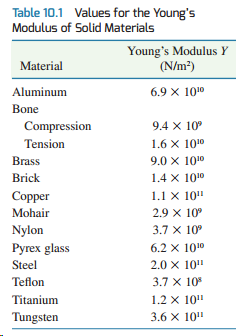
A long slender bar is made from an unknown material. The length of the bar is 0.83 m, its cross-sectional area is 1.3 × 10⁻⁴ m2, and its mass is 2.1 kg. A sound wave travels from one end of the bar to the other end in 1.9 × 10⁻⁴ s. From which one of the materials listed in Table 10.1 is the bar
As the drawing shows, one microphone is located at the origin, and a second microphone is located on the + y axis. The microphones are separated by a distance of D = 1.50 m. A source of sound is located on the + x axis, its distances from microphones 1 and 2 being L1 and L2, respectively. The speed
Consult Multiple-Concept Example 4 in order to review a model for solving this type of problem. Suppose that you are standing by the side of a road in the Sahara desert where the temperature has reached a hot 56 °C (130 °F). A truck, traveling at a constant speed, passes by. After 4.00 s have
In a mixture of argon (atomic mass = 39.9 u) and neon (atomic mass = 20.2 u), the speed of sound is 363 m/s at 3.00 × 10² K. Assume that both monatomic gases behave as ideal gases. Find the percentage of the atoms that are argon and the percentage that are neon.
Refer to Multiple-Concept Example 4 for a review of the concepts that play roles in this problem. Civil engineers use a transit theodolite when surveying. One version of this device determines distance by measuring the time required for an ultrasonic pulse to reach a target, reflect from it, and
A source of sound is located at the center of two concentric spheres, parts of which are shown in the drawing. The source emits sound uniformly in all directions. On the spheres are drawn three small patches that may or may not have equal areas. However, the same sound power passes through each
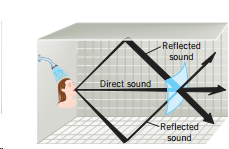
Suppose that in Conceptual Example 8 (see Figure 16.24) the person is producing 1.1 mW of sound power. Some of the sound is reflected from the floor and ceiling. The intensity of this reflected sound at a distance of 3.0 m from the source is 4.4 × 10⁻⁶ W/m2. What is the total sound intensity due
Suppose that a public address system emits sound uniformly in all directions and that there are no reflections. The intensity at a location 22 m away from the sound source is 3.0 × 10⁻⁴ W/m2. What is the intensity at a spot that is 78 m away?
A man stands at the midpoint between two speakers that are broadcasting an amplified static hiss uniformly in all directions. The speakers are 30.0 m apart and the total power of the sound coming from each speaker is 0.500 W. Find the total sound intensity that the man hears (a) When he is at his
A person fishing from a pier observes that four wave crests pass by in 7.0 s and estimates the distance between two successive crests to be 4.0 m. The timing starts with the first crest and ends with the fourth. What is the speed of the wave?
Two sources of sound are located on the x axis, and each emits power uniformly in all directions. There are no reflections. One source is positioned at the origin and the other at x = + 123 m. The source at the origin emits four times as much power as the other source. Where on the x axis are the
Deep ultrasonic heating is used to promote healing of torn tendons. It is produced by applying ultrasonic sound over the affected area of the body. The sound transducer (generator) is circular with a radius of 1.8 cm, and it produces a sound intensity of 5.9 × 10³ W/m2. How much time is required
A rocket, starting from rest, travels straight up with an acceleration of 58.0 m/s2. When the rocket is at a height of 562 m, it produces sound that eventually reaches a ground-based monitoring station directly below. The sound is emitted uniformly in all directions. The monitoring station measures
A woman stands a distance d from a loud motor that emits sound uniformly in all directions. The sound intensity at her position is an uncomfortable 3.2 × 10⁻³ W/m2. There are no reflections. At a position twice as far from the motor, what are (a) The sound intensity (b) The sound intensity level
The volume control on a surround-sound amplifier is adjusted so the sound intensity level at the listening position increases from 23 to 61 dB. What is the ratio of the final sound intensity to the original sound intensity?
A listener doubles his distance from a source that emits sound uniformly in all directions. There are no refl ections. By how many decibels does the sound intensity level change?
Sound is passing perpendicularly through an open window whose dimensions are 1.1 m × 0.75 m. The sound intensity level is 95 dB above the threshold of hearing. How much sound energy comes through the window in one hour?
The bellow of a territorial bull hippopotamus has been measured at 115 dB above the threshold of hearing. What is the sound intensity?
Using the data in the graphs that accompany this problem, determine the speed of the wave.
Hearing damage may occur when a person is exposed to a sound intensity level of 90.0 dB (relative to the threshold of hearing) for a period of 9.0 hours. One particular eardrum has an area of 2.0 × 10⁻⁴ m2. How much sound energy is incident on this eardrum during this time?
A portable radio is sitting at the edge of a balcony 5.1 m above the ground. The unit is emitting sound uniformly in all directions. By accident, it falls from rest off the balcony and continues to play on the way down. A gardener is working in a flower bed directly below the falling unit. From the
A source emits sound uniformly in all directions. A radial line is drawn from this source. On this line, determine the positions of two points, 1.00 m apart, such that the intensity level at one point is 2.00 dB greater than the intensity level at the other.
A bird is flying directly toward a stationary bird-watcher and emits a frequency of 1250 Hz. The bird-watcher, however, hears a frequency of 1290 Hz. What is the speed of the bird, expressed as a percentage of the speed of sound?
Dolphins emit clicks of sound for communication and echolocation. A marine biologist is monitoring a dolphin swimming in seawater where the speed of sound is 1522 m/s. When the dolphin is swimming directly away at 8.0 m/s, the marine biologist measures the number of clicks occurring per second to
A convertible moves toward you and then passes you; all the while, its loudspeakers are producing a sound. The speed of the car is a constant 9.00 m/s, and the speed of sound is 343 m/s. What is the ratio of the frequency you hear while the car is approaching to the frequency you hear while the car
A 3.49-rad/s (33 1/3rpm) record has a 5.00-kHz tone cut in the groove. If the groove is located 0.100 m from the center of the record (see drawing), what is the wavelength in the groove?
The security alarm on a parked car goes off and produces a frequency of 960 Hz. The speed of sound is 343 m/s. As you drive toward this parked car, pass it, and drive away, you observe the frequency to change by 95 Hz. At what speed are you driving?
A car is parked 20.0 m directly south of a railroad crossing. A train is approaching the crossing from the west, headed directly east at a speed of 55.0 m/s. The train sounds a short blast of its 289-Hz horn when it reaches a point 20.0 m west of the crossing. What frequency does the car's driver
A loudspeaker in a parked car is producing sound whose frequency is 20 510 Hz. A healthy young person with normal hearing is standing nearby on the sidewalk but cannot hear the sound because the frequency is too high. When the car is moving, however, this person can hear the sound. (a) Is the car
A wireless transmitting microphone is mounted on a small platform that can roll down an incline, directly away from a loudspeaker that is mounted at the top of the incline. The loudspeaker broadcasts a tone that has a fixed frequency of 1.000 × 10⁴ Hz, and the speed of sound is 343 m/s. At a time
A car is accelerating while its horn is sounding. Just after the car passes a stationary person, the person hears a frequency of 966.0 Hz. Fourteen seconds later, the frequency heard by the person has decreased to 912.0 Hz. When the car is stationary, its horn emits a sound whose frequency is 1.00
The siren on an ambulance is emitting a sound whose frequency is 2450 Hz. The speed of sound is 343 m/s.(a) If the ambulance is stationary and you (the "observer") are sitting in a parked car, what are the wavelength and the frequency of the sound you hear?(b) Suppose that the ambulance is moving
A microphone is attached to a spring that is suspended from the ceiling, as the drawing indicates. Directly below on the floor is a stationary 440-Hz source of sound. The microphone vibrates up and down in simple harmonic motion with a period of 2.0 s. The difference between the maximum and minimum
A recording engineer works in a soundproofed room that is 44.0 dB quieter than the outside. If the sound intensity that leaks into the room is 1.20 × 10⁻¹⁰ W/m2, what is the intensity outside?
A sound wave travels in air toward the surface of a freshwater lake and enters into the water. The frequency of the sound does not change when the sound enters the water. The wavelength of the sound is 2.74 m in the air, and the temperature of both the air and the water is 20 °C. What is the
You are flying in an ultralight aircraft at a speed of 39 m/s. An eagle, whose speed is 18 m/s, is flying directly toward you. Each of the given speeds is relative to the ground. The eagle emits a shrill cry whose frequency is 3400 Hz. The speed of sound is 330 m/s. What frequency do you hear?
A car driving along a highway at a speed of 23 m/s strays onto the shoulder. Evenly spaced parallel grooves called "rumble strips" are carved into the pavement of the shoulder. Rolling over the rumble strips causes the car's wheels to oscillate up and down at a frequency of 82 Hz. How far apart are
The average sound intensity inside a busy neighborhood restaurant is 3.2 × 10⁻⁵ W/m2. How much energy goes into each ear (area = 2.1 × 10⁻³ m2) during a one-hour meal?
A bat emits a sound whose frequency is 91 kHz. The speed of sound in air at 20.0 °C is 343 m/s. However, the air temperature is 35 °C, so the speed of sound is not 343 m/s. Assume that air behaves like an ideal gas, and find the wavelength of the sound.
Two transverse standing waves are shown in the drawing. The strings have the same tension and length, but the bottom string is more massive. Which standing wave, if either, is vibrating at the higher frequency?(a) The top standing wave has the higher frequency, because the traveling waves have a
A standing wave on a string fixed at both ends is vibrating at its fourth harmonic. If the length, tension, and linear density are kept constant, what can be said about the wavelength and frequency of the fifth harmonic relative to the fourth harmonic? (a) The wavelength of the fifth harmonic is
A longitudinal standing wave is established in a tube that is open at both ends (see the drawing). The length of the tube is 0.80 m. What is the wavelength of the waves that make up the standing wave?(a) 0.20 m(b) 0.40 m(c) 0.80 m(d) 1.20 m(e) 1.60 m
A longitudinal standing wave is established in a tube open at only one end (see the drawing). The frequency of the standing wave is 660 Hz, and the speed of sound in air is 343 m/s. What is the length of the tube?(a) 0.13 m(b) 0.26 m(c) 0.39 m(d) 0.52 m(e) 0.65 m
Two cellists, one seated directly behind the other in an orchestra, play the same note for the conductor, who is directly in front of them. Because of the separation between the cellists, destructive interference occurs at the conductor. This separation is the smallest that produces destructive
A loudspeaker is producing sound of a certain wavelength. Which combination of the wavelength λ (expressed as a multiple of λ0) and the speaker's diameter D (expressed as a multiple of D0) would exhibit the greatest amount of diffraction when the sound leaves the speaker and enters the room? (a)
Sound of a given frequency leaves a loudspeaker and spreads out due to diffraction. The speaker is placed in a room that contains either air or helium. The speed of sound in helium is about three times as great as the speed of sound in air. In which room, if either, does the sound exhibit the
Two musicians are comparing their trombones. The first produces a tone that is known to be 438 Hz. When the two trombones play together they produce 6 beats every 2 seconds. Which statement is true about the second trombone? (a) It is producing either a 432-Hz sound or a 444-Hz sound. (b) It is
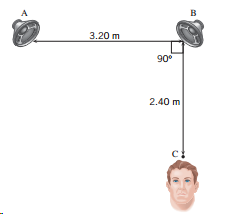
In Figure 17.7, suppose that the separation between speakers A and B is 5.00 m and the speakers are vibrating in phase. They are playing identical 125-Hz tones, and the speed of sound is 343 m/s. What is the largest possible distance between speaker B and the observer at C, such that he observes
A listener is standing in front of two speakers that are producing sound of the same frequency and amplitude, except that they are vibrating out of phase. Initially, the distance between the listener and each speaker is the same (see the drawing). As the listener moves sideways, the sound intensity
Speakers A and B are vibrating in phase. They are directly facing each other, are 7.80 m apart, and are each playing a 73.0-Hz tone. The speed of sound is 343 m/s. On the line between the speakers there are three points where constructive interference occurs. What are the distances of these three
Consult Multiple-Concept Example 3 for background pertinent to this problem. A speaker has a diameter of 0.30 m. (a) Assuming that the speed of sound is 343 m/s, find the diffraction angle u for a 2.0-kHz tone. (b) What speaker diameter D should be used to generate a 6.0-kHz tone whose diffraction
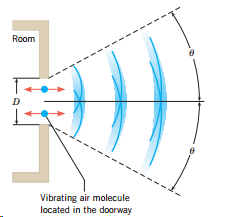
For one approach to problems such as this, see Multiple-Concept Example 3. Sound emerges through a doorway, as in Figure 17.10. The width of the doorway is 77 cm, and the speed of sound is 343 m/s. Find the diffraction angle u when the frequency of the sound isFigure 17.10:(a) 5.0 kHz(b) 5.0 × 10²
The following two lists give the diameters and sound frequencies for three loudspeakers. Pair each diameter with a frequency, so that the diffraction angle is the same for each of the speakers, and then find the common diffraction angle. Take the speed of sound to be 343 m/s. Diameter, D
A 3.00-kHz tone is being produced by a speaker with a diameter of 0.175 m. The air temperature changes from 0 to 29 8C. Assuming air to be an ideal gas, find the change in the diffraction angle u.
Sound (speed = 343 m/s) exits a diffraction horn loudspeaker through a rectangular opening like a small doorway. A person is sitting at an angle a off to the side of a diffraction horn that has a width D of 0.060 m. This individual does not hear a sound wave that has a frequency of 8100 Hz. When
Two speakers, one directly behind the other, are each generating a 245-Hz sound wave. What is the smallest separation distance between the speakers that will produce destructive interference at a listener standing in front of them? The speed of sound is 343 m/s.
Two pianos each sound the same note simultaneously, but they are both out of tune. On a day when the speed of sound is 343 m/s, piano A produces a wavelength of 0.769 m, while piano B produces a wavelength of 0.776 m. How much time separates successive beats?
A 440.0-Hz tuning fork is sounded together with an out-of-tune guitar string, and a beat frequency of 3 Hz is heard. When the string is tightened, the frequency at which it vibrates increases, and the beat frequency is heard to decrease. What was the original frequency of the guitar string?
Two ultrasonic sound waves combine and form a beat frequency that is in the range of human hearing for a healthy young person. The frequency of one of the ultrasonic waves is 70 kHz. What are (a) The smallest possible (b) The largest possible value for the frequency of the other ultrasonic wave?
Two cars have identical horns, each emitting a frequency of fs = 395 Hz. One of the cars is moving with a speed of 12.0 m/s toward a bystander waiting at a corner, and the other car is parked. The speed of sound is 343 m/s. What is the beat frequency heard by the bystander?
A sound wave is traveling in seawater, where the adiabatic bulk modulus and density are 2.31 × 10⁹ Pa and 1025 kg/m3, respectively. The wavelength of the sound is 3.35 m. A tuning fork is struck under water and vibrates at 440.0 Hz. What would be the beat frequency heard by an underwater swimmer?
Two loudspeakers are mounted on a merry-go-round whose radius is 9.01 m. When stationary, the speakers both play a tone whose frequency is 100.0 Hz. As the drawing illustrates, they are situated at opposite ends of a diameter. The speed of sound is 343.00 m/s, and the merry-go-round revolves once
The fundamental frequency of a string fixed at both ends is 256 Hz. How long does it take for a wave to travel the length of this string?
A string that is fixed at both ends has a length of 2.50 m. When the string vibrates at a frequency of 85.0 Hz, a standing wave with five loops is formed. (a) What is the wavelength of the waves that travel on the string? (b) What is the speed of the waves? (c) What is the fundamental frequency of
Two wires, each of length 1.2 m, are stretched between two fixed supports. On wire A there is a second-harmonic standing wave whose frequency is 660 Hz. However, the same frequency of 660 Hz is the third harmonic on wire B. Find the speed at which the individual waves travel on each wire.
To review the concepts that play roles in this problem, consult Multiple-Concept Example 4. Sometimes, when the wind blows across a long wire, a low-frequency "moaning" sound is produced. This sound arises because a standing wave is set up on the wire, like a standing wave on a guitar string.
A string has a linear density of 8.5 × 10⁻³ kg/m and is under a tension of 280 N. The string is 1.8 m long, is fixed at both ends, and is vibrating in the standing wave pattern shown in the drawing. Determine the(a) Speed,(b) Wavelength,(c) Frequency of the traveling waves that make up
A copper block is suspended from a wire, as in part 1 of the drawing. A container of mercury is then raised up around the block, as in part 2, so that 50.0% of the block's volume is submerged in the mercury. The density of copper is 8890 kg/m3, and that of mercury is 13 600 kg/m3. Find the ratio of
The drawing shows two strings that have the same length and linear density. The left end of each string is attached to a wall, while the right end passes over a pulley and is connected to objects of different weights (WA and WB). Different standing waves are set up on each string, but their
Standing waves are set up on two strings fixed at each end, as shown in the drawing. The two strings have the same tension and mass per unit length, but they differ in length by 0.57 cm. The waves on the shorter string propagate with a speed of 41.8 m/s, and the fundamental frequency of the shorter
Loudspeakers A and B are vibrating in phase and are playing the same tone, which has a frequency of 250 Hz. They are set up as in Figure 17.7, and point C is located as shown there. However, the distance between the speakers and the distance between speaker B and point C have the same value d. The
A tube with a cap on one end, but open at the other end, has a fundamental frequency of 130.8 Hz. The speed of sound is 343 m/s (a) If the cap is removed, what is the new fundamental frequency of the tube? (b) How long is the tube?
An organ pipe is open at both ends. It is producing sound at its third harmonic, the frequency of which is 262 Hz. The speed of sound is 343 m/s. What is the length of the pipe?
The range of human hearing is roughly from twenty hertz to twenty kilohertz. Based on these limits and a value of 343 m/s for the speed of sound, what are the lengths of the longest and shortest pipes (open at both ends and producing sound at their fundamental frequencies) that you expect to find
The fundamental frequencies of two air columns are the same. Column A is open at both ends, while column B is open at only one end. The length of column A is 0.70 m. What is the length of column B?
A piccolo and a flute can be approximated as cylindrical tubes with both ends open. The lowest fundamental frequency produced by one kind of piccolo is 587.3 Hz, and that produced by one kind of flute is 261.6 Hz. What is the ratio of the piccolo's length to the flute's length?
A thin 1.2-m aluminum rod sustains a longitudinal standing wave with vibration antinodes at each end of the rod. There are no other antinodes. The density and Young's modulus of aluminum are, respectively, 2700 kg/m3 and 6.9 × 10¹⁰ N/m2. What is the frequency of the rod's vibration?
A vertical tube is closed at one end and open to air at the other end. The air pressure is 1.01 × 10⁵ Pa. The tube has a length of 0.75 m. Mercury (mass density = 13 600 kg/m3) is poured into it to shorten the effective length for standing waves. What is the absolute pressure at the bottom of the
Two ideal gases have the same temperature and the same value for g (the ratio of the specific heat capacities at constant pressure and constant volume). A molecule of gas A has a mass of 7.31 × 10226 kg, and a molecule of gas B has a mass of 1.06 × 10⁻²⁵ kg. When gas A (speed of sound = 259 m/s)
A tube, open at only one end, is cut into two shorter (nonequal) lengths. The piece that is open at both ends has a fundamental frequency of 425 Hz, while the piece open only at one end has a fundamental frequency of 675 Hz. What is the fundamental frequency of the original tube?
A string is fixed at both ends and is vibrating at 130 Hz, which is its third harmonic frequency. The linear density of the string is 5.6 × 10⁻³ kg/m, and it is under a tension of 3.3 N. Determine the length of the string.
One method for measuring the speed of sound uses standing waves. A cylindrical tube is open at both ends, and one end admits sound from a tuning fork. A movable plunger is inserted into the other end at a distance L from the end of the tube where the tuning fork is. For a fixed frequency, the
A pipe open only at one end has a fundamental frequency of 256 Hz. A second pipe, initially identical to the first pipe, is shortened by cutting off a portion of the open end. Now, when both pipes vibrate at their fundamental frequencies, a beat frequency of 12 Hz is heard. How many centimeters
Divers working in underwater chambers at great depths must deal with the danger of nitrogen narcosis (the "bends"), in which nitrogen dissolves into the blood at toxic levels. One way to avoid this danger is for divers to breathe a mixture containing only helium and oxygen. Helium, however, has the
The drawing graphs a string on which two pulses (half up and half down) are traveling at a constant speed of 1 cm/s at t = 0 s. Using the principle of linear superposition, draw the shape of the string at t = 1 s, 2 s, 3 s, and 4 s.
Both drawings show the same square, each of which has a side of length L = 0.75 m. An observer O is stationed at one corner of each square. Two loudspeakers are located at corners of the square, as in either drawing 1 or drawing 2. The speakers produce the same single-frequency tone in either
Two strings have different lengths and linear densities, as the drawing shows. They are joined together and stretched so that the tension in each string is 190.0 N. The free ends of the joined string are fixed in place. Find the lowest frequency that permits standing waves in both strings with a
The two speakers in the drawing are vibrating in phase, and a listener is standing at point P. Does constructive or destructive interference occur at P when the speakers produce sound waves whose frequency is(a) 1466 Hz(b) 977 Hz? Justify your answers with appropriate calculations. Take the speed
Two carpenters are hammering at the same time, each at a different hammering frequency. The hammering frequency is the number of hammer blows per second. Every 4.6 s, both carpenters strike at the same instant, producing an effect very similar to a beat frequency. The first carpenter strikes a blow
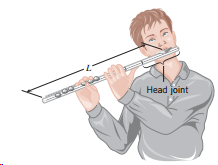
A flautist is playing a flute as discussed in Example 6, but now the temperature is 305 K instead of 293 K. As a result, the speed of sound is no longer 343 m/s. Therefore, with the length calculated in Example 6, the note middle C does not have the proper fundamental frequency of 261.6 Hz. In
A sound wave with a frequency of 15 kHz emerges through a circular opening that has a diameter of 0.20 m.Concepts:(i) The diffraction angle for a wave emerging through a circular opening is given by sin u 5 1.22 l/D, where l is the wavelength of the sound and D is the diameter of the opening. What
Showing 4400 - 4500
of 8241
First
38
39
40
41
42
43
44
45
46
47
48
49
50
51
52
Last
Step by Step Answers

 Get 50% OFF
Claim Now
Get 50% OFF
Claim Now


.png)
.png)
.png)
.png)
.png)
.png)
.png)
.png)
.png)
.png)
.png)
.png)
.png)
.png)
.png)
.png)
.png)
.png)
.png)
.png)