New Semester
Started
Get
50% OFF
Study Help!
--h --m --s
Claim Now
Question Answers
Textbooks
Find textbooks, questions and answers
Oops, something went wrong!
Change your search query and then try again
S
Books
FREE
Study Help
Expert Questions
Accounting
General Management
Mathematics
Finance
Organizational Behaviour
Law
Physics
Operating System
Management Leadership
Sociology
Programming
Marketing
Database
Computer Network
Economics
Textbooks Solutions
Accounting
Managerial Accounting
Management Leadership
Cost Accounting
Statistics
Business Law
Corporate Finance
Finance
Economics
Auditing
Tutors
Online Tutors
Find a Tutor
Hire a Tutor
Become a Tutor
AI Tutor
AI Study Planner
NEW
Sell Books
Search
Search
Sign In
Register
study help
physics
modern physics
Physics 10th edition David Young, Shane Stadler - Solutions
The drawing shows a lower leg being exercised. It has a 49-N weight attached to the foot and is extended at an angle u with respect to the vertical. Consider a rotational axis at the knee.(a) When u 5 90.08, find the magnitude of the torque that the weight creates.(b) At what angle u does the
A solid disk rotates in the horizontal plane at an angular velocity of 0.067 rad/s with respect to an axis perpendicular to the disk at its center. The moment of inertia of the disk is 0.10 kg ∙ m2. From above, sand is dropped straight down onto this rotating disk, so that a thin uniform ring of
A solid cylindrical disk has a radius of 0.15 m. It is mounted to an axle that is perpendicular to the circular end of the disk at its center. When a 45-N force is applied tangentially to the disk, perpendicular to the radius, the disk acquires an angular acceleration of 120 rad/s2. What is the
A block (mass = 2.0 kg) is hanging from a massless cord that is wrapped around a pulley (moment of inertia = 1.1 x 10⁻³ kg • m2), as the drawing shows. Initially the pulley is prevented from rotating and the block is stationary. Then, the pulley is allowed to rotate as the block falls. The cord
The drawing shows an outstretched arm (0.61 m in length) that is parallel to the floor. The arm is pulling downward against the ring attached to the pulley system, in order to hold the 98-N weight stationary. To pull the arm downward, the latissimus dorsi muscle applies the force in the drawing, at
A thin, rigid, uniform rod has a mass of 2.00 kg and a length of 2.00 m.(a) Find the moment of inertia of the rod relative to an axis that is perpendicular to the rod at one end.(b) Suppose all the mass of the rod were located at a single point. Determine the perpendicular distance of this point
Two identical wheels are moving on horizontal surfaces. The center of mass of each has the same linear speed. However, one wheel is rolling, while the other is sliding on a frictionless surface without rolling. Each wheel then encounters an incline plane. One continues to roll up the incline, while
An inverted "V" is made of uniform boards and weighs 356 N. Each side has the same length and makes a 30.0° angle with the vertical, as the drawing shows. Find the magnitude of the static frictional force that acts on the lower end of each leg of the "V."
One end of a meter stick is pinned to a table, so the stick can rotate freely in a plane parallel to the tabletop. Two forces, both parallel to the tabletop, are applied to the stick in such a way that the net torque is zero. The first force has a magnitude of 2.00 N and is applied perpendicular to
By means of a rope whose mass is negligible, two blocks are suspended over a pulley, as the drawing shows. The pulley can be treated as a uniform solid cylindrical disk. The downward acceleration of the 44.0-kg block is observed to be exactly one-half the acceleration due to gravity. Noting that
A crate of mass 451 kg is being lifted by the mechanism shown in part a of the figure. The two cables are wrapped around their respective pulleys, which have radii of 0.600 and 0.200 m. The pulleys are fastened together to form a dual pulley and turn as a single unit about the center axle, relative
The figure shows a uniform crate resting on a horizontal surface. The crate has a square cross section and a weight of W = 580 N, which is uniformly distributed. At the bottom right edge of the surface is a small obstruction that prevents the crate from sliding when a horizontal pushing force is
Two spheres are each rotating at an angular speed of 24 rad/s about axes that pass through their centers. Each has a radius of 0.20 m and a mass of 1.5 kg. However, as the figure shows, one is solid and the other is a thin-walled spherical shell. Suddenly, a net external torque due to friction
A rod is lying on the top of a table. One end of the rod is hinged to the table so that the rod can rotate freely on the tabletop. Two forces, both parallel to the tabletop, act on the rod at the same place. One force is directed perpendicular to the rod and has a magnitude of 38.0 N. The second
The kinetic energy of an object attached to a horizontal ideal spring is denoted by KE and the elastic potential energy by PE. For the simple harmonic motion of this object the maximum kinetic energy and the maximum elastic potential energy during an oscillation cycle are KEmax and PEmax,
A block is attached to a horizontal spring. On top of this block rests another block. The two-block system slides back and forth in simple harmonic motion on a frictionless horizontal surface. At one extreme end of the oscillation cycle, where the blocks come to a momentary halt before reversing
Five simple pendulums are shown in the drawings. The lengths of the pendulums are drawn to scale, and the masses are either m or 2m, as shown. Which pendulum has the smallest angular frequency of oscillation?(a) A(b) B(c) C(d) D(e) E
An external force (in addition to the spring force) is continually applied to an object of mass m attached to a spring that has a spring constant k. The frequency of this external force is such that resonance occurs. Then the frequency of this external force is doubled, and the force is applied to
Drawings A and B show two cylinders that are identical in all respects, except that one is hollow. Identical forces are applied to each cylinder in order to stretch them. Which cylinder, if either, stretches more?(a) A and B both stretch by the same amount.(b) A stretches more than B.(c) B
Which one of the following graphs correctly represents the restoring force F of an ideal spring as a function of the displacement x of the spring from its unstrained length?
You have two springs. One has a greater spring constant than the other. You also have two objects, one with a greater mass than the other. Which object should be attached to which spring, so that the resulting spring-object system has the greatest possible period of oscillation? (a) The object with
To measure the static friction coefficient between a 1.6-kg block and a vertical wall, the setup shown in the drawing is used. A spring (spring constant = 510 N/m) is attached to the block. Someone pushes on the end of the spring in a direction perpendicular to the wall until the block does not
A 30.0-kg block is resting on a flat horizontal table. On top of this block is resting a 15.0-kg block, to which a horizontal spring is attached, as the drawing illustrates. The spring constant of the spring is 325 N/m. The coefficient of kinetic friction between the lower block and the table is
A 15.0-kg block rests on a horizontal table and is attached to one end of a massless, horizontal spring. By pulling horizontally on the other end of the spring, someone causes the block to accelerate uniformly and reach a speed of 5.00 m/s in 0.500 s. In the process, the spring is stretched by
The fan blades on a jet engine make one thousand revolutions in a time of 50.0 ms. Determine (a) The period (in seconds) (b) The frequency (in Hz) of the rotational motion. (c) What is the angular frequency of the blades?
A block of mass m = 0.750 kg is fastened to an unstrained horizontal spring whose spring constant is k = 82.0 N/m. The block is given a displacement of + 0.120 m, where the 1 sign indicates that the displacement is along the + x axis and then released from rest. (a) What is the force (magnitude and
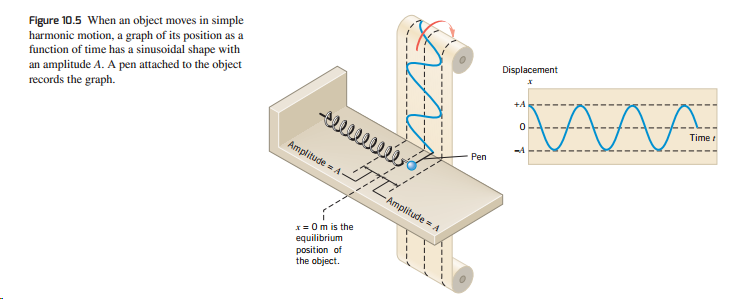
An 0.80-kg object is attached to one end of a spring, as in Figure 10.5, and the system is set into simple harmonic motion. The displacement x of the object as a function of time is shown in the drawing. With the aid of these data, determine(a) The amplitude A of the motion,(b) The angular
The drawing shows three identical springs hanging from the ceiling.Nothing is attached to the first spring, whereas a 4.50-N block hangs from the second spring. A block of unknown weight hangs from the third spring. From the drawing, determine(a) The spring constant (in N/m) and(b) The weight of
Objects of equal mass are oscillating up and down in simple harmonic motion on two different vertical springs. The spring constant of spring 1 is 174 N/m. The motion of the object on spring 1 has twice the amplitude as the motion of the object on spring 2. The magnitude of the maximum velocity is
A spring stretches by 0.018 m when a 2.8-kg object is suspended from its end. How much mass should be attached to this spring so that its frequency of vibration is f = 3.0 Hz?
An object attached to a horizontal spring is oscillating back and forth along a frictionless surface. The maximum speed of the object is 1.25 m/s, and its maximum acceleration is 6.89 m/s2. How much time elapses between an instant when the object's speed is at a maximum and the next instant when
A vertical spring (spring constant = 112 N/m) is mounted on the floor. A 0.400-kg block is placed on top of the spring and pushed down to start it oscillating in simple harmonic motion. The block is not attached to the spring. (a) Obtain the frequency (in Hz) of the motion. (b) Determine the
A tray is moved horizontally back and forth in simple harmonic motion at a frequency of f = 2.00 Hz. On this tray is an empty cup. Obtain the coefficient of static friction between the tray and the cup, given that the cup begins slipping when the amplitude of the motion is 5.00 × 10⁻² m.
A pen contains a spring with a spring constant of 250 N/m. When the tip of the pen is in its retracted position, the spring is compressed 5.0 mm from its unstrained length. In order to push the tip out and lock it into its writing position, the spring must be compressed an additional 6.0 mm. How
The drawing shows three situations in which a block is attached to a spring. The position labeled "0 m" represents the unstrained position of the spring. The block is moved from an initial position x0 to a final position xf, the magnitude of the displacement being denoted by the symbol s. Suppose
A spring is hung from the ceiling. A 0.450-kg block is then attached to the free end of the spring. When released from rest, the block drops 0.150 m before momentarily coming to rest, after which it moves back upward. (a) What is the spring constant of the spring? (b) Find the angular frequency
A 3.2-kg block is hanging stationary from the end of a vertical spring that is attached to the ceiling. The elastic potential energy of this spring block system is 1.8 J. What is the elastic potential energy of the system when the 3.2-kg block is replaced by a 5.0-kg block?
In a room that is 2.44 m high, a spring (unstrained length = 0.30 m) hangs from the ceiling. A board whose length is 1.98 m is attached to the free end of the spring. The board hangs straight down, so that its 1.98-m length is perpendicular to the floor. The weight of the board (104 N) stretches
In preparation for shooting a ball in a pinball machine, a spring (k = 675 N/m) is compressed by 0.0650 m relative to its unstrained length. The ball (m = 0.0585 kg) is at rest against the spring at point A. When the spring is released, the ball slides (without rolling). It leaves the spring and
A heavy-duty stapling gun uses a 0.140-kg metal rod that rams against the staple to eject it. The rod is attached to and pushed by a stiff spring called a "ram spring" (k = 32 000 N/m). The mass of this spring may be ignored. The ram spring is compressed by 3.0 × 10⁻² m from its unstrained length
A rifle fires a 2.10 × 10⁻²-kg pellet straight upward, because the pellet rests on a compressed spring that is released when the trigger is pulled. The spring has a negligible mass and is compressed by 9.10 × 10⁻² m from its unstrained length. The pellet rises to a maximum height of 6.10 m above
An 86.0-kg climber is scaling the vertical wall of a mountain. His safety rope is made of nylon that, when stretched, behaves like a spring with a spring constant of 1.20 × 10³ N/m. He accidentally slips and falls freely for 0.750 m before the rope runs out of slack. How much is the rope stretched
A horizontal spring is lying on a frictionless surface. One end of the spring is attached to a wall, and the other end is connected to a movable object. The spring and object are compressed by 0.065 m, released from rest, and subsequently oscillate back and forth with an angular frequency of 11.3
A spring is resting vertically on a table. A small box is dropped onto the top of the spring and compresses it. Suppose the spring has a spring constant of 450 N/m and the box has a mass of 1.5 kg. The speed of the box just before it makes contact with the spring is 0.49 m/s.(a) Determine the
Review Conceptual Example 8 before starting this problem. A block is attached to a horizontal spring and oscillates back and forth on a frictionless horizontal surface at a frequency of 3.00 Hz. The amplitude of the motion is 5.08 × 10⁻² m. At the point where the block has its maximum speed, it
A spring lies on a horizontal table, and the left end of the spring is attached to a wall. The other end is connected to a box. The box is pulled to the right, stretching the spring. Static friction exists between the box and the table, so when the spring is stretched only by a small amount and the
A 1.1-kg object is suspended from a vertical spring whose spring constant is 120 N/m. (a) Find the amount by which the spring is stretched from its unstrained length. (b) The object is pulled straight down by an additional distance of 0.20 m and released from rest. Find the speed with which the
A 1.00 × 10⁻²-kg bullet is fired horizontally into a 2.50-kg wooden block attached to one end of a massless horizontal spring (k = 845 N/m). The other end of the spring is fixed in place, and the spring is unstrained initially. The block rests on a horizontal, frictionless surface. The bullet
A simple pendulum is made from a 0.65-m-long string and a small ball attached to its free end. The ball is pulled to one side through a small angle and then released from rest. After the ball is released, how much time elapses before it attains its greatest speed?
Astronauts on a distant planet set up a simple pendulum of length 1.2 m. The pendulum executes simple harmonic motion and makes 100 complete vibrations in 280 s. What is the magnitude of the acceleration due to gravity on this planet?
A spiral staircase winds up to the top of a tower in an old castle. To measure the height of the tower, a rope is attached to the top of the tower and hung down the center of the staircase. However, nothing is available with which to measure the length of the rope. Therefore, at the bottom of the
Two physical pendulums (not simple pendulums) are made from meter sticks that are suspended from the ceiling at one end. The sticks are uniform and are identical in all respects, except that one is made of wood (mass = 0.17 kg) and the other of metal (mass = 0.85 kg). They are set into oscillation
Multiple-Concept Example 11 explores the concepts that are important in this problem. Pendulum A is a physical pendulum made from a thin, rigid, and uniform rod whose length is d. One end of this rod is attached to the ceiling by a frictionless hinge, so the rod is free to swing back and forth.
Multiple-Concept Example 11 provides some pertinent background for this problem. A pendulum is constructed from a thin, rigid, and uniform rod with a small sphere attached to the end opposite the pivot. This arrangement is a good approximation to a simple pendulum (period = 0.66 s), because the
A small object oscillates back and forth at the bottom of a frictionless hemispherical bowl, as the drawing illustrates. The radius of the bowl is R, and the angle u is small enough that the object oscillates in simple harmonic motion. Derive an expression for the angular frequency v of the motion.
Two stretched cables both experience the same stress. The first cable has a radius of 3.5 × 10⁻³ m and is subject to a stretching force of 270 N. The radius of the second cable is 5.1 × 10⁻³ m. Determine the stretching force acting on the second cable.
When subjected to a force of compression, the length of a bone decreases by 2.7 × 10⁻⁵ m. When this same bone is subjected to a tensile force of the same magnitude, by how much does it stretch?
A 59-kg water skier is being pulled by a nylon tow rope that is attached to a boat. The unstretched length of the rope is 12 m, and its cross-sectional area is 2.0 × 10⁻⁵ m2. As the skier moves, a resistive force (due to the water) of magnitude 130 N acts on her; this force is directed opposite to
A solid steel cylinder is standing (on one of its ends) vertically on the floor. The length of the cylinder is 3.6 m and its radius is 65 cm. When an object is placed on top of the cylinder, the cylinder compresses by an amount of 5.7 × 10⁻⁷ m. What is the weight of the object?
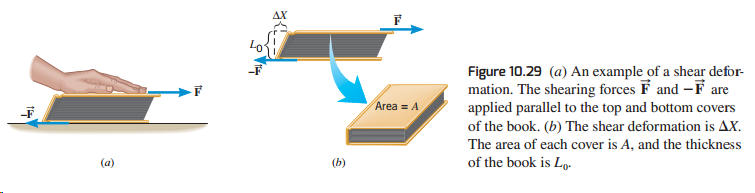
The drawing shows a 160-kg crate hanging from the end of a steel bar. The length of the bar is 0.10 m, and its cross-sectional area is 3.2 × 10⁻⁴ m2.Neglect the weight of the bar itself and determine(a) The shear stress on the bar(b) The vertical deflection DY of the right end of the bar.
A copper cube, 0.30 m on a side, is subjected to two shearing forces, each of which has a magnitude F = 6.0 × 10⁶ N (see the drawing). Find the angle u (in degrees), which is one measure of how the shape of the block has been altered by shear deformation.
A spring (k = 830 N/m) is hanging from the ceiling of an elevator, and a 5.0-kg object is attached to the lower end. By how much does the spring stretch (relative to its unstrained length) when the elevator is accelerating upward at α = 0.60 m/s2?
A copper cylinder and a brass cylinder are stacked end to end, as in the drawing. Each cylinder has a radius of 0.25 cm. A compressive force of F = 6500 N is applied to the right end of the brass cylinder. Find the amount by which the length of the stack decreases.
A piece of aluminum is surrounded by air at a pressure of 1.01 × 10⁵ Pa. The aluminum is placed in a vacuum chamber where the pressure is reduced to zero. Determine the fractional change ∆V/V0 in the volume of the aluminum.
One end of a piano wire is wrapped around a cylindrical tuning peg and the other end is fixed in place. The tuning peg is turned so as to stretch the wire. The piano wire is made from steel (Y = 2.0 × 10¹¹ N/m2). It has a radius of 0.80 mm and an unstrained length of 0.76 m. The radius of the
A die is designed to punch holes with a radius of 1.00 × 10⁻² m in a metal sheet that is 3.0 × 10⁻³ m thick, as the drawing illustrates. To punch through the sheet, the die must exert a shearing stress of 3.5 × 10⁸ Pa. What force must be applied to the die?
A piece of mohair taken from an Angora goat has a radius of 31 × 10-6 m. What is the least number of identical pieces of mohair needed to suspend a 75-kg person, so the strain experienced by each piece is less than 0.010? Assume that the tension is the same in all the pieces.
Two rods are identical in all respects except one: one rod is made from aluminum and the other from tungsten. The rods are joined end to end, in order to make a single rod that is twice as long as either the aluminum or tungsten rod. What is the effective value of Young's modulus for this composite
A square plate is 1.0 × 10⁻² m thick, measures 3.0 × 10⁻² m on a side, and has a mass of 7.2 × 10⁻² kg. The shear modulus of the material is 2.0 × 10¹⁰ N/m2. One of the square faces rests on a flat horizontal surface, and the coefficient of static friction between the plate and the surface is
A gymnast does a one-arm handstand. The humerus, which is the upper arm bone (between the elbow and the shoulder joint), may be approximated as a 0.30-m-long cylinder with an outer radius of 1.00 × 10⁻² m and a hollow inner core with a radius of 4.0 × 10⁻³ m. Excluding the arm, the mass of the
Depending on how you fall, you can break a bone easily. The severity of the break depends on how much energy the bone absorbs in the accident, and to evaluate this let us treat the bone as an ideal spring. The maximum applied force of compression that one man's thighbone can endure without breaking
A 0.70-kg block is hung from and stretches a spring that is attached to the ceiling. A second block is attached to the first one, and the amount that the spring stretches from its unstrained length triples. What is the mass of the second block?
A 61-kg snow skier is being pulled up a 128 slope by a steel cable. The cable has a cross-sectional area of 7.8 × 10⁻⁵ m2. The cable applies a force to the skier, and, in doing so, the cable stretches by 2.0 × 10⁻⁴ m. A frictional force of magnitude 68 N acts on the skis and is directed opposite
A loudspeaker diaphragm is producing a sound for 2.5 s by moving back and forth in simple harmonic motion. The angular frequency of the motion is 7.54 × 10⁴ rad/s. How many times does the diaphragm move back and forth?
A person bounces up and down on a trampoline, while always staying in contact with it. The motion is simple harmonic motion, and it takes 1.90 s to complete one cycle. The height of each bounce above the equilibrium position is 45.0 cm. Determine (a) The amplitude and (b) The angular frequency of
A simple pendulum is swinging back and forth through a small angle, its motion repeating every 1.25 s. How much longer should the pendulum be made in order to increase its period by 0.20 s?
An archer, about to shoot an arrow, is applying a force of +240 N to a drawn bowstring. The bow behaves like an ideal spring whose spring constant is 480 N/m. What is the displacement of the bowstring?
A uniform 1.4-kg rod that is 0.75 m long is suspended at rest from the ceiling by two springs, one at each end of the rod. Both springs hang straight down from the ceiling. The springs have identical lengths when they are unstretched. Their spring constants are 59 N/m and 33 N/m. Find the angle
Between each pair of vertebrae in the spinal column is a cylindrical disc of cartilage. Typically, this disc has a radius of about 3.0 × 10⁻² m and a thickness of about 7.0 × 10⁻³ m. The shear modulus of cartilage is 1.2 × 10⁷ N/m2. Suppose that a shearing force of magnitude 11 N is applied
A block rests on a frictionless horizontal surface and is attached to a spring. When set into simple harmonic motion, the block oscillates back and forth with an angular frequency of 7.0 rad/s. The drawing indicates the position of the block when the spring is unstrained. This position is labeled
A vertical ideal spring is mounted on the floor and has a spring constant of 170 N/m. A 0.64-kg block is placed on the spring in two different ways. (a) In one case, the block is placed on the spring and not released until it rests stationary on the spring in its equilibrium position. Determine
Multiple-Concept Example 6 reviews the principles that play roles in this problem. A bungee jumper, whose mass is 82 kg, jumps from a tall platform. After reaching his lowest point, he continues to oscillate up and down, reaching the low point two more times in 9.6 s. Ignoring air resistance and
When an object of mass m1 is hung on a vertical spring and set into vertical simple harmonic motion, it oscillates at a frequency of 12.0 Hz. When another object of mass m2 is hung on the spring along with the first object, the frequency of the motion is 4.00 Hz. Find the ratio m2/m1 of the masses.
A 0.200-m uniform bar has a mass of 0.750 kg and is released from rest in the vertical position, as the drawing indicates. The spring is initially unstrained and has a spring constant of k = 25.0 N/m. Find the tangential speed with which end A strikes the horizontal surface.
A cylindrically shaped piece of collagen (a substance found in the body in connective tissue) is being stretched by a force that increases from 0 to 3.0 × 10⁻² N. The length and radius of the collagen are, respectively, 2.5 and 0.091 cm, and Young's modulus is 3.1 × 10⁶
A copper rod (length = 2.0 m, radius = 3.0 × 10⁻³ m) hangs down from the ceiling. A 9.0-kg object is attached to the lower end of the rod. The rod acts as a "spring," and the object oscillates vertically with a small amplitude. Ignoring the rod's mass, find the frequency f of the simple harmonic
A helicopter is using a steel cable to lift a 2100-kg jeep (see the figure). The unstretched length of the cable is 16 m, and its radius is 5.0 × 10⁻³ m. By what amount does the cable stretch when the jeep is hoisted straight upward with an acceleration of + 1.5 m/s2?The jeep applies a force -
A 75-kg diver is standing at the end of a diving board while it is vibrating up and down in simple harmonic motion, as indicated in the figure. The diving board has an effective spring constant of k = 4100 N/m, and the vertical distance between the highest and lowest points in the motion is 0.30
A 68.0-kg bungee jumper is standing on a tall platform (L0 = 46.0 m), as indicated in the figure. The bungee cord has a natural length of L0 = 9.00 m and, when stretched, behaves like an ideal spring with a spring constant of k = 66.0 N/m. The jumper falls from rest, and it is assumed that the only
The drawing shows three containers filled to the same height with the same fluid. In which container, if any, is the pressure at the bottom greatest?(a) Container A, because its bottom has the greatest surface area.(b) All three containers have the same pressure at the bottom.(c) Container A,
Three solid objects are floating in a liquid, as in the drawing. They have different weights and volumes, but have the same thickness (the dimension perpendicular to the page). Rank the objects according to their density, largest first. (a) A, B, C (b) A, C, B (c) B, A, C (d) B, C, A (e) C, A,
A hollow pipe is submerged in a stream of water so that the length of the pipe is parallel to the velocity of the water. If the water speed doubles and the cross-sectional area of the pipe triples, what happens to the volume flow rate of the water passing through the pipe? (a) The volume flow rate
In the drawing, water flows from a wide section of a pipe to a narrow section. In which part of the pipe is the volume flow rate the greatest?(a) The wide section(b) The narrow section(c) The volume flow rate is the same in both sections of the pipe.
Blood flows through a section of a horizontal artery that is partially blocked by a deposit along the artery wall. A hemoglobin molecule moves from the narrow region into the wider region. What happens to the pressure acting on the molecule?(a) The pressure increases.(b) The pressure decreases.(c)
Water is flowing down through the pipe shown in the drawing. Point A is at a higher elevation than B and C are. The cross-sectional areas are the same at A and B but are wider at C. Rank the pressures at the three points, largest first.(a) PA, PB, PC(b) PC, PB, PA(c) PB, PC, PA
A viscous fluid is flowing through two horizontal pipes. The pressure difference P2 - P1 between the ends of each pipe is the same. The pipes have the same radius, although one is twice as long as the other. How does the volume flow rate QB in the longer pipe compare with the rate QA in the shorter
Two liquids, 1 and 2, are in equilibrium in a U-tube that is open at both ends, as in the drawing. The liquids do not mix, and liquid 1 rests on top of liquid 2. How is the density ρ1 of liquid 1 related to the density ρ2 of liquid 2? (a) ρ1 is equal to ρ2 because the liquids are in
An antifreeze solution is made by mixing ethylene glycol (ρ = 1116 kg/m3) with water. Suppose that the specific gravity of such a solution is 1.0730. Assuming that the total volume of the solution is the sum of its parts, determine the volume percentage of ethylene glycol in the solution.
A gold prospector finds a solid rock that is composed solely of quartz and gold. The mass and volume of the rock are, respectively, 12.0 kg and 4.00 × 10⁻³ m3. Find the mass of the gold in the rock.
A fountain sends a stream of water straight up into the air to a maximum height of 5.00 m. The effective cross-sectional area of the pipe feeding the fountain is 5.00 × 10⁻⁴ m2. Neglecting air resistance and any viscous effects, determine how many gallons per minute are being used by the fountain.
Showing 4000 - 4100
of 8241
First
34
35
36
37
38
39
40
41
42
43
44
45
46
47
48
Last
Step by Step Answers

 Get 50% OFF
Claim Now
Get 50% OFF
Claim Now


.png)
.png)
.png)
.png)
.png)
.png)
.png)
.png)
.png)
.png)
.png)
.png)
.png)
.png)
.png)
.png)
.png)
.png)
.png)
.png)
.png)
.png)
.png)
.png)
.png)
.png)
.png)
.png)
.png)
.png)
.png)
.png)
.png)


