New Semester
Started
Get
50% OFF
Study Help!
--h --m --s
Claim Now
Question Answers
Textbooks
Find textbooks, questions and answers
Oops, something went wrong!
Change your search query and then try again
S
Books
FREE
Study Help
Expert Questions
Accounting
General Management
Mathematics
Finance
Organizational Behaviour
Law
Physics
Operating System
Management Leadership
Sociology
Programming
Marketing
Database
Computer Network
Economics
Textbooks Solutions
Accounting
Managerial Accounting
Management Leadership
Cost Accounting
Statistics
Business Law
Corporate Finance
Finance
Economics
Auditing
Tutors
Online Tutors
Find a Tutor
Hire a Tutor
Become a Tutor
AI Tutor
AI Study Planner
NEW
Sell Books
Search
Search
Sign In
Register
study help
physics
modern physics
Physics 10th edition David Young, Shane Stadler - Solutions
At a distance of 1.60 m from a point charge of +2.00 µC, there is an equipotential surface. At greater distances there are additional equipotential surfaces. The potential difference between any two successive surfaces is 1.00 × 10³ V. Starting at a distance of 1.60 m and moving radially outward,
The drawing shows a uniform electric field that points in the negative y direction; the magnitude of the field is 3600 N/C. Determine the electric potential difference (a) VB - VA between points A and B, (b) VC - VB between points B and C, and (c) VA - VC between points C and A.
What is the capacitance of a capacitor that stores 4.3 µC of charge on its plates when a voltage of 1.5 V is applied between them?
Two identical capacitors store different amounts of energy: capacitor A stores 3.1 × 10⁻³ J, and capacitor B stores 3.4 × 10⁻⁴ J. The voltage across the plates of capacitor B is 12 V. Find the voltage across the plates of capacitor A.
The electronic flash attachment for a camera contains a capacitor for storing the energy used to produce the flash. In one such unit, the potential difference between the plates of an 850-µF capacitor is 280 V.(a) Determine the energy that is used to produce the flash in this unit.(b) Assuming
The same voltage is applied between the plates of two different capacitors. When used with capacitor A, this voltage causes the capacitor to store 11µC of charge and 5.0 × 10⁻⁵ J of energy. When used with capacitor B, which has a capacitance of 6.7 µF, this voltage causes the capacitor to store
A parallel plate capacitor has a capacitance of 7.0 µF when filled with a dielectric. The area of each plate is 1.5 m2 and the separation between the plates is 1.0 × 10⁻⁵ m. What is the dielectric constant of the dielectric?
Two capacitors are identical, except that one is empty and the other is filled with a dielectric (k = 4.50). The empty capacitor is connected to a 12.0-V battery. What must be the potential difference across the plates of the capacitor filled with a dielectric so that it stores the same amount of
The membrane that surrounds a certain type of living cell has a surface area of 5.0 × 10⁻⁹ m2 and a thickness of 1.0 × 10⁻⁸m. Assume that the membrane behaves like a parallel plate capacitor and has a dielectric constant of 5.0. (a) The potential on the outer surface of the membrane is +60.0 mV
Multiple-Concept Example 3 employs some of the concepts that are needed here. An electric car accelerates for 7.0 s by drawing energy from its 290-V battery pack. During this time, 1200 C of charge passes through the battery pack. Find the minimum horsepower rating of the car.
Capacitor A and capacitor B both have the same voltage across their plates. However, the energy of capacitor A can melt m kilograms of ice at 0 °C, while the energy of capacitor B can boil away the same amount of water at 100 °C. The capacitance of capacitor A is 9.3 µF. What is the capacitance
What is the potential difference between the plates of a 3.3-F capacitor that stores sufficient energy to operate a 75-W light bulb for one minute?
An empty parallel plate capacitor is connected between the terminals of a 9.0-V battery and charged up. The capacitor is then disconnected from the battery, and the spacing between the capacitor plates is doubled. As a result of this change, what is the new voltage between the plates of the
Point A is located 0.25 m away from a charge of -2.1 × 10⁻⁹C. Point B is located 0.50 m away from the charge. What is the electric potential difference VB - VA between these two points?
Review Multiple-Concept Example 4 to see the concepts that are pertinent here. In a television picture tube, electrons strike the screen after being accelerated from rest through a potential difference of 25 000 V. The speeds of the electrons are quite large, and for accurate calculations of the
Two capacitors have the same plate separation, but one has square plates and the other has circular plates. The square plates are a length L on each side, and the diameter of the circular plate is L. The capacitors have the same capacitance because they contain different dielectric materials. The
Three point charges, -5.8 × 10⁻⁹ C, -9.0 × 10⁻⁹ C, and +7.3 × 10⁻⁹ C, are fixed at different positions on a circle. The total electric potential at the center of the circle is -2100 V. What is the radius of the circle?
Equipotential surface A has a potential of 5650 V, while equipotential surface B has a potential of 7850 V. A particle has a mass of 5.00 × 10⁻² kg and a charge of +4.00 × 10⁻⁵ C. The particle has a speed of 2.00 m/s on surface A. A non conservative outside force is applied to the particle, and
An empty capacitor has a capacitance of 3.2 µF and is connected to a 12-V battery. A dielectric material (k = 4.5) is inserted between the plates of this capacitor. What is the magnitude of the surface charge on the dielectric that is adjacent to either plate of the capacitor?
A positive charge q1 is located 3.00 m to the left of a negative charge q2. The charges have different magnitudes. On the line through the charges, the net electric field is zero at a spot 1.00 m to the right of the negative charge. On this line there are also two spots where the total electric
Two particles each have a mass of 6.0 × 10⁻³ kg. One has a charge of +5.0 × 10⁻⁶ C, and the other has a charge of -5.0 × 10⁻⁶ C. They are initially held at rest at a distance of 0.80 m apart. Both are then released and accelerate toward each other. How fast is each particle moving when the
The capacitance of an empty capacitor is 1.2 mF. The capacitor is connected to a 12-V battery and charged up. With the capacitor connected to the battery, a slab of dielectric material is inserted between the plates. As a result, 2.6 × 10⁻⁵ C of additional charge flows from one plate, through the
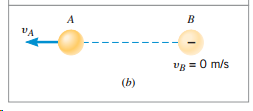
Multiple-Concept Example 4 deals with the concepts that are important in this problem. As illustrated in Figure 19.5b, a negatively charged particle is released from rest at point B and accelerates until it reaches point A. The mass and charge of the particle are 4.0 × 10⁻⁶ kg and 22.0 × 10⁻⁵ C,
Particle 1 has a mass of m1 = 3.6 x 10⁻⁶ kg, while particle 2 has a mass of m2 = 6.2 x 10⁻⁶ kg. Each has the same electric charge. These particles are initially held at rest, and the two-particle system has an initial electric potential energy of 0.150 J. Suddenly, the particles are released
Two identical point charges (+2.4 × 10⁻⁹C) are fixed in place, separated by 0.50 m (see the figure). Concepts: (i) The electric field is a vector and has a direction. At the midpoint, what are the directions of the individual electric-field contributions from qA and qB? (ii) Is the magnitude of
An electron and a proton, starting from rest, are accelerated through an electric potential difference of the same magnitude. In the process, the electron acquires a speed ve, while the proton acquires a speed vp. Find the ratio ve/vp.
Each resistor in the three circuits in the drawing has the same resistance R, and the batteries have the same voltage V. The values for R and V are 9.0 Ω and 6.0 V, respectively. Determine the total power delivered by the battery in each of the three circuits.
Eight different values of resistance can be obtained by connecting together three resistors (1.00, 2.00, and 3.00 Ω) in all possible ways. What are the values?
A resistor is connected across the terminals of a 9.0-V battery, which delivers 1.1 × 10⁵ J of energy to the resistor in six hours. What is the resistance of the resistor?
Determine the power supplied to each of the resistors in the drawing.
The circuit shown in the drawing is constructed with six identical resistors and an ideal battery. When the resistor R4 is removed from the circuit, the current in the battery decreases by 1.9 A. Determine the resistance of each resistor.
A 1.40-Ω resistor is connected across a 9.00-V battery. The voltage between the terminals of the battery is observed to be only 8.30 V. Find the internal resistance of the battery.
When a light bulb is connected across the terminals of a battery, the battery delivers 24 W of power to the bulb. A voltage of 11.8 V exists between the terminals of the battery, which has an internal resistance of 0.10 Ω. What is the emf of the battery?
A battery has an internal resistance of 0.012 Ω and an emf of 9.00 V. What is the maximum current that can be drawn from the battery without the terminal voltage dropping below 8.90 V?
A battery delivering a current of 55.0 A to a circuit has a terminal voltage of 23.4 V. The electric power being dissipated by the internal resistance of the battery is 34.0 W. Find the emf of the battery.
When a "dry-cell" flashlight battery with an internal resistance of 0.33 Ω is connected to a 1.50-Ω light bulb, the bulb shines dimly. However, when a lead-acid "wet-cell" battery with an internal resistance of 0.050 Ω is connected, the bulb is noticeably brighter. Both batteries have the same
The resistance of a bagel toaster is 14 Ω. To prepare a bagel, the toaster is operated for one minute from a 120-V outlet. How much energy is delivered to the toaster?
The drawing shows a portion of a larger circuit. Current flows left to right in each resistor. What is the current in the resistor R?
Find the magnitude and the direction of the current in the 2.0 Ω resistor in the drawing.
Using Kirchhoff 's loop rule, find the value of the current I in part c of the drawing, where R = 5.0 Ω. (Parts a and b of the drawing are used in the online tutorial help that is provided for this problem in the WileyPLUS homework management program.)
Determine the current (both magnitude and direction) in the 8.0- and 2.0 Ω resistors in the drawing.
Determine the voltage across the 5.0 Ω resistor in the drawing. Which end of the resistor is at the higher potential?
None of the resistors in the circuit shown in the drawing is connected in series or in parallel with one another. Find(a) The current I5 and the resistances(b) R2 and(c) R3.
The coil of wire in a galvanometer has a resistance of RC = 60.0 Ω. The galvanometer exhibits a full-scale deflection when the current through it is 0.400 mA. A resistor is connected in series with this combination so as to produce a nondigital voltmeter. The voltmeter is to have a full-scale
Nondigital voltmeter A has an equivalent resistance of 2.40 × 10⁵ Ω and a full-scale voltage of 50.0 V. Nondigital voltmeter B, using the same galvanometer as voltmeter A, has an equivalent resistance of 1.44 × 10⁵ Ω. What is its full-scale voltage?
A galvanometer with a coil resistance of 9.00 Ω is used with a shunt resistor to make a nondigital ammeter that has an equivalent resistance of 0.40 Ω. The current in the shunt resistor is 3.00 mA when the galvanometer reads full scale. Find the full-scale current of the galvanometer.
In measuring a voltage, a voltmeter uses some current from the circuit. Consequently, the voltage measured is only an approximation to the voltage present when the voltmeter is not connected. Consider a circuit consisting of two 1550-Ω resistors connected in series across a 60.0-V battery. (a)
Two capacitors are connected in parallel across the terminals of a battery. One has a capacitance of 2.0 μF and the other a capacitance of 4.0 μF. These two capacitors together store 5.4 × 10⁻⁵ C of charge. What is the voltage of the battery?
Three parallel plate capacitors are connected in series. These capacitors have identical geometries. However, they are filled with three different materials. The dielectric constants of these materials are 3.30, 5.40, and 6.70. It is desired to replace this series combination with a single parallel
Two capacitors are connected to a battery. The battery voltage is V = 60.0 V, and the capacitances are C1 = 2.00 μF and C2 = 4.00 μF. Determine the total energy stored by the two capacitors when they are wired (a) In parallel and (b) In series.
Determine the equivalent capacitance between A and B for the group of capacitors in the drawing.
A 2.00-μF and a 4.00-μF capacitor are connected to a 60.0-V battery. What is the total charge supplied to the capacitors when they are wired (a) In parallel and (b) In series with each other?
Suppose that two capacitors (C1 and C2) are connected in series. Show that the sum of the energies stored in these capacitors is equal to the energy stored in the equivalent capacitor.
For the circuit shown in the drawing, what is the ratio of the current I1 in resistance R1 to the current I2 in resistance R2?(a) I1/I2 = R1/R2(b) I1/I2 = R2 / R1 + R2(c) I1/I2 = R1 / R1 + R2(d) I1/I2 = I(e) I1/I2 = R2/R1
In the following three arrangements each resistor has the same resistance R. Rank the equivalent resistances of the arrangements in descending order (largest first).(a) A, B, C(b) B, A, C(c) B, C, A(d) A, C, B(e) C, B, A
A battery has an emf of V and an internal resistance of r. What resistance R, when connected across the terminals of this battery, will cause the terminal voltage of the battery to be 1/2V? (a) R = 1/2 r (b) R = 2r (c) R = 4r (d) R = r (e) R = 1/4 r
When applying Kirchhoff 's rules, one of the essential steps is to mark each resistor with plus and minus signs to label how the potential changes from one end of the resistor to the other. The circuit in the drawing contains four resistors, each marked with the associated plus and minus signs.
Three capacitors are identical, each having a capacitance C. Two of them are connected in series. Then, this series combination is connected in parallel with the third capacitor. What is the equivalent capacitance of the entire connection? (a) 1/2C (b) 1/3C (c) 3C (d) 2/3C (e) 3/2C
Which one of the following graphs correctly represents Ohm's law, where V is the voltage and I is the current?(a) A(b) B(c) C(d) D
Two wires are made from the same material. One wire has a resistance of 0.10 Ω. The other wire is twice as long as the first wire and has a radius that is half as much. What is the resistance of the second wire? (a) 0.40 Ω (b) 0.20 Ω (c) 0.10 Ω (d) 0.050 Ω (e) 0.80 Ω
A single resistor is connected across the terminals of a battery. Which one or more of the following changes in voltage and current leaves unchanged the electric power dissipated in the resistor? (A) Doubling the voltage and reducing the current by a factor of two (B) Doubling the voltage and
For the circuit shown in the drawing, what is the voltage V1 across resistance R1?(a) V1 = (R1/R2)V(b) V1 = (R2/R1)V(c) V1 = V(d) V1 = (R1/R1 + R2)V(e) V1 = (R1 + R2/R1)V
A defibrillator is used during a heart attack to restore the heart to its normal beating pattern (see Section 19.5). A defibrillator passes 18 A of current through the torso of a person in 2.0 ms. (a) How much charge moves during this time? (b) How many electrons pass through the wires connected to
The resistance and the magnitude of the current depend on the path that the current takes. The drawing shows three situations in which the current takes different paths through a piece of material. Each of the rectangular pieces is made from a material whose resistivity is p = 1.50 ×
A 3.00-μF and a 5.00-μF capacitor are connected in series across a 30.0-V battery. A 7.00-μF capacitor is then connected in parallel across the 3.00-μF capacitor. Determine the voltage across the 7.00-μF capacitor.
A 7.0-μF and a 3.0-μF capacitor are connected in series across a 24-V battery. What voltage is required to charge a parallel combination of the two capacitors to the same total energy?
The drawing shows two capacitors that are fully charged (C1 = 2.00 μF, q1 = 6.00 μC; C2 = 8.00 μF, q2 = 12.0 μC). The switch is closed, and charge flows until equilibrium is reestablished (i.e., until both capacitors have the same voltage
A circuit contains a resistor in series with a capacitor, the series combination being connected across the terminals of a battery, as in Figure 20.37a. The time constant for charging the capacitor is 1.5 s when the resistor has a resistance of 2.0 × 10⁴ Ω. What would the
The circuit in the drawing contains two resistors and two capacitors that are connected to a battery via a switch. When the switch is closed, the capacitors begin to charge up. What is the time constant for the charging process?
How many time constants must elapse before a capacitor in a series RC circuit is charged to 80.0% of its equilibrium charge?
Four identical capacitors are connected with a resistor in two different ways. When they are connected as in part a of the drawing, the time constant to charge up this circuit is 0.72 s. What is the time constant when they are connected with the same resistor, as in part b?
Each of the four circuits in the drawing consists of a single resistor whose resistance is either R or 2R, and a single battery whose voltage is either V or 2V. The unit of voltage in each circuit is V = 12.0 V and the unit of resistance is R = 6.00 Ω. Determine(a) The power supplied to
Two wires are identical, except that one is aluminum and one is copper. The aluminum wire has a resistance of 0.20 Ω. What is the resistance of the copper wire?
A fax machine uses 0.110 A of current in its normal mode of operation, but only 0.067 A in the standby mode. The machine uses a potential difference of 120 V. In one minute(a) How much more charge passes through the machine in the normal mode than in the standby mode, and(b) How much more energy is
For the circuit shown in the drawing, find the current I through the 2.00-Ω resistor and the voltage V of the battery to the left of this resistor.
In Section 12.3 it was mentioned that temperatures are often measured with electrical resistance thermometers made of platinum wire. Suppose that the resistance of a platinum resistance thermometer is 125 Ω when its temperature is 20.0 °C. The wire is then immersed in boiling chlorine, and the
The circuit in the drawing shows two resistors, a capacitor, and a battery. When the capacitor is fully charged, what is the magnitude q of the charge on one of its plates?
A galvanometer has a full-scale current of 0.100 mA and a coil resistance of 50.0 Ω. This instrument is used with a shunt resistor to form a nondigital ammeter that will register full scale for a current of 60.0 mA. Determine the resistance of the shunt resistor.
An 86-Ω resistor and a 67-Ω resistor are connected in series across a battery. The voltage across the 86-Ω resistor is 27 V. What is the voltage across the 67-Ω resistor?
A 75.0-Ω and a 45.0-Ω resistor are connected in parallel. When this combination is connected across a battery, the current delivered by the battery is 0.294 A. When the 45.0-Ω resistor is disconnected, the current from the battery drops to 0.116 A. Determine (a) The emf and (b) The internal
A cylindrical wire has a length of 2.80 m and a radius of 1.03 mm. It carries a current of 1.35 A, when a voltage of 0.0320 V is applied across the ends of the wire. From what material in Table 20.1 is the wire made?
The total current delivered to a number of devices connected in parallel is the sum of the individual currents in each device. Circuit breakers are resettable automatic switches that protect against a dangerously large total current by "opening" to stop the current at a specified safe value. A
The filament in an incandescent light bulb is made from tungsten. The light bulb is plugged into a 120-V outlet and draws a current of 1.24 A. If the radius of the tungsten wire is 0.0030 mm, how long must the wire be?
An aluminum wire is hung between two towers and has a length of 175 m. A current of 125 A exists in the wire, and the potential difference between the ends of the wire is 0.300 V. The density of aluminum is 2700 kg/m3. Find the mass of the wire.
A circuit contains a 48-V battery and a single light bulb whose resistance is 240 Ω. A second, identical, light bulb can be wired either in series or in parallel with the first one (see the figure). Concepts:(i) How is the power P that is delivered to a light bulb related to the bulb's
For this problem concerning Kirchhoff 's junction rule and loop rule, refer to the figure. Concepts:(i) Notice that there are two loops, labeled 1 and 2 in this circuit. Does it matter that there is no battery in loop 1, but only two resistors? Explain.(ii) The currents through the three resistors
A coil of wire has a resistance of 38.0 Ω at 25 °C and 43.7 Ω at 55 °C. What is the temperature coefficient of resistivity?
A large spool in an electrician's workshop has 75 m of insulation-coated wire coiled around it. When the electrician connects a battery to the ends of the spooled wire, the resulting current is 2.4 A. Some weeks later, after cutting off various lengths of wire for use in repairs, the electrician
High-voltage power lines are a familiar sight throughout the country. The aluminum wire used for some of these lines has a cross-sectional area of 4.9 × 10⁻⁴ m2. What is the resistance of ten kilometers of this wire?
The temperature coefficient of resistivity for the metal gold is 0.0034 (C°)-1, and for tungsten it is 0.0045 (C°)-1. The resistance of a gold wire increases by 7.0% due to an increase in temperature. For the same increase in temperature, what is the percentage increase in the resistance of a
A tungsten wire has a radius of 0.075 mm and is heated from 20.0 to 1320 °C. The temperature coefficient of resistivity is α = 4.5 × 10⁻³ (C°)-1. When 120 V is applied across the ends of the hot wire, a current of 1.5 A is produced. How long is the wire? Neglect any effects due to thermal
An especially violent lightning bolt has an average current of 1.26 × 10³ A lasting 0.138 s. How much charge is delivered to the ground by the lightning bolt?
Two cylindrical rods, one copper and the other iron, are identical in lengths and cross-sectional areas. They are joined end to end to form one long rod. A 12-V battery is connected across the free ends of the copper-iron rod. What is the voltage between the ends of the copper rod?
A digital thermometer employs a thermistor as the temperature-sensing element. A thermistor is a kind of semiconductor and has a large negative temperature coefficient of resistivity α. Suppose that α = -0.060 (C°)-1 for the thermistor in a digital thermometer used to measure the temperature of
An electric blanket is connected to a 120-V outlet and consumes 140 W of power. What is the resistance of the heater wire in the blanket?
The heating element in an iron has a resistance of 24 Ω. The iron is plugged into a 120-V outlet. What is the power delivered to the iron?
A blow-dryer and a vacuum cleaner each operate with a voltage of 120 V. The current rating of the blow-dryer is 11 A, and that of the vacuum cleaner is 4.0 A. Determine the power consumed by (a) The blow-dryer and (b) The vacuum cleaner. (c) Determine the ratio of the energy used by the blow-dryer
There are approximately 110 million households that use TVs in the United States. Each TV uses, on average, 75 W of power and is turned on for 6.0 hours a day. If electrical energy costs $0.12 per kWh, how much money is spent every day in keeping 110 million TVs turned on?
An MP3 player operates with a voltage of 3.7 V, and is using 0.095 W of power. Find the current being supplied by the player's battery.
An electric heater used to boil small amounts of water consists of a 15-Ω coil that is immersed directly in the water. It operates from a 120-V socket. How much time is required for this heater to raise the temperature of 0.50 kg of water from 13 °C to the normal boiling point?
Showing 4600 - 4700
of 8241
First
40
41
42
43
44
45
46
47
48
49
50
51
52
53
54
Last
Step by Step Answers

 Get 50% OFF
Claim Now
Get 50% OFF
Claim Now


.png)
.png)
.png)
.png)
.png)
.png)
.png)
.png)
.png)
.png)
.png)
.png)
.png)
.png)
.png)
.png)
.png)
.png)
.png)
.png)
.png)
.png)
.png)
.png)
.png)
.png)
.png)
.png)
.png)
.png)


