New Semester
Started
Get
50% OFF
Study Help!
--h --m --s
Claim Now
Question Answers
Textbooks
Find textbooks, questions and answers
Oops, something went wrong!
Change your search query and then try again
S
Books
FREE
Study Help
Expert Questions
Accounting
General Management
Mathematics
Finance
Organizational Behaviour
Law
Physics
Operating System
Management Leadership
Sociology
Programming
Marketing
Database
Computer Network
Economics
Textbooks Solutions
Accounting
Managerial Accounting
Management Leadership
Cost Accounting
Statistics
Business Law
Corporate Finance
Finance
Economics
Auditing
Tutors
Online Tutors
Find a Tutor
Hire a Tutor
Become a Tutor
AI Tutor
AI Study Planner
NEW
Sell Books
Search
Search
Sign In
Register
study help
physics
modern physics
Physics 10th edition David Young, Shane Stadler - Solutions
A generator is connected to a resistor and a 0.032-H inductor in series. The rms voltage across the generator is 8.0 V. When the generator frequency is set to 130 Hz, the rms voltage across the inductor is 2.6 V. Determine the resistance of the resistor in this circuit.
The reactance of a capacitor is 68 V when the ac frequency is 460 Hz. What is the reactance when the frequency is 870 Hz?
A tank circuit in a radio transmitter is a series RCL circuit connected to an antenna. The antenna broadcasts radio signals at the resonant frequency of the tank circuit. Suppose that a certain tank circuit in a shortwave radio transmitter has a fixed capacitance of 1.8 × 10⁻¹¹ F and a variable
The power dissipated in a series RCL circuit is 65.0 W, and the current is 0.530 A. The circuit is at resonance. Determine the voltage of the generator.
A 10.0-V resistor, a 12.0-µF capacitor, and a 17.0-mH inductor are connected in series with a 155-V generator. (a) At what frequency is the current a maximum? (b) What is the maximum value of the rms current?
The capacitance in a series RCL circuit is C1 = 2.60 µF, and the corresponding resonant frequency is f01 = 7.30 kHz. The generator frequency is 5.60 kHz. What is the value of the capacitance C2 that should be added to the circuit so that the circuit will have a resonant frequency that matches the
A series RCL circuit is at resonance and contains a variable resistor that is set to 175 Ω. The power delivered to the circuit is 2.6 W. Assuming that the voltage remains constant, how much power is delivered when the variable resistor is set to 562 Ω?
The resonant frequency of an RCL circuit is 1.3 kHz, and the value of the inductance is 7.0 mH. What is the resonant frequency (in kHz) when the value of the inductance is 1.5 mH?
A series RCL circuit has a resonant frequency of 1500 Hz. When operating at a frequency other than 1500 Hz, the circuit has a capacitive reactance of 5.0 Ω and an inductive reactance of 30.0 Ω. What are the values of (a) L and (b) C?
In a series RCL circuit the generator is set to a frequency that is not the resonant frequency. This nonresonant frequency is such that the ratio of the inductive reactance to the capacitive reactance of the circuit is observed to be 5.36. The resonant frequency is 225 Hz. What is the frequency of
A capacitor is connected to an ac generator that has a frequency of 3.4 kHz and produces a voltage of 2.0 V. The current in the capacitor is 35 mA. When the same capacitor is connected to a second ac generator that has a frequency of 5.0 kHz, the current in the capacitor is 85 mA. What voltage does
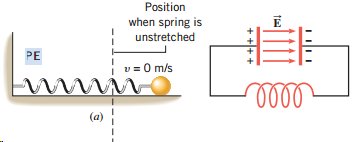
A charged capacitor and an inductor are connected as shown in the drawing (this circuit is the same as that in Figure 23.16a). There is no resistance in the circuit. As Section 23.4 discusses, the electrical energy initially present in the charged capacitor then oscillates back and forth between
In the absence of a nearby metal object, the two inductances (LA and LB) in a heterodyne metal detector are the same, and the resonant frequencies of the two oscillator circuits have the same value of 630.0 kHz. When the search coil (inductor B) is brought near a buried metal object, a beat
A 108-Ω resistor, a 0.200-µF capacitor, and a 5.42-mH inductor are connected in series to a generator whose voltage is 26.0 V. The current in the circuit is 0.141 A. Because of the shape of the current-frequency graph (see Figure 23.17), there are two possible values for the frequency that
A circuit consists of a resistor in series with an inductor and an ac generator that supplies a voltage of 115 V. The inductive reactance is 52.0 Ω, and the current in the circuit is 1.75 A. Find the average power delivered to the circuit.
In a series circuit, a generator (1350 Hz, 15.0 V) is connected to a 16.0-Ω resistor, a 4.10-µF capacitor, and a 5.30-mH inductor. Find the voltage across each circuit element
Review Conceptual Example 5 and Figure 23.13. Find the ratio of the current in circuit I to the current in circuit II in the high-frequency limit for the same generator voltage.Figure 23.13Figure 23.13 (a) These circuits are discussed in the limit of very small or low frequency in Conceptual
The resistor in a series RCL circuit has a resistance of 92Ω, while the voltage of the generator is 3.0 V. At resonance, what is the average power delivered to the circuit?
Two ac generators supply the same voltage. However, the first generator has a frequency of 1.5 kHz, and the second has a frequency of 6.0 kHz. When an inductor is connected across the terminals of the first generator, the current delivered is 0.30 A. How much current is delivered when this inductor
A series circuit contains only a resistor and an inductor. The voltage V of the generator is fixed. If R = 16 Ω and L = 4.0 mH, find the frequency at which the current is one-half its value at zero frequency.
When a resistor is connected by itself to an ac generator, the average power delivered to the resistor is 1.000 W. When a capacitor is added in series with the resistor, the power delivered is 0.500 W. When an inductor is added in series with the resistor (without the capacitor), the power
Part a of the figure shows a heterodyne metal detector being used. As part b of the figure illustrates, this device utilizes two capacitor/ inductor oscillator circuits, A and B. Each produces its own resonant frequency, f0A = 1/[2π(LAC)1/2] and f0B = 1/[2π(LBC)1/2]. Any difference between these
Two parallel plate capacitors are filled with the same dielectric material and have the same plate area. However, the plate separation of capacitor 1 is twice that of capacitor 2. When capacitor 1 is connected across the terminals of an ac generator, the generator delivers an rms current of 0.60 A.
An ac generator has a frequency of 1200 Hz and a constant rms voltage. When a 470-V resistor is connected between the terminals of the generator, an average power of 0.25 W is consumed by the resistor. Then, a 0.080-H inductor is connected in series with the resistor, and the combination is
Two parallel plate capacitors are identical, except that one of them is empty and the other contains a material with a dielectric constant of 4.2 in the space between the plates. The empty capacitor is connected between the terminals of an ac generator that has a fixed frequency and rms voltage.
A capacitor is connected across an ac generator whose frequency is 750 Hz and whose peak output voltage is 140 V. The rms current in the circuit is 3.0 A. (a) What is the capacitance of the capacitor? (b) What is the magnitude of the maximum charge on one plate of the capacitor?
A capacitor (capacitance C1) is connected across the terminals of an ac generator. Without changing the voltage or frequency of the generator, a second capacitor (capacitance C2) is added in series with the first one. As a result, the current delivered by the generator decreases by a factor of
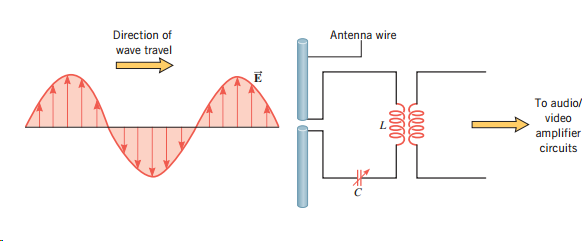
The drawing shows an x, y, z coordinate system. A circular loop of wire lies in the z, x plane and, when used with an LC-tuned circuit, detects an electromagnetic wave. Which one of the following statements is correct?(a) The wave travels along the x axis, and its electric field oscillates along
The drawing shows two sheets of polarizing material. Polarizer 1 has its transmission axis aligned vertically, and polarizer 2 has its transmission axis aligned at an angle of 45° with respect to the vertical. Light that is completely polarized along the vertical direction is incident either
An electromagnetic wave travels in a vacuum. The wavelength of the wave is tripled. How is this accomplished? (a) By tripling the frequency of the wave (b) By tripling the speed of the wave (c) By reducing the frequency of the wave by a factor of three (d) By reducing the speed of the wave by a
An electromagnetic wave is traveling in a vacuum. The magnitudes of the electric and magnetic fields of the wave are ______, and the electric and magnetic energies carried by the wave are ______. (a) Equal, proportional (but not equal) to each other (b) Proportional (but not equal) to each other,
The drawing shows four situations-A, B, C, and D-in which an observer and a source of electromagnetic waves can move along the same line. In each case the source emits a wave of the same frequency, and in each case only the source or the observer is moving. The arrow in each situation denotes the
The team monitoring a space probe exploring the outer solar system finds that radio transmissions from the probe take 2.53 hours to reach earth. How distant (in meters) is the probe?
FM radio waves have frequencies between 88.0 and 108.0 MHz. Determine the range of wavelengths for these waves.
Magnetic resonance imaging, or MRI (see Section 21.7), and positron emission tomography, or PET scanning (see Section 32.6), are two medical diagnostic techniques. Both employ electromagnetic waves. For these waves, find the ratio of the MRI wavelength (frequency = 6.38 × 10⁷ Hz) to the PET
A certain type of laser emits light that has a frequency of 5.2 × 10¹⁴ Hz. The light, however, occurs as a series of short pulses, each lasting for a time of 2.7 × 10⁻¹¹ s. (a) How many wavelengths are there in one pulse? (b) The light enters a pool of water. The frequency of the light remains
Two radio waves are used in the operation of a cellular telephone. To receive a call, the phone detects the wave emitted at one frequency by the transmitter station or base unit. To send your message to the base unit, your phone emits its own wave at a different frequency. The difference between
A positively charged object with a mass of 0.115 kg oscillates at the end of a spring, generating ELF (extremely low frequency) radio waves that have a wavelength of 4.80 × 10⁷ m. The frequency of these radio waves is the same as the frequency at which the object oscillates. What is the spring
Review Conceptual Example 3 for information pertinent to this problem. When we look at the star Polaris (the North Star), we are seeing it as it was 680 years ago. How far away from us (in meters) is Polaris?
Figure 24.12 illustrates Michelson's setup for measuring the speed of light with the mirrors placed on Mt. San Antonio and Mt. Wilson in California, which are 35 km apart. Using a value of 3.00 × 10⁸ m/s for the speed of light, find the minimum angular speed (in rev/s) for the rotating
A laptop computer communicates with a router wirelessly, by means of radio signals. The router is connected by cable directly to the Internet. The laptop is 8.1 m from the router, and is downloading text and images from the Internet at an average rate of 260 Mbps, or 260 megabits per second. (A
A lidar (laser radar) gun is an alternative to the standard radar gun that uses the Doppler effect to catch speeders. A lidar gun uses an infrared laser and emits a precisely timed series of pulses of infrared electromagnetic waves. The time for each pulse to travel to the speeding vehicle and
(a) Neil A. Armstrong was the first person to walk on the moon. The distance between the earth and the moon is 3.85 × 10⁸ m. Find the time it took for his voice to reach the earth via radio waves. (b) Someday a person will walk on Mars, which is 5.6 × 10¹⁰ m from the earth at the point of closest
A politician holds a press conference that is televised live. The sound picked up by the microphone of a TV news network is broadcast via electromagnetic waves and heard by a television viewer. This viewer is seated 2.3 m from his television set. A reporter at the press conference is located 4.1 m
A mirror faces a cliff located some distance away. Mounted on the cliff is a second mirror, directly opposite the first mirror and facing toward it. A gun is fired very close to the first mirror. The speed of sound is 343 m/s. How many times does the flash of the gunshot travel the roundtrip
A laser emits a narrow beam of light. The radius of the beam is 1.0 × 10⁻³ m, and the power is 1.2 × 10⁻³ W. What is the intensity of the laser beam?
An industrial laser is used to burn a hole through a piece of metal. The average intensity of the light is S̅ = 1.23 × 10⁹ W/m2. What is the rms value of(a) The electric field and(b) The magnetic field in the electromagnetic wave emitted by the laser?
The maximum strength of the magnetic field in an electromagnetic wave is 3.3 × 10⁻⁶ T. What is the maximum strength of the wave's electric field?
On a cloudless day, the sunlight that reaches the surface of the earth has an intensity of about 1.0 × 10³ W/m2. What is the electromagnetic energy contained in 5.5 m3 of space just above the earth's surface?
Consult Multiple-Concept Example 5 to review the concepts on which this problem depends. A light bulb emits light uniformly in all directions. The average emitted power is 150.0 W. At a distance of 5.00 m from the bulb, determine(a) The average intensity of the light,(b) The rms value of the
Multiple-Concept Example 5 provides some pertinent background for this problem. The mean distance between earth and the sun is 1.50 × 10¹¹ m. The average intensity of solar radiation incident on the upper atmosphere of the earth is 1390 W/m2. Assuming that the sun emits radiation uniformly in all
A stationary particle of charge q = 2.6 × 10⁻⁸ C is placed in a laser beam (an electromagnetic wave) whose intensity is 2.5 × 10³ W/m2. Determine the magnitudes of the(a) Electric and(b) Magnetic forces exerted on the charge. If the charge is moving at a speed of 3.7 × 10⁴ m/s perpendicular to
The power radiated by the sun is 3.9 × 1026 W. The earth orbits the sun in a nearly circular orbit of radius 1.5 × 10¹¹ m. The earth's axis of rotation is tilted by 27° relative to the plane of the orbit (see the drawing), so sunlight does not strike the equator perpendicularly. What
An electromagnetic wave strikes a 1.30-cm2 section of wall perpendicularly. The rms value of the wave's magnetic field is determined to be 6.80 × 10⁻⁴ T. How long does it take for the wave to deliver 1850 J of energy to the wall?
A heat lamp emits infrared radiation whose rms electric field is Erms = 2800 N/C.(a) What is the average intensity of the radiation?(b) The radiation is focused on a person's leg over a circular area of radius 4.0 cm. What is the average power delivered to the leg?(c) The portion of the leg being
A gamma-ray telescope intercepts a pulse of gamma radiation from a magnetar, a type of star with a spectacularly large magnetic field. The pulse lasts 0.24 s and delivers 8.4 × 10⁻⁶ J of energy perpendicularly to the 75-m2 surface area of the telescope's detector. The magnetar is thought to be 4.5
A distant galaxy emits light that has a wavelength of 434.1 nm. On earth, the wavelength of this light is measured to be 438.6 nm.(a) Decide whether this galaxy is approaching or receding from the earth. Give your reasoning.(b) Find the speed of the galaxy relative to the earth.
A speeder is pulling directly away and increasing his distance from a police car that is moving at 25 m/s with respect to the ground. The radar gun in the police car emits an electromagnetic wave with a frequency of 7.0 × 10⁹ Hz. The wave reflects from the speeder's car and returns to the police
The drawing shows three situations-A, B, and C-in which an observer and a source of electromagnetic waves are moving along the same line. In each case the source emits a wave that has a frequency of 4.57 × 10¹⁴ Hz. The arrows in each situation denote velocity vectors of the observer and source
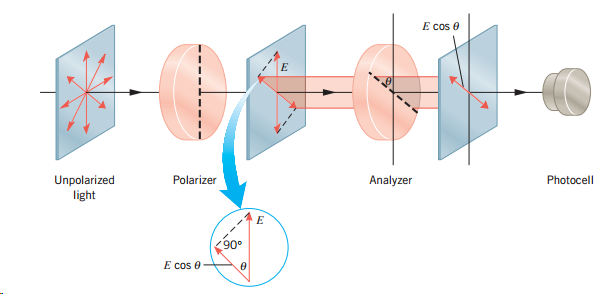
Unpolarized light whose intensity is 1.10 W/m2 is incident on the polarizer in Figure 24.20.(a) What is the intensity of the light leaving the polarizer?(b) If the analyzer is set at an angle of θ = 75° with respect to the polarizer, what is the intensity of the light that reaches the
FM radio stations use radio waves with frequencies from 88.0 to 108 MHz to broadcast their signals. Assuming that the inductance in Figure 24.4 has a value of 6.00 × 10⁻⁷ H, determine the range of capacitance values that are needed so the antenna can pick up all the radio waves broadcasted by FM
The drawing shows three polarizer/analyzer pairs. The incident light beam for each pair is unpolarized and has the same average intensity of 48 W/m2. Find the average intensity of the transmitted beam for each of the three cases (A, B, and C) shown in the drawing.
Light that is polarized along the vertical direction is incident on a sheet of polarizing material. Only 94% of the intensity of the light passes through the sheet and strikes a second sheet of polarizing material. No light passes through the second sheet. What angle does the transmission axis of
Review Conceptual Example 7 before solving this problem. Suppose that unpolarized light of intensity 150 W/m2 falls on the polarizer in Figure 24.23a, and the angle u in the drawing is 30.0°. What is the light intensity reaching the photocell?Figure 24.23:
The drawing shows light incident on a polarizer whose transmission axis is parallel to the z axis. The polarizer is rotated clockwise through an angle α. The average intensity of the incident light is 7.0 W/m2. Determine the average intensity of the transmitted light for each of the six cases
For each of the three sheets of polarizing material shown in the drawing, the orientation of the transmission axis is labeled relative to the vertical. The incident beam of light is unpolarized and has an intensity of 1260.0 W/m2. What is the intensity of the beam transmitted through the three
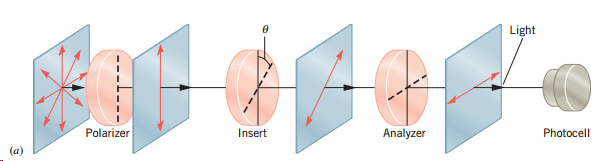
Before attempting this problem, review Conceptual Example 7. The intensity of the light that reaches the photocell in Figure 24.23a is 110 W/m2, when θ = 23°. What would be the intensity reaching the photocell if the analyzer were removed from the setup, everything else remaining the
The drawing shows four sheets of polarizing material, each with its transmission axis oriented differently. Light that is polarized in the vertical direction is incident from the left and has an average intensity of 27 W/m2. Determine the average intensity of the light that emerges on the right in
Obtain the wavelengths in vacuum for(a) Blue light whose frequency is 6.34 × 10¹⁴ Hz, and(b) Orange light whose frequency is 4.95 × 10¹⁴ Hz. Express your answers in nanometers (1 nm = 10-9 m).
The magnitude of the electric field of an electromagnetic wave increases from 315 to 945 N/C.(a) Determine the wave intensities for the two values of the electric field.(b) What is the magnitude of the magnetic field associated with each electric field?(c) Determine the wave intensity for each
The human eye is most sensitive to light with a frequency of about 5.5 × 10¹⁴ Hz, which is in the yellow-green region of the electromagnetic spectrum. How many wavelengths of this light can fit across the width of your thumb, a distance of about 2.0 cm?
Suppose that a police car is moving to the right at 27 m/s, while a speeder is coming up from behind at a speed of 39 m/s, both speeds being with respect to the ground. Assume that the electromagnetic wave emitted by the police car's radar gun has a frequency of 8.0 × 10⁹ Hz. Find the difference
The electromagnetic wave that delivers a cellular phone call to a car has a magnetic field with an rms value of 1.5 × 10⁻¹⁰ T. The wave passes perpendicularly through an open window, the area of which is 0.20 m2. How much energy does this wave carry through the window during a 45-s phone call?
Equation 16.3, y = A sin (2πft - 2πx/λ), gives the mathematical representation of a wave oscillating in the y direction and traveling in the positive x direction. Let y in this equation equal the electric field of an electromagnetic wave traveling in a vacuum. The maximum electric field is A =
A beam of polarized light with an average intensity of 15 W/m2 is sent through a polarizer. The transmission axis makes an angle of 25° with respect to the direction of polarization. Determine the rms value of the electric field of the transmitted beam.
An argon-ion laser produces a cylindrical beam of light whose average power is 0.750 W. How much energy is contained in a 2.50-m length of the beam?
A flat coil of wire is used with an LC-tuned circuit as a receiving antenna. The coil has a radius of 0.25 m and consists of 450 turns. The transmitted radio wave has a frequency of 1.2 MHz. The magnetic field of the wave is parallel to the normal to the coil and has a maximum value of 2.0 × 10⁻¹³
What fraction of the power radiated by the sun is intercepted by the planet Mercury? The radius of Mercury is 2.44 × 10⁶ m, and its mean distance from the sun is 5.79 × 10¹⁰ m. Assume that the sun radiates uniformly in all directions.
Suppose that the light falling on the polarizer in Figure 24.20 is partially polarized (average intensity = SÌ…P) and partially unpolarized (average intensity = SÌ…U). The total incident intensity is SÌ…P + SÌ…U, and the percentage polarization is 100 SÌ…P / (SÌ…P + SÌ…U). When
The figure shows the popular dish antenna that receives digital TV signals from a satellite. The average intensity of the electromagnetic wave that carries a particular TV program is S̅ = 7.5 × 10⁻¹⁴ W/m2, and the circular aperture of the antenna has a radius of r = 15 cm. Concepts:(i) How
The light beam in the figure passes through a polarizer whose transmission axis makes an angle Ï• with the vertical. The beam is partially polarized and partially unpolarized, and the average intensity SÌ…0 of the incident light is the sum of the average intensity SÌ…0, polar of the
A truck driver is broadcasting at a frequency of 26.965 MHz with a CB (citizen's band) radio. Determine the wavelength of the electromagnetic wave being used. The speed of light is c = 2.9979 × 10⁸ m/s.
In a dentist's office an X-ray of a tooth is taken using X-rays that have a frequency of 6.05 × 10¹⁸ Hz. What is the wavelength in vacuum of these X-rays?
Which one of the following statements concerning spherical mirrors is correct?(a) Only a convex mirror can produce an enlarged image.(b) Both concave and convex mirrors can produce an enlarged image.(c) Only a concave mirror can produce an enlarged image, provided the object distance is less than
The drawing shows a top view of an object located to the right of a mirror. A single ray of light is shown leaving the object. After reflection from the mirror, through which location, A, B, C, or D, does the ray pass?(a) A(b) B(c) C(d) D
Review Conceptual Example 2. Suppose that in Figure 25.9b the two perpendicular plane mirrors are represented by the -x and -y axes of an x, y coordinate system; mirror 1 is the -x axis, and mirror 2 is the -y axis. An object is in front of these mirrors at a point whose coordinates are x = -2.0 m
The drawing shows two plane mirrors that intersect at an angle of 50°. An incident light ray reflects from one mirror and then the other. What is the angle u between the incident and outgoing rays?
Two plane mirrors are facing each other. They are parallel, 3.00 cm apart, and 17.0 cm in length, as the drawing indicates. A laser beam is directed at the top mirror from the left edge of the bottom mirror. What is the smallest angle of incidence with respect to the top mirror, such that the laser
The drawing shows a top view of a square room. One wall is missing, and the wall on the right is a mirror. From point P in the center of the open side, a laser is pointed at the mirrored wall. At what angle of incidence must the light strike the right-hand wall so that, after being reflected, the
When an object is located very far away from a convex mirror, the image of the object is 18 cm behind the mirror. Using a ray diagram drawn to scale, determine where the image is located when the object is placed 9.0 cm in front of the mirror. Note that the mirror must be drawn to scale also. In
The image of a very distant car is located 12 cm behind a convex mirror.(a) What is the radius of curvature of the mirror?(b) Draw a ray diagram to scale showing this situation.
A 2.0-cm-high object is situated 15.0 cm in front of a concave mirror that has a radius of curvature of 10.0 cm. Using a ray diagram drawn to scale, measure(a) The location and(b) The height of the image. The mirror must be drawn to scale.
A convex mirror has a focal length of -40.0 cm. A 12.0-cm-tall object is located 40.0 cm in front of this mirror. Using a ray diagram drawn to scale, determine the(a) Location and(b) Size of the image. Note that the mirror must be drawn to scale.
A plane mirror and a concave mirror (f = 8.0 cm) are facing each other and are separated by a distance of 20.0 cm. An object is placed between the mirrors and is 10.0 cm from each mirror. Consider the light from the object that reflects first from the plane mirror and then from the concave mirror.
On the +y axis a laser is located at y = +3.0 cm. The coordinates of a small target are x = +9.0 cm and y = +6.0 cm. The +x axis represents the edge-on view of a plane mirror. At what point on the +x axis should the laser be aimed in order for the laser light to hit the target after reflection?
The image behind a convex mirror (radius of curvature = 68 cm) is located 22 cm from the mirror.(a) Where is the object located and(b) What is the magnification of the mirror? Determine whether the image is(c) Upright or inverted and(d) Larger or smaller than the object.
A concave mirror (R = 56.0 cm) is used to project a transparent slide onto a wall. The slide is located at a distance of 31.0 cm from the mirror, and a small flashlight shines light through the slide and onto the mirror. The setup is similar to that in Figure 25.18a.Figure 25.18a(a) How far from
A small statue has a height of 3.5 cm and is placed in front of a concave mirror. The image of the statue is inverted, 1.5 cm tall, and located 13 cm in front of the mirror. Find the focal length of the mirror.
A concave mirror (f = 45 cm) produces an image whose distance from the mirror is one-third the object distance. Determine(a) The object distance and(b) The (positive) image distance.
The outside mirror on the passenger side of a car is convex and has a focal length of -7.0 m. Relative to this mirror, a truck traveling in the rear has an object distance of 11 m. Find(a) The image distance of the truck and(b) The magnification of the mirror.
Showing 4900 - 5000
of 8241
First
43
44
45
46
47
48
49
50
51
52
53
54
55
56
57
Last
Step by Step Answers

 Get 50% OFF
Claim Now
Get 50% OFF
Claim Now


.png)
.png)
-1.png)
-2.png)
.png)
.png)
.png)
.png)
.png)
.png)
.png)
.png)
.png)
.png)
.png)
.png)
.png)
.png)
.png)
.png)
.png)
.png)
.png)
.png)


